Introduction
One of the ways a language is learned, especially a foreign language, is by personal extensive reading. When people read widely, they are exposed to the linguistic structure of what they read and so learn it consciously or unconsciously. What they come across in their reading remains in their minds and adds to their general knowledge. This includes knowledge of the language they read. General wide reading reinforces the language students have been formally taught in their language classes. Exposure to grammatically correct language would improve their language skills. On the other hand, exposure to incorrect language would negatively affect the language skills of foreign learners and cause them to use wrong language comfortably, not knowing that they are erroneous in their usage.
The printed word is powerful, and many people, especially young learners, believe that what is printed is necessarily correct. Hence the novels available in our markets for the entertainment of our population through personal extensive reading, and the books selected to use for the teaching of literature in secondary schools, have great influence on the language production of the readers. Standard British English is taught in Cameroon schools. The question to ask is whether new Anglophone Cameroon writings, and especially those selected for the teaching of literature, are up to the standard of English expected of young Cameroonians.
Broughton et al (Reference Broughton, Brumfit, Flavell, Hill and Pincas1980: 110) have this to say:
The practice of extensive reading needs little justification. It is clearly the easiest way of bringing the foreign learner into contact with a substantial body of English. If he reads, and what he reads is of some interest to him, then the language of what he has read rings in his head, the patterns of collocation and idiom are established almost painlessly with a range and intensity which is impossible in terms of oral classroom treatment of the language, where the constraints of lock-step teaching and multiple repetitions, however necessary they may be, impose severe restrictions on the sheer volume of the amount of language with which pupils come into contact.
Edna P. DeHaven (Reference Connor1979: 465) points to even further benefits of reading:
Library books offer many possibilities for expanding vocabulary and other skills and appreciations. … Wide reading improves children's thinking and conceptualization and helps them develop a general awareness of the relationship and structure of ideas. Quality books acquaint children with good expository and creative writing and help them develop a cognitive framework for self-expression.
Are Anglophone Cameroon new writings books of quality? Can they help children develop their creative writing as well as enhance or improve on their grammar, spelling and punctuation? In evaluating material that should be used for school teaching or that should be placed on the syllabus for Cameroonian schools, the powers that be should consider whether ‘the material is compatible with knowledge of the children's language development, and provides for continuous and well-rounded growth in using and enjoying language’ (DeHaven, Reference Connor1979: 467).
To carry out this study, two novels used for literature in Forms 2 and 3 respectively in some secondary schools in Anglophone Cameroon have been selected. They are Ngwa J. Neba's Manka'a (Reference DeHaven2002), and Kemonde Wangmonde's A Challenge to Young Girls (Reference Wangmonde2002). Data collected from these novels are cited and discussed below. I will deal with only three categories of errors in this study: grammar, punctuation and spelling inconsistencies. Furthermore to avoid repetition only two mistakes per category will be exemplified and the total number given in brackets. The model used for the study is basic error analysis. Although this may seem an unduly prescriptive approach, it is an appropriate one in the context of works set for formal study, which are expected to provide suitable language models for students.
Novel 1: Manka'a
Grammar/Sentence Structure
The grammar errors found in Manka'a are of various types. The first type to be identified has to do with relative pronouns – who, which, that, whom, whose – which introduce relative clauses in complex sentences. Relative pronouns are mutually exclusive and relative clauses function as post-modifiers of nouns. However, there is another set of relative pronouns – who, whom, which, whoever, whomever, whichever, what, whatever – that introduce nominal relative clauses. Nominal relative clauses function as noun phrases so they can be subjects and direct objects of sentences (Greenbaum & Nelson, Reference Greenbaum and Nelson2002: 104 & 128). In the text under study, there is an instance where two mutually exclusive relative pronouns are juxtaposed in the same clause, instead of using a single nominal relative pronoun (n = 1). The example phrase is …to harvest that which she had nursed, rather than the plainer ‘to harvest what she had nursed’. This may have been a hypercorrection on the part of the author or copy-editor trying to avoid what happens in non-standard constructions like the man what I saw.
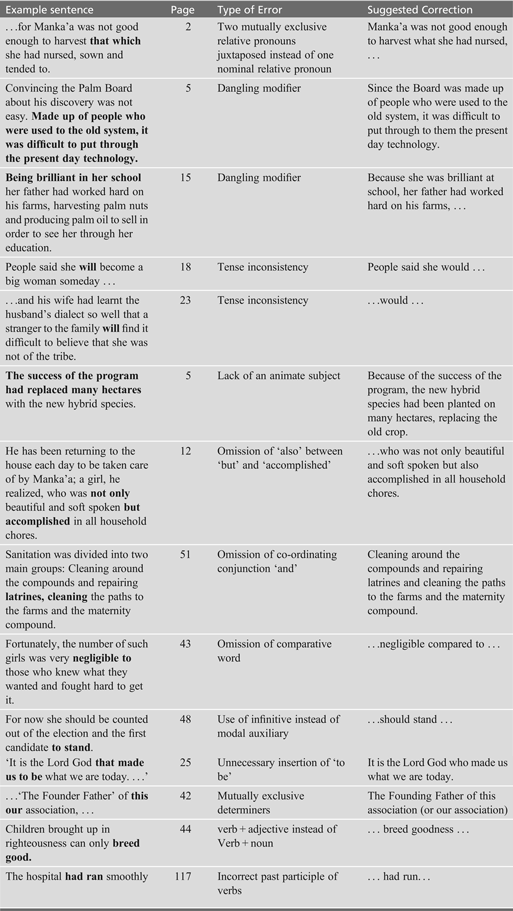
The second type of error discovered is that of dangling modifiers. A dangling modifier has no subject of its own, and its implied subject cannot be identified with the subject of the sentence though it can usually be identified with some other phrase in the sentence (Greenbaum & Nelson, Reference Mesthrie2002: 158–9). Absolute clauses are non-finite or verbless adverbial clauses which have their own subjects. If adverbial clauses have no subject of their own, their implied subject is generally the same as the subject of the sentence; if this is not the case, then there is an instance of dangling. In Manka'a, there are occasional dangling modifiers (n = 2), which do impact upon the readability of the text (see table 1).
Types of Grammatical Errors in Manka'a
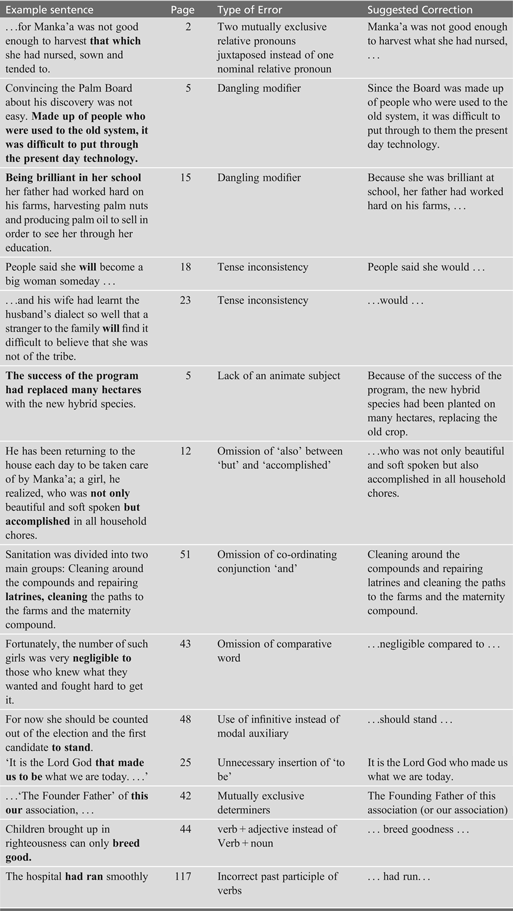
Tense inconsistency is the third category of errors found in the text we are examining. Time references are not always considered during conjugation of verbs. While one should not be unduly prescriptive in assessing English as a second or foreign language, the occurrence of basic errors is not acceptable in a set work used for the teaching of literature in schools and for improving students' English. This is one of the most common errors in the text (n = 5).
Other isolated errors occur throughout the novel (n = 9), as can be seen in table 1. Boldface is used to indicate the part of the sentence where an error occurs.
Punctuation
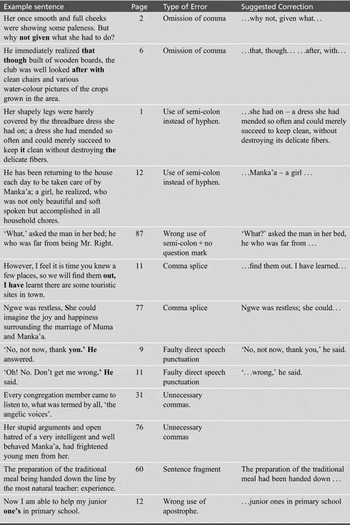
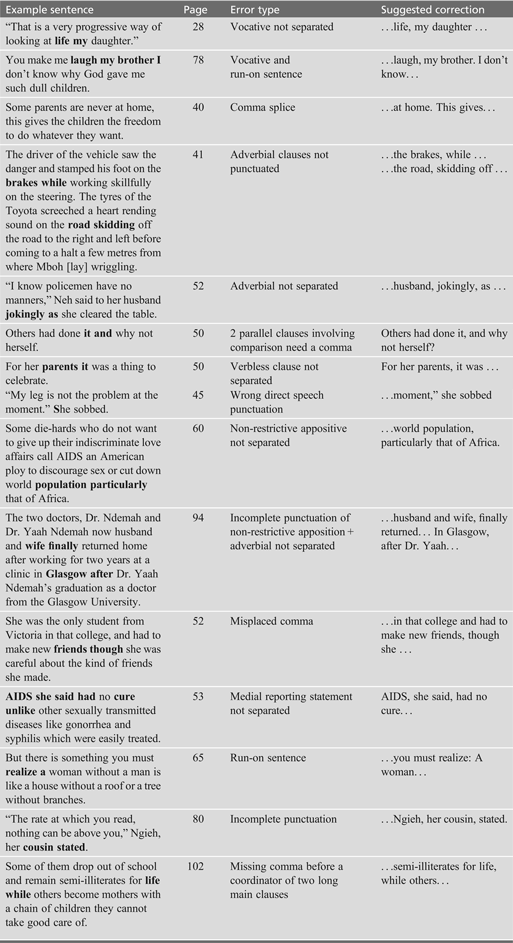
As far as punctuation is concerned, the greatest weakness manifested in Manka'a is the absence of obligatory commas in sentences (n = 70). Non-restrictive clauses should be separated from the rest of the sentence with a comma or a pair of commas, as the case may be. Adverbial clauses are punctuated with commas, as well as vocatives and interjections (Connor, 1990: 61–3). These punctuation rules are not always observed in the text. Then there is the use of commas where another major punctuation mark is needed, thereby creating comma splices (n = 4). In addition, some sentence fragments and a few run-on sentences do exist in the text. Lastly, rules for punctuating direct speech are also not always followed (n = 8). For example, in the case of a final reporting clause, if the direct speech sentence would ordinarily end in a full stop, one puts a comma before the quotation marks, and the first letter for the reporting clause is in lower case (except if it is a proper noun). This rule has not been observed all the time in Manka'a. Table 2 below contains examples of wrong punctuation, again limited to two examples per category. Where two consecutive words appear in bold, a comma is missing between them. I have given a corrected version of the first few only, as examples. Again, where the symbol ≈ appears on the third column of the table, the error type has been repeated.
Types of Punctuation Errors in Manka'a

Spelling inconsistency
In Manka'a, the word ‘program’ is spelled on page 5 using the American orthographic system. One would think that the author has decided to use that system throughout his work. However, on the following page he uses the British spelling system to spell the word ‘colour’, and on page 9 ‘parlour’. This can be very confusing to young secondary school students, if the education system insists on consistency between American and British norms.
Novel 2: A Challenge to Young Girls
Errors of grammar
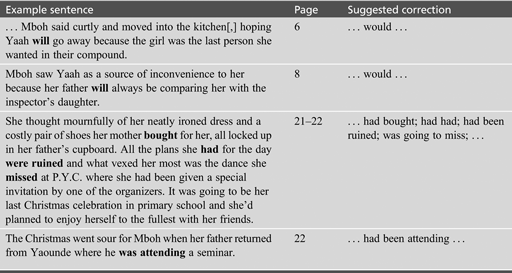
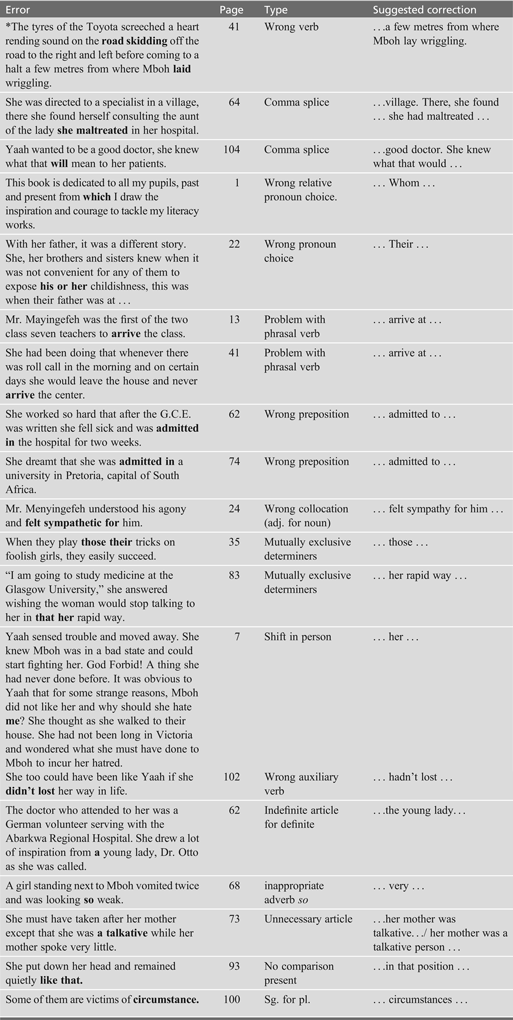
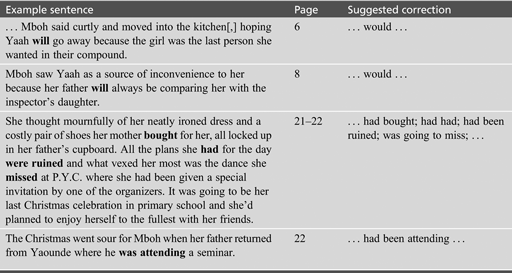
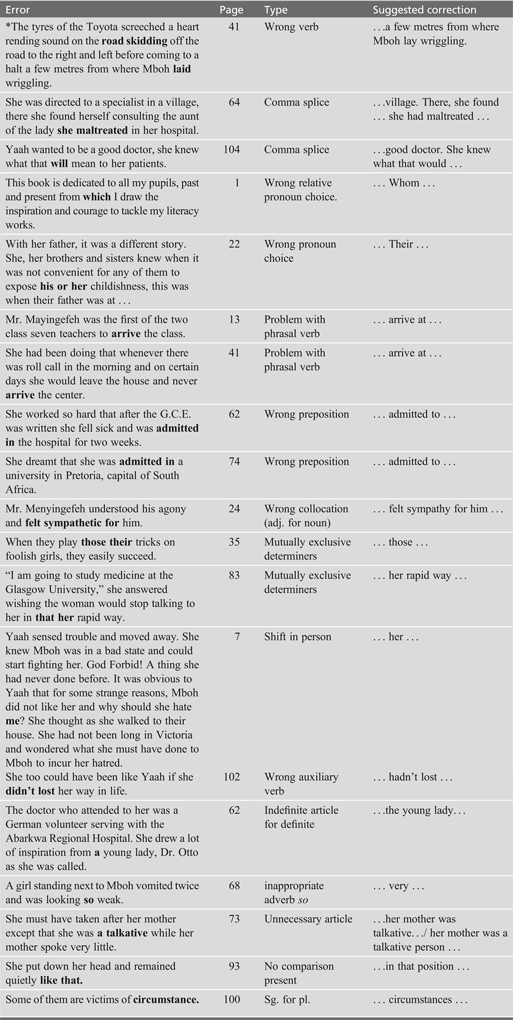
Of the grammar errors found in A Challenge to Young Girls, verb tense inconsistency and failure to express time relationships accurately top the list (n = 41). Table 3 illustrates a few of these. Other less frequent types are given in table 4 (totalling another 23 examples). Again the number of examples per category are limited to no more than two.
Some tense errors in A Challenge to Young Girls
A selection of other grammatical errors in A Challenge to Young Girls
Punctuation
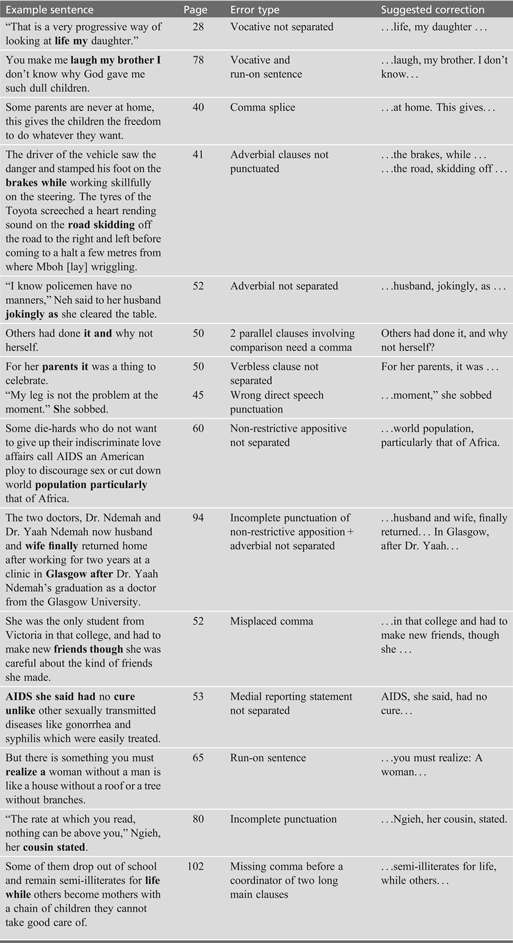
Punctuation errors similar to those in Manka'a are found in A Challenge for Young Girls. There are many obligatory commas missing. Other examples show overuse of the comma, when it is not required at all, or when some other punctuation mark would have been more appropriate. Table 5 gives a sample of such errors (which totalled 35 in all). For reasons of space only one example per category of error is listed.
Punctuation errors in A Challenge to Young Girls
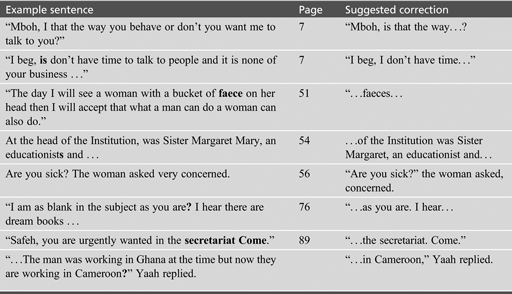
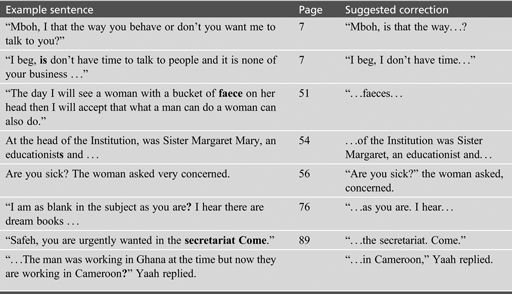
Some of the punctuation and spelling errors in A Challenge to Young Girls are simply typographical and point to the need for better proof-reading by publisher and author. Table 6 gives a list of these errors, indicated again in bold.
Possible typographical errors in A Challenge to Young Girls
Conclusion
‘Cameroon English’ is a variety of English that is nationally and internationally recognised, by inter alia a publisher like Mouton de Gruyter in their Handbook of Varieties of English (2004, reprinted in part as Mesthrie, Reference Neba2008). In Manka'a, there are indeed examples of Cameroon English usage as far as vocabulary is concerned. For example, on page 13, Mr. Ayuk tells Manka'a: ‘You are like my last follower’, meaning ‘youngest junior sister’ or ‘youngest sibling’. On page 11 of A Challenge for Young Girls, Yaah says, ‘… Why should somebody be angry because I am brilliant? … This is wonderful O.’ Her mother replies, ‘This is our wonderful world, my daughter.’ Wonderful is used here as a common ‘Cameroonianism' to mean ‘terrible’ (in the Standard British English sense). Such local idioms and occasional turns of grammar can be valuable in adding a local flavour to a text, especially in conversation within a novel. But this does not apply to the kinds of grammar and spelling referred to in tables 1 to 5.
First, the question to be asked is whether basic grammar and punctuation rules of Standard English can be waived in Cameroon national literature. I am of the opinion that this should not be the case, since this standard is taught (or is supposed to be taught) in schools throughout the country. Emerging writers need to pay attention to the conventions of standard English in their work, especially in writings which aspire to be used for the teaching of literature in schools. On the other hand, if the rules are to be ignored, then students should not be penalised during the marking of their scripts, be it during class tests, promotion examinations, or official examinations like the General Certificate of Education (GCE) examination. This hardly seems possible. Secondly, I am questioning whether literature teachers call their students' attention to these errors and correct them during lessons, or simply ignore them. It is not entirely clear whether the teachers themselves are aware of these errors.
Cameroonian publishers appear to have difficulties with the editing process. They need to get good editors – specialists in the field – and pay them well enough to do their work efficiently. Writers themselves should also assure adequate proof-reading of their works before sending them to publishing houses. Finally, how books are selected to be placed on the official list of books authorised for school use in Cameroon is questionable. What are the criteria for book selection? Do those who select the books actually read through them first to find out their suitability for the various subjects and grades of students they are to be used for? Young Cameroonians deserve better quality than what is being offered to them at present in terms of books for literary studies.
 DR MIRIAM AYAFOR obtained her Bachelor's degree in English in 1980 from the University of Yaoundé, Cameroon, and immediately started teaching English in secondary schools in her country. Later, in 1993, she obtained a Master's in Modern English Language from Leeds University, England. On her return to Cameroon, she continued with language teaching in secondary schools, while also teaching part-time at the University of Dschang, Cameroon. She moved to Britain again in 2002 and obtained a doctorate degree from the University of Ulster at Coleraine in November 2005. Dr Ayafor is presently full time Senior Lecturer in English Language in the University of Yaoundé, Cameroon. She is interested in research into falling standards of English, literacy problems among the schooled, and Pidgins and Creoles. Email: miriamayafor@yahoo.co.uk