Introduction
Functional status in patients with Alzheimer's disease (AD) is usually evaluated by a patient's ability to undertake activities of daily living (ADL). A number of subjective and performance-based questionnaires have been developed to assess ADL in patients with AD (Marshall et al., Reference Marshall, Amariglio, Sperling and Rentz2012). Such questionnaires usually comprise a list of common activities that a person would, under normal circumstances, be expected to perform without difficulty. ADL are divided into basic ADL (BADL), which are related to standard self-care tasks (e.g. eating, using the bathroom, and bathing), and instrumental ADL (IADL), which may not be necessary for fundamental functioning but allow independent living (e.g. housework, financial management, and correct use of medications). Whereas BADL tend to become impaired in the moderate-to-severe stages of AD, the more complex IADL are more likely to start to decline in the earlier stages of the disease (Marshall et al., Reference Marshall, Amariglio, Sperling and Rentz2012). Given the wide variation in tasks usually classified as IADL, it has been suggested that a more in-depth analysis of these tasks and how they associate with one another could improve the clinical applicability of ADL assessments (Brown et al., Reference Brown, Devanand, Liu and Caccappolo2011; Marshall et al., Reference Marshall, Amariglio, Sperling and Rentz2012).
A number of studies in patients with AD, using a variety of ADL questionnaires, have found ADL to be associated with key cost and caregiver outcomes. Greater impairment in ADL has been identified as an important predictor of total societal costs across different countries (Gustavsson et al., Reference Gustavsson2011); caregiver burden (Germain et al., Reference Germain2009; Kim et al., Reference Kim, Chang, Rose and Kim2012; Haro et al., Reference Haro2014); and informal caregiver time (Germain et al., Reference Germain2009; Haro et al., Reference Haro2014). Informal caregiver time, which includes time spent assisting with BADL and IADL, and supervision time (i.e. time spent protecting the patient from dangerous events), has been identified as a major component of societal costs of care in patients with AD (Gustavsson et al., Reference Gustavsson2011; Wimo et al., Reference Wimo2013). In addition, increase in more subjective measures of caregiver burden (e.g. the Zarit Burden Interview [ZBI]) is associated with a faster time to institutionalization and death in AD patients (Brodaty et al., Reference Brodaty, McGilchrist, Harris and Peters1993; Balardy et al., Reference Balardy, Voisin, Cantet and Vellas2005). Therefore, there is a need to expand our understanding of the different factors comprising ADL, and how these influence or are associated with different outcomes. Although studies usually report total ADL, BADL, or IADL scores (as in the aforementioned studies), there may be individual factors or groups of factors of ADL driving different cost and caregiver outcomes at different stages of the disease. To date, however, we have not been able to identify any studies that have investigated this.
The Alzheimer's Disease Cooperative Study – Activities of Daily Living Scale (ADCS-ADL) is an informant-based, disease-specific assessment of functional ability that has been widely used in clinical trials of mild-to-moderate AD (Galasko et al., Reference Galasko, Schmitt, Thomas, Jin and Bennett2005). A recent factor analysis of this questionnaire used baseline data from the PLASA (PLAn de Soin et d'aide dans la maladie d'Alzheimer) study, a prospective randomized trial comparing usual care with a non-pharmacological intervention in patients with AD (Nourhashemi et al., Reference Nourhashemi2010). Results suggested that ADCS-ADL questions could be grouped into four subdomains: basic activities, domestic/household activities, communication and engagement with the environment activities, and outside activities (the latter reflecting an individual's ability to independently function outside the home; Kahle-Wrobleski et al., Reference Kahle-Wrobleski, Coley, Lepage, Cantet, Vellas and Andrieu2014). The aim of the current hypothesis-generating study was to obtain a better understanding of how patient function impacts societal costs and caregiver outcomes by examining the association between these outcomes and scores for total ADL, BADL, IADL, and the four ADL subdomains (confirmed by factor analysis) and/or individual ADL questions. The study used baseline data from a prospective observational study of community-living AD patients (GERAS).
Methods
Patient and caregiver data
Patient data were obtained from the GERAS study, an 18-month prospective, multicenter, observational study, being conducted in France (N = 419), Germany (N = 552), and the United Kingdom (N = 526), of the routine care of community-living patients with AD. Participants were aged ≥55 years, with a Mini-Mental State Examination (MMSE) score of ≤26, and diagnosed with probable AD (National Institute of Neurological and Communicative Disorders, and Stroke and Alzheimer's Disease and Related Disorders Association criteria; McKhann et al., Reference McKhann, Drachman, Folstein, Katzman, Price and Stadlan1984). The study design and methods have previously been described in detail (Wimo et al., Reference Wimo2013). All patients had to have a primary caregiver willing to participate in the study and to undertake responsibility for the patient for ≥6 months of the year. The primary caregiver was an informal caregiver who, according to the family, normally took most responsibility for the day-to-day decisions and provision of home care for the patient. All patients (or their legal representative) and caregivers were required to provide written informed consent, and the study was approved by ethical review boards in each country following country regulations. Patients were stratified according to disease severity at baseline using MMSE criteria based on the UK guidelines (as reported previously in Wimo et al., Reference Wimo2013): “mild AD severity” (MMSE = 21−26 points); “moderate AD severity” (MMSE = 15−20 points); “moderately severe/severe AD severity” (MMSE <15 points).
In addition to patient and caregiver socio-demographic data, other assessments carried out at baseline included patient cognitive function assessed using the MMSE, and patient functional ability assessed using the ADCS-ADL (Galasko et al., Reference Galasko, Schmitt, Thomas, Jin and Bennett2005). Caregivers completed the ZBI, a widely used instrument for measuring subjective caregiver burden in AD (Zarit et al., Reference Zarit, Reever and Bach-Peterson1980). Information on caregiver time during the month before the baseline visit was collected using the Resource Utilization in Dementia (RUD) instrument (Wimo et al., Reference Wimo, Wetterholm, Mastey, Winblad, Wimo, Jönsson, Karlsson and Winblad1998). The RUD collects information on time spent on informal care (separated into the hours spent assisting with BADL, IADL, and supervision time) and information on lost working days. We investigated caregiver supervision time as well as total caregiver time, as supervision time was identified as the largest component of caregiver time at baseline in the GERAS cohort (Wimo et al., Reference Wimo2013; Haro et al., Reference Haro2014). Caregiver supervision time has also been found to contribute to both caregiver burden and costs (Leicht et al., Reference Leicht2011; Wimo et al., Reference Wimo2013; Haro et al., Reference Haro2014). Moreover, supervision time will have less overlap with the basic and instrumental factors of ADL than the other two aspects of caregiver time (time spent on BADL and IADL). Although total societal costs provide a reflection of the patient plus caregiver-related costs of caring for a patient with AD, patient healthcare and social care costs were selected as an outcome because of their relevance to the healthcare provider.
Confirmatory factor analysis of the ADCS-ADL
The ADCS-ADL is a 23-item (6 BADL; 17 IADL) inventory developed as a rater-administered disease-specific questionnaire. It is widely used to assess functional ability in clinical trials in AD, and is completed on behalf of the patient by his/her caregiver (Galasko et al., Reference Galasko1997; Reference Galasko, Schmitt, Thomas, Jin and Bennett2005). The caregiver is first asked, whether the patient has attempted each specific ADL during the past four weeks. If the patient did attempt the ADL, the caregiver is asked to rate the patient's performance level based on a set of performance descriptions. Scores for each item and the overall score for the tool are calculated. The range for the total ADCS-ADL score is 0 to 78. Separate scores can be derived for BADL (0 to 22) and IADL (0 to 56).
The baseline data of GERAS were used to perform a confirmatory factor analysis (CFA) of the previously mentioned factor analysis of the ADCS-ADL conducted by Kahle-Wrobleski et al. (Reference Kahle-Wrobleski, Coley, Lepage, Cantet, Vellas and Andrieu2014) using baseline data from the PLASA study. Model fit was assessed using the standardized root mean square residual (SRMSR), the root mean square error of approximation (RMSEA), and the Bentler Comparative Fit Index (CFI). An acceptable fit was determined by CFI >0.90 and RMSEA <0.10.
Generalized linear model analyses
Generalized linear models (GLMs) were used to analyze the relationship between ADL scores (total ADL, BADL, and IADL), scores for the ADL subdomains confirmed through factor analysis, and each of the following outcomes: total and caregiver supervision time, total societal costs (defined as patient healthcare and social care costs plus caregiver informal care costs), patient healthcare and social care costs (γ distribution with a log link function), and the ZBI total score (normal distribution with an identity link function). All GLMs were run with country, patient age, MMSE severity group, and caregiver relationship (spouse: yes/no) as included factors. Model fit was assessed through the Akaike Information Criterion (AIC) and R2 statistics when adding ADL total score, BADL and IADL scores, and the scores of the confirmed subdomains. In addition, likelihood ratio tests (LRTs) were performed on nested models of the ADL factors to confirm the findings of GLMs. If any of the ADL subdomains provided an improved model fit to any of the outcomes, we also looked at a model that included responses to individual ADL questions. Full models for GLMs are provided in Supplementary Table S1 (Table S1 is available as supplementary material attached to the electronic version of this paper at www.journals.cambridge.org/jid_IPG). To aid interpretation of the coefficients from the GLM γ distribution models (cost and caregiver time outcomes), the percentage change in the mean cost or mean number of caregiver hours per patient for each unit change in the ADL variable is reported; however, these are not adjusted for the respective range in each domain or subdomain. To aid interpretation of the coefficients from the GLM normal distribution models (ZBI total score), the change in ZBI score for each one-point change in the ADL score being used is reported. In both cases the percentage change associated with a one-point change in ADL score was calculated as (exp(0 – (exponential β-coefficient)) – 1) × 100.
As there are concerns about the ability of ADCS-ADL to adequately capture functioning in individuals with milder AD severity (Sacco et al., Reference Sacco2012), we were interested in identifying factors of ADL that may be particularly sensitive to change in milder severity disease. Hence, for all five outcomes the same GLMs described above were run, including the following terms: country; patient age; mild MMSE (yes/no); caregiver relationship; ADL score; and a mild MMSE × ADL score interaction term. The GLM models for the cost outcomes included these terms: country; patient age; number of patient co-morbidities; patient experienced a fall; caregiver working for pay; mild MMSE (yes/no); ADL score; and mild MMSE × ADL score interaction term.
Sensitivity analyses
Sensitivity analyses were conducted to test the strength of individual questions identified from the GLMs (e.g. would any of the other basic activities questions substitute for the basic activities question on bathing?).
Relationship between total ADL score and AD severity
The relationship between total ADL score and the MMSE baseline score was explored through regression models, with ADL score as the dependent variable and the MMSE score as the independent variable. Similar models were run for the two main domains (BADL and IADL) and the subdomains confirmed through factor analysis, and their relationship with MMSE score.
Missing data
Missing data were minimal (<1%) for all the outcome measures (total and caregiver supervision time, total societal costs, patient healthcare and social care costs, and the ZBI total score). Sensitivity analyses were conducted on the GLM models for (1) total ADL and (2) BADL + IADL, where missing data was only 2.4%. The results from these models were consistent with the models based on patients with no missing ADL items. A sensitivity analysis was additionally conducted, where patients with missing responses to specific ADL questions were imputed. Three separate analyses were performed: (1) missing question responses were assumed to have a score of zero; (2) missing question responses were assumed to have the maximum score for that question; and (3) a multiple imputation approach was used using the Markov chain Monte Carlo methods. All three sensitivity analyses were in agreement with the primary CFA regarding the SRMSR, RMSEA, and the Bentler CFI values. Hence, we conclude that our findings are robust, and we assumed that patients not included in the GLM models are missing completely at random.
Statistical methods
Descriptive summary statistics are provided for the baseline characteristics of patients and caregivers, and of the outcomes of interest, overall and by MMSE severity. Estimates (with 95% confidence intervals) and p-values are presented for all GLM analyses.
All analyses were performed using SAS version 9.2 (SAS Institute, Cary, NC, USA).
Results
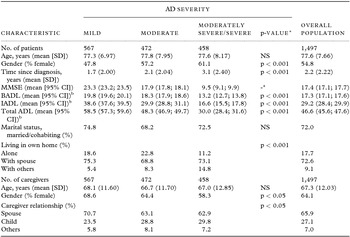
The baseline characteristics of patients and caregivers participating in the GERAS study across all three countries have been reported in detail (Wimo et al., Reference Wimo2013). Most patients participating in GERAS were living in their own home with their spouse as the main caregiver (Table 1). Patients with more severe disease were less likely to be living alone, and were more likely to be female and to have a longer disease history.
Patient and caregiver characteristics at baseline

Notes: aNo statistical analysis performed.
bAssessed using the Alzheimer's Disease Cooperative Study – Activities of Daily Living Scale (ADCS-ADL).
*For comparison between AD severity groups (ANOVA for continuous variables and Cochran–Mantel–Haenszel test for categorical variables).
“Mild” AD severity = MMSE 21–26 points; “moderate” AD severity = MMSE 15–20 points; “moderately severe/severe” AD severity = MMSE < 15 points.
AD = Alzheimer's disease; ADL = activities of daily living; BADL = basic activities of daily living; CI = confidence interval; IADL = instrumental activities of daily living; NS = not significant (p ≥ 0.05).
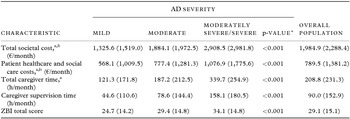
Baseline data for all outcomes of interest – caregiver burden (ZBI total score), total and caregiver supervision hours, and cost outcomes (total societal and patient healthcare and social care costs) – increased with severity of the disease (Table 2).
Caregiver and cost outcomes by AD severity at baseline

Notes: Data are mean values ± SD.
aCaregiver time = number of hours for basic ADL + number of hours for instrumental ADL + supervision time (capped at 720 h per month).
bCalculated using an opportunity cost approach taking into account only productivity loss for working age caregivers and lost leisure time for retired people or those who never worked or stopped working for reasons other than care of the patient. Unit costs for caregiver time for working caregivers: value of lost production time (based on average wage). Non-working caregivers: value of lost leisure time (based on 35% of average wage). Caregiver time was capped at 720 h (the maximum number of hours in a month at 24 h/day and excluding caregiver supervision time). Costs were calculated for the month prior to baseline. Total societal costs = patient healthcare and social care costs + caregiver informal care costs.
*For comparison between AD severity groups (Wald χ 2 test from generalized models for costs and caregiver time; for the ZBI score, p-values are taken from the type III sums of squares from the generalized linear model).
“Mild” AD severity = MMSE 21–26 points; “moderate” AD severity = MMSE 15–20 points; “moderately severe/severe” AD severity = MMSE < 15 points.
AD = Alzheimer's disease; ZBI = Zarit Burden Interview.
Confirmatory factor analysis results
A CFA run on the overall GERAS data using the factor pattern of the ADCS-ADL reported by Kahle-Wrobleski et al. (Reference Kahle-Wrobleski, Coley, Lepage, Cantet, Vellas and Andrieu2014) (which used data from the PLASA study) suggested a good fit with this analysis (model fit statistics for the entire GERAS cohort were SRMSR = 0.049, RMSEA = 0.060 and Bentler CFI = 0.92). The CFA confirmed that ADL questions could be grouped into the following four subdomains: basic activities, domestic/household activities, communication/engagement with the environment activities, and outside activities (Supplementary Table S2 and Supplementary Figure S1 are available as supplementary material attached to the electronic version of this paper at www.journals.cambridge.org/jid_IPG). Similar “acceptable fits” were seen between CFAs run using data from each of the three MMSE severity groups and the factor pattern generated by the PLASA analysis: mild AD severity patients (SRMSR = 0.059; RMSEA = 0.058; Bentler = 0.89); moderate AD severity patients (SRMSR = 0.063; RMSEA = 0.055; Bentler = 0.89); and moderately severe/severe AD patients (SRMSR = 0.055; RMSEA = 0.060; Bentler = 0.91). Based on the results from the CFA, there was no evidence to suggest that the subdomains identified from the PLASA study data should not be considered when exploring the relationship between ADL and outcome measures in the GERAS patient population. Hence, the ADL subdomains used in the GLM models were those identified by the PLASA analysis.
GLM analyses results
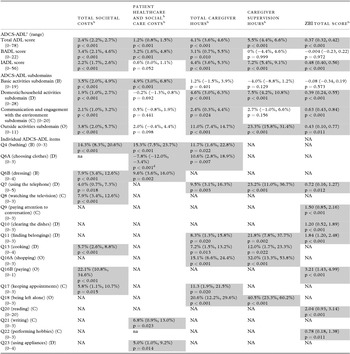
Total societal costs was the only outcome found to be associated with all ADL scores (total ADL, BADL, and IADL) as well as all four confirmed subdomains and some of the individual ADL questions (Table 3). One-point lower ADL domain and subdomain scores (signifying worse function) were equivalent to higher total societal costs (Table 3).
Associations between ADCS-ADL scores and outcomes (estimates from multivariate models)a

Notes: aResults for each outcome are generated from separate GLMs, all run with country, patient age, MMSE severity group, and caregiver relationship (spouse: yes/no) as included factors.
bFor continuous ADL variables, the percentage change (95% confidence interval [CI]) in the mean cost or mean number of caregiver hours per patient for each unit change of the ADL score is reported; positive values indicate higher cost/hours for lower ADL scores (signifying worse function); however, these are not adjusted for the respective range in each domain or subdomain. In the ZBI model, the estimate relates to the change in the ZBI total score (95% CI) for each unit point change in ADL score; positive values indicate greater caregiver burden for lower ADL scores.
cAssessed using the ADCS-ADL.
dFactor goes in the opposite direction (i.e. lower costs are associated with lower functional scores).
B = basic activities item; C = communication activities item; D = domestic/household activities item; O = outside activities item.
“Mild” AD severity = MMSE 21–26 points; “moderate” AD severity = MMSE 15–20 points; “moderately severe/severe” AD severity = MMSE < 15 points.
ADCS-ADL = Alzheimer's Disease Cooperative Study – Activities of Daily Living Scale; BADL = basic activities of daily living; GLMs = Generalized Linear Model analyses; IADL = instrumental activities of daily living; NA = not applicable to the model; ZBI = Zarit Burden Interview.
Patient healthcare and social care costs were associated with total ADL and BADL but not IADL scores, and with only the basic activities subdomain. One-point lower total ADL, BADL, and basic activities subdomain scores were associated with higher costs.
Both total caregiver hours and caregiver supervision hours were associated with total ADL and IADL scores as well as the domestic/household and outside activities subdomains. One-point lower ADL scores were associated with higher total caregiver hours and higher caregiver supervision hours. In contrast to caregiver supervision hours, total caregiver hours also demonstrated associations with BADL and the communication/engagement with the environment subdomain. Neither outcome was significantly associated with the basic activities subdomain.
Caregiver burden (ZBI total score) was associated with total ADL and IADL scores and with the domestic/household, communication and outside activities subdomains: lower ADL scores resulted in significantly higher ZBI scores (signifying a worsening of caregiver burden). There was no association between this outcome and the BADL score or the basic activities subdomain score.
In addition to comparing models through the AIC, a sensitivity analysis was conducted, which looked at nested models between the ADL factors. The results of comparing the LRTs of these nested models supported the conclusion on the benefit of breaking down the ADL score into subdomains (data not shown).
Some outcomes also showed a significant association with specific individual ADL questions (as shown in Table 3); in general, the model fit was similar when any of these individual questions were replaced with another question from the same subdomain, showing that the individual questions within a subdomain were largely interchangeable (data not shown). Exceptions to this were seen only in the total caregiver hours model, in which the individual basic activities question, Q4 (bathing) and the domestic/household activities questions, Q6A (choosing clothes), Q7 (using the telephone), Q11 (finding belongings), and Q13 (cooking), all of which were significantly associated with total caregiver hours, could not be replaced by other individual questions.
Overall, a one-point lower IADL score (range 0–56) was associated with 2.2% higher total societal costs, 4.4% higher total caregiver hours, 7.2% higher caregiver supervision hours, and a 0.48 higher ZBI score. A one-point lower BADL score (range 0–22) was associated with 3.4% higher total societal costs, 3.2% higher patient healthcare and social care costs, and 3.1% higher total caregiver hours.
GLM analysis by AD severity group
There was a linear relationship between MMSE scores and ADL scores in the total, BADL, and IADL domains and all four subdomains (Supplementary Figure S2 is available as supplementary material attached to the electronic version of this paper at www.journals.cambridge.org/jid_IPG), with increasing cognition deficits reflecting greater impairments in all ADL domains.
Sensitivity analysis identified several interactions between outcomes and ADL scores that differed according to MMSE severity (mild vs. moderate-to-severe; Figure 1). Notably, there were significant (p ≤ 0.007) differences between the mild and moderate-to-severe AD groups in associations between: total societal costs and total ADL, IADL, and the outside activities subdomain; both total and caregiver supervision hours and total ADL, IADL, and the outside activities subdomain; and ZBI score and total ADL score. A one-point lower outside activities ADL subdomain score was associated with 6.9% higher total societal costs in the mild AD severity group compared with 1.5% higher costs in the moderate-to-severe AD group. Corresponding higher values for caregiver total and supervision hours were 17.2% and 35.3%, respectively, in the mild severity group and 6.1% and 13.5%, respectively, in the moderate-to-severe AD group. There was no significant interaction between MMSE severity (mild vs. moderate-to-severe) and patient healthcare and social care costs (p = 0.50).
Interactions between outcomes and ADL scores that differed between MMSE AD severity (mild vs. moderate-to-severe) groups (sensitivity analysis); interactions that differ significantly between AD severity groups are indicated using bold p-values. ADL = activities of daily living; BADL = basic activities of daily living; IADL = instrumental activities of daily living; MMSE = Mini-Mental State Examination.

Discussion
This study found significant associations between key cost and caregiver outcomes and components of ADL (defined as total ADL, BADL, and IADL scores, and the scores of four ADL subdomains confirmed by factor analysis) using data from the GERAS observational study in community-based patients with AD. In particular, significant associations were identified between total societal costs (patient healthcare and social care costs plus caregiver informal care costs) and caregiver total and supervision hours and the derived ADL subdomain of outside activities. These differed significantly between patients with mild AD and those with moderate-to-severe AD, suggesting that this subdomain may be potentially informative in determining outcomes in patients with mild AD.
Factor analysis of ADCS-ADL confirmed the presence of a basic activities subdomain commensurate with the original BADL domain of the ADCS-ADL questionnaire (Galasko et al., Reference Galasko, Schmitt, Thomas, Jin and Bennett2005), and separated IADL into three distinct subdomains: domestic/household, communication/engagement with the environment, and outside activities. All four subdomains showed a linear relationship with MMSE score similar to that seen with the total ADL, BADL, and overall IADL scores.
BADL and the basic activities subdomain
Lower BADL scores were associated with higher total societal costs and, specifically, higher patient healthcare and social care costs. This is supported by the finding that the basic activities subdomain was the only subdomain to show an association with patient costs. Thus, a poor ability to self-care had the greatest impact on patient health and social care costs, possibly because such patients require care from external sources (e.g. home helps, district nurse visits, etc.), which have clear cost implications. Few studies appear to have investigated the specific contribution of BADL impairment to patient costs. However, in a study conducted by Zhu et al. (Reference Zhu2006) in the United States, increased impairments in both BADL and IADL (assessed using the Blessed Dementia Rating Scale) were associated with increases in patient direct medical costs as well as informal care costs.
Lower BADL and basic activities subdomain scores were not directly associated with higher caregiver supervision hours. This is perhaps surprising, as less time spent on supervision was significantly associated with fewer deficits in both BADL and IADL in a previous analysis of the GERAS baseline data (Haro et al., Reference Haro2014). However, Haro et al. (Reference Haro2014) analysis included additional caregiver factors in the multiple linear regression analyses, whereas our analysis used GLMs with γ distributions.
A lower BADL score was associated with higher total caregiver hours, but there was no association between this outcome and the basic activities subdomain. Given the overlap of items comprising BADL and the basic activities subdomain confirmed in the factor analysis (which differ only in the questions relating to choosing clothes [BADL] and being able to dress [basic activities subdomain]), this finding appears contradictory. However, the significant association observed between total caregiver time and the individual ADL item on choosing clothes (Table 3) demonstrates the importance of this one item in its contribution to the assessment of BADL.
A lower BADL score was not associated with greater caregiver burden (as assessed using the ZBI score). There was also no association between caregiver burden and the basic activities subdomain or any individual basic activities question. A number of studies have reported a weak or no relation between ADL in patients with dementia and the perceived emotional burden of their caregivers (Serrano-Aguilar et al., Reference Serrano-Aguilar, Lopez-Bastida and Yanes-Lopez2006; Campbell et al., Reference Campbell2008). These findings therefore imply that poor self-care in a patient does not add to the caregiver's emotional burden of caregiving, which appears to contradict the previously mentioned association between higher functional impairment and a higher caregiver burden (e.g. Kim et al., Reference Kim, Chang, Rose and Kim2012; Haro et al., Reference Haro2014). However, as BADL generally become impaired in the moderate-to-severe stage of AD (Marshall et al., Reference Marshall, Amariglio, Sperling and Rentz2012), it is possible that by the time patients have progressed to this stage of the disease, caregivers may have developed coping strategies (Del-Pino-Casado et al., Reference Del-Pino-Casado, Frías-Osuna, Palomino-Moral and Pancorbo-Hidalgo2011) or have started using informal and formal support services (Snyder, Reference Snyder2000), which may have influenced their experience and outcomes related to care provision. It can also be speculated that caregivers of patients with BADL impairments, who have more severe AD, have fewer expectations of the patient. Perhaps also there is a differential subjective appraisal of caring tasks, with more caregiving satisfaction being associated with providing assistance for BADL versus IADL. Additional work is needed to evaluate these potential mechanisms.
Instrumental ADL
Instrumental activities of daily living were found to be significantly associated with the total societal costs of AD, caregiver burden, and total caregiver time and supervision time. The lack of an association between IADL and patient health and social care costs may reflect the fact that all patients enrolled in GERAS have caregivers to help manage medication and comorbidities, which may minimize such costs. Although few studies have investigated associations between IADL and key outcomes in patients with AD, those we identified were generally supportive of our findings.
Handels et al. (Reference Handels, Wolfs, Aalten, Verhey and Severens2013) found IADL to be a key determinant of societal costs of care of patients with dementia or cognitive impairment, a finding in agreement with a study by Wattmo et al. (Reference Wattmo, Paulsson, Minthon and Londos2013), which showed that a slower decline in IADL was associated with a longer time to the implementation of community-based home-help services and its associated costs.
Both ADL and IADL were found to predict caregiver burden in an analysis by Kim et al. (Reference Kim, Chang, Rose and Kim2012); however, the authors found caregiver burden to be more strongly associated with deteriorating IADL than with total ADL. Impairments in IADL were identified as a predictor of the objective burden of informal care (amount of time or costs spent on informal care) in a systematic review involving ten studies conducted in patients with dementia (Wolfs et al., Reference Wolfs2012). Lower IADL scores (commensurate with worse function) were also associated with a higher caregiver burden in previous analyses of the GERAS study (Haro et al., Reference Haro2014; Reed et al., Reference Reed2014) and in the ICTUS study, a European longitudinal cohort study in patients with mild-to-moderate AD (Germain et al., Reference Germain2009). In the previous GERAS analysis (Reed et al., Reference Reed2014), the relationship observed between functionality (ADCS-ADL total score) and caregiver burden in both adult–child and spousal caregivers in the GERAS study was predominantly associated with IADL rather than BADL for both caregiver–patient relationship cohorts. These results are supported by the finding in the current study that IADL, and not BADL, was associated with caregiver supervision hours.
The finding in the current analysis that IADL scores, and not BADL scores, impact on caregiver burden may be indicative of a differential relationship between this outcome and ADL. The majority of the previously mentioned studies reporting a weak or no relation between ADL in patients with dementia and the perceived burden of their caregivers (Serrano-Aguilar et al., Reference Serrano-Aguilar, Lopez-Bastida and Yanes-Lopez2006; Campbell et al., Reference Campbell2008) assessed total ADL with no breakdown of BADL or IADL. It is therefore possible that their overall findings of no association between ADL and caregiver burden masks a specific association between this outcome and IADL.
IADL subdomains
Loss of ability of a patient with AD to communicate contributes to caregiver burden (Snyder, Reference Snyder2000), and this was reflected in our finding that a lower communication subdomain score was associated with a higher ZBI score. However, given that a one-point lower communication subdomain score was associated with only a 0.63 higher ZBI score (mean score 29.1), this change is unlikely to be clinically relevant. Lower communication subdomain scores were also associated with higher total caregiver hours and total societal costs, but not caregiver supervision hours. However, supervision time is typically not included in estimations of informal caregiver costs, a major contributor to total societal costs (Gustavsson et al., Reference Gustavsson2011; Handels et al., Reference Handels, Wolfs, Aalten, Verhey and Severens2013; Wimo et al., Reference Wimo2013).
Outside and domestic/household activities can be seen as a representative of the level of a patient's independence. Both of these ADL subdomains were associated with all outcomes, with the exception of patient healthcare and social care costs, which would imply that they are the most relevant subdomains driving the IADL domain (patient healthcare and social care costs were the only outcome not associated with IADL). However, in the analysis of interactions with AD severity groups (mild vs. moderate-to-severe), only the association between the outside activities subdomain and the outcomes of total societal costs and caregiver hours (supervision and total) differed significantly. Hence, it would appear that the ADL outside activities subdomain might better discriminate these outcomes in patients with mild AD from those with moderate-to-severe AD. In patients with milder AD, therefore, it can be hypothesized that measuring/monitoring their ability to function independently outside the home may be more useful than assessing overall IADL when assessing functional ability or in monitoring functional decline. As IADL impairments generally appear earlier in the disease course than deficits in BADL, we could speculate that this finding might also be of value in assessing patients with mild cognitive impairment (MCI). There is growing evidence that patients with MCI have functional deficits in IADL (Brown et al., Reference Brown, Devanand, Liu and Caccappolo2011). However, not all patients with MCI progress to AD. A better understanding of the type and severity of IADL impairment may help to identify patients in the very early stages of AD and thus promote the earlier recognition of care needs and the implementation of support services. Such an understanding may also, therefore, affect future policy and service development. Further investigation of the outside activities subdomain may be informative in this context.
Study strengths and limitations
One of the strengths of this study is the good correlation between the CFA run on the overall GERAS data using the factor pattern reported in the PLASA study and the factors identified by Kahle-Wrobleski et al. (Reference Kahle-Wrobleski, Coley, Lepage, Cantet, Vellas and Andrieu2014) using data from the prospective randomized PLASA study (Nourhashemi et al., Reference Nourhashemi2010). Similar correlations were also apparent between the CFAs run using data from each of the three MMSE severity groups and the factor pattern generated by the PLASA analysis.
Other strengths of our analysis are that the GERAS study data were obtained from a large AD population characterized by a wide range of disease severity. In contrast to the PLASA study factor analysis (Kahle-Wrobleski et al., Reference Kahle-Wrobleski, Coley, Lepage, Cantet, Vellas and Andrieu2014), however, it should be noted that data were missing for <1% of patients in the GERAS study (Wimo et al., Reference Wimo2013), whereas a limitation of the Kahle-Wrobleski et al. (Reference Kahle-Wrobleski, Coley, Lepage, Cantet, Vellas and Andrieu2014) study was that it was not possible to include all participants in the analyses due to missing baseline data in 35% of patients. Sensitivity analyses found missing data to have no effect on the results of the GLM models conducted in the current study.
Limitations of this study include the fact that the GERAS population was a clinic-based convenience sample (not a population-based cohort) and therefore not fully representative of a typical AD patient cohort. In a population-based cohort, patients having dementia tend to be diagnosed in later stages of the disease, and families require more information and psycho education to cope with the consequences of the disease; hence, caregiver time and costs may differ from this clinic-based cohort. Baseline parameters were gathered by patient and caregiver recall, and hence may be subject to recall bias (Evans and Crawford, Reference Evans and Crawford1999). It should also be borne in mind that the ADCS-ADL is a subjective measure of a patient's ability to perform ADL, completed on behalf of the patient by his/her caregiver. Caregivers have been shown to underestimate the functional status of patients with AD, especially with regard to IADL (Zanetti et al., Reference Zanetti, Geroldi, Frisoni, Bianchetti and Trabucchi1999), a finding related to the caregiver's perceived burden (Mangone et al., Reference Mangone1993).
The current factor analysis was based on baseline (cross-sectional) data from the GERAS study. As GERAS is a prospective study, it is intended that the reliability of this analysis will be assessed using longitudinal data when available.
Conclusions
Stratifying patients by their ability to carry out subdomains of ADL may lead to a better understanding of the association between patient function and costs and caregiver outcomes at different stages of AD. Assessment of the outside activities subdomain in milder stages of the disease in particular could be important for use in the diagnosis of functional impairment within AD and in the monitoring of disease progression; it may provide a useful measure in clinical trials.
Conflict of interest
The GERAS study and this analysis were supported by Eli Lilly and Company Limited. Mark Belger, Catherine Reed, and Jeffrey Scott Andrews are employees of Eli Lilly and Company Limited. Josep M. Argimon, Giuseppe Bruno, Richard Dodel, and Anders Wimo have received financial compensation from Eli Lilly for participation on the GERAS Advisory Board. Roy W. Jones, Bruno Vellas, and Josep Maria Haro are consultants for Eli Lilly.
Description of authors’ roles
M. Belger was responsible for carrying out statistical analysis and the statistical design of the analysis. J.S. Andrews, J.M. Haro, C. Reed, and B. Vellas contributed to the data analysis and drafting of the paper. J.M. Argimon, G. Bruno, R. Dodel, R.W. Jones, and A. Wimo critically revised the paper for important intellectual content.
Acknowledgments
The authors wish to thank all investigators who participated in the study. We would like to express our gratitude to all patients and their caregivers who participated in this study. The authors would like to acknowledge Drs Gill Gummer and Deirdre Elmhirst (Rx Communications, Mold, UK) for medical writing assistance for the preparation of this paper, funded by Eli Lilly and Company.
Supplementary material
To view supplementary material for this article, please visit http://dx.doi.org/10.1017/S1041610215001349.