Horseweed, also known as marestail, is a common winter annual broadleaf weed belonging to the Asteraceae family (Gleason and Cronquist Reference Gleason and Cronquist1963). Horseweed is a native of North America and widely distributed in the United States and Canada. It is prevalent in no-till annual cropping systems, pastures, orchards, roadsides, and industrial and waste areas of North, Central, and South America (Miller and Miller Reference Miller and Miller1999). It is a highly competitive weed in agronomic crops. Byker et al. (Reference Byker, Soltani, Robinson, Tardif and Lawton2013) reported that the season-long interference from horseweed competition could reduce soybean [Glycine max (L.) Merr.] grain yield by 83% to 93%. Similarly, Ford et al. (Reference Ford, Soltani, McFadden, Nurse, Robinson and Sikkema2014) reported a 92% reduction in corn (Zea mays L.) grain yield at a horseweed density of 60 plants m−2. Horseweed competition in cotton (Gossypium hirsutum L.) reduced lint yield up to 2.9-fold (Owen et al. Reference Owen, Mueller, Main, Bond and Lawrence2011; Steckel and Gwathmey Reference Steckel and Gwathmey2009). Although limited published information is available on horseweed interference in wheat, it has become an increasingly troublesome weed during fallow periods in no-till wheat–fallow rotations in the arid to semi-arid regions of the U.S. Great Plains.
Horseweed germinates throughout the year, although most plants emerge in the fall and overwinter as rosettes (Bolte Reference Bolte2015; Buhler and Owen Reference Buhler and Owen1997). It is a prolific seed producer, and a single plant can produce up to 200,000 seeds that when wind-borne can disperse over long distances (Bhowmik and Bekech Reference Bhowmik and Bekech1993; Shields et al. Reference Shields, Dauer, VanGessel and Neumann2006; Weaver Reference Weaver2001). The majority of horseweed seeds emerge from the soil surface, and shallow burial (>0.5 cm) therefore reduces seedling emergence (Nandula et al. Reference Nandula, Eubank, Poston, Koger and Reddy2006). Furthermore, seeds have a short life span and will remain viable for only 2 to 3 yr (Davis and Johnson Reference Davis and Johnson2008). Therefore, tillage is an effective tool for managing horseweed seedbanks (Brown and Whitwell Reference Brown and Whitwell1988). However, tillage has only limited potential for use in the dryland production systems of the Northern Great Plains due to low annual precipitation (<30 cm) and the need to conserve soil moisture. Growers in this region utilize no-till fallow for soil moisture conservation from winter precipitation (Lenssen et al. Reference Lenssen, Waddell, Johnson and Carlson2007), with heavy reliance on nonselective herbicides, especially glyphosate, for weed control in chemical fallow preceding winter wheat (Kumar et al. Reference Kumar, Jha and Reichard2014).
Glyphosate is one of the most predominant and frequently used broad-spectrum, nonselective herbicides for burndown weed control in fallow or before crop planting. The high rate of adoption of glyphosate-resistant (GR) soybean, cotton, and corn in the United States has resulted in an often sole reliance on glyphosate for weed control (Green 2011; Shaw et al. 2009). Consequently, overreliance on glyphosate has led to the unprecedented evolution of 17 GR weeds in the United States (Heap Reference Heap2017). GR horseweed was the first weed to develop resistance to glyphosate in U.S. corn and soybean fields (VanGessel 2001). At present, GR horseweed has been reported in 27 U.S. states (Heap Reference Heap2017). In addition, horseweed populations with resistance to other herbicide families, including bipyridyliums, imidazolinone, pyrimidinylthioobenzoic acid, sulfonylureas, sulfonylaminocarbonyl-triazolinones, triazines, triazinone, ureas, and trazolopyrimidine, have been reported (Gadamski et al. Reference Gadamski, Ciarka, Gressel and Gawronski2000; Heap Reference Heap2017; Mueller et al. Reference Mueller, Massey, Hayes, Main and Stewart2003; Smisek et al. Reference Smisek, Doucet, Jones and Weaver1998).
Growers have observed greater horseweed infestations in cereal production fields in the northeastern parts of Montana, including Phillips, Valley, Garfield, McCone, Roosevelt, Richland, Dawson, and Prairie counties (Survey, Jha, unpublished data). Typically, a chemical fallow field receives two to three applications of glyphosate alone or with 2,4-D/dicamba per year to obtain season-long weed control (Kumar et al. Reference Kumar, Jha and Reichard2014). Glyphosate is also used for burndown (before wheat planting) and postharvest in wheat stubble (Kumar and Jha Reference Kumar and Jha2015; Young et al. Reference Young, Yenish, Launchbaugh, McGrew and Alldredge2008). The enhanced selection pressure from this repeated use of glyphosate has resulted in the evolution and escalating spread of GR kochia [Kochia scoparia (L.) Schrad.] in Montana and other Great Plains states (Heap Reference Heap2017; Kumar et al. Reference Kumar, Jha, Giacomini, Westra and Westra2015). More recently, a Russian-thistle (Salsola tragus L.) population was confirmed resistant to glyphosate in a wheat production field in Choteau County, MT (Kumar et al. Reference Kumar, Spring, Jha, Lyon and Burke2017).
During late summer 2015, inconsistent control of a horseweed accession following two applications of glyphosate (870 g ae ha−1 per application) was observed in a chemical fallow (wheat–fallow) field in McCone County in eastern Montana. In response to the control failure, seeds from the surviving horseweed plants were collected from the field and evaluated for putative resistance to glyphosate. There is a lack of published information on the effectiveness of alternative herbicides to control GR horseweed in wheat–fallow rotations. Additionally, the collected GR accession might have developed cross- or multiple resistance to other POST herbicides registered for use in wheat and/or fallow. Therefore, the objectives of this research were to (1) confirm and characterize the level of glyphosate resistance in the putative GR horseweed accession using whole-plant dose–response and shikimate accumulation assays and (2) evaluate the efficacy of POST herbicides labeled for use in wheat–fallow rotations to control GR horseweed.
Materials and Methods
Plant Materials
Seeds of a putative GR horseweed accession were collected during the late fall of 2015, from a no-till fallow field near Vida in McCone County, MT. The sampled field had been in a no-till wheat fallow field for >10 yr, with a history of repeated glyphosate use. Seeds were collected from 10 randomly selected fully matured horseweed plants that had survived two glyphosate applications (870 g ae ha−1 each). After threshing and cleaning, seeds from individual plants of the putative GR horseweed accession (GR-MT) were composited into one sample and stored in plastic Ziploc® bags at 4 C until used. A glyphosate-susceptible (GS) horseweed accession (referred to as GS-NE) known to be susceptible at the recommended field use rate (870 g ae ha−1) of glyphosate was collected from a soybean field at the South Central Ag Lab, University of Nebraska–Lincoln, Clay Center, NE, in 2015. A known GR horseweed accession (referred to as GR-NE) collected from Havelock Agronomy Farm, University of Nebraska–Lincoln, Lincoln, NE, was included for comparison.
Discriminate Dose Experiments
Field-collected seeds from all three horseweed accessions (GR-MT, GR-NE, and GS-NE) were sown separately on the surface of 53 cm by 35 cm by 10 cm germination flats filled with a commercial potting mixture (VermiSoilTM, Vermicrop Organics, 4265 Duluth Avenue, Rocklin, CA) in a greenhouse at the Montana State University Southern Agricultural Research Center near Huntley, MT. The greenhouse environment was 26/23 ± 3 C day/night temperatures and 16/8 h day/night photoperiods with supplemental lighting provided by metal-halide lamps (550 μmol m−2 s−1). Fifty seedlings from each accession were treated with the recommended field use rate (870 g ae ha−1) of the potassium salt of glyphosate (Roundup PowerMax®, Monsanto Company, St Louis, MO) when seedlings were at the rosette stage (5- to 8-cm diameter). The glyphosate treatment was applied with 2% w/v ammonium sulfate (AMS) using a cabinet spray chamber (Research Track Sprayer, De Vries Manufacturing, RR 1 Box 184, Hollandale, MN) equipped with an even flat-fan nozzle tip (TeeJet® 8001EXR, Spraying System, Wheaton, IL) calibrated to deliver 94 L ha−1 of spray solution at 276 kPa.
Surviving horseweed plants were then transplanted into 10-L pots containing the previously described potting mixture and allowed to grow in the greenhouse under the conditions described earlier. Individual plants from each accession were covered with pollination bags (DelStar Technologies, 601 Industrial Drive, Middletown, DE) to prevent cross-pollination, and the progeny seeds from the selfed plants were obtained for conducting subsequent whole-plant dose–response experiments. Seeds of the GS-NE accession were generated from unsprayed plants following this same procedure.
Whole-Plant Glyphosate Dose Response
Previous research has shown differences in glyphosate efficacy on GR horseweed depending on the growth stage of the plants (Mellendorf et al. Reference Mellendorf, Young, Matthews and Young2013). Therefore, two separate experiments were conducted to characterize the glyphosate resistance levels in GR horseweed accessions (GR-MT and GR-NE) through a whole-plant glyphosate dose–response assay. The first experiment involved glyphosate applications at the early-rosette stage (seedlings with 5- to 8-cm diameter); the second experiment involved glyphosate applications at the late-rosette stage (seedlings with 12- to 15-cm diameter) of horseweed plants. Greenhouse experiments were conducted at the Montana State University (MSU) Southern Agricultural Research Center (SARC) near Huntley, MT, during the summer of 2016 and repeated in fall of 2016. The progeny seeds from selfed horseweed accessions (GR-MT, GR-NE, and GS-NE) were separately sown on the germination flats filled with a commercial potting mixture as described previously. At the 1– to 2–true leaf stage, horseweed seedlings were individually transplanted into 10-cm-diameter plastic pots containing the potting mixture described previously. Experiments were set up in a randomized complete block design with eight replications (1 plant pot−1) per treatment. Horseweed plants from each accession were treated with glyphosate at doses of 0, 217, 435, 870, 1,260, 1,740, 3,480, 5,280, 6,960, and 8,700 g ae ha−1 when plants were at the early-rosette stage (5- to 8-cm diameter). For the late-rosette stage (12- to 15-cm diameter), glyphosate doses of 0, 217, 435, 870, 1,260, 1,740, 3,480, 5,220, 6,960, 8,700, 17,400, and 26,100 g ae ha−1 were used. All treatments included AMS and were applied using a cabinet spray chamber as described previously. After glyphosate application, horseweed plants were returned to the greenhouse, watered as needed to avoid moisture stress, and fertilized (Miracle-Gro® water-soluble fertilizer [24–8–16], Scotts Miracle-Gro Products, 14111 Scottslawn Road, Marysville, OH) weekly to maintain vigorous growth. Visually assessed injury rating on a scale of 0 (no injury) to 100 (complete plant death) was recorded at 1, 2, and 3 wk after treatment (WAT). The aboveground shoot biomass was harvested at 3 WAT, and dried at 65 C for 3 d to determine the aboveground shoot dry weight per plant, expressed as a percentage of the nontreated control.
Whole-Plant Shikimate Accumulation
Following the methods of Perez-Jones et al. (Reference Perez-Jones, Park, Polge, Colquhoun and Mallory-Smith2007), the influence of glyphosate on shikimate accumulation over time was evaluated in the selected GR (GR-MT, GR-NE) and GS (GS-NE) horseweed accessions in the fall of 2016 and repeated in the spring of 2017. Horseweed plants from each accession were grown in 10-cm-diameter plastic pots in the greenhouse under the previously described growing conditions. At the rosette stage (8- to 10-cm diameter), plants were treated with glyphosate at 1,260 g ha−1 using the spray chamber. Plants were immediately returned to the greenhouse after glyphosate application. At 1, 3, 7, and 10 d after treatment (DAT), the young leaf tissue was harvested from each treated plant. Approximately 100 mg of chopped tissue was transferred to 5-ml glass vials containing 1 ml of 0.25 N HCl plus 0.1% (v/v) polysorbate surfactant. The glass vials were stored at 25 C for 24 h. Shikimate accumulation at each sampling date was determined using the methods described by Cromartie and Polge (Reference Cromartie and Polge2000) with slight modifications. About 50-ml aliquot from each vial was pipetted into a 2-ml microcentrifuge tube, and 200 μl of periodic acid and sodium metaperiodate (0.25% [w/v] each) was added to each tube. The microcentrifuge tubes were incubated at room temperature for 90 min, and 200 μl of 0.6 N sodium hydroxide and 0.22 M sodium sulfite was then added. Shikimate accumulation was measured using an Epoch 2 Microplate Spectrophotometer (BioTek Instruments, headquartered in Winooski, VT) at 380 nm. The tissue collected from a nontreated horseweed plant from each accession was used as a reference absorbance at each harvest time. A standard curve was developed using known concentrations of shikimate. There were 10 horseweed plants (replications) for each accession.
Response of Horseweed Accessions to POST Herbicides
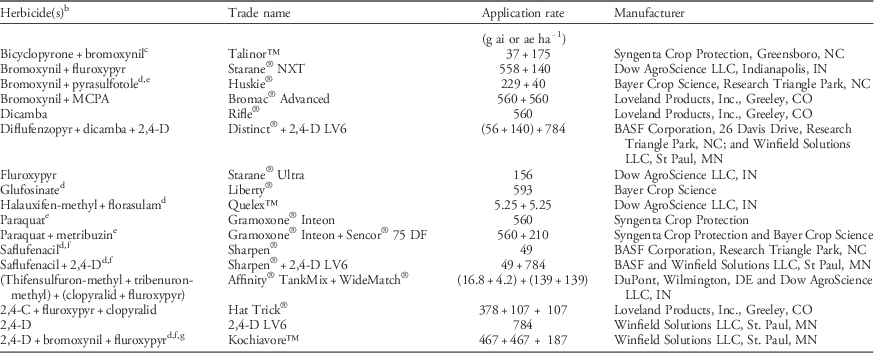
Greenhouse experiments were conducted at the MSU-SARC near Huntley, MT, to determine the effectiveness of different POST herbicides for controlling GR and GS horseweed accessions during the summer of 2016 and in the fall of 2016. Seeds of all three horseweed accessions (GR-MT, GR-NE, and GS-NE) were separately sown in germination flats containing the previously described commercial potting mixture. Horseweed seedlings at the 1– to 2–true leaf stage were individually transplanted into 10-cm-diameter plastic pots in the greenhouse under the previously described growing conditions. Horseweed seedlings (8- to 10-cm diameter) from all three accessions were treated with the recommended field use rates of POST herbicides (Table 1). Herbicide treatments were applied using the spray chamber as described previously. Experiments were set up in a randomized complete block design with five replications (1 plant pot−1). Visual assessment on injury rating (on a scale of 0% to 100%) and the aboveground shoot biomass per plant were recorded at 3 WAT. Data on aboveground shoot biomass were expressed as a percentage of biomass reduction relative to the nontreated control for each accession.
List of alternative POST herbicides for controlling glyphosate-resistant (GR-MT, GR-NE) and glyphosate-susceptible (GS-NE) horseweed accessions.Footnote a

a Abbreviations: GR-MT, glyphosate-resistant accession from McCone County, MT; GR-NE, glyphosate-resistant accession from Lincoln, NE; GS-NE, glyphosate-susceptible accession from Lincoln, NE.
b Herbicides are labeled in wheat, barley (Hordeum vulgare L.), or in chemical fallow. Herbicides were applied to horseweed plants at rosette stage (8- to 10-cm diameter).
c Crop oil concentrate at 1% (v/v) was included.
d Ammonium sulfate at 2 % (w/v) was included.
e Nonionic surfactant at 0.25% (v/v) was included.
f Methylated seed oil at 1% (v/v) was included.
g Activator 90 at 0.25% (v/v) was included.
Statistical Analyses
Data from all experiments were subjected to ANOVA using PROC MIXED in SAS v. 9.3 (SAS Institute, SAS Campus Drive, Cary, NC 27513) to test the main effects of experimental run, accession, treatment (glyphosate dose in the whole-plant dose response and whole-plant shikimic acid accumulation or time for shikimic acid accumulation or herbicide in the alternative POST herbicide study) and their interactions. Replication and interactions involving replication were random effects in the model. Residual analyses were performed on the injury rating and shoot dry weight reductions (percent of nontreated control) using PROC UNIVARIATE, and homogeneity of variance was checked, with all data meeting ANOVA assumptions. Comparisons for shikimate accumulation between horseweed accessions at different harvest times were made using Student’s t test. For alternative POST herbicides, means for injury rating and shoot dry weight reduction were separated using Fisher’s protected LSD test at P<0.05.
For whole-plant glyphosate dose–response assays, the shoot dry weight reductions (percent of nontreated control) for each horseweed accession were regressed over glyphosate doses using a three-parameter log-logistic model (Ritz et al. Reference Ritz, Baty, Streibig and Gerhard2015; Seefeldt et al. Reference Seefeldt, Jensen and Fuerst1995):
 $$Y{\equals} \left\{ {D\,/\,1 {\plus} {\rm exp} \left[ {B \left( {{\rm log} X{\minus} {\rm log }E} \right.} \right]} \right\}$$
where Y refers to the response variable (injury rating or shoot dry weight as percentage of nontreated), D is the upper limit, B is the slope of each curve, E is the glyphosate dose required to cause 50% response (i.e., 50% injury referred to as I50 or 50% reduction in shoot dry weight referred as GR50), and X is the glyphosate dose. It was evident from lack-of-fit tests (P>0.05) that the nonlinear regression models accurately described the injury (P=0.231) and shoot dry weight (P=0.421) data for each accession. Nonlinear regression parameter estimates, standard errors, I90 or GR90 (glyphosate dose needed for 90% injury or 90% reduction in shoot dry weight, respectively), and 95% confidence intervals (CI) for each accession were determined using the ‘drc’ package in R software (Knezevic et al. Reference Knezevic, Streibig and Ritz2007). Based on the I50 or GR50 values, the resistance index (referred to as the R/S ratio) for each GR horseweed accession was estimated by dividing the GR50 value of a GR accession by the GR50 value of the GS accession.
Results and Discussion
More than 90% of the plants from the GR-MT and GR-NE accessions survived the discriminate dose (870 g ae ha−1) of glyphosate, whereas none of the GS-NE plants survived this discriminate dose (unpublished data).
Whole-Plant Glyphosate Dose–Response
Early-Rosette Stage (5- to 8-cm diameter)
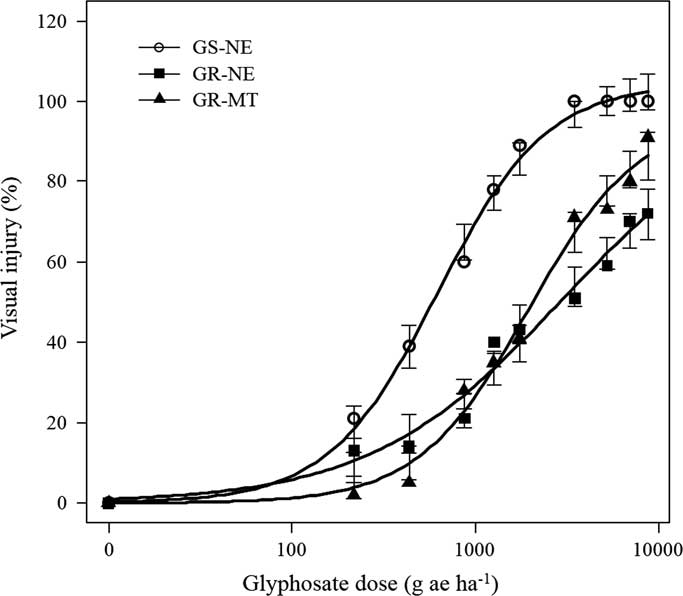
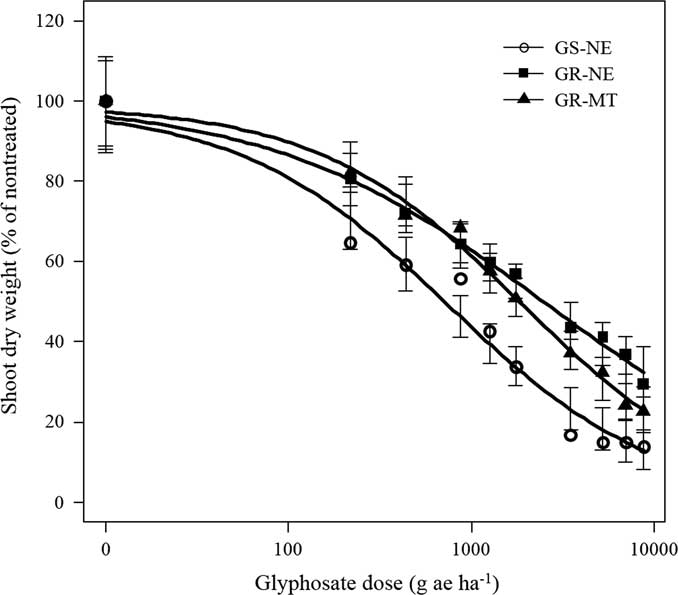
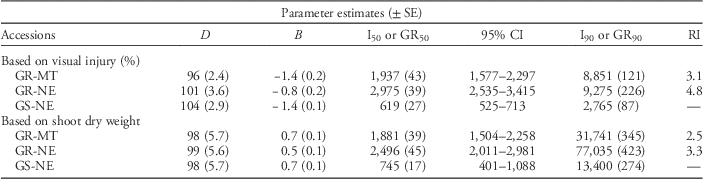
The interaction of experimental run with accession or glyphosate dose was not significant; hence, data were pooled over runs. A differential response of injury and aboveground shoot dry weight reduction (percent of nontreated control) to increasing doses of glyphosate was observed between the resistant (GR-MT and GR-NE) and susceptible (GS-NE) horseweed accessions (Figures 1 and 2). On the basis of visual assessment of injury rating, the I50 values for GR-MT and GR-NE accessions were 1,937 and 2,975 g ae ha−1, respectively, and were greater than the 619 g ae ha−1 for the GS-NE accession (Table 2; Figure 1). Based on these I50 values, the GR-MT and GR-NE accessions had 3.1- and 4.8-fold resistance to glyphosate, respectively. Furthermore, the I90 values indicated an almost three times higher dose of glyphosate was needed to achieve 90% injury of the two GR accessions relative to the GS accession.
Injury response of glyphosate-resistant (GR; GR-MT from McCone County, MT; GR-NE from Lincoln, NE) and glyphosate-susceptible (GS-NE from Lincoln, NE) horseweed accessions treated with increasing doses of glyphosate at the early-rosette stage (5- to 8-cm diameter) in whole-plant dose–response experiments averaged over runs. Symbols represent actual values, whereas lines represent predicted values. Vertical bars indicate ± standard error of the mean values.

Shoot dry weight response of glyphosate-resistant (GR; GR-MT from McCone County, MT; GR-NE from Lincoln, NE) and glyphosate-susceptible (GS-NE from Lincoln, NE) horseweed accessions treated with increasing doses of glyphosate at the early-rosette stage (5- to 8-cm diameter) in whole-plant dose–response experiments averaged over runs. Symbols represent actual values, whereas lines represent predicted values. Vertical bars indicate ± standard error of the mean values.

Regression parameter (Equation 1) estimates from the whole-plant dose–response study on the basis of visually assessed injury and shoot dry weight (percent of nontreated) of horseweed accessions treated with glyphosate at the early-rosette stage (5- to 8-cm diameter).Footnote a

a Abbreviations: GR-MT, glyphosate-resistant accession from McCone County, MT; GR-NE, glyphosate-resistant accession from Lincoln, NE; GS-NE, glyphosate-susceptible accession from Lincoln, NE; D, upper limit of the response; B, relative slope around I50 or GR50; I50 and GR50 are effective doses (g ae ha−1) of glyphosate causing 50% injury and reduction in shoot dry weights, respectively; I90 and GR90 are effective doses (g ae ha−1) of glyphosate required for 90% injury and shoot dry weight reduction, respectively; CI, confidence interval; RI, resistance index (calculated as a ratio of I50 or GR50 of a GR accession to I50 or GR50 of the GS accession).
On the basis of the shoot dry weight response, the GR50 values for GR-MT and GR-NE accessions were 1,881 and 2,496 g ae ha−1, respectively, and were marginally higher than the 745 g ae ha−1 rate for the GS-NE accession (Table 2; Figure 2). Based on these GR50 values, the GR-MT and GR-NE accessions exhibited 2.5- and 3.3-fold resistance to glyphosate, respectively. Similarly, Hanson et al. (Reference Hanson, Shrestha and Shaner2009) reported a horseweed accession from Central Valley, CA, with a 4.8-fold level of resistance. A GR horseweed accession from Delaware with higher levels of resistance to glyphosate (8- to 13-fold) has been reported (VanGessel et al. Reference VanGessel, Ayeni and Majek2001), and similarly, GR horseweed accessions collected from cotton and soybean fields in Mississippi had 8- to 12-fold levels of resistance to glyphosate (Koger et al. Reference Koger, Poston, Hayes and Montgomery2004). In our study, the GR90 values for GR-MT and GR-NE horseweed accessions were 2.3 and 5.7 times higher than the GS-NE accession, respectively, suggesting that glyphosate may no longer be an effective option for controlling these GR horseweed accessions.
Late-Rosette Stage (12- to 15-cm diameter)
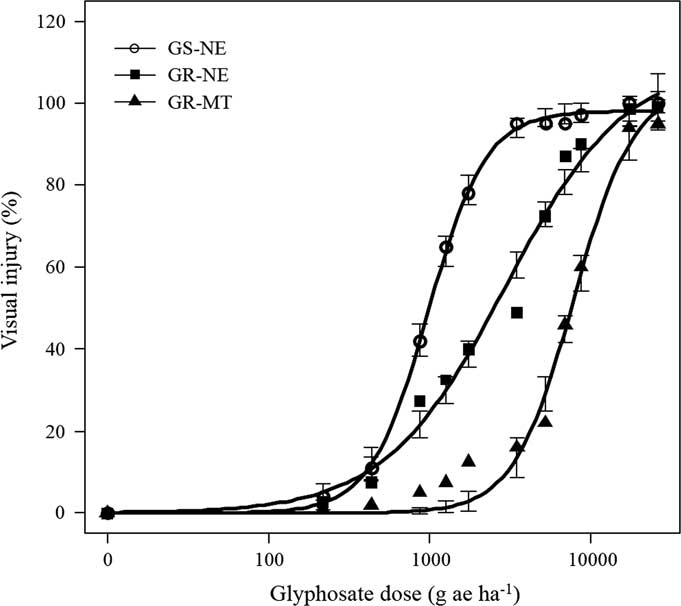
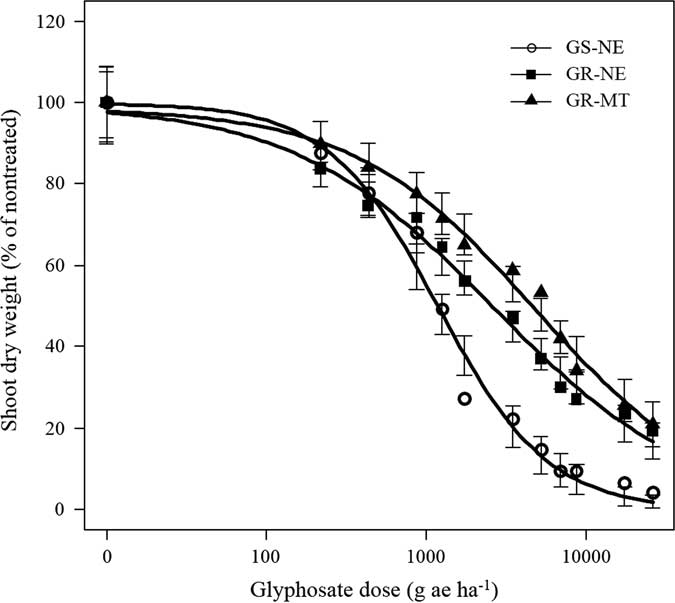
The interaction of experimental run with accession or glyphosate dose was not significant; hence, data were pooled over runs. On the basis of whole-plant glyphosate dose response, both GR horseweed accessions had 1.6 to 4.0 times higher I50 values compared with the I50 values at the early-rosette stage. The I50 values at the late-rosette stage were 7,799, 4,949, and 977 g ae ha−1 for the GR-MT, GR-NE, and GS-NE horseweed accessions, respectively (Table 3; Figure 3). Based on these I50 values, the GR-MT and GR-NE horseweed accessions had 7.9- and 5.0-fold resistance to glyphosate, respectively. Furthermore, the I50 values for the GR-MT and GR-NE accessions at the late-rosette stage were 8.9 and 5.6 times the field use rate (870 g ae ha−1) of glyphosate for this growth stage. Additionally, these GR accessions required a dose of glyphosate approximately six times greater to achieve 90% injury compared with the GS-NE accession.
Injury response of glyphosate-resistant (GR; GR-MT from McCone County, MT and GR-NE from Lincoln, NE) and glyphosate-susceptible (GS-NE from Nebraska, NE) horseweed accessions treated with increasing doses of glyphosate at the late-rosette stage (12- to 15-cm diameter) in whole-plant dose–response experiments averaged over runs. Symbols represent actual values, whereas lines represent predicted values. Vertical bars indicate ± standard error of the mean values.

Regression parameter (Equation 1) estimates from the whole-plant dose–response study on the basis of visually assessed injury and shoot dry weight (percent of nontreated) of horseweed accessions treated with glyphosate at the late-rosette stage (12- to 15-cm diameter).Footnote a

a Abbreviations: GR-MT, glyphosate-resistant accession from McCone County, MT; GR-NE, glyphosate-resistant accession from Lincoln, NE; GS-NE, glyphosate-susceptible accession from Lincoln, NE; D, upper limit of the response; B, relative slope around I50 or GR50; I50 and GR50 are effective doses (g ae ha−1) of glyphosate causing 50% injury and reduction in shoot dry weights, respectively; I90 and GR90 are effective doses (g ae ha−1) of glyphosate required for 90% injury and shoot dry weight reduction, respectively; CI, confidence interval; RI, resistance index (calculated as a ratio of I50 or GR50 of a GR accession to I50 or GR50 of the GS accession).
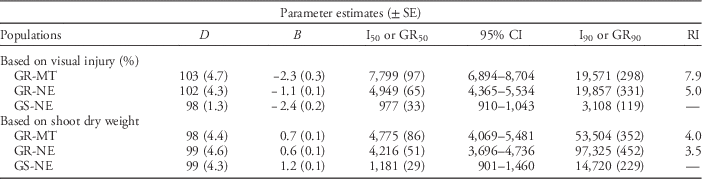
On the basis of shoot dry weight reduction (percentage of nontreated control), the GR-MT and GR-NE horseweed accessions had 4.0- and 3.5-fold levels of resistance to glyphosate, respectively (Table 3; Figure 4). The GR-MT and GR-NE horseweed accessions at the late-rosette stage exhibited GR50 values of 5.4 and 4.8 times the field use rate of glyphosate. In addition, the GR-MT and GR-NE accessions also showed higher GR90 values (3.6 to 6.6 times higher than the GS-NE accession) at the late-rosette stage compared with the early-rosette stage (Table 3). In contrast to our results, Koger et al. (Reference Koger, Poston, Hayes and Montgomery2004) reported no effect of plant size on glyphosate resistance levels in GR horseweed accessions from Mississippi.
Shoot dry weight response of glyphosate-resistant (GR; GR-MT from McCone County, MT; GR-NE from Lincoln, NE) and glyphosate-susceptible (GS-NE from Lincoln, NE) horseweed accessions treated with increasing doses of glyphosate at the late-rosette stage (12- to 15-cm diameter) in whole plant dose–response experiments averaged over runs. Symbols represent actual values, whereas lines represent predicted values. Vertical bars indicate±standard error of the mean values.

Whole-Plant Shikimate Accumulation
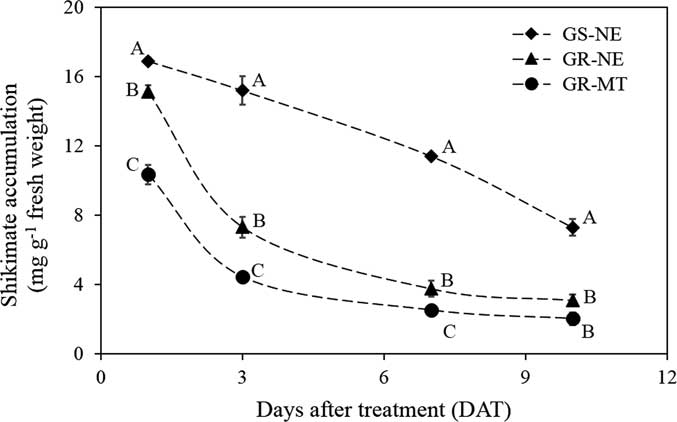
Data were combined over experimental runs because of a lack of significant interaction of run by accession. The main effects of horseweed accession (P=0.0056), harvest time (P<0.05), and the interaction of accession with harvest time (P<0.0031) were significant. The GS-NE accession accumulated higher shikimate than the GR-MT and GR-NE accessions at all harvest times (Figure 5). In general, a decrease in shikimate accumulation was observed in horseweed accessions from 1 through 10 d after glyphosate treatment. The GS-NE accession accumulated approximately 2.1, 3.1, and 2.4 times more shikimic acid than the GR-NE accession at 3, 7, and 10 d after glyphosate treatment. Similarly, the shikimate accumulation by GS-NE horseweed accession was 3.4, 4.5, and 3.6 times greater than the GR-MT accession at 3, 7, and 10 d after glyphosate treatment. Shikimate accumulations in GR horseweed accessions from Arkansas, Delaware, and Mississippi were 7.0-, 1.4-, and 4.0-fold lower, respectively, than the GS accession when treated with 5.3 mg ae L−1 of glyphosate solution in a leaf-disk assay (Koger et al. Reference Koger, Shaner, Henry, Nadler-Hassar, Thomas and Wilcut2005).
Shikimate accumulation of glyphosate-susceptible (GS-NE from Lincoln, NE; filled diamond) and glyphosate-resistant (GR-NE from Lincoln, NE: closed triangles; GR-MT from McCone County, MT: closed circles) horseweed accessions as affected by time averaged over runs. Vertical bars represent standard errors of the mean (n=10). Similar uppercase letters indicate no differences between accessions within a harvest time according to Fisher’s protected LSD test at P<0.05.

A lower level of shikimate accumulation has been observed in other GR weeds following glyphosate treatment. For instance, a GR rigid ryegrass (Lolium rigidum Gaudin) biotype from California accumulated 10-fold less shikimic acid than the susceptible biotype at 11 d after glyphosate treatment at 2.24 kg ha−1 (Simarmata et al. Reference Simarmata, Kaufmann and Penner2003). Another GR rigid ryegrass biotype with altered glyphosate translocation patterns accumulated two times less shikimate than a susceptible population at 4 DAT with glyphosate at 0.42 kg ha−1 (Perez-Jones et al. Reference Perez-Jones, Park, Polge, Colquhoun and Mallory-Smith2007). A GR goosegrass [Eleusine indica (L.) Gaertn.] biotype also accumulated approximately 2-fold less shikimic acid than the susceptible biotype at 2 d after glyphosate treatment (Tran et al. Reference Tran, Baerson, Brinker, Casagrande, Faletti, Feng, Nemeth, Reynolds, Rodriguez, Shaffer, Stalker, Taylor, Teng and Dill1999). In contrast, Mueller et al. (2013) reported no significant differences in shikimate accumulation among the GR and GS populations of horseweed at 2 and 4 d after glyphosate treatment. The differential shikimate accumulation between GR and GS accessions observed in our study can possibly be attributed to target-site mutations or altered translocation patterns, as previously reported in other GR weed species (Cross et al. Reference Cross, McCarty, Tharayil, McElroy, Chen, McCullough, Powell and Bridges2015; Perez-Jones et al. Reference Perez-Jones, Park, Polge, Colquhoun and Mallory-Smith2007; Simarmata et al. Reference Simarmata, Kaufmann and Penner2003; Wakelin and Preston Reference Wakelin and Preston2006).
Effectiveness of Alternative POST Herbicides
Visual Assessment of Percent Injury
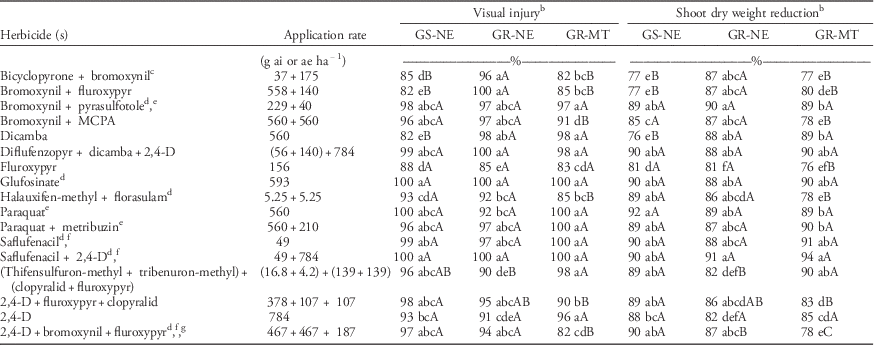
The interaction of experimental run by accession or herbicide treatment was not significant; hence, results were combined over two runs. The interaction of herbicide treatment by accession was significant (P<0.0001) on percent visual injury at 3 WAT, indicating a differential response of these accessions to the POST herbicides (labeled in wheat–fallow rotation) evaluated in this study. A majority of the alternate POST herbicide programs tested were effective on all three horseweed accessions. The premix of bromoxynil with pyrasulfotole or MCPA; diflufenzopyr + dicamba+2,4-D; glufosinate; paraquat alone or in combination with metribuzin; saflufenacil alone or in combination with 2,4-D; thifensulfuron+tribenuron in combination with clopyralid+fluroxypyr; and 2,4-D alone provided effective visual injury (≥90%) of all three horseweed accessions (Table 4). In another study conducted by Mellendorf et al. (Reference Mellendorf, Young, Matthews and Young2013), visual injury of GR horseweed plants with paraquat (840 g ai ha−1) and saflufenacil (25 g ai ha−1) was ≥90% at 2 WAT. Similarly, in a field study, the percent visual injury of GR horseweed with glufosinate at 580 g ai ha−1 was 95% at 2 WAT (Steckel et al. Reference Steckel, Craig and Hayes2006).
Visual injury estimates and shoot dry weight reduction (relative to nontreated control) of horseweed accessions at 3 wk after treatment with various POST herbicides.Footnote a

a Abbreviations: GR-MT, glyphosate-resistant (GR) accession from McCone County, MT; GR-NE, glyphosate-resistant accession from Lincoln, NE; GS-NE, glyphosate-susceptible accession from Lincoln, NE. Herbicides were applied to horseweed plants at the rosette stage (8- to 10-cm diameter).
b For visual injury or shoot dry weight reduction data, means for a horseweed accession within a column followed by similar lowercase letters are not different based on Fisher’s protected LSD test at P<0.05; means for an herbicide treatment within a row followed by similar uppercase letters are not different based on Fisher’s protected LSD test at P<0.05.
c Crop oil concentrate at 1% (v/v) was included.
d Ammonium sulfate at 2 % (w/v) was included.
e Nonionic surfactant at 0.25% (v/v) was included.
f Methylated seed oil at 1% (v/v) was included.
g Activator 90 at 0.25% (v/v) was included.
For the GS-NE horseweed accession, injury with halauxifen-methyl+florasulam and 2,4-D+bromoxynil+fluroxypyr was ≥93% at 3 WAT. In contrast, injury with bromoxynil+bicyclopyrone, bromoxynil+fluroxypyr, dicamba alone, and fluroxypyr alone ranged between 82 to 88% at 3 WAT (Table 4).
For the GR-NE accession, control with fluroxypyr, halauxifen+florasulam, and 2,4-D+bromoxynil+fluroxypyr was comparable to the GS-NE accession (Table 4). However, higher visual injury with bromoxynil+bicyclopyrone, bromoxynil+fluroxypyr, and dicamba was observed for the GR-NE (96% to 100%) than the GS-NE accession. In another study, injury of GR horseweed with dicamba at 140 and 280 g ae ha−1 was 93% and 98%, respectively, at 4 WAT (Everitt and Keeling Reference Everitt and Keeling2007). Kruger et al. (Reference Kruger, Davis, Weller and Johnson2010) also observed effective control (>97%) of GR horseweed with dicamba at 280 g ai ha−1.
For the GR-MT accession, injury with bromoxynil+bicyclopyrone, bromoxynil+fluroxypyr, and fluroxypyr alone was comparable to the GS-NE accession (Table 4). However, visual injury with halauxifen+florasulam (85%) and 2,4-D+bromoxynil+fluroxypyr (82%) was lower compared with the GS-NE and GR-NE accessions.
Shoot Dry Weight Reduction
The interaction of herbicide treatment by accession was significant (P<0.0001) for percent shoot dry weight reduction. In general, the response of all three horseweed accessions for shoot dry weight reduction was consistent with the percent control assessment for a majority of the POST herbicides tested. For example, bromoxynil in combination with pyrasulfotole or MCPA; diflufenzopyr+dicamba+2,4-D; glufosinate; paraquat alone or in combination with metribuzin; saflufenacil alone or in combination with 2,4-D; thifensulfuron+tribenuron in combination with clopyralid+fluroxypyr; and 2,4-D alone reduced shoot dry weight of all three horseweed accessions by 82% to 94% (Table 4). Bromoxynil in combination with bicyclopyrone or fluroxypyr provided 77% to 80% reduction in shoot dry weight of the GS-NE and GR-MT accessions compared with 87% reduction of the GR-NE accession. The shoot dry weight reductions of the GR-MT accession with fluroxypyr, halauxifen+florasulam, 2,4-D+fluroxypyr+clopyralid, and 2,4-D+bromoxynil+fluroxypyr were 76%, 78%, 83%, and 78%, and were lower than both the GS-NE and GR-NE accessions.
These results confirm the first report of GR horseweed in a no-till wheat–fallow system in Montana. Along with previous cases of GR kochia and Russian-thistle (Heap Reference Heap2017), the evolution of GR horseweed will be an additional challenge for Montana cereal producers. Importantly, an escalating spread of GR horseweed in the cereal fields of Montana can be expected because of horseweed’s prolific seed production and wind-mediated seed dispersal (Bhowmik and Bekech Reference Bhowmik and Bekech1993; Shields et al. Reference Shields, Dauer, VanGessel and Neumann2006), if not managed proactively.
Growers’ awareness and adoption of best management practices (Norsworthy et al. Reference Norsworthy, Ward, Shaw, Llewellyn, Nichols, Webster, Bradley, Frisvold, Powles, Burgos, Witt and Barrett2012) are critical to prevent further development of GR horseweed populations in this region. Growers should be proactive in managing the horseweed seedbank in wheat using crop competition and herbicide mixtures (multiple sites of action) investigated in this study, which needs to be validated under field conditions. All possible efforts should be made to prevent seed production by GR horseweed plants in the field. The ongoing work on the underlying mechanism of resistance in GR-MT, genetic inheritance, and the fitness cost (if any) associated with glyphosate resistance will determine the potential spread of GR alleles in horseweed populations in the U.S. Great Plains.
Acknowledgments
The authors greatly appreciate the valuable assistance provided by Leonard Schock (grower) from McCone County, MT, and the MSU extension agents in the seed collection of glyphosate-resistant horseweed. We also thank Anjani J., Charlemagne A. Lim, and Shane Leland for their technical assistance in conducting this research and the Montana Wheat and Barley Committee for funding this research.