Introduction
Since the creation of the National Health Service (NHS) in 1948, the health system in England has been highly socialized. Public sector funds currently account for around 85% of total healthcare expenditure (Hawe, Reference Hawe2008). NHS patients requiring hospital care were almost invariably treated in a public hospital – until recently.
In 2003, the Labour government signed the first contracts with private hospitals to provide care for NHS patients. Introduced in two phases, centrally contracted services have been negotiated on a provider-specific basis. However, the intention is that both public and private providers of care to NHS patients will be reimbursed on the same basis under prospective payment arrangements, with private providers forming an extended choice network (Department of Health, 2007b). This should ensure that choice is based on quality and not on price (Department of Health, 2007d).
The idea of using new or existing capacity in the private sector to treat publicly funded patients is not isolated to England. Similar initiatives have been recently implemented in Australia, Denmark, Ireland, New Zealand and Spain (Siciliani and Hurst, Reference Siciliani and Hurst2005). Such initiatives typically take the form of a public purchaser of health services contracting out to privately owned providers some volume of activity for publicly funded patients. Buying from the private sector may be a quick way to access additional capacity compared to, for example, constructing new public hospitals, and so enable national targets to be met. It may also provide a competitive spur to public hospitals, encouraging efficiency. In France, public providers in 2005 typically received a price that was 81% higher than the price paid to private providers (Aballea et al., Reference Aballea, Bras and Seydoux2006). It has been argued that the tariffs should converge by 2012, and differ only insofar as is necessary to reflect variations in underlying costs.
The English form of prospective payment is termed ‘Payment by Results’ (PbR) and has been introduced in a phased manner for public hospitals since 2003/4 with full implementation expected in 2008/9. Under PbR, hospital revenue is related to the number and type of patients treated with the price per patient fixed in advance and independently of the costs incurred by the individual hospital. In effect, this can be considered a form of ‘equal pay for equal work’.
However, PbR is not a ‘pure’ form of prospective payment. Public hospitals receive additional payments to account for geographical variations in the costs of land, buildings and staff through the so-called Market Forces Factor (MFF). Hospitals with a higher MFF score receive a higher tariff for every patient treated. The justification for the MFF is that public hospitals are not free to locate where they wish and, therefore, are constrained to pay local factor prices rather than relocating to areas with lower costs. MFF payments therefore seek to compensate for differences in the level of these unavoidable, or exogenous, factor prices. Failure to account for such constraints through the payment system would financially advantage hospitals in more favourable circumstances.
The entry of private providers to the NHS market raises the question of whether and how PbR arrangements should take account of any exogenous cost factors they might face. The government is committed to establishing a ‘fair playing field’ across the public and private sectors, which means that an objective of competitive neutrality – achieving a ‘level’ playing field – should be tempered by the requirement on the NHS to meet its social objectives, or ‘public service obligations’ (CBI and Serco Institute, 2006).
The objective of this article is to identify and assess exogenous cost differentials between public and private providers that could make prospective payment unfair, and to determine the best policy instrument to correct for such differences. Our approach is as follows. In Section 2, we provide a simplified version of the institutional set-up that includes a single regulator, a set of purchasing authorities, and a set of public and private providers. We describe three instruments available to influence provider behaviour, namely (i) PbR tariff adjustment, (ii) non-activity-related payments, and (iii) regulatory policies (including taxation). We then consider whether public and private providers face different types of exogenous cost constraints, which we classify under two broad categories: regulatory constraints (Section 3) and production-process constraints (Section 4). In Sections 3 and 4, we also assess which type of instrument is best applied to allow for these constraining factors and its suitability in a dynamic situation when the regulator might wish to encourage market entry. Section 5 discusses policy implications.
Institutional set-up
We consider a healthcare system in which there are three types of actor: a regulator (the government, or its representative the Department of Health (DH)), a set of public and private providers (NHS hospital trusts, Independent Sector Treatment Centres), and a set of regional authorities that purchase hospital services on behalf of their resident population (Primary Care Trusts). Patients play a passive role, with purchasing authorities acting as their (perfect) agents.
The regulator sets prices at national level, so that providers are paid a fixed price pj (a PbR tariff in England) per treatment of type j. The price pj is calculated every year as a function of average reported costs across all providers in the previous year. This payment system is also known as yardstick competition (Shleifer, Reference Shleifer1985). The attraction of this form of competition is that, given that price is fixed, providers will compete on quality rather than price. Moreover, this system, as opposed to previous remuneration systems based on fixed or quasi-fixed budgets, introduces an incentive to increase the volume of activity performed and encourages providers to reduce their treatment costs.
The regulator recognizes that providers face different exogenous constraints that impact on their costs of production. Failure of a fixed price regime to account for the exogenous cost differentials would result in some providers being financially advantaged at the expense of others (Shleifer, Reference Shleifer1985: 326). It will generate large profits for providers with low exogenous costs and losses for providers with high exogenous costs.
The regulator has three instruments available to adjust for such cost differences, namely (i) PbR tariff adjustment, (ii) non-activity-related payments, and (iii) regulatory policies.
The first possibility is for the regulator to pay a higher PbR tariff to providers with higher exogenous costs (similarly to what is currently done under MFF arrangements). The advantage of this approach is that if the exogenous cost varies with activity level, reimbursement will be proportionate. The drawback of adjusting the tariff is that it might undermine the integrity of the yardstick-competition regime. Instead of a national set of fixed prices, there is a risk that prices revert to being provider-specific. This is undesirable for two reasons. First, calculating the size of price adjustment is unlikely to be straightforward, particularly when the influence of exogenous cost factors is not directly proportional to activity (i.e. returns to scale are variable rather than constant). Second, more crucially, it may encourage purchasing authorities to purchase from providers that have lower adjusted prices, which is precisely what the fixed-price regime seeks to avoid.
Non-activity-related payments entail the regulator giving rebates or additional payments directly to providers to compensate for the influence of each specific unavoidable factor. In effect, providers face two revenue streams, with these payments from the regulator being separate to the payments by the purchasing authorities for the treatments provided to their population. This ensures that purchaser behaviour is not distorted by differential prices. Moreover, the basis for making non-activity-related payments can be factor-specific and transparent and can be adjusted periodically, as in Australia.Footnote 1 However, there are also drawbacks associated with non activity-related payments. First, estimating these payments may be costly and time consuming. Second, as payments are based on costs reported by providers, this may encourage providers to ‘game’ by exaggerating reported costs.
The third set of instruments available to the regulator encompasses policy, regulative or legislative mechanisms, including taxation. Such instruments are most appropriate when the cost differentials are themselves due to different regulatory regimes. We consider these in the next section, before turning to cost differentials that impact on the costs of the production process.
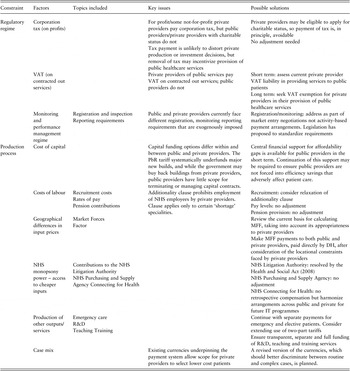
In the next sections, we consider the extent to which public and private providers face different exogenous constraints on their costs. We classify constraints under two categories: those related to the regulatory environment (Section 3); and those that impact on production-process costs (Section 4). An overview of findings is presented in Table 1.
Taxonomy of unavoidable factors potentially effecting cost differentials between public and private providers

Regulatory environment
In England, key regulatory factors that may affect the costs incurred by public and private healthcare providers include:
Corporation tax
Value Added Tax (VAT)
Monitoring and performance management regimes
Corporation tax
In contrast to public providers, for-profit and not-for profit private providers with corporate status are required to pay corporation tax on profits from services provided to NHS patients. In some situations, asymmetric tax rules between the public and private sectors could constitute a form of state aid equivalent to an indirect subsidy (Office of Fair Trading, 2004). However, asymmetry in the healthcare context does not map precisely on to the public/private divide. Many private providers are not-for-profit companies and, as such, are required to reinvest surpluses rather than distribute them to their shareholders. Not-for-profit companies may be eligible to apply for charitable status, which would mean that surpluses would not be subject to corporation tax. To be granted charitable status, an organization is required under the Charities Act (2006) to demonstrate that it has charitable purposes that are for the public benefit; guidance on what this involves for fee-charging organizations, such as healthcare providers, is expected later in 2008.Footnote 2 Some private not-for-profit healthcare providers already have charitable status: e.g., the London clinic,Footnote 3 a leading private hospital, receives an estimated £4 million in tax exemptions thanks to its charitable status.Footnote 4 This implies that corporation tax is not truly exogenous for the provider.
How does corporation tax influence behaviour? Corporation tax is levied as a proportion of profits, so if a firm’s objective is to maximize profit, then this tax will not distort decisions about how to organize production. However, it could impact investment decisions, because corporation tax lowers the returns to private investment, which may discourage investment in services for NHS patients. But this depends on the gains that could be made from alternative use of the investment funds. If this alternative is also subject to corporation tax, then current arrangements are non-distortionary. However, if private providers were exempt from paying corporation tax on their NHS activities, then this would increase the returns from NHS-related activities relative to alternative investment opportunities.
Corporation tax is therefore unlikely to distort either investment or production decisions, and private providers can avoid corporation tax by adopting charitable status. Although some private providers are liable for corporation tax, payment of this tax is not outside of the provider’s control and so does not constitute grounds for taking corrective action.
Value Added Tax (VAT)
In common with public providers, private providers in England do not pay VAT in the provision of clinical services to NHS patients. However, whereas public providers can claim back VAT on certain contracted-out services, such as catering, childcare, laundry, and purchasing and procurement services, private providers cannot (CBI and Serco Institute, 2006, PriceWaterhouseCoopers LLP, 2005b). This has led to charges of ‘major inconsistencies’, with private providers facing higher levels of irrecoverable VAT than public providers (PriceWaterhouseCoopers LLP, 2005a; CBI and Serco Institute, 2006).
Current government policy is that if irrecoverable VAT is incurred by the private sector in its provision of NHS services, then no government compensation will be forthcoming (Department of Health, 2006e).
The application of differential VAT rules means that public and private providers face an uneven playing field. The simplest way to achieve tax neutrality is by the harmonization of tax rules, providing VAT exemption for private providers in their provision of NHS services. This approach would level the playing field at the source of the problem, without introducing potential inefficiencies. This change would require approval from HM Treasury and is an option for the longer term. In the short term, non-activity-related payments could be made to compensate private providers for the differential VAT burden.
Monitoring and performance management regimes
It is argued that there are currently ‘major inconsistencies in the way in which government regulation … [applies] to public, private and voluntary providers’ (CBI and Serco Institute, 2006). The Confederation of British Industry (CBI) has advocated ‘regulation neutrality’, with public organizations subject to the same regulatory environment as their private sector competitors.
There are two key areas of difference in the monitoring and performance management regimes that public and private providers face:
Registration and inspection requirements
Reporting requirements
Registration and inspection requirements
Registration of providers acts as a barrier to entry to the healthcare market, and is justified on the grounds of informational asymmetry: patients cannot properly assess the quality of care so the government intervenes to ensure minimum standards are met.
Public and private providers face different market entry requirements, particularly in the area of licensing regulations (PriceWaterhouseCoopers LLP, 2005a). Private providers are required to register with the Healthcare Commission (HCC) and must pay registration fees (totalling around £4,000 for a private hospital) that public providers do not pay (Healthcare Commission, 2006).
Private providers are subject to ‘significant regulatory and contractual scrutiny’, and the nature of this scrutiny differs from that applied to public providers (Healthcare Commission, 2007). The NHS Partners Network estimates that annual inspections by regulatory bodies add about 2% to annual costs (Kendall and NHS Partners Network, Reference Kendall2007b). However, public providers also incur costs, of between £48,000 and £95,000 depending on hospital size, arising from their ‘annual health check’ undertaken by the Healthcare Commission (Department of Health, 2007c).
At present, there are insufficient data in the public domain to determine the magnitude and importance of any differences in exogenous costs faced by public and private providers. However, these exogenous costs reflect fixed costs of market entry and continued participation, and do not vary by level of activity. Therefore, any financial compensation should be through a premium for participation (i.e. a non-activity-related payment) rather than by a price adjustment (i.e. to the PbR tariff). As convergence of registration and inspection regimes is planned, this should ensure equal treatment of providers and so render financial compensation unnecessary (Department of Health, 2007c).
Reporting requirements
All providers of hospital care to NHS patients are contractually obliged to provide activity data on NHS patients for Hospital Episodes Statistics (HES). Private providers must invest in software, infrastructure, and staff training to provide this information, whereas public providers receive centrally funded information and technology (IT) support (PriceWaterhouseCoopers LLP, 2005a).
Although provision of HES data is costly for private providers, public providers also face high costs as a consequence of the requirement for accurate patient-level data under prospective payment arrangements. Studies estimate that the annual increased administrative burden of PbR is in the order of £100,000 per hospital, much of which is driven by higher costs of data collection (Audit Commission, 2005; Marini and Street, Reference Marini and Street2007). These costs are reflected in the PbR tariff, so private providers already receive some public funding to cover these costs. This suggests that any residual difference between public and private providers in the costs of providing HES data may be negligible.
Other regulatory bodies require data from private providers (Kendall and NHS Partners Network, Reference Kendall2007b). For instance, private providers are mandated to report information for the National Joint Registry data set on hip and knee replacements, and are charged to do so. In contrast, reporting is not mandatory for public providers and no charge is made (Healthcare Commission, 2007). For their part, public providers are mandated to make Reference Cost returns which are not currently required from private providers.
On balance, therefore, it is unclear that different reporting requirements systematically favour one group of providers over another. Rather than attempting to estimate and compensate for the cost of differential reporting requirements, arrangements could be standardized where appropriate. The Health and Social Care Act (2008), which legislates that the same requirements apply to all providers, should achieve this (Office of Public Sector Information, 2008). It is anticipated that the Act’s requirements will be fully implemented by April 2010.
Production process factors
There are a number of influences that have the potential to give rise to differences in the costs of producing health care between public and private providers. These include:
Costs of capital
Costs of labour
Geographical variation in input prices
Access to cheaper inputs
Provision of emergency care and other outputs
Case-mix
Costs of capital
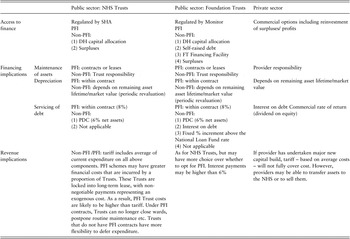
Several factors determine the costs of capital providers incur (Table 2). Among the public hospitals in the NHS, we distinguish between those who have Foundation status and those who do not. Compared to standard public hospitals, Foundation hospitals have more flexibility in decision-making, including greater discretion over investment.
The costs of capital: differences between and within types of provider

PBC: Prudential Borrowing Code; PDC: public dividend capital; PFI: Private Finance Initiative;
Sources: Monitor (2005), PriceWaterhouseCoopers LLP (2005b), Pollock et al. (2002), Gaffney et al. (1999)
Prior to the 1990s, capital – assets with a life of more than one year – was considered a ‘free good’ in the NHS, with new investment funded by government grants (Gaffney et al., Reference Gaffney, Pollock, Price and Shaoul1999). The 1990 NHS and Community Care Act changed the system to one of debt financing, requiring public hospitals to pay capital charges to the Treasury (HM Treasury, 2005; Pollock et al., Reference Pollock, Shaoul and Vickers2002). As new hospitals are likely to have above-average capital costs compared to older hospitals whose historic capital costs may be largely written off (Palmer, Reference Palmer2006), all public hospitals are subject to a five-yearly ‘revaluation’. This exercise aims to ensure the opportunity costs of capital are reflected in NHS accounts and to bring the NHS into line with commercial accounting practice. On average, capital charges comprise an estimated 6% of the value of a hospital’s net assets (Pollock et al., Reference Pollock, Shaoul and Vickers2002).
Since 1997, most new major capital investments for the NHS have been financed under the Private Finance Initiative (PFI). Ownership of the new asset is held by a private consortium, to which hospitals pay annual charges averaging between 8% and 11% of their income (Gaffney et al., Reference Gaffney, Pollock, Price and Shaoul1999; Shaoul et al., Reference Shaoul, Stafford and Stapleton2008; Pollock et al., Reference Pollock, Shaoul and Vickers2002). These payments cover the cost of leasing the new facilities and of procuring non-clinical services (Shaoul et al., Reference Shaoul, Stafford and Stapleton2008). PFI may give rise to budgetary inflexibilities as hospitals are ‘locked into’ long-term contracts which offer contractors little incentive for efficiency (National Audit Office, 2008; Shaoul et al., Reference Shaoul, Stafford and Stapleton2008).
As the PbR tariff is based on national average costs, it will only partially compensate hospitals for PFI payments because only a fraction of public providers incur PFI charges. Therefore, the tariff will systematically underfund providers who incur this type of capital cost. Whether providers can avoid these costs depends on the nature of their contracts. Private providers, who do not operate under public service obligations, may be able to transfer ownership of facilities such as newly built treatment centres to the NHS (Gainsbury, Reference Gainsbury2008). However, the scope for public hospitals to terminate PFI contracts is limited and may generate unavoidable affordability pressures (Pollock et al., Reference Pollock, Shaoul and Vickers2002). Although there is central financial support for the first few years of PFI operation (Department of Health, 2006d: §118), affordability pressures could prove unsustainable in the longer term. In consequence, the possibility of a systematic and critical difference between public and private providers with respect to the nature of these fixed costs cannot be ruled out.
As capital costs are fixed and do not vary with activity level, adjustments to the PbR tariff are inappropriate. Non-activity-related payments could be made to compensate providers for the shortfall between provider income and cost. One option would be to extend central financial support – currently offered on only a short-term basis – to address affordability gaps. This would need to be determined on a hospital-specific basis. In the long term, if hospitals can reduce their average costs by expanding activity, then long-term financial support could jeopardize these potential efficiency gains. To reduce this risk, the reimbursement system should encourage providers to consider the effect on future capital spending so that new building is configured to deliver care more efficiently (e.g. by providing more scope for day case activity).
However, if hospitals have limited scope for expanding activity, even in the long term, then, in the absence of central support, public providers operating under PbR will have to reduce exposure to capital repayments by identifying efficiency savings elsewhere. There is a risk that this could adversely affect patient care. Therefore, further careful investigation into possible solutions is warranted before firm policy decisions can be made.
Costs of labour
While labour costs might differ between public and private providers, these differences only constitute grounds for corrective action through the reimbursement system if the costs incurred are not within the provider’s control.
Public providers tend to abide by national terms and conditions and to enrol staff under the NHS pension scheme. Few have exploited the opportunity to introduce local arrangements, as the implementation of the new consultant contract exemplifies (National Audit Office, 2007). Staff employed directly by private providers are employed on terms decided by the employer (Barron et al., Reference Barron2006) (Ev 80) and there is ‘no requirement to impose obligations on the private sector to engage any medical workforce on identical terms to the NHS’ (Barron et al., Reference Barron2006)(Ev 106).
Hence, while rates of pay and pension arrangements differ, these are determined by the providers themselves – even if public providers choose not to exercise local flexibility. Any price adjustment through PbR could distort decisions about terms and conditions offered to prospective employees.
However, recruitment costs have differed between the public and private sector for reasons beyond the provider’s control. Contracts with the first phase of private providers included an ‘additionality’ constraint, which prohibited providers from employing anyone who had worked for the NHS in the past six months. This constraint was introduced to ‘conserve NHS clinical skills’ (Department of Health, 2006a) and restricted access to the full pool of labour, forcing private providers to rely on overseas clinicians (Barron and House of Commons Health Committee, Reference Barron, Hewitt, Carruthers, Taylor, Kirkup and Searle2006: 3). The additionality clause was relaxed in the second phase of contracts so that it applied only to a defined list of shortage professions with NHS consultants constrained to work for contracted private providers only during their ‘non-contracted’ hours (Barron and House of Commons Health Committee, Reference Barron, Hewitt, Carruthers, Taylor, Kirkup and Searle2006: §116).
In effect, this externally imposed constraint may result in differential costs for private and public providers, and can be considered anti-competitive. This constraint has since been relaxed; if the constraint were to be abolished, this would ensure a level playing field. However, abolition of the additionality clause may undermine public healthcare sector capacity to meet its social obligations, and this may justify retention of the clause in some form.
Geographical variation in input prices – market forces factor
In addition to activity-related payments, PbR allows the DH to make direct payments to all public providers to compensate for ‘unavoidable cost differences in delivering services in different parts of the country’ (Department of Health, 2006c: §3.59). As mentioned in the introduction, the MFF is designed to take account of local market conditions that may impact the price of factor inputs, notably labour. The fundamental reason that public hospitals in England are eligible for the MFF is that they cannot locate where they wish – public hospitals are charged with serving their local population. They cannot simply chose to relocate to another part of the country where the price of factor inputs might be lower. In effect, public hospitals face locational constraints that impact on their production costs and that are outside their control.
Private providers are also subject to locational constraints because new entry is based on a capacity mapping exercise that has established local need. This makes them eligible for MFF payments. However, whereas public providers are paid the MFF directly by the DH (Department of Health, 2007d), private providers invoice the local purchasing authority directly for tariff plus the relevant MFF adjustment (Department of Health, 2007a). This could disincentivize purchasers from commissioning private sector activity and encourage competition based on price (Kendall and NHS Partners Network, Reference Kendall2007a). The solution would be to apply the central payment mechanism to both private and public providers.
NHS monopsony power – access to cheaper inputs
Public providers benefit from being part of a large network of NHS providers. This benefit is realized through various forms of collective action, of most relevance here being the ability to act as a monopsony (single) purchaser of various inputs into the production process. A monopsony purchaser is able to negotiate lower prices from suppliers than would be obtained by purchasers negotiating on an individual basis. The principal areas of benefit are in the purchase of services from arm’s length bodies (Department of Health, 2004):
insurance against clinical negligence claims, through the NHS Litigation Authority
supplies through the NHS Purchasing and Supply Agency (PASA)
IT services through NHS Connecting for Health (CfH).
NHS Litigation Authority
Although the Clinical Negligence Scheme for Trusts (CNST) is voluntary, all public providers are members. The CNST, which covers medical malpractice claims, is considered to be less expensive and provide better coverage than clinical negligence insurance from the private sector.
At present private providers cannot join the scheme directly, but contributions relating to their care of NHS patients are normally made on their behalf by the relevant purchasing authority (PCTs) (Department of Health, 2005).Footnote 5 The contributions are funded by the DH to the purchasing authority through a ‘dual tariff’ arrangement (PriceWaterhouseCoopers LLP, 2005b). This means that private providers of NHS care effectively receive a ‘reverse subsidy’, as, unlike public hospitals, they do not pay contributions.
Provision has been made in the recent Health and Social Care Act to extend eligibility for CNST to include non-NHS providers of NHS care (Department of Health, 2007c). Once implemented, private providers can join the indemnity scheme and pay contributions directly. This ensures that the benefits of collective public healthcare sector action extend to private providers.
NHS Purchasing and Supply Agency (PASA)
NHS PASA handles the procurement of national contracts for a range of supplies and services to NHS bodies, including IT services and maintenance contracts, staffing and a range of medical and non-medical supplies. It is not apparent, however, that the ability to benefit from collective purchasing represents a competitive advantage that requires correction through payment arrangements. Indeed, private providers may benefit indirectly from the bargaining power exerted by the NHS, if this reduces prices for the health sector as whole, or devise their own strategies to secure lower prices. Nor are private providers precluded from joining forces to negotiate on a collective basis. As such, the existence of the NHS PASA does not provide grounds for making compensating payments to private providers.
Connecting for Health: IM&T
NHS Connecting for Health (CfH) was established in April 2005 as a single national IT provider for the NHS (NHS Connecting for Health, 2005). Although public providers are responsible for implementation costs, the DH has invested substantially in the programme, such as towards the costs of providing new computer systems for NHS organizations (National Audit Office, 2006). The magnitude of this subsidization is unknown because CfH does not systematically monitor local IT spending (House of Commons Committee of Public Accounts, 2007). In contrast, private providers of NHS services are ‘both required and authorized to link with core NHS CfH systems’Footnote 6 at their own expense (Department of Health and Central Clinical Procurement Programme team, 2007; Department of Health, 2006e). This includes cost of compliance with changes to NHS technical or data standards (Department of Health, 2006e).
To the extent that public providers have been subsidized, the CfH programme can be considered a form of ‘state aid’ that may not be competitively neutral (CBI and Serco Institute, 2006). That said, existing contracts between the DH and private providers mandate full integration with NHS IM&T systems (Department of Health and Central Clinical Procurement Programme team, 2007). Therefore, private providers have accepted the cost of this responsibility as a condition for market entry. These have been compensated partly through the participation premium paid to centrally procured private providers, suggesting that it is unnecessary to make an ongoing adjustment for differential costs of IM&T.
If future large-scale initiatives similar to CfH were to be initiated, competition law would require government to make the same service available to all providers, regardless of their ownership type.
Production of other outputs/services: emergency care, R&D, teaching and training
Emergency care
Private providers in England are not obliged to provide a full range of hospital services and, as result, may benefit from lower costs by specializing in a limited set of activities (Dranove, Reference Dranove1987). Most notably, private providers treat elective patients while public providers must also treat emergency patients. Emergency activity is largely outside the hospital’s control and is subject to a high degree of unpredictability on a daily basis. If bed occupancy rates exceed 85%, there is a substantial risk that there will be no available beds for patients requiring emergency admission (Bagust et al., Reference Bagust, Place and Posnett1999), which means that capacity needs to be kept on stand-by to meet this risk. Joint management of emergency and elective cases allows economies of scope to be exploited because there is a reduced requirement to hold stand-by capacity. In effect, the risk of non-availability of beds is transferred to elective patients, who may then remain on the waiting list for longer. However, the pressure to reduce waiting times has diminished the scope for public hospitals to employ this strategy.
There are three strategies to deal with the cost implications associated with caring for emergency patients.
First, price could be differentiated by setting. This option has been adopted in the US, where payments made for treatment conducted in Ambulatory Surgical Centers (ASCs) – which specialize in relatively few elective procedures – are substantially lower than those made for treatment in acute hospitals (Ellis and Vidal-Fernández, Reference Ellis and Vidal-Fernández2007). The problem is that this would undermine incentives to locate provision in the most cost-effective setting.
The second option is to pay a higher price for emergency activity, to reflect the high costs associated with holding ‘stand-by’ capacity. This is already a feature of PbR, where there is both an elective and emergency HRG tariff. Moreover, if costs of emergency care increase as a consequence of having to hold more stand-by capacity available this will be reflected in the Reference Costs and in the future price of the emergency HRG tariff. The price differential between elective and emergency tariffs may stimulate emergency admissions. In recognition of this, the Department of Health has instructed that the tariff be reduced by 50% once emergency admissions have exceeded a set threshold (Department of Health, 2006d).
The third option is to use ‘two-part tariffs’, consisting of a block payment plus a payment per unit of activity. Payments of this form have been devised to fund A&E (accident and emergency) departments (and minor injuries units) in England in recognition of their high fixed costs and volatile activity base. This funding arrangement is particularly suitable for services where capacity has to be held on stand-by to meet highly variable demand. In this context, two-part tariffs allow for better risk sharing between purchaser and provider. Arrangements for A&E departments are based on a 80:20 fixed:variable funding model, in which a grant covers 80% of (fixed) costs and 20% of revenue is related to (variable) activity up to a planned level (Department of Health, 2007d). (In actual fact, a ‘three-part tariff’ is being adopted because above the planned level, the A&E department is paid the full A&E tariff.) A challenge in implementing this type of arrangement lies in determining the size of grant which, as mentioned in Section 2, should not be based simply on each provider’s self-reporting of their fixed costs, as this could introduce perverse incentives.
R&D, teaching and training
Under PbR, the tariff reflects payment for the provision of care to particular types of patient. However, hospitals produce services in addition to their patient-related activities. The three main outputs are Research and Development (R&D), teaching (training for qualification), and training (continuing professional development).
Efforts have been made to encourage private providers to undertake more training for qualification, because the treatment centre setting offers useful training environments for junior doctors by providing experience of straightforward elective case-loads (Healthcare Commission, 2007; Department of Health, 2006b). Funding for private sector training is to come from the tariff, while public providers receive separate funding. There may be opportunities for private providers to access R&D funding. The nature of activity in private treatment centres, where case-mix and service scope are more limited than those of public hospitals, potentially also offers suitable settings for clinical research (e.g. trials of a new artificial hip joint or of a new cataract lens).
If R&D, teaching, and training are outputs that are intrinsically different to patient care, then one solution would be to make funding separate and transparent. Access to these funding streams could be extended to private providers. Of course, there may be cross-subsidization between patient-related activities and the provision of these other services. However, this is best dealt with by ensuring that R&D, teaching, and training is fully funded for both private and public providers and that spending is properly audited. Although this estimation process may be challenging, it should not be the role of the prospective payment regime to correct for inadequacies in funding arrangements for these other types of output.
Case mix
It is often argued that private providers face lower costs because the case-mix of the patients treated is characterized by patients with lower severity.
The tariff is based on currencies that describe patient care known as Healthcare Resource Groups (HRGs). Existing currencies (HRG version 3.5) may inadequately differentiate routine from complex cases (Department of Health, 2007d). Private providers can select lower cost patients by the systematic application of exclusion criteria. On the other hand, public sector organizations are obliged to treat all patients in a non-discriminatory manner. However, although it is conceivable that the tariff may overfund private sector organizations, the poor quality of data reporting has limited the scope for empirical testing (Healthcare Commission, 2007; Mason et al., Reference Mason, Miraldo, Siciliani, Sivey and Street2008).
As this potential cost differential is directly proportional to activity levels, adjustments to the tariff are an obvious solution. A revised set of currencies (HRG version 4), which aims to improve groupings and allow purchasers flexibility to unbundle payments for items such as high-cost drugs and diagnostics, is to be introduced in 2009/10 and it is hoped that this will resolve discrepancies (Department of Health, 2007d).
Conclusions
In England, unavoidable cost differences between public and private healthcare providers may arise from regulatory or production-process constraints. Three instruments are available to adjust for exogenous cost differentials and ensure the playing field is fair: PbR tariff adjustment, non-activity-related payments, and regulatory policies.
Some of the factors considered in this article, such as corporation tax, are avoidable and require no adjustment to be made. In others, such as provision of teaching or research, differences are best addressed by separate funding streams rather than by loading these costs on to a prospective payment system. Regulatory changes, such as the legislation embodied in the Health and Social Care Act (2008), will address some types of exogenous cost differentials, including those arising from different monitoring and reporting requirements and differential access to negligence schemes for providers. This instrument also appears to be appropriate for the long-term resolution of differences in VAT rules, payment of the MFF, and differential access to labour supply. Changes to the PbR tariff are warranted only where costs are directly related to activity levels; this is a potential solution for emergency care where a two-part tariff, consisting of a block payment plus a payment per unit of activity, can compensate providers for high fixed costs and a volatile activity base. Non-activity-related payments can be used in the short term for addressing issues such as VAT or as a premium for participation to encourage market entry.
Of all the factors that could result in an unfair playing field, capital costs are the most critical. First, there are significant differences between and within sectors in the burden these costs represent for providers. Second, the existing PbR tariff, which is based on average costs, recompenses providers for only a fraction of the capital costs incurred and therefore systematically underfunds providers who have undertaken major capital projects. Third, the UK government may ‘buy back’ unwanted premises from private providers once their contract expires. However, public providers are typically locked into long-term contracts that are almost impossible to terminate and that generate affordability pressures that may be unsustainable in the longer term. As these costs do not vary with activity level, adjustments to the PbR tariff are inappropriate. Non-activity-related payments could be made to compensate providers for the shortfall between provider income and cost, but the feasibility of this option is unclear and requires further investigation.
Acknowledgements
We would like to thank David Epstein for his help understanding the complexities of capital costs. The project was funded by the Department of Health in England as part of a programme of policy research. The views expressed are those of the authors and may not reflect those of the funder.