


Introduction
Two persistent issues in the Indian criminal justice system have been the overcrowding of prisons and the over-incarceration of pre-trial detainess, referred to as undertrials in India. Based on 2020 data, the latest Prison Statistics of India Report establishes that undertrials comprise 76% of the prison population.Footnote 1 The fact that our prisons are primarily populated with persons not convicted of an offence is cause for deep concern. While the problem of undertrial overrepresentation is widely acknowledged, with a range of influencing factors and possible solutions discussed;Footnote 2 in reality, we understand too little of the problem to be able to respond in any meaningful way.
The over-incarceration of undertrials is inextricably linked with the bail practices of trial courts that decide on the detention and release of accused persons before and during trial. As discussed in the next section, the present statutory law and judicial discourse provides little guidance on the process and approach for deciding such matters. Despite this reality, there have not been too many efforts to empirically research decision making in such matters and the impact of these decisions on the undertrial population in prisons, as will be seen in the ‘Context Setting’ section. Existing data cannot tell us if the incarceration of undertrials is largely due to the rejection of bail applications, the imposition of onerous conditions while allowing bail that the accused is unable to comply with, or undertrials just not applying for bail. Any meaningful effort to decongest prisons and reduce the proportion of undertrials in our prisons must answer these questions.
The present article is an attempt to address a small part of this large issue, with its primary focus on bail outcomes in Sessions Courts.Footnote 3 Based on an analysis of outcomes in bail applications, this article argues that trial courts conflate the trial and pre-trial process, importing concepts such as guilt into the pre-trial detention process instead of limiting the scope of inquiry to questions of risk. As explained in the ‘Methodology and Scope’ section, the team analysed ‘regular’ bail orders of Sessions Courts of Delhi available from the eCourts system between 2017 and 2019 for the offence of theft and rape, the most frequently occurring offences within cases under the Indian Penal Code 1860 (IPC), in their respective categories of seriousness. The analysis has limitations in light of its focus on Sessions Courts and in limiting its scope to judicial orders: it does not capture data from oral proceedings in court that are not recorded in the final order, and is not capable of informing us of prior efforts to secure bail in these cases. Despite these limitations, we argue that the study still offers valuable insights into the functioning of the pre-trial detention process that provide a roadmap for further research and reform. While the article does present data on the nature of conditions imposed by such courts, such an analysis remains incomplete without data from prisons on the release or continued detention of individuals whose applications were so allowed.
The findings of the empirical analysis presented in the penultimate section reveal that bail was allowed in 70% of theft cases and 54% of rape cases. A deeper analysis of the reasoning in such orders reveal serious concerns about the approach and processes followed in such matters. Among the dismissal orders, the presumed guilt of the accused and the alleged seriousness of the offence play an outsize role in such determinations. Furthermore, there is a stark absence of individualisation that is necessary for the risk assessment required in such proceedings, with judges and lawyers adopting pro forma arguments and reasoning across cases.
Ultimately, the problems in decision-making in such matters stem from a deeper failure to clearly establish the purposes of detention pending trial and to design processes and requirements that are suited for such purposes. Fundamentally, detention pending trial is a preventive action – it is intended to protect against the accused reoffending, absconding, or interfering with the judicial process. This preventive purpose renders it completely different from that of the trial process, necessitating a different framework in which the focus of the evidence should be on risk and not guilt. In addition, the seriousness of offence should not be an independent factor in determination of such matters. Instead, it should form the basis for differential standards of assessment based on risk, such that offences that carry a higher risk in terms of reoffending, absconding, or tampering may require a higher burden of proof before bail can be granted.
The data reveals a failure to develop and implement individualised and specialised processes for bail matters that comply with this preventive purpose of pre-trial detention. Such failure to design processes and guidance results in judges importing approaches and factors from the trial process that remain unjustified outside of the punitive detention process. In conclusion, we argue that a fundamental reimagination of the approach to bail is required – one that is clear about its purpose and then reimagines standards and processes in compliance with this purpose.
Legal Framework
Bail, while undefined in the Code of Criminal Procedure 1973 (CrPC), is generally understood as the security for the release of a person accused of a criminal offence to guarantee their attendance during the investigation or trial process.Footnote 4 The CrPC regulates the release of persons pending trial by providing the circumstances under which a person is entitled to release.
At the first level, all offences in the IPC and other penal legislations are divided into bailable and non-bailable offences.Footnote 5 In bailable offences, the accused is entitled to bail as a matter of right, while in non-bailable offences the grant of bail is discretionary.Footnote 6 In general, bailable offences are less serious offences, usually involving punishment of less than three years of imprisonment, although this rule is by no means absolute.Footnote 7
A range of circumstances and processes govern release on bail, with differing standards under special legislations and different processes for release on account of delays in investigation and trial.Footnote 8 However, the present article restricts its scope to release for non-bailable offences in the IPC in the form of regular bail (as opposed to anticipatory or default bail). Each aspect of bail law and practice in India raises complex issues that require independent consideration. Although the scope of the present article is limited, we still believe that our findings and arguments can inform discourse across the spectrum of issues on bail.
While the police can release individuals on bail, discourse generally has focused on judicial grant or denial of bail.Footnote 9 Persons in custody must regularly be presented before magistrates, once within twenty-four hours of the arrest and regularly every fifteen days to determine whether further custody is required, in either police or judicial custody, with limits on the period for which police custody can be granted.Footnote 10 A person can apply for bail during such ‘remand proceedings’ or in separate applications. They can apply multiple times, and if the application is rejected, they can then appeal to the appellate courts: the Sessions Court, the High Court, or even the Supreme Court.Footnote 11 In light of limitations in accessing data, as explained in the ‘Methodology and Scope’ section, the present article only considers applications to the Sessions Courts of Delhi.
The CrPC does not specify the grounds for the grant or rejection of bail in non-bailable offences, with much of the guidance on exercising this discretion provided by the Supreme Court. While considering applications for bail, the Supreme Court has repeatedly emphasised the importance of providing reasons for granting or rejecting bail, both to demonstrate that the decision involved application of mind and to allow the appellate court to evaluate the reasoning of the lower court's decision.Footnote 12
Although there is no constitutional right to bail, the Supreme Court has highlighted its links with rights under Article 21 of the Constitution of India, holding that the prolonged and arbitrary detention of individuals violates the right to speedy trial and access to justice.Footnote 13 Refusal of bail is a restriction of personal liberty protected under Article 21 and therefore can only be permitted if it is justified as a necessary infringement.Footnote 14 In addition, a fundamental value of the criminal process is the presumption of innocence, which the Supreme Court has recognised ought to restrict the detention of individuals not yet convicted of any offence.Footnote 15
In light of these protections, detention of individuals has been primarily permitted to prevent the ‘triple test’ of risks: the risk of reoffending, flight risk, and the risk of tampering with evidence and influencing witnesses.Footnote 16 However, while the Supreme Court has highlighted these three considerations, it has also consistently listed a range of additional factors to be examined in making such a determination, with particular emphasis on the seriousness of the alleged offence and the available evidence against the accused.Footnote 17
One such articulation of the relevant factors can be found in the Supreme Court's decision in Prasanta Kumar Sarkar v Ashis Chatterjee: ‘whether there is any prima facie or reasonable ground to believe that the accused had committed the offence; nature and gravity of the accusation; severity of the punishment in the event of conviction; danger of the accused absconding or fleeing, if released on bail; character, behaviour, means, position and standing of the accused; likelihood of the offence being repeated; reasonable apprehension of the witnesses being influenced; and danger of justice being thwarted by grant of bail.’Footnote 18 Other factors include the position of the accused with reference to the victim and the witnesses.Footnote 19
Among the factors listed, the Supreme Court has consistently emphasised the importance of considering the seriousness of offence accused of, as one of the ‘basic considerations in the grant and rejection of bail’.Footnote 20 The reasoning for this is that accused persons facing the likelihood of severe punishments are more likely to abscond or threaten the victims and their family in order to avoid the harsh punishment.Footnote 21 In addition, the Supreme Court has expressed the need to keep in mind the interests of the victim's family and community that lose faith in the justice process when such accused are released on bail.Footnote 22 Judges have also highlighted the necessity to consider the evidence against the accused, but advised the deciding court not to exhaustively evaluate the merits of the case, but instead limit itself to a prima facie evaluation of the case.Footnote 23
While discourse on concerns with administration of bail in the country has emphasised the adequacy of existing guidelines and the need for better implementation, we argue that fundamental inconsistencies and gaps in the guidance from the Supreme Court itself have contributed to problems in trial court decision-making.Footnote 24 One such issue is the lack of sufficient clarity from the Supreme Court on the relationship between the purposes of pre-trial detention and the factors, such as the nature of crime that it has deemed appropriate to consider while granting bail. For instance, the risk of reoffending is the purpose that detention is intended to protect against, while the criminal history of the accused might be a relevant factor in determining whether such a risk is present. But the Supreme Court lists risk of reoffending as a factor, without clarifying the manner in which such a risk might be demonstrated. By clarifying the purpose of detention, a clearer and more useful articulation of factors for such determination could be developed. The primary purpose of pre-trial detention ought to be to protect against the triple test of risk, that is, of reoffending, of absconding, or of tampering. While the 268th Law Commission of India Report on bail discusses the concept of risk assessment, it lists similar factors for such assessment as laid down by the Supreme Court without engagement on the relationship between the factors and the triple test.Footnote 25
Of particular interest here are questions concerning the gravity of the offence and considerations of guilt. As discussed above, the Supreme Court has declared both of these factors to be relevant considerations while deciding on bail applications. However, declaring these two factors to be relevant in and of themselves without connecting them to the purposes of pre-trial detention has resulted in widespread inconsistency and subjectivity on how these factors are accounted for in bail adjudication. We would argue that there needs to be significant clarity on how the guilt of the accused and seriousness of the offence translates into considerations under the triple test.
Guilt of the accused can only be established through the trial process, on the basis of evidence proved beyond reasonable doubt. It is unclear what purpose it serves in bail adjudication, as there is no evident link between guilt of the accused and the triple test. Even if, on the limited evidence available at the pre-trial stage, an accused appears to be guilty, if it is determined that there is no risk of the accused absconding, reoffending, or tampering, the accused ought to be released and only detained once the guilt has been established through the rigour of the trial process. Guilt and risk must be viewed independently of each other, and the court must abandon its focus on guilt during bail adjudication.
Similarly, by keeping the purposes of pre-trial detention at the heart of the judicial process, gravity of the offence can be made relevant in a manner that has consequences for the ‘triple test’ discussed above. The seriousness of the offence ought not to be an independent factor, but the requirements and thresholds of the ‘triple test’ can be shaped by issues of gravity of the offence. For instance, considerations of tampering with evidence/influencing witnesses might be very different in the context of theft on one hand and child rape on the other. The court might be fully justified in requiring a higher standard to be convinced that there is no threat of tampering with the evidence/influencing the witnesses in the context of child rape than theft. In that sense, the nature and gravity of the offence can have a bearing on the burden that the accused has to bear in convincing the court that the concerns of the ‘triple test’ will not play out if released on bail.Footnote 26
The lack of clarity on the purposes of detention and the factors to be considered for pre-trial detention has additionally led to a failure to establish specific guidance that would assist in making the determination of whether bail should be granted. The court has not provided instructions on the nature of evidence that can be considered, or the standard of proof required to establish that there is sufficient risk that justifies detention of an individual. In fact, the little guidance provided thus far has been contradictory. A few early cases advised a preference in favour of grant of bail, with Justice Krisha Iyer famously stating ‘bail not jail’Footnote 27 and generally advising discretion in favour of granting bail, unless exceptional circumstances require otherwise.Footnote 28 Subsequent cases, however, have repeatedly stated that ‘discretion in grant of bail [is] to be exercised in a judicious manner and not as a matter of course’, a starkly contradictory approach.Footnote 29
The absence of specific guidance from the Supreme Court on the approach and process for deciding such applications has influenced the problematic outcomes visible in the decisions analysed in the present article, as discussed subsequently. The lack of guidance on processes specific to bail adjudication has resulted in trial courts importing factors from the trial process in bail adjudication, with an inordinate focus on guilt of the accused and gravity of offence in bail adjudication and the triple test rarely figuring in the orders. The lack of clarity on standards has resulted in an implicit preference for detention at least until the investigation is complete. Fundamentally, the Supreme Court has failed to provide guidance on the process for determination of risk in bail matters, which has resulted in a complete lack of individualised assessment of such risk in cases.
Context Setting
The over-incarceration of undertrials and the problems with the law regulating bail in India have been the subject of multiple studies and reform efforts.Footnote 30 Discourse on the issue has identified a range of influencing factors and systemic problems that have contributed to the state of current prisons.Footnote 31 While the role of the current law and practice of bail in India has been recognised, empirical research on the issue has been insufficient to identify the precise nature of the problem. The focus has largely been on prisons as a site of research and intervention, with comparatively less attention on the influence of trial court decision-making.Footnote 32
The Prison Statistics of India reports released by the National Crime Records Bureau (NCRB) have consistently shown that undertrials constitute the majority of inmates in prisons.Footnote 33 Academic engagement on the issue has generally relied on these NCRB statistics to critique the overrepresentation of undertrials in the prison population, highlighting the fundamental concern of imprisoning individuals not convicted of any offence and the harms of detention on such individuals.Footnote 34 While there has been acknowledgement of the influence of the law and practice of arrests and bail in such over-representation, there has been little effort to empirically assess the impact of trial court practices.Footnote 35 Empirical research by civil society has generally focused on release of undertrials from prisons such as through the Undertrial Review Committees and Periodic Review Committees.Footnote 36 Similarly, a range of Law Commission of India reports have been published that engage with the issues of undertrial detention and bail, but these have generally focused on data from prisons or a doctrinal analysis of the law and have not considered evidence of trial court practices.Footnote 37
The disproportionate focus on prisons has resulted in a failure to identify the key contributors to the large undertrial population: is it due to excessive criminalisation of particular populations, indiscriminate arrests failing to comply with the law, bail applications being rejected, or the imposition of onerous conditions that a majority socio-economically vulnerable population cannot comply with?Footnote 38 While there has been extensive discourse on the problems with a monetary bail system in government reports, academic literature, and Supreme Court judgments, the reality is that there is no evidence of the extent of the contribution of this compliance failure to the incarceration of undertrials.Footnote 39 Before the ‘undertrial problem’ can be addressed, it is essential that the precise contribution of various factors be identified, which could then be remedied accordingly. A component of this process has to be evaluating the decisions of trial courts on bail and the corresponding detention or release of undertrials per prison records towards identifying the source of the problem and ultimately developing effective reforms.
An exception to this focus on prisons was the empirical study of trial court decision making undertaken by the Centre for Law and Policy Research (CLPR) in 2020.Footnote 40 The study involved a combination of court observations and analyses of court records in three districts of Karnataka to assess the outcomes in first productions before magistrates in terms of release on bail or the nature of custody imposed (ie, police versus judicial). The study found that effective legal representation (defined as filing an application for bail) and the nature of the offence strongly influenced the nature of outcomes. In addition, analysis of court records revealed that bail is more likely to be granted later in the case, usually fifteen days after arrest.
This article studies the outcomes of bail applications before the Sessions Courts of Delhi to assess the extent of trial courts’ rejection of bail and conducts an in-depth analysis of the processes and reasonings in such matters to identify areas of intervention and reform. This study explores the factors that primarily influence the outcome of the case, and the evidence (or lack thereof) considered in such proceedings. While the study has limitations, it serves as the first in-depth analysis of reasoning by trial court judges in bail decisions towards instituting more effective reform at the site of decision-making on detention of undertrials.
Methodology and Scope
In light of the ease of access, the study relied on the eCourts system to compile bail orders and focused on the state of Delhi due to the advanced level of digitisation of trial court matters in the state.Footnote 41 The eCourts system records bail applications to Sessions Courts as a separate case type (unlike applications to magistrates, which were far more difficult to access separately), that is, ‘Bail Matters’ for the state of Delhi. The study relied on ‘data scraping’ to collate information from the case status pages and copies of all orders of all Bail Matters cases in the state of Delhi between 2017 and 2019.
The scraping process resulted in the extraction of data of 94,342 cases. From these, 26,142 (27.71% of the total cases) had no orders available online and were thus excluded. As the study was focused on decision-making in regular bail cases, 29,534 cases were excluded on the basis of case types and outcomes, including orders in matters of anticipatory bail or cancellation of bail and any form of disposal of a matter other than being allowed or dismissed, such as applications that were dismissed as withdrawn. The largest proportion of such cases were anticipatory bail cases, totalling 24,963 (26.46% of the total cases). This process of filtering ultimately resulted in a dataset of 38,666 cases.
Due to the high volume of cases, the team adopted a second level of filtering on the basis of the nature of offence. It is worth mentioning that this exercise required separately extracting information on the offence from the final bail order, since the eCourts’ ‘case status’ page largely fails to accurately record the various offences arrested or charged under.Footnote 42 The team then adopted a two-pronged classification approach. The first step was to identify whether the case was bailable and non-bailable, wherein the inclusion of any non-bailable section resulted in the case being classified as a non-bailable case. The team restricted its analysis to IPC and non-bailable cases, excluding cases that included an offence under a special legislation or that involved only bailable offences.Footnote 43
The second category was that of seriousness, determined based on the highest punishment possible for the accused across the different sections arrested under or charged with. This means that if the accused was charged under section 376 of the IPC (which carries the maximum punishment of life imprisonment), as well as section 379 of the IPC (which carries the maximum punishment of three years), then the case would be classified as one of life imprisonment since that is the maximum punishment possible for that accused if convicted of all sections arrested for or charged under. The cases were then accordingly classified into the following categories:
• below three years,
• three to six years,
• seven years and above, below life,
• life imprisonment, and
• death penalty.
On an analysis of the data, the team chose specific offences for analysis that had the highest frequency in particular seriousness categories: 379 IPC (theft) as the most frequent in the ‘three to six years’ category and 376 IPC (rape) as the most frequent in the ‘life imprisonment’ category.Footnote 44 This means that amongst cases in which the maximum punishment possible was six years, the section that appeared most frequently was 379 IPC. We chose this sample of cases to ensure representation of two varied offences in order to contrast the responses by judges to different offences as well as to capture the broad spectrum of responses by judges across all orders within each offence.
The study is limited by its focus on judicial orders, and thus unable to account for the oral arguments and evidence that may be presented in court and not recorded in the final order. In addition, by sourcing data from the eCourts system, the analysis excludes a large number of cases for which orders were unavailable online. The data also did not capture prior efforts to secure bail in these cases. Furthermore, the study is restricted by its focus on two offences, which became necessary due to the infeasible size of the larger dataset under consideration. Finally, it is worth mentioning that while data is available on the nature of conditions imposed when bail is allowed, without access to corresponding information on release from prisons, the study is limited in its capacity to comment on the issue of onerous bail conditions.
However, since the study analysed all available bail orders under both offences across Delhi in the specified time period, it presents a comprehensive overview of the processes and approach to such proceedings across judges and across two distinct and varied offences. While further research may be necessary that overcomes these specific limitations, the extensive analysis of these orders provides valuable insights into the broader approach to such proceedings in a manner that can inform such future research and the imagination of systemic reform.
The following section documents the findings of the quantitative and qualitative analysis of bail orders and its implications for bail reform in India. This article primarily analyses the nature of arguments raised by the defence and prosecution as well as the reasoning adopted by judges on three issues: the focus on guilt of the accused as opposed to risk under the triple test, the lack of individualised evidence and determination in such orders, and the lack of standards and processes governing bail adjudication that allows for inconsistent and problematic decision-making by trial court judges.
Critical Analysis
At the outset, it is important to recognise the unique nature of the decision to detain or release someone pending trial. It must necessarily be seen as distinct from punitive detention, which is imposed as punishment for the commission of an offence only when the person has been found guilty beyond reasonable doubt, based on admissible evidence. An undertrial remains innocent of the offence accused of/charged with and therefore cannot not be detained punitively. This protection is located in the presumption of innocence, which requires the system to presume that a person is innocent until proven guilty and also protects them from the consequences that follow a conviction of an offence, unless extraordinary circumstances dictate otherwise.Footnote 45 Detention pending trial can only be justified if it is imposed in order to prevent a harm that specifically outweighs the right to liberty and presumption of innocence of an individual: to prevent absconding, reoffending, and tampering of evidence (the ‘triple test’).Footnote 46
While these purposes are well-recognised, their implications for the processes and restrictions that ought to then be incorporated in making such determinations are less clear. Unlike a trial, which is focused on the establishment of guilt of the crime accused of, pre-trial detention proceedings function as a determination of risk of harm. Making this determination requires a specialised process to identify specific and individualised evidence of the risk of the accused inflicting any one or more of the harms that the detention is intended to protect against. Guilt is not relevant to the determination since this is not about punishment for an offence committed. Instead, it requires specific evidence that there is significant risk that the individual will inflict harm on the trial process that justifies their detention.
The data of bail orders from the Sessions Courts of Delhi reveals a conflation between punitive and pre-trial detention, which is fundamentally preventive, with the courts importing factors from the trial process such as guilt and seriousness of offence into the pre-trial detention process. There is also a complete lack of individualisation of the process, with pro forma arguments and reasoning dominating the orders. Finally, there is a lack of standards or processes that govern these proceedings – a result of failure of guidance from the Supreme Court that requires urgent redress.
Overview of the Dataset
The study analysed data from 1,893 theft cases and 1,243 rape cases, documenting the outcome of each case, the arguments of the prosecution and defence, and the reasoning of the judge.Footnote 47 Although the orders did not discuss the facts of the cases in much detail, the cases cover a range of different offences, with theft of mobile phones and vehicles constituting the majority of theft cases, at 38.50% and 26.51% respectively. Among rape cases where such information was available, 41.94% cases comprised ‘false promise to marry’ cases that allegedly involved consensual relations between the accused and the complainant on the promise of marriage, which the accused did not ultimately comply with. Outside of this category, acquaintance rape constituted a high proportion of rape cases at 28.82%, which includes rape by accused previously known to the complainant such as tenants, landlords, neighbours, etc (see Appendix 2). It is worth mentioning that this dataset is not representative of cases being prosecuted generally, but is a limited representation (due to low availability of information in orders) of cases in which bail was sought before the Sessions Court.Footnote 48
The data also revealed that such matters are generally disposed of quickly. A majority of applications were listed the day after being filed and disposed of on the same day of being listed, with 65.40% of theft cases and 55.99% of rape cases disposed of on the same day of being listed. There were a few concerning instances of such matters taking more than thirty days for disposal despite the general urgency of such matters, constituting less than 1% of theft cases and 2.41% of rape cases. 63.38% of applicants from theft cases and 53.3% of applicants from rape cases were in custody for a period between sixteen and sixty days before their matter was decided (see Appendix 1).Footnote 49
As can be seen from Tables 1 and 2 below, a majority of both theft and rape applications for bail were allowed by Sessions Courts, with the court granting bail to the accused to be released from detention (subject to conditions) in 69.62% of theft cases and 54.38% of rape cases.
Outcome of Bail Applications for Theft Cases

Outcome of Bail Applications for Rape Cases

While a much higher proportion of bail applications for theft cases were allowed, the proportion of bail applications for rape cases that were allowed was surprising given the courts’ emphasis on not granting bail in ‘serious offences’ (as discussed in the ‘Legal Framework’ section). Even section 437 of the CrPC bars release by magistrates for such crimes, requiring that no person shall be released ‘if there appear reasonable grounds for believing that he has been guilty of an offence punishable with death or imprisonment for life’.Footnote 50
Although the Sessions Courts retain the power to release the accused on bail in such cases, a majority of the rape cases (65.48%) in the dataset that were granted bail appeared to follow the guidance under section 437 of the CrPC by releasing the accused on the basis of evidence of the accused's innocence (see Table 6). However, an analysis of the orders revealed the problematic reasoning on which such decisions are based. The defence and many of the judges that allowed bail to be granted in such cases would rely on problematic grounds such as the character of the complainant or delays in registering the complaint after the incident. These are concerning as they blame the complainant, stating that such an educated woman ‘should have known better’ rather than recognising the accused's fault in the act, or fail to recognise that there may be many reasons for a delay in registering the complaint, which is not indicative of the complaint being false.Footnote 51
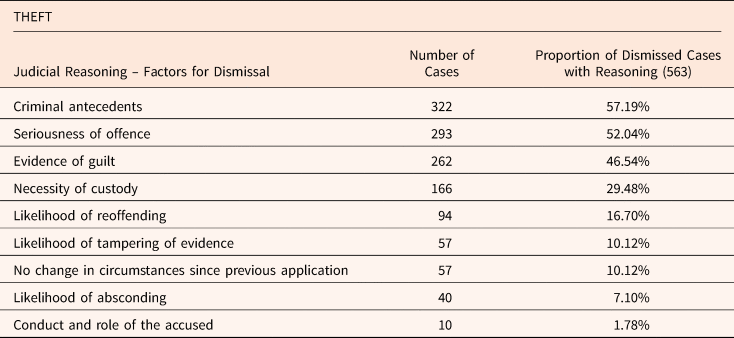
There were 563 theft cases in which the application was dismissed, and the judges provided some reasoning for their decisions. Similarly, there were 561 of such rape cases where the case was dismissed with some reasoning provided. It is important to note that each factor in Tables 3 to 6 was counted independently in each order – this means that an order dismissing the application for bail may rely on both criminal antecedents of the accused and seriousness of the offence, each of which is counted once. The factors discussed below therefore overlap across bail orders, but the proportion of each factor across total orders is presented to provide some perspective of its relevant prevalence.
Theft Judicial Reasoning – Factors for Dismissal
There were 1,171 theft cases in which the application was allowed, and the judges provided some reasoning for their decisions. Similarly, there were 588 of such rape cases where applications were allowed with some reasoning provided.
A deeper analysis of the prosecution and defence arguments as well as judicial reasoning reveals fundamental problems plaguing the determination of bail matters before the Sessions Courts of Delhi. This will be examined below.
Guilt versus Risk
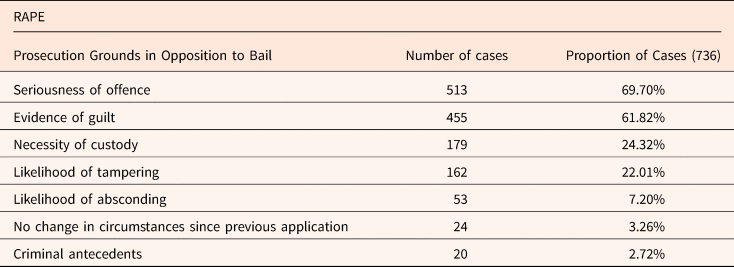
In essence, the data reveal a conflation between punitive and pre-trial detention, which should be preventive in scope. Trial courts fail to separate the pre-trial detention process from the trial process and therefore end up engaging only with aspects of the trial itself. In opposing bail, prosecutors usually simply recount the evidence against the accused, making such arguments in 52.26% of theft cases and 61.82% of rape cases. Otherwise, they would highlight the seriousness of the offence accused of, as they did in 36.53% of theft cases and 69.70% of rape cases (see Appendix 3). Similarly, the defence will generally argue that the accused is innocent and has been falsely implicated; this was done in 80.75% of theft cases and 93.04% of rape cases (see Appendix 4).
This focus on guilt and the seriousness of the offence also played an outsized role in judicial reasoning in such matters. Among bail applications that were dismissed, evidence of guilt was a ground relied on by judges in 46.54% of theft orders and 57.75% of rape orders, while seriousness of the offence played a role in 52.04% of theft cases and 80.04% of rape cases. Similarly, evidence of innocence of the accused was a ground in 65.48% of rape cases in which the application for bail was granted (see Tables 3 and 4).
Rape Judicial Reasoning – Factors for Dismissal
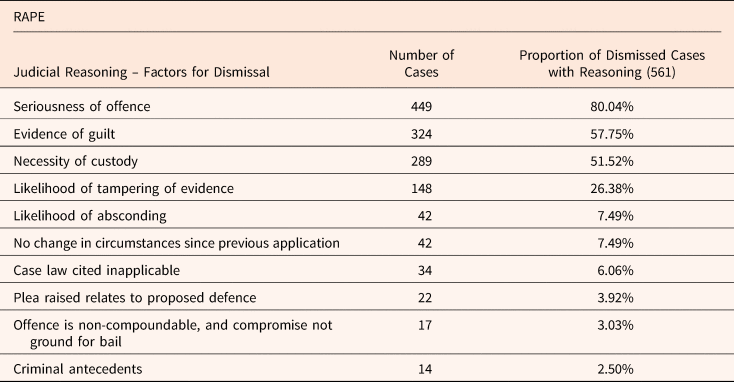
The triple test rarely featured in the orders, whether in arguments from counsels or in the reasoning of the judge. The likelihood of absconding, tampering, or reoffending was argued by the prosecution in 11.49%, 10.64%, and 8.38% of theft cases respectively, while the likelihood of tampering and absconding was argued by the prosecution in 22.01% and 7.20% of rape cases respectively (see Appendix 3). The defence argued that the accused would not abscond, misuse liberty, or tamper with evidence in only 6.46% of theft cases and 5.54% of rape cases (see Appendix 4). Among orders where the application for bail was dismissed, the judges highlighted the likelihood of reoffending, tampering, absconding in 16.70%, 10.12% and 7.10% of theft orders respectively and the likelihood of tampering and absconding in 26.38% and 7.49% of rape orders respectively (see Tables 3 and 4). Conversely, the ground that the accused would not abscond, misuse liberty, or tamper with evidence was mentioned in only 0.94% of theft orders and 3.91% of rape orders in which bail was granted (see Tables 5 and 6).
Theft Judicial Reasoning – Factors for Allowing

Rape Judicial Reasoning – Factors for Allowing

The focus on guilt and seriousness arises from the Supreme Court guidance itself, which problematically lists them as independent factors for consideration in such matters. As discussed in the ‘Legal Framework’ section above, guilt ought to play no role in adjudication in the pre-trial stage as it is independent of the purpose of pre-trial detention, that is, risk in terms of the triple test. Furthermore, seriousness of offence should not be an independent factor in such determinations but can be relied on in terms of its links with the risks that pre-trial detention is intended to protect against. If a particular offence carries a higher likelihood of risk, the court may place a higher burden to establish the lack of risk before bail is granted. However, reliance on the gravity of offence as an independent factor is a problematic importation of aspects of trial into the pre-trial process.
This shows a failure to recognise the unique nature of proceedings that pre-trial detention represents, and a reliance on familiar processes from trial instead of developing specialised processes required for the determination of risk of harm. Such processes must necessarily be individualised and must also require their own standards of establishing such risk. However, the current practice is far removed from compliance with such individualised processes.
Lack of Individualisation
The decision-making process in bail cases ought to be individualised. It requires a determination that the specific accused is at risk to abscond, reoffend, or tamper. In addition, the imposition of conditions when bail is allowed requires individualisation as it presumes that a certain condition, generally financial, will deter the accused from absconding or from otherwise harming the trial process. This requires evidence distinct from the trial process, unrelated to the offence, but specific to the individual in addition to evidence of the likelihood of the risk they pose.
However, with current practice simply importing the trial process to such determinations, there is little to no effort by trial courts to individualise the process. The prosecution routinely opposes bail based on pro forma arguments of evidence of guilt against the accused, opposing bail in 96.81% of theft cases and 96.59% of rape cases in which the submissions of the prosecution were recorded (see Appendix 3). Similarly, the defence presents near identical arguments of innocence of the accused, together with a statement of the period the accused spent in custody (see Appendix 4). The matters are disposed of quickly by the judge based on a few common grounds that are repeated across cases, such as on evidence of guilt or innocence, seriousness of the offence, criminal antecedents against the accused, period undergone in custody, and the necessity of custody of the accused (see Tables 5 and 6).
A ground that appeared frequently in arguments and the reasoning of the judge is the necessity of the custody of the accused, which was relied on without any individualisation specific to the accused. In 13.65% of theft cases and 24.32% of rape cases, the prosecution claimed that the custody of the accused is required as the investigation remains incomplete, or recovery has not yet been undertaken (see Appendix 3). Conversely, the defence would argue that custody is not required anymore as the investigation or recovery is complete or the chargesheet has been filed; with these claims forming 57.53% of theft cases and 33.37% of rape cases (see Appendix 4). Among cases where bail was granted, the courts invoked such practical considerations of custody not being required in 71.56% of theft cases and 43.88% of rape cases (see Tables 3 and 4). While dismissing bail applications, the necessity of custody of accused played a role in judicial reasoning in 29.48% of theft cases and 52.52% of rape cases (see Tables 5 and 6). The concern with such reasoning is the implicit presumption that custody is required for all individuals during the investigation process, with no specific engagement of the court on how such custody is essential for that particular accused in that particular offence or why such requirements could not be met without placing the accused in custody. This lack of individualised justification is present across prosecution and defence arguments as well as judicial reasoning. Specifically, amongst orders granting bail, it represents a concerning presumption in favour of detention at least until the investigation is complete.
The lack of individualisation is also evident from the absence of socio-economic profiling, with personal circumstances appearing only in a minority of defence arguments and orders in which bail was granted. Personal circumstances including residence, familial circumstances, age, and occupation were presented by the defence in 25.92% of theft cases and 23.89% of rape cases (see Appendix 4). However, among the orders granting bail, personal circumstances were grounds in the judicial reasoning in only 13.92% of theft cases and 8.84% of rape cases (see Tables 3 and 4). Socio-economic circumstances assume particular relevance in bail proceedings, with information on residential status and familial ties, among others, being pertinent to determination of risk.Footnote 52 This should also be seen in light of the class and caste character to bail decision-making, with the undertrial population in prisons comprising a majority of socio-economically vulnerable individuals.Footnote 53
While the triple test appears infrequently, when it does appear there are negligible efforts to establish a specific risk of the accused absconding, reoffending, or tampering with witnesses. Generally, dismissals on the basis of such risk simply relied on bald prosecutorial declarations of risk of the accused violating the triple test or otherwise merely highlighting the seriousness of the offence as evidence of such risk. Similarly, even amongst the orders that granted bail, the judges simply held that there was ‘no chance of the accused absconding’ or ‘no likelihood of tampering with evidence’, without any specific individualised evidence of why the accused was unlikely to pose a risk.
An important aspect of the pre-trial detention process is the guarantees or security imposed when bail is granted to ensure that the accused attends the trial and complies with the other conditions of bail. The guarantees for compliance usually take the form of surety from another person who guarantees the attendance of the accused in court and who will forfeit a particular sum if the accused fails to attend trial or comply with the conditions of bail.Footnote 54 The full amount is to be returned on completion of trial. The CrPC prescribes that the amount of bond should not be excessive and should be fixed according to the circumstances of the case.Footnote 55
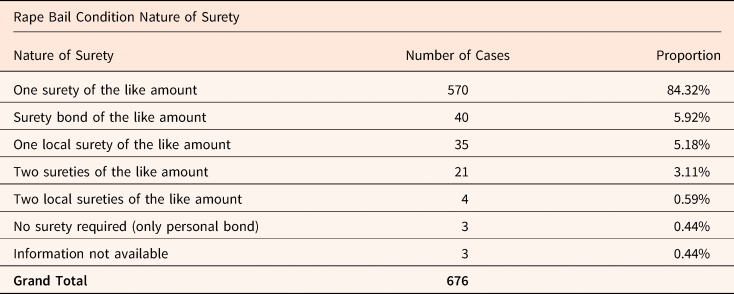
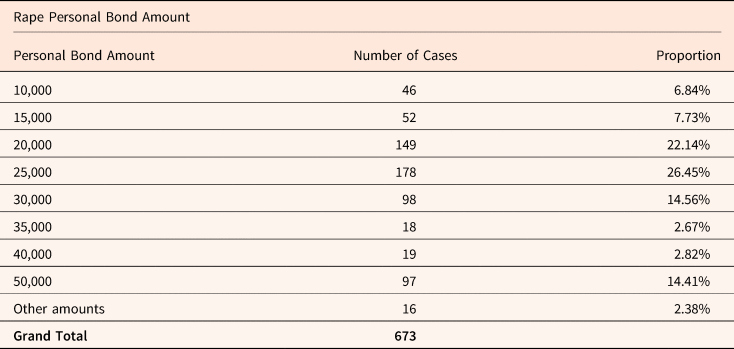
While imposing conditions of bail, both the theft and rape orders imposed a set of standard amounts across cases, choosing between the sums of INR 10,000, 15,000, 20,000, and 25,000. Nearly all orders required a bond and at least one surety, with only three orders from the rape cases requiring a personal bond only without a surety (see Appendix 8). Not a single order in the entire dataset explained the reasons for the choice of particular conditions or the amounts imposed, or how the condition related to the individual circumstances of the accused. With the corresponding lack of information in the orders on the socio-economic profile of the accused, it is a serious question whether the imposition of conditions is individualised, despite the CrPC providing processes to do so.Footnote 56 As long as data on compliance is unavailable, there are limits to the capacity to comment on the implications of this practice, but the lack of discussion in the order while imposing conditions should still be cause for grave concern.
Lack of Standards and Processes
The problems observed across such cases arise from a lack of guidance, both from the statute and Supreme Court judgments. At present, case law conflates the purpose of detention, the factors that must be considered in such decision-making, and the evidence required for such a determination. For instance, cases refer to the ‘risk of absconding’ as a factor in evaluating whether bail should be granted, when in reality it is the purpose of pre-trial detention that is one of the risks detention is aimed to protect against. This conflation of factors and purpose provides little explanation of how such determinations of risk should be done. As an example, ‘lack of familial roots’ might be an accurate predictor of the risk of absconding and would thus be an example of a factor that should be considered in bail adjudication in assessing whether there is a risk of absconding.
In addition, there is no clarity on the standards of proof in such matters that would explain which party ought to present evidence, the standard of evidence that must be proven, and the consequences for failing to do so. In fact, the Supreme Court has directly contradicted itself on this point both expressing that discretion should be in favour of granting bail and stating that the ‘discretion in grant of bail [is] to be exercised in a judicious manner and not as a matter of course’.Footnote 57 The lack of such standards results in an implicit presumption in favour of detention during the period of investigation, as evident from the reasoning of judges in matters that were allowed (as discussed in the ‘Lack of Individualisation’ section).Footnote 58
All of these issues stem from a failure to truly engage with the unique nature of proceedings in determining release pending trial. There is no guidance on the nature of evidence required in such proceedings, resulting in evidence of guilt being the primary point of engagement in orders. Any other factors that appear in the orders rely on vague allegations and statements as proof, as there are no standards for the evidence required for such grounds to be considered. For instance, it is worth noting that the criminal history of the accused in question was a frequent ground of consideration in theft cases. Criminal antecedents were invoked by the prosecution in 44.07% of theft cases and were invoked by judges in orders dismissing bail in 57.19% of theft cases (see Appendix 3 and Table 5). Yet the evidence relied upon to claim such criminal history raises serious concerns with prior convictions against the accused recorded in only fifteen orders in which criminal antecedents were invoked by judges to dismiss bail (4.66% of the orders), and the remaining relying on vague statements of ‘previous involvement in several cases’, which were considered sufficient for dismissal of the application.
Even the seriousness of the offence, when invoked, relied on vague statements of ‘seriousness and gravity of the offence’ instead of any evidence that establishes the seriousness of the particular crime accused of. Interestingly, many of the cases in which the Supreme Court laid down factors for deciding bail matters involved serious offences such as murder, and saw the Supreme Court overturning the High Court's decisions to grant bail.Footnote 59 It is this reality that likely influenced the emphasis on the seriousness of the offence in guidelines, but this both fails to acknowledge the differing standards under the law for granting bail in offences that potentially carry the death penalty and life imprisonment (see the ‘Legal Framework’ section) and fails to provide adequate guidance for other offences. For instance, what constitutes seriousness in an offence for theft as compared to murder? There is no clarity from the Supreme Court and seriousness is repeatedly invoked by trial court judges with no deeper engagement on the issue, with seriousness of the offence invoked by judges in this manner in 52.04% of the theft cases that were dismissed (see Table 5).
One pattern that emerged from the data was the stark variation in outcomes amongst judges. At least four judges from the dataset granted bail in over 95% of theft cases they considered, while five judges allowed bail applications in over 80% of the rape cases disposed of by them. Conversely, three judges dismissed over 70% of the bail applications for theft cases decided by them, while another four judges dismissed over 70% of the bail applications for rape cases disposed of by them. On the other hand, two judges allowed 100% of the bail applications for theft and rape matters considered by them respectively (see Appendix 5). The data raises questions about the role of the judge in the variation in outcomes and its links with the lack of standards and processes in bail adjudication. However, without further and deeper investigation, involving examination of case records and observation of court proceedings, such claims cannot be definitely made. But the data does indicate the need for further research on this question.
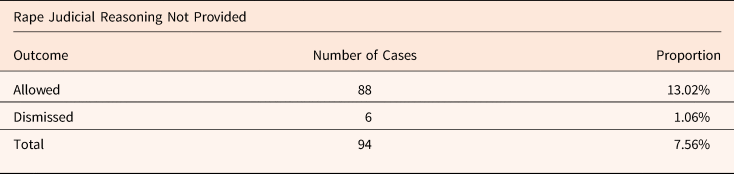
It is also worth mentioning that while most orders were reasoned, there were a few that did not provide any specific reasons for their ultimate decision, constituting 8.40% of theft cases and 7.56% of rape cases (see Appendix 6). While a handful provided no reasoning at all, in general these orders would recount arguments from both sides and then simply state that ‘in view of overall facts and circumstances’ bail is granted or rejected. While the proportions are small, it is a matter of concern that such orders are appearing at all, given that the Supreme Court has repeatedly stated the importance of reasons being given in bail orders, both to demonstrate that the decision involved application of mind and to enable any court in appeal to assess the reasoning behind the decision under consideration.Footnote 60
In addition, a small but significant pattern that emerged was the impact of conceding statements on the outcome of the case, which is representative of the lack of processes governing such proceedings. In a small proportion of cases, the order would record concessions or admissions from the prosecution, investigating officer, or complainant. This data reveals that the application would be allowed in a far higher proportion if there was a conceding statement from any such party and would be dismissed at a greater proportion if there was an indicting statement from such party. In all thirty-five theft cases and twenty-six rape cases where the prosecution made a conceding statement or other admission, bail was granted (see Appendix 3).Footnote 61 An investigating officer's conceding statement saw bail being granted in 91.63% of theft cases and 88.30% of rape cases, while an indicting statement saw 69.04% of theft cases and 59.03% of rape cases dismissed.Footnote 62 Amongst the rape cases, a statement from the complainant supporting the dismissal of the application saw 68.32% of applications being dismissed, while a statement not objecting to bail being granted saw 89.52% of the applications allowed (see Appendix 7). The issue with such outcomes is that it is located in a context of complete lack of guidance on the role of the prosecution, investigating officer, or complainant in such a process, which ultimately allows for such divergent contributions and varied outcomes.Footnote 63
Even when the law provides a process for such decision-making, the courts failed to undertake the necessary detailed exercises. When imposing conditions for bail, the CrPC allows the court or a subordinate magistrate to conduct a separate inquiry to determine what surety should be imposed, in which affidavits can be considered as proof of relevant facts.Footnote 64 However, not a single order in either the theft or rape dataset provides any indication of such an inquiry being undertaken, with conditions imposed absent any explanation of the choice of condition or the specific amount chosen.
Truly engaging with a pre-trial detention system requires a fundamental revamp of the approach and processes undertaken by trial courts. At the first level, we need to clarify that the triple test is the purpose of such detention and separate the factors to be considered in making such a determination. While there has been extensive research on (as well as subsequent critique of) the factors that are predictors of risk in other jurisdictions,Footnote 65 we have undertaken no such research in India. Identifying factors for such determination requires empirical research to identify the factors that could be relevant in our own country. It requires answering a range of questions: for instance, are community ties relevant? How accurate is it in predicting risk? How does one establish community ties? How many in our country can establish such evidence? Once the factors that are relevant for such determinations are identified, specialised processes and standards need to be developed that can demonstrate individualised evidence of risk of harm to the trial process. This approach has also garnered recognition from the Law Commission of India, which has recommended pre-trial risk assessment and checklist models that can guide prosecutorial discretion in assessing the risk posed by the accused on release.Footnote 66
Conclusion
The overrepresentation of undertrials in the prison population is a persistent concern in India's criminal justice system. This article is an attempt to help address the issue through an empirical analysis of the judicial reasoning of trial courts that decide on the detention and release of these individuals. By analysing the outcomes and judicial reasoning in bail matters, this article sought to identify the gaps in such adjudication that could have a bearing on incarceration of undertrials. While the study is limited by its focus on Sessions Courts and on orders available online, it reveals patterns of decision-making by trial courts that can guide a reimagining of the system to make it more rational and effective for its purpose.
The data reveals a near total failure to design and implement the unique processes required for bail adjudication. The primary consideration of the triple test (that is, the risk of absconding, reoffending, or tampering) rarely appears in orders. Instead, judges simply import factors from the trial process, in particular, placing an outsized focus on guilt and seriousness of the offence, while dismissing applications. Judges also fail to individualise the process, with vague allegations and statements considered sufficient as evidence of factors raised. The lack of standards and processes has also resulted in an implicit presumption in favour of detention, at least until the investigation is complete.
The system requires fundamental reimagination to ensure it is in line with the core purposes of bail adjudication. Adjudication of pre-trial detention should be realigned to focus on addressing the triple test of risks. This means abandoning the focus on guilt – which should be left to the trial process – and reimagining the integration of the seriousness of offence in the process. The gravity of offence can be examined in light of its links with the triple test, with a higher burden placed on the accused in offences that carry a greater risk. Ultimately, greater doctrinal coherence is required, particularly from the Supreme Court, in rigorously establishing the requirements of the triple test and guiding bail adjudication accordingly.
Appendices
Appendix 1. Durations
The case status page of the eCourts system records information on when the application is filed, when the matter is first listed, and when the matter is finally disposed of. This data is available for all cases in the dataset.
Theft Filing to Disposal Duration

Rape Filing to Disposal Duration

Theft First Listed to Disposal Duration

Rape First Listed to Disposal Duration

The orders generally record the date on which the accused was remanded in custody. This was used to calculate the period in custody on the date of the order. No information was available for 446 of the theft cases and 530 of the rape cases.
Theft Period in Custody

Rape Period in Custody

Appendix 2. Facts
Description of facts were available in only 1,143 of the theft cases (60.38% of the total theft cases) and 701 of the rape cases (56.40% of the total rape cases). The miscellaneous category captures fact categories that appeared less than ten times in the dataset.
Theft Facts

Rape Facts

Appendix 3. Prosecution
The judge recorded the submissions of the prosecution in 1,097 cases or 57.95% of the dataset of theft cases. In 35 cases, the prosecution either did not oppose bail or otherwise made concessions or admissions in their arguments in the proceedings.
Theft Prosecution Grounds in Opposition to Bail

The judge recorded the submissions of the prosecution in 762 cases or 61.30% of the dataset of rape cases. In 26 cases, the prosecution either did not oppose bail or otherwise made concessions or admissions in their arguments in the proceedings.
Rape Prosecution Grounds in Opposition to Bail
Appendix 4. Defence
The grounds raised by the defence were recorded in 1,408 cases or 74.38% of the total theft cases and in 992 cases or 79.81% of the total rape dataset.
Theft Defence Grounds in Support of Bail

Rape Defence Grounds in Support of Bail

Appendix 5. Judge Variation in Outcomes
The data below compares outcomes of (anonymised) judges who have decided at least twenty cases in the dataset, comparing the proportion of allowed and dismissed applications for each judge.
Theft Judge Variation in Outcomes

Rape Judge Variation in Outcomes

Appendix 6. Judicial Reasoning
Theft Judicial Reasoning Not Provided

Rape Judicial Reasoning Not Provided
Appendix 7. Conceding and Indicting Statements
The statement of the investigating officer was recorded in 478 theft cases and 315 rape cases.
Theft Investigating Officer Statement

Rape Investigating Officer Statement

Complainant's statements were only recorded in the dataset of rape cases, in 326 cases in total.
Rape Complainant's Statement

Appendix 8. Conditions
Theft Bail Condition Nature of Bond

Theft Bail Condition Nature of Surety

Rape Bail Condition Nature of Bond

Rape Bail Condition Nature of Surety
Theft Personal Bond Amount

Theft Surety Bond Amount

Rape Personal Bond Amount
Rape Surety Bond Amount

The data below presents the other conditions imposed by the Sessions Courts while allowing bail, in addition to the bond and surety conditions. The categories are not mutually exclusive, and therefore, a single case could include multiple other conditions.
Theft Other Conditions

Rape Other Conditions



