Introduction
Chyle leaks (CL) following neck dissection represent a serious complication with a variation of reported incidence from 1 to 8 per cent. Such cases are associated with thoracic duct (TD) injury, particularly in the left side of the neck at the terminal portion of the duct.Reference de Gier, Balm, Bruning, Gregor and Hilgers1, Reference Baker, Tassone, Dooley, Galloway and Zitsch2 The reported incidence rises in patients with metastatic lymphadenopathy in level 4 of the neck (most commonly seen in thyroid, laryngeal and hypopharyngeal malignancy), bilateral neck dissection or salvage surgery.Reference Lee, Nam, Chung, Chang and Park3
Chyle leak noted intra-operatively during neck dissection warrants immediate repair. It is recognised that diathermy and bipolar haemostasis are ineffective on dilated lymphatics due to lack of the haemoglobin protein, prompt intra-operative repair of any observed TD injury is essential. Repair techniques include the use of non-absorbable suture, metallic ligaclips and fibrin sealant utilisation. Post-operatively, a fat-free diet is recommended as a prophylactic measure to reduce pressure within the ligated TD and potentially minimises CL post-operatively.Reference Nixon, Harrison-Phipps, Jeanon, Oakley and Simo4
Clinically, post-operative CL is suspected by the presence of milky-coloured fluid in the drain, which should be promptly managed based on a multi-disciplinary approach involving dieticians, head and neck surgeons and thoracic surgeons. Medical management is usually commenced while awaiting biochemical confirmation with analysis of the drained fluid by assessing the presence of elevated lymphocyte count, triglycerides over 110mg/dl and chylomicron of more than 4 per cent,Reference Gregor5 medical management is usually commenced.Reference Molena, King and Davies-Husband6 Low-volume CL are often addressed medically and after a period of observation. Higher-volume leaks are at risk of compromising patients metabolically, are unlikely to settle, therefore prompt surgical intervention is warranted.
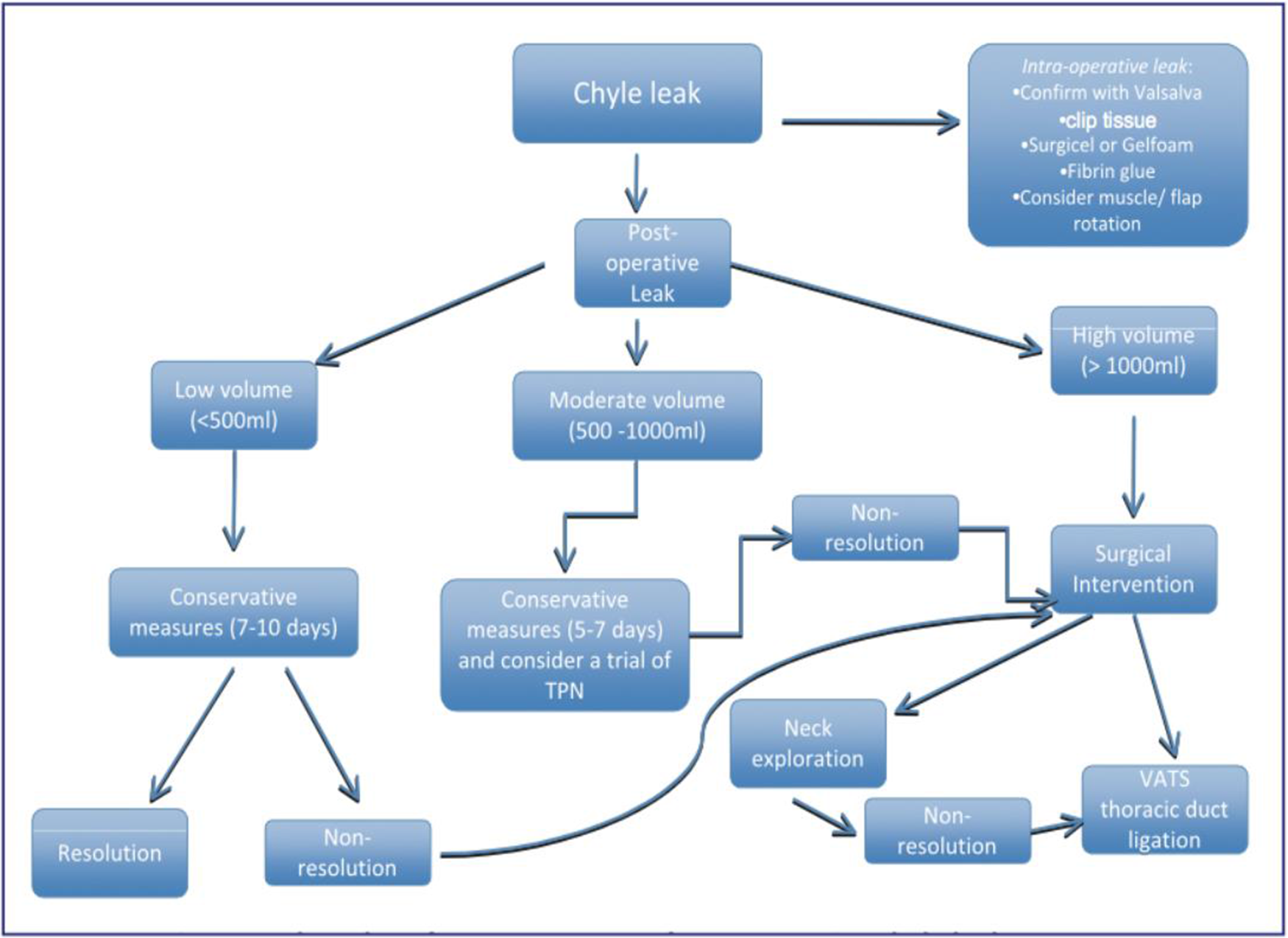
Currently, there is no widely agreed-upon guideline for the management of CL following neck dissection. In 2011, the senior authors published a guideline for CL management based on best evidence available and expert opinion at a tertiary head and neck centre (Figure 1).Reference Nixon, Harrison-Phipps, Jeanon, Oakley and Simo4 Its aim was early identification, risk stratification and management of post-operative CL based upon volume output to minimise morbidity. If surgical intervention is warranted, it is advocated to use video-assisted thoracoscopic surgery (VATS) TD embolisation procedure. Re-exploration of the neck has only been performed as a last resort, as it involves entering through the operated field increasing the risk of associated morbidity, and excellent results have been observed with VATS TD ligation. This study evaluates the outcomes and effectiveness of a structured, volume-based protocol for post-operative CL introduced at our institution, using chyle output stratification to guide medical versus surgical intervention, aiming to improve outcomes. While other proposed guidelines have been published before, this management algorithm emphasises timely intervention in high-risk patients. There is a greater emphasis on avoiding the primary surgical site and this demonstrates the effectiveness of this algorithmic approach.
Adapted from Joshi et al, this flowchart depicts the management of post-operative chyle leak, divided into low, moderate and high-volume drainage categories.

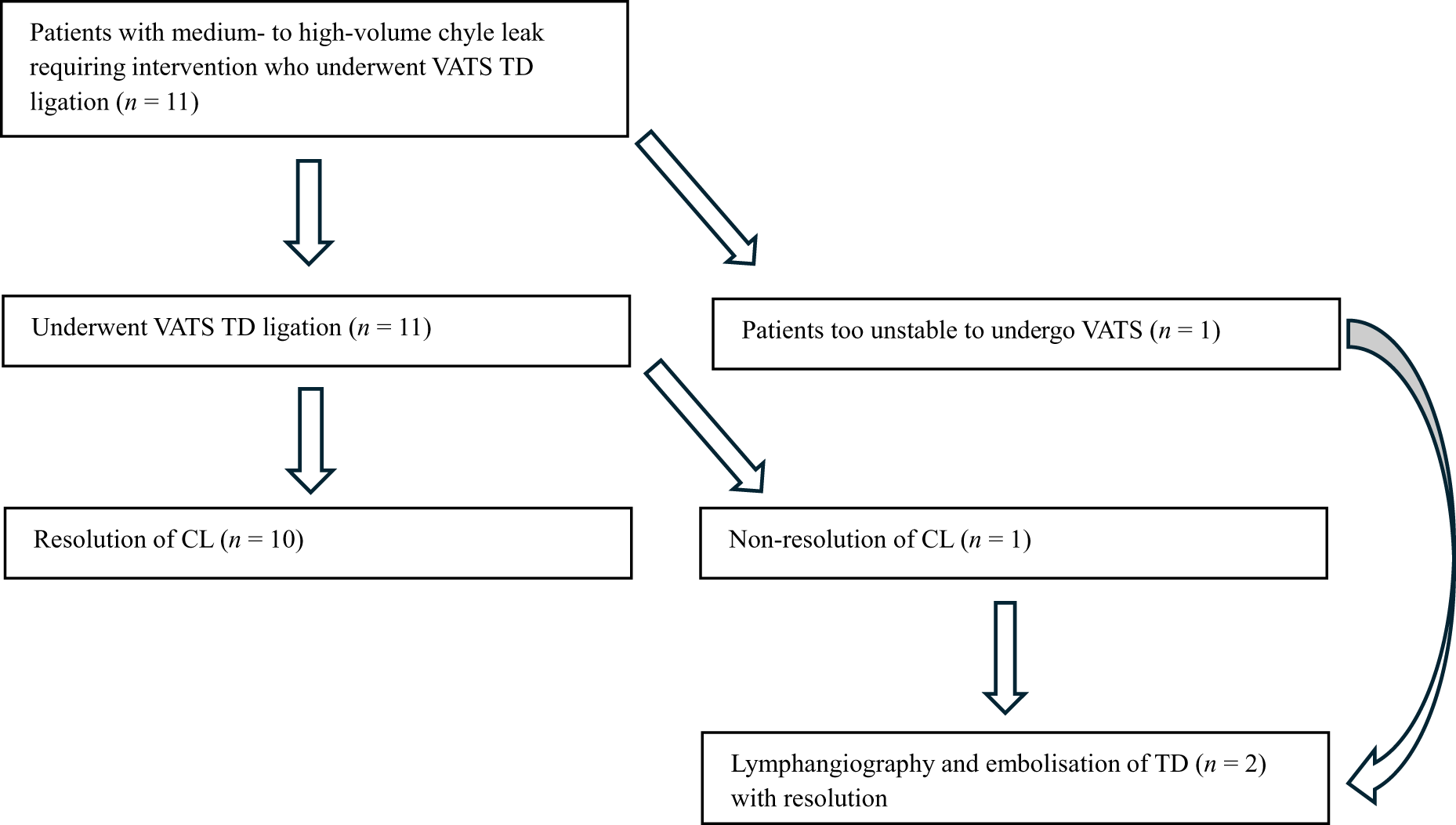
Outcomes of patients who underwent interventions for CL.

Materials and methods
Study design and setting
A retrospective chart review was conducted of all patients who developed clinical and biochemically confirmed CL, following neck dissection for malignant head and neck and thyroid disease between 2010 and 2024 at a single academic tertiary referral head and neck unit.
Patient characteristics
Inclusion criteria: adult patients who developed CL after undergoing neck dissection for malignant disease were included. Exclusion criteria: patients were excluded who developed CL for non-malignant disease or due to insufficient follow-up.
Outcome measures
Data were obtained from patient records, including age, sex, surgical procedure, time from operation to development of CL, volume of drainage output (categorised into high/medium/low), management approach, time for CL to resolve post-operatively and duration of stay for those who underwent intervention.
Statistical analysis
Categorical variables were expressed using frequency (n) and per cent. Continuous variables were represented using the mean and range. Two patients transferred from other centres had missing staging data.
Management
All CLs were initially managed medically with a trial of low-fat diet either via oral intake and nasogastric feeding or total parenteral nutrition, orlistat and octreotide. Low-volume leaks (< 500ml/24h) are managed medically for 7–10 days. Moderate-volume leaks (500–1000ml/24h) are managed medically for 5–7 days. High-volume CL (> 1000 ml/24h) is planned for early surgical intervention while concurrently medical management is commenced. Surgical intervention in the form of VATS TD ligation is pursued if the CL remains unresolved, despite medical management in low and moderate CL and where the risk of medical complications, such as infection and wound breakdown, is high.
A very low-fat diet (low in long-chain triglycerides (LCTs)) is initiated on confirmation of CL with early input from dietitians. Patients tolerating oral intake are provided with education materials to guide intake and provided with an individualised menu while in hospital, as well as supplementation with Fortijuice (Nutricia Ltd., Trowbridge, UK) and a multi-vitamin. If patients are nil by mouth or require supplementary support, they will be initiated on enteral feeding with no LCT to avoid increasing chyle volume. Patients with ongoing medium- or high-volume leaks are considered for total parenteral nutrition (TPN) while planning surgical intervention to attempt to reduce the production of chyle.
Results and analysis
Patients and characteristics
Thirty-five patients with CL following neck dissection were included in this study, with three patients transferred from other centres for definitive management included. Sixty-eight point six per cent of patients were male (n = 24) and 31.4 per cent female (n = 11), with a mean age of 51 years (range = 20–86 years). Eleven point four per cent (n = 4) underwent isolated neck dissection, while the rest had neck dissection associated with thyroidectomy 45.7 per cent (n = 16), laryngectomy 17.1 per cent (n = 6), partial glossectomy 11.4 per cent (n = 4), parotidectomy 5.7 per cent (n = 2), hemimandibulectomy 5.7 per cent (n = 2), orbital exenteration 2.8 per cent (n = 1). Patients presented with CL between 1 and 15 days post-operatively. One patient (2.8 per cent) had an intra-operative CL noted, which was addressed at the time of neck dissection; however, chyle was present in the drain output on the first post-operative day.
Chyle leak stratification and management approach
Sixty-five point seven per cent of patients (n = 23) with low-volume leaks were managed medically, with resolution of CL in all within 5–22 days (mean 9.8). One patient went back to theatre 2 days later for drainage and direct repair of CL due to a large collection in the neck which resolved on day 1 post-operatively. Eleven point four per cent of patients (n = 4) with moderate-volume leaks were managed medically for up to 7 days before planning to undergo VATS TD ligation. Twenty per cent of patients (n = 7) had high-volume leaks and underwent early VATS TD ligation. One patient underwent early lymphangiogram embolisation (LE) of the TD (Table 1).
Chyle leak management according to CL volume classification; CL = chyle leak; VATS = video-assisted thoracoscopic surgery

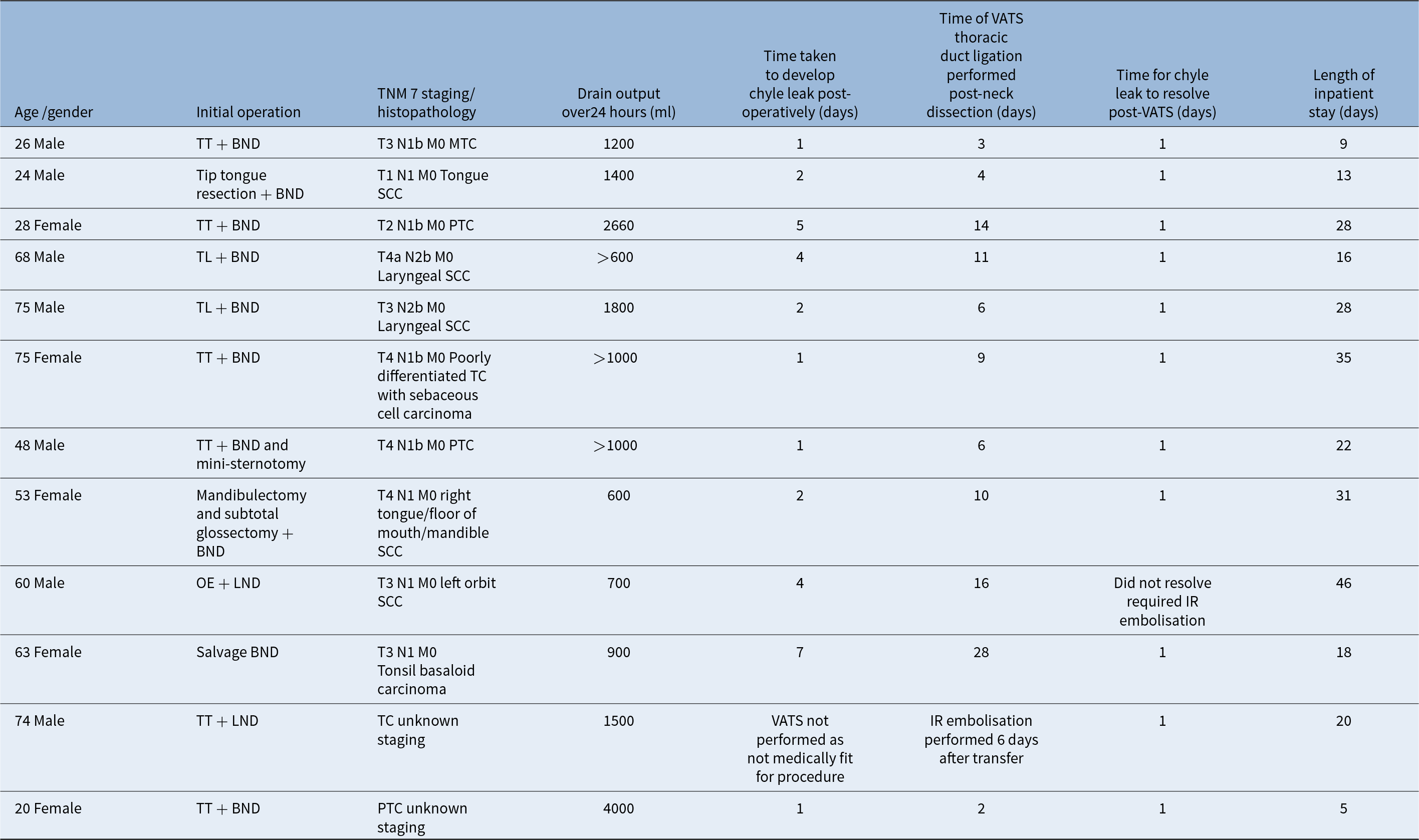
Thirty-one point four per cent of patients (n = 11) in total underwent VATS TD ligation. There was resolution of CL within one day post-operatively in 90.9 per cent of those patients (n = 10). One patient’s CL did not resolve after ligation and required two attempts at LE before resolution. One patient developed a small pneumothorax after undergoing VATS TD ligation, which was managed conservatively before being discharged 3 days later. A further patient transferred from another centre underwent LE rather than VATS TD ligation for a large-volume leak, as they remained unstable with a type II myocardial infarction and failed extubation after the initial procedure (Table 2).
Characteristics of patients who underwent surgical intervention; TT = total thyroidectomy; BND = bilateral neck dissections; TL = total laryngectomy; LND = left neck dissection; OE = orbital exenteration; MTC = medullary thyroid carcinoma; SCC = squamous cell carcinoma; PTC = papillary thyroid carcinoma; TC = thyroid carcinoma; VATS = video-assisted thoracoscopic surgery; IR = interventional radiology

One hundred per cent resolution of CL in patients, and after discharge no patients re-presented with ongoing CL, demonstrating clinical success of the algorithmic approach.
Discussion
Management of CL is challenging; however, early stratification by the volume of CL can aid clinical decision making and effective management. Thus, an algorithmic management approach was adopted at this centre, combining both medical and interventional options. All patients were managed based on the aforementioned established guidelines. This multi-disciplinary approach of CL involved both medical and surgical interventions, with dietary modifications managed by dieticians and VATS TD ligation procedures performed by thoracic surgeons when indicated. Patients referred from other centres for management of their CL were included in the study. Medical management consisted of a fat-free diet and pharmacological therapy with orlistat and octreotide. Surgical management via TD ligation following a VATS approach involves detection of the TD by a right-sided lateral approach to the thorax. The TD is subsequently occluded by mass ligation of the tissue superior to the supra-diaphragmatic hiatus, which lies between the aorta and the azygos vein. Cessation of CL was defined as the termination of chyle-like fluid from the neck or the neck drain with biochemical confirmation.
The key findings indicate that low- and medium-volume leaks (< 1000ml/day) should be managed medically with a defined timeframe to consideration of surgical intervention in the form of VATS TD ligation, if the CL is not resolving. High-volume CL (> 1000ml/day) should be commenced on medical management initially while early arrangements for surgical intervention are encouraged. This study further demonstrates that VATS TD ligation is a safe and effective procedure, achieving resolution of CL in all but one case within the first day following ligation, with minimal associated morbidity. Effective management of CL, apart from depending on identifying the need for prompt intervention, also requires a multi-disciplinary approach. Therefore, prompt assessment involving dieticians, radiologists, head and neck and thoracic surgeons is essential, facilitating a more personalised approach and early operative planning, when indicated. Should CL occur in hospitals lacking dedicated thoracic surgical services, establishing referral pathways to specialised tertiary centres can significantly improve outcomes, as demonstrated by the three patients transferred for definitive management who were all discharged shortly after. All the above aim to alleviate symptom burden, reduce the duration of hospital stay and ultimately reduce morbidity rates.
Two patients underwent LE. The first patient’s CL did not resolve after VATS TD ligation and required two attempts at LE before resolution and discharge 45 days after the initial operation. The second patient was transferred from another head and neck centre for management for chylothorax secondary to TD after total thyroidectomy and neck dissection. Post-operatively, they had a failed extubation attempt and type II myocardial infarction and therefore were not fit for TD ligation. Their high-volume leak resolved 1 day after LE, demonstrating another powerful adjunct in the management of CL.
Medical management remains the first-line treatment for low- and medium-volume leaks. Measures such as a fat-free diet, correction of metabolic imbalances, somatostatin analogues (octreotide),Reference Molena, King and Davies-Husband6 lipase inhibitors (orlistat),Reference Belloso, Saravanan and de Carpentier7 and when required, enteral feeding or TPN are employed. Any LCT delivered in enteral feeds will increase chyle volume, as such feeds containing medium-chain triglycerides (MCTs) are used or feeds with a mix of LCT/MCT, depending on surgical team preference. It is very challenging to identify the optimum feed and LCT/MCT ratio to balance nutritional needs and management of the CL due to poor consensus and reporting within the literature. As such, at our institution, we have opted for feeds containing only MCT. Lipids contained in TPN are metabolised differently compared to those absorbed in the digestive tract and therefore will not increase the volume of the CL. However, given the complexity and cost, TPN is reserved for patients with refractory CL.Reference Smith, Higginson, Breik, Praveen and Parmar8 In this study, twenty-three patients with a low-output leak were successfully treated with medical therapy alone. While conservative measures can be effective, prolonged use may delay definitive treatment in persistent or high-output cases, increasing the risk of further complications.Reference Nixon, Harrison-Phipps, Jeanon, Oakley and Simo4 Therefore, early stratification by leak volume and adherence to a defined timeframe for medical therapy are critical in guiding timely surgical intervention.
For high-output or refractory CL, a range of interventional options exists, varying from minimally invasive techniques to open approaches. These primarily include VATS TD ligation, LE and neck re-exploration. Surgical re-exploration of the neck can be technically challenging in terms of identifying the TD and may often be unsuccessful, resulting in further delay for definitive treatment,Reference Nixon, Harrison-Phipps, Jeanon, Oakley and Simo4 increasing the likelihood of complications. On the contrary, percutaneous lymphangiogram and embolisation, an emerging alternative to VATS TD ligation, has shown promising results in selected cases. Nguyen et al. reported a 91.7 per cent technical success rate and 100 per cent resolution of CL post-neck dissection with lymphatic duct embolisation.Reference Cuong, Hoan, Tra, Luu, Tuan and Canh9 However, this technique requires specialised expertise and may necessitate repeat procedures, as demonstrated by Ushinsky et al., who achieved an 86 per cent success rate with three patients requiring additional interventions.Reference Kim, Bang, Choi, Won and Kwon10, Reference Ushinsky, Guevara and Kim11
Video-assisted thoracoscopic TD ligation offers a minimally invasive alternative with established efficacy, as evidenced by our case series and corroborated by previously published studies. It promotes an enhanced recovery of head and neck patients, as it expediently halts the high drain output, avoids the surgical morbidity associated with the open thoracotomy approachReference Belloso, Saravanan and de Carpentier7, Reference Abdel-Galil, Milton and McCaul12, Reference Wurnig, Hollaus, Ohtsuka, Flege and Wolf13 and reduces hospital stay.Reference Ilczyszyn, Ridha and Durrani14 While VATS still carries its own risks, the 90.9 per cent success rate of this approach, as demonstrated by our case series, ultimately translates into patients being less likely to develop metabolic, nutritional and immune complications. Similarly, Ilczyszyn et al.Reference Ilczyszyn, Ridha and Durrani14 reviewed a series of case reports and concluded that thoracoscopic ligation is effective at stemming intractable chyle fistulas, with no added morbidity. Other studies, such as Nandy et al., reserved VATS TD ligation for patients who had persistent high output despite optimal medical management for 14 days. They treated three patients with surgical management, all of whom followed with a rapid recovery.Reference Nandy, Jayaprakash, Rai, Kumar, Puj and Tripathi15 While the published efficacy is promising, to undergo any VATS procedure carries risks. Reported incidence of risks associated with VATS is bleeding (1.5 per cent), pain, infection (0.9 per cent), persistent air leak (4.7 per cent), risk of converting to an open procedure and injury to local structures, such as the oesophagus or phrenic nerve.Reference Łochowski and Kozak16 As found in this study, one patient developed a pneumothorax, and another underwent two further procedures until cessation of their CL. These risks must be weighed and balanced with the harm from leaving the CL untreated or the risks associated with re-exploring the neck. Due to the leak of chyle, inflammation in the neck can form, causing difficulty identifying the TD. On balance, an approach that treats the underlying cause and avoids the original surgical site, VATS TD ligation provides a safe, effective and prompt way of treating CL.
Comparison with other studies reveals some discrepancies between proposed management algorithms, particularly in defining high-output leaks and determining the duration of medical management before surgical intervention. For instance, categorisation of chyle leak as low or high for the purposes of this study, greater than 1000 ml was considered high output and warranted early surgical intervention, other centres class high volume as greater than 500 ml or 600 ml. Furthermore, the duration of trialling medical treatment before surgery varies, advocating for between 3–7 days, before proceeding to surgical management. However, agreement is reached in the clear benefit of VATS TD ligation in persistent or high CL.Reference Nandy, Jayaprakash, Rai, Kumar, Puj and Tripathi15, Reference Leović, Pastorčić Grgić, Gugić Radojković, Blivajs, Matoc and Gršić17
This study adds to the body of evidence in the management of CL by providing guidance on the timeframe for medical management and when to consider surgical intervention. In addition, to our knowledge, it is the largest case series reporting on outcomes of VATS TD ligation procedure for CL management after neck dissection. Akin to the systematic review of CL medical management,Reference Molena, King and Davies-Husband6 a systematic review and meta-analysis of the surgical management of CL would add valuable evidence to the management of this rare complication of neck dissection.
Limitations of this study
Due to the rarity of CL as a complication of neck surgery, even a fourteen-year retrospective case series in a major UK tertiary referral centre yielded a low number of patients, which limits the power of the study. Furthermore, it is a non-controlled study. Both of these limitations are due to the rarity of CL post-neck surgery. Nonetheless, this study highlights and assesses the effectiveness of a timeframe for the medical and surgical management of CL that head and neck teams can incorporate into their clinical practice.
Conclusions
Chyle leak is a rare but potentially troublesome complication of head and neck oncological surgery involving neck dissections. Although medical measures are employed, non-resolving low- and medium-volume leaks, as well as high-volume leaks, may require surgical intervention. An agreed management protocol should be encouraged to manage patients with CL. Early VATS ligation of the TD provides a safe and effective method of treating high-volume (> 1000ml) CL refractory to medical interventions.
Compliance with Ethical standards
The authors assert that all procedures contributing to this work comply with the ethical standards of the relevant national and institutional guidelines on human experimentation (please name) and with the Helsinki Declaration of 1975, as revised in 2008.
Financial support
This research received no specific grant from any funding agency, commercial or not-for-profit sectors.
Competing interests
The authors declare none.
Ethical statement and informed consent
Our retrospective study was conducted in accordance with the ethical guidelines of the Declaration of Helsinki and was approved by the Institutional Review Board at Guy’s Cancer Centre. The requirement for informed consent was waived because of the retrospective design.