Introduction
During microbial fermentation in the gastrointestinal tract (GIT) of poultry, a key role is played by nutrition, primarily by the chemical composition and sanitary quality of feed. Some of the nutrients in feed are not digested with the aid of naturally produced enzymes but are fermented in the lower GIT of poultry, mainly in the caecum, and the fermentation processes affect the health and performance of birds (Yanget al., 2009).The final effect of postileal fermentation is determined by many factors, including the loss and utilisation of energy supplied by short-chain fatty acids (SCFAs), the major products of fermentation (Bjerrumet al.,2006). Research conducted 30 years ago (Klasinget al., 1987) showed that chickens raised in a pathogen-free environment grow 15% faster than those raised under conventional conditions. In the conventional system, the gut microflora uses up part of dietary energy and is a nutritional ‘burden’ in fast-growing birds (Lanet al., 2005).This is an importantconsideration, particularly in birds fed antibiotic-free diets. Feed antibiotics have a selective, but generally inhibitory effect on the counts of intestinal microorganisms.The last few decades have witnessed significant changes in poultry nutrition, including the introduction of new feed additives (e.g. next-generation fibre-degrading enzymes) and wide use ofalternative protein sources such as rapeseed meal (RSM), sunflower meal (SFM) and legume grains to replace soybean meal (SBM) in poultry diets. In view of the above, the following question arises: how do changes in diet composition influence the course and effects ofpostileal fermentation in the GIT of birds, in particular broiler chickens and turkeys? This paper seeks to address this question, referring to recent findings.
Cereal fibre and its influence on postileal fermentation in the GIT of poultry
Research conducted in the early 1980s revealed that non-starch polysaccharides NSPs of cereals interact with microbial populations and fat digestibility. Campbellet al. (1983) demonstrated that the effect of rye-based diets was more pronounced in conventional than in germ-free birds. Subsequent studies have shown that NSPs promote the growth of microbial populations that produce bile acid deconjugating enzymes and, ultimately, decrease fat digestibility (Feighner and Dashkevicz, Reference FEIGHNER and DASHKEVICZ1987). Effects of the gut microbiota on fat digestion were investigated by Campbellet al. (1983) who found that animal performance was improved through supplementation of rye- and barley-based diets with emulsifiers. The hydrolysis of conjugated bile acids was detected in members of the following genera:Clostridium, Lactobacillus, Fusobacterium, Bacteroides, Bifidobacterium, PeptostreptococcusandStreptococcus.
Broilers and turkeys have a relatively short large intestine and a relatively fast feed passage rate through the GIT. Therefore, the rate of caecal fermentation is increased by soluble rather than insoluble dietary fibre. The water-soluble fraction of NSPs is known to increase the viscosity of intestinal digesta and the risk of bacterial overgrowth in the gut, which was prevented with the use of feed antibiotics. In recent years, there has been a growing interest in cereals as the main dietary source of NSPs and a dietary factor influencing postileal fermentation. Kirchgessneret al. (1999) estimated that in chickens the energy value of triticaleNSPsreached 7.8 kJ/g, and it was almost 10% higher in ducks and geese. In a later study, Jamrozet al. (2002) compared the digestibility and energy value of NSPs in young chickens, ducks and geese and revealed that NSPs contributed approximately 3.5% of metabolisable energy in the three poultry species. Based on the digestibility of NSP sugar residues and the formation of SCFAs in the gut, the energy of NSPs was estimated at 2.8, 3.2 and 2.7 kJ/g NSPs ingested in chickens, ducks and geese, respectively. It should however, be stressed that previous research did not revealed a significant effect ofcaecectomy on nutrient utilisation (Chaplin, Reference CHAPLIN1989; Sonet al., 2000), which suggests that caecal fermentation is not an essential process in high-yielding poultry.The ban on the use of antibiotics as growth promoters in animal feed has contributed to the popularity of NSP-degrading enzymes used to inhibitmicrobial overgrowth in the small intestine and to control the microbial population in the caecum (Bedford and Cowieson, Reference BEDFORD and COWIESON2012). NSP-degrading enzymes affect fermentation in the GIT in two ways: they improve nutrient digestion in the ileum thus decreasing the rate of fermentation in the upper GIT, and they supply readily fermentable oligosaccharides to the caecum in the process of depolymerising NSPs. By increasing nutrient digestibility, NSP-degrading enzymes may also reduce the amount of excreta in birds, which is an important environmental consideration.
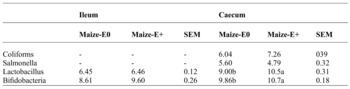
According to Hespellet al. (1997) and Liet al. (2000), most NSP-degrading enzymes provide di-, tri- and tetrasaccharides or larger oligomers to the intestinal lumen. If produced, monosaccharides tend to be absorbed before reaching the caecum (Penget al., 2004).In another experiment (Nianet al., 2011) exogenous xylanase supplementation (4000 U/kg) of a maize-based diet improved feed conversion, increased diet AME and net energy for production. Higher production of CO2and heat was noted, which was probably related to enhanced activity of intestinal microbiota. As shown inTable 1, the addition of xylanase to maize-based diets did not affect the abundance of ileal microbiota but increased the abundance of caecal microbiota.
The effect of xylanase on the counts of bacteria in the ileum and caecum (log10CFU/g) of broilers fed maize-based diets (Nianet al., 2011).

E-enzyme addition
abMeans within a row with no common superscript differ significantly (P<0.05)
It is well known that depolymerisation of dietary NSPs should increase carbohydrate digestibility and decrease the rate of carbohydrate fermentation by intestinal microflora in the crop, duodenum, and ileum. However, the NSPs degraded by enzymes in the small intestine to low-molecular-weight polysaccharides and possibly oligosaccharides would be more readily fermented to SCFA in the caecum than their intact form (Bedford and Cowieson, Reference BEDFORD and COWIESON2012). Zduńczyket al. (2013) reported that the addition of exogenous enzymes to a diet containing RSM had a beneficial effect on bacterial enzyme activity in the caecum as manifested by reduced β-glucuronidase activity and increased activities of other enzymes, including glycolyticα-glucosidase, α- and β-galactosidase, whichcould be indicative of changes in the enzymatic profile of caecal microbiota.This corroborates the findings of Choctet al.(1996) who found that the addition of NSP-degrading enzymes to broiler diets decreased SCFA concentrations in the ileum and simultaneously increased SCFA concentrations in the caecal contents, from 118 to 5 and from 369 to 930μmoles/g fresh digesta, respectively.In our earlier study (Juśkiewiczet al., 2010) the addition of NSP-degrading enzymes to diets with a different content of high-fibrous SFM significantly decreased caecal SCFA concentrations despite an increase in bacterial glycolytic activity. In an experiment conducted with broilers by Ordaet al. (2006), increasing dietary levels of yellow lupin significantly decreased colony forming units ofE. coliandLactobacilluswhile enzyme supplementation reduced the faecal levels of the former and significantly increased the counts of the latter bacteria. The above findings support the hypothesis that NSP-degrading enzymes can indirectly act as a prebiotic provider at the caecal level (Costaet al., 2008).
The use of NSP-degrading enzymes is a common practice in poultry feeding, so postileal fermentation should be investigated in combination with NSP-degrading enzymes. NSP depolymerisation exerts a promotional effect on caecal fermentation providing insignificant amount of metabolic energy for birds and also stimulating growth positive and negative bacteria.The effect of NSP-degrading enzymes, on bacterial species diversity in the caecum should be further investigated as literature data are often contradictory.
The effect of SBM substitutes on postileal fermentation in the GIT of poultry
One of the importantfactors thatmay affect theactivity ofintestinalmicrobiotais thecomposition of themain protein sources in the diet. The ban on the use of meat-and-bone meal in animal feeds in the European Union has contributed to problems with diet formulation, especially in young growing animals. Broiler chicken diets may contain up to 40% of vegetable protein sources such as SBM, RSM, SFM and others. In diets for turkeys, in particular young heavy-type birds, plant protein supplements may exceed 50% of the total ration. Plant protein supplements differ with respect to the amounts and composition of the carbohydrate fraction and the content of other substances (mainly polyphenolic compounds) which may affect the fermentation process. SBM is characterised by a high protein content and is a rich source of carbohydrates (over 30%), approximately half of which are sucrose and oligosaccharides (includingraffinose family oligosaccharides (RFOs)).Soybean mealtypically has low metabolisable energy content, compared with cereals, due to negligible starch content and higher concentrations of indigestible NSPs, which are part of the dietary fibre fraction.
Due to high concentrations(up to 6%)ofRFOs in SBM, SBM-rich diets fed to the youngest birds may contain large amounts of raffinose family oligosaccharides(RFOs) fermented in the lower GIT. In young turkeys (up to 8 weeks of age), RFOs can constitute approximately 2.5% of the diet (Jankowskiet al., 2009). Raffinose family oligosaccharidesare extensively fermented by bacterial populations in the birds’ caecum and, to a certain extent, in the distal ileum. A high content of soybean oligosaccharides in the diet may induce excessive hydration of digesta, diarrhoea, and an uncontrolled increase in intestinal bacterial populations. On the other hand, some authors have ascribed prebiotic effects to dietary RFOs (Chow, Reference CHOW2002; Gulewiczet al., 2002).Raffinose family oligosaccharideshave been shown to decrease the digestion of other fibrous constituents, to affect intestinal morphology, and the rate of intestinal cell turnover (Coonet al., 1990). The results of experiments conducted by the authors of this review indicate that soybean α-galactosides seem to significantly affect the development and physiology of the GIT,e.g.the development of duodenal mucosa, thus their recommended content of diets fed to growing turkeys is approximately 1% (Juśkiewiczet al., 2009; Zduńczyket al., 2010).
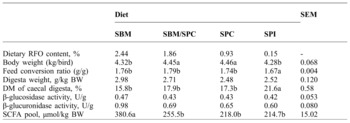
In the experiment presented inTable 2, differences in RFO content were due to the inclusion of SBM, soybean protein concentrate (SPC) or soybean protein isolate (SPI) as the main protein source in diets. The total production of SCFAs in the caeca of eight week old turkeys fed the SBM diet was significantly higher, compared with the other groups. There were no differences in the SCFA profile among the treatments. In conclusion, partial or almost complete replacement of SBM with SPC suppressed the fermentation process in the caeca, but enhanced the growth rate of birds. This corroborates the findings of Korinet al. (1993) who noted a negative correlationbetween RFO levels and the true metabolisable energy corrected to the zero nitrogen balance (TMEn) content of SBM. Coonet al. (1990) and van Kempenet al. (2006) reported that soybean oligosaccharides may decrease energy utilisation and have a negative effect on ileal dry matter (DM) digestibility in piglets. A decrease in the final body weights of SPI group birds was most probably due to other factors such as increased concentrations of digesta DM, which reduced the rate of food passage and improved digesta utilisation. Feed conversion ratio was significantly lower in the SPI groups, compared with the other groups. Other investigators also demonstrated that α-galactosides such as raffinose, stachyose and verbascose favourably stimulate the lower GIT microflora (Chow, Reference CHOW2002). On the other hand, some authors suggested an opposite effect of soybean oligosaccharides (Liyinget al., 2003). Soybean oligosaccharides have hygroscopic properties and may affect digesta transit through the GIT by elevating intestinal osmolarity and viscosity (Bedford, Reference BEDFORD1995). Zduńczyket al. (1998) demonstrated that oligosaccharides extracted from lupin seeds can reduce water absorption in the perfused small intestine of rats. In another study, Kocheret al.(2010) showed that some enzymes may increase NSP degradation from SBM and improve its caecal fermentation. The above authors suggested that the observed increase in AME could be partially explained by energy contribution via caecal fermentation of SBM NSPs.
Theeffectof different concentrations of raffinose family oligosaccharides (RFOs) on the growth rate and caecal function in turkeys at 8 weeks of age (Jankowskiet al., 2009).

SBM-soybean meal, SPC - soybean protein concentrate, SPI - soybean protein isolate, RFO - raffinose family oligosaccharides, BW -body weight, DM-dry matter, SCFA - short chain fatty acids,abMeans within a row with no common superscript differ significantly (P<0.05)
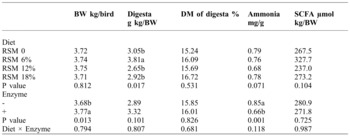
The effect of different dietary levels of RSM and NSP-degrading enzymeson caecal function in young turkeys (Zdunczyk et al., 2013).

BW -body weight, DM-dry matter, SCFA - short chain fatty acids, RSM - rapeseed meal,abMeans within a row with no common superscript differ significantly (P<0.05)
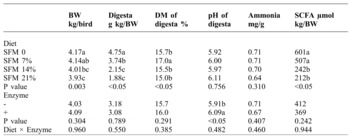
The effect of different dietary levels of sunflower meal (SFM) and NSP-degrading enzymeson caecal function in young turkeys (Juśkiewicz et al., 2010).

BW -body weight, DM-dry matter, SCFA - short chain fatty acids, SFM - sunflower mealabMeans within a row with no common superscript differ significantly (P<0.05)
Rapeseed meal has a high pectin content and complex fibre matrix structure, which results in its high water-holding capacity and poor nutrient availability for monogastric animals, including poultry. Zduńczyket al. (2013) found that the effect of RSM, rich not only in NSPs but also in lignin and polyphenols, may be more pronounced in turkeys than in broiler chickens due to a much longer fattening period in the former. An increase in RSM content above 6% of the diet decreased the amount of caecal digesta, but it had no effect on other parameters of caecal function, including SCFA production (Table 3). The addition of NSP-degrading enzymes increased the weight of caecal digesta, decreased ammonia concentrations, had no effect on SCFA production, and increased the body weights of 8-week-old turkeys.
A slower rate of microbial fermentation following the addition of RSM is due to its high content of insoluble polysaccharides and lignin (Bach Knudsen, Reference BACH KNUDSEN1997), which are relatively resistant to microbial fermentation in the lower GIT. Rapeseed meal is rich in polyphenolic compounds (Amarowiczet al., 2001), known as growth-reducing agents and influencing proliferation of gastrointestinal microbiota (Negi and Jayaprakasha, Reference NEGI and JAYAPRAKASHA2001), and has a relatively low content of water-soluble NSPs (Slominski and Campbell, Reference SLOMINSKI and CAMPBELL1987).
In the past, the use of lupin seeds as a source of protein for poultry was limited due to its high content of bitter alkaloids and NSPs, which negatively affects the growth rate of birds, feed intake and nutrient utilisation. Over the last few decades, plant breeders have worked on selecting lupinvarietiesthat arelowinalkaloids, to improve thenutritional value of lupin as a feed ingredient for monogastrics. Nevertheless, whole lupin seeds still contain approximately 35% NSPs, of which more than 5% are soluble, which affects microbial fermentation and may limit the use of lupins in poultry nutrition.
The composition and activity of gut microbiota was analysed in laying hens fed for 24 weeks a control diet containing SBM and two experimental diets supplemented with 10 or 20% blue lupin seed meal used as a substitute for SBM (Zduńczyket al., 2014). In comparison with soybean, lupin seeds had a higher content of neutral detergent fibre (NDF) and RFOs (25.4vs.9.61% and 7.98vs.5.91%, respectively). In comparison with the control group, the diet with 20% lupins decreased digesta DM and increased the activity levels of mucosal sucrase and maltase in the small intestine. Higher (20%) inclusion level of lupins in laying hen diets had a positive effect on the composition of caecal microbiota. Changes included an increase in the counts ofBifidobacterium spp.,Lactobacillusand/orEnterococcus spp., and a decrease in the counts ofEscherichia coliand bacteria of the generaBacteroides, PrevotellaandPorphyromonas, which enhanced the activity ofbacterial glycolytic enzymes (α- and β-glucosidase, α- and β- galactosidase andα-arabinopyranosidase) and short-chain fatty acid production. The results indicated that beneficial changes in the composition and enzymatic activity of caecal microbiota prevented deterioration in the laying performance of hens fed diets supplemented with lupin seeds which considerably increased the content of NDF and RFOs in the ration.
Lupin seeds are characterised by arelatively high content of a mixture of complex non-starch polysaccharides and oligosaccharides (α-galactosides). The hull from sweet yellow lupins (L. luteus) comprises mostly cellulose, hemicellulose and lignin, which are poorly digested by poultry (Cerning and Filiatre, Reference CERNING and FILIATRE1980), so it should not significantly affect microbial fermentation, while lupin kernels contain mainlyβ-(1-4)-galactan consisting of a mixture of D-galactose, L-arabinose, L-rhamnose, and galacturonic acid (Bach Knudsen, Reference BACH KNUDSEN1997). The cotyledons of lupin seeds contain approximately 8% of RFOs. It has been suggested by some authors that lupin oligosaccharides may be partially digested, may have a negative osmotic effect and could stimulate microbial growth. However, the results of studies on the nutritional effects of galactose-containing oligosaccharides from legumes have been inconsistent (Coonet al., 1990).
Different results were reported in a study where diets were supplemented withSFM at 7%, 14% and 21% andfed for eight weeks to young turkeys(Jankowskiet al., 2011; Juśkiewiczet al., 2010). The effect of partial replacement of SBM with SFM on the intestinal adaptation and growth performance of young turkeys is presented inTable 4. The dietary inclusion of SFM at 14% and 21% caused a significant decrease in the final body weights of birds, caecal digesta weightand the rate of bacterial production of SCFAs. The above mentioned researchers speculated that high SFM inclusion provided extensive amounts of crude fibre, lignin and water-insoluble NSPs resistant to microbial fermentation. Microbiological investigations performed by Mikulskiet al. (2011) revealed that a high dietary level of SFM (21%) in turkey diets caused a significant increase in caecalE. coliandBacteroidesandPrevotellagenera bacteria counts. It seems that at eight weeks of age, which is a critical period, an excessive level of SFM in the diet for growing turkeys does not support the health-promoting effects of gastrointestinal microbiota. The above results indicate that high-fibre SFM could be used at up to 7% without any adverse effects on the GIT physiology of growing turkeys.
The results of these experiments show that RSM and lupin seeds, applied as partial substitutes for SBM in turkey diets, affected fermentation processes in the GIT of turkeys to a relatively low degree. This is probably due to the fact that both SBM substitutes insignificantly decreased RFO concentrations, and they did not cause considerable changes in the NSP profile of diets. An increase in SFM content, from 7% to 14% and 21%, significantly reduced SCFA production in the caecum, which could lead to lower daily gains, similarly as a substantial decrease in RFO levels in the diet containing a soybean protein isolate.
Conclusions
The recent advances in our understanding of the postileal fermentation in the digestive tract of birdsmay allow for precise feed formulation and good diet utilization. But it seems that precise modulation ofpostileal fermentation to improve birds’ performance still needs more research for better understanding of this complex system. Raw materials (grains and protein sources) seem to be the most important nutritional factors affecting postileal fermentation. However, certain feed additives could be very valuable tools to manipulate birds’ caecal fermentation.