


Introduction
Over the past 25 years, several researchers have focused on rumination as it plays a prominent role in predicting and maintaining depressive symptoms. The meta-cognitive model of rumination (Papageorgiou and Wells, Reference Papageorgiou and Wells2003) is one of the representative models for the mechanisms of rumination and depression. According to this model, at first, a positive meta-belief such as ‘ruminating about my problems helps me’ occurs in response to a trigger. Further, in response to positive meta-beliefs, rumination, which is supposed to help in problem solving or understanding the problem, occurs. However, in many cases, rumination is prolonged and repetitive without resulting in any effective solution. Consequently, negative meta-beliefs about rumination such as ‘ruminating about my problems is uncontrollable’ are likely to grow. Moreover, negative meta-beliefs induce further rumination, which exacerbates depressive symptoms (Papageorgiou and Wells, Reference Papageorgiou and Wells2009). Conversely, Papageorgiou and Wells (Reference Papageorgiou and Wells2003) also considered that depression-related cognition and/or behaviour could also be a factor of negative meta-beliefs.
Although some prior studies have supported the meta-cognitive model of rumination, almost all previous studies employed a cross-sectional design. There are insufficient longitudinal studies supporting the meta-cognitive model of rumination (except Papageorgiou and Wells, Reference Papageorgiou and Wells2009). Longitudinal studies are essential for examining the relationship between rumination, meta-beliefs and depression, as these variables indicate high correlations and the general factor of repetitive thinking style can be assumed to be based on these variables. Under such conditions, significant pathways will probably be obtained, even if they lack causal relationships.
In addition to the meta-cognitive model of rumination (Papageorgiou and Wells, Reference Papageorgiou and Wells2003), we focused on the uncontrollability of rumination (Raes et al., Reference Raes, Hermans, Williams, Bijttebier and Eelen2008), which reflects the perception or experience of having uncontrollable thoughts and might be driven by negative meta-beliefs. Uncontrollability of rumination has also garnered much attention recently as it is closely related to depressive symptoms (Raes et al., Reference Raes, Hermans, Williams, Bijttebier and Eelen2008). However, no previous studies have longitudinally examined the relationship between negative meta-beliefs, uncontrollability of rumination, and depressive symptoms. Therefore, these issues need to be addressed.
We longitudinally examine the meta-cognitive model and uncontrollability of rumination and depression. Although both causal analytic and understanding rumination (Raes et al., Reference Raes, Hermans, Williams, Bijttebier and Eelen2008) are involved in rumination in response to positive meta-beliefs, we used both factors to examine whether rumination type could predict negative meta-beliefs and whether positive meta-beliefs predicted causal analytic and understanding rumination.
Method
Participants and procedure
Data were collected at two points: April (Time 1) and October (Time 2). Participants took part in exchange for course credits. Participants were Japanese undergraduate students who majored in psychology (Time 1: n = 242, 156 women, 20.15 ± 3.44 years; Time 2 (6 months later): n = 117, 71 women, 20.43 ± 0.82 years). The questionnaire consisted of the Beck Depression Inventory Second Edition (BDI-II), Positive Beliefs about Rumination Scale (PBRS), Negative Beliefs about Rumination Scale (NBRS) and Leuven Adaptation of Rumination on Sadness Scale–causal analytic factor and understanding factor (LARSS). Before responding to the questionnaire, all participants provided informed consent for each investigation. This research was approved by the ethics committee of Human Sciences, University of Tsukuba (no. 27-11).
Measures
We measured positive meta-beliefs using the PBRS (Papageorgiou and Wells, Reference Papageorgiou and Wells2003), rumination in response to positive meta-beliefs using the LARSS (Raes et al., Reference Raes, Hermans, Williams, Bijttebier and Eelen2008), negative meta-beliefs using the NBRS (Papageorgiou and Wells, Reference Papageorgiou and Wells2009), uncontrollability of rumination using the LARSS uncontrollability factor, and depression using the BDI-II (Beck et al., Reference Beck, Steer and Brown1996).
Statistical analyses
All analyses were conducted using IBM SPSS 22.0 and Amos 22.0. To address missing-at-random data, the full information maximum likelihood method was used. To comprehensively examine the meta-cognitive model of rumination and depression, cross-lagged effect modelling was conducted. For model selection, we used chi-square, comparative fit index (CFI), root mean square error of approximation (RMSEA), 90% confidence interval (CI), and Akaike's Information Criterion (AIC). We set the criterion of good-fit model, chi-square less than 2 d.f., CFI more than .97, RMSEA less than .05 and lower bound of 90% CI was .00, and acceptable AIC. As a 90% CI of the RMSEA is influenced by the sample size and considering the current small sample size, the criterion of the upper bound of 90% CI was much less than .10.
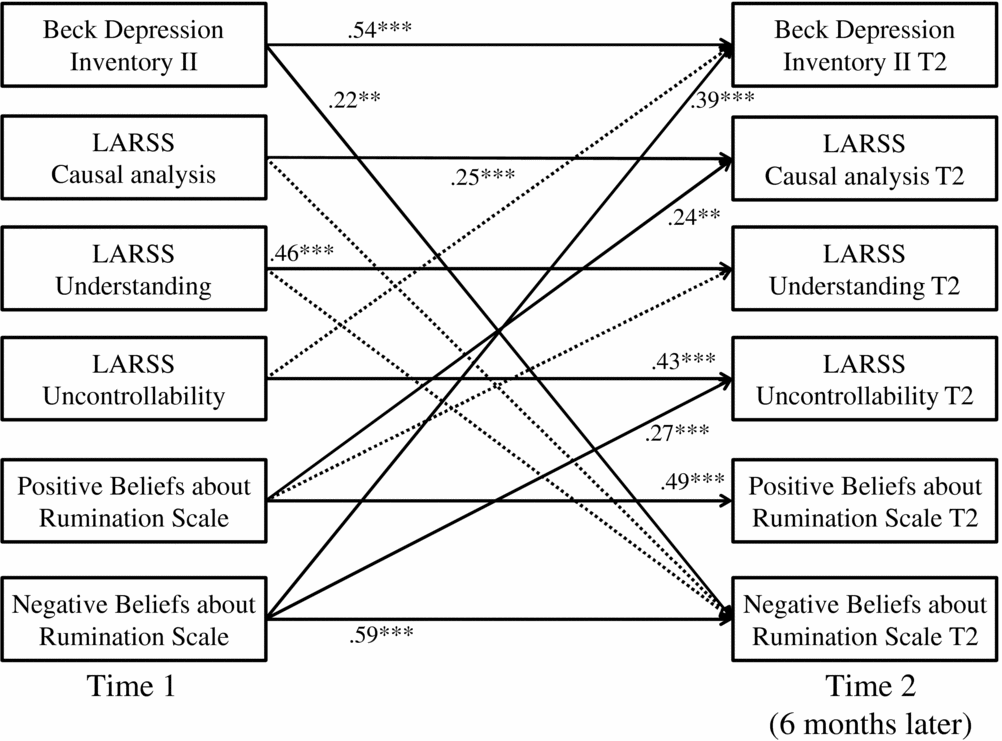
We used cross-lagged effect modelling to infer the reciprocal relationships. We tested eight cross-lagged pathways in our hypothetical model and specified what pathways were particularly relevant (Fig. 1; see also Fig. 1 in supplemental material). In addition to freely estimated baseline autoregressions, our hypothetical model assumed several regression pathways: PBRS at Time 1 to LARSS causal analysis and understanding at Time 2, LARSS causal analysis and understanding at Time 1 to NBRS at Time 2, NBRS at Time 1 to LARSS uncontrollability and depressive symptoms at Time 2, LARSS uncontrollability at Time 1 to depressive symptoms at Time 2, and depressive symptoms at Time 1 to negative meta-beliefs at Time 2.
Cross-lagged effect modelling of the meta-cognitive model of rumination and depression (**p < .01, ***p < .001). LARSS, Leuven Adaptation of Rumination on Sadness Scale; non-significant paths are illustrated as dotted lines.

Results
Descriptive statistics and correlations
There was a non-significant difference between the participants at Time 1 and Time 2 in the BDI-II (t = 0.20, p = .84), PBRS (t = 0.28, p = .78), NBRS (t = 0.21, p = .84), LARSS causal analysis (t = 0.24, p = .81), understanding (t = 0.52, p = .60), and uncontrollability (t = 0.95, p = .34) scores. There was also a non-significant difference between the drop-out group and completed group at Time 1 for BDI-II (t = 0.01, p = .99), PBRS (t = 0.54, p = .59), NBRS (t = 0.65, p = .51), LARSS causal analysis (t = 0.17, p = .86), understanding (t = 1.71, p = .09), and uncontrollability (t = 0.72, p = .47) scores. For these reasons, the following analysis was conducted assuming the missing-at-random data.
Cross-lagged effects modelling
Our hypothetical model was a good-fit based on chi-square, CFI, RMSEA (chi-square = 32.92, d.f. = 22, p = .063, CFI = .993, RMSEA = .045, 90% CI = [.000, .076], AIC = 168.92). The results showed that there was a significant positive effect of positive meta-beliefs at Time 1 on causal analytic rumination at Time 2 (β = .24, B = .20, SE = .07, p = .003). Negative meta-beliefs moderately predicted elevated levels of depressive symptoms at Time 2 (β = .39, B =.43, SE =.09, p < .001), and, in turn, depressive symptoms at Time 1 positively predicted high negative meta-beliefs at Time 2 (β = .22, B = .18, SE = .06, p = .002). Moreover, there was a positively significant effect of negative meta-beliefs at Time 1 on uncontrollability of rumination at Time 2 (β = .27, B = .18, SE = .05, p < .001). These results support our hypothetical model.
On the other hand, positive meta-beliefs at Time 1 did not predict the understanding form of rumination at Time 2 (β = .14, B = .12, SE = .06, p = .065). Moreover, negative meta-beliefs at Time 2 were not predicted by causal analytic rumination at Time 1 (β = .01, B = .02, SE = .14, p = .88) and understanding form of rumination at Time 1 (β = .05, B = .08, SE = .11, p = .49). Uncontrollability of rumination at Time 1 did not predict depressive symptoms at Time 2 (β = –.05, B = .09, SE = .13, p = .48).
Discussion
We performed longitudinal measurements for 6 months and conducted cross-lagged effect modelling to investigate the meta-cognitive model and the uncontrollability of rumination and depression.
In line with the meta-cognitive model of rumination and our hypothetical model, the results showed that positive meta-beliefs somewhat predicted prominent levels of causal analytic rumination. Previous studies had used a cross-sectional design to understand this (e.g. Papageorgiou and Wells, Reference Papageorgiou and Wells2003); however, we extended those findings by verifying the relationship longitudinally. On the other hand, inconsistent with the meta-cognitive model of rumination and our hypotheses, positive meta-beliefs did not predict the understanding form of rumination. The results suggested that causal analytic rumination was more driven than the understanding form of rumination by positive meta-beliefs.
We did not find such causal analytic or an understanding form of rumination that contributed to the strengthening of negative meta-beliefs. This finding is inconsistent with the meta-cognitive model of rumination and some cross-sectional studies (e.g. Papageorgiou and Wells, Reference Papageorgiou and Wells2003). The potential reason for this dissimilar result could be the way rumination was measured. Previous studies used the Ruminative Responses Scale (RRS; Treynor et al., Reference Treynor, Gonzalez and Nolen-Hoeksema2003) to measure rumination; however, we used the LARSS causal analysis and understanding factors. The RRS includes brooding types of rumination and depression-related rumination (Treynor et al., Reference Treynor, Gonzalez and Nolen-Hoeksema2003), and this scale is highly correlated with depressive symptoms. On the other hand, the LARSS causal analysis and understanding factors are moderately correlated with depressive symptoms. This implies that the prediction of RRS on negative meta-beliefs, which was supported by previous studies, might be confounded by depression-related elements which were included in the RRS. Our finding regarding the prediction of depressive symptoms on negative meta-beliefs also supports this view.
Consistent with the meta-cognitive model of rumination and our hypothetical model, negative meta-beliefs moderately predicted prominent levels of depressive symptoms. This result was a replication of the findings of Papageorgiou and Wells (Reference Papageorgiou and Wells2009). Moreover, results suggest that depressive symptoms also somewhat predicted prominent levels of negative meta-beliefs. This longitudinal relationship is a novel finding. Therefore, negative meta-beliefs and depressive symptoms were reciprocally associated with each other. The prediction of depressive symptoms on negative meta-beliefs suggests that depression-related cognition or behaviour might be involved in increasing negative meta-beliefs.
Finally, consistent with our hypothetical model, the results suggest that negative meta-beliefs drive uncontrollability of rumination. However, uncontrollability of rumination did not contribute to depressive symptoms. The results explained the working mechanism of meta-cognitive therapy for rumination. Wells (Reference Wells2009) argued that rumination, as a response to meta-beliefs, persisted if meta-beliefs were modified. This is because rumination itself was habituated to and associated with some stimulus within the environment. According to these theories, meta-cognitive therapy for rumination treats meta-beliefs about rumination; however, it cannot treat rumination itself. Nevertheless, the fact that meta-cognitive therapy was effective in reducing depressive symptoms could be because negative meta-beliefs are the root of depressive symptoms. This, conversely, means that it is not essential to treat the uncontrollability of rumination itself.
The limitations of the present study were that we examined only non-clinical students and had a relatively small sample. Further examinations regarding clinical depression and using a large sample are needed. In addition, examination of different time frames would shed light on how variables in the meta-cognitive model behave over time.
Acknowledgements
We are grateful to Dr Costas Papageorgiou for providing materials.
Ethical statements: All procedures performed in this study were in accordance with the ethical standards of the institutional and/or national research committee and with the 1964 Helsinki declaration and its later amendments or comparable ethical standards.
Conflicts of interest: The authors declare that they have no conflicts of interest.
Financial support: This work was supported by Japan Society for the Promotion of Science (grant number 14J00543).
Supplementary material
To view supplementary material for this article, please visit https://doi.org/10.1017/S1352465818000103




Comments
No Comments have been published for this article.