I. INTRODUCTION
Responsive hydrogels display a large and reversible volume change upon changes in environmental conditions including pH, temperature, redox, light, and chemical entities.Reference Hou, Matthews, Smitherman, Bulick, Hahn, Hou, Han and Grunlan1–Reference Liu, Chen, Guo and Jiang4
For most applications of responsive gels, such as actuators, sensors, or drug delivery systems, the ability to control or maximize the response rate is one of the most important factors for technical success.Reference Suzuki and Kumagai5–Reference Burdick, Khademhosseini and Langer7 Therefore, swelling and shrinking rate of these gels are the critical properties that should be considered in the design and preparation of appropriate gels for each application. However, conventional hydrogels cross-linked by chemical cross-linkers such as BIS or irradiation by γ-rays show obvious slow response rate due to their characteristic of structure.Reference Hirotsu and Onuki8,Reference Takigawa, Araki, Takahashi and Masuda9 According to the previous research, the volume change process of gels is generally determined by the cooperative diffusion of the polymer in the solvent; meanwhile, the cooperative diffusion is controlled by the diffusion coefficient of polymers and the distance of the path for water diffusing out of gels. For typical nonporous hydrogels, such as PNIPA hydrogels cross-linked by BIS, the diffusion coefficient of polymers is on the order of 10−7 cm2/s, resulting in a slow response rate.Reference Gehrke10,Reference Kato and Gehrke11 On account of that the diffusion coefficient for polymer is hard to improve drastically, and decreasing the diffusion path length of water is regarded as an effective method to achieve a fast response rate. Obviously, water that flows into/out of the porous hydrogels through the interconnected pores is faster than diffusion through the gels' network. On the other hand, when homogeneous NIPA hydrogels undergo an increased temperature across the lower critical solution temperature (LCST), changes in their morphology, that is, skin layer or bubble formation, are observed on the gel surface. This phenomenon can slow down the response rate and induce structural disorders and functional decline of the gels. The interconnected porous structure could eliminate the “surface effect” significantly.Reference Kaneko, Yoshida, Sakai, Sakurai and Okano12
Aiming at the preparation of porous hydrogels, many kinds of techniques have been used to make the pores inside the gels, such as adding various pore-forming agents, synthesizing the gels above the LCST to make a phase separation or at a freezing temperature to form the ice crystal as a pore template, using the mixing solution, graft-copolymerization, and semi-interpenetrating network structure.Reference Kaneko, Asoh and Akashi13–Reference Mahdavinia, Marandi, Pourgavadi and Kiani19 Among all these techniques, synthesizing at “freezing temperature” is a simple and practical one since the ice crystal could form localized templates in polymer network, which leaves the interconnecting pores after the ice changes to water and provides the channels for water diffusion. The gels prepared by freezing polymerization always exhibit a very fast response rate. For example, when freezing the polymerized PNIPA hydrogels prepared by Xu could lose 95 wt% water in 1 min and reswell to 70 wt% of former gel in 30 min, whereas the PNIPA hydrogels with interpenetrating silicon skeleton network synthesized by using freezing polymerization at −14 °C could lose 72 wt% water within 6 s.Reference Xue, Champ, Huglin and Jones20,Reference Strachotová, Strachota, Uchman, Šlouf, Brus, Pleštil and Matějka21 In general, previous research studies with respect to freezing polymerization are almost all focused on the gels cross-linked by chemical cross-linker (OR gels), and the intrinsic poor mechanical properties of such gels are still a great drawback for the application although their response rate has been improved by freezing process. Therefore, it is promising to prepare a gel with well comprehensive performance by carrying out the freezing polymerization technique on the gels originally having excellent mechanical properties.
In this study, PNIPA nanocomposite hydrogels cross-linked by nanosized clay (NC gels) were synthesized by a two-step freezing polymerization instead of traditional polymerization at 20 °C to create porous structure in gels. NC gels, developed by Haraguchi et al., have been extensively investigated as advanced hydrogel materials. In NC gels, the exfoliated sheet clay as a multifunctional physical cross-linker is uniformly dispersed in an aqueous medium with flexible polymer chains linking them together, and more homogeneous distribution of clay and less cross-linking units than OR gels avoid the localization of stress during deformation and improve the mechanical properties of gels dramatically. Therefore, NC gels exhibit large deformability (higher than 1000%), amazing toughness, high optical transparency, good swelling properties, and fast response rate.Reference Haraguchi, Takehisa and Fan22–Reference Endo, Miyazaki, Haraguchi and Shibayama26 Obviously, choosing NC gels as the matrix for freezing polymerization is superior to OR gels due to their excellent mechanical properties. Meantime, for NC gels, it should be more attractive when the gels have a great improvement on response rate.
However, the effect of freezing on gels’ structure and properties is complicated and controlled by several factors, such as the content of water, the crosslink density, and the freezing temperature. These factors have all been researched focusing on various OR gels. Okay prepared the PAAm hydrogels with different concentrations of monomer at various freezing temperatures and concluded that the pore structure could be controlled by both variates. The critical temperature that determines the interconnection of pores was found. When polymerizing below −8 °C, the gels exhibit interconnected micropores. The content of water affects the size of the pores.Reference Ozmen, Dragan and Okay27 Huglin synthesized a series of PNIPA OR gels at −28 °C followed by polymerization at 20 °C. The reaction time at 20 °C determines the response rate of gels directly.Reference Xue, Hamley and Huglin28 Strachotová et al. prepared double network PNIPA OR gels by freezing the pre-solution at before, on, and after the gel-point of system, the different freezing time helped in distinguishing the properties of gels.Reference Lutecki, Strachotová, Uchman, Brus, Pleštil, Šlouf, Strachota and Matějka29 Among these factors, the start freezing time is easy to control and adjust. The formation of solid-state ice crystal in different reaction time related to various polymer structures makes a disparate impact on the structure of gels. For example, freezing the gels after the formation of network structure, the ice crystal formed outside the polymer matrix makes a slight effect on the polymer network structure. While, before the formation of network, the ice crystal should affect the situation of polymer chains, networks and form inside the polymer matrix to make the pores as a template.
Due to the characteristic of PNIPA NC gels that the content of cross-linker clay in gels determines all properties of gels, controlling the freezing time and the content of clay may be the convenient method to adjust the properties of gels. Specially, based on different mechanisms between NC gels and OR gels, it is necessary to investigate the effect of start time of freezing in polymerization on the structure and properties of NC gels comprehensively. There is no doubt that finding the rule of freezing time affecting the properties of the gels with various content of clay is valuable to prepare the gels with a fast response rate and excellent properties.
II. MATERIALS AND METHODS
A. Materials
Poly(N-isopropylacrylamide) (PNIPA) provided by TCI Co., Japan, was purified by recrystallization from a toluene/n-hexane mixture (2/1 w/w) and dried under vacuum at 40 °C. Potassium peroxodisulfate (KPS) and N,N,N′,N′-tetramethylethylenediamine (TEMED) were all purchased from Aladdin Co., China, and used without further purification. Synthetic hectorite “Laponite RD” ([Mg5.34Li0.66Si8O20-(OH)4] Na0.667 with 7.68 wt% Na4P2O7, layer size = 20–30 nm*Φ 1 nm) was purchased from Rockwood Co. Deionized water was distilled for all experiments including swelling/deswelling experiments.
B. Methods
1. Synthesis of gels
Freezing polymerized PNIPA NC gels (named as F-NC gels) were prepared by a two-step polymerization technique. In brief, the first step is as follows: a transparent aqueous solution consisting of water, inorganic clay, and NIPA monomer was prepared through a 1 h stirring by magnetic stirrer at ice-water temperature. Then, the aqueous solution of initiator KPS and catalyst TEMED was added into the former solution with stirring; all process was under the protection of pure nitrogen. Immediately, transfer the pre-polymerization solution to the mold and seal, and free radical polymerization was allowed to proceed in a water bath at 20 °C for a set time (t). Following the first step, the second polymerization step was performed by transferring the mold to the condition at −28 °C and reacting for 48 h. Finally, the prepared gels were immersed into deionized water to remove the unreacted monomer as purification. The mass ratio of water:monomer:initiator:catalyst was 1000:100:1.02:0.755. In this research, four different kinds of polymerization modes corresponding to different time for starting freezing (or represent as the reaction time (t) in the first step) were used in polymerization, which is described in detail in Sec. III. A. The resulting gels are expressed as Fn-NCm gels, where n and m correspond to the reaction mode and the mole percent of clay against NIPA monomer, respectively. Meanwhile, the NC gels synthesized at 20 °C were also prepared and named as N-NCm gels for comparison.
2. Characterization of gels
The transparency of the gels in polymerization was detected with a Lambda 950 UV/vis spectrophotometer (Perkin-Elmer Inc., Waltham, MA) at 600 nm wave length and 20 °C. The morphology of the network structure of gels was observed by a S000n low-vacuum scanning electron microscope (Hitachi Inc., Schaumburg, IL), each sample for observation was rapidly frozen and subsequently frozen-dried for 48 h under vacuum at −40 °C. The surface morphology of shrinking gels was observed by a LV100POL/50iPOL polarizing microscope (Nikon Inc., Japan), the sample in dehydration at 50 °C was rapidly wiped and transferred to a microscope slide for observation. Differential scanning calorimetry (DSC) was performed using a DSC-7 differential scanning calorimeter (Perkin-Elmer Inc.) in a nitrogen gas atmosphere with milled gels, heating from 30 to 250 °C at a heating rate of 1 °C/min. Glass transition temperatures (T g) were obtained from the second run after heating to 250 °C in the first run. X-ray diffraction profiles were obtained by using a D8 advance Cu Kα x-ray diffractometer (Bruker AXS Inc., Madison, WI) with milled dried samples.
3. Dynamic rheological experiments
The rheological tests were carried out on a stress-controlled rheometer AR2000 (TA Instruments Inc., New Castle, DE) in dynamic mode at 20 °C. The linear viscoelasticity region was confirmed by a dynamic strain sweep at a constant frequency of 1 rad/s. The storage moduli G′ and loss moduli G″ were characterized by dynamic frequency sweeps from 0.1 to 100 rad/s, conducted in fixed strain γ = 1%, which is within the linear regime, confirmed by dynamic strain sweeps.
4. Mechanical measurements
Tensile mechanical measurements were performed on gels of the same size 5.5 mm Φ*80 mm length using a UTM6000 universal mechanical tester (Suns Inc., China). The sample length between the jaws was 35 mm, the crosshead speed was 100 mm/min, the initial cross section 23.75 mm2 was used to calculate the tensile strength and tensile modulus, and the tensile strain was taken as the length change relative to the initial length of the sample. The tensile modulus was calculated from the increase in load detected between the elongation of 20 and 100%.
5. Swelling experiments
The swelling experiment was performed by immersing the dried gels in water at 20 °C at least for 48 h to reach the equilibrium. The weight of gel was measured after wiping off the excess water on the surface with moistened filter paper. The swelling ratio was calculated from the following formula: Swelling ratio (SR) = (W t − W d)/W d, where W t is the weight of swollen hydrogels at specific time (t) and W d is the dry weight of the hydrogels.
6. Deswelling kinetics experiments
The deswelling kinetics of the hydrogels after a temperature jump from the equilibrated swollen state at 20 °C to the hot water at 50 °C were measured after wiping off the excess water on the surface with moistened filter paper. The water retention corresponding to deswelling ratio was calculated from the following formula: Water retention (WR) = (W t − W d)/(W s − W d)*100%, where W s is the weight of equilibrate hydrogels.
III. RESULTS AND DISCUSSION
A. Gel's preparation
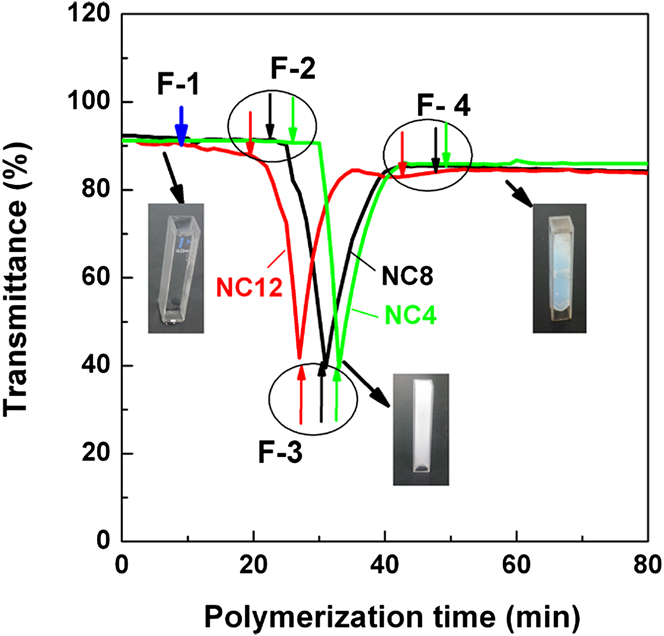
In freezing polymerization, the formation of ice crystal at different polymerization stages plays a dominant role in determining the structure and properties of gels, which is attributed to the disparate impact of steric hindrance and template effect on the formation of polymer network structure. While comparing with OR gels having fast gelling speed (gelation in 2–3 min), NC gels exhibit a relative long time and individual formation process, being unique to each gel system. For different NCn gels, the same reaction time may correspond to different polymerization degrees and structure features due to the individual reaction process. Hence, confirming the polymerization status accurately is the prerequisite for investigating the impact of freezing on gels. Focusing on the formation of NC gels, Haraguchi has proved that the changed transparency of solution is related to the formation process of NC gels directly. Four typical status related to the change of structure were found; to describe it briefly, at the beginning of polymerization, the pre-solution is transparent, in which the initiation and the gradual formation of oligomers happen. As polymerization continues, the abrupt decrease of transmittance appears, related to the start of gelation, which is attributed to the change in density locally due to the formation of clay-brush particles in the surface of clay. After that, the formation of the longer grafted polymer chains and the disappearance of density discrepancy between clay-brush particles and matrix collectively result in the recovery of transparency. Finally, the transparency remains at a high degree, indicating the formation of gels. According to this mechanism, start of freezing in these four representative status should result in different effects on the gels significantly.
Although the formation mechanism of NC gels is similar, making sure the polymerization stage of various NC gels precisely by fixed time or experience may be invalid due to the unique formation process, which is determined by the concentration of monomers, reaction temperature, the mass of clay, initiator, and catalyst collectively. Consequently, for a precise judgment relative to the time and corresponding polymerization stage, for the NC4, NC8, and NC12 gels involved in this paper, the transparency change in polymerization is measured by UV spectrophotometer respectively, and the typical curves are shown in Fig. 1, from which the polymerization process could be confirmed.
Changes of optical transparency during the polymerization of NC4, NC8, NC12 gels.

Based on the curves, four different freezing modes corresponding to the start of freezing at different polymerization stages were chosen. As shown in Fig. 1, for each NC gels, the freezing was designed to start at 10 min after reaction at 20 °C (F-1 mode), 5 min before the drastic decrease of transparency (F-2 mode), the time at the lowest transparency (F-3 mode), and 10 min after the recovery of transparency (F-4 mode). Considering the heat transmission speed (about 3–5 min to form the ice crystal in this research), these four freezing modes guarantee that the formation of ice crystal starts at the four typical stages of polymerization as described above: the start of polymerization, the start of clay-brush structure formation, the formation of longer grafted polymer chains, and the finish of gelation, respectively.
Besides, in nomenclature of Fn-NCm gels, n corresponds to the freezing mode, for example, F1-NCm gels are the gels synthesized by F-1 mode.
B. Morphology of gels
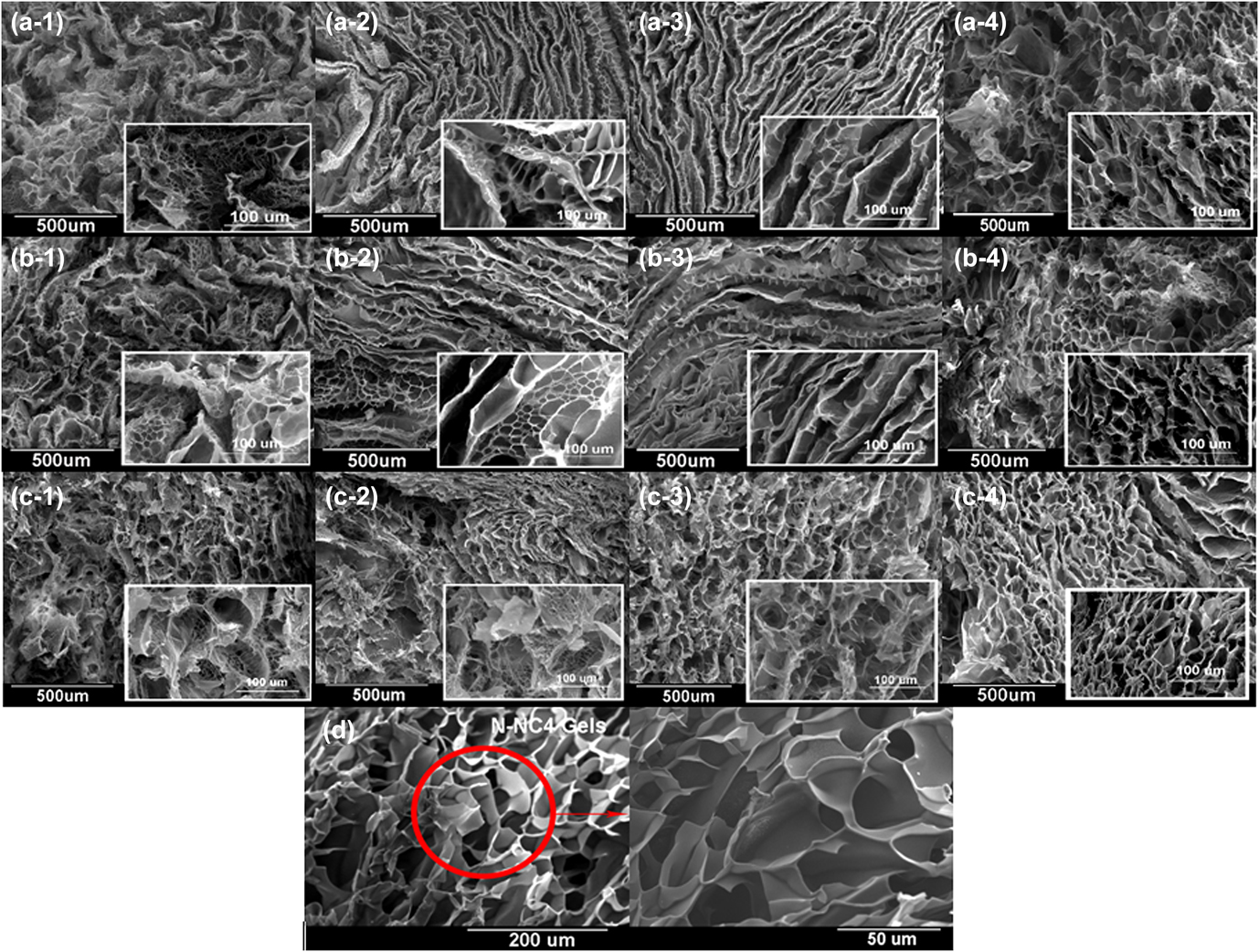
The ice crystal formed in different polymerization time determines the morphology of gels' structure. Figure 2 exhibits the evolution of morphologies belonged to the NC4, NC8, and NC12 gels polymerized by different freezing modes. For F1-NC4 gel, the network structure is extremely disordered with enormous quantities of interpenetrating micropores dispersed in entire gel's matrix, the sizes of micropores distribute in a wide range from 1–30 μm. F2-NC4 gel and F3-NC4 gel display a similar morphology, in which the polymer network becomes clear with discernible profile, meaning more regular structure, by comparison, the interpenetrating porous structure of F2-NC4 gel is more intensive. Relatively, F4-NC4 gel exhibits an integral macroporous network structure similar to that of N-NC gels [Fig. 2(d)], the interpenetrating micropores are almost invisible. To explain the mechanism of this change, in F-1 mode, freezing is carried out before the formation of long polymer chains, on the one hand, the ice crystal limits the space for enough activity of polymerized short chains so that effects the enough crosslink, resulting in a disordered network structure instead of integrated crosslink network. On the other hand, the random dispersion of ice in the polymer matrix leads to the formation of interpenetrating micropores. With the delay of freezing time, in F-2 mode, although the gelation does not happen, the polymer chains in clay have gradually formed, which guarantees the resulting formation of relatively integral network structure, while the ice crystal formed among uncrosslinked polymer chains could still produce the interpenetrating micropores. Comparably, in F-3 mode, the freezing happens during the process of gelation, the formed network structure weakens the effect of ice crystal, resulting in the decrease of micropores significantly. Finally, in F-4 mode, due to the formation of stable and integrated polymer network, the ice crystal forms out of the polymer matrix, which could only affect the shape and size of macropores of gel's skeleton.
Representative SEM images of frozen-dried gels (a) Fn-NC4, (b) Fn-NC8, (c) Fn-NC12, and (d) N-NC4. Images of 1, 2, 3, 4 correspond to the F1, F2, F3, and F4 gels.

The morphologies of NC8 and NC12 gels were also observed for a horizontal detailed comparison. As shown in Fig. 2(b), the evolution of structure for F-NC8 gels undergoes a similar process as that of F-NC4 gels, the difference is just the size and intensity of macropores due to the differentiated crosslink density. Furthermore, it is noteworthy that the morphology belonged to NC12 gels exhibits some distinctive characteristic. Despite that the interpenetrating pores still appear in F1-NC12 and F2-NC12 gels, the polymer network looks like more integral, revealing the slight impact of freezing on formation of polymer network. It may be explained reasonably that with the increase of cross-linker clay, the distance between nanosized sheet decreases, which makes the crosslink of polymer chains easier to achieve, even under the freezing condition. Therefore, it could be concluded that the structure of NC gels with high content of clay is impacted by the freezing more slightly.
C. Mechanical properties of gels
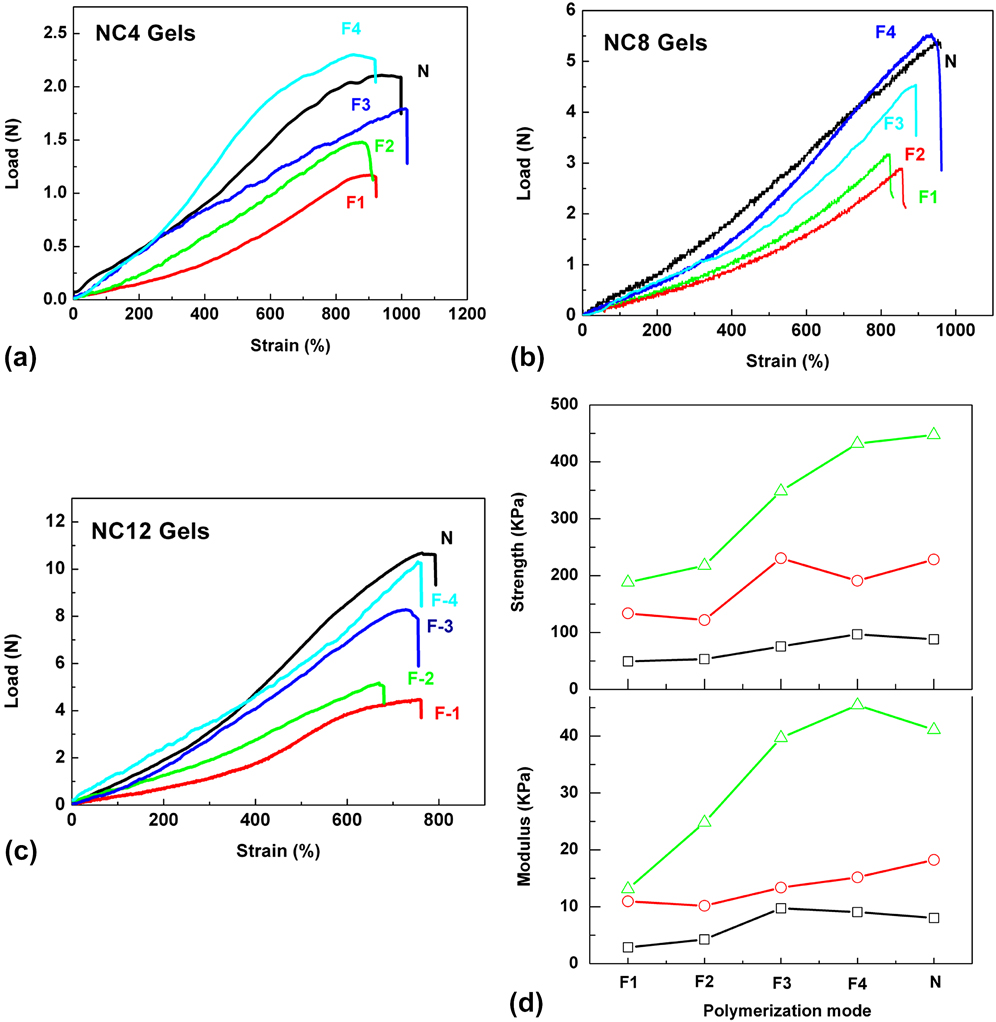
NC gels exhibit excellent mechanical properties including toughness, large deformation, high tensile modulus and strength due to the homogeneous crosslink of polymer chains by clay. Undoubtedly, the change of structure affected by freezing should lead to changed mechanical properties of gels. In tensile tests, all F-NC gels still display a flexible and toughness feature, being hard to destroy under bending and large deformation, which is similar to N-NC gels. However, the changed tensile behavior of F-NC gels is also worth to investigate in detail. The load–strain curves of F-NC gels are shown in Figs. 3(a)–3(c), obviously, for all gels, the maximum load decreases considerably with the earlier start time of freezing, especially for F1 and F2 series gels, revealing the serious impact of freezing on the strength of gels. While, the F4-NCm gels exhibit similar curves with that of N-NC gels. From the calculated tensile strength and modulus shown in Fig. 3(d), it could be found that the tensile strength and modulus of F1 and F2-NC gels decrease drastically to only half of N-NC gels'. Associating the mechanical data with the evolution of gels' morphology discussed above, it could be summarized that the gels with more integral network structure possess higher tensile strength basically. Apparently, the interconnected porous structure makes the network become more easily damageable under stress. Besides, for NC gels, the tensile strength and modulus increase with the increase of clay dramatically, the rule is also available to the F-NC gels.
Tensile properties of N-NC gels and F-NC gels. (a), (b), (c) are the load–strain curves of gels in tensile tests and (d) is the calculated strength and modulus of gels.

In summary, although the freezing polymerization indeed causes the considerable decrease of mechanical properties, especially for the gels prepared by F-1 and F-2 mode, comparing with other gels reported previously, some F-NC gels still exhibit excellent mechanical properties (such as elongation of break higher than 800% and tensile strength higher than 200 kPa), which is acceptable in many application fields.
D. Viscoelastic behavior of gels
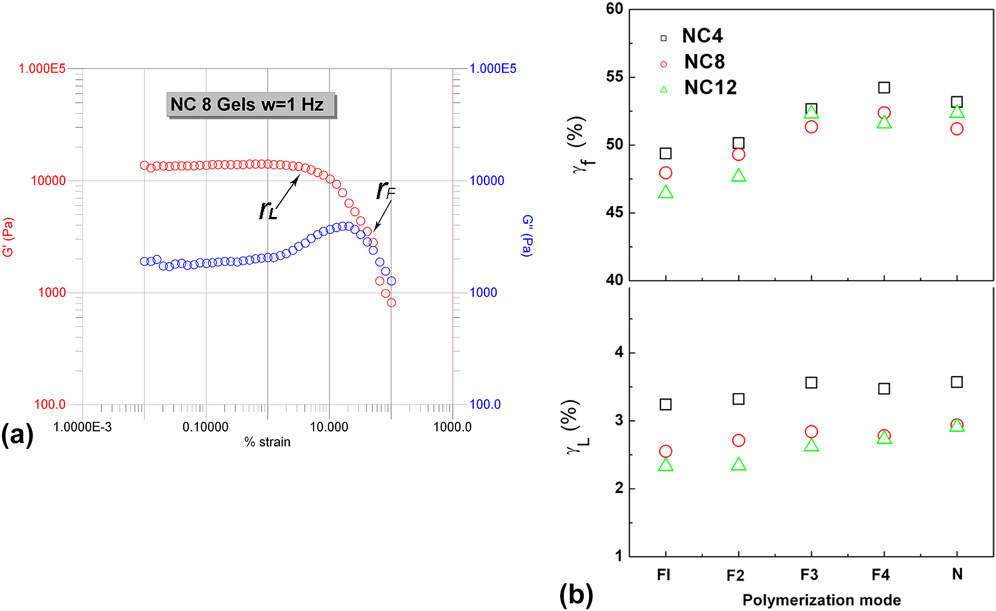
The viscoelasticity behavior responds the strength and structure feature of gels. Through the dynamic strain sweep, it was found that, as the typical curve shown in Fig. 4(a), the strain γ of all analyzed gels could be divided into three regions according to the feature of storage modulus G′ and loss modulus G″. They are, linear viscoelasticity region (LVE) (γ < γL), in which G′ keeps unity, corresponding to the complete gel phase, yield region (γL < γ < γf), in which G′ decreases but is still higher than G″, the sample keeps the character of gels, while only partial deformation could recovery, flow region (γf < γL), in which G″ becomes higher than G′, meaning that the sample displays complete irreversible deformation. The γf and γL of F-NC gels, corresponding to the ultimate deformation for keeping complete elasticity and the initial deformation for viscous deformation of gels, are shown in Fig. 4(b). The change in tendency of γL and γf for Fn-NCm (m = 4, 8, 12) gels as a function of freezing mode is similar, the obvious decline of both γf and γL is observed in F1 and F2 gels, indicating that the elasticity of gels should be destroyed under lower deformation.
γf and γL of N-NC gels and F-NC gels in dynamic strain sweep at fixed frequency = 1 Hz. (a) Typical G′ and G″ curves of N-NC8 gel. (b) γf and γL as a function of polymerization mode.

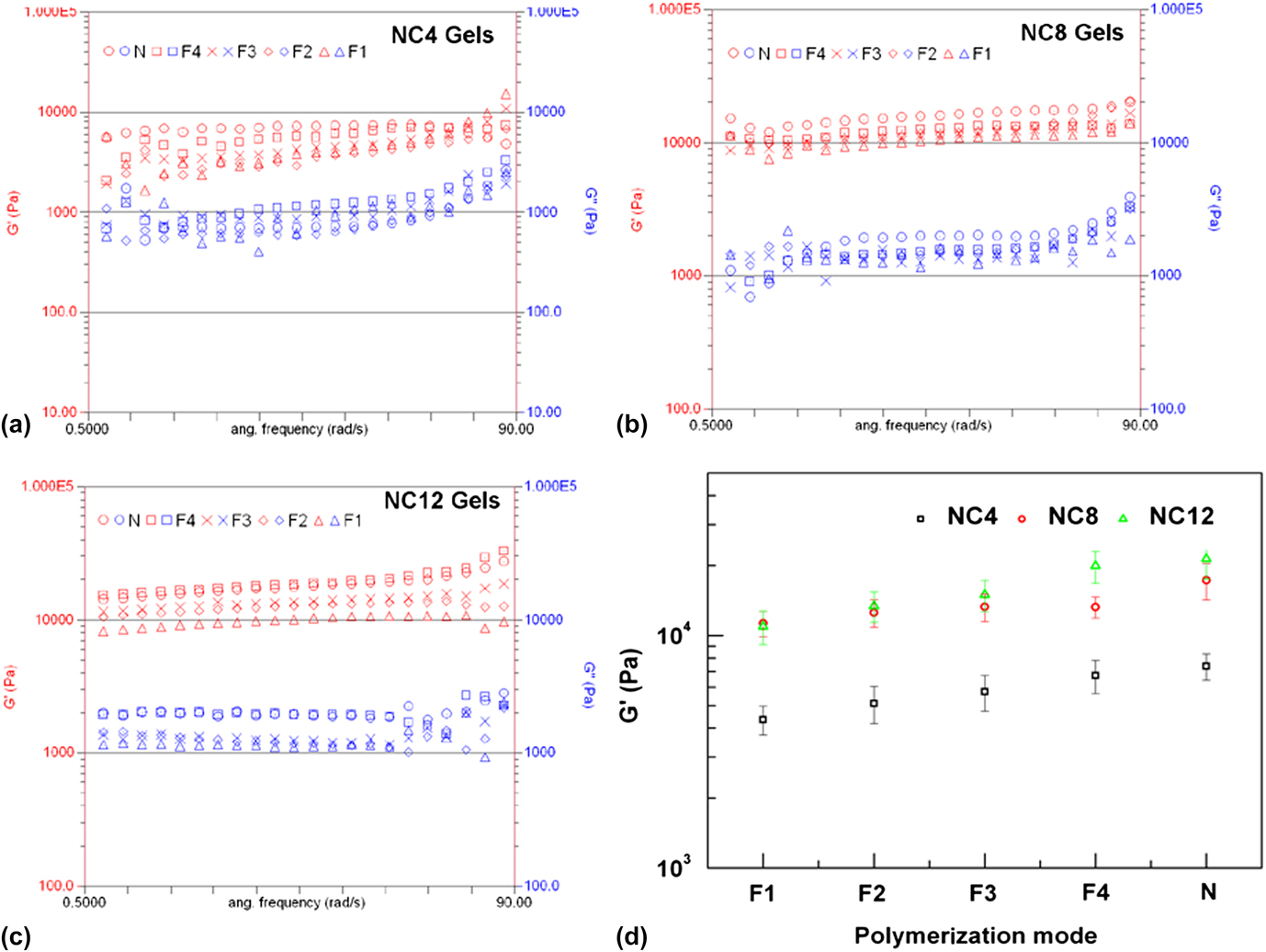
Meantime, G′ in LVE region is commonly regarded as the strength of gels. G′ and G″ of all gels measured by a dynamic frequency sweep under 1% strain (in LVE region) are shown in Fig. 5. For the gels with the same content of clay, the freezing polymerization results in the considerable decrease of G′, indicating the significant decline of gels' strength, especially for the F1 and F2 gels, their G′ are only half of that of N-NC gels, which well agrees with the change of strength gotten from tensile test.
G′ and G″ of F-NC gels measured under dynamic frequency sweep at fixed strain γ = 1%, which is in LVE. (a) F-NC4 gels, (b) F-NC8 gels, (c) F-NC12 gels, (d) is G′ of Fn-NCm gels as a function of polymerization mode.

E. Swelling behavior
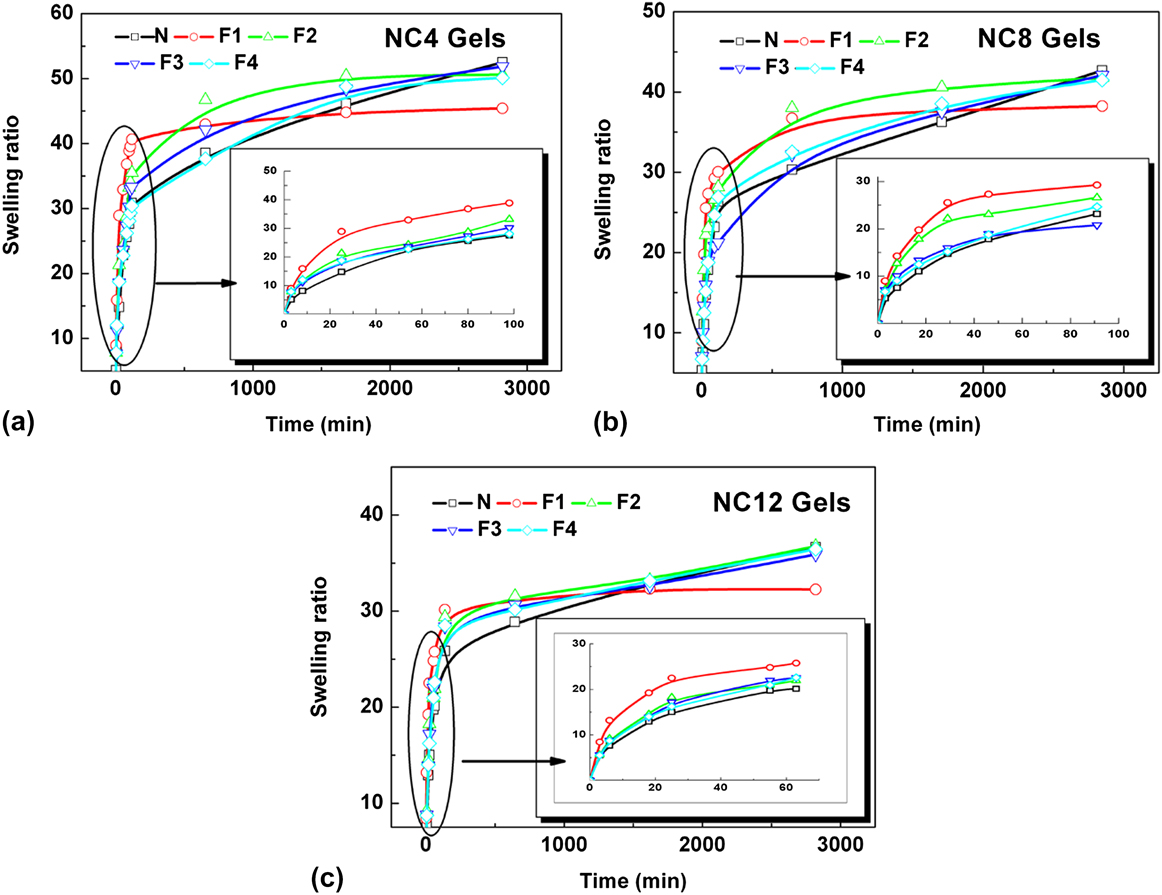
Figure 6 shows the plots of water uptake as a function of time for F-NC gels in swelling process. As we see, for the F-NCm gels, the alteration of swelling curves with different polymerization modes shows a similar tendency. To describe it in detail, first, F1-NCm gels all exhibit a considerable decrease of equilibrium swelling ratio obviously, whereas other F-NCm gels own a similar swelling ability as that of N-NCm gels. More importantly, as shown in detail images of swelling rate within a short time at the beginning of swelling, the gels prepared by freezing polymerization display a faster swelling rate, the swelling ratio of F1-NCm gels within initial 20 min almost is two times than that of N-NC4 gel. In particular, the F1-NC4 gel could swell to 30 times of its dried weight in 20 min. For other F-NC gels, the swelling rate increases at different degrees.
The swelling ratio of N-NC gels and F-NC gels as a function of time (a) NC4 gels, (b) NC8 gels, (c) NC12 gels.

F. Deswelling kinetics
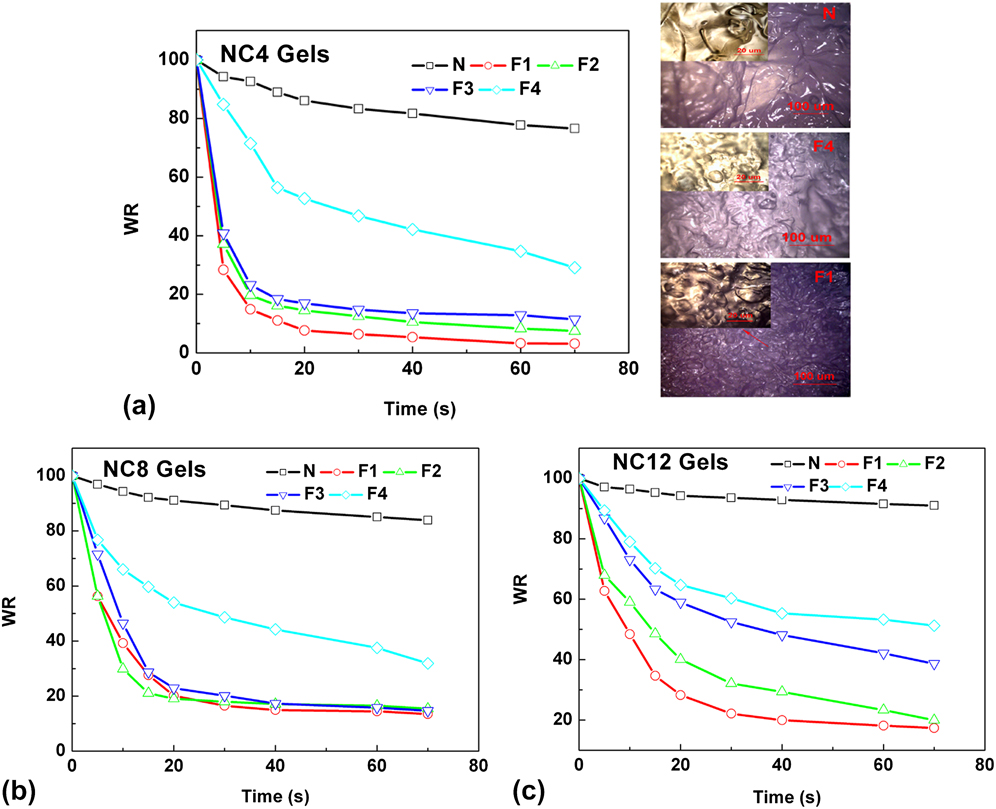
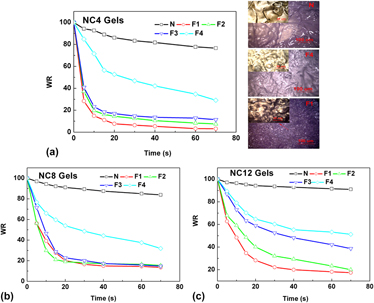
Freezing polymerization, as one of the most important approach to produce the porous structure, is generally used to improve the response rate of gels. Figure 7 shows the deswelling kinetics of N-NC gels and F-NC gels after a temperature jump from equilibrated swollen state at 20 °C to ultrapure water at 50 °C. It can be clearly seen that the gels prepared by freezing polymerization exhibit a significant faster deswelling rate than that of N-NC gels. Specially, For NC4 and NC8 gels, the gels polymerized by F-1, F-2, and F-3 mode display similar deswelling behavior, the gels could lose 80–90 wt% of retention water within 20 s, which is considered as an ultrarapid deswelling rate comparing with that of other gels reported previously. Meanwhile, the deswelling rate of F4-NC gels is slower than that of F1-3 gels obviously, although still faster than that of N-NC gels. In deswelling curves of Fn-NC12 gels, a stepwise increase of deswelling rate with the earlier start time of freezing is observed, revealing more dependency of deswelling rate on the freezing time. Combining the morphologies in Fig. 2, it is easy to find out the relevance between the deswelling rate with the morphology of gels, that is, the gels with higher degree of interconnected microporous structure possess a faster deswelling rate, which is attributed to more channels for the water diffusing out of the gels through a shorter path.
Deswelling kinetics of N-NC gels and F-NC gels in water at 50 °C (a) Fn-NC4 gels, (b) Fn-NC8 gels, (c) Fn-NC12 gels. In image (a), the micrographs are the surface of corresponding Fl, F4, and N-NC4 gels at temperature above LCST.

Another phenomenon observed in our experiment may be also a non-negligible factor with respect to the faster shrinking rate. The surface micrographs of N-NC gels and F-NC4 taken by polarizing microscope during the hydrogels were dehydrating at the temperature above their LCST. As shown in Fig. 7(a) (right of image), the surface of F1-NC4 gel consists of a large number of obvious opening pores, attributed to the earlier freezing, this kind of surface morphology may avoid the “surface effect” and provide the channels for allowing the entrapped water to be squeezed out freely and quickly. By contrast, there are fewer of micropores inside the F4-NC4 gel, which tends to that of N-NC gels closely.
G. Discussion about the structure of F-NC gels
All obtained results about properties respond to the change of gels' structure closely. In the following discussion, we tried to analyze and establish the correlation between properties and structure so as to find out the essential reason for explaining the changed properties.
Comparing with N-NC gels, one of the most significant transformations of F-NC gels is the changed mechanical properties such as strength, modulus, and dynamic viscoelastic behavior, especially for F1 and F2-NC gels, the strength and modulus decrease significantly. In the present study, the kinetic theory of rubber elasticity, used to establish the classic structure model of NC gels by Haraguchi, is also utilized here to analyze the change of gels' structure. The F-NC4 gels are investigated as a typical case.
In the kinetic theory of rubber elasticity,Reference Tobolsky, Carlson and Indictor30 the equation of state of the swollen network, prepared by polymerization of the mixed solution consisting of solvent, monomer, and cross-linking agent, the tensile strains can be expressed as
 $$F = \Phi N$^*$kT\left\{ {{\rm{\alpha }} - {{\left( {{1 \mathord{\left/ {\vphantom {1 {\rm{\alpha }}}} \right. \kern-\nulldelimiterspace} {\rm{\alpha }}}} \right)}^2}} \right\}\quad ,$$
where F is the force per unit original (undeformed) cross sectional area of the swollen network (F = force/A 0), N* is the number of network chains per unit volume in the swollen networks, k is Boltzmann’s constant, T is the absolute temperature, and α is the relative extension α = L/L 0. Φ, called a front factor, is related to the specifics of the cross-linking process and chains and can be expressed as:
 $$\Phi = \left\{ {{{{{\left( {{r_{\rm{i}}}} \right)}^2}} \mathord{\left/ {\vphantom {{{{\left( {{r_{\rm{i}}}} \right)}^2}} {{{\left( {{r_{\rm{f}}}} \right)}^2}}}} \right. \kern-\nulldelimiterspace} {{{\left( {{r_{\rm{f}}}} \right)}^2}}}} \right\}\quad ,$$
where (r i)2 is the mean square distance between network junctions in the swollen network and (r f)2 is the mean square end-to-end distance of the network chains considered as existing in free space.
We make the rational hypothesis that Φ is close to unity in NC gels provided the polymer chains take random conformation in the ample space between junctions, i.e., between clay sheets.
Hence, N* is calculated from (1) by using F at a given elongation (α = 2). The results of all NC4 gels are listed in Table I. As we can see that N* of F1 and F2 gel shows a drastic decrease than that of N-NC gel, indicating that the number of network chains per unit volume decreases significantly.
The calculated structural parameters of N-NC4 and F-NC4 gels.

a Stress at elongation of 100%.
b Number of cross-linking polymer chains per clay sheet.
c Number of clay sheets per unit volume (100 nm cube) of NC4 gels.
d Number of cross-linking polymer chains per unit volume (100 nm cube) of NC gels.
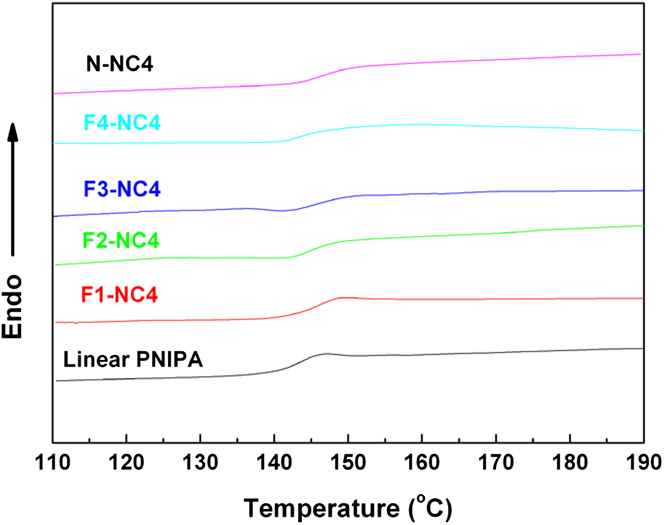
e T g of dry linear PNIPA was observed at 141.5 °C.
Meanwhile, in the theory of rubber elasticity, N* is also related to the molecular weight between cross-links M c, which can be expressed as
 $$N$^*$ = \left( {{{\rho $^*${N_{{\rm{AV}}}}} \mathord{\left/ {\vphantom {{\rho *{N_{{\rm{AV}}}}} {{M_{\rm{c}}}}}} \right. \kern-\nulldelimiterspace} {{M_{\rm{c}}}}}} \right)\left\{ {1 - \left( {{{2{M_{\rm{c}}}} \mathord{\left/ {\vphantom {{2{M_{\rm{c}}}} {{M_{\rm{c}}}}}} \right. \kern-\nulldelimiterspace} {{M_{\rm{n}}}}}} \right)} \right\}\quad$$
Here, ρ* is the density of the polymer in the swollen gel, N AV is Avogadro's number, M c is the molecular weight of the chain between cross-links, and M n is the molecular weight of the primary molecular chains. In this research, the yields of F-NC4 gels estimated by dried gels are all nearly higher than 97%, meaning that the ρ* of all gels is same with that of N-NC gels basically. So, it could be deduced that the decrease of N* is ascribed to the increase of M c or the decrease of {1 − (2M c/M n)}. According to the hypothesis advanced by Haraguchi, for N-NC gels, 2M c/M n is a traditional correction for chain ends not effectively tied into conventional cross-linked networks and becomes negligible when the number of chain ends is small relative to cross-linked chains. Suppose that this hypothesis is still available to F-NC gels, M c of F-NC gels is calculated and listed in Table I. It could be seen that M c of F1 and F2 gels increases drastically.
On the other hand, based on the hypothesis above, the F-NC gels should match the classic gels’ network mode that all polymer chains are cross-linked in gels.Reference Nielsen31 Therefore, the storage modulus G′ of gels is related to the average number of equivalent units in a network strand N, N and G′ can be expressed as:
 $$G' = {{RT} \over {{N_{{\rm{AV}}}}{a^3}N}}\phi _0^{2/3}{\phi ^{1/3}}\quad ,$$
where R is the universal gas constant, T is the absolute temperature,  ${\phi _0}$ and
 $\phi$ are the volume fraction of gels in relaxed and swollen state, respectively, N AV a 3 is the mole volume of solvent.
For the gels with the same freed ratio and swelling ratio, such as Fn-NC4 gels, they own the same  ${\phi _0}$,
 $\phi$, R, T, and N AV a 3. According to Eq. (4), G′ is inversely proportional to N, meantime, M c = NM 0, M 0 is the molecular weight of single unit, it can be deduced that:
 $${{G_1^\prime } \mathord{\left/ {\vphantom {{G_1^\prime } {G_2^\prime }}} \right. \kern-\nulldelimiterspace} {G_2^\prime }} = {{{M_{{{\rm{c}}_2}}}} \mathord{\left/ {\vphantom {{{M_{{{\rm{c}}_2}}}} {{M_{{{\rm{c}}_1}}}}}} \right. \kern-\nulldelimiterspace} {{M_{{{\rm{c}}_1}}}}}\quad ,$$
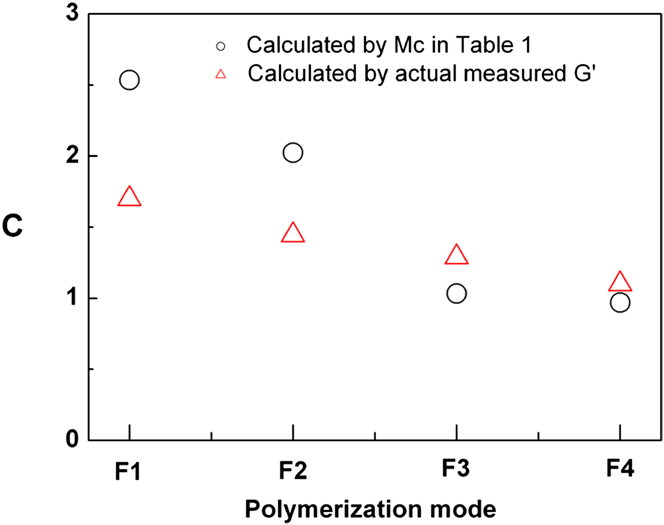
For more convenience comparison, we define “C” as the value of (G′N-NC4 gels)/(G′Fn-NC4 gel), n = 1, 2, 3, 4, two series of C, calculated from (5) by using M c in Table I, and by actual measured G′ in Fig. 5, respectively, corresponding to the ideal and practical condition, are exhibited in Fig. 8. Obviously, two kinds of C are inconsistent, especially for F1 and F2 gels. The ideal C calculated by M c is significantly lower than the practical one, indicating that the real M c of F1 and F2-NC gels should be lower than the ideal value calculated from Eq. (3). Further, it could be inferred that the truth may deviate the hypothesis as the basic of calculating M c from Eq. (3) that the number of chain ends is small relative to cross-linked chains, corresponding to that the 2M c/M n could be negligible.

To figure out the possible structure of F-NC gels further, the thermal analysis is used here. For cross-linked polymers in which M c was known, NielsenReference Ricciardi, D’Errico, Auriemma, Ducouret, Tedeschi, De Rosa, Laupretre and Lafuma32 proposed the empirical equation for estimating the shift in T g as
 $${T_{\rm{g}}} - {T_{{\rm{g}}0}} = {{3.9 \times {{10}^4}} \mathord{\left/ {\vphantom {{3.9 \times {{10}^4}} {{M_{\rm{c}}}}}} \right. \kern-\nulldelimiterspace} {{M_{\rm{c}}}}}\quad$$
DSC curves of linear PNIPA, N-NC4, and Fn-NC4 gels are exhibited in Fig. 9, and T g of gels is listed in Table I. As shown in the table, T g of F1-NC4 gels and F2-NC4 gels exhibits a small decline, about 0.7°C and 0.5 °C lower than that of N-NC4 gel. Based on Eq. (6), M c of F1-NC4 and F2-NC4 gel calculated is approximately 6.5*104 and 4.87*104, respectively, which is significantly lower than the ideal data listed in Table I.
DSC curves of N-NC4, Fn-NC4 gels, and linear PNIPA.

According to the discussion above, the reasonable assumption with respect to the structure change of F-NC gels could be made. For F-NC gels with freezing at the earlier stage of polymerization, such as F1 and F2 gels, the number of cross-linking polymer chains decreases considerably while the molecular weight of the chain between cross-links, M c, does not increase correspondingly, revealing that partial polymer chains may not involve in cross-linking, but exists in other state.
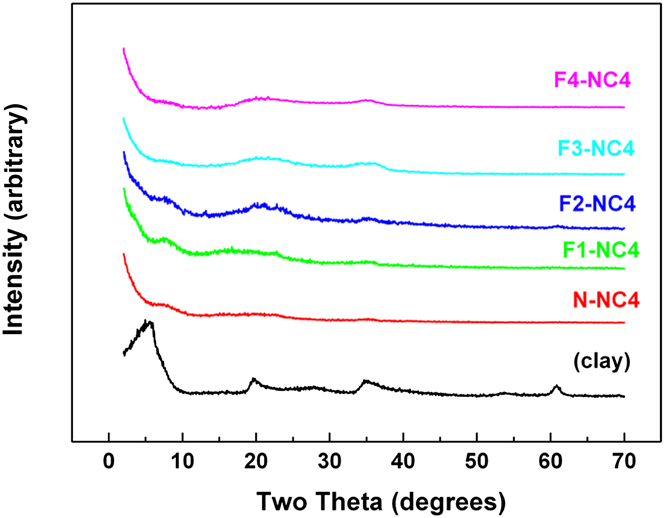
Except the crosslink of polymer chains, the effect of freezing on the dispersion of NC in the gels is also necessary to be clarified. Figure 10 shows the x-ray diffractograms of clay, N-NC4 gel, and Fn-NC4 gels. The spectrum of clay shows obvious diffraction band centered at 2θ = 6°, which is attributed to the basal layer spacing between clay platelets of 1.30 nm. However, this characteristic peak is invisible in all curves belonged to N-NC4 gel and Fn-NC4 gels, revealing that there is no aggregated clay existed in gels. Therefore, it could be concluded that the freezing process causes a slight effect on the dispersion of clay, they are still dispersed in gels uniformly. This conclusion could also be proved by the high transparency of all gels (transmittance higher than 90%).
X-ray diffraction profiles with Cu Kα x-rays of clay, N-NC4 gels, and Fn-NC4 gels.

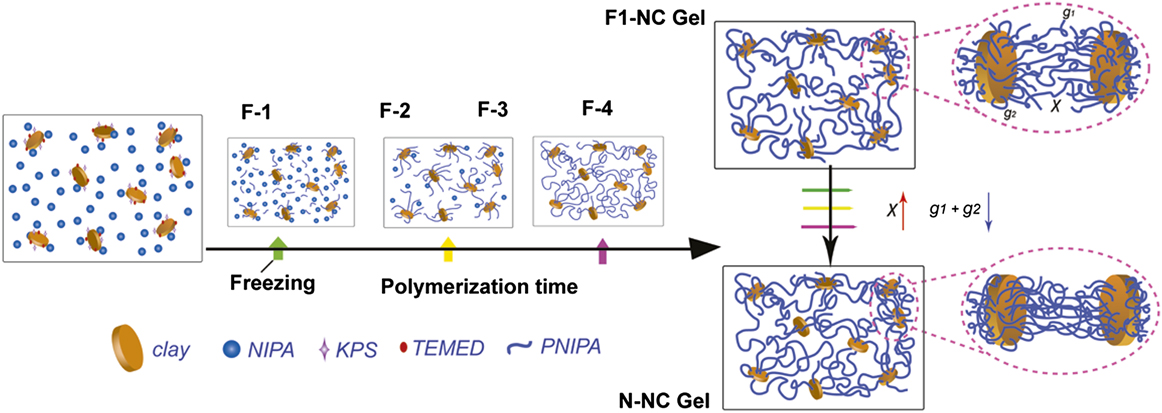
Based on the all analysis results, the supposed model representing the structure and related mechanism of F-NC gels was established. As shown in Fig. 11, the freezing starting at the different state of system results in a corresponding structure. We use χ, g1, and g2 to represent cross-linked chain, grafted chain, and looped chain, as three kinds of basic existed mode of polymer chains in gels. In N-NC gels, χ plays a dominant role, almost all polymer chains are cross-linked by clay. For the gels prepared by freezing in the initial stage of polymerization (such as F-1 mode), although the free radical initiation and polymerization have happened, the formation of ice crystal still influences the long-range linkage and entanglement of polymer chains around the clay significantly due to the steric hindrance. Therefore, χ decreases considerably while the g1 and g2 increase, meaning the decrease of effective crosslink by clay, which is considered the main reason of the decreased strength and G′ rather than the increased M c. Meantime, the increased g1 and g2 chains with free end, forms a similar structure as polymer-brush, which could motive freely and thereby resulting in an accelerated shrinking of polymer when hydrophilic-to-hydrophobic transition happens. This may be the another important reason to explain the ultrarapid deswelling rate. In F-4 mode, the freezing carried out in later stage of polymerization, the ice crystal forms out of polymer matrix due to the basically formed polymer crosslink skeleton. As a result, the effect of freezing on the structure of gels is mild, which only results in the extended network and a small amount of interconnected micropores. It is also noteworthy that the evolution of structure from N-NC gels to F1-NC gels is a gradual process with the forward shift of freezing time, the structure of F2 and F3 gels is between that of F1 and F4 gels.
Schematic representation of the mechanism and presumed structure models of N-NC gels and F-NC gels. The arrows in time axis, are related to the various start time of freezing, corresponding to the lines with the same color labeled in structure evolution trend.

IV. CONCLUSIONS
In this paper, PNIPA/clay nanocomposite hydrogels with ultrarapid response rate were prepared by two-step freezing polymerization. Four typical polymerization modes were chosen to start the freezing, and the effect of freezing time on the properties and structure of gels with different content of clay was investigated systemically. From the test results, the obvious dependency of gels' properties including mechanical properties, swelling ratio, and swelling/deswelling kinetics on the freezing time was found. Summarily, the gels prepared by freezing at the beginning of polymerization exhibit a fast swelling and an ultrarapid deswelling rate due to the absolute interconnected porous structure, the gels could swell to 30 times weight of the dried gels within 20 min, and lose 80–90 wt% retained water in gels within 20 s, which is considered as a prominent response ability, being potential in application, while, the tensile strength, modulus, and storage modulus decrease considerably. Relatively, the gels prepared by freezing at the formation of clay/polymer long chain structure own better strength, but the response rate decreases. Finally, the properties of gels prepared by freezing after the formation of integrated polymer network are similar as that of the gels prepared at room temperature. Meantime, the content of clay also makes a non-ignorable impact on the freezing effect, for the gels with higher clay content, the earlier freezing time is necessary to achieve the fast response rate.
Based on the analysis of the properties, morphologies, and structure parameters of gels, the presumed structure model of F-NC gels was established. For the gels prepared by freezing at the early stage of polymerization, the freezing impacted the effective crosslink of polymer chains between exfoliated clay significantly, the cross-linked chains χ decreased, grafted chain g1 and looped chains g2 increased correspondingly. Relatively, with the later start time of freezing, the structure of gels changed to be similar to that of N-NC gels gradually, the freezing only resulted in extended network and a small amount of micropores in gels. This mode could explain the change of properties reasonably.
Considering the properties comprehensively, especially the decreased mechanical properties and improved response rate. We suggested that for the gels with low content of clay, the gels prepared by F-2 and F-3 mode own the best integrated performance such as fast response rate, good swelling ability, and mechanical properties. For the gels with high content of clay, such as NC12 gels, due to their original excellent mechanical properties, F-1 mode may be a good choice.
ACKNOWLEDGMENTS
We acknowledge the financial support of the National Natural Science Foundation (Grant Nos. 21104017, 61174100, 21253001) and Hunan Provincial Science and Technology Project (Grant No. 2012FJ4369).