Introduction
As a result of the detrimental health and socioeconomic disparities associated with smoking, the Health Education Authority's (HEA) National Smoking Cessation guidelines (Raw, McNeill, & West, Reference Raw, McNeill and West1998; Raw, McNeill, & West, Reference Raw, McNeill and West2000) covered how the NHS should treat tobacco dependence. The focus was to reduce the burden of death and ill health caused by tobacco by providing free local support to smokers, through behavioural and pharmacological support. Following the first local Stop Smoking Services initiated in 1999 they have since spread across the United Kingdom (Bell et al., Reference Bell, McCullough, Greaves, Mulryne, Jategaonkar and DeVries2006). Stop Smoking Services are delivered in various settings, including community, primary, and secondary care settings. They are commissioned by Local Authorities, since the White Paper (DoH, 2010) “Equity and Excellence, Liberating the NHS” outlined the need for local government to take ownership of a number of public health-related services including smoking cessation. The majority of smoking cessation services are outsourced to primary care settings, including pharmacies and GP practices, as opposed to core team specialist support advisors (Brose et al., Reference Brose, West, McDermott, Fidler, Croghan and McEwen2011).
According to the Information Centre for Health and Social Care (ICHSC, 2011) during 2010–2011, 787,527 people accessed NHS Stop Smoking services within England; out of this figure, 383,548 people were successfully reported to be smoke-free at the four weeks treatment point yielding a 49% quit rate. However, this figure is not representative of all Stop Smoking Services. Service uptake and quit rates vary dramatically, particularly within London (Brose, McEwen, & West Reference Brose, McEwen and West2012; DoH 2013). Effectiveness varies greatly from region to region, and there is considerable variation across different local services (Brose et al., Reference Brose, West, McDermott, Fidler, Croghan and McEwen2011; West, May, West, Croghan, & McEwen, Reference West, May, West, Croghan and McEwen2013). In the United Kingdom, quit rates have been suggested to vary widely ranging from 29% to 60% (DoH, 2013). The type of support and setting can also influence success rate. For example, Brose et al. (Reference Brose, West, McDermott, Fidler, Croghan and McEwen2011) found that group support was linked to higher success rates than one-to-one support; primary care settings were less successful than specialist clinics; and, the type of treatment offered can also have an impact on outcome (e.g., success rate was increased when in combination Nicotine Replacement Therapy (NRT) or Varenicline). These findings imply that success rate variance exits between and within services.
Training to become an accredited Stop Smoking advisor involves the completion of the Level Two Stop Smoking advisor Training programme (DoH, 2013). This training is delivered and developed on a local level as it covers elements of the service unique to a specific localities and population. The DoH (2013) Service Monitoring and Guidance states that training should consists of two localised Stop Smoking Advisor training sessions to equip the individual with the skills and knowledge needed to provide intensive one-to-one stop smoking advice to smokers who would like to stop smoking. According to the DoH (2012), training should be focused on evidence-based treatment that combines the use of pharmaceutical treatments with behavioural support.
In addition to the local Level Two training, Local Authorities are also encouraged to recommend that their advisors complete the National Centre for Smoking Cessation Training (NCSCT; DoH, 2013). The NCSCT was introduced in 2011 as a set of online training modules used to support Level Two training and encourage the standardisation of training across the United Kingdom (Brose, West, Michie, Kenyon, & McEwen, Reference Brose, West, Michie, Kenyon and McEwen2012). Its role is to facilitate the effectiveness of evidence-based tobacco control programmes and smoking cessation interventions, provided by local Stop Smoking services. The importance of training was identified by Brose, West et al. (Reference Brose, West, Michie, Kenyon and McEwen2012) demonstrating that NCSCT training positively impacted Stop Smoking Advisors’ performance as their theoretical knowledge was shown to have increased.
Whist smoking prevalence amongst various healthcare professional groups is less than that of the general population (Chiesa et al., Reference Chiesa, Knorst, Franciscatto, Krumel and Mezzomo2004) it is important to assess what effect, if any, a positive smoking status has, on attitudes towards patient smoking behaviour and/or the likelihood of successfully supporting patients in stopping smoking. There has been little research into this, as many healthcare professionals may not wish to disclose their smoking status as this could potentially jeopardise their position. Furthermore, withholding smoking status could be justified by a fear of criticisms from other healthcare professionals and patients, or feelings of guilt and hypocrisy when advising patients in stopping smoking (Lindson-Hawley, Begh, McDermott, McEwen, & Lycett, Reference Lindson-Hawley, Begh, McDermott, McEwen and Lycett2013). Thus, it is possible that many stop smoking advisors face an inter-personal struggle with their own tobacco use. Such conflicts may have an impact on patient care. Nagle et al. (Reference Nagle, Schofield and Redman1999) found that in comparison to nurses who did not smoke, nurses who smoked were less likely to refer patients who smoked to speciality smoking cessation services and were less likely to motivate patients who smoked into stopping smoking. However, Lindson-Hawley et al. (Reference Lindson-Hawley, Begh, McDermott, McEwen and Lycett2013) found that smoking status of Stop Smoking Advisors did not affect their success rate. It therefore could be suggested that smoking history does not have an impact on Stop Smoking advisor success rate and that perhaps other factors that require further investigation may be attributed to smoking advisor effectiveness.
Whilst there has been research carried out on the impact of the Stop Smoking service, there has been little research focusing on NHS Stop Smoking Advisors’ smoking attitudes and histories and their impact on quit rates. Vogt, Hall, and Marteau (Reference Vogt, Hall and Marteau2010) investigated the reason why smokers may be reluctant to seek stop smoking support, and identified that the primary reason for reluctance was due to the smoker's preconceived perception of smoking cessation practitioners with the misperception that all advisors had never smoked, and therefore would not be able to empathise with smoking cessation, resulting in smokers being less likely to seek their support. It has also been suggested that healthcare professionals’ attitudes towards smoking and their own smoking status may have an impact on clinical effectiveness in providing smoking cessation support (Bradford, Sheffer, Crews, Payne, & Smith, Reference Bradford, Sheffer, Crews, Payne and Smith2008; Parna, Rahub, & Rahu, Reference Parna, Rahub and Rahu2005; Pipe, Sorensen, & Reid Reference Pipe, Sorensen and Reid2009). In addition, it has been suggested that attitudes held by healthcare professionals can impact the way in which other health-related behavioural interventions including healthy eating and weight management are delivered (Harvey, Summerbell, Kirk, & Hills, Reference Harvey, Summerbell, Kirk and Hills2002). Therefore, it is important to address healthcare professionals’ views and attitudes towards certain health-related behaviours during trainings.
Other factors such as Stop Smoking Advisor demographic profile characteristics may also play a role in advisor effectiveness . These factors may include age, gender, education level, and ethnicity, and will therefore be examined as possible determinants in explaining advisor effectiveness variances. Training level may also contribute towards variances in service effectiveness. Currently, each Local Authority within the United Kingdom is responsible for developing and delivering its own training package, meaning that training may vary from region to region (DoH, 2012). According to Brose, West, Michie, and McEwen (Reference Brose, West, Michie and McEwen2013), it is predicted that advisors who have completed the additional NCSCT training will have higher smoking quit rates in comparison to non-NCSCT trained advisors. Training healthcare professionals within primary care has been an effective way of implementing smoking cessation services on a wider scale (Lancaster and Fowler, Reference Lancaster and Fowler2000). However, Lancaster and Fowler (Reference Lancaster and Fowler2000) found that although training healthcare professionals to provide smoking cessation support increased ability to identify smokers and to provide smoking cessation support, it did not significantly increase clinical effectiveness in helping patients to stop smoking. It is difficult to determine the exact reason for this, as there may be a number of causal factors contributing to this phenomenon, including the number of days and hours healthcare professionals attended training, number of years practicing as an advisor, advisor confidence, and proportion of time dedicated towards smoking cessation work in comparison with their primary role. Therefore, the level of training undertaken and proportion of time spent delivering smoking cessation support, essentially their experience, may also be a contributing factor in determining advisor effectiveness variances and will be measured accordingly.
The aim of this study was to identify what makes an effective Stop Smoking Advisor, thus determining what key contributing factors are involved in influencing high quit rates. This study aimed to investigate variables that contribute towards Stop Smoking Advisor variances in patient outcome.
Method
Participants
A cross-sectional sample of 159 London-based NHS Level Two trained Stop Smoking Advisors from 24 London boroughs were recruited for the study. The sample was made up of 52 (32.7%) males and 107 (67.3%) females. Participants’ ages ranged from 20 to 65 years of age, with a mean of 39.94 and standard deviation (SD) of 12.04. With regard to education level, a total of 103 (64.8%) participants were graduates, out of which 34 (21.4% of total sample) had postgraduate qualifications and 56 (35.2%) were non-graduates. In addition, 34 (21.4%) participants had practiced as stop smoking advisors for 1 year or less, 52 (32.7%) had practiced for 2–4 years, 41 (25.8%) had practised for 5–7 years, and 32 (20.1%) had practiced for 8 years or more. Participants were classified by their job titles: sessional stop smoking advisors, core team/service commissioners, healthcare assistants, practice nurses, general practitioners (GP), administrators, pharmacy counter assistants, dispensers, and pharmacists. This was done in order to be able to compare and contrast the different job role settings of service provision (e.g., GP, pharmacy or core team/specialist settings). Out of the 159 participants, 41 (25.8%) were pharmacists, 6 (3.8%) were pre-registration pharmacists, 11 (6.9%) were counter assistants working within a pharmacy setting, 23 (14.5%) were dispensers and pharmacy technicians. Furthermore, 18 (11.3%) participants were healthcare assistants working in a GP setting, 2 (1.3%) were GPs, 6 (3.8%) were GP administrators, and 23 (14.5%) were practice nurses. In addition, 28 (17.6%) were core team Stop Smoking service advisors and 1 (0.6%) participant was a service commissioner or advisor.
Materials
A multi-scaled survey comprised of various standardised scaled questionnaires. The predictor variables were categorised into the following categories: advisor demographic and profile characteristics, advisor training profile, and advisor tobacco use profile. Each category consisted of a number of factors which were measured using three standardised scales. The survey consisted of these counterbalanced measures.
Advisor demographic and profile characteristics
To measure Stop Smoking Advisor profile characteristics, the following data was collated: advisor gender, age, and ethnicity; borough in which practiced; number of years practiced as a stop smoking advisor; number of advisors worked with; type of setting worked in (pharmacy, GP practice, or specialist setting); number of patients supported per year; proportion of time spent delivering smoking cessation support; advisor education level; and advisor-reported quit rate.
Advisor training profile
In order to asses training level, the following were measured: number of National Centre for Smoking Cessation modules completed; number of years since training; and borough in which trained.
Advisor tobacco use profile
In order to achieve a well-rounded knowledge of advisor tobacco usage (current and historic), two standardised scales were used to measure nicotine dependence (current and historic). These included the following: the Fagerström Test for Nicotine Dependence (FTND; Fagerström & Schneider, Reference Fagerström and Schneider1989), and the Fagerström Test for Nicotine Dependence – Smokeless Tobacco (FTND-ST; Ebbert, Patten, & Schroede, Reference Ebbert, Patten and Schroeder2006) as a measure of oral tobacco consumption. Questions regarding quantity and use of tobacco products such as roll-up tobacco, cigars, and pipes’ weekly quantity smoked in addition to weekly and monthly frequency of shisha use. This was done primarily for descriptive purposes, in order to build a tobacco use profile of the sample. These questions gave a direct indicator of tobacco usage that was not otherwise included in the FTND questionnaire. Attitudes towards tobacco were also measured using two standardised scales including the Global Attitude Towards Smoking (GATS; Trafimow & Sheeran, Reference Trafimow and Sheeran1998), which was used to measure how favourable/unfavourable, anti/pro and positive/negative participant attitudes towards smoking. In addition, the Attitudes Towards Smoking Scale (ATS-18; Etter, Humair, Bergman, & Perneger, Reference Etter, Humair, Bergman and Perneger2000) was used to measure attitudes towards the psychological aspects, health effects, and pleasures derived from smoking. Furthermore, as an extraneous controllable variable, it was recorded whether or not the advisor lived with a smoker.
Procedure
Ethical approval was gained from the University Research Ethics Committee prior to commencing the recruitment phase of the study. Service commissioners, managers, and The Local Pharmaceutical Committee of North East London were contacted prior to recruitment and informed of the study. Participants were briefed and consented to take part in the study in accordance with BPS guidelines. Participants were primarily recruited via email. North-East London pharmacy advisors were recruited via an email link sent with the participation of the North East London Local Pharmaceutical Committee. Further data was collected via a snowball sample in which advisors forwarded the research links to colleagues. Participants were also recruited via the research being promoted at a London Local Tobacco Control Network meeting, at which the link of the study was circulated. In order to have a randomised sample, participants were recruited from across London Stop Smoking services, from a range of Stop Smoking Advisor settings and professional backgrounds within primary care and community settings. The study link directed participants to a SurveyMonkey® questionnaire which formulated the study, including the FTND, the adapted FTND to suit smokeless tobacco (FTND-ST), the ATS-18, and the GAT. In order to control for potential extraneous variables that may affect advisor performance, factors such as estimated proportion of time spent providing Stop Smoking support, years spent delivering the service and occupation were measured. Furthermore, questions which control for the number of advisors per base and the level of further training were also included. Upon completion of the survey, participants were debriefed fully with further information relating to the study.
Results
Stop Smoking Advisors worked in GP practice (30.8%), a pharmacy (50.9%), or a core Stop Smoking service setting (18.2%). A quarter of participants reported being historic tobacco users, a fifth had never tried tobacco, and a third reported that they had only ever tried tobacco once. Current FTND scoring showed that only five (3%) of participants scored high or very high FTND scores. Furthermore, 18 (11%) participants were classified as scoring as light user to low dependency. This implies that overall very small proportions of the sample were highly dependent tobacco users. With regards to historic FTND, more than two-thirds of participants were reported to be non-historic tobacco users and over two-fifths had at some point been tobacco dependent with a medium to very high FTND score. In total, 59 (37%) participants had not completed any additional NCSCT training modules, whilst six (3.7%) participants completing all six variables modules (NCSCT stage one training, stage two training, very brief advice training, second-hand smoking training, pregnancy training, and mental health training module).
The majority (46; 28.9%) of participants reported that they spent just 0–10% of time during their job role providing smoking cessation support, whereas 10 (6.3%) participants reported that they spent 71% or more of their time providing stop smoking support. In total, 28 (17.6%) of participants supported 0–10 patients, 41 (25.8%) supported 11–20 patients, 57 (35.9%) supported 21–50 patients, 18 (11.3%) supported 51–99 patients, and 15 (9.4%) had supported 100 or more patients.
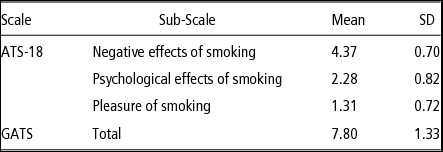
Table 1 shows attitudes towards smoking scores via the scoring of the ATS-18 and GATS results. The scoring represents the mean total scores; the higher the scoring, the higher the negative attitude. A high negative rating for the ATS-18 indicates negative perceptions expressed towards smoking with regards to its health impacts, the psychological impact, and the general act of smoking. The GATS scale is measured as a mean total, the higher the GATS scoring the greater the negative regard towards smoking, implying an anti-smoking stance.
ATS-18 and GATS scorings

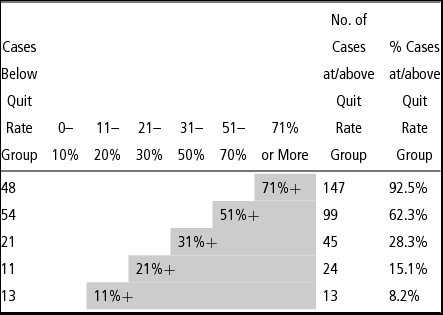
The outcome variable of advisor-reported quit rate was measured in six ordinal categories. Table 2 demonstrates the advisor-reported quit rate categories used to measure advisors performance and the results obtained. The majority (34%) of the sample disclosed their advisor-reported quit rate to be within the range of 31–50%. This was followed by the 50–70% quit rate group (30%). Therefore, over 60% of participants rated their success rate to be 30% or higher. This is in line with the department of health guidance standards of achieving a quit rate of 35% or above and would indicate that although these were advisor-reported estimates of quit rates the results are in line with national data.
Smoking advisor-reported quit rate performance

In order to identify key predictors of reported quit rate, we initially conducted a univariate correlation analysis using SPSS. Results of the correlation indicated a positive correlation between advisor-reported quit rate and proportion of time spent delivering smoking cessation support (r = 0.280, N = 159, p < 0.005, two-tailed). Furthermore, advisor-reported quit rate was also found to be positively correlated with the number of patients supported (r = 0.194, N = 159, p < 0.005, two-tailed). Service setting was not found to be correlated with quit rate (r = 0.002, N = 159, p > 0.5). Moreover, smoking status was not found to be correlated with advisor-reported quit rate (r = −0.098, N = 159, p = 0.984); and neither was the number of NCSCT training modules completed (r = −0.026, N = 159, p = 0.745). In addition, the number of patients supported was found to be positively correlated with proportion of time spent delivering stop smoking support (r = 0.423, N = 159, p < 0.005, two-tailed). Likewise, core service setting when compared with pharmacy setting was found to be negatively correlated with number of patients recruited (r = −0.206, N = 159, p < 0.005, two-tailed).
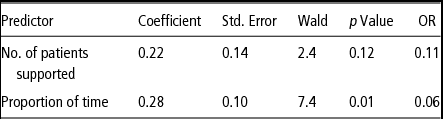
In order to clarify to what extent the predictor variables influenced the outcome variable, a regression analysis using a PLUM (Polytomous Universal Model) was carried out to determine the impact of the predictor variables on the outcome variable. The PLUM model has been supported by McCullagh (Reference McCullagh1980): It has been found to be effective as it produces a single regression coefficient estimate of the covariates of each outcome variable response category and therefore can easily be interpreted when addressing the association between variables responses. The predictor variables included in the ordinal model were shown to be significant in the preliminary Spearman correlation analyses. These included the following: number of patients supported in a given year, proportion of time spent delivering stop smoking support, number of NCSCT training modules completed, mean ATS scoring for pleasure of smoking, mean ATS scoring for the negative effects of smoking, mean ATS scoring for the psychological effects of smoking, GATS mean scoring, current smoking status vs. never tried smoking, pharmacy setting vs. core team service setting. In order to justify the analysis outcome, an ordinal model justifying the significance of the predictor variables was required. The number of patients supported and the proportion of time spent delivering stop smoking support influenced advisor-reported quit rate (Table 3); however, in the parameter estimates of the main model analysis, it was found that proportion of time spent delivering stop smoking support was the one significant variable that was positively associated with advisor-reported quit rate. The main ordinal models’ chi-square statistic (p < 0.0005), indicates that the final model gives a significant improvement over the baseline intercept-only model. The goodness-of-fit of the model was also addressed using a pseudo, R2. This was used to summarise the proportion of variance in the outcome that can be accounted for by the predictor variables. The pseudo R2 was shown to contribute for 12% of the variance (e.g., Nagelkerke = 0.120). The test for parallel lines was also carried out. This was shown to be non-significant (p > 0.05). Parameter estimates were also used to reinforce suitability of the ordinal regression model. An increase in proportion of time spent delivering smoking cessation support (expressed in percent) was associated with an increase in the odds of a high advisor-reported quit rate, with an odds ratio of 1.32 (95% CI, 0.78 to 0.48), Wald χ2 (1) = 45.816, p < 0.05.
Ordinal logistic regression with significantly correlated predictor variables

Notes. Assuming other independent variables are constant.
Further regression analyses were carried out to identify other factors that could influence advisor-reported quit rate. Smokers who had only tried tobacco were more likely to score higher on quit rate in comparison to current tobacco users (OR = 1.33). Those who had never tried tobacco reported higher advisor-reported quit rates. As data on setting type was collected in the survey, it was possible to compare the difference in advisor-reported success rate of each setting (core service, GP, and pharmacy setting support). Pharmacy setting advisors were more likely to score high quit rates (OR = 0.69) in comparison to core stop smoking advisors (OR = 2.43) and GP setting advisors (OR = 2.43). On further analysis, however, this difference did not prove to be significant.
Discussion
The current study reports data identifying that the proportion of time spent delivering smoking cessation support can positively impact upon advisor-reported quit rate. The mode of delivery was predominantly via community practitioners, e.g., pharmacists and GPs (81%) compared to that of a specialist service setting (18.2%), which is commensurate with McDermott et al. (Reference McDermott, Beard, Brose, West and McEwen2013) review of smoking cessation delivery. Although the number of patients supported is positively correlated with advisor-reported quit rate, this does not influence it. Smoking status, number of years practiced, number of NCSCT training modules completed, attitudes and beliefs about tobacco use, and smoking status (current or historic) did not have an impact on Stop Smoking Advisor-reported performance in this sample. However, the proportion of time spent delivering smoking cessation support was positively associated with predicted quit rate, suggesting that more time spent delivering Stop Smoking support the increased likelihood of success. Whilst it is vital to not underestimate the importance of the patient–advisor relationship, this research suggests that non-tobacco users and tobacco users are equally as likely to rate themselves as having high quit rates. With regard to the advisor-reported quit rate as a measure of cessation, the self-evaluation may be an overestimate by those with a vested interest in self-promotion/efficacy. Thus, the quit rate may be somewhat inflated from that of patient reports or real quit rates. However, this is equal across the groups and therefore a limiting factor as the purpose is to compare between the groups. Future studies should make it explicit that 4-week patient reported quit rates should form the basis of measures of success (West, Reference West2005). Furthermore, smoking history does not appear to be associated with attitudes towards smoking in this sample. Ex-smokers rated smoking as negatively as non-smokers. In addition, FTND and FTN-ST scaling did not appear to be related to attitudes towards smoking in the current sample, as no correlation was observed, although the number of participants that reported being current tobacco users was small in this study (7%) and below the general smoking prevalence of 20% (ONS, 2013).
Findings from this study reinforce previous research that has argued that further training does not impact on practice nurses’ introducing the topic of smoking cessation with their patients (Moxham, Dwyer, & Reid-Searl, Reference Moxham, Dwyer and Reid-Searl2013). Although Moxham et al. (Reference Moxham, Dwyer and Reid-Searl2013) did not sample NHS-trained Stop Smoking advisors, they did identify differences between nurses who reported being smokers in comparison to the nurses who were non-smokers. In contrast to the findings of this study, Harvey et al. (Reference Harvey, Summerbell, Kirk and Hills2002) argued that healthcare professionals have been found to be influenced by their attitudes towards health behaviours; and this, in turn, may influence patient outcomes. Harvey et al. (Reference Harvey, Summerbell, Kirk and Hills2002) found that dieticians rated obese people more negatively than overweight people, and believed, to an extent, that obese patients were responsible for their own condition. Although the behaviour of smoking differs from that of excessive eating and weight gain, smoking can be compared to obesity as it is the result of lifestyle behaviour. Both behaviours require self-change and change maintenance (Polivy & Herman, Reference Polivy and Herman2002). Furthermore, both the habit of overeating and that of smoking require willpower and resolve to overcome and have been applied to attribution theory (Glanz, Daltroy, Lewis, & Rimer, Reference Glanz, Lewis and Rimer1990). The attribution theory implies that behaviour can be attributed to environmental and emotional factors (Glanz et al., Reference Glanz, Lewis and Rimer1990). Therefore, healthcare professionals may view the two behaviours in a similar manner and may view heavier smokers in a more negative regard compared to lighter smokers.
Dogar and Siddiqi (Reference Dogar and Siddiqi2013) has promoted the effectiveness of pharmacotherapy, such as the use of a combination of nicotine replacement therapy, bupropion and Varenicline to be used alongside behavioural support in supporting heavily dependent smokers in quitting. As smoking cessation services vary in medication availability these factors may contribute to variability when measuring Stop Smoking advisors’ performance. It is important to address this in future studies, as the inability to practice using certain treatments can have an impact on quit rate.
One of the strengths of this study is that it is one of the first studies to assess the impact of NCSCT training. Therefore, results could help to support the future trainings and recruitment of Stop Smoking advisors. Previous literature that has investigated advisor-reported quit and level of training in smoking cessation advisors did not include NCSCT training (McDermott, West, Brose, & McEwen, Reference McDermott, West, Brose and McEwen2012).
In contrast to the result of this study, other research has found that additional online training can increase skills in promoting smoking cessation amongst healthcare professionals, although it is important to note this research did not include smoking cessation advisors (Shishani, Stevens, Dotson, & Riebe, Reference Shishani, Stevens, Dotson and Riebe2013). According to Shishani et al. (Reference Shishani, Stevens, Dotson and Riebe2013), following completion of an online smoking cessation training module, student nurses showed an increase in self-rated levels of smoking cessation skills in advising, assessing, assisting, and arranging compared to the baseline. This suggests that additional online training could increase clinical skills and self-reported self-efficacy in delivering smoking cessation interventions amongst healthcare professionals. Previous research by Sheffer, Barone, and Anders (Reference Sheffer, Barone and Anders2009) also supports the benefits of increased training in smoking cessation effectiveness. Sheffer et al. (Reference Sheffer, Barone and Anders2009) also suggested that attitudes towards smoking cessation treatments become more favourable with as little as one-hour training, thus increasing the chances of treatment or referrals being offered to patients. This theory has also been reinforced within UK GP settings (Ulbricht et al., Reference Ulbricht, Meyer, Schumann, Rumpf, Ulfert and Hapkea2006).
According to Anczak and Nogler (Reference Anczak and Nogler2003), routine interventions by healthcare professionals assessing smoking status and motivation to change behaviour are important. However, this must be done using a systematic approach that is advocated by all healthcare professionals. It is therefore vital to identify factors that contribute to raising the issue of smoking and effectiveness when identifying and/or supporting patients in stopping smoking.
This study has gone some way to helping to identify some of the key factors associated with delivering effective smoking cessation advisor-reported outcomes. However, further research still remains necessary to identify other factors that may have not been considered within this relatively small sample; so that potential confounding variables can be more accurately ruled out. It is hoped that if factors such as training level, smoking status, smoking history, and attitudes towards smoking are measured as predictor variables they can be applied to predict the measured outcome variable of quit rate. The questions this study attempted to answer included identifying if ex-smokers make better smoking cessation advisors than advisors who have never smoked. The most significant factor, found in this study, in increasing advisor-reported quit rate was proportion of time spent delivering stop smoking support. Therefore, the greater the amount of time spent delivering smoking cessation support, the greater the advisor-reported success rate.
Empirical evidence suggested that patient outcome can be influenced by healthcare professionals’ health beliefs and effective healthcare professional-to-patient communication (Jagosh et al., Reference Jagosh, Boudreau, Steinert, MacDonald and Ingram2011 ). Previous literature suggests that health care professionals’ profile characteristics can influence their beliefs and in turn influence patient outcomes (Ferguson et al., Reference Ferguson, Patten, Schroeder, Offord, Eberman and Hurt2003). This study did not support the finding of Ferguson et al. (Reference Ferguson, Patten, Schroeder, Offord, Eberman and Hurt2003). Instead the study's results supported the concept suggested by Moxham et al. (Reference Moxham, Dwyer and Reid-Searl2013) that the resource of time was the sole key influential predictor of patient outcome in smoking cessation. This study reinforces the need and importance for adequate time to be spent delivering smoking cessation interventions, since failing to allocate sufficient time could negatively impact on smoking cessation success rates. Time allocations should be outlined when selecting and training health care professionals to provide smoking cessation services. We conclude that being an active Stop Smoking advisor may be more influential in the delivery of an effective service when compared to other smoking advisor predictor variables such as tobacco use or training profile.
Acknowledgements
The authors would like to thank those who participated in the study.
Financial Support
There is no source of funding.
Conflict of Interest
This paper has not been published or accepted for publication and is not under consideration elsewhere. There is no conflict of interest to declare.
Ethical Standards
This research was approved by London Metropolitan University Psychology Research Ethics Committee.