Hurricane Dorian matched the “Labor Day” hurricane of 1935 as the strongest recorded Atlantic hurricane to make landfall with maximum sustained winds of 185 miles/h.1 On September 1, 2019, Hurricane Dorian made landfall on Great Abaco Island of the Bahamas in the area of Marsh Harbour. Abaco Island has a population of 17,224, with the largest settlement being Marsh Harbour.2 On September 2, Dorian, still a category 5 hurricane, made landfall on Grand Bahama, where it stalled for approximately 24 h before weakening and moving up the east coast of the North America. In the Bahamas, early reports identified over 50 hurricane-related fatalities. The official damage was estimated at US $7 billion. As of September 17, there were still over 1300 missing persons reported.3–5
Team Rubicon (TR) is a US-based, nongovernmental organization (NGO) specializing in disaster response. The organization was founded in 2010 and has since expanded to a roster of over 100,000 volunteers with an operational scope that spans nonmedical and medical response. In 2018, the World Health Organization (WHO) verified TR as a Type 1 Mobile Emergency Medical Team (EMT-1 Mobile). TR was the first NGO in the Western Hemisphere to earn this designation. Since then, TR has deployed the EMT-1 to the Mariana Islands, Mozambique, and most recently, to the Bahamas.
EMT-1 MOBILE
The WHO implemented the Emergency Medical Teams (EMT) initiative to standardize and coordinate deployment of qualified medical teams in disasters.6 The initiative defines “minimum standards” for medical response teams operating in disaster zones. The EMT-1 Mobile is designed to provide initial outpatient emergency care, basic primary care, and basic public health response to 100 patients/d for a self-sustained 14-day period.
TR’s EMT-1 Mobile at baseline is comprised of 2 mobile treatment units composed of a physician, nurse, and 2 paramedics. In response to Hurricane Dorian, TR augmented the EMT-1 Mobile with an additional mobile unit. To facilitate the mobile model, the medical teams operated out of a forward operating base (FOB) on Abaco from which they could travel by air or ground to assigned missions throughout Abaco and surrounding areas.
MISSION AND OUTCOMES
TR does not deploy the EMT-1 Mobile assets without express written consent from the partner nation. However, TR’s standard operating procedure is to deploy an advanced reconnaissance and coordination team (ADVON) to the affected country as close as possible to the onset of the disaster to conduct rapid needs assessments (RNA) and facilitate collaboration with relevant authorities. The ADVON, comprised of a 3-person team, including 1 physician and 2 logistics personnel, arrived in Nassau on September 3, 2019. The ADVON immediately met with the Ministry of Health (MOH) to obtain an official request and permission to operate in the Bahamas.
On September 4, 2019, TR obtained an official request from the MOH, and the EMT was activated. On the 4th of September, 2 members of the ADVON also traveled to Abaco and established a FOB in the area of Little Harbour, approximately 30 km south of Marsh Harbour. The EMT arrived in Nassau on September 5 and arrived on Abaco on September 6.
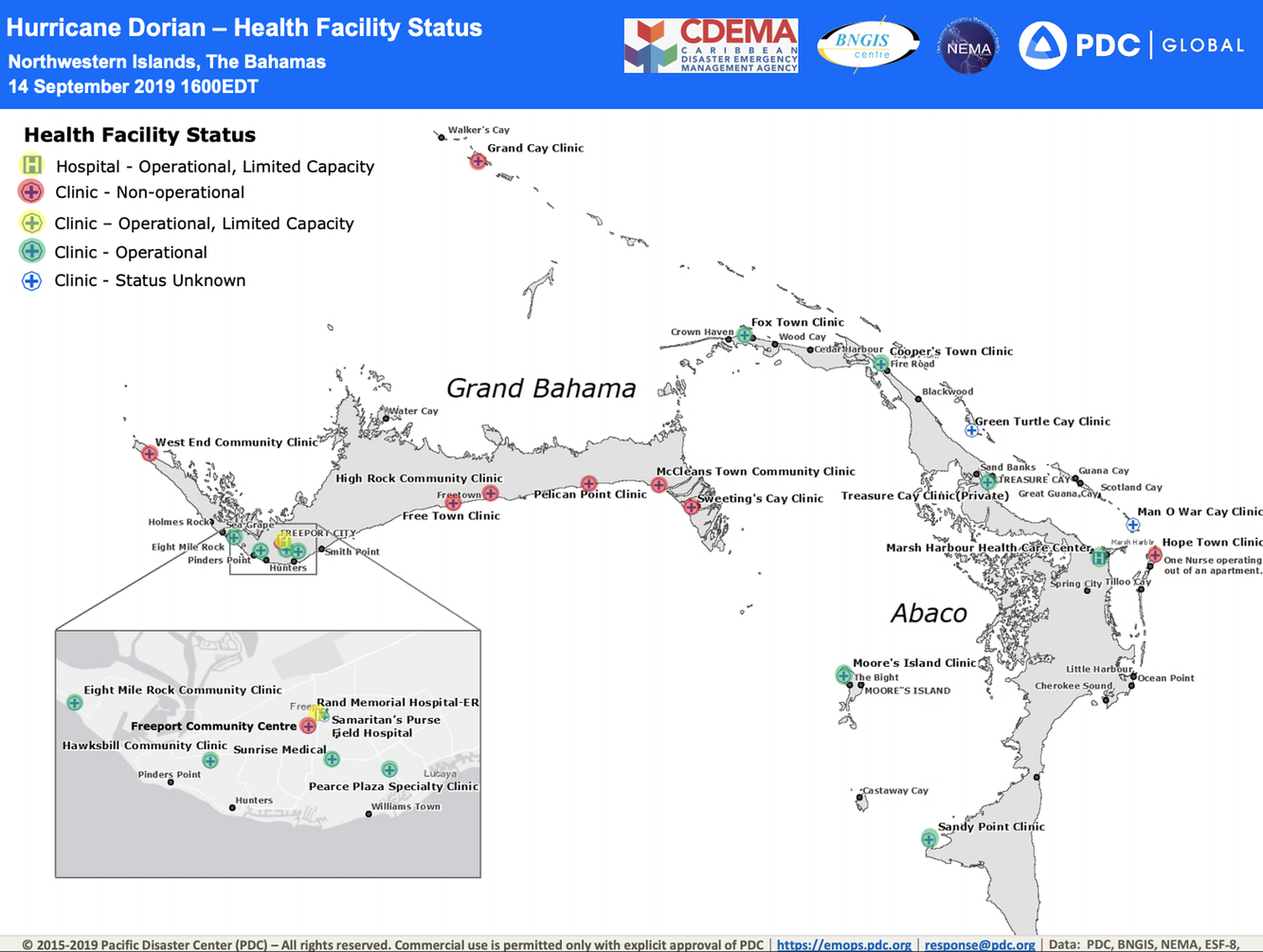
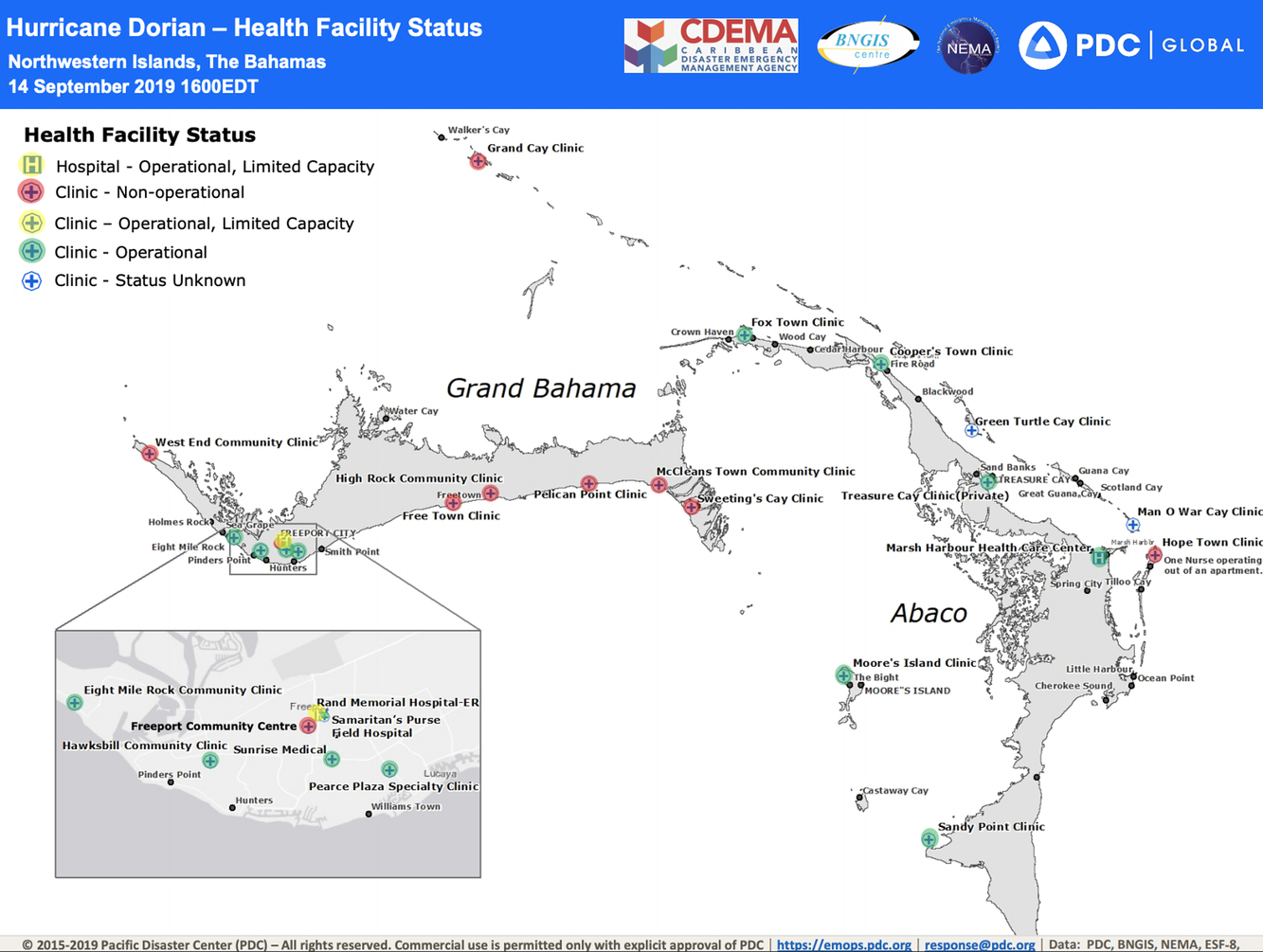
Given the level of destruction and total loss of communication capabilities across the country, the MOH first tasked TR with conducting an RNA of the health infrastructure on Abaco and surrounding cays (Figure 1).
Health Facility Status in Northwestern Bahamas as of September 14, 2019. Provided courtesy of Bahamas National Emergency Management Agency.
Although not a conventional EMT-1 Mobile mission set, a technology-enabled RNA is a core capability for TR and is vital in the setting of multiple, highly dispersed clinical sites. In Abaco, the team divided into smaller units to conduct assessments on 9 distinct cays, 8 of which had to be accessed by rotor wing aircraft due to geographic location or destruction of the only bridge connecting land masses (ie, Fox Town).
The RNA revealed several observations that were critical to the ongoing response. First, there was a widespread evacuation from Abaco before Dorian’s landfall. This action significantly decreased the island’s population and likely reduced the number of medically vulnerable victims. In particular, complex medical patients, such as those dependent on hemodialysis, were reportedly relocated to Nassau or the United States before landfall. Second, the Bahamian government prestocked medical supplies at outlying clinics in June 2019, mitigating many of the potential emergent supply requirements. Third, the construction of the health facilities appeared far superior to most other structures on the island, and clinics were largely functional despite massive destruction of homes. Fourth, there was a very heavy international response presence on Abaco. Some of the NGOs were working at the direction of the MOH, but others had self-deployed and were operating largely outside the official coordinated response.
The combination of preparedness activities of the Bahamian government resulted in a significant reduction in major, acute medical needs. Although the team did conduct several emergent medical evacuations, the majority of encounters were for basic medical screening examinations and psychosocial reassurance. Minor wounds and rashes constituted a minority of the remaining patient complaints. Some concerns were expressed from the population regarding scarcity of chronic medications and anticipated need for refills. Overall, the EMT-1 Mobile had 92 patient contacts and 4 medical evacuations. The MOH de-activated the team on September 16, and the team returned to the United States on September 17.
DISCUSSION AND CHALLENGES
As with most disasters, numerous challenges existed in responding to Hurricane Dorian. We identified 3 key themes within these challenges: communication, coordination, and flexibility of operations. As the EMT-1 Mobile is a relatively new asset for TR, there were unique organizational challenges as well.
Communication
Difficulties in communication are common in disasters. Challenges in technology such as poor cellular phone reception, lack of Internet capabilities, and inconsistent power all posed significant but not unique challenges. In addition to stressing a tactical level of communication, the limitations resulted in delays in field reporting to the National Emergency Management Agency (NEMA) and gaps in early situational awareness. TR has a very strong technology and communication package with Began satellites, portable satellite phones, and mobile Wi-Fi hotspots. Even with this robust capability, the teams experienced difficulty accessing enough bandwidth to submit reports in required formats.
Coordination
A key component of the international disaster response framework is respect for national autonomy. Ethical response requires that the affected nation request and approve any international response. This process can add delays, but is crucial for coordination. In the Bahamas, the Pan American Health Organization (PAHO) established an EMT Coordination Cell (EMTCC). However, domestic medical coordination was split between the MOH and NEMA. As a result, early in the response, there were significant challenges in coordination among PAHO, NEMA, and MOH, resulting in conflicting taskings. For instance, frequently the EMT was tasked to assist at clinics that already had fixed type 1 clinics established by other organizations. Complicating coordination, a variety of NGO’s self-deployed to the Bahamas or were operating with less than stated capabilities.
Flexibility of Operations
TR’s EMT-1 mobile demonstrated significant operational flexibility. Rarely did the team find a need for traditional mobile clinics. Early in the operation, the teams conducted highly mobile RNA across the islands. These assessments used smaller teams, such as 1 doctor and 1 nurse as opposed to a full EMT-1 strike team. When they found gaps, the team would provide impromptu support for fixed facilities or occasionally set up free-standing mobile treatment areas. As the health system recovered, the teams provided mobile care at internally displaced persons camps alongside the MOH. As a result, the team served at times in both a fixed and mobile capacity as well as in a more limited role when assessing and providing care on outlying islands.
The role of an EMT-1 Mobile in disasters occurring in first-world countries is unique. During TR’s previous EMT-1 Mobile deployment following the cyclones in Mozambique in March 2019, the mobile unit was an ongoing asset to reach remote villages that had little to no healthcare at baseline. However, in first-world countries where clinics were back in operations rather rapidly postdisaster, the EMT-1 Mobile could have been most useful in the few days immediately after the disaster to reach outlying towns where clinics had not yet reopened. This requires that the coordinating authorities recognize and support a nuanced operational model.
CONCLUSIONS
TR successfully deployed a WHO EMT-1 Mobile to Abaco Island after Hurricane Dorian. Overall, the medical preparedness activities of the Bahamas limited major acute medical requirements. Clearly, faster team access to communities will improve the organization’s impact. Future considerations for activation of a mobile EMT include attention to the timing of deployment and the varying role of the EMT-1 Mobile in countries with first-world medical systems.
Supplementary material
To view supplementary material for this article, please visit https://doi.org/10.1017/dmp.2019.107.