


1. Introduction
1.1. Motivation
The premium-reserve (hereafter referred to as P-R) process for non-life products is always a very challenging task in the insurance industry as the actuarial team needs to consider the various characteristics of the insured object, the potential demand from the policy holders, the available information about the competition of the targeted market and the reserve that must be kept. Thus, the main data source on which premium strategy is formulated is not only based on the insurance company’s own historical data on policies and claims, but also supplementary information from external sources. At last but not least, it should be emphasised that every company’s objective is to minimise the level of the required reserve. Consequently, the main challenge that a company faces is to set a fair premium that comes up from a reserve minimisation procedure which takes into account different actuarial and financial parameters as well as the market’s competition.
In real-world actuarial applications, a premium principle connects the cost of a general insurance policy to the moments of the corresponding claim arrival and severity distributions. Insurers add a loading to this cost price in order to make profit and cover their expenses. After this consideration, two main questions are raised: “How an optimal premium can be calculated in order to minimise the level of the required reserve?” and “How it is possible to find a premium strategy that takes into consideration market’s competition and all the different economic parameters that affect company’s reserve except for the cost of a general insurance policy?”.
A usual approach concerning non-life insurance pricing is the use of generalised linear models. A number of key ratios are dependent on a set of rating factors (see Ohlsson & Johansson, Reference Ohlsson and Johansson2010). For personal lines insurance which are designed to be sold in large quantities, the key ratios are often the claim frequency and the severity (cost per claim), while for commercial lines insurance which are designed for relatively small legal entities, the loss ratio may be also considered (i.e. claim costs per earned premium). Rating factors are grouped into classes (i.e. factor variables) and may include information about the policyholder, the insured risk as well as the geographic and demographic information.
1.2. Developments in competitive insurance markets
It is generally admitted that many lines of insurance are highly competitive and as a result in the real-world insurance applications, the loading depends critically on the price that other insurers charge for comparable policies. Clapp (Reference Clapp1985) demonstrates that insurance firms are able to use the quantity of insurance to compete for customers. By changing the level of indemnity while holding the premium rate constant (quantity competition), it is possible to induce customers to reveal their risk class. In Rothschild & Stiglitz (Reference Rothschild and Stiglitz1992), a competitive equilibrium may not exist and when this exists it may have strange properties.
Taylor (Reference Taylor1986) is the first who explores the relation between the market’s behaviour, and the optimal response of an individual insurer, whose objective is to maximise the expected present value of the wealth arising over a predefined finite time horizon. He also assumes that the insurance products display a positive price elasticity of demand. Thus, if the market as a whole begins underwriting at a loss, any attempt by a particular insurer to maintain profitability will result in a reduction of its volume of business. Moreover, for a given sequence of average market prices over fixed years to the planning horizon, Taylor (Reference Taylor1986, Reference Taylor1987) simplifies the demand function making several assumptions such that the demand function to be stationary over time, to be proportional to the demand of the preceding year, etc. According to his results, the optimal strategies do not follow what someone might expect. For instance, it is not the case that profitability is best served by following the market during a period of premium rate depression. In particular, the optimal strategy may well involve underwriting for important profit margins at times when the average market premium rate is well short of breaking even. Therefore, he states that the optimal response depends upon various factors including: (a) the predicted time which will elapse before a return of market rates into profitability, (b) the price elasticity of demand for the insurance product under consideration and (c) the rate of return required on the capital supporting the insurance operation.
Emms & Haberman (Reference Emms2005) extend significantly Taylor’s (Reference Taylor1986, Reference Taylor1987) ideas considering the continuous form of his model, and specifically, they define
 $$dq=qg(p/\bar{p})dt$$
and
 $$dw={\minus}\alpha wdt{\plus}q\left( {p\,{\minus}\,\pi } \right)dt$$
, where q is the insurer’s exposure at time t, the insurer’s premium (per unit exposure) is p, the market’s average premium (per unit exposure) is
 $$\bar{p}$$
, the wealth process is w and the mean claim size (per unit exposure) is π. The demand function is exp(g) and α represents the loss of wealth due to returns paid to shareholders. They assume that
 $$\bar{p}$$
is a positive random process with finite mean at time t and leave the distribution for the mean claim size process π unspecified. With this formulation, w is an accurate reflection of the wealth of the company at time t since each policyholder pays a premium pdt per unit exposure for each dt of cover. Consequently, there are no outstanding liabilities at the end of the planning horizon T. The objective function is
 $$V=\mathop {{\rm max}}\limits_p \left( {{\Bbb E}\left[ {w\left( T \right)\!\mid\!S\left( 0 \right)} \right]} \right)$$
that maximises the expected wealth at the end of the planning horizon T given the information on the state S at time t=0.
Emms et al. (Reference Emms2007) model markets average premium as a geometric Brownian motion
 $${{d\bar{p}} \over {\bar{p}}}=\mu dt{\plus}\sigma dZ$$
, where Z is a Wiener process and the drift μ and the volatility σ are assumed to be constant. The future market average premium is lognormally distributed (and hence positive), i.e.,
 $${\rm log}\;\bar{p}\left( t \right)\,\sim\,N\left( {{\rm log}\,\bar{p}_{0} {\plus}\left( {\mu \,{\minus}\,{1 \over 2}\sigma ^{2} } \right)t,\sigma ^{2} t} \right)$$
. They define the demand process by
 $$q_{{k{\plus}1}} =f\left( {p_{{k{\plus}1}} ,\bar{p}_{{k{\plus}1}} } \right)q_{k} $$
. Their aim is, for a given linear utility function of wealth U(w, t), to define
 $$J={\Bbb E}\left( {\mathop{\int}\nolimits_0^T {U\left( {w(s),s} \right)ds} } \right)$$
, and to maximise it over a choice of strategies p. This is similar to the objective function used by Taylor (Reference Taylor1986), where the profit is replaced by the total wealth at time T. What is more, the authors consider two different choices of demand functions; the exponential demand function, where
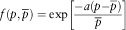 $$f(p,\bar{p})={\rm exp}\left[ {{{{\minus}a(p{\minus}\bar{p})} \over {\bar{p}}}} \right]$$
, for some constant α>0, and the constant elasticity demand function, where
 $$f(p,\bar{p})=\left( {{p \over {\bar{p}}}} \right)^{{{\minus}a}} $$
, and the utility function is equal to
 $$U(w,t)=e^{{{\minus}\beta t}} w$$
, where β is the intertemporal discount rate. Finally, they study two premium strategies: the first strategy is to set a premium of the form
 $$p(t)=k\bar{p}(t)$$
, where k is constant; the second one sets the p as a function of the break-even premium π, the difference of the market average premium
 $$\bar{p}$$
and the break-even premium, i.e.,
 $$p(t)=\pi {\plus}r(\bar{p}(t)\,{\minus}\,\pi )$$
, and hence they optimise it over the single parameter r.
Emms (2007
Reference Emmsa
) determines the optimal strategy for an insurer, which maximises again a particular objective function over a fixed planning horizon, and the premium by using a competitive demand model as well as expected main claim size. Thus, he assumes that the premium is partially determined by the price relative to the rest of the insurance market. According to that paper, it is not enough that an insurer sets a price to cover claims if the rest of the market undercuts that price. In addition, the demand law specifies how the insurer’s income and exposure change in comparison with the market premium; a low relative premium generates exposure but leads to reduced premium income. He introduces the relative loss ratio, which is defined as the ratio between the break-even premium of the insurer and the market’s average premium,
 $$\gamma _{t} ={{\pi _{t} } \over {\bar{p}_{t} }}$$
. The break-even premium is the actuarial premium without any profit margin, and it can be deduced from the insurer’s previous claims data, and a loading factor to account for expenses and interest rates. What is more, he assumes that the break-even premium is a stochastic process.
In Emms (Reference Emms2008), two forms of stochasticity are considered: the uncertainty in the future market average premium and the uncertainty in the change of exposure from a given relative premium level. The optimal premium is determined using dynamic programming and this is compared with the deterministic one. In Emms’ (Reference Emms2008) model, the actual exposure the insurer gains is
 $$dq=q_{t} (G{\minus}t)dt{\plus}\sigma _{1} dW_{t} $$
, where G=G(q
t
, k
t
) is the demand function, σ
1=σ
1(q
t
)≥0 the volatility of policy sales, dW
t
a standard Brownian motion and
 $k_{t} =p_{t} /\bar{p}_{t} $
the premium relative to the market average premium. The aim is to find the optimal relative premium strategy
 $$k_{t}^{{\asterisk}} $$
, which maximises the expected utility of the terminal wealth
 $${\Bbb E}\left( {U_{2} \left( {w_{T} } \right)\!\mid\!x_{t} =x_{0} } \right)$$
, where U
2 is the utility function,
 $$x_{t} =(q_{t} ,\bar{p}_{k} ,w_{t} )^{T} $$
the state vector and T the planning horizon. According to his results, if the market’s average premium is a stochastic parameter, then the optimisation problem is reduced to a set of characteristic strip equations which are analysed using the phase diagram. If the change in the exposure is also stochastic, then an analytical expression can be found for the optimal premium strategy, when the objective is to maximise the expected terminal wealth in an infinite insurance market with an exponential utility function.
Later, Emms (Reference Emms and Haberman2011) introduces a simple parameterisation which represents the insurance market’s response to an insurer adopting a pricing strategy determined via optimal control theory and claims are modelled using a lognormally distributed mean claim size rate. Analytically, a generalisation of the demand function, which has been mentioned initially in Emms (2007 Reference Emmsa , 2007 Reference Emmsb ), is assumed, which implements the impacts on the optimal premium strategy for an insurer. If there is no reaction in the market, then he finds an analytical expression for the optimal relative premium, and if there is no insurance claims, then the optimal relative premium is 0, since there is no need for insurance. Even though the optimal premium strategy is given explicitly, it is not immediately apparent from the analytical solution how the demand function affects the optimal strategy. Consequently, he introduces a set of parameters and considered the deviation of the optimal strategy corresponding to changes in the parameter set. As the sensitivity of the market to the value of insurance is decreased, demand for insurance increases, and the optimal strategy can lead to negative premium values if the markets overprice insurance.
Recently, Pantelous & Passalidou (Reference Pantelous and Passalidou2013) introduce a stochastic demand function for the volume of business of an insurance company into a discrete-time extending Taylor’s (Reference Taylor1986, Reference Taylor1987) ideas further. In addition, using a linear discounted function for the wealth process of the company, as in Emms et al. (Reference Emms2007), they provide an analytical (endogenous) formula for the optimal premium strategy of the insurance company when it is expected to lose part of the market. Mathematically speaking, they create a maximisation problem for the wealth process of a company, which is solved by using a stochastic dynamic programming (see Emms, Reference Emms2008). Thus, the optimal controller (i.e. the premium) is defined endogenously by the market as the company struggles to increase its volume of business into a competitive environment with the same characteristics as Taylor (Reference Taylor1986, Reference Taylor1987), Emms & Haberman (Reference Emms2005) and Emms et al. (Reference Emms2007) have used. Furthermore, they consider two different strategies for the average premium of the market, and the optimal premium policy is derived and fully investigated.
In Pantelous & Passalidou (Reference Pantelous and Passalidou2015), the volume of business is formed to be a general stochastic demand function, extending further their previous idea (see Pantelous & Passalidou, Reference Pantelous and Passalidou2013), making the model more pragmatic and realistic. Thus, for the formulation of the volume of business, the company’s reputation is also considered. According to Cretu & Brodie (Reference Cretu and Brodie2007), a company’s reputation (or corporate reputation) has a strong influence on buying decisions or in other words, on the demand of the company’s product. In our case, the function for the volume of business emphasises the ratio of the market’s average to the company’s premium, the past year’s experience, the company’s reputation and a stochastic disturbance. In addition, following the existing literature, the same linear discounted function for the wealth process of the company is used (see also Emms et al., Reference Emms2007; Pantelous & Passalidou, Reference Pantelous and Passalidou2013). Finally, the optimal premium can be calculated for either negative or positive effect of the company’s reputation (see also Pantelous & Passalidou, Reference Pantelous and Passalidou2013).
In the literature so far as this is presented above, a common assumption is made that there exists a single insurer whose pricing strategy does not cause any reaction in the rest of the market’s competitors. Lately, this assumption has been revisited, and some game theoretic approaches have been developed instead (see Emms, Reference Emms, Haberman and Savoulli2012; Dutang et al., Reference Dutang, Albrecher and Loisel2013; Wu & Pantelous, Reference Von Neumann and Morgenstern2016) and references therein for further details. However, further details are omitted in the present paper.
1.3. Demand for a non-linear optimal control framework
As in Taylor (Reference Taylor1986, Reference Taylor1987), Emms et al. (Reference Emms2007) and Pantelous & Passalidou (Reference Pantelous and Passalidou2013), the volume of business is directly connected to the company’s product demand function. Market’s demand for an insurance product is the relationship between the product’s price and the product demanded by all customers. In the model studied in Pantelous & Passalidou (Reference Pantelous and Passalidou2015), the volume of business function is derived from the equilibrium points of the competitive market (perfect competition), which are defined by the intersection of the demand and supply curves. These points determine the contracts of general insurance that have been purchased, and its prices, which are equal to the marginal cost of services.
Both in Pantelous & Passalidou (Reference Pantelous and Passalidou2013, Reference Pantelous and Passalidou2015), the disturbance of the volume of business function denotes the set of all other stochastic variables that are considered to be relevant to the demand function (moreover, they are assumed to be independently distributed in time and Gaussian). However, this significant function should also be developed by modelling many other micro–macroeconomic factors that affect the company’s volume of business and consequently, the optimal premium strategy. Thus, a more thoughtful analysis of this real-world insurance problem demands that the volume of business to be modelled as a non-linear function with respect to reserve, the premium, the noise and a quadratic performance criterion concerning the utility function to be implemented. Indeed, there are quite a few examples where non-linear analysis to model different insurance’s applications is required (see for instance Kremer, Reference Kremer2004, Reference Kremer2006; Fanti et al., Reference Fanti, Gori and Sodini2013).
At this point, let us continue with some arguments about the choice of a quadratic minimisation problem. Indeed, quadratic forms are the next simplest functions after linear ones. Like linear functions, they have a matrix representation, so that studying quadratic forms reduces to studying symmetric matrices. In addition, the second-order condition that distinguish maxima from minima in economic optimisation problems are stated in terms of a quadratic form. It should be mentioned that several well-known economic problems are modelled using quadratic objective functions, such as the risk minimisation problems in finance, where riskiness is measured by the (quadratic) variance of the returns from investments, etc. (see Simon & Blume, Reference Simon and Blume1994; Searle & Willett, Reference Searle and Willett2001). Concerning insurance’s application, Lai (Reference Lai2011) uses a quadratic utility function to find the sufficient conditions on the insurance premium and deductible to increase the production for a risk-averse firm.
Giving another dimension to Pantelous & Passalidou (Reference Pantelous and Passalidou2013, Reference Pantelous and Passalidou2015) model, in the present paper the volume of business in year k is not only proportional to the ratio of the market’s average and company’s premium, but it is also related to a function of the form
 $f_{k} \left( {R_{k} ,\tilde{p}_{k} ,\theta _{k} } \right)$
, where
 $$F_{k} (R_{k} ,\tilde{p}_{k} )\,\,{\triangleq}\,\,{\Bbb E}[f_{k}^{2} (R_{k} ,\tilde{p}_{k} ,\theta _{k} )]$$
. As it will be clearer in the next section, the function
 $F_{k} \left( {R_{k} ,\tilde{p}_{k} } \right)$
consists of micro–macroeconomic parameters, which are implemented in a competitive P-R model. These are the income insurance elasticity of demand, the numbers of insured and the inflation in addition to the fame of company. Since it is not straightforward to define completely the function
 $f_{k} \left( {R_{k} ,\tilde{p}_{k} ,\theta _{k} } \right)$
because of its stochastic property, a rational approach is given by the function
 $F_{k} \left( {R_{k} ,\tilde{p}_{k} } \right)$
.
Thus, the main contribution of this paper can be highlighted on the following key points. First, an optimal quadratic control model for the determination of the P-R strategy is developed as a minimisation problem in a non-linear framework for the very first time according to the authors’ knowledge. In this approach, the present value of the company’s reserve is required to be close to 0. Second, the stochastic function
 $$f_{k} (R_{k} ,\tilde{p}_{k} ,\theta _{k} )$$
that affects the company’s reserve is analysed considering different micro–macroeconomic parameters, which directly or indirectly affect the optimal premium. Finally, as in Pantelous & Passalidou (Reference Pantelous and Passalidou2013, Reference Pantelous and Passalidou2015), the insurance premium is given dynamically and includes a good number of interesting and very informative parameters about the competition of the market.
The paper is organised as follows: in section 2, a non-linear model in discrete-time for the P-R strategy of an insurance market is constructed. The utility and the reserve functions are discussed and the main model’s assumptions as well as their necessary economic interpretation are provided. In section 3, the calculation of the optimal premium is derived which is presented using a theorem. In addition, in this section, some special cases of the function
 $$f_{k} (R_{k} ,\tilde{p}_{k} ,\theta _{k} )$$
are presented. The discussion of the main results is given in section 4. Then, section 5 presents a numerical application to illustrate further the theoretical findings of the paper. Finally, section 6 concludes the paper and it gives directions for further research.
2. Model Formulation
2.1. Basic notation
In this part of the paper, following close the notation which is provided by Taylor (Reference Taylor1986, Reference Taylor1987), Emms & Haberman (Reference Emms2005), Emms et al. (Reference Emms2007) and Pantelous & Passalidou (Reference Pantelous and Passalidou2013, Reference Pantelous and Passalidou2015), the following parameters are defined:
 $$\{ V_{k} \} _{{k\in {\Bbb N}}} $$
: denotes the sequence of the volume of business (or exposure) underwritten by the insurer in year [k, k+1). This volume may be measured in any meaningful unit, e.g. number of contracts, claims incurred, total man-hours at risk (for workers’ compensation insurance). In our paper, we consider the number of contracts as the volume of exposure.
 $$\{ \pi _{k} \} _{{k\in {\Bbb N}}} $$
: denotes the sequence of the break-even premium in year [k, k+1), i.e. risk premium plus expenses per unit exposure.
 $$\{ p_{k} \} _{{k\in {\Bbb N}}} $$
: denotes the sequence of the premium charged by the insurer in year [k, k+1).
 $$\{ \bar{p}_{k} \} _{{k\in {\Bbb N}}} $$
: denotes the sequence of the “average” premium charged by the market in year [k, k+1). It is a stochastic parameter.
 $$\{ \theta _{k} \} _{{k\in {\Bbb N}}} $$
: denotes the sequence of the set of all other stochastic variables (which are assumed to be independently distributed in time and not only Gaussian) and it is considered to be relevant to the demand function in year [k, k+1).
 $$\{ q_{k} \} _{{k\in {\Bbb N}}} $$
: denotes the sequence of the present day value factor of a reserve asset in year [k, k+1).
 $$\{ B_{k} \} _{{k\in {\Bbb N}}} $$
: denotes the sequence of the income elasticity of demand concerning insurance contracts in year [k, k+1).
 $$\{ C_{k} \} _{{k\in {\Bbb N}}} $$
: denotes the sequence of the inflation rate in year [k, k+1).
 $$\{ M_{k} \} _{{k\in {\Bbb N}}} $$
: denotes the sequence of the number of insured in year [k, k+1).
 $$\{ g_{k} \} _{{k\in {\Bbb N}}} $$
: denotes the sequence of the reputation’s impact to the volume of business in year [k, k+1).
2.2. Utility and reserve function
Borch (Reference Borch1974, Reference Borch1990) and Gerber & Pafumi (Reference Gerber and Pafumi1999) show the importance of the utility theory to formulate and model some real-world problems that were relevant to insurance industry. Von Neumann & Morgenstern (Reference Wu and Pantelous1947) argue that the existence of a utility function can derive from a set of axioms governing a preference ordering, thus our suggested reserve utility function has the following two basic properties:
-
a. U(R k ) is a decreasing function of reserve R k .
-
b. U(R k ) is a convex function of R k .
The first property deals with the required evidence that less reserve is better, which is a reasonable target for every insurance company. One way to justify the second property is to require the marginal utility U(R k ) to be an increasing function of reserve R k or equivalently, that the gain of utility resulting from a premium gain of g, U(R k +g)−U(R k ) to be an increasing function of the reserve. The utility function which is proposed is equal to the sum of the present value of company’s reserve from the starting year which is equal to 0 till year N−1 times 1/2 plus the present value of the company’s reserve in year N times 1/2.
In a linear framework (see Pantelous & Passalidou, Reference Pantelous and Passalidou2013, Reference Pantelous and Passalidou2015) the process R k is denoted as the insurer’s reserve at time [k, k+1), which is given by
 $$R_{{k{\plus}1}} ={\minus}a_{k} R_{k} {\plus}\left( {p_{k} \,{\minus}\,\pi _{k} } \right)V_{k} $$
where
 $$a_{k} \in [0,1]$$
denotes the excess return on reserve (i.e. return on reserve required by the shareholders of the insurer whose strategy is under consideration). Thus, −a
k
R
k
is the cost of holding R
k
in the time interval [k, k+1).
As in Taylor (Reference Taylor1986, Reference Taylor1987), Pantelous & Passalidou (Reference Pantelous and Passalidou2013, Reference Pantelous and Passalidou2015), the volume of business in year k is assumed to be proportional to the ratio of the market’s average premium to the company’s premium in year k times the company’s volume of business in the preceding year. Furthermore, the volume of business is stochastic due to the stochastic parameter θ k which is assumed to be independently distributed in time and not always Gaussian, and indirectly affects the premium and finally the company’s reserve (see also Assumption 2 (see next subsection)).
In this paper, a minimisation problem with respect to
 $$\tilde{p}_{k} ={1 \over {p_{k} }}$$
is considered, where the following quadratic performance criterion is valid
 $${\Bbb E}_{{R0}} \left[ {\mathop{\sum}\limits_{k=0}^{N{\minus}1} {{1 \over 2}q_{k} R_{k}^{2} } {\plus}{1 \over 2}q_{N} R_{N}^{2} } \right]$$
subject to the stochastic dynamic system of the P-R process
 $$R_{{k{\plus}1}} ={\minus}a_{k} R_{k} {\plus}m_{k} {\plus}Z_{k} \tilde{p}_{k} {\plus}{\rm sign}(f_{k} )f_{k} (R_{k} ,\tilde{p}_{k} ,\theta _{k} )$$
where R
0 is known,
 $m_{k} =V_{{k{\minus}1}} \bar{p}_{k} $
,
 $Z_{k} ={\minus}V_{{k{\minus}1}} \bar{p}_{k} \pi _{k} $
,
 $$R_{k} ,\tilde{p}_{k} ,\theta _{k} \in {\Bbb R}$$
,
 $$f_{k} :{\Bbb R}{\times}{\Bbb R}{\times}{\Bbb R}\to{\Bbb R}$$
, q
k
, q
N
, α
k
, Z
k
and
 $$m_{k} \in {\Bbb R}$$
and sign(f
k
)=±1 denotes the way that the function
 $$f_{k} (R_{k} ,\tilde{p}_{k} ,\theta _{k} )$$
affects company’s reserve. Since market’s average premium is stochastic, Z
k
and m
k
are also stochastic. In other words,
 $${\Bbb E}\left( {m_{k} } \right)=V_{{k{\minus}1}} {\Bbb E}\left( {\bar{p}_{k} } \right)$$
,
 $${\Bbb E}\left( {Z_{k} } \right)={\minus}V_{{k{\minus}1}} {\Bbb E}\left( {\bar{p}_{k} } \right)\pi _{k} ={\minus}{\Bbb E}\left( {m_{k} } \right)\pi _{k} $$
.
Remark 1
Equation (2.3) is an interesting and significant extension of the relevant equations in Taylor (Reference Taylor1986, Reference Taylor1987) and Pantelous & Passalidou (Reference Pantelous and Passalidou2013, Reference Pantelous and Passalidou2015) in discrete-time framework. Actually, if
 $$f_{k} (R_{k} ,\tilde{p}_{k} ,\theta _{k} )$$
is eliminated completely, then Taylor’s (Reference Taylor1986) and Pantelous & Passalidou’s (Reference Pantelous and Passalidou2013) simplified approaches are deriving. It should be also mentioned that Taylor (Reference Taylor1986) is proposing a non-linear framework, but instead a linear approach of the wealth (equivalently here, of the reserve) process is discussed eventually.
2.3. Assumptions
The following assumptions are made:
Assumption 1
 $$f_{k} (R_{k} ,\tilde{p}_{k} )\,{\triangleq}\,{\Bbb E}\left[ {f_{k} (R_{k} ,\tilde{p}_{k} ,\theta _{k} )} \right]$$
is 0 for all
 $$R_{k} ,\tilde{p}_{k} \in {\Bbb R},k=0,\,\ldots\,,N{\minus}1$$
. There is no loss of generality to assume that
 $$f_{k} (R_{k} ,\tilde{p}_{k} )\,{\triangleq}\,0$$
, because appropriate choices of −a
k
, Z
k
, m
k
will model any mean value of f
k
which is linear in
 $$R_{k} ,\tilde{p}_{k} $$
.
Assumption 2
 $$F_{k} (R_{k} ,\tilde{p}_{k} )\,{\triangleq}\,{\Bbb E}\left[ {f_{k}^{2} (R_{k} ,\tilde{p}_{k} ,\theta _{k} )} \right]$$
exists and is a general quadratic function of
 $$R_{k} ,\tilde{p}_{k} $$
for k=0, … , N−1.
 $$F_{k} (R_{k} ,\tilde{p}_{k} )$$
has the following representation
 $$F_{k} (R_{k} ,\tilde{p}_{k} )\,{\triangleq}\,B_{k} \left( {{1 \over 2}R_{k}^{2} C_{k} {\plus}\tilde{p}_{k} g_{k} R_{k} {\plus}{1 \over 2}\tilde{p}_{k}^{2} M_{k} } \right)$$
where
 $$B_{k} ,C_{k} ,M_{k} ,g_{k} \in {\Bbb R}$$
.
Remark 2 The income elasticity, B k , of non-life insurance measures the responsiveness of the demand for general insurance contracts to a change in the income of the people demanding them ceteris paribus (all other factors held constant). Lee & Chiu (Reference Lee and Chiu2012) conclude that insurance, like other developed financial services, has grown in quantitative importance as part of the general advancement of financial sectors and that there is a relationship between non-life insurance premiums and real income. According to their study, income elasticity of non-life insurance premiums are larger than 1.
Remark 3 The inflation, C k , can change dramatically company’s reserve since inflation reflects a reduction in the purchasing power per unit of money or loss of real value in the medium of exchange and unit of account within the economy. D’Arcy (Reference D’Arcy1982) finds that both the underwriting profit margin and insurance investment returns are negatively correlated with the inflation rate during the period 1951–1976. Krivo (Reference Krivo2009) determines that although inflation and the underwriting profit margin are not significantly correlated over the subsequent period 1977–2006, investment returns and the year-to-year change in underwriting profit margin are both significantly negatively correlated with inflation over that period. Lowe & Warren (Reference Lowe and Warren2010) describe the negative impact of inflation on property-liability insurers’ claim costs, loss reserves and asset portfolios. They express concern that most current actuaries, underwriters and claim staff have never experienced severe inflation, so could be slow to adapt to any change in the economic environment. In other words, property-liability insurers are impacted by inflation in several ways. The clearest impact is the cost of future claims on current policies according to Ahlgrim & D’Arcy (Reference Ahlgrim and D’Arcy2012).
Remark 4 A critical factor that affects demand for non-life insurance and indirectly premium and reserve is the number of insureds, M k , in the market. As new insureds enter the market this has a direct effect on insurance contracts that insureds are willing and able to buy. An increase in the number of buyers means that there are more individual demand curves to add up to get the general insurance demand curve, so market’s demand increases. An increase in demand shifts the demand curve to the right so at each premium, the quantity of contract’s demand increases. The excess demand causes the premium to rise and equilibrium is restored at a different point.
Remark 5 As it has been discussed in detail in Pantelous & Passalidou (Reference Pantelous and Passalidou2015), the reputation of the company affects the product’s demand, and consequently, the optimal premium as well as the company’s reserve. The reputation of a business, g k , is essential to its survival. The trust and confidence of the client can have a direct and profound effect on a company’s bottom line.
Assumption 3:
 $$F_{k} (R_{k} ,\tilde{p}_{k} )\geq 0,\forall R_{k} \in {\Bbb R},\,\tilde{p}_{k} \in {\Bbb R}$$
.
Assumption 3 is necessary (hence not at all restrictive) in order that
 $$F_{k} (R_{k} ,\tilde{p}_{k} )$$
be a covariance function for each
 $$R_{k} ,\tilde{p}_{k} \in {\Bbb R}$$
. The optimal control sequence
 $$\left\{ {\tilde{p}_{k} } \right\}$$
is to be drawn from sequences of closed loop controllers, i.e. of the form
 $$\tilde{p}_{k} =D_{k} \left( {{\scr R}_{k} } \right);{\scr R}_{k} \,{\triangleq}\,\left\{ {R_{0} ,R_{1} ,\,\ldots\,,R_{k} } \right\}$$
, where
 $$D_{k} :{\Bbb R}{\times}{\Bbb R}\to{\Bbb R};\,k=0,\,\ldots\,,N\,{\minus}\,1$$
. Note that because θ
k
is a sequence of random variables independently disturbed in time, knowledge of this is equivalent to knowledge of
 $${\scr R}_{k} $$
so that the sequences of closed loop controllers can be written
 $$\tilde{p}_{k} =D_{k} \left( {R_{k} } \right);k=0,\,\ldots\,,N\,{\minus}\,1$$
.
Moreover, the following assumptions are also needed.
Assumption 4 There is positive price elasticity of demand, i.e. if the market as a whole begins underwriting at a loss, any attempt by a particular insurer to maintain profitability will result in a reduction of his volume of business.
Assumption 5 There is a finite time horizon.
Assumption 6 Demand in year k+1 is assumed to be proportional to demand in the preceding year k.
3. Calculate the Optimal Premium in the P-R Process
3.1. The main result
In this section, the optimal premium,
 $$\tilde{p}_{k}^{{\asterisk}} $$
, that the insurance company intends to charge is calculated by minimising the expected total utility of the reserve equations (2.2) and (2.3) over a finite time horizon T, and over a choice of strategies p. The next theorem provides the optimal premium strategy for the finite time horizon minimisation problem (equations (2.1)–(2.3), see also Kushner, Reference Kushner1970; Jacobson, Reference Jacobson1974). Let us define first
 $$\tilde{u}_{k} =2V_{{k{\minus}1}}^{2} \pi _{k}^{2} {\Bbb E}\left( {\bar{p}_{k}^{2} } \right)S_{{k{\plus}1}} {\plus}B_{k} M_{k} S_{{k{\plus}1}} $$
 $$\tilde{a}_{k} =2a_{k} V_{{k{\minus}1}} \pi _{k} {\Bbb E}\left( {\bar{p}_{k} } \right)S_{{k{\plus}1}} {\plus}B_{k} g_{k} S_{{k{\plus}1}} $$
 $$\tilde{m}_{k} ={\minus}2V_{{k{\minus}1}}^{2} \pi _{k} {\Bbb E}\left( {\bar{p}_{k}^{2} } \right)S_{{k{\plus}1}} \,{\minus}\,V_{{k{\minus}1}} \pi _{k} {\Bbb E}\left( {\bar{p}_{k} } \right)d_{{k{\plus}1}} $$
where
 $$S_{k} =q_{k} {\plus}2a_{k}^{2} S_{{k{\plus}1}} {\plus}B_{k} C_{k} S_{{k{\plus}1}} \,{\minus}\,\tilde{u}_{k}^{{{\minus}1}} \tilde{a}_{k}^{2} ,\,S_{N} =q_{N} $$
 $$d_{k} ={\minus}2a_{k} V_{{k{\minus}1}} {\Bbb E}\left( {\bar{p}_{k} } \right)S_{{k{\plus}1}} \,{\minus}\,d_{{k{\plus}1}} a_{k} \,{\minus}\,\tilde{a}_{k} \tilde{u}_{k}^{{{\minus}1}} \tilde{m}_{k} ,\,d_{N} =0$$
 $$e_{k} =V_{{k{\minus}1}}^{2} {\Bbb E}\left( {\bar{p}_{k}^{2} } \right)S_{{k{\plus}1}} {\plus}V_{{k{\minus}1}} {\Bbb E}\left( {\bar{p}_{k} } \right)d_{{k{\plus}1}} {\plus}e_{{k{\plus}1}} {\minus}{1 \over 2}\tilde{u}_{k}^{{{\minus}1}} \tilde{m}_{k}^{2} ,\,e_{N} =0$$
Theorem 1 Using equations (3.1)–(3.6), and
 $$\tilde{u}_{k} \,\geq \,0\;{\rm for}\,{\rm all}\;k\,\in \{ 0,\,\ldots\,,N\,{\minus}\,1\} $$
the optimal premium strategy is given by
 $$\tilde{p}_{k}^{{\asterisk}} ={\minus}\left[ {{{\tilde{a}_{k} R_{k} {\plus}\tilde{m}_{k} } \over {\tilde{u}_{k} }}} \right];\,k=0,\,\ldots\,,N\,{\minus}\,1$$
and the minimum value is given by
 $${1 \over 2}R_{0}^{2} S_{0} {\plus}d_{0} R_{0} {\plus}e_{0} $$
Proof: Let us define
 $$J_{k} \left( {R_{k} } \right)\,{\triangleq}\mathop {{\rm min}}\limits_{p_{k} ,\,\ldots\,,p_{{N{\minus}1}} } {\Bbb E}_{{R_{k} }} \left[ {\mathop{\sum}\limits_{i=\kappa }^{N{\minus}1} {{1 \over 2}R_{i}^{2} q_{i} {\plus}{1 \over 2}R_{N}^{2} q_{N} } } \right]$$
The optimal performance criterion satisfies Bellman equation
 $$\eqalignno{ & J_{k} \left( {R_{k} } \right)\,{\triangleq}\mathop {{\rm min}}\limits_{p_{k} ,\,\ldots\,,p_{{N{\minus}1}} } {\Bbb E}_{{R_{k} }} \left[ {{1 \over 2}R_{k}^{2} q_{k} {\plus}J_{{k{\plus}1}} \left( {R_{{k{\plus}1}} } \right)} \right] \cr & J_{k} \left( {R_{k} } \right)\,{\triangleq}\mathop {{\rm min}}\limits_{p_{k} ,\,\ldots\,,p_{{N{\minus}1}} } \left\{ {{1 \over 2}R_{k}^{2} q_{k} {\plus}{\Bbb E}_{{R_{k} }} \left[ {J_{{k{\plus}1}} \left( {R_{{k{\plus}1}} } \right)} \right]} \right\} $$
and
 $$J_{N} (R_{N} )={1 \over 2}R_{N}^{2} u_{N} $$
. We now show by induction that
 $$J_{k} (R_{k} )\,{\triangleq}\,{1 \over 2}S_{k} R_{k}^{2} {\plus}d_{k} R_{k} {\plus}e_{k} $$
solves equation (3.11), by noting that equation (3.12) is true for k=N, assuming that equation (3.12) is true for k+1 and proving that is true for k. Substituting the assumed expression into the right hand side of equation (3.11) yields
 $$\matrix{ {\mathop {{\rm min}}\limits_{p_{k} } \left\{ {{1 \over 2}R_{k}^{2} q_{k} {\plus}{\Bbb E}_{{R_{k} }} \left[ {{\minus}a_{k} R_{k} {\minus}V_{{k{\minus}1}} \pi _{k} \bar{p}_{k} \tilde{p}_{k} {\plus}V_{{k{\minus}1}} \bar{p}_{k} {\plus}{\rm sign}(f_{k} )f_{k} (R_{{k,}} \tilde{p}_{k} ,\theta _{k} )} \right]^{2} S_{{k{\plus}1}} } \right.} \hfill \cr {\left. {{\plus}{\Bbb E}_{{R_{k} }} \left[ {{\minus}a_{k} R_{k} {\minus}V_{{k{\minus}1}} \pi _{k} \bar{p}_{k} \tilde{p}_{k} {\plus}V_{{k{\minus}1}} \bar{p}_{k} {\plus}{\rm sign}(f_{k} )f_{k} (R_{{k,}} \tilde{p}_{k} ,\theta _{k} )} \right]d_{{k{\plus}1}} {\plus}e_{{k{\plus}1}} } \right\}} \hfill \cr {=\mathop {{\rm min}}\limits_{p_{k} } \left\{ {{1 \over 2}R_{k}^{2} q_{k} {\plus}{\Bbb E}_{{R_{k} }} [a_{k}^{2} R_{k}^{2} {\plus}V_{{k{\minus}1}}^{2} \pi _{k}^{2} \bar{p}_{k}^{2} \tilde{p}_{k}^{2} {\plus}V_{{k{\minus}1}}^{2} \bar{p}_{k}^{2} {\plus}2a_{k} R_{k} V_{{k{\minus}1}} \pi _{k} \bar{p}_{k} \tilde{p}_{k} } \right.} \hfill \cr {{\minus}2a_{k} R_{k} V_{{k{\minus}1}} \bar{p}_{k} {\minus}2a_{k} R_{k} {\rm sign}(f_{k} )f_{k} (R_{{k,}} \tilde{p}_{k} ,\theta _{k} )} \hfill \cr {{\minus}2V_{{k{\minus}1}}^{2} \pi _{k} \bar{p}_{k}^{2} \tilde{p}_{k} {\minus}2V_{{k{\minus}1}} \pi _{k} \bar{p}_{k} \tilde{p}_{k} {\rm sign}(f_{k} )f_{k} (R_{{k,}} \tilde{p}_{k} ,\theta _{k} )} \hfill \cr {{\plus}2V_{{k{\minus}1}} \bar{p}_{k} {\rm sign}(f_{k} )f_{k} (R_{{k,}} \tilde{p}_{k} ,\theta _{k} ){\plus}\left[ {sign(f_{k} )f_{k} (R_{{k,}} \tilde{p}_{k} ,\theta _{k} )} \right]\left. {^{2} } \right]S_{{k{\plus}1}} } \hfill \cr {\left. {{\plus}{\Bbb E}_{{R_{k} }} \left[ {{\minus}a_{k} R_{k} {\minus}V_{{k{\minus}1}} \pi _{k} \bar{p}_{k} \tilde{p}_{k} {\plus}V_{{k{\minus}1}} \bar{p}_{k} {\plus}{\rm sign}(f_{k} )f_{k} (R_{{k,}} \tilde{p}_{k} ,\theta _{k} )} \right]d_{{k{\plus}1}} {\plus}e_{{k{\plus}1}} } \right\}} \hfill \cr {=\mathop {{\rm min}}\limits_{p_{k} } \left\{ {{1 \over 2}R_{k}^{2} q_{k} {\plus}\left[ {a_{k}^{2} R_{k}^{2} } \right.{\plus}V_{{k{\minus}1}}^{2} \pi _{k}^{2} {\Bbb E}\left( {\bar{p}_{k}^{2} } \right)\tilde{p}_{k}^{2} {\plus}V_{{k{\minus}1}}^{2} {\Bbb E}\left( {\bar{p}_{k}^{2} } \right)} \right.} \hfill \cr{{\plus}2a_{k} R_{k} V_{{k{\minus}1}} \pi _{k} {\Bbb E}\left( {\bar{p}_{k} } \right)\tilde{p}_{k} {\minus}2a_{k} R_{k} V_{{k{\minus}1}} {\Bbb E}\left( {\bar{p}_{k} } \right){\minus}2V_{{k{\minus}1}}^{2} \pi _{k} {\Bbb E}\left( {\bar{p}_{k}^{2} } \right)\tilde{p}_{k} {\plus}{\Bbb E}\left[ {f_{k} (R_{{k,}} \tilde{p}_{k} ,\theta _{k} )} \right]\left. {^{2} } \right]S_{{k{\plus}1}} \quad\quad\quad \;\;\;(3.13)} \hfill \cr \matrix{ \left. {{\plus}\left[ {{\minus}a_{k} R_{k} {\minus}V_{{k{\minus}1}} \pi _{k} {\Bbb E}\left( {\bar{p}_{k} } \right)\tilde{p}_{k} {\plus}V_{{k{\minus}1}} {\Bbb E}\left( {\bar{p}_{k} } \right)} \right]d_{{k{\plus}1}} {\plus}e_{{k{\plus}1}} } \right\} \vskip 8pt \hfill \cr \matrix{ {=\mathop {{\rm min}}\limits_{p_{k} } \left\{ {{1 \over 2}R_{k}^{2} q_{k} {\plus}a_{k}^{2} R_{k}^{2} S_{{k{\plus}1}} {\plus}V_{{k{\minus}1}}^{2} \pi _{k}^{2} {\Bbb E}\left( {\bar{p}_{k}^{2} } \right)\tilde{p}_{k}^{2} S_{{k{\plus}1}} {\plus}V_{{k{\minus}1}}^{2} {\Bbb E}\left( {\bar{p}_{k}^{2} } \right)S_{{k{\plus}1}} } \right.} \hfill \cr {{\plus}2a_{k} R_{k} V_{{k{\minus}1}} \pi _{k} {\Bbb E}\left( {\bar{p}_{k} } \right)\tilde{p}_{k} S_{{k{\plus}1}} \,{\minus}\,2a_{k} R_{k} V_{{k{\minus}1}} {\Bbb E}\left( {\bar{p}_{k} } \right)S_{{k{\plus}1}} {\minus}2V_{{k{\minus}1}}^{2} \pi _{k} {\Bbb E}\left( {\bar{p}_{k}^{2} } \right)\tilde{p}_{k} S_{{k{\plus}1}} } \hfill \cr {{\plus}B_{k} \left( {{1 \over 2}R_{k}^{2} C_{k} {\plus}\tilde{p}_{k} g_{k} R_{k} {\plus}{1 \over 2}\tilde{p}_{k}^{2} M_{k} } \right)S_{{k{\plus}1}} } \hfill \cr {\left. {{\minus}a_{k} R_{k} d_{{k{\plus}1}} {\minus}V_{{k{\minus}1}} \pi _{k} {\Bbb E}\left( {\bar{p}_{k} } \right)\tilde{p}_{k} d_{{k{\plus}1}} {\plus}V_{{k{\minus}1}} {\Bbb E}\left( {\bar{p}_{k} } \right)d_{{k{\plus}1}} {\plus}e_{{k{\plus}1}} } \right\}} \hfill \cr } \hfill \cr} \hfill \cr } $$
Because of equation (3.7), the control that minimises equation (3.13) is given by equation (3.8). When this is substituted into equation (3.13), we obtain
 $$\eqalignno{ & {1 \over 2}R_{k}^{2} \left[ {q_{k} {\plus}2a_{k} ^{2} S_{{k{\plus}1}} {\plus}B_{k} C_{k} S_{{k{\plus}1}} {\minus}\tilde{u}_{k}^{{{\minus}1}} \tilde{a}_{k}^{2} } \right] \cr & \quad \quad \quad \quad \quad \quad \quad \quad {\plus}R_{k} \left[ {{\minus}2a_{k} V_{{k{\minus}1}} {\Bbb E}\left( {\bar{p}_{k} } \right)S_{{k{\plus}1}} {\minus}d_{{k{\plus}1}} a_{k} \,{\minus}\,\tilde{u}_{k}^{{{\minus}1}} \tilde{a}_{k}^{2} } \right] \cr & \quad \quad \quad \quad \quad \quad \quad \quad \quad {\plus}\left[ {V_{{k{\minus}1}}^{2} {\Bbb E}\left( {\bar{p}_{k}^{2} } \right)S_{{k{\plus}1}} {\plus}V_{{k{\minus}1}} {\Bbb E}\left( {\bar{p}_{k} } \right)d_{{k{\plus}1}} {\plus}e_{{k{\plus}1}} {\minus}{1 \over 2}\tilde{u}_{k}^{{{\minus}1}} \tilde{m}_{k}^{2} } \right] $$
Using equations (3.1)–(3.3) in (3.14) yields the fact that equation (3.12) is true. Thus, the proof by induction is complete. □
Remark 6 In practice, the optimal premium given by equation (3.8), makes real sense when
 $$\tilde{a}_{k} R_{k} {\plus}\tilde{m}_{k} \lt \,0$$
. Indeed, the inequality is satisfied if the accumulated reserve retains small, which is actually the main output of the control process. Otherwise, if the inequality is not satisfied, then the previous year premium is considered as the desirable one, and no further changes are suggested (see Pantelous & Passalidou, Reference Pantelous and Passalidou2013).
Remark 7 In Jacobson (Reference Jacobson1974), theorem 2 shows that under certain conditions the inequality which is given by equation (3.7) is satisfied. Similar result could be implied here, however, for the purpose of the present paper, further discussion is omitted.
3.2. Three special cases
In the previous subsection, a minimisation problem using a quadratic performance criterion (2.2) is considered for the non-linear wealth function (2.3), where
 $$f_{k} (R_{k} ,\tilde{p}_{k} ,\theta _{k} )$$
is not defined explicitly; instead the function
 $$F_{k} (R_{k} ,\tilde{p}_{k} )$$
is formulated. In this subsection, three cases of the function
 $$f_{k} (R_{k} ,\tilde{p}_{k} ,\theta _{k} )$$
are presented.
3.2.1. Standard linear-quadratic case
Assume that
 $$f_{k} (R_{k} ,\tilde{p}_{k} ,\theta _{k} )=\Gamma _{k} \theta _{k} ,\;\Gamma _{k} \in {\Bbb R}$$
with
 $${\Bbb E}\left[ {\theta _{k} } \right]=0,\;{\Bbb E}\left[ {\theta _{k}^{2} } \right]=\Lambda _{k} $$
. In this case,
 $$F_{k} (R_{k} ,\tilde{p}_{k} )=\Lambda _{k} \Gamma _{k}^{2} ,\,\forall R_{k} ,\tilde{p}_{k} ,k$$
and the optimal premium is independent of
 $$\Lambda _{k} \Gamma _{k}^{2} $$
. This is the simplest case that can be considered explicitly, where the company’s reserve function (2.3) is affected by the stochastic parameter θ
k
times the factor Γ
k
. As we have mentioned earlier, θ
k
denotes the set of all other stochastic variables and it is also considered to be relevant to the company’s demand function and it is indirectly connected to the company’s reserve function. Γ
k
measures the impact that the parameter has to the reserve function through the demand function. Since all the other parameters of the reserve function are known, the factor Γ
k
θ
k
can be calculated and further analysed. In this special case the optimal premium strategy is given by equation (3.8), where
 $$\eqalignno{ & \tilde{u}_{k} =2V_{{k{\minus}1}}^{2} \pi _{k}^{2} {\Bbb E}\left( {\bar{p}_{k}^{2} } \right)S_{{k{\plus}1}} ,\;\tilde{a}_{k} =2a_{k} V_{{k{\minus}1}} \pi _{k} {\Bbb E}\left( {\bar{p}_{k} } \right)S_{{k{\plus}1}} \cr & \quad \quad \quad S_{k} =q_{k} {\plus}2a_{k}^{2} S_{{k{\plus}1}} \,{\minus}\,\tilde{u}_{k}^{{{\minus}1}} \tilde{a}_{k}^{2} ,\;S_{N} =q_{N} $$
and
 $$\tilde{m}_{k} $$
is given by equation (3.3). All the other parameters are the same as in Theorem 1.
3.2.2. Random vector dependent upon absolute value of linear combination of R
k
and
 $$\tf="corisande_font_bolditalic" {\vskip -5.6pt\tilde} \hskip -3ptP _{k}$$

Assume now that
 $$R_{{k{\plus}1}} ={\minus}a_{k} R_{k} {\plus}Z_{k} \tilde{p}_{k} {\plus}m_{k} {\plus}\left| {N_{k} R_{k} {\plus}h_{k} \tilde{p}_{k} } \right|\Gamma _{k} \theta _{k} $$
where N
k
and h
k
denote the financial risk that the market confronts and the future expectations of the insured in time [k, k+1], respectively (see Schlesinger & Doherty, Reference Schlesinger and Doherty1985; Lorent, Reference Lorent2010; Huang et al., Reference Huang, Shiu and Wang2011; Lee & Chiu, Reference Lee and Chiu2012; Lee et al., Reference Lee, Chiu and Chang2013). Again the statistics of θ
k
are
 $${\Bbb E}\left[ {\theta _{k} } \right]=0,\;{\Bbb E}\left[ {\theta _{k}^{2} } \right]=\Lambda _{k} $$
. Thus, in this case
 $$f_{k} (R_{k} ,\tilde{p}_{k} ,\theta _{k} )=\left| {N_{k} R_{k} {\plus}h_{k} \tilde{p}_{k} } \right|\Gamma _{k} \theta _{k} $$
Here, the absolute value of this factor is used as Γ
k
θ
k
that takes either positive or negative values. As all the other parameters of the reserve function are known, the factor Γ
k
θ
k
can be calculated and further analysed. Note that equation (3.16) includes, if
 $$\tilde{p}_{k} \in {\Bbb R}$$
,
 $$R_{{k{\plus}1}} ={\minus}a_{k} R_{k} {\plus}Z_{k} \tilde{p}_{k} {\plus}m_{k} {\plus}\left| {\tilde{p}_{k} } \right|\Gamma _{k} \theta _{k} $$
. Again it is easy to see that equation (3.16) satisfies our assumptions and
 $$\vskip -5pt\quad\quad\quad\quad\quad\quad\quad\quad f_{k} (R_{k} ,\tilde{p}_{k} )=0\,{\rm and}\,F_{k} (R_{k} ,\tilde{p}_{k} )=\left| {N_{k} R_{k} {\plus}h_{k} \tilde{p}_{k} } \right|\Lambda _{k} \Gamma _{k}^{2}$$
In this special case the optimal premium strategy is given by equation (3.9), where
 $$\matrix{ {\tilde{u}_{k} =2V_{{k{\minus}1}}^{2} \pi _{k}^{2} {\Bbb E}\left( {\bar{p}_{k}^{2} } \right)S_{{k{\plus}1}} ,\;\tilde{a}_{k} =2a_{k} V_{{k{\minus}1}} \pi _{k} {\Bbb E}\left( {\bar{p}_{k} } \right)S_{{k{\plus}1}} } \cr {\tilde{m}_{k} ={\minus}2V_{{k{\minus}1}}^{2} \pi _{k} {\Bbb E}\left( {\bar{p}_{k}^{2} } \right)S_{{k{\plus}1}} {\minus}V_{{k{\minus}1}} \pi _{k} {\Bbb E}\left( {\bar{p}_{k} } \right)d_{{k{\plus}1}} {\plus}\left| {h_{k} } \right|\Lambda _{k} \Gamma _{k}^{2} } \cr {S_{k} =q_{k} {\plus}2a_{k}^{2} S_{{k{\plus}1}} \,{\minus}\,\tilde{u}_{k}^{{{\minus}1}} \tilde{a}_{k}^{2} ,\;S_{N} =q_{N} } \cr {d_{k} ={\minus}2a_{k} V_{{k{\minus}1}} {\Bbb E}\left( {\bar{p}_{k} } \right)S_{{k{\plus}1}} \,{\minus}\,d_{{k{\plus}1}} a_{k} \left| {N_{k} } \right|\Lambda _{k} \Gamma _{k}^{2} \,{\minus}\,\tilde{a}_{k} \tilde{u}_{k}^{{{\minus}1}} \tilde{m}_{k} } \cr } $$
3.2.3. Norm-dependent random vector
Finally, assume that
 $$R_{{k{\plus}1}} ={\minus}a_{k} R_{k} {\plus}Z_{k} \tilde{p}_{k} {\plus}m_{k} {\plus}\left( {{1 \over 2}C_{1} R_{k}^{2} {\plus}g_{1} \tilde{p}_{k} R_{k} {\plus}{1 \over 2}M_{1} \tilde{p}_{k}^{2} } \right)^{{1/2}} \Gamma _{k} \theta _{k} $$
where C 1≥0. Thus, in this case
 $$f_{k} (R_{k} ,\tilde{p}_{k} ,\theta _{k} )=\left( {{1 \over 2}C_{1} R_{k}^{2} {\plus}g_{1} \tilde{p}_{k} R_{k} {\plus}{1 \over 2}M_{1} \tilde{p}_{k}^{2} } \right)^{{1/2}} \Gamma _{k} \theta _{k} $$
where C
1, g
1 and M
1 denote the inflation rate, the competition’s affection and the number of consumers, respectively. Here, these three factors are constant for the whole duration, and they are also multiplied by the stochastic parameter
 $\theta _{k} \,({\Bbb E}\left[ {\theta _{k} } \right]=0,\;{\Bbb E}\left[ {\theta _{k}^{2} } \right]=\Lambda _{k} )$
and the factor Γ
k
. Indeed, the inflation rate can change dramatically company’s reserve as it reflects the reduction of the purchasing power per unit of money or loss of real value in the medium of exchange and unit of account within the economy. Furthermore, company’s reputation has an impact on both company’s reserve and premium, and finally the number of the consumers directly affects company’s demand and indirectly premium. Again, since all the other parameters of the reserve function are known, the factor Γ
k
θ
k
can be calculated and further analysed. Note that if C
1=1, g
1=M
1=0 we have noise Γ
k
θ
k
multiplied by
 $$\left\Vert {R_{k} } \right\Vert$$
. Equation (3.17) is non-linear
 $$f_{k} (R_{k} ,\tilde{p}_{k} )=0\,{\rm and}\,F_{k} (R_{k} ,\tilde{p}_{k} )=\left( {{1 \over 2}C_{1} R_{k}^{2} \,{\plus}\,g_{1} \tilde{p}_{k} R_{k} {\plus}{1 \over 2}M_{1} \tilde{p}_{k}^{2} } \right)\Lambda _{k} \Gamma _{k}^{2} $$
In this special case the optimal premium strategy is given by equation (3.8), where
 $$\matrix{ {\tilde{u}_{k} \,{\triangleq}\,2V_{{k{\minus}1}}^{2} \pi _{k}^{2} {\Bbb E}\left( {\bar{p}_{k}^{2} } \right)S_{{k{\plus}1}} {\plus}M_{1} \Lambda _{k} \Gamma _{k}^{2} } \cr {\tilde{a}_{k} \,{\triangleq}\,2a_{k} V_{{k{\minus}1}} \pi _{k} {\Bbb E}\left( {\bar{p}_{k} } \right)S_{{k{\plus}1}} {\plus}g_{1} \Lambda _{k} \Gamma _{k}^{2} S_{{k{\plus}1}} } \cr {S_{k} =q_{k} {\plus}2a_{k}^{2} S_{{k{\plus}1}} {\plus}C_{1} \Lambda _{k} \Gamma _{k}^{2} {\minus}\tilde{u}_{k}^{{{\minus}1}} \tilde{a}_{k}^{2} ,\;S_{N} =q_{N} } \cr } $$
and
 $$\tilde{m}_{k} $$
is given by equation (3.3). All the other parameters are the same as in Theorem 1.
4. Discussion About the Optimal Premium
Initially, it is essential to mention that the optimal premium is calculated based on three main factors, i.e.
 $$\tilde{u}_{k} ,\tilde{a}_{k} ,\tilde{m}_{k} $$
, which have the three following significant parameters:
-
∙ the break-even premium;
-
∙ the company’s volume of business of the preceding year; and
-
∙ the expectation of market’s average premium.
These factors also appeared in Pantelous & Passalidou (Reference Pantelous and Passalidou2013, Reference Pantelous and Passalidou2015). The expectation of the market’s average premium is directly related to the market’s competition, which affects the company’s premium. Moreover, the break-even premium is directly related to the company’s profitability as well as its reserve, and the volume of business of the preceding year is indicative to the company’s volume of business as well as the optimal premium.
Apart from the parameters mentioned above, one other parameter also appeared. This is S k+1, which is calculated based on the following:
-
∙ the present day value factor;
-
∙ the market’s inflation; and
-
∙ the income elasticity of demand.
These economic factors play the most crucial role concerning the company’s reserve on which optimal premium is depended on. The present day value factor is used to simplify the calculation for finding the present value of a series of values in the future. It is based on a discount interest rate and the number of periods. The inflation and the interest rates are linked, and frequently referenced in macroeconomics. Inflation refers to the rate at which prices for goods and services rises. In general, as interest rates are lowered, people are able to borrow more money. The result is that consumers have more money to spend, causing the economy to grow and inflation to increase. The opposite holds true for rising interest rates. As interest rates are increased, consumers tend to have less money to spend. With less spending, the economy slows and inflation decreases. The income elasticity of demand affects every financial factor of every market and every business in it since both are related directly or indirectly to the consumer’s income. These parameters are related to company’s reserve directly since the main difference between the optimal premium calculated in this paper and the ones mentioned in our previous papers is that the optimal premium is related directly to the company’s reserve.
Now, the factor
 $$\tilde{a}_{k} $$
depends also on
-
∙ the excess return of capital, i.e. return on capital required by the shareholders of the insurer whose strategy is under consideration; and
-
∙ company’s reputation.
Excess return on capital refers to principal payments back to “capital owners” (shareholders, partners, unit holders) that exceeds the growth (net income/taxable income) of an insurance business or investment. As the financial risk in a market becomes higher the shareholders probably will ask for a higher excess return of capital. Moreover, firms with strong positive reputations attract better people. They are perceived as providing more value, which often allows them to charge a premium. Their customers are more loyal and buy broader ranges of products and services. Because the market believes that such companies will deliver sustained earnings and future growth, they have higher price-earnings multiples and market values and lower costs of capital.
Another important factor is the future expectations of the insured. Buyers make decisions based on a comparison of current and future prices. They are motivated to purchase an insurance contract at the lowest possible price. If that lowest price is the one existing today, then they will buy today. If that lowest price is expected to occur in the future, then they will wait until later to buy. Finally, the optimal premium depends on the parameter
 $$\tilde{u}_{k} $$
which calculates on the number of the insured.
Consequently, the main parameters that appeared to affect the optimal premium pricing policy in Pantelous & Passalidou (Reference Pantelous and Passalidou2013, Reference Pantelous and Passalidou2015) continue to be present in the new optimal premium equation (3.8) (i.e. break-even premium, previous year’s volume and the expectation of the market’s average premium). Additionally, to the three parameters that mentioned above, the level of the company's reserve is also implemented in the optimal premium pricing equation. Now, the optimal premium depends on many more parameters. Thus, the proposed new optimal premium is getting closer to reality since it takes into consideration different market’s financial factors, which affect indirectly the company’s optimal premium strategy.
5. Numerical Application
In order to illustrate the main theoretical finding of this paper, a numerical example is presented. Unfortunately, since the real data are not available in public, we cannot be analytic and thus several assumptions have to be implemented. Consequently, the derived numerical results are subjective and they merely illustrate the applicability of our theoretical findings. The following lines present the main parameters which are needed for the calculation of the company’s optimal premium according to the proposed model.
 $${\Bbb E}(\bar{p}_{k} )={\rm US}\,\$\,200$$
; g
k
=0.2; V
k−1
=5,000; a
k
=0.8; π
k
=US$80; d
k+1=2.1;
 $${\rm Var}(\bar{p}_{k} )=41$$
; S
k+1=0.5; B
k
=1.2; R
k
=US$720,000 and M
k
=106,
 $$\Lambda _{k} =35.000$$
,
 $$\Gamma _{k} =20$$
, h
k
=1,000.
The expectation of the market’s average premium can be found following Pantelous & Passalidou’s (Reference Pantelous and Passalidou2013)’s suggested average premium strategy. In this strategy, the average premium is calculated considering all the competitors of the market, and their proportions regarding the volume of business. In mathematical terms, the expected average premium of the market is equal to
 $$\quad\quad\quad\quad\quad\quad\quad{\Bbb E}\left( {\bar{p}} \right)={1 \over m}\mathop{\sum}\limits_{i=1}^K {b_{{i,n}} p_{{i,n}} } b_{{i,n}} ,\,{\rm where}\;b_{{i,n}} =V_{{i,n}} \left( {\mathop{\sum}\limits_{i=1}^K {V_{{i,n}} } } \right)^{\!\!{{\minus}1}} \,{\rm and}\,\mathop{\sum}\limits_{i=1}^K {b_{{i,n}} } =1$$
for every year n, p i,n is the premium of the ith company for the year n; K the number of the competitors (including also our company’s premium) in the insurance market and is the number of years for the available data (i.e. we assume that we have the uniform distribution for the weight of every year). We recall here that the parameter θ k is also a stochastic parameter.
After some calculations, the optimal premium is given by
 $$\tilde{p}^{{\asterisk}} =0.00531$$
, and since
 $$\tilde{p}=p^{{{\minus}1}} $$
, the optimal premium strategy is equal to p*=US$188.42. As it is mentioned above, an important parameter that affects company’s optimal premium is the company’s reserve. Now, Table 1 and Figure 1 present the optimal premium for different levels of reserve ceteris paribus. The same analysis has been provided for Special Cases 1, 2 and 3 (see Figure 1). S
k+1 parameter is different for each special case since it depends on different values. For Special Case 1 the parameter S
k+1 is equal to 0.0005, and for Special Cases 2 and 3 the parameter is equal to 0.05 and 0.6, respectively.
Company’s premium for different levels of reserve (US$).

Company’s premium for different levels of reserve (US$).

As company’s reserves turns out to be bigger the optimal premium is also getting bigger. This is quite rational, since companies with bigger reserve tend to charge their clients a higher premium. On the other hand, companies with a smaller reserve charge a smaller premium in order to attract more new customers. The results for the three special cases are similar. In fact the optimal premium calculated for Special Cases 1 and 2 are very close to the one calculated by equation (3.8).
Another important parameter that affects the company’s optimal premium is the competition or in other words the market’s average premium. Here, Table 2 and Figure 2 present the optimal premium for different levels of market’s competition ceteris paribus. The same analysis has been done for Special Cases 1, 2 and 3 (see Figure 2).
Company’s premium for different values of market’s average premium (US$).

Company’s premium for different values of market’s average premium (US$).

As the market’s average premium turns out to be higher, the optimal premium does getting lower. The optimal premium does not always follow market’s swing. In fact, the optimal premium is lower than market’s average premium till company’s competitive equilibrium point which is US$195, and after this point it is lower than the market’s average premium. The results for the three special cases are similar. As before, the optimal premium calculated for Special Cases 1 and 3 are very close to the one calculated by equation (3.8) but the minimum value of equation (3.9) is different.
Moreover, for 1,000 random values of market’s average premium, which are chosen randomly from values between US$170 and US$220, a quantile–quantile plot of the quantiles of the optimal premium versus the theoretical quantile values from a normal distribution is presented (see Figure 3). The plot appears linear for an optimal premium between US$160 and US$200, and between these values the distribution of optimal premium is normal. The same analysis has been done for Special Cases 1, 2 and 3 with similar results as you can see in Figure 3.
Quantile plot of 1,000 random paths of optimal premium versus standard normal. QQ, quantile–quantile plot.

6. Conclusions
In this paper, an optimisation process for the calculation of a fair premium is described. This topic is of a greatest interest for the practitioners as well as the whole insurance industry. Analytically, a non-linear premium pricing model which is described by equation (2.3) is developed and the premium which is given by equation (3.8) is derived by minimising a quadratic performance criterion (see equation (2.2)). The reserve is considered to be a stochastic equation which has an additive random non-linear function of the state, premium and not necessarily Gaussian noise (θ k ), which is, however, independently distributed in time, provided only that the mean value (see Assumption 1) and the covariance of the random function (see Assumption 2) is 0 and a quadratic function of the state, premium and other parameters, respectively.
The new premium does not only capture the break-even premium, the company’s volume of business of the preceding year, the expectation of market’s average premium as it did in the linear models, but also the income insurance elasticity of demand, the number of consumers and the inflation in addition to the company’s reputation. Finally, the derived optimal premium depends on the company’s reserve as well as the other already mentioned above factors.
Acknowledgements
The authors would like to acknowledge the gracious support of this work through the EPSRC and ESRC Centre for Doctoral Training on Quantification and Management of Risk and Uncertainty in Complex Systems and Environment (EP/L015927/1) (https://www.liv.ac.uk/risk-and-uncertainty-cdt/). This paper has benefited from comments of participants at the 16th Conference of the Applied Stochastic Models and Data Analysis International Society, University of Piraeus, Greece.



