

1. Introduction
The realis/irrealis distinction and its overt realization in different languages have been widely investigated in the literature (Chafe Reference Chafe, Bybee and Fleischman1995; Mithun Reference Mithun, Bybee and Fleischman1995, Reference Mithun1999; Bybee Reference Bybee1998; Palmer Reference Palmer2001; Plungian Reference Plungian, Hansen and Karlik2005; Portner Reference Portner2009; de Hann Reference de Haan2012, to name a few).
Examining the formal correspondence between irrealis and subjunctive mood, the present article aims to show, (contra Darzi and Kwak Reference Darzi and Kwak2015), that while irrealis is not necessarily realized in the subjunctive form, the subjunctive form necessarily implicates the irrealis value of the irrealis mood projection (MoodirrealisP) in Persian.
With this objective in view, the structure of this short contribution is as follows. Section 2 presents a brief review of the various definitions of irrealis mood and its different morpho-syntactic realizations across languages. Section 3 deals with the distribution of subjunctive in Persian, including matrix and subordinate clauses, and suggests that all subjunctive clauses in Persian are interpreted as irrealis in the Conceptual-Intentional (C-I) system. Section 4 argues against Darzi and Kwak's (Reference Darzi and Kwak2015) claim that the irrealis analysis of subjunctive in Persian is not tenable.
2. What is irrealis?
Chafe (Reference Chafe, Bybee and Fleischman1995) considers realis/irrealis to be a cognitive distinction determined by how the speaker's ideas accord with what s/he believes to be objective reality. According to Chafe, the sentences in (1) are interpreted as realis because they express the speaker's direct perception of states or events, whereas the sentences in (2), describing states or events constructed only in the speaker's imagination, are interpreted as irrealis.Footnote 1
-
(1) past states I had a toothache.
past perfective events I got the car fixed.
present states I've got a toothache.
present imperfective events The car's getting fixed.
(Chafe Reference Chafe, Bybee and Fleischman1995: 350, (1))
-
(2) yes-no questions Did you get the car fixed?
negations I didn't get the car fixed.
futures I'm going to get the car fixed.
necessities I need to get the car fixed.
possibilities I might get the car fixed.
imperatives Get the car fixed.
prohibitions Don't get the car fixed.
conditions If I get the car fixed…
(Chafe Reference Chafe, Bybee and Fleischman1995: 350, (2))
In line with Chafe (Reference Chafe, Bybee and Fleischman1995), Mithun (Reference Mithun, Bybee and Fleischman1995: 368, Reference Mithun1999: 173) defines realis as portraying situations actualized or actually occurring, knowable through experience or direct perception, and irrealis as portraying situations as purely within the realm of thought, knowable only through imagination. Contra Chafe, however, Bybee (Reference Bybee1998: 267–268) argues that the function of modal categories is discourse-oriented and that the realis/irrealis distinction should be determined based on the speaker's asserting, or not asserting, the truth of the proposition.
In the cartographic approach to syntactic structure, Cinque (Reference Cinque1999: 73, 88) regards irrealis mood as indicating that the speaker does not know the truth or falsity of the proposition. In his account, every functional head appears with a default (unmarked) or marked value. For Moodirrealis, [realis] and [irrealis] are the default and marked values, respectively (Cinque Reference Cinque1999: 129). Thus, syntactically speaking, the Moodirrealis projection is where the realis/irrealis distinction is encoded. Further, in the cartography of syntactic structure, every functional head has a specific semantic interpretation that encodes some cognitive concept (Cinque Reference Cinque1999: 132, Reference Cinque2013: 51–52). Chafe's, Mithun's and Bybee's definitions of (ir)realis contain the semantic and pragmatic concepts that can be considered as the interpretive content to be syntacticized in the irrealis mood projection.
In this study, realis and irrealis are defined as in (3), an amalgam of the above-mentioned factors.
-
(3)
-
a. Realis is the default value of the Moodirrealis projection that at the C-I system, interprets the state or event as asserted to be actualized or actually occurring in the base world at the reference time.
-
b. Irrealis is the marked value of the Moodirrealis projection that at the C-I system, interprets the state or event as not asserted to be actualized or actually occurring in the base world at the reference time.
-
By “assert” I mean the representative type of speech act which is different from directives, expressives, commissives and declarations (see Searle Reference Searle1976: 10–16), and not as opposed to “presuppose”, as defined in Stalnaker (Reference Stalnaker1978).
The inclusion of “the base world” (i.e., the evaluation world) in (3) is significant because the complement of fiction verbs, such as dream, describes an actualized state or event not in the present world where we live, but in a world (i.e., the dream world) based on which the state or the event is evaluated. Thus, in (4), the event of running in the snow was actually occurring (in the dream world), and hence is interpreted as realis in its base/evaluation world (see also Farkas Reference Farkas, Hirschbühler and Koerner1992, Reference Farkas2003).
-
(4) I dreamed that I was running in the snow.
Similarly, it is crucial to mention in the definitions of realis and irrealis that the actuality of the state or event is “at the reference time,” in the sense of Reichenbach (Reference Reichenbach1947). The event of running in the snow in (4) is actually occurring at the reference time, that is, at the time of dreaming which is in the past of the speech time, and not at the speech time (the time of writing sentence (4) here). If this account is on the right track, then simple future sentences, as in (5), express realis states or events, since the actuality of the state or the event is evaluated with respect to the reference time which is the same as the event time, both being in the future of the speech time (i.e., S < E = R) (cf. Chafe Reference Chafe, Bybee and Fleischman1995). Empirical evidence for this claim is that simple future sentences in Caddo are marked for realis, as shown in (6).
-
(5) I will run in the snow as soon as I arrive there.
-
(6) cííbáwʔaʔ
ci-yi=bahw-ʔaʔ
1st.agent.realis-see-fut
‘I'll look at it.’ (Chafe Reference Chafe, Bybee and Fleischman1995:358, (20))
(Chafe Reference Chafe, Bybee and Fleischman1995: 358, (20))
In addition to the theoretical discussions on irrealis mood, the morpho-syntactic realization of the realis/irrealis distinction has been empirically investigated across languages. The distinction can be manifested in adverbs (perhaps in English), verbal affixes (ci-yi and t'a-yi in Caddo), particles (cèe in Kammu), clause linkers (ba and hi in Central Pomo) and complementizers (mis and sis in Alsea). Moreover, many authors suggest that the indicative/subjunctive distinction is a reflection of the realis/irrealis distinction (for arguments for and against this idea, see Farkas Reference Farkas, Hirschbühler and Koerner1992, Reference Farkas2003; Portner Reference Portner1997, Reference Portner2009, Reference Portner, Maienborn, von Heusinger and Portner2011; Palmer Reference Palmer2001; Cornilescu Reference Cornilescu2004; Giannakidou Reference Giannakidou2009; Siegel Reference Siegel2009; de Hann Reference de Haan2012; and references therein).Footnote 2 Two pieces of evidence suggest that in Persian the indicative form does not necessarily represent the realis value of MoodirrealisP (see also Darzi and Kwak Reference Darzi and Kwak2015). First, as shown in (7), the indicative can be employed in the clausal complement of the speculative predicate hæds = zædæn ‘to guess’. Obviously, the event of winning is not asserted to be actualized in the base world (the present world, here) at the time of guessing (i.e., the reference time). It is, thus, interpreted as irrealis.
-
(7) hæds = mi-zæn-æm ke to mi-bær-i
guess impfv-hit-1sg that you impfv-win-2sg
‘I guess that you will win.’
Second, the indicative is used in the antecedent and the consequent of counterfactual conditionals. In (8), neither the state of having money nor the event of buying a house is asserted to be actualized in the base world at the reference time.
-
(8) ʔæge pul dɑʃt-æm, xune mi-xær-id-æm
if money have.pst-1sg house impfv-buy-pst-1sg
‘If I had money, I would have bought a house.’
We see from these examples that in Persian, the indicative may appear in realis (as in the matrix clause in (7)) or irrealis contexts (as in the complement clause in (7), and in the two clauses in (8)). This shows that the irrealis value of the irrealis mood head is not necessarily realized in the subjunctive form in Persian.
In the next section, after an overview of the distribution of the subjunctive form in Persian matrix and subordinate clauses, it is shown that all subjunctive clauses are interpreted as irrealis in Persian.
3. Subjunctive clauses in Persian and the irrealis mood
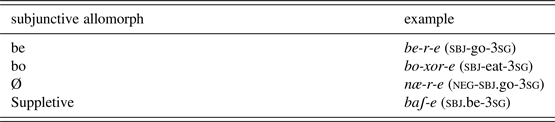
As shown in Table 1, the subjunctive marker in Persian appears with four different phonetic forms on verbs.
Subjunctive form in Persian

Persian subjunctive can be found in matrix and subordinate clauses. Matrix subjunctive clauses, after Lakoff (Reference Lakoff1968) and Palmer (Reference Palmer2001), can be grouped into six classes: imperatives, jussives, optatives, deliberatives, speculatives, and concessives (as in (9a-f)).
-
(9)
-
a. be-bin (imperative)
sbj-see.2sg
‘See!’
-
b. sæbr kon-im (jussive)
patience sbj.do-1pl
Intended: ‘Let's be patient!’
-
c. xodɑ ʃæfɑ-t be-de (optative)
God cure-you.acc sbj-give.3sg
‘May God cure you!’
-
d. tʃe kon-æm (deliberative)
what sbj.do-1sg
‘What should I do?’
-
e. ʔehtemɑlæn be-r-e (speculative)
probably sbj-go-3sg
‘She/he probably goes.’
-
f. puldɑr bɑʃ-i-o mɑʃin næ-xær-i (concessive)
rich sbj.be-2sg-and car neg-sbj.buy-2sg
Intended: ‘It is strange that you are rich and you do not buy a car.’
-
Concerning subordinate clauses, the subjunctive form can appear in complement clauses, adverbial clauses, and relative clauses (as in (10a-c)).Footnote 3
-
(10)
-
a. to hæq = dɑr-i ke be-xænd-i (complement clause)
you right have-2sg that sbj-laugh-2sg
‘You have the right to laugh.’
-
b. mi-xænd-æm ke to ro be-xænd-un-æm (adverbial clause)Footnote 4
impfv-laugh-1sg that you om sbj-laugh-caus-1sg
‘I laugh to make you laugh.’
-
c. doxtær-i ke dærs be-xun-e movæffæq mi-ʃ-e (relative clause)
girl-indf that lesson sbj-read-3sg successful impfv-become-3sg
‘A girl who would study becomes successful.’
-
All the situations described in the subjunctive clauses in (9) and (10) are irrealis. They are not actualized in the base world at the reference time, or, when actualized, as in the concessive sentence (9f), the speaker does not assert the actuality of the state or event; the speech act of sentence (9f) is not representative, but expressive.
Cinque (Reference Cinque2006: 137) notes that evaluative adverbs modify facts. Following this, Ilkhanipour and Darzi (Reference Ilkhanipour and Darzi2015) and Ilkhanipour (Reference Ilkhanipour2016) propose that evaluative adverbs have an uninterpretable realis feature, [urealis], and hence are compatible only with realis clauses.Footnote 5 Thus, another reason to consider the subjunctive clauses in (9) and (10) as describing irrealis situations is that these clauses are not compatible with evaluative adverbs, such as xoʃbæxtɑne ‘fortunately’ and moteʔæssefɑne ‘regrettably’. This is shown in (11) and (12) (see also Ilkhanipour Reference Ilkhanipour2014).
-
(11)
-
a. (*xoʃbæxtɑne/*moteʔæssefɑne) be-bin
fortunately/regrettably sbj-see.2sg
‘(*Fortunately/*regrettably) see!’
-
b. (*xoʃbæxtɑne/*moteʔæssefɑne) sæbr kon-im
fortunately/regrettably patience sbj.do-1pl
Intended: ‘Let's (*fortunately/*regrettably) be patient!’
-
c. (*xoʃbæxtɑne/*moteʔæssefɑne) xodɑ ʃæfɑ-t be-de
fortunately/regrettably God cure-you.acc sbj-give.3sg
‘(*Fortunately/*regrettably) may God cure you!’
-
d. (*xoʃbæxtɑne/*moteʔæssefɑne) tʃe kon-æm
fortunately/*regrettably what sbj.do.1sg
‘(*Fortunately/*regrettably) what should I do?’
-
e. (*xoʃbæxtɑne/*moteʔæssefɑne) ʔehtemɑlæn be-r-e
fortunately/regrettably probably sbj-go.3sg
‘(*Fortunately/*Regrettably) she/he probably goes.’
-
f. (*xoʃbæxtɑne/*moteʔæssefɑne) puldɑr bɑʃ-i-o mɑʃin næ-xær-i
fortunately/regrettably rich sbj.be-2sg-and car neg-sbj.buy-2sg
Intended: ‘It is strange that (*fortunately/*regrettably) you are rich and you do not buy a car.’
-
-
(12)
-
a. to hæq=dɑr-i ke (*xoʃbæxtɑne/*moteʔæssefɑne) be-xænd-i
you right=have-2sg that fortunately/regrettably sbj-laugh-2sg
‘You have the right to (*fortunately/*regrettably) laugh.’
-
b. mi-xænd-æm ke (*xoʃbæxtɑne/*moteʔæssefɑne) to ro be-xænd-un-æm
impfv-laugh-1sg that fortunately/regrettably you om sbj-laugh-caus-1sg
‘I laugh to (*fortunately/*regrettably) make you laugh.’
-
c. doxtær-i ke (*xoʃbæxtɑne/*moteʔæssefɑne) dærs be-xun-e,
girl-indf that fortunately/regrettably lesson sbj-read-3sg
movæffæq mi-ʃ-e
successful impfv-become-3sg
‘A girl who (*fortunately/*regrettably) would study becomes successful.’
-
The irrealis analysis of subjunctive mood in Persian has been questioned in Darzi and Kwak (Reference Darzi and Kwak2015). In section 4, it is shown that their counter-arguments are not theoretically and empirically cogent.
4. Replies to Darzi and Kwak Reference Darzi and Kwak2015
To argue against the irrealis analysis of subjunctive mood in Persian, Darzi and Kwak (Reference Darzi and Kwak2015: 3–4) put forth two pieces of evidence. First, they claim that the subjunctive complements to some “factive” predicates, namely tævɑnestæn ‘to manage’ and movæffæq ʃodæn ‘to succeed/to become successful’ as in (13) and (14), are interpreted as realis.
-
(13) ʔæli tunest be-r-e ʔunʤɑ
Ali manage.pst.3sg sbj-go-3sg there
‘Ali managed to go there.’
(Darzi and Kwak Reference Darzi and Kwak2015: 4, (11))
-
(14) ʔespɑnijɑ movæffæq ʃo-d ʔingilis-o ʃekæst=be-d-e
Spain successful become-pst.3sg England-om beating=sbj-give-3sg
‘Spain succeeded in beating England.’
(Darzi and Kwak Reference Darzi and Kwak2015: 4, (12))
Second, Darzi and Kwak (Reference Darzi and Kwak2015: 4) believe that the subjunctive complement to causative predicates, such as vɑdɑr = kærdæn ‘to force’, involves a performed action, and hence is interpreted as realis.
-
(15) ʔæli mæn-o vɑdɑr=kærd (ke) ʔin ketɑb-o be-xun-æm
Ali me-om forced=do.pst.3sg (that) this book-om sbj-read-1sg
‘Ali forced me to read this book.’
(Darzi and Kwak Reference Darzi and Kwak2015: 4, (13))
There are two major problems with Darzi and Kwak's (Reference Darzi and Kwak2015) account. The first problem is a conceptual one; Darzi and Kwak do not explicate factivity and merely consider tævɑnestæn ‘to manage’ and movæffæq ʃodæn ‘to succeed/to become successful’ to be factive predicates. In fact, tævɑnestæn and movæffæq ʃodæn are not factive predicates. Factive predicates express the speaker's or the attitude holder's mental state or attitude toward a proposition whose truth is presupposed (e.g., Noonan Reference Noonan and Shopen2007, Becker Reference Becker, Becker and Remberger2010). tævɑnestæn and movæffæq ʃodæn do not express the speaker's or the attitude holder's mental state or attitude and hence are not included in the definition of factive predicates. Instead, they are achievement predicates that express the manner or realization of achievement (or lack thereof, in case of negative achievement predicates) (Noonan Reference Noonan and Shopen2007: 139). If the event described in the complement of an achievement predicate is an actualized event at the time of the achievement event (i.e., matrix tense), then the matrix achievement predicate will lose its achievement meaning: an already actualized event cannot be re-actualized by being achieved. As such, if the events of going there and beating England in (13) and (14), respectively, independent of the matrix achievement predicates, were actualized or actually occurring at the reference time, that is, at the time of managing and succeeding, tævɑnestæn and movæffæq ʃodæn would lose their achievement meaning.
As noted by an anonymous reviewer, one may suggest that tævɑnestæn and movæffæq ʃodæn are implicative predicates that, similar to factive predicates, introduce some presupposition. Note, however, that although achievement predicates presuppose the actualization of the embedded event upon the actualization of the matrix event (the latter expressed in the matrix achievement predicate), they imply that the embedded event has not been actualized by the time of (and independent of) the achieving event. So, the presupposition with implicative predicates, unlike the presupposition with factive predicates, is dependent on the actualization of the matrix predicate. Moreover, with the implicative predicates (i.e., achievement predicates here), the presupposition that the embedded event is actualized can be held only in affirmative contexts; the presupposition will fail when the matrix clause is negated or interrogated (see also Karttunen Reference Karttunen1971). I will elaborate on this issue in the following lines.
The second problem with Darzi and Kwak (Reference Darzi and Kwak2015) is an empirical one; their account is not consistent within Persian. In (16), the complement clause is identical to the complement clause in (14). If Darzi and Kwak (Reference Darzi and Kwak2015) had been correct, we should have expected the complement clause in (16) to be rendered as realis. This is not the case; it is certain that the beating event is rendered as irrealis in (16a-b). Note that the irrealis reading of the embedded event cannot be attributed to the possible effect of negation on the modal semantics of the complement; in (16b), the matrix clause is not negated (but only shifted to an incomplete aspect), however, the complement event is not perceived as actualized at the reference time.
-
(16)
-
a. ʔespɑnijɑ movæffæq næ-ʃo-d ʔingilis-o ʃekæst = be-d-e.
Spain successful neg-become-pst.3sg England-om beating = sbj-give-3sg
‘Spain did not succeed in beating England.’
-
b. ʔespɑnijɑ dɑʃt movæffæq mi-ʃo-d
Spain have.pst.3sg successful impfv-become-pst.3sg
ʔingilis-o ʃekæst=be-d-e.
England-om beating sbj-give-3sg
‘Spain was about to succeed in beating England.’
-
Furthermore, the interrogative form of the sentences in (13) and (14) does not (even at the speech time) imply the actualization of the embedded events. This can be seen in (17). Note that what is questioned is the matrix (and not the complement) clause.
-
(17)
-
a. ʔɑjɑ ʔæli tunest be-r-e ʔunʤɑ
Q Ali manage.pst.3sg sbj-go-3sg there
‘Did Ali manage to go there?’
-
b. ʔɑjɑ ʔespɑnijɑ movæffæq ʃo-d ʔingilis-o ʃekæst = be-d-e
Q Spain successful become-pst.3sg England-om beating sbj-give-3sg
‘Did Spain succeed in beating England?’
-
Comparing negative and interrogative forms of achievement sentences like (17), where no actualized reading of the embedded event is available, with negative and interrogative forms of factive sentences, as in (18), where the embedded event is interpreted as realis, shows that the “actualized” reading of the embedded event in affirmative achievement sentences is not rooted in the embedded clause itself, but is the result of the perfective affirmative form of the matrix achievement predicate.
-
(18)
-
a. ʔu pæʃimɑn ni-st ke xænd-id
he regretful neg-be.3sg that laugh-pst.3sg
‘He doesn't regret that he laughed.’
-
b. ʔɑjɑ ʔu pæʃimɑn ʔæst ke xænd-id
Q he regretful be.3sg that laugh-pst.3sg
‘Does he regret that he laughed?’
-
Similar arguments are applicable with regard to the causative construction in (15). If the event of reading the book were realis at the reference time, that is, at the time of forcing, the causative meaning of vɑdɑr = kærdæn ‘to force’ would be lost. Moreover, if the causative predicate in the matrix clause is negated, the realis interpretation of the complement event fades out. As shown in (19), the event of reading the book can be rendered as irrealis if the speaker continues as in (19a) or as realis if the speaker continues as in (19b). In any case, the event of reading the book in the complement clause of the causative predicate is not asserted to be actualized or actually occurring in the base world at the reference time, and hence should be considered as irrealis.
-
(19) ʔæli mæn-o vɑdɑr=næ-kærd (ke) ʔin ketɑb-o be-xun-æm
Ali me-om forced=neg-do.pst.3sg (that) this book-om sbj-read-1sg
‘Ali did not force me to read this book.’
-
a. pæs mæn ketɑb-o næ-xun-d-æm
so I book-om neg-read-pst-1sg
‘So I did not read the book.’
-
b. xod-æm xun-d-æm-eʃ
self-my read-pst-1sg-it
‘I read it by myself.’
-
In addition to these counter-arguments against Darzi and Kwak (Reference Darzi and Kwak2015), evaluative adverbs (e.g., xoʃbæxtɑne ‘fortunately’) cannot be used in the complements of achievement and causative predicates, as shown in (20). Remember, from the previous section, that evaluative adverbs are compatible only with the realis value of the irrealis mood. Thus, the value of the irrealis mood in the complement clauses of these predicates must be irrealis.Footnote 6
-
(20)
-
a. ʔæli tunest (ke) (*xoʃbæxtɑne) be-r-e ʔunʤɑ
Ali manage.pst.3sg that fortunately sbj-go-3sg there
‘Ali managed to (*fortunately) go there.’
-
b. espɑnijɑ movæffæq ʃo-d (ke) (*xoʃbæxtɑne) ʔingilis-o
Spain successful become-pst.3sg that fortunately England-om
ʃekæst=be-d-e.
beating sbj-give-3sg
‘Spain succeeded in (*fortunately) beating England.’
-
c. ʔæli mæn-o vɑdɑr=kærd (ke) (*xoʃbæxtɑne) ʔin ketɑb-o be-xun-æm
Ali me-om forced do.pst.3sg (that) fortunately this book-om sbj-read-1sg
‘Ali forced me to (*fortunately) read this book.’
-
It should be noted, however, that it is possible to use evaluative adverbs in the matrix clauses of these sentences, as shown in (21).
-
(21)
-
a. (xoʃbæxtɑne) ʔæli tunest (ke) be-r-e ʔunʤɑ
fortunately Ali manage.pst.3sg that sbj-go-3sg there
‘Fortunately Ali managed to go there.’
-
b. (xoʃbæxtɑne) ʔespania movæffæq ʃo-d (ke) ʔingilis-o
fortunately Spain successful become-pst.3sg that England-om
ʃekæst=be-d-e
beating sbj-give-3sg
‘Fortunately Spain succeeded in beating England.’
-
c. (xoʃbæxtɑne) ʔæli mæn-o vɑdɑr=kærd (ke) ʔin ketab-o be-xun-æm
fortunately Ali me-om forced do.pst.3sg (that) this book-om sbj-read-1sg
‘Fortunately Ali forced me to read this book.’
-
Thus, in this section we can conclude that the states or events described in the subjunctive complements of achievement and causative predicates are not interpreted as realis on their own. However, the achievement and the causative meanings of the matrix predicates in affirmative perfective sentences give rise to what can be called “realis illusion”: the reader is deluded into thinking that the complement state or event is realis on its own.
5. Conclusion
To sum up, this short contribution posited Chafe's (Reference Chafe, Bybee and Fleischman1995), Mithun's (Reference Mithun, Bybee and Fleischman1995, Reference Mithun1999), Bybee's (Reference Bybee1998) and Cinque's (Reference Cinque1999) ideas in order to define (ir)realis as the (non-)assertion of the actuality of a state or event in the base world at the reference time. Next, it introduced Persian subjunctive clauses in matrix and subordinate environments, and argued that all subjunctive clauses are interpreted as irrealis in Persian. Three arguments were provided against Darzi and Kwak's (Reference Darzi and Kwak2015) claim that the irrealis analysis of subjunctive in Persian is problematic. A final remark to be made here is that while the Persian subjunctive can occur only in irrealis contexts, other languages may employ the subjunctive form in the complement of factive predicates (e.g., French regretter ‘to regret’) which is interpreted as realis. The realis use of subjunctive has been attributed to pragmatic (e.g., Siegel Reference Siegel2009) and diachronic (e.g., Becker Reference Becker, Becker and Remberger2010) factors in these languages.