Introduction
Hearing loss is currently the leading cause of disability globally.Reference Wilson, Tucci, Merson and O'Donoghue1 In different countries, around 0.5 to 5 per 1000 neonates and infants suffer from congenital or early childhood onset sensorineural deafness or severe-to-profound hearing loss.Reference Johnson, White, Widen, Gravel, James and Kennalley2 The incidence of congenital hearing loss in neonates in the neonatal intensive care unit was found to be 10–20 times higher than that of the healthy newborn population.Reference Johnson, White, Widen, Gravel, James and Kennalley2 A long-term study of audiological follow up among neonatal intensive care unit graduates with sensorineural hearing loss (SNHL) showed that nearly 40 per cent of the patients showed a progressive hearing impairment.Reference Martínez-Cruz, Poblano and García-Alonso3 Congenital or acquired hearing loss in infanthood could result in lifelong deficits, such as in language and speech development, which could then severely impair educational and occupational performance.Reference Keren, Helfand, Homer, McPhillips and Lieu4
In order to reduce the adverse effects of prelinguistic hearing loss, early identification of hearing loss and appropriate intervention within the first six months of life are vital to the well-being of neonates. The Joint Committee on Infant Hearing5 has recommended the 1-3-6 guidelines for the early detection and intervention of hearing loss. This programme advises that hearing screening for neonates should be conducted by one month of age, definitive diagnostic testing by three months of age and appropriate intervention initiated by six months of age.
Neonates in neonatal intensive care units suffer more varied pathologies and risk factors than newborns in healthy nurseries, meaning an increased incidence of hearing loss.Reference Salvago, Martines and Martines6 Previous studies demonstrated that the risk factors for neonatal hearing impairment include preterm birth, low birth weight, hyperbilirubinaemia with exchange transfusion, asphyxia, infection (especially cytomegalovirus infection), ototoxic drugs, family history of early, progressive or delayed onset permanent childhood hearing loss, being in the neonatal intensive care unit for more than five days, and craniofacial malformation.Reference Morton and Nance7,Reference Korver, Smith, Van, Schleiss, Bitner-Glindzicz and Lustig8
In our previous study, we investigated the risk factors for failure in the first-time screening test among neonates in neonatal intensive care units and found that the hearing screening pass rates for them were significantly lower than those of healthy neonates. Risk factors such as neonatal respiratory distress syndrome, neonatal hyperbilirubinaemia, low birth weight, revised advanced maternal age (more than 40 years), congenital heart disease, caesarean-section and artificial feeding are risk factors of first-time hearing test failures.Reference Zhai, Fang, Li, Chen and Chen9 But the hearing levels of these neonates at 42-day or 3-month follow-up time points remain to be elucidated. Although the risk factors for hearing loss in neonates have been well documented in the last few decades, the quantity of these papers has decreased in recent years. The incidence and prognosis of some risk factors identified previously has changed quickly with the rapid development of medical technology in the past decade. Therefore, further attention should be given to this subject.
In this study, we followed up the neonates in the neonatal intensive care unit who failed in the first-time hearing tests for up to three months to observe the prevalence and outcomes of hearing loss and comprehensively investigated the correlation of both neonate-related and pregnancy-related factors in hearing loss.
Materials and methods
This study was a retrospective cross-sectional study, in which we analysed the association of common risk factors with the results of hearing tests (screening or diagnostic) in neonates in the neonatal intensive care unit. All the data were collected within the framework of the newborn hearing screening programme in the Shanghai area of China. The study protocol was approved by the Committee on Human Research of Shanghai Children's Medical Center, Shanghai Jiaotong University School of Medicine (SCMCIRB-K20140068-1).
Patients
All the 572 patients were enrolled from the neonatal intensive care unit of Shanghai Children's Medical Center from January 2020 to December 2020, with 317 males (55.4 per cent) and 255 females (44.6 per cent), 323 caesarean-section cases (56.47 per cent) and 249 natural labour cases (43.53 per cent), and a mean gestational age at birth of 36.8 ± 3.2 weeks and a mean birth weight of 2819 ± 796 g.
We also recruited 1459 healthy newborn controls (758 males and 701 females) from our hearing centre from January 2015 to December 2019 and from Sanya City Womenfolk and Infant Health Care Hospital Affiliated to Shanghai Children's Medical Center from June 2020 to August 2020, among which there were 583 caesarean-section cases. Those who had a family history of congenital hearing loss and a history of ototoxic drug usage were excluded from this study.
The neonate-related risk factors included caesarean section (n = 323, 56.47 per cent), preterm birth (n = 239, 41.78 per cent), low birth weight (n = 179, 31.29 per cent, including 40 very low birth weight cases), neonatal hyperbilirubinaemia (neonatal hyperbilirubinaemia, n = 407, 71.15 per cent, including 5 cases who had transfusion), neonatal hypoxia (n = 148, 25.87 per cent), Activity, Pulse, Grimace, Appearance, Respiration less than 8 (n = 66, 11.54 per cent), infection (n = 137, 23.95 per cent), congenital heart disease (n = 171, 29.90 per cent), twins (n = 75, 13.11 per cent) and in vitro fertilisation (n = 26, 4.55 per cent). The pregnancy-related risk factors included advanced maternal age (maternal age equal to or more than 35 years, n = 145, 25.35 per cent, including 20 cases with revised advanced maternal age (maternal age, equal to or more than 40 years, 3.50 per cent), pregnancy-induced hypertension syndrome (n = 73, 12.76 per cent) and gestational diabetes mellitus (n = 95, 16.61 per cent) (Figure 1).
Common diagnoses for neonates. NHB = neonatal hyperbilirubinaemia; C-section = caesarean section; LBW = low birth weight; CHD = congenital heart disease; NRDS = neonatal respiratory distress syndrome; AMA = advanced maternal age; GDM = gestational diabetes; PIH = pregnancy-induced hypertension syndrome mellitus; APGAR = Activity, Pulse, Grimace, Appearance, Respiration; IVF = in vitro fertilisation

Hearing screening and diagnostic tests
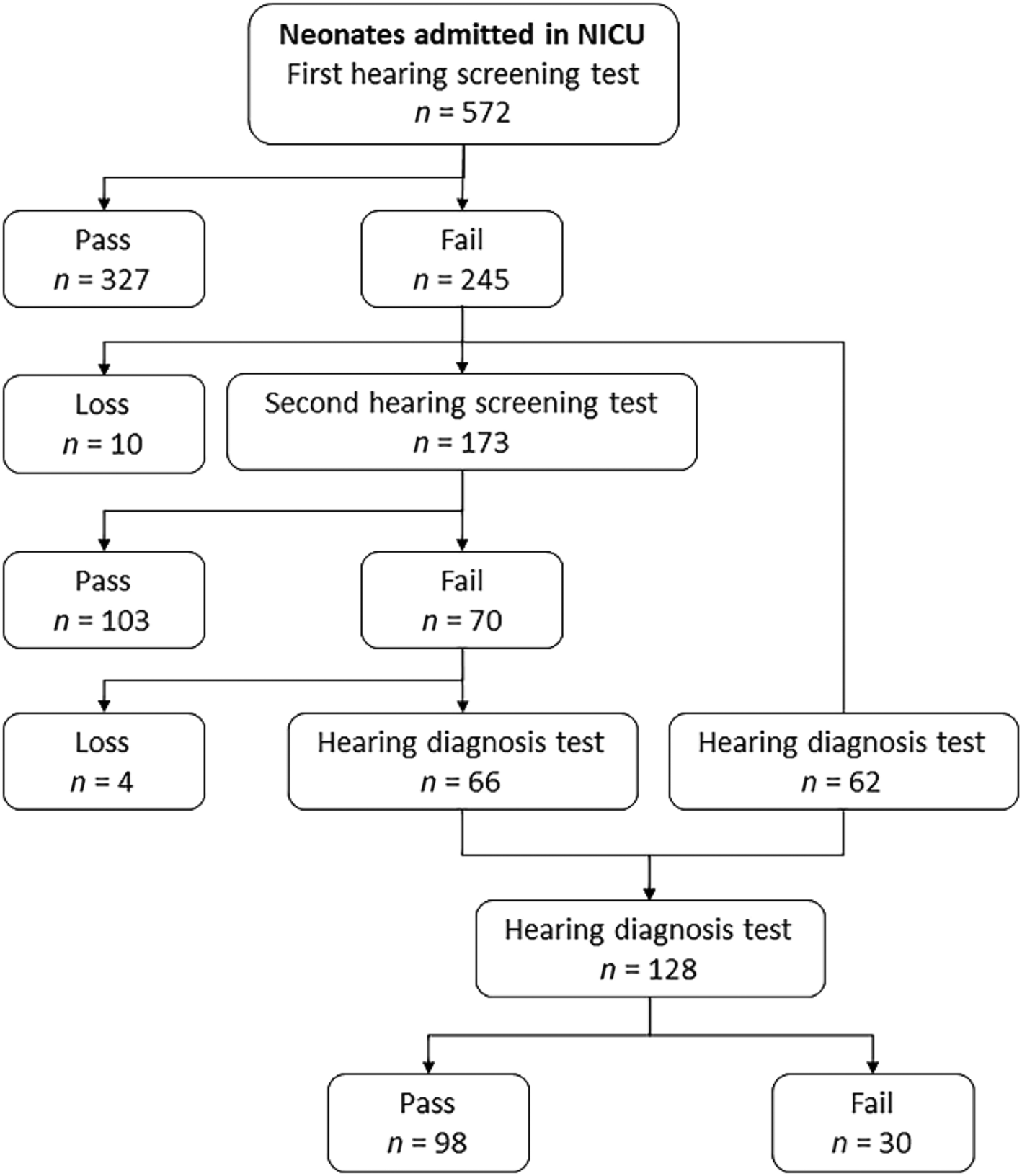
Auditory brainstem response (ABR), also known as brainstem auditory evoked potentials was used in the study. We performed automated auditory brainstem response, distortion product otoacoustic emission (DPOAE) testing, and 1000 Hz probe tone acoustic impedance testing for the first hearing screening test for neonates within 5 days of birth. Infants who failed the automated ABR, otoacoustic emissions (OAE) or acoustic impedance tests in one or both ears were classified as a hearing screen failure, and automated ABR, DPOAE and acoustic impedance were retested 42 days after birth. Comprehensive diagnostic hearing tests including brainstem auditory evoked potentials, DPOAE and acoustic impedance were performed for infants who failed in the retest or failed in the first test but did not have the retest. All hearing tests were analysed by a single audiologist who was blind to the medical records of the neonates. A schematic overview of the neonatal hearing screening programme for infants is shown in Figure 2.
Schematic overview of the neonatal hearing screening programme for high-risk neonates. NICU = neonatal intensive care unit

Automated ABR, DPOAE and acoustic impedance tests were conducted with Titan auditory analysis platform (Interacoustics, Middlefart, Denmark) and the ABRIS440 default CE-Chirp® protocol. Automated ABR presented click stimuli at a rate of 30–37 clicks per second with the threshold at 35 dBnHL. The sampling frequency was 10.2 kHz/second, and the filter frequency range was 70 Hz to 4 kHz. Recording electrode, reference electrode and earth electrode were placed on the forehead just below the hairline, the ipsilateral mastoid area and the glabellum, respectively, with electric resistance below 5 kΩ. The passed or failed results of automated ABR were presented as pass or refer.
In DPOAEs, the ratio of the f2/f1 frequencies was 1.24. Six frequencies were tested at 1.0, 1.5, 2.0, 3.0, 4.0 and 6.0 kHz. Results of DPOAE testing were judged as a pass with a signal to noise ratio of equal to or more than 6 dB noted in no less than 4 of 6 frequencies. The acoustic impedance test was conducted at the frequency of 1000 Hz. Single- or double-peak was defined as a normal middle-ear function at 1000 Hz.
Brainstem auditory evoked potential testing was conducted with Eclipse objective auditory analysis platform (Interacoustics A/S, Middlefart, Denmark) and the NB CE-Chirp® protocol. For brainstem auditory evoked potentials, click stimuli was initiated at 70 dBnHL with a rate of 30.0 Hz and 1200 times in total. The intensity was reduced if the I, III and V waves were drawn clearly. Otherwise, the stimulation intensity was increased. The results of brainstem auditory evoked potentials were recorded as different auditory thresholds in different frequencies. Hearing loss was defined as greater than 35 dBnHL for brainstem auditory evoked potentials.
Statistical analysis
The kappa (κ) statistic was used to assess the agreement between the automated ABR and distortion product otoacoustic emission (DPOAE). The following κ cut-off values were used: equal to or less than 0 is absence of agreement, 0.00–0.20 is poor agreement, 0.21–0.40 is fair agreement, 0.41–0.60 is moderate agreement, 0.61–0.80 is good agreement, and more than 0.80 is excellent agreement. The Pearson chi-square (χ2) test was used in comparisons between automated ABR and DPOAE results and the correlation analysis between diagnostic hearing test results and risk factors. The correlations between first hearing test pass rates and risk factors were analysed retrospectively by both univariate logistic regression and multivariate stepwise logistic regression analysis. All the analyses were performed with Stata statistical software (version 15.0; StataCorp, College Station, USA), and p < 0.05 was considered statistically significant.
Results
Patient follow up
In total, 572 neonates admitted to the neonatal intensive care unit were screened for hearing loss during their hospitalisation as part of the newborn hearing screening programme, with 317 (317 of 572, 55.4 per cent) males and 255 (255 of 572, 44.6 per cent) females. The mean gestational age at birth was 36.8 ± 3.2 weeks, and the mean birth weight was 2819 ± 796 g (Table 1). There were 245 (245 of 572, 42.8 per cent) neonates who failed the first hearing screening tests, among whom 235 (235 of 245, 95.9 per cent) underwent retests and 10 (10 of 245, 4.1 per cent) newborn infants who were lost to follow up after the first test. Among all the 173 (173 of 235, 73.6 per cent) neonates who completed the second screening, 70 (70 of 173, 40.5 per cent) failed again and 66 (66 of 173, 38.2 per cent) completed the third test. Four cases were lost to follow up after the second test. Sixty-two (62 of 235, 26.4 per cent) skipped directly to the third test. Of all the 128 cases who completed the third test, the diagnostic test, 30 cases (30 of 128, 23.4 per cent) failed in brainstem auditory evoked potentials, 28 (28 of 128, 21.9 per cent) failed in OAE and 33 (33 of 128, 25.8 per cent) failed in acoustic impedance tests (Figure 2).
Correlation between first hearing tests results and pregnancy and neonate related risk factors
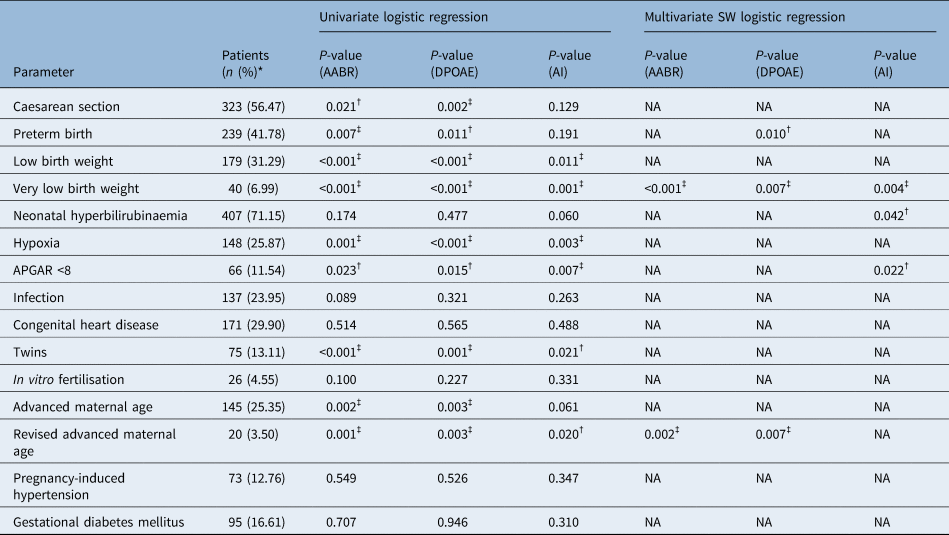
*n = 572; †p <0.05, ‡p <0.01. SW = stepwise; AABR = automated auditory brainstem response; DPOAE = distortion product otoacoustic emission; AI = acoustic impedance; NA = not applicable; APGAR = Activity, Pulse, Grimace, Appearance, Respiration
Hearing screening test results
The pass rates in infants for automated ABR, distortion product otoacoustic emissions (DPOAEs) and acoustic impedance at the first hearing screening were 69.93 per cent (800 of 1144), 70.02 per cent (801 of 1144) and 92.92 per cent (1063 of 1144), respectively, which is significantly lower than the healthy controls, whose pass rates were 90.30 per cent (2635 of 2918), 92.46 per cent (2698 of 2918) and 96.37 per cent (2812 of 2918), respectively. The pass rate of acoustic impedance testing was significantly higher than that of DPOAE (p < 0.001) and automated ABR tests (p < 0.001). The pass rates of automated ABR and DPOAE tests in infants who passed the acoustic impedance test were 74.60 per cent (793 of 1063) and 75.07 per cent (798 of 1063), respectively, which is slightly higher than the whole pass rates for automated ABR and DPOAE. However, the pass rates for automated ABR and DPOAE in infants who failed in acoustic impedance tests were only 8.64 per cent (7 of 81) and 3.7 per cent (3 of 81), respectively, significantly lower than those who passed acoustic impedance. Of all cases, 25.87 per cent (296 of 1144) of ears failed in both automated ABR and DPOAE tests, 65.82 per cent (753 of 1144) of ears passed in both tests, 4.20 per cent (48 of 1144) of ears failed only automated ABR and 4.11 per cent (47 of 1144) of ears failed only DPOAE. The results given by automated ABR and DPOAE tests were in good agreement and excellent agreement in left and right ears, respectively (left ear: κ = 0.813, p < 0.001; right ear: κ = 0.791, p < 0.001).
The correlations between the pass rates of screening tests and the risk factors were analysed with both univariate logistic regression and stepwise logistic regression analysis. Univariate logistic regression analysis showed that the automated ABR failure rate of the first hearing screening was positively correlated with caesarean section (p = 0.021), preterm birth (p = 0.007), low birth weight (p < 0.001), very low birth weight (p < 0.001), hypoxia (p = 0.001), Activity, Pulse, Grimace, Appearance, Respiration score less than 8 (p = 0.023), twins (p < 0.001), advanced maternal age (p = 0.002) and revised advanced maternal age (p = 0.001). The failure rate of DPOAE testing was positively correlated with caesarean section (p = 0.002), preterm birth (p = 0.011), low birth weight (p < 0.001), very low birth weight (p < 0.001), hypoxia (p < 0.001), Activity, Pulse, Grimace, Appearance, Respiration score less than 8 (p = 0.015), twins (p = 0.001), advanced maternal age (p = 0.003) and revised advanced maternal age (p = 0.003). The failure rate of acoustic impedance testing was positively correlated with low birth weight (p = 0.011), very low birth weight (p = 0.001), hypoxia (p = 0.003), Activity, Pulse, Grimace, Appearance, Respiration score less than 8 (p = 0.007), twins (p = 0.021) and revised advanced maternal age (p = 0.02).
Stepwise logistic regression analysis indicated that the automated ABR test failure rate of the first hearing screening was positively correlated with very low birth weight (p < 0.001) and revised advanced maternal age (p = 0.002). The failure rate of DPOAE testing was positively correlated with preterm birth (p = 0.010), very low birth weight (p = 0.007) and revised advanced maternal age (p = 0.007). The failure rate of acoustic impedance was positively correlated with very low birth weight (p = 0.004), neonatal hyperbilirubinaemia (p = 0.042) and Activity, Pulse, Grimace, Appearance, Respiration score less than 8 (p = 0.022) (Table 1).
Correlation between diagnostic tests
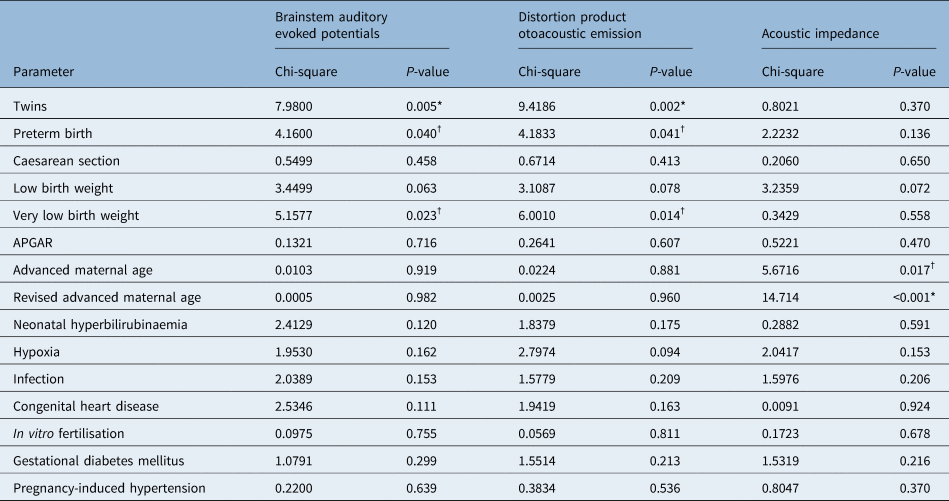
In total, 30 cases (30 of 572, 5.24 per cent) failed in brainstem auditory evoked potentials, 28 (28 of 572, 4.90 per cent) failed in OAE and 33 (33 of 572, 5.77 per cent) failed in acoustic impedance. The Pearson chi-square test showed that brainstem auditory evoked potentials failure was correlated with preterm birth (p = 0.040), very low birth weight (p = 0.023) and twins (p = 0.005). Distortion product otoacoustic emission failure was correlated with preterm birth (p = 0.041), very low birth weight (p = 0.014) and twins (p = 0.002). Acoustic impedance failure was correlated with advanced maternal age (p = 0.017) and revised advanced maternal age (p < 0.001) (Table 2).
Correlation between diagnostic hearing tests results and pregnancy and neonate related risk factors

*p < 0.01; †p < 0.05. APGAR = Activity, Pulse, Grimace, Appearance, Respiration
Discussion
Early hearing detection and intervention are advocated, with birth hearing screening and intervention no later than 3–6 months of age. This programme has positively impacted outcomes for children suffering from deafness or hearing impairment and their families.5 In the present study, the failure rate for first hearing screening of neonates in the neonatal intensive care unit was 42.8 per cent, which is comparable to previous studies.Reference Khairy, Abuelhamed, Ahmed, El Fouly and Elhawary10–Reference Hille, van Straaten and Verkerk12 The cases that failed in different screening tests did not totally overlap with each other. Although the pass rate in automated ABR was slightly higher than in DPOAE, the pass rates of these two tests in left and right ears were in good and excellent agreement, respectively.
Among all the neonates who failed in the first screening and completed the second screening, 59.5 per cent went back to normal and 40.5 per cent failed again. In the diagnostic hearing test, only 5.24 per cent failed in brainstem auditory evoked potentials, 4.9 per cent failed in OAE and 5.77 per cent failed in acoustic impedance. Similarly, Psarommatis et al. reported that 64.2 per cent of high-risk neonates who failed at initial screening showed complete recovery and 15 per cent showed partial recovery. Reversible automated ABR abnormalities might be attributed to temporary auditory dysfunction, secondary to external and middle-ear pathology or retarded central nervous system maturation.Reference Psarommatis, Florou, Fragkos, Douniadakis and Kontrogiannis13
The combination of automated ABR, distortion product otoacoustic emission (DPOAE) and acoustic impedance tests help to screen hearing loss comprehensively, and, to our knowledge, our study is the first time this combination of tests has been used. Automated ABR measures average neural response to repeated sound signals, and DPOAE detects sound produced by movements of outer hair cells of the cochlea. Both reflect the functions of the auditory pathway. Sometimes neonates may have retained amniotic fluid or infectious effusion in the middle ear, which can cause failure in automated ABR and OAE tests.Reference Zhai, Fang, Li, Chen and Chen9 The current study showed that the pass rates of automated ABR and DPOAE in infants who failed in acoustic impedance testing were significantly lower than those who passed acoustic impedance. Therefore, acoustic impedance is also needed to detect fluid and pressure in middle ears, thus increasing the specificity of SNHL diagnosis. The 1000 Hz probe tone acoustic impedance test is recommended before the age of 9 months for superior sensitivity and specificity than 226 Hz.Reference Hoffmann, Deuster, Rosslau, Knief, Am Zehnhoff-Dinnesen and Schmidt14 Although there are different pros and cons in these tests, the combination of automated ABR, OAE and 1000 Hz probe tone acoustic impedance tests could help to increase the efficiency of hearing screening tests, and therefore this combination was highly recommended by the Joint Committee on Infant Hearing in 2019.5
In the present study, preterm birth and very low birth weight were independent risk indicators that were positively associated with neonatal hearing loss. Preterm birth is often accompanied by low birth weight,Reference Wroblewska-Seniuk, Greczka, Dabrowski, Szyfter-Harris and Mazela15 and these neonates are commonly exposed to other risk factors such as low Activity, Pulse, Grimace, Appearance, Respiration score, intensive care treatment with mechanical ventilation, hypoxia, ototoxic drugs and neonatal hyperbilirubinaemia. It has been reported that the prevalence of neonatal hearing loss consistently increases with decreasing gestational age (1.2 per cent to 7.5 per cent from 31 to 24 weeks) and decreasing birth weight (1.4 per cent to 4.8 per cent from equal to or more than 1500 g to less than 750 g).Reference van Dommelen, Verkerk, van Straaten, Baerts, von Weissenbruch and Duijsters16 Extremely premature babies have a high risk of functional impairment of the brainstem auditory pathway because of neonatal bronchopulmonary dysplasia and associated unfavourable conditions.Reference Wang and Jiang17 Children with birth weight less than 750 g showed a higher frequency of SNHL than other premature infants because they were more likely to have mechanical ventilation, furosemide application, bronchopulmonary dysplasia and other neurological morbidities.Reference Martínez-Cruz, García, Poblano and Ochoa-López18
The popularisation of the use of assisted reproductive technologies has contributed to an increased incidence of twin pregnancies worldwide. Our findings suggested that twin birth put neonates at higher risk of hearing loss. The mechanisms underlying the high prevalence of hearing impairment among twins remain unclear. Instead of factors specific to twins, such as monochorionic placentation, death of the co-twin or being born first, previous studies have reported that in preterm twin newborns, in vitro fertilisation and the presence of intraventricular haemorrhage were independently associated with an increased risk of abnormal hearing outcomes.Reference Kim, Choi, Jung, Park, Yoo and Park19 Twin babies tend to have more adverse factors, such as low birth weight, premature birth, mechanical ventilation more than five days, neonatal hyperbilirubinemia, infections, ototoxic medications and family history of hearing loss.Reference Sasireka, Jaya, Vignesh and Muthukumar20 The intricate pathologies and risk factors in preterm, very low birth weight and twin neonates make it necessary for long-term monitoring and appropriate audiological management of hearing loss.
With the rapid socioeconomic development and increasing respect for women's rights, more women get married and then pregnant after 35 or even 40 years old. Advanced maternal age was found to be negatively correlated with the pass rate of hearing screening tests and revised advanced maternal age was noted to be associated with diagnostic hearing test failures. As has been previously reported, women aged 45–54, 40–44, and 35–39 years were at higher risk for a broad range of adverse outcomes such as caesarean section, pre-eclampsia and gestational diabetes.Reference Sheen, Wright, Goffman, Kern-Goldberger, Booker and Siddiq21 Actually, it has been well established in the literature that offspring exposed to unfavourable environmental conditions in utero, such as gestational diabetes, preeclampsia and intrauterine growth restriction during the early stages of development are subject to long-term health consequences, including hearing loss.Reference Biagioni, May and Broskey22 These potential risks should be taken into consideration seriously before pregnancy for women aged over 35.
Bilirubin-induced auditory impairment primarily influences brainstem nuclei and the auditory nerve, leading to auditory neuropathy spectrum disorder.Reference Olds and Oghalai23 Hearing impairment occurs about 10–50 times more frequently in neonates with severe neonatal hyperbilirubinaemia.Reference Boskabadi, Zakerihamidi, Moradi and Bakhshaee24 However, in this study, only five cases received transfusions. The tiny sample size of severe neonatal hyperbilirubinaemia made it impossible for statistical analysis. It has been shown that low Activity, Pulse, Grimace, Appearance, Respiration score and perinatal hypoxia were associated with childhood SNHL.Reference Kvestad, Lie, Eskild and Engdahl25 Neonates with low Activity, Pulse, Grimace, Appearance, Respiration scores in the current study, however, were not shown to be correlated with an increased risk of permanent hearing loss. Jiang et al. reported similar findings that temporary low Activity, Pulse, Grimace, Appearance, Respiration score (scores of equal to or less than 7 at 1 or 5 minutes and equal to or more than 8 at 10 minutes but without hypoxic-ischemic encephalopathy) was found not to be accompanied by any significant auditory impairment.Reference Jiang, Shao and Wilkinson26 We speculated that most of them may only suffer from temporary and mild neonatal hyperbilirubinaemia or perinatal hypoxia and were timely and effectively treated, which significantly lowered the chance of hearing impairment.
• Hearing screening pass rates for automated auditory brainstem response and distortion product otoacoustic emissions were significantly lower than those of acoustic impedance for high-risk neonates
• Hearing level abnormalities of most neonates who needed hearing retests were completely or partially reversible
• Preterm birth, very low birth weight, twins and advanced maternal age are potential risk factors of permanent hearing loss
There are some limitations and possible improvements for this study. First, we did not have normal neonate controls for the diagnostic brainstem auditory evoked potentials tests because our hearing centre in a children's hospital could not collect many healthy controls because of a lack of referrals. Second, this study was limited by the sample size and follow-up duration of those neonates with abnormal diagnostic hearing results. Some delayed-onset hearing loss (such as large vestibular aqueduct syndrome) or those with temporary auditory dysfunction or retarded central nervous system maturation might be missed or misdiagnosed, therefore leading to biases. Larger sample, longer-term follow-up studies are needed to further clarify the outcomes and prognosis of hearing loss of neonates in neonatal intensive care units.
Conclusion
In conclusion, the hearing screening pass rates of neonates in the neonatal intensive care unit were lower than those of normal neonates. Results of automated ABR and distortion product otoacoustic emissions in left and right ears were at a good and excellent agreement, respectively, and their pass rates were significantly lower than that of acoustic impedance tests. Abnormalities in the hearing levels of most neonates who needed hearing retests were completely or partially reversible. Preterm birth, very low birth weight, twins and advanced maternal age were potential risk factors of permanent hearing loss.
Acknowledgements
This study was supported by National Natural Science Foundation (Feng Zhai, grant number NSFC81900939) and Shanghai Children's Medical Center (Jie Chen, grant number: ZCQ-SCMC2018-9).
Competing interests
None declared