1. Introduction
My main goal for this paper is to demonstrate that Corpus Linguistics (CL) has a lot to offer to the Applied Linguistics (AL) community. I will provide an overview of some recent work I have done at the intersection of CL and AL and in collaboration with colleagues from different sub-fields of AL and beyond. I will introduce these colleagues to you along the way. The studies I am going to share are grouped into three topics: usage-based second language acquisition (SLA), corpus-based language assessment, and empirical legal language analysis. What ties these studies together is the use of corpora as well as a shared focus on phraseology, or the study of language patterns, which recognizes the inseparability of lexis and grammar (Römer, Reference Römer2009) and treats the two in an integrated fashion.
Since the 1970s, corpora (i.e., large, systematic, computerized collections of texts) and corpus-analytic techniques have enabled insights into the nature of language that no other types of data or methodology had before. Corpora have profoundly changed the ways in which we see and describe language(s). As John Sinclair, a leading first-generation corpus linguist, who introduced me and other scholars around the world to this new way of doing language analysis, observed in his seminal monograph Corpus, Concordance, Collocation, ‘the language looks rather different when you look at a lot of if at once’ (Sinclair, Reference Sinclair1991, p. 100). The power, according to Sinclair, lies in observing what he calls ‘repeated events’ (Sinclair, Reference Sinclair2004, p. 28). Over the last half century, not only general theoretical linguistics but also a range of areas within AL have benefitted from this new, different perception of and perspective on language. This last point is illustrated well by the program for this conference. Treating the AAAL 2021 program as a corpus, I looked up ‘corpus’ and ‘corpora’ to see how many papers discussed or mentioned these words in their abstracts. I found that within the ‘on demand’ section of the program, there are 158 records that use the word ‘corpus’ and 140 that contain ‘corpora’. To see whether these instances of corpus/corpora were well dispersed across AAAL's thematic strands, I looked at each abstract they occurred in and found that, out of the 22 strands, 20 include papers that talk about ‘corpora’ or ‘corpus’. The papers within these strands cover a wide range of topics and fields of application, ranging from language policy (e.g., the paper by Peter J. Torres) to language assessment (e.g., the paper by Geoffrey LaFlair and Jesse Egbert) to languages for specific purposes such as aviation English (e.g., the paper by Malila Prado and Noriko Ishihara).
2. Corpora and phraseology
As I hinted at earlier, a particular strength of CL lies in allowing us to uncover the patterned nature of language. In a 2008 article on evaluation in academic writing, I used traditional corpus analytic techniques like keyword and word frequency analyses to automatically extract items of evaluative meaning from a corpus of book reviews but found that those steps were not successful, at which point I concluded, echoing what Sinclair and others have pointed out too, that ‘[t]he word is not enough’ (Römer, Reference Römer2008, p. 121). A phraseological approach, however, was successful and allowed me to automatically and semi-automatically extract units of meaning from the corpus. Again referring back to Sinclair, language has a ‘phraseological tendency’ (Sinclair, Reference Sinclair2004, p. 29, Reference Sinclair1991): words do not appear in isolation, but go together and make meanings by their combinations. Sinclair, inspired by scholars like Ludwig Wittgenstein and John Rupert Firth, also reminds us that ‘the normal primary carrier of meaning is the phrase and not the word’ (Reference Sinclair, Granger and Meunier2008, p. 409). Words in isolation do not mean anything on their own but start to take on meaning(s) when we put them in context.
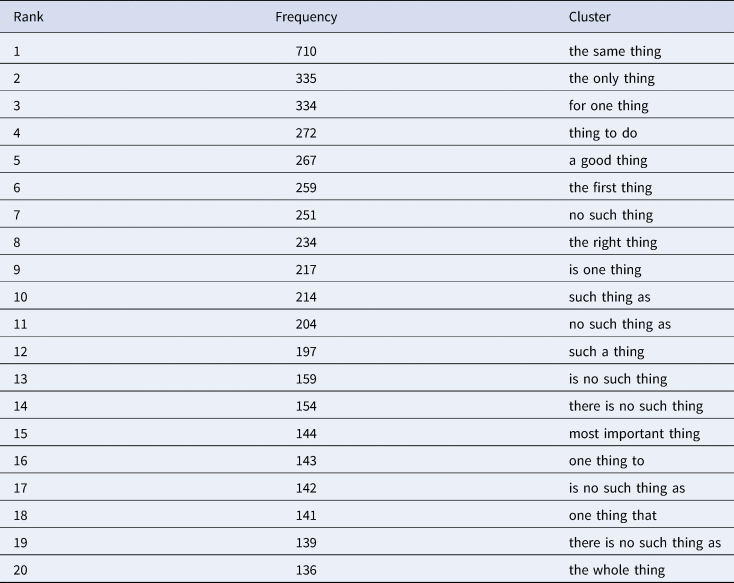
Another thing we learn from corpus researchers, and I am here quoting Michael Stubbs, is that ‘[m]any words are frequent because they are used in frequent phrases’ (Stubbs, Reference Stubbs2009, p. 119). Let us look at the word ‘thing’ to illustrate this last point. A corpus can tell us why ‘thing’ is the most frequent noun in English. Table 1 lists the 20 most frequent word clusters of different lengths that contain ‘thing’ in an 80-million word subset of academic prose of the Corpus of Contemporary American English (COCA). We see that ‘thing’ is highly frequent because it occurs in frequent phrases that have important communicative functions and that we use to create meaning in language; for example, ‘the same thing’, ‘a good thing’, and ‘there is no such thing’. With its focus on language patterns, corpus research has also taught us that when a word occurs in different patterns, it also tends to express different meanings. Examples (1) and (2) are taken from the Collins COBUILD English Dictionary (discussed in Hunston & Francis, Reference Hunston and Francis1998, p. 51), and show that when the verb ‘recover’ is followed by ‘from’, followed by a noun or noun phrase, it means ‘to get better’. When ‘recover’ is immediately followed by a noun or noun phrase, it means ‘to get back’. This demonstrates that linguistic usage patterns and meanings are ‘mutually dependent’ (Hunston & Francis, Reference Hunston and Francis2000, p. 3) and cannot be separated.
(1) He is recovering from a knee injury. (pattern: ‘recover’ + ‘from’ + N; meaning: ‘get better’)
(2) Police … recovered stolen goods. (pattern: ‘recover’ + N; meaning: ‘get back’)
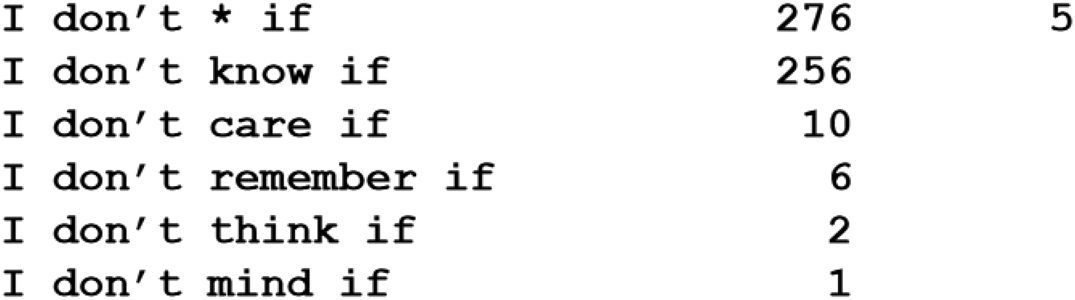
The phraseological concepts used in the case studies I am about to discuss include n-gram, p-frame, and verb-argument construction. N-grams are fixed sequences of n words; for example, ‘I don't know’ is a 3-gram and ‘as soon as possible’ a 4-gram. P-frames or phrase-frames are n-grams with one or more variable slot(s) that can be filled with so-called ‘variants’. So, in the p-frame ‘as * as possible’, the * slot can be filled with multiple words, including ‘soon’, ‘much’, and ‘many’. Figure 1 shows the p-frame ‘I don't * if’ with frequency information for its five variants in MICASE, the Michigan Corpus of Academic Spoken English. Within the theoretical framework of Construction Grammar, constructions have been defined as fixed pairings of form and meaning that are entrenched in the speaker's mind and conventionalized in the speech community (Bybee, Reference Bybee2010; Goldberg, Reference Goldberg1995). Verb-argument constructions (VACs) are a type of construction consisting of a verb and its grammatical arguments; for example, ‘V N’ (transitive construction) or ‘V in N’ (verb plus ‘in’ plus noun or noun phrase).
Top-20 ‘thing’ clusters (3–6 words long) in COCA-academic (list generated with AntConc; Anthony, Reference Anthony2019)

The phrase-frame ‘I don't * if’ with its five variants in MICASE (results generated with kfNgram; Fletcher, Reference Fletcher2007).

3. Phraseology and applied CL
Let me now take you on a journey through three types of case studies, all of them illustrating phraseology research based on corpora.
3.1. Usage-based SLA
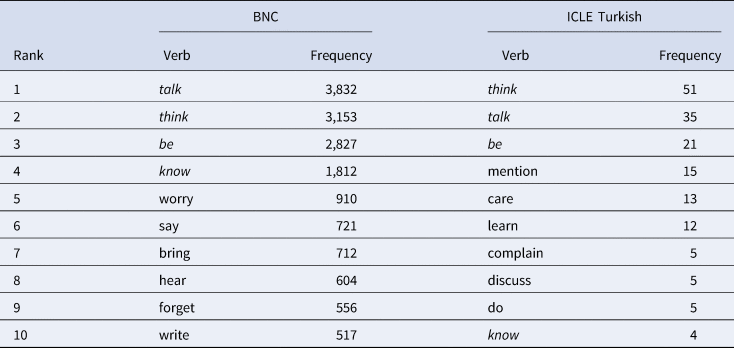
I will start by highlighting three recent corpus studies that, I think, all contribute to a better understanding of SLA and have implications for language pedagogy. My co-author on the first study, published as Römer and Yilmaz (Reference Römer and Yilmaz2019), is Selahattin Yilmaz. The study focuses on a set of 19 VACs in advanced Turkish learner writing in English. The aim of this study was to find out in what ways learners’ constructional knowledge is influenced by English usage and by cross-linguistic transfer from their first language (L1). We used data from two corpora, the Turkish sub-component of the International Corpus of Learner English (ICLE) and the British National Corpus (BNC, representing L1 English usage) on a selection of VACs. The selected VACs all consisted of a verb followed by a preposition followed by a noun or noun phrase (e.g., ‘V with N’ exemplified in ‘I like to go with the flow’). We found that advanced L1 Turkish learners are sensitive to verb-in-VAC distributions in L1 usage and that their verb-VAC associations, that is the connections between lexical items and constructions, overlap with those of L1 English speakers, showing medium to strong correlations. Table 2 contains a small sample from our dataset and shows the ten most frequent verbs in the ‘V about N’ construction in the two study corpora. We see that four verbs (set in italics) are shared between top-10 lists, including the most frequent choices ‘think’ and ‘talk’.
Top-10 verbs in ‘V about N’ (table adapted from Römer & Yilmaz, Reference Römer and Yilmaz2019, p. 119)

However, we also found differences between learner and L1 speaker verb choices, which can be explained on the basis of cross-linguistic transfer from Turkish, the learners’ L1. To study cross-linguistic transfer effects, we worked with the 50-million word Turkish National Corpus (TNC) and looked up translation equivalents of VAC components (selected verbs and prepositions) in this corpus of L1 Turkish writing. Learners show both morphological and collocational transfer from their L1. For example, two verbs that occurred repeatedly in the ‘V about N’ construction in the Turkish learner data but not in the BNC were ‘mention’ and ‘discuss’ (‘mention about sth.’ and ‘discuss about sth.’).Footnote 2 We found that these phrases might be modelled on a construction in Turkish that consists of a noun with a postposition plus a verb (‘N + postpos V’) as in ‘N hakkında tartış-’, which translates to ‘N about discuss’. In our ICLE Turkish data, we also observed a comparatively high frequency of ‘V in N’, the most common of the 19 analyzed VACs in terms of overall token number. This ‘overuse’ of ‘V in N’ (compared with L1 usage), could be due to the common use of ‘in’ translation equivalents as morphological markers in Turkish (case markers, adpositions). In Turkish, translation equivalents of English ‘in’ often combine with nouns, as in ‘şüphe içinde’ (‘hesitation in(locative) inside of’), which may have led to ‘be in hesitation’ in learner production. Similar unidiomatic uses of this VAC in the Turkish learner data include ‘parents are in lack of money’ and ‘they were in desire for big amounts of money’. So, what do these findings mean for teaching English as a second (L2) or foreign language to L1 Turkish learners? Based on our study, we think that, when we introduce constructions, it would help to highlight those verb-VAC combinations that are typical in usage. We would also recommend addressing cross-linguistic transfer effects by pointing out typological differences between the learners’ L1 and their L2, as well as to focus on constructions that learners struggle with. In the case of L1 Turkish learners, ‘V in N’ would be one of those constructions.
The second study in this section on usage-based SLA was co-authored by Jamie Garner and appeared as Römer and Garner (Reference Römer and Garner2019). The study focuses on the use of five high-frequency VACs (a subset of the 19 VACs covered in Römer & Yilmaz, Reference Römer and Yilmaz2019) in L1 Italian and L1 Spanish learner English production. Different from the previous study, we here focus on spoken rather than written learner data, and on data from different proficiency levels rather than just advanced learner data. Our aim here was to find out how learner VAC knowledge develops from low-intermediate (B1) to high-advanced language proficiency (C1/C2). We used a subset of the Trinity Lancaster Corpus (TLC; Gablasova et al., Reference Gablasova, Brezina and McEnery2019), which is a cross-sectional corpus of English as a Foreign Language (EFL) test taker speech, as well as the BNC as a proxy for L1 English usage. Our TLC subset contained transcripts of speech samples from 750 learners, making up about 1 million words. From these corpora we extracted data on ‘V about N’, ‘V for N’, ‘V in N’, ‘V like N’, and ‘V with N’, and performed various types of analyses on the VAC data, including normalized entropy analysis, correlation analysis, and regression analysis. We found that learners’ verb-in-VAC production becomes more predictable and more ZipfianFootnote 3 as their proficiency increases, bringing it more in line with target usage. Looking at three groups of learners (Italian, Spanish, Mexican) separately, we also found that these groups strongly overlap in their verb selections for the five focus VACs if proficiency levels are controlled for. Verb-in-VAC frequency in usage was found to be a strong predictor for learners’ verb choices, and we observed an increase of overlap of verb choices with target usage as learner proficiency increased. This study again provides additional evidence for strong usage effects on SLA, which confirms findings of earlier, smaller scale studies on VACs (e.g., Ellis & Ferreira-Junior, Reference Ellis and Ferreira-Junior2009; Ellis et al., Reference Ellis, O'Donnell and Römer2014). I would argue that we could use this knowledge in pedagogical contexts. Knowing that learners are sensitive to input frequencies could be taken advantage of in teaching, for instance by creating what Madlener (Reference Madlener2015) calls ‘structured input floods’, which have been shown to enhance construction learning. In such input floods, learner input is enhanced (or flooded) ‘with task-essential exemplars of the target structure in a principled way’ (Madlener, Reference Madlener2015, p. 92).
The third and final study in this thematic section, Römer (Reference Römer2019), focuses more comprehensively on VACs than the two studies I just discussed. Rather than looking at a subset of constructions, I am trying to explore all VACs used by L1 German learners of English from beginner to advanced levels, using a syntactically parsed corpus (a corpus which contains information on syntactic relationships between words). The aims of this study are to find out what the first VACs are that emerge in these learners, what changes there are over time in the learners’ VAC repertoires and in their preferred verb-VAC associations, and what role formulaic sequences play in their VAC acquisition. The study combines methods from both CL and NLP (Natural Language Processing) and uses data from a pseudo-longitudinal corpus of English EFL learner writing called EFCAMDAT, the Education First-Cambridge Open Language Database (Alexopoulou et al., Reference Alexopoulou, Geertzen, Korhonen and Meurers2015; Geertzen et al., Reference Geertzen, Alexopoulou and Korhonen2013). The study also uses reference data from a subset of COCA of roughly 80 million words of academic writing.
What I study in the project that Römer (Reference Römer2019) is based on are the patterns of a large number of verbs (about 700,000 verb tokens), which were extracted from about 68,000 EFCAMDAT learner texts (roughly 6 million words) from CEFR levels A1 through C1. The project combines various types of analytic techniques, including comparisons of frequency-sorted VAC and verb-in-VAC lists across learner levels, correlation analysis, normalized entropy analysis, verb cluster analysis, and concordance analysis (details on these analytic techniques are provided in Römer, Reference Römer2019).Footnote 4 The first sets of results from this large-scale study (summarized in Römer, Reference Römer2019) indicate that the first VACs that emerge in L1 German learners of English include simple transitive, intransitive, and copula be constructions, that the learners’ VAC repertoire grows steadily from A1 to C1 levels, and that from low to higher proficiency levels, verb-in-VAC preferences shift from predominantly high frequency verbs to lower frequency verbs. Results for two high-frequency VACs that I have studied in more detail, the transitive construction (subject + verb + direct object) and a simple modal verb construction (subject + modal verb + verb + direct object), also show that from lower to higher levels, verb associations move closer towards an L1 usage norm, showing more lexical overlap with and more similar entropy values to the COCA data.
An additional finding from the verb cluster analysis that I found particularly interesting as a phraseologist was that we can observe a development from small sets of fixed word sequences at lower proficiency levels to a wider repertoire of more variable sequences at the B1 and B2 levels. So, we see formulaic sequences giving way to more abstract constructions as learners advance in language proficiency. For example, while A2 level learners repeatedly produce ‘make me happy’, B2 learners use variations of this phrase such as ‘make you happy’, ‘would make you happy’, and ‘will make you happy’ in addition to ‘make me happy’. Similarly, upper-intermediate and advanced learners who contributed to EFCAMDAT do not only frequently use ‘make a decision’, but also repeatedly produce ‘make difficult decisions’, ‘make the right decision’, and ‘make certain decisions’. This indicates a shift from fixed phrases to more variable constructions.
3.2. Language assessment
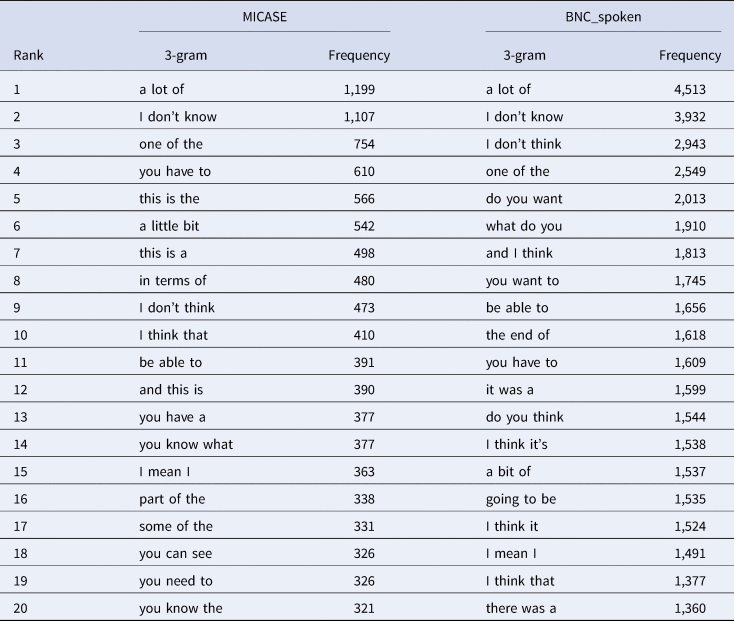
I will now move on to phraseology and corpus studies within the area of language assessment and feature two studies that were published as Römer (Reference Römer2017) and Römer and Banerjee (Reference Römer and Banerjee2018). The first of the two studies focuses on n-grams and p-frames in spoken English (i.e., items that lie at the intersection of lexis and grammar), and also examines rating scales of high stakes speaking tests. Its aims are to use phraseological analysis to illuminate aspects of speech, and to determine in how far rubrics of high stakes speaking tests capture these aspects of speech. For this study, I used two corpora of spoken English: MICASE, the Michigan Corpus of Academic Spoken English, and the spoken subcomponent of the BNC. I applied various corpus-analytic techniques to these corpora, with the goal of identifying central aspects of authentic spoken lexicogrammar. The analyses highlighted core features of speech, such as the frequent use of discourse markers (e.g., ‘so’, ‘like’), backchanneling devices (e.g., ‘yeah’, ‘okay’), and hesitation markers (e.g., ‘uh’, ‘erm’), and also showed that spoken language is dominated by phraseological patterns which perform central discourse functions and connect lexis and grammar. To illustrate this, Table 3 shows the 20 most frequent fixed three-word sequences (3-grams) in MICASE and the spoken part of the BNC (BNC_spoken). If we try to categorize those 3-grams and see what they serve to do, we find that they function variably as quantifiers (e.g., ‘one of the’, ‘a bit of’), discourse markers (e.g., ‘you know’, ‘I mean’), discourse structuring devices (e.g., ‘in terms of’, ‘at the same time’), and stance markers (e.g., ‘I don't think’, ‘I think that’).
Top-20 3-grams in MICASE and BNC_spoken (table adapted from Römer, Reference Römer2017, p. 483)

In my analysis of rating scales of the speaking components of internationally recognized tests (e.g., TOEFL iBT, IELTS, Cambridge English: Advanced), I found that these aspects of authentic spoken English were insufficiently reflected in these rating scales, and that there is a lack of acknowledgement of the interrelatedness of vocabulary and grammar there. My recommendation at that point, purely driven by corpus evidence, was to avoid giving separate scores for two skills (i.e., lexical and grammatical competence) that are closely interrelated. This recommendation is in line with Alderson and Kremmel (Reference Alderson and Kremmel2013), which questions the usefulness of separating vocabulary and grammar in the context of testing learners’ reading ability. I argued that a phraseological approach could help bring speaking assessment more in line with the reality of authentic speech, and also help make life easier for raters. On this last point, a study by Ruegg et al. (Reference Ruegg, Fritz and Holland2011) showed that raters of a proficiency test in Japan, the Kanda English Proficiency Test, found it difficult to keep lexis and grammar apart in scoring tests and often gave the same score for both areas (see also Ruegg, Reference Ruegg2015). In the conclusion to Römer (Reference Römer2017), I noted that there is a need to make concrete suggestions on how to implement a phraseological approach in rating scale development, and that, as a corpus linguist, I did not have the relevant expertise to make those suggestions but would need to team up with an assessment expert.
So, for the next featured study, Römer and Banerjee (Reference Römer and Banerjee2018), I did team up with a language assessment professional, Jayanti Banerjee. This study focuses on frequent n-grams and p-frames in spoken test taker language across proficiency levels, and aims to validate the MET (Michigan English Test) speaking test with the help of phraseological analysis. In this study, we asked whether, and if so in what ways, test taker phraseological competence differs across levels, and whether the MET speaking test provides a good way of eliciting what learners are able to do at each level in terms of using phraseological items. To address these questions, we created a 448,000-word corpus of 720 transcribed MET speaking tests from four CEFR levels (A2, B1, B2, C1) and extracted lists of n-grams and p-frames of different lengths from the level-specific subsets of this spoken test taker corpus. Our findings indicate: (i) an increase of repeatedly used n-gram types from levels A2 to C1, (ii) a development from simple, and at times unidiomatic sequences (e.g., ‘to make exercise’, ‘it's more easy’), to more complex, idiomatic phrases, and (iii) strong differences in the types of high frequency n-grams used across levels. For instance, at the A2 level we find n-grams that include a number of hesitation markers (‘erm I think’, ‘erm there is a’) and repetitions (‘you can you can’, ‘in the in the’), whereas we find several high-frequency n-grams expressing stance or evaluation at the B2 and C1 levels (‘I think that’, ‘it seems to be’, ‘on the other hand’).
Another interesting thing we observed in this study, in terms of the development of test taker phraseological competence, was an increase in the productivity of p-frames at the higher levels. While learners at the B2 and C1 levels used p-frames such as ‘I * that’ productively with a high number of different lexical items filling the ‘*’ slot (including ‘think’, ‘know’, ‘believe’, ‘remember’, ‘understand’), A2 level learners mostly relied on a small number of p-frame realizations, with one of them being the dominant choice (here ‘I think that’) and accounting for the lion's share of all p-frame tokens—illustrating what Ellis (Reference Ellis2012, p. 17) calls a ‘phrasal teddy bear’. Overall, our findings suggested that the MET rating scale is successful at distinguishing between test takers at different levels of phraseological competence, and that the MET speaking test design enables test takers to demonstrate their language proficiency insofar as this is evidenced by increases in their phraseological competence.
3.3. Empirical legal language analysis
The last two studies I would like to share with you fall into the ‘beyond’ category of my presentation title and provide examples of empirical legal language analysis. So, how can corpora and corpus approaches (again with a focus on phraseology) be used in legal scholarship to help us better understand problems that are of concern to lawyers and legal scholars?
The first of the two studies in this section, published as Ren et al. (Reference Ren, Wood, Cunningham, Abbady, Römer, Kuhn and Egbert2020), is the result of collaborative work between a group of lawyers and linguists, and focused on a phraseological analysis of a corpus of founding era American English. The aim of the study was to determine the original public meaning of the word ‘case’ in Article III of the US Constitution. We wanted to find out, with the help of corpus analysis, whether the meaning of ‘case’ during the founding era was limited to ‘injured plaintiff litigation’ or whether it referred to something more general. This former, more narrow interpretation was used in 2019 by the US Court of Appeals for the Fourth Circuit to justify dismissing a lawsuit brought against Donald Trump claiming that he violated the Constitution's prohibition against receiving emoluments from foreign states. To address this question, we used data on ‘case’ (and ‘cases’) and the patterns the word frequently occurs in retrieved from a corpus called COFEA, the Corpus of Founding Era American English, consisting of texts from 1760 to 1799 and making up more than 136 million words. Our COFEA analysis was complemented by historical text analysis for which we accessed the Founders Online database (founders.archives.gov), a text repository that stores texts from 1706 to 1836.
Results from this study, based on an analysis of the phraseological patterns in which ‘case’ typically occurred in founding era American English, indicate that those who drafted and ratified the US Constitution likely would have understood ‘cases arising under laws passed by the general Legislature’ to be a type or an example of ‘questions as involve the National peace and harmony’. In other words, the latter (‘questions…’) would have been a more general category of jurisdiction than the former (‘cases … ’; Ren et al., Reference Ren, Wood, Cunningham, Abbady, Römer, Kuhn and Egbert2020, p. 557). The results also indicated that those who drafted and ratified the US Constitution would not have understood ‘case(s)’ as having a stable, inherent meaning such as ‘adversarial litigation’, but understood that the word takes on different meanings, constructed through its combination with accompanying words. We argued that ‘case’ functions as a so-called ‘shell noun’ (Schmid, Reference Schmid2000), a semantically general or vague noun that inherits meanings from the specific lexical contexts it is used in. This work in applied CL is potentially important in terms of its practical relevance, as it may prompt a reevaluation of the Supreme Court's assumption that the original meaning of ‘cases’ in Article III was restricted to meaning ‘injured plaintiff litigation’, an assumption that we cannot confirm based on our extensive corpus analysis.
Continuing the collaboration between a lawyer (Clark Cunningham) and a corpus linguist (myself), the second study in this section—and the last one I would like to showcase in this paper—again focuses on a phraseological analysis of a corpus of founding era American English, this time with the aim to determine the original public meaning of the word ‘misdemeanor’ in Article II, Section 4 of the US Constitution. We chose this topic because the meaning of the phrase ‘high crimes and misdemeanours’ in the section of the US Constitution that defines grounds for impeachment has been a fairly hotly contested issue of public discourse in this country over the last two years, and an issue that legal scholars do not appear to agree on. For instance, emeritus Harvard Law professor Alan Dershowitz argued in January 2020 during the first Senate impeachment trial of Donald Trump that the terms ‘crime’ and ‘misdemeanor’ are synonymous and that what Trump was accused of did not constitute a crime. Several legal scholars rejected Dershowitz's interpretation and argued that the phrase ‘high crimes and misdemeanors’ was a legal term of art or idiom. Our study was first presented at the 6th Annual Law and Corpus Linguistics Conference at Brigham Young University in February 2021 (Cunningham & Römer, Reference Cunningham and Römer2021) and is currently in preparation for publication in a law journal.
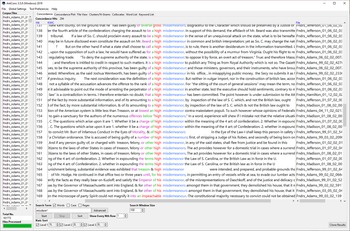
For this study, we extracted data on ‘misdemeanor(s)’ and the patterns it frequently occurs in from a 67 million word corpus of more than 180,000 texts downloaded from the Founders Online archive. The texts in our corpus were written between 1706 and 1836 by or to early American leaders, including George Washington, Benjamin Franklin, and Alexander Hamilton. We used this corpus to address several open questions in legal scholarship on this topic, including: (i) In founding era American English, was ‘high crimes and misdemeanors’ a fixed phrase or legal term of art? (ii) Were ‘crime’ and ‘misdemeanor’ used synonymously during this time? (iii) Did ‘high’ and ‘other’ in sequences in which they are followed by two nouns modify both nouns or only the first one? and (iv) What meaning does ‘high misdemeanors’ add to the impeachment clause? A search for ‘misdem*’ in AntConc, using the * character to capture spelling variants as well as singular and plural forms, resulted in 294 instances of the search term in the Founders Online corpus, distributed fairly evenly across 203 texts. A subset of these 294 results is displayed in the AntConc screenshot in Figure 2. Sorting the context of the concordance allowed us to easily see phraseological patterns around the search term. To complement the concordance search, we carried out a distribution analysis to find out how ‘misdem*’ is distributed across texts, an n-gram analysis to extract repeated phrases of different lengths that contain ‘misdem*’, and a collocation analysis to identify which words are most strongly associated with ‘crime(s)’ and ‘misdemeanor(s)’ and contribute to their meaning in context.
Part of the concordance results for the search term ‘misdem*’ in the Founders Online corpus, sorted to the left.

The findings of these analyses indicate that in founding era American English usage, ‘high crimes and misdemeanors’ was not a fixed phrase or a legal term of art but that there was considerable variability in this phrase (e.g., ‘crimes or misdemeanors’, ‘a high misdemeanor’, ‘misdemeanors, and other crimes’). Our results on the collocation profiles of ‘crime(s)’ and ‘misdemeanor(s)’ suggest that the two nouns were not used synonymously but occur in distinct lexical contexts. We also found that, after we looked systematically at the construction ‘other N and N’ in our corpus, ‘other’ tends to modify both nouns, as in ‘other officers and soldiers’, ‘other days and times’, or ‘other matters and things’. The same applies to ‘high’ in ‘high N and N’ sequences, in which it predominantly modifies not just the first but both nouns (e.g., ‘high consideration and respect’, ‘high regard and esteem’). So, to those who ratified the US Constitution, the impeachment clause would have been interpreted to include ‘treason, bribery, and other high crimes and other high misdemeanors’. Our analysis of what meaning ‘high misdemeanors’ adds to the impeachment clause is still ongoing as it requires us to go back and forth between the concordance results and the 203 source texts in which ‘misdemeanor’ occurs. Initial results from this ongoing analysis suggest that ‘high misdemeanor(s)’ repeatedly appears in contexts describing misconduct that affects government functioning or threatens the authority or security of the state.
4. Corpora for AL: Looking ahead
As I am coming to a close, I hope that this journey through some of my recent work has shown that corpora and corpus analytic techniques can be powerful tools in addressing important questions across a range of different areas of AL (and beyond). My hope was to illustrate how corpus-based research with a focus on phraseology has led me to new insights into the process of language acquisition, and the patterned nature of various types of language, and that those insights have implications for SLA, for pedagogy, for language assessment, and potentially for other fields of research (such as legal scholarship) too. Another thing I hope to have highlighted in this paper is the importance of inter- and intra-disciplinary collaboration that has significantly impacted and strengthened my recent research. I would argue that collaborative work is essential for an impactful future of AL. My research in applied CL has benefited immensely from collaboration and from the additional skill sets that each collaborator brought to the table. In my recent research history, this included the skill sets of language acquisition researchers, language teachers, language assessment specialists, and legal scholars, including Jayanti Banerjee, Clark Cunningham, Nick Ellis, Jamie Garner, and Selahattin Yilmaz, all of whom I am lucky to count among my co-authors.
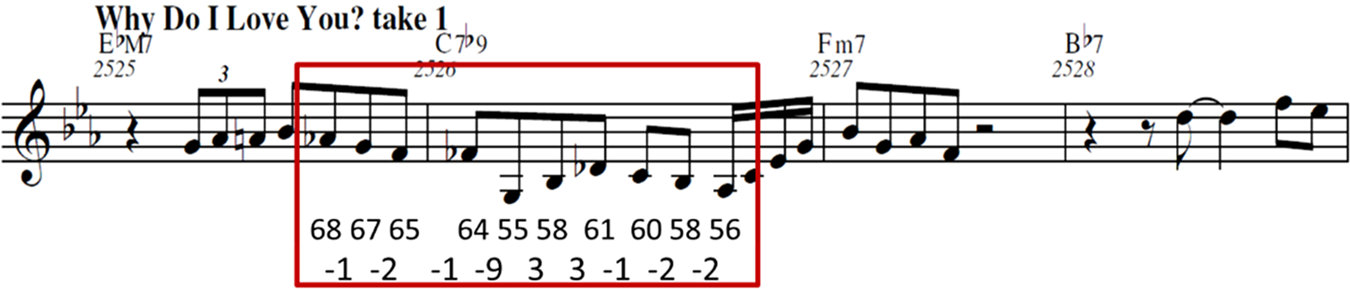
Looking ahead at next tasks that would be important to include in our applied CL research agenda, I would recommend that we work more on creating and analyzing new types of corpora including longitudinal learner corpora, dense learner corpora (corpora that contain a large amount of data from each learner), and English as a Lingua Franca (ELF) corpora, following the lead of the ELFA (English as a Lingua Franca in Academic Settings), VOICE (Vienna Oxford International Corpus of English), and ACE (Asian Corpus of English) projects. I would also suggest that, in future research in this area, we continue to combine different types of data and analytic methods. The studies I showcased here all benefited from a combination of quantitative and qualitative research methods. In other studies, I have argued in favor of triangulating corpus evidence and data collected in psycholinguistic experiments, which can provide a different lens on the phenomenon of interest and strengthen the validity of a study (Römer et al., Reference Römer, Roberson, O'Donnell and Ellis2014, Reference Römer, Skalicky and Ellis2018). A third recommendation would be to team up with researchers from neighboring fields (e.g., psychology, computer science) and to connect more to other disciplines that may benefit from empirical language analysis and approaches to highlighting patterns in language. In my recent interdisciplinary collaborations, I have learned that language patterns can provide answers to important questions unrelated to linguistics, and also that the ‘language’ of interest may not always consist of words. In a project that aimed to uncover central aspects of jazz improvisation, my collaborator, music professor Martin Norgaard, and I worked with a corpus of jazz solos in which pitches were converted into intervals represented as positive or negative numbers of half step changes (e.g. −1, 3), as illustrated by the example from Charlie Parker's ‘Why Do I Love You?’ in Figure 3. With the help of corpus analysis (using AntConc on a corpus of 456 solos from the Weimar Jazz Database), we demonstrated the ubiquitous use of patterns by jazz artists and highlighted the central role patterns play in real-time music creation (Norgaard & Römer, Reference Norgaard and Römerforthcoming). I would encourage fellow applied linguists to explore potential opportunities for inter-disciplinary collaboration and see how their skills can be applied to address questions in other research domains.
Example of an interval sequence from Charlie Parker's ‘Why do I love you?’.

Ute Römer is an Associate Professor in the Department of Applied Linguistics and ESL at Georgia State University. Her research interests include phraseology, second language acquisition, academic discourse analysis, and the application of corpora in language learning and teaching. She serves on a range of editorial boards of professional journals and is General Editor of the book series Studies in Corpus Linguistics (John Benjamins). Her research has been published in a range of applied, corpus, and cognitive linguistics journals including Language Learning, The Modern Language Journal, International Journal of Corpus Linguistics, Corpora, and Cognitive Linguistics. More information about her work can be found at: http://uteroemer.weebly.com/.