Introduction
Whiteflies (Hemiptera: Sternorrhyncha: Aleyrodoidea) are among the most important global agricultural pests. The family Aleyrodidae has 1556 species (Martin and Mound, Reference Martin and Mound2007) with 161 genera under two subfamilies, namely Aleyrodicinae and Aleyrodinae. The generic classification of Aleyrodidae is based on the morphology of the fourth nymphal instar, the so-called pupal case or puparia, as the majority of species cannot be distinguished in their adult stage. Of these, Bemisia tabaci (Gennadius) (Hemiptera: Aleyrodidae) is widely distributed throughout the tropical and subtropical areas and has become an important pest of field crops in agriculture and horticulture (Perring, Reference Perring2001; Dinsdale et al., Reference Dinsdale, Cook, Riginos, Buckley and De Barro2010; De Barro et al., Reference De Barro, Liu, Boykin and Dinsdale2011). It is ranked as one of the world's worst invasive organisms that feeds on over 900 host plants and plays an important role as a vector of more than 111 plant viruses (Global invasive species database, http://www.issg.org/database). Recently, De Barro et al. (Reference De Barro, Liu, Boykin and Dinsdale2011) evaluated the 24 morphologically indistinguishable populations of the B. tabaci complex using genetic methods, and concluded that it is a complex of 11 well-defined, high-level groups. These populations differ with respect to the host range, dispersal behaviour, fecundity, insecticide resistance and ability to transmit begomoviruses (Jones, Reference Jones2003; Berry et al., Reference Berry, Fondong, Rey, Rogan and Brown2004). The behaviourally different Bemisia populations observed in high density on the leaves of leucaena [Leucaena leucocephala (Lam.) de Wit (Fabaceae)] prompted us to review the current knowledge that revealed lacunae in our information about its biology, morphology and biochemical aspects. Accordingly, the populations on leucaena were compared with those of cotton solely based on morphology and biology, and evaluated to test the hypothesis that the occurrence of B. tabaci on leucaena is a new host record, and that these populations are morphologically and biologically different.
Materials and methods
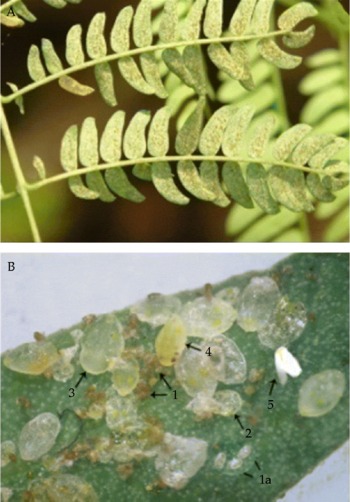
For establishing leucaena as a host, field surveys were conducted throughout India from 2008 to 2010 (Fig. 1). To determine the duration of different developmental stages, males and females were confined on the abaxial surface of a fully expanded leaf in micro-cages, as described by Zang et al. (Reference Zang, Liu and Liu2005) and Xu et al. (Reference Xu, De Barro and Liu2010). Thus field-collected populations were reared up to the third generation and the samples from the fourth generation were used for further laboratory studies at 30 ± 2°C and 40 ± 10% relative humidity. As leucaena leaves are small, 25 adults (irrespective of sex) were confined on a leaflet. The eggs laid were further observed at 24 h intervals. Transitions not directly observed were inferred from changes in morphology and size, or from the presence of exuviae. A Leica ES2 stereozoom microscope was used for observing the different life-cycle stages and observations were replicated 10 times. To evaluate the sex ratio, adults were anaesthetized with carbon dioxide for 15–20 s and sexed while they were inactive, with a total of 1829 specimens (degrees of freedom 19).
A, Bemisia tabaci on Leucaena leucocephala. B, leaflet showing eggs (1), first instar (1a), second instar (2), third instar (3), fourth instar (4) and adult (5) (a colour version of this figure can be found online at journals.cambridge.org/jti).

To analyse the fecundity and longevity, newly emerged males and females were collected from the cotton and leucaena plants, and confined as individual pairs in ventilated Petri plates having minute holes on both sides (90 × 15 mm) using leaves of 5- to 10-day-old plants. The petiole of the leaf was inserted into a wetted sponge for maintaining turgidity. The longevity and number of eggs laid were recorded daily and 10 such pairs observed. All observations on life-cycle stages were subjected to a single-factor ANOVA and mean ( ± SE) provided for each population (degrees of freedom 19).
For morphometrics, samples of eggs, nymphal instars and adults (n = 30) were obtained from cotton and leucaena during April–June 2010. Measurements of eggs, nymphal instars and adults were carried out with 10–50 × magnifications using a Wild M8 stereozoom microscope. Eggs were measured after carefully brushing them from the leaf surface onto a clean glass plate using minute needles and a fine camel hair brush. Nymphal instars were measured along the longest and widest axis (apex, middle and base) while still attached to the leaf. The adults were frozen at − 20°C for 1 h and then measured along the longest axis from the front of the head to the tip of the forewing, and at the widest region of the wings (degrees of freedom 59).
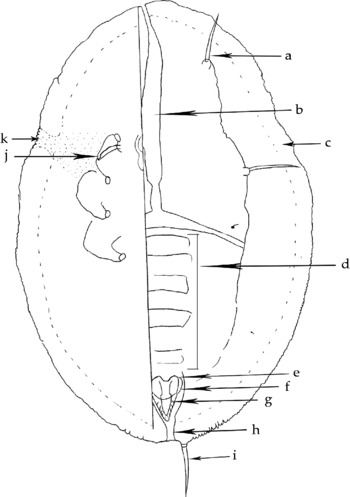
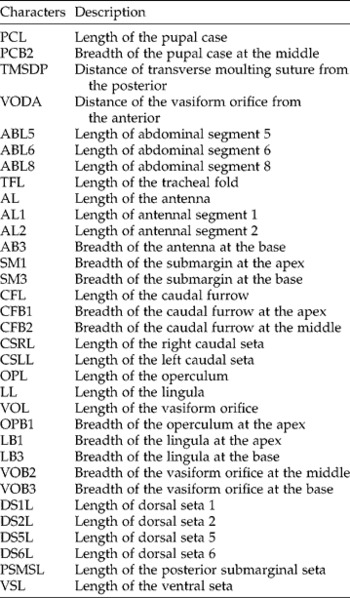
With regard to the puparia, morphometric characters given by Martin (Reference Martin1987), Gill (Reference Gill1990), and Jesudasan and David (Reference Jesudasan and David1991) were taken into account for the selection of taxonomically important characters from the head, thorax and abdomen, with 10 characters from the head, nine from the thorax and 43 from the abdomen (Fig. 2). A sample size of 30 specimens was analysed accordingly, with specimens collected on the same day or at least consecutive days. Data were subjected to single-factor ANOVA (degrees of freedom 59).
Morphometrics of the puparia of Bemisia tabaci – characters. a, dorsal seta; b, transverse moulting suture; c, submarginal area; d, abdominal segments; e, operculum; f, vasiform orifice; g, lingula; h, caudal furrow; i, caudal seta; j, antenna; k, tracheal fold.

Multivariate morphometric analyses were used to represent the multidimensional pattern of variation among the populations from cotton and leucaena. Principal component analysis using the PRINCOMP procedure of SAS (SAS Institute, Inc.) was carried out for the 33 significant characters selected via single-factor ANOVAs, and the principal components of differences in the morphological data were determined.
Esterase characterization was carried out by homogenizing individual adult females from the cotton and leucaena plants separately in a microfuge tube in 5 μl of homogenization buffer (0.1 m phosphate buffer, pH 7.4, 0.1% Triton X-100), using a multi-homogenizer, and a volume of 15 μl sample buffer (0.1% Triton X-100, 2% glycerol, 0.02% Bromophenol Blue and 0.5 m Tris–HCl, pH 6.8) was added to each microfuge tube. Aliquots (15 μl) of each homogenate were loaded in the stacking gel (3%), and superimposed on the 8% resolving gel. Gels were run at 150 V and 50 mA for 120 min using electrophoresis buffer (0.025 m Tris, 0.195 m glycine, pH 8.2). Esterase bands were visualized by the addition of 0.02% α-naphthyl acetate dissolved immediately before use in 0.1 m phosphate buffer (pH 6), and containing 0.4% Fast Blue RR Salt and incubated in the dark until the dark brown-coloured bands appeared. Electrophoretic mobility (R m) of bands was scored in relation to the migration distance in the buffer interface and assays were repeated twice to achieve consistent results.
Results
More than 900 plant species have been reported as the host plants of B. tabaci (Perring, Reference Perring2001; Berry et al., Reference Berry, Fondong, Rey, Rogan and Brown2004), and there is only one record for Leucaena glauca (synonymous with L. leucocephala from Taiwan (Hsieh et al., Reference Hsieh, Wang and Ko2006)).
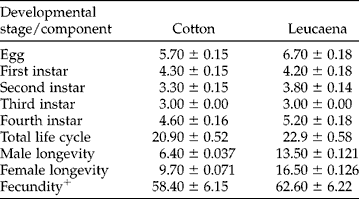
Developmental periods of stages given in Table 1 reveal that the total life-cycle of B. tabaci takes 20.9 ( ± 0.52) and 22.9 ( ± 0.58) days on cotton and leucaena, respectively. Likewise, hatching of egg, moulting to the third instar and emergence of adults were faster on cotton than on leucaena. Single-factor ANOVA revealed significant differences in incubation period and fourth instar (P < 0.001). The male:female sex ratio was 1:3.7 for cotton (n = 406) and 1:4 (n = 1423) for leucaena.
Development of Bemisia tabaci on cotton and leucaena (in days; mean ±SE; n=10)
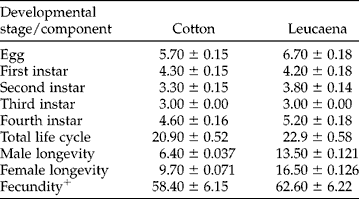
+ Eggs per female.
Fecundity and longevity details are also given in Table 1. On average, each female laid six eggs per day on cotton, and 3.7 eggs per day on leucaena; and a single female laid a maximum of 92 eggs on cotton and 89 on leucaena, and a minimum of 41 on cotton and 31 on leucaena; significant differences were found in the longevity of male and female between the hosts (P < 0.001). The pattern of oviposition was uniform throughout and no obvious differences were observed. Longevity studies showed that the lifespan of females is longer than that of males on both cotton and leucaena, but both lived longer on leucaena when compared with cotton.
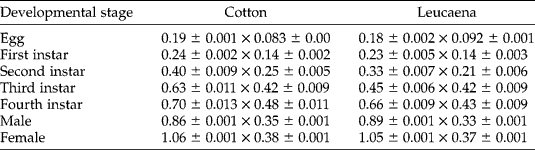
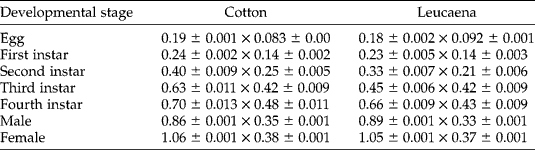
The morphometrics of the length and breadth of eggs, instars and adults revealed significant differences between the hosts. In general, eggs, instars and females from leucaena were comparatively smaller in size than those from cotton; and males were found to be longer in size on leucaena (Table 2). The cotton and leucaena populations significantly differed (P < 0.05) in the following traits: the length of eggs, second, third and fourth instars; the breadth at the apex and at the base of the first instar; the breadth at the apex and middle of the second instar; the breadth at the apex, middle and base of the third instar; the breadth at the middle of the fourth instar.
Morphometrics of the developmental stages of Bemisia tabaci on cotton and leucaena (length×breadth; in mm; mean±SE; n=30)
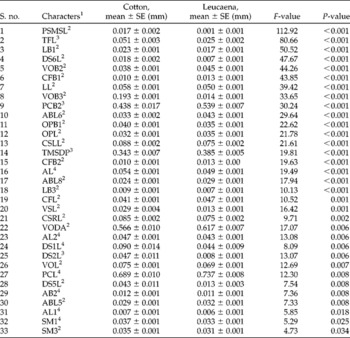
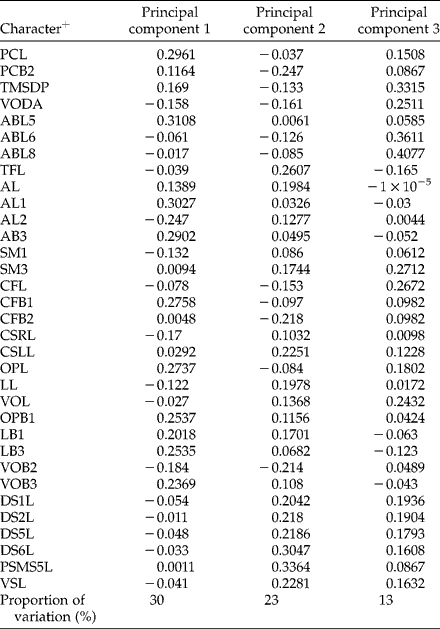
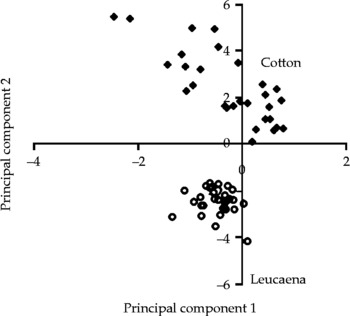
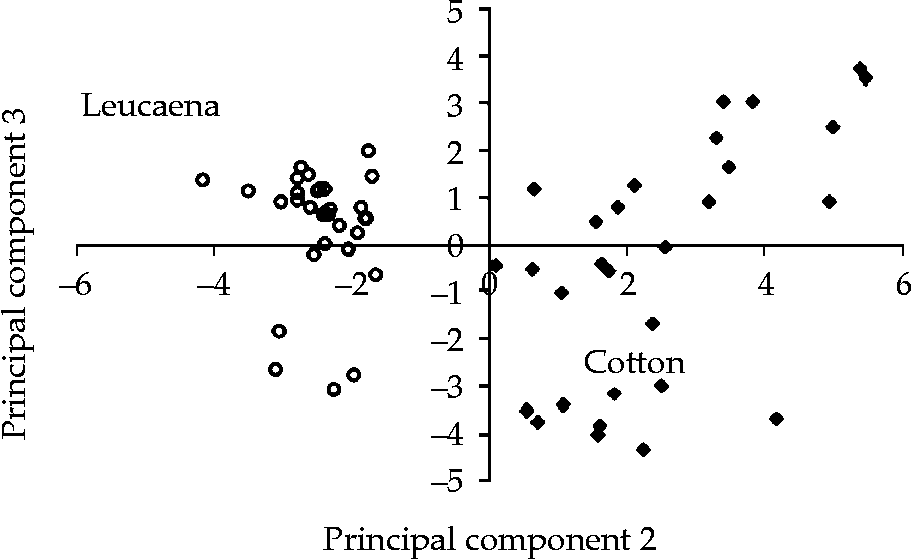
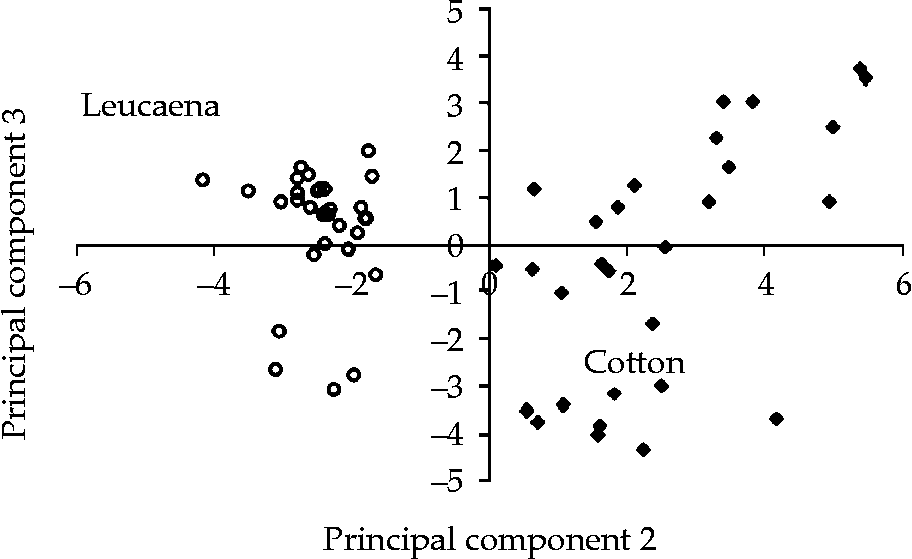
Of the 62 measurements of the puparia analysed, 33 showed significant differences (P < 0.05) between the cotton and leucaena populations (Tables 3 and 4); 70% of the measurements of head, 44% of those of the thorax and 51% of those of the abdomen showed significant differences. The contribution of these 33 morphological variables towards the first three principal components is given in Table 5, and the ordination of samples onto the first two and second and third principal axes is plotted in Figs 3 and 4. Mapping of the host association of samples in this ordination reveals a good separation of the cotton and leucaena populations. In the first principal component, half of the variables have a positive relationship and could explain 30% of the total variance (Table 5). The second principal component contrasts the effect of the length of the puparia, tracheal fold, antennal segment, right caudal seta, operculum, lingula, vasiform orifice, dorsal setae 1–6, ventral setae, the breadth of puparia, caudal furrow, submargin and the distance of transverse moulting suture with 23% of the total variation. The third principal component reveals negative relationships for the tracheal fold, antennal segment and lingula. Thus the first three principal components together account for 66% of the total variance and need to be heavily relied upon for the differentiation of the populations.
Morphometrics of the puparia of Bemisia tabaci from cotton and leucaena – characters

Morphometrics of the puparia of Bemisia tabaci from cotton and leucaena – ANOVA (n=30)

1 For the expansion of the abbreviations, see Table 3.
2 On the abdomen.
3 On the thorax.
4 On the head.
Morphometrics of the puparia of Bemisia tabaci from cotton and leucaena – proportion of contribution and variable coefficients of the first three eigenvectors for principal component analyses
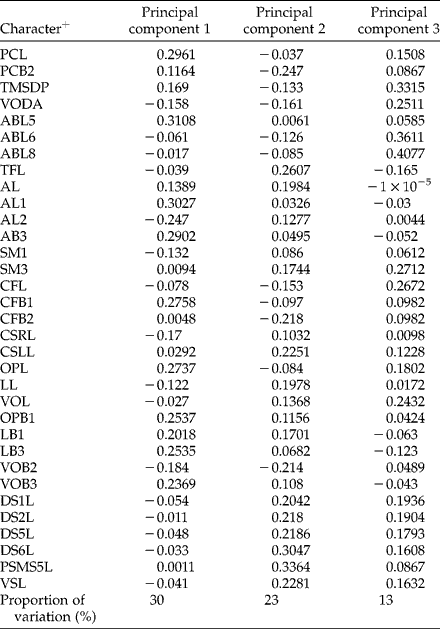
+ For the expansion of the abbreviations, see Table 3.
Morphometrics of the puparia of Bemisia tabaci from cotton and leucaena: principal component 1 versus 2

Morphometrics of the puparia of Bemisia tabaci from cotton and leucaena: principal component 2 versus 3
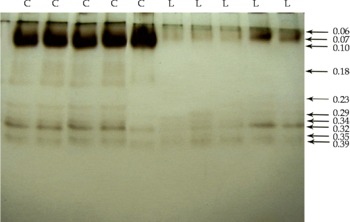
Esterase banding patterns of the populations indicate that both populations had one slow-moving and five fast-moving bands, and the relative mobility value of the fast-moving bands was similar in the two populations (0.29, 0.32, 0.34, 0.35 and 0.39). The slow-moving band had R m values of 0.10 and 0.07 for the cotton and leucaena populations, respectively. In addition, the cotton populations showed two bands (0.18 and 0.23), which were absent in the leucaena populations, indicating physiological differences (Fig. 5).
Non-specific esterases of Bemisia tabaci in the populations from cotton (C) and leucaena (L) (a colour version of this figure can be found online at journals.cambridge.org/jti).

Discussion
We report for the first time leucaena as a new host for B. tabaci in India. Nascimento et al. (Reference Nascimento, Correa and Reginaldo2006) reported that the control of B. tabaci by aqueous extracts of L. leucocephala might be due to a plant metabolite in the extract that is not involved in the feeding by B. tabaci. We also demonstrate that this population differs significantly in its biology, morphometrics and esterases compared with those from cotton. The time required for B. tabaci to complete the development from egg to adult was significantly influenced by the host plant: individuals from cotton populations developed comparatively faster and the size of eggs, instars and females were larger than those on leucaena, except in the case of the breadth of eggs and the length of males. These results corroborate the findings of Musa and Ren (Reference Musa and Ren2005) who documented differences in biology and developmental stages of B. tabaci on soyabean in its various cultivars. Mound (Reference Mound1963) concluded that the breadth of the immature B. tabaci varies morphologically and morphometrically on different hosts. Bemisia tabaci eggs, nymphs and females on cotton are longer and broader than those on leucaena, while fecundity was higher and the lifespan of adults was longer on leucaena. Principal component analysis indicated that the populations on these hosts exhibit differences in salient morphological characters considered in puparia for the identification of B. tabaci, corroborating earlier results from Jayasekera et al. (Reference Jayasekera, Thomas, Kar and Ramamurthy2010) who documented morphological differences in B. tabaci populations from cotton, okra, brinjal and soyabean. Differences in the mobility of non-specific bands, and the absence of two esterase bands in the leucaena populations strongly support the ecological and physiological differences among the populations studied.
Conclusion
Our results show that many taxonomic characters in the puparia defining the species of B. tabaci are significantly affected by host plant-related differences, in this case from cotton and leucaena. These populations are distinct in at least 33 morphometric measurements as revealed by principal component analyses. Also, these are distinct in their critical biological attributes and hence are destined to be biotypes or intraspecific populations. The new leucaena B. tabaci population from India should be further analysed with regard to the recently established 24 different populations and their placement under 11 distinct level groups, especially in terms of differences in insecticide resistance, virus transmission and molecular aspects (De Barro et al., Reference De Barro, Liu, Boykin and Dinsdale2011).