I met Zab Maboungou on an unseasonably brisk morning in May 2011. I was on my way to my first class at her studio in Montreal when I recognized her in the crowd at the corner of Mount-Royal and St. Laurent. With her neck nestled in a light scarf, she looked up and smiled knowingly as the traffic light ahead turned green ushering forward a wave of pedestrians. I built up the courage and went to introduce myself, though I stumbled on the words, momentarily forgetting my French and the lines I had rehearsed on the Metro ride over. She smiled, patiently, and I tried again. In class that day, with the drums lined up along the wall (but no drummer to play them), the students practiced walking, uttering the syllables “lo-ké-to” with each step as Maboungou carefully watched and corrected our alignment. Engrossed in this very fundamental movement activity, I heard Maboungou explain that we were learning to stand again. She made comments throughout class that aimed to adjust not only our movement but also our conception of our bodies and surroundings. That day, she spoke poetically of the chest as a center that can be simultaneously proud and humble, of the difference between art that is about individualism and art that is about interaction, and of the importance of being attentive to the ground upon which we stand.Footnote 1 I left class in a haze, still thinking through the comments she had made. When I returned home, I opened my notebook and wrote a comment to myself: “This is how a philosopher teaches dance.”
In his writings on African American conceptions of “beauty,” Thomas DeFrantz (Reference DeFrantz2005) brings together dance and philosophy in a way that resonates with Maboungou's teaching style. DeFrantz notes that articulating black beauty through philosophy allows him “to consider African American subjectivity within dance that might allow it to flourish on its own terms” (100) while also lending it greater weight in discourses of Western humanism (95).Footnote 2 Working in Canada, Maboungou similarly merges her background in dance and philosophy, using her artistic and pedagogical endeavors to pose fundamental questions about creativity, time, space, existence, and the self. Since at least the 1950s, however, alongside the emergence of decolonization movements across Africa, scholars like Frantz Fanon ([1952] Reference Fanon1967)Footnote 3 have questioned the utility of the philosophical field of ontology, critiquing the paradoxes tied to articulations of race and subjectivity that it inevitably provokes. Much of the contemporary rhetoric surrounding academic notions of human nature, the individual subject, and a rational self, was developed during the European Enlightenment, a period that struggled to justify colonialism and slaveryFootnote 4 while creating many of the racial paradigms that continue to inform Europe, Africa, and the Americas today. And yet, though tangled and marked by imperfections, counterontologies can become important political tools in decolonization strategies. Gayatri Spivak speaks to this conflict in her critique of subaltern studies (Reference Spivak and Spivak1987) and suggests that productive gains can be made through a “strategic use of positivist essentialism” (205). By imagining an essentialized group consciousness (the subaltern), postcolonial studies can articulate a new historical figure and intervene in Western historiography (though not without some controversy).Footnote 5 Considering Maboungou's own philosophical approach to dance, what might her work be able to offer in the creation of such counterontologies?
Montreal choreographer Zab Maboungou is an artist/philosopherFootnote 6 whose work speaks to the paradoxical tensions within and between ontology and identity. Maboungou, who grew up in Brazzaville, studied philosophy in France, and migrated west to Montreal in the 1970s, has been a prolific dancer and advocate for African diaspora artists in Canada. Her current work, deeply personal and reflective, uses a movement vocabulary based on dances she learned in her youth in the Republic of the Congo as a lexicon for exploring metaphysical questions of self, identity, time, and place—questions that, on the one hand, are in tension with Fanon's distrust of ontology but, on the other hand, provide fertile ground for reimagining conceptions of subjecthood through contemporary African dance.
In this article, I explore how Maboungou's choreography and pedagogy engender what I call an “embodied Africanist metaphysics”—an exploration of foundational questions about existence, ontology, and the self through a movement vocabulary derived from African and African diaspora dance practices. I describe how her 2009 work De/Liberate Gestures reimagines ontological ideas about being and time by playing with speed, duration, and “deliberate” action. Similarly, her pedagogical strategies ask dancers to contemplate their most seemingly intuitive movement choices while offering insightful aphorisms that encourage deep personal reflection. Maboungou's philosophical interests have expanded over the years, generating ripples of strategic change in Canadian arts policy, in the work of other artists in the community, and more generally challenging Eurocentric ontological constructions of “blackness,”Footnote 7 “being,” and “African dance.”
This article is based on my ethnographic experience of studying with Zab Maboungou at her studio, Cercle d'expression artistique Nyata NyataFootnote 8 in Montreal, Canada. From September 2011 until April 2012, I attended classes at Nyata Nyata two to three times a week, studying with Maboungou as well as her protégé Karla Étienne and taking workshops with guest artists who came to the school. Though I was not in her professional training program, I often took classes with these students and have since corresponded with several of them; their reflections on Maboungou's pedagogy inform my research. I also frequently attended performances by her company as well as her public talks.Footnote 9 Despite her busy schedule, Maboungou was able to sit down with me for an interview in March 2012 and has generously continued to correspond with me about this research ever since.
My own subject position as a white researcher with a background in Western culture and society and dance training in ballet and modern dance further complicates the paradox of evading Eurocentrism. Though I do not want to make this paper about my own whiteness, a strategy that might serve to recenter and privilege white subjecthood, it still deserves consideration. Though perhaps not entirely resolvable, I try to complicate my first-person experiences and counter potential white biases by including the voices of Maboungou and her students often, providing additional perspectives on the observations I make here. I also want to clarify that my argument is not an attempt to create an ontology, but rather to understand how Maboungou's choreographic and pedagogical strategies are effective in creating a metaphysical approach that instigates change. Politically speaking, I would argue that Maboungou's claims that the lokéto principles have universal appeal while being rooted in African dance practices help complicate the Eurocentrism that proliferates throughout Canada and the United States.
Embodied Africanist Metaphysics
Many notable West African thinkers have looked to the performing arts to express subjecthood and to enunciate an identity for “Africa” while challenging European misconceptions about an essentialized Africa as “other” or a space of “lack.”Footnote 10 Nigerian playwright Wole Soyinka (Reference Soyinka1976) uses Yoruban tragedy as a means for exploring the nuanced similarities and differences in the “creative rhythms” (38) of Africa and Europe and to help historicize West African theatrical traditions. In his writing, Soyinka sees dance and music as essential components in Yoruban theater that are able to reveal understandings about self and ancestry.Footnote 11 Similarly, postcolonial theorist Achille Mbembe (Reference Mbembe2005) evocatively discusses Congolese music and endows dance with the ability to reflect fundamental questions about existence: “Never simply movement of the human form, Congolese dance embodies something that resembles a search for original life, for perpetual genesis, and, through this, for an ideal of happiness and serenity … dancing becomes a way of journeying outside the self” (2005).Footnote 12 Soyinka and Mbembe both recognize dance as a vehicle for reflection and thought, potentially offering powerful observations into questions of identity, being, and self.
Part of Maboungou's artistic process involves posing—in her class instruction and her choreography—foundational questions about art and Africa as a way of redirecting Eurocentric assumptions that may influence her Montreal audiences. In an interview, Maboungou explained:
Real tradition, authentic tradition, is only in the dreams of those traditionalists or those people who are looking for exoticism and think there is something [in Africa] that has never moved. … [Growing up in the Congo] I was in a world that was changing, being transformed, … that was questioning tradition versus modernity, … not ready to just embrace tradition because it still had to be identified at this point, [because of] being colonized. Not embracing modernization because that meant the colonizers. … When people would say “oh in Africa this is how they do it” … I would say in Africa? What is Africa? [When I started teaching dance] I was working on my thesis … and I was just not ready to go and teach traditional steps, “and this is what my aunty does, and this is what my village blah blah blah.” I felt that I had to come up with something … something that is basically human. (2012a)
“What is Africa?” Maboungou asks. As she notes, having grown up during the revolution in the Congo, her experience of “Africa” was not one of some mythical past, but an Africa in the midst of decolonizing and becoming something new—though what was not yet clear. With these experiences in her background, Maboungou set out to teach not in a way that would superficially detail what Africa is, a task that she suggests Westerners want from Africans, but to interrogate those elemental uncertainties that a continent in the process of decolonizing itself had to ask. Similar questions emerge in Maboungou's choreography and pedagogy and are what I am describing here as an embodied Africanist metaphysics.
In using the term “Africanist,” I borrow from the work of scholar Brenda Dixon Gottschild. In Digging the Africanist Presence (Reference Gottschild1996), Gottschild uses the term to identify “concepts and practices that exist in Africa and the African diaspora and have their roots in concepts or practices from Africa” (xiv). Much the way Gottschild identifies aesthetic differences between Africanist and Europeanist cultural products and practices, I argue that Maboungou's work identifies a philosophical tension between Eurocentric understandings of subjecthood and a decolonizing approach to subjecthood emerging from an African diaspora perspective. I use the term “metaphysics” loosely to articulate Maboungou's interest in, as she describes, “what is basically human.” Maboungou's choreography and teaching often engage with notions of identity, existence, human nature, being, space, time—concepts generally associated with this philosophical field. These fundamental questions, never fully answered but rather continually asked in her work, destabilize the imagined universality of Eurocentric ontologies about being and presumed understandings of what “Africa” is. I also use “embodied” to emphasize how these questions are often motivated by the body, whether moving or still; while language and logic continue to inform Maboungou's philosophical approach to choreography and pedagogy, the body is not excluded from these processes.Footnote 13
Contemporary African Dance
In alignment with Maboungou's own use of the term, I describe her choreography as “contemporary African dance.” This concept however is fraught with controversy.Footnote 14 Choreographer Faustin Linyekula, a prolific dance artist in the Democratic Republic of the Congo (DRC) whose work borrows readily from European and American dance traditions (in addition to local interests like ndombolo),Footnote 15 finds it inhibiting when the adjective “African” is used to describe what he does or does not do: “I am showing the individual in a context where there is no space for individuals. … I speak in my own name, not in the name of ‘all Congolese’ or [worse] ‘all Africans’” (quoted in Gottschild Reference Gottschild2007). In the same vein, the term “contemporary African dance” has the potential to mask the complexities and multiplicities of dance in Africa and its diaspora; as a label it could potentially be hindering or reductive. Spivak speaks of a similar concern and after developing her work on strategic essentialism she became wary of the way her ideas were being used.Footnote 16 Essentialism still carries with it the dangers of eradicating multiplicity within a social group and creating its own kind of hegemony. Crucial to her postulation was the idea that essentialization was a temporary strategy employed by a community in order to gain social ground in a productive way.
The potential critique raised by Linyekula serves as a caveat to the term “contemporary African dance.” Yet Maboungou and Linyekula work in different sociopolitical contexts. Linyekula's experience speaks to the importance of artistic difference under the oppressiveness of the DRC's current regime and the violence emerging from the imposition of communal identities over individual voices. Maboungou, on the other hand, seeks to develop a strong African diaspora dance community within a predominantly white environmentFootnote 17 and in keeping with Spivak, Maboungou's “contemporary African dance” appears to be, at least for now, strategically productive in helping African diaspora dance artists carve out a space for their work in Montreal. In this case, “contemporary African dance” as well as Maboungou's own embodied Africanist metaphysics serve to strengthen this community despite the potential hazards of essentialism. Yet, Maboungou seems conscious of these hazards as well.
While Maboungou teaches that the very notion of “African dance” is a myth, an invention of the diaspora that fails to account for the vast cultural differences that shape dances on the African continent, strategically, the employment of the terms “contemporary” and “African” help dismantle stereotypes about Africa as immersed in traditions of the past. “It's political,” she explained to me. “There is a necessity for you to understand that contemporary is not Western” (Maboungou Reference Maboungou2012a). At the same time, Maboungou's discomfort with using the term “African dance” is apparent in the fluctuating name of her technique. While Maboungou has elected to use the word “African” to describe her choreographic vocabulary, she recently removed “African” from her technique's moniker (from “Rythme, Posture, Alignemnet de la Danse Africaine” to “Rythme, Posture, Alignement de la Danse”).Footnote 18 While her technique classes are clearly rooted in Africanist movement principles (in particular, the idea of lokéto which I outline later in this essay), this name change was, evidently, a way to promote the technique's “universal” applications. Maboungou's strategic deployment of geographical markers and racialized terms potentially creates moments of rupture, allowing her students and her audiences to consider how “contemporary African dance” can speak to current events while decentering assumptions that align Eurocentric discourses with a universal present.
“African dance” often acts as a shorthand formulation in the diaspora to refer to dance practices, usually from sub-Saharan West Africa, with some connection (imagined or otherwise) to precolonial traditions. This vision is in many ways insufficient and has its own problematic history of oversimplifying African history and culture (interestingly, nearly all of Maboungou's students when asked to define “African dance” would correct me and say “African dances”).Footnote 19 For many Montreal artists, the term “contemporary African dance” offers more room for variation. As choreographer and former Maboungou student Rhodnie Désir once explained to me, contemporary African dance, at least as practiced in Montreal's African diaspora, might be distinguished by its interest not in preserving traditions of the past, but in using those traditions to reflect on the present in unique ways: “Contemporary is traditional, but … there is a notion that it is your own creation, of what you want to add. It's not about protection but really anchoring yourself in what has [lasted over the centuries] and from there you add your own perspective” (2016a). Désir emphasizes that there is a slipperiness to these terms—that for her, the traditional is itself contemporary (and in further conversation, she too sees Africa as a space of many). However, Désir, not entirely willing to accept this common usage of “traditional” and “contemporary” even as she explains it, emphasizes the importance of individual perspective in contemporary African dance—a stipulation that creates room for variation and difference within this controversial category.
Montreal and Eurocentrism
The challenges Maboungou poses to whiteness are particularly important in Montreal, a community that struggles with articulations of ethnicity and power. Québec's complex history of colonialism shapes current anxieties about ethnicity in the province. Today, a majority of Québec's population has ancestral ties to French colonists who were themselves recolonized by the British in the late eighteenth century. French-speaking Canada has struggled for generations against continual systemic discrimination aimed at ensuring that English-speaking Canada maintains its power in political and economic matters in the country.Footnote 20 In the 1960s, inspired in part by the decolonization movements taking place across Africa, French Canada, especially in Québec, began to voice its concern about the control English-speaking Canada seemed to have over government and business institutions, and a developing French-Canadian nationalism brought forth some interest in seeing the province of Québec, the only province where French-speakers outnumbered English-speakers, separate from Canada and become its own country. In order to strengthen this vision of an independent Québec, supporters of Québec sovereignty initially relied heavily on arguments that the province was ethnically distinct from the rest of CanadaFootnote 21 though these generalizations often negated First Nations who continue to have legitimate claims to the land, not to mention those in the province who do not identify ethnically as English or French. Today, ethnic nationalism continues to be a significant impetus as Québec rallies against English hegemony in Canada, and while debates about ethnicity and belonging have taken on more complex nuances in recent years, especially as nationalism falls out of fashion and Québec's developing interculturalismFootnote 22 takes shape, heterogeneity within the province is still sometimes seen as a threat to the preservation of French culture from assimilative forces of English Canada.Footnote 23
Likely due to the significant role that ethnic nationalism has played in Québec's cultural politics as well as to French Canada's ancestral identification with French-European culture, critics (especially Anglophone critics) have frequently charged the Montreal dance scene with accusations of being Eurocentric. This Eurocentrism became especially pronounced in the 1980s and 1990s when the city's celebrated biennial Festival International de Nouvelle Danse (FIND) came to prominence.Footnote 24 FIND featured major modern dance companies from around the world along with some of Montreal's own local companies and drew an international crowd of dance scholars, critics, and audiences alike. Although the festival claimed to reflect global trends in dance, the majority of the companies were comprised of white dancers from Montreal and Europe, which suggests that its scope was somewhat limited.
In 1999, FIND strayed from its habitual tribute to Europe for thematic inspiration and chose to feature dances made in or inspired by the African continent. However, that year's festival was fraught with controversy, especially over the colonialist projects of several European choreographers (Susanne Linke, Clara Andermatt, and Mathilde Monier) working with African dancers. Although Maboungou was invited to present work in FIND's 1999 festival, she was also vocal about her frustration over the way the organization framed Africa and continued to focus on European artists. “When I read in the paper that European dance would be presenting African dance for the first time I was scandalized. I saw this as a personal and collective outrage that shocked the most profound part of myself my experiences and my knowledge”(Maboungou Reference Maboungou and Pontbriand2001, 182, author's translation).Footnote 25 Maboungou also did not feel the organization understood or appreciated her work. She had brought her piece Incantation (1995) to them previously, but it was refused as being too traditional—a misplaced criticism that would frequently come up for Maboungou in the course of her career and one of the motivating factors behind calling her style “contemporary African.” Maboungou was also disappointed by the placement of her performance (2012a); with so many events taking place across the city, hers was scheduled in a small venue and began each night at 11 p.m.Footnote 26
Adding to this complexity, Maboungou's choreography is not typical of the African diaspora dance normally seen in North America. Despite the potential for Maboungou's work to be consumed by a colonialist Eurocentric gaze in Montreal, Maboungou resists these sight lines because her work seems to undermine white expectations and assumptions about “African dance.” Maboungou's approach has been noticed by other dance scholars as well. In the book, Choreographing Difference (1997), Ann Cooper Albright analyzes Maboungou's Reverdanse (1991) and notices that while the work features numerous identifiable characteristics associated with African dance, “the deep internal focus of her solo and the subtle shifts of emotion differ radically from the African dance that usually gets presented in Canada and the United States” (22–23). For Albright, the perpetual shifting of the tone and look of Reverdanse allows Maboungou to elude the Eurocentric gaze that tries to fix her to traditional notions of “Africa:”
The fact that Maboungou is always in motion, always at once creating and dissolving images, allows her both to enact an identity and refuse its stability. Her dancing is about the process of becoming, not the “what” one has become. The gap centered by this difference forces the viewer to look again, asking us to follow the nuances in her very personal experience of that identity. (Albright Reference Albright1997, 23)
In the 1990s, Maboungou's choreography garnered attention for demonstrating the variety that is possible within the African diaspora, encouraging her audiences to unlearn many of the biases they once held about African dance. And while this fluidity can be productive for resisting categorization imposed from without, there can be strength in seeking firmer definitions from within. In other words, the “‘what’ one has become” that Albright believes Maboungou effectively evades can in other instances be redirected as a way of claiming subjecthood. I argue that Maboungou has recently taken up the project of articulating an embodied Africanist metaphysics, one that seeks new formulations of identity through embodied reconsiderations of foundational philosophical principles, especially those that relate to the idea of a “self” situated in time and space. These interests are especially pronounced in her piece De/Liberate Gestures.
Reflecting on a 2009 performance of De/Liberate Gestures, Montreal dance critic Philip Szporer writes: “I don't know ‘where’ she is while she dances, in what ‘space’ or ‘time,’ or even what landscape she occupies. It doesn't matter, because she is spellbinding, effortlessly embodying the mystery of being” (2016).Footnote 27 Building on Szporer's reading, as well as the promotional material that describes this choreography as “engaging in the here and now … a dance for thought” (Nyata Nyata Reference Nyata2016), I read this work as a corporeal engagement with metaphysical themes of space and time as well as with questions about identity and agency.Footnote 28
De/Liberate Gestures
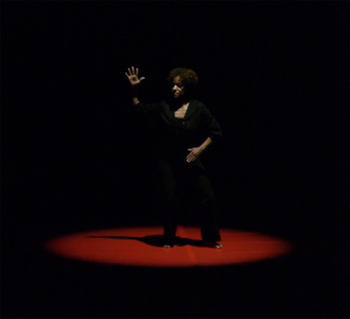
Maboungou presented De/Liberate Gestures in Toronto during the 2012 International Association of Blacks in Dance (IABD) conferenceFootnote 29 with musicians Marc Keyevuh and Elli Miller-Maboungou, but the work first became part of her company's repertoire in 2009. Because this performance of De/Liberate Gestures occurred during an event aimed at uniting “Black” dance artists (a racialized marker that Maboungou is not entirely comfortable with),Footnote 30 I consider how this particular iteration of the work engages consciously with conversations about identity and subjecthood within the African diaspora. Maboungou's performance was situated between two American companies known for their virtuosity in modern dance: the Philadelphia Dance Company (PHILADANCO) and the Alvin Ailey American Dance Theater. Before Maboungou's performance began, her distinctive approach became apparent as a new floor of red marley had to be set up prior to the start of the work and removed immediately after. Though De/Liberate Gestures took place on a proscenium stage, a structure developed in and often associated with European culture, Maboungou's use of the red marley quite literally changed the very ground upon which she performed. The red reflection created by the floor warmed the stage and gave Maboungou and her musicians a brightness that helped to counter the drowning effect of their dark costumes and the black curtains behind them (Photo 1).
De/Liberate Gestures (2012). Choreographed and performed by Dance Maboungu. Photo courtesy of Dance Immersion.

De/Liberate Gestures begins as a bright circular spotlightFootnote 31 illuminates the center of the red floor. Maboungou enters the stage wearing black pants, a black shirt, and a short, fitted black blazer; she walks purposefully and stops when she arrives in the center of the lit space; Maboungou carefully takes a wide-legged stance. Her knees bend and her torso tilts forward slightly as she places her arms at perpendicular angles. The lights are only on for a moment, before, surprisingly, they go out again. Though the stage is not visible, a single, repeated beat from a tamaFootnote 32 pierces the air at a moderate pace and continues, holding the attention of the hushed auditorium during a lengthy period of darkness.
The tension from the pulsing drum continues to mount when, finally, the spot returns on a still, solitary Maboungou. Slowly, almost imperceptibly, she begins to shift her gaze. When her eyes finally settle on something in the distance, a buildup of potential energy transforms into a kinetic burst—in a single breath, she lunges, circles her arms, and turns back on herself, kicks her leg toward downstage and returns to her opening still position. The pressing sound of the tama, steadily keeping time like a metronome, continues throughout this next moment of stillness. Again, seemingly out of nowhere, Maboungou breaks from her static pose to repeat the same swift sequence of gestures, ultimately returning to stillness but this time adding a sinuous quality to the movement of her feet and hands as she takes her stance. In a final iteration of this pattern, alternating between tranquility and controlled frenzy, Maboungou abbreviates her fast sequence of movements to a single kick of the leg, tilting her torso and folded arms away from the gesturing limb, before taking a pause while standing in profile. The tama suddenly stops.
The pauses, stillnesses, and blackouts in this opening sequence as well as the juxtaposition of the quick and the slow over the steady moderate thudding of the tama disrupt theatrical conventions about linear time and continuity. The long blackout so near to the start of the work foreshadows the end in the beginning as the audience waits silently for the piece to begin again. Maboungou continuously returns to the same pose, repeating movements, with difference, as if to echo the previous moment; this repetition encourages us to see the past in the present; yet, the disjunctive timing between each iteration suggests that these moments are not necessarily a continuation of one another. Time and space are disrupted in Maboungou's play with velocity. Her juxtaposition of quickness and stillness, seemingly in conflict with the steady moderate pace of the tama, creates instability, bringing the audience into noticeably different relationships to speed and time and creating moments of rupture within mere seconds. And yet, for all her speed, Maboungou remains in a single spot on the stage—she moves but she does not travel. In this way, the opening sequence of De/Liberate Gestures unsteadies the audience's understanding of Maboungou's position in space and time.
In silence now, she turns her seemingly rigid body back around and swiftly digs her forearms and stiff hands into the space in front of her. She pivots around herself and pauses. The section that follows, performed without drum accompaniment, is characterized by the twist and torque of her body, sometimes as a whole, continuously changing its facing; other times the rotation is restricted to a single part of the body, like the knee or wrist. Maboungou plays with angles and perpendicular lines of the arms, legs, and torso though as the section continues, Maboungou's chest and shoulders gradually soften. Maboungou's pelvis and ribs move sparingly—a quality that distinguishes her style within the African diaspora. Although she teaches that the torso has two centers, the pelvis and the chest, they are only occasionally visibly separate. Preferring to use angular shapes of the arms and legs, Maboungou frequently dances with her torso flat but pitched forward and the shifts of her body are rooted in the connection between her feet and the ground. The subtle back and forth in her body comes from her weight alternating from sitting in the heels to the toes, and her torso moves in accordance with her contact to the floor. In order to create this effect, her torso often appears rigid and solid, her groundedness almost immoveable. But while she dances most prominently with this straight torso, there are still some instances of fluidity—sudden moments of softness will cause her ribs to make a circular motion or her hips to pull her in a new direction.
This section is performed entirely in silence. Like many other African and African diaspora dance artists, Maboungou values the relationship between dancer and drummer, and it is something that comes up in her writing and her classes often. Yet, in this part of the performance, which takes place in silence, her dance is not in immediate or obvious dialogue with a drummer, but rather creates its own rhythms. Watching this moment, I was reminded of a comment Maboungou had made in class one afternoon the previous September. I had just begun working with her and was surprised that we so rarely worked with a drummer in class. “Don't listen to the drums,” she explained, “listen to the rhythm inside you. Once you can do that, you can speak to any drummer in the world” (Maboungou Reference Maboungou2011a). In this silent middle section, Maboungou seems to speak from this internal rhythm, her body eventually calling back her drummer, who responds by reentering the stage.
The final, climactic section of the work begins when Maboungou's drummer, Mark Keyevuh, enters the stage playing the tama once again. Maboungou's body, still mostly shaped by lines and angles, exhibits increasing moments of softness where the torso undulates and the arms curve. Keyevuh's beat is, at first, the same moderate tempo that opened the work. Initially, Maboungou responds with pauses—standing in profile with her arms raised to frame her head or with her legs together and her torso parallel to the floor. The still poses change to movement when Maboungou raises her knee, initiating a jump that takes her into a steady stepping pattern to the rhythm of the drum (though she accentuates counterrhythms in her arms and torso). With one knee bent, the other leg straight and in front of her, Maboungou pitches her body forward and circles one arm as she taps the drum's beat with her foot. While her arm acts like that of a clock and her foot patiently keeps the pulse, the tama starts beating double time, a new rhythmic motif that is introduced sporadically throughout the rest of the work. A second drummer, Elli Miller-Maboungou, enters the stage and at varying intervals interjects a measure of syncopation on the ngomas.Footnote 33 In an instant, all three performers find the same synchronous beat, the original beat played by the tama, now marched out in Maboungou's feet, and increasing in volume on the ngomas, which lasts only a moment before each performer finds her or his own rhythm. A rich polyphonic scene imbricates drum and dance, placing them in conversation with one another, until suddenly all three simultaneously stop and the piece ends.
There is an understated quality to the work. Energetically distinct from the performances by the PHILADANCO and Ailey companies that bookend De/Liberate Gestures, Maboungou's movements appear subdued and introspective. While the work changes with each performance, this internal and contemplative energy is a constant; for audience members, the allure of the work rests in watching Maboungou's movement choices unfold. In explaining her performance process, which she describes as “progression” rather than improvisation, Maboungou explains:
It involves identifying a means of taking charge of living relational forces. These cannot be simply stated or affirmed without being challenged in order to negotiate them, implying, on an aesthetic level inseparable from the level of transformation required, a change in the level of complexity which both integrates and retains (retention and inclusion aspect) and opens up (space and possibility). (2015)Footnote 34
At the heart of Maboungou's choreography lies this principle of progression, an exercise of agency that shapes her relationship to place and opportunity. Dance scholar Danielle Goldman (Reference Goldman2010) argues that there is a tendency in dance studies to see improvisation (or similar processes) as a practice that liberates the dancer from sociopolitical restrictions. However, dancing bodies, particularly racialized and gendered dancing bodies, are not easily distanced from the political identities that are assigned to them. A more nuanced reading might suggest that the “freedom” (or “liberation” in this case) that comes with improvisation is, as Goldman argues, in part due to the sense of empowerment that comes from “literally giving shape to oneself by deciding how to move in relation to an unsteady landscape. To engage oneself in this manner, with a sense of confidence and possibility, is a powerful way to inhabit one's body and to interact in the world” (5). De/Liberate Gestures speaks to this sense of possibility. Maboungou's choreography, while engaging with the “here and now,” situates her in a time and space whose rules she herself seemingly dictates and that we as an audience are asked to contemplate. Her interest in these qualities becomes apparent in the title of this work; the play on words, the solidus or slash embedded within the word “deliberate,” suggests that freedom may be contained within conscious and intentional actions. Similar themes, especially of choice and subjecthood, emerge in Maboungou's technique classes.
Lokéto: Reappropriating the “Universal”
Dance pedagogue and scholar Raquel Monroe (Reference Monroe2011) laments the struggle her department faces each year in trying, on the one hand, to encourage students to pursue classes in West African dance while, on the other hand, continuing to use ballet as a measure of a student's skill. Often, despite best efforts to contextualize dance histories, the illusion that ballet is the “the foundation of all dance” (42) continues to haunt many university dance programs. The prevalence of Europeanist aesthetics in Canada and the United States is gradually waning, but ballet continues to maintain a strong presence in public expectations for dance, especially in evaluating the “quality” or “discipline” of dancers.
Over the last three decades, Maboungou has developed her own technique that requires a highly nuanced awareness of the body. As in ballet, the focus, discipline, and athleticism of the training Maboungou's advanced dancers are required to pursue in order to perform her work appeal to North American expectations of elitism in concert dance. And while similar physical demands might be said to exist in many technique practices, Maboungou's classes are also devoted to metaphysical investigations through contemporary African dance, offering an additional challenge to ballet's imagined “universality.”
Maboungou describes her RYPADA technique (“Rythme, Posture, et Alignment, de la Danse”)Footnote 35 as an attempt to create something “basically human” (Maboungou Reference Maboungou2012a). Crucial to this technique (and its admittedly ambitious goal) is the concept of lokéto. From Lingala,Footnote 36 lokéto means “hips,” a testament to the significant role the pelvis plays in propelling a dancer's movement, but in Maboungou's classes, lokéto is a complex concept that encapsulates many ideas. In Maboungou's studio, a poster on the wall describes lokéto as follows:
Lo: Time/Movement of the Feet/Support/Force and Impulse
Ké: Time/Movement of the Knee/Spring and dynamic
To: Time/Movements of the Hips/Flexibility and receptivity
(author's translation)Footnote 37
The syllables lo-ké-to are broken down so that each sound corresponds with an articulating joint or body part. In its most basic formulation, “lo” is the foot, “ké” is the knee, and “to” is the pelvis. The pelvis is the first body center, but there is a second, the rib cage. Accordingly, Lo-ké-to can also be translated into the upper body, “lo” being the hands, “ké” being the elbow, and “to” being the shoulder girdle. During beginner classes, typically the focus is on patterns of walking and so most often, lokéto refers to the foot-knee-pelvis combination. The foot and knee joints may move up or down depending on the pattern given, but the “to,” the pelvis, is almost always a return to a strong stable center (though, as the studio description indicates, in theory, this center must also be flexible and receptive rather than simply rigid). In class, we also vocalize the syllables “Lo-ké-to” as we move—a kind of onomatopoeia to help keep time in our bodies.
In my own experience at Nyata Nyata, Maboungou's beginner RYPADA classes seemed to dispel preconceived understandings of the body and its position in space by continuously practicing a single deceptively difficult act: walking. In the time I spent in the beginner class, we did not learn lengthy movement phrases, but spent our time very carefully reconsidering this fundamental act of locomotion, not taking any movement choice for granted. We might learn a variation on the basic walking pattern, adding a saut (either a hop or a jump), sliding the feet together, walking backward or sideways, or using slightly different shapes in the torso and/or arms. Most (if not all) of the time I spent in Maboungou's beginner class, in 2011, involved walking from one side of the room to the other,Footnote 38 without music, while uttering the syllables “Lo-ké-to” as the class moved. Though the process may seem trying, as a student I found it was very effective in heightening my somatic awareness. As I walked, I would think of the paradoxical movement and stability of my “basin” (pelvis)—not a contradiction to be resolved but a puzzle to contemplate forever. I became hyperaware of the way my knee settled over my foot as I transferred weight from one side of the body to the other. I am still struck by how difficult it is to position this midleg joint in the precise right spot over my foot so that I am both secure and ready for action. And never before had I thought so intensely about the contact my foot makes with the floor—especially my big toe. While it seems so obvious to notice when the heel comes into contact with the ground, the big toe is where the drummer takes her cue, as Zab explained in one class (Maboungou Reference Maboungou2011b); before I could learn to work with a drummer, I had to master my big toe. This return to a most fundamental way of moving could be seen as a restructuring of foundational movement grammars—a profound rethinking of the way we articulate our bodily thoughts in space.
In her technique classes Maboungou will often make evocative and poetic observations about one's sense of self and the human world, aligning personal reflections with lokéto corporeal principles. In class, while students are exploring lokéto movement concepts and quite literally learning to walk again, Maboungou will frequently pause to give corrections that hint at more profound questions about existence. Her reflections sometimes consider the nature of humans and their relationship to space: “There is no front or back in nature. Humans make up a front and back because they are so concerned with where they are going,” she once explained watching us walk through the space, encouraging us to understand how every “forward” movement has its own “backward” resistance (Maboungou Reference Maboungou2011c). Other times, she brings the body and the intellect together in ways that speak to universal notions of humankind: “Rhythm is the heart of the human intellect. It is the language of language that articulates our breath into matter” (2012c). And sometimes her words resonate on a more spiritual plane: “If there is a paradise, it is on the ground” (2012c). While these reflections are in part a way of provoking new kinds of movement, they often resonate on a more profound level, asking students to think differently about their understanding of humanity and their relationship to their surroundings.
In my conversations with other students at the school, I found their experiences seemed similar to my own. I asked several alumnae of the professional training program (called PEFAPDA)Footnote 39 to describe to me what they felt was most important that they learned at Nyata Nyata; in addition to developing personal artistry, these students told me about profound revelations about their own experience of the world. One student explained to me that among the many things he learned during his time at Nyata Nyata was to “be conscious of the responsibility we have to live our lives through the gestures we make in each moment.”Footnote 40 Another student wrote: “I learned to make connections between the body and spirit, between the body and thought, between the body and rhythm.”Footnote 41 She goes on to say “Working with Zab helped me redefine and reshape the perception that I have of myself. From my entity to my flesh.”Footnote 42 As the final comment suggests, the role of the body in this contemplation is critical.
Maboungou's philosophical meditations are not separate from the body (a Cartesian dualism that she teaches against).Footnote 43 Instead, her comments on universal themes are connected to what she sees taking place in the bodies of her students as they learn her movements, and in turn, learning to move in new ways inspires students to rethink their relationship to their “entity” and their “flesh.” Maboungou's own writings suggest that this kind of embodied exploration of self and surroundings is a foundational interest of her work in dance. Maboungou writes in her article Tech/niques/ologies of Transformation (2014): “By his breath, step and gesture, the dancer initiates a conversation between the intimate and the universal … Like the drummer, the dancer can reconfigure time sequences and thereby contract or dilate space inside and outside of his body.”Footnote 44 Crucially, the body, its movements, and its breath speak to both the micro and macro levels—”the intimate and the universal.” And in the body, the dancer shapes her surroundings, her relationship to time and space. The dancer moves, and the physics of her situation—her place in time and space as well as how she conceives of herself in these dimensions—changes. Maboungou's approach to technique challenges the philosophical language of the European Enlightenment by reappropriating the concept of a universal metaphysics but rooting it, embodying it, in lokéto movement principles, effectively articulating philosophical concepts in new embodied terms.
Exploring “universal” themes with a contemporary African dance vocabulary is an important strategy for confronting Eurocentric thought in Montreal. The involvement of the body in these philosophical reflections certainly prompts dancers to consider how the corporeal might be more involved in such ontological conclusions. But it is also an opportunity to revisit the very concept of the “universal,” an idea that became a central tenant in the writings of the European Enlightenment and a powerful, unspoken assumption that informs constructions of whiteness. Cultural theorist Warren Montag (Reference Montag and Hill1997) suggests that during the eighteenth century, European thought became deeply invested in notions of universal humanism and yet often dehumanized non-European cultures. In Montag's formulation, the European Enlightenment seemed to arrive at the egregious generalization that “to be white is to be human and to be human is to be white” (285). In addressing subjecthood and universalisms through contemporary African dance, Maboungou is able to reformulate the question of “what is human,” exposing implicit cultural assumptions and encouraging her dancers to rediscover interpretations of human nature during technique class. Her articulation of ontological queries through the assistance of a contemporary African dance practice strategically recenters discussions of self, subjecthood, and universalisms through a language rooted in an Africanist movement practice, effectively destabilizing its Europeanist counterparts in white contemporary dance circles in Montreal. Politically, Maboungou's choreography and technique intervene in the rhetoric that positions modern dance and ballet as universally expressive of the human condition and suggest that her RYPADA technique offers these same possibilities.
Conclusion
While postcolonial thinkers like Fanon ([1952] Reference Fanon1967)) have looked askance at ontology, Maboungou's approach has been politically productive for African diaspora dance in the Eurocentric milieu of Montreal and of Canada more generally. Since the founding of her school in 1986, Maboungou has been sought out by numerous Canadian institutions, such as the Canada Council for the Arts, to counsel them on their policies,Footnote 45 especially with regard to their attention to diversity and the “multicultural” rhetoric that has become so central to Canadian nationalism. In this sense, Maboungou's embodied Africanist metaphysics have offered a strategic challenge to Eurocentric values in conversation with Canada's public arts institutions.
Similarly, though contemporary choreographers like Linyekula worry that defining “contemporary African dance” might essentialize difference and silence plurality, Maboungou's metaphysics has been an important starting point for other Montreal artists. Rhodnie Désir, a choreographerFootnote 46 with an increasingly international stature and a former student at Nyata Nyata, speaks of the important influence Nyata Nyata had on her growth as an artist:
For me Nyata Nyata has played a big role in my process, as an individual, as a human being in society and also as a dancer and choreographer. … It was really a moment of understanding what does dance mean really? What does creation mean really? … To understand the body self in space and alignment … and the program made me acknowledge my African roots and my Black culture and also me myself in society. And I don't think I would be the same person if I did not go through that program. (2016a)
Désir, though no longer working with Zab, acknowledges the significant role Maboungou's questions about art, self, and identity played in her development as an artist, whether in pushing her to articulate fundamental ideas about dance, creation, and the body in space, to research and learn more about her heritage, or to consider her own position in society. In part, Maboungou's founding of Cercle d'expression artistique Nyata Nyata created a semi-autonomous space, both physical and metaphysical, where the artistry of African diaspora dancers could be nurtured, providing an important alternative to the city's conventionally white dance spaces.
In Montreal, contemporary African dance has been marginalized, exoticized, or outright ignored, but Maboungou's embodied Africanist metaphysics offer an important intervention into Eurocentric frameworks that have constructed ontological categories of subjecthood through which “African dance” has been judged. Instead, Maboungou's approach to ontology and subjectivity asks dancers and audience members alike to reconsider assumed universal truths about space, time, and self. Her current choreographic work reconceptualizes space, time, agency, and self while creating an environment of contemplation that reimagines contemporary African dance. Similarly, Maboungou's teaching encourages deeply personal philosophical investigations through technique classes, reappropriating universal themes and conceptions of the self through lokéto corporeal principles. And while these tactics potentially essentialize “contemporary African dance,” Maboungou's work has productively challenged Eurocentrism in Canada, whether it be in the palpable transformations that have occurred in Canadian arts policies, in the growth of African diaspora dance artists in Montreal and Canada, or in the more general ways that “Africa” and contemporary African dance are being rearticulated to avoid Eurocentric assumptions about art and identity. Maboungou's work encourages artists and audiences to contemplate universality, subjecthood, and the human condition from an Africanist perspective, potentially serving to change the generally “whitened” expectations of Montreal's contemporary dance scene, while demonstrating the complexities of contemporary African dance as it continues to grow roots in Canada.