INTRODUCTION
Hokkaido Island is the northernmost and one of the largest islands of Japan and is located in a subarctic zone (Figure 1). The fish biodiversity in Hokkaido waters is made up of a range of subtropical to subarctic species (Amaoka et al., Reference Amaoka, Nakaya and Yabe2011; Nakabo, Reference Nakabo and Nakabo2013), and this ichthyofauna differs to that from other parts of Japanese Islands. Japan covers a large latitudinal range and therefore has a diverse ichthyofauna (Amaoka et al., Reference Amaoka, Nakaya and Yabe2011; Nakabo, Reference Nakabo and Nakabo2013; Figure 1).
Map showing the warm (red lines) and cold (blue lines) currents around Japan, and the sampling point. The yellow star marks Suttsu Bay, south-west Hokkaido Island, where the northernmost specimens of Sagamia geneionema and Chromis notata were collected in 2011. The orange coastlines indicate the previous distribution shared by the two species in and near Japanese waters, while the green coastlines indicate the additional previous distributions of C. notata.

This paper presents the first records of two temperate species, Chromis notata (Temminck & Schlegel, 1843) and Sagamia geneionema (Hilgendorf, 1879), from Suttsu Bay (Sea of Japan), south-western Hokkaido. Until now, the distributional ranges of Chromis notata and Sagamia geneionema have been recognized as being from Hong Kong to Aomori Prefecture, Japan (Aonuma et al., Reference Aonuma, Yoshino, Yagishita and Nakabo2013; Iwatsubo & Motomura, Reference Iwatsubo and Motomura2013), and from Naga-shima Island, Kagoshima Prefecture to Aomori Prefecture (Akihito et al., Reference Akihito, Sakamoto, Ikeda, Aizawa and Nakabo2013), respectively.
MATERIALS AND METHODS
On 31 August 2011, two specimens of the damselfish Chromis notata were collected by hand net at the Masadomari Fishing Port, Suttsu Bay, south-western Hokkaido, Japan (42°49′26–29″N 140°11′15–19″E; Figure 1). In addition, on 30 October 2011, one specimen of the goby Sagamia geneionema was collected by hook-and-line at the same locality. These specimens were taken to the municipal residential house for researchers in Kuromatsunai town, where they were anaesthetized in ethyl benzoate and then photographed (see Motomura & Ishikawa, Reference Motomura and Ishikawa2013 for methods). After a few weeks in formalin, the individuals were transferred to 70% ethyl alcohol. The specimens of C. notata were deposited in the Kanagawa Prefectural Museum of Natural History, Odawara, Japan (KPM-NI), while the specimen of S. geneionema was deposited in the Biological Laboratory, Imperial Palace, Tokyo, Japan (BLIP). The photographs of the specimens were deposited in the Image Database of Fishes of the Kanagawa Prefectural Museum of Natural History (KPM-NR). So, in this case, each individual has two KPM registration numbers: one is the specimen's number, while the other is the photograph's number.
The scientific names and methods for identification, counts and measurements followed Aonuma et al. (Reference Aonuma, Yoshino, Yagishita and Nakabo2013), Akihito et al. (Reference Akihito, Sakamoto, Ikeda, Aizawa and Nakabo2013) and Nakabo & Nakayama (Reference Nakabo, Nakayama and Nakabo2013) with the modification of the scientific name by Iwatsubo & Motomura (Reference Iwatsubo and Motomura2013). Observations were made on the left-hand side of the body and standard length (SL) was recorded to the nearest 0.1 mm.
RESULTS
The specimens of Chromis notata were registered as KPM-NI 29102 (24.6 mm SL) and 29108 (25.7 mm SL) (specimens) and KPM-NR 77472 and 77478 (photographs) (Figure 2A), while the specimen of Sagamia geneionema was registered as BLIP 26770018 (90.1 mm SL) and KPM-NR 152512 (Figure 2B).
Photographs of the specimens recorded from Suttsu Bay, Sea of Japan. A. Chromis notata (specimen: KPM-NI 29108, photograph: KPM-NR 77478, 25.7 mm SL, photo by Y. Miyazaki, 31 August 2011); B. Sagamia geneionema (specimen: BLIP 26770018, photograph: KPM-NR 152512, 90.1 mm SL, photo by Y. Miyazaki, 30 October 2011).
The two C. notata specimens had the following characteristics: dorsal-fin rays XIII, 12–13; anal-fin rays II, 11–12; pectoral-fin rays 19–20; pelvic-fin rays I, 5; body depth 38.0–40.5% of SL; head length 32.9–34.2% of SL; snout length 8.6–8.7% of SL; interorbital width 11.8–12.1% of SL; caudal-peduncle depth 12.6–13.6% of SL; caudal-peduncle length 18.1–18.7% of SL; tubed lateral-line scales 18; margin of infraorbital series smooth; two spinous procurrent caudal rays at both upper and lower caudal-fin origins; large black blotch on base of pectoral fin.
The specimen of Sagamia had the following characteristics: dorsal-fin rays VIII–I, 14; anal-fin rays I, 13; pectoral-fin rays 22; pelvic-fin rays I, 5; scales in longitudinal row 64; scales in transverse row 18; predorsal scales 21; body depth 17.5% of SL; head length 28.0% of SL; snout length 9.3% of SL; interorbital width 7.7% of SL; caudal-peduncle depth 9.7% of SL; caudal-peduncle length 20.5% of SL; free soft rays on upper part of pectoral fin; vertical side of head with many barbels.
DISCUSSION
The records of both temperate species Chromis notata and Sagamia geneionema from Hokkaido waters extend their distributions northward. A similar northerly range extension to Suttsu Bay was documented by Miyazaki et al. (Reference Miyazaki, Terui, Senou and Washitani2013) for Platycephalus sp. 2 of Nakabo & Kai (Reference Nakabo, Kai and Nakabo2013), one of the Platycephalus indicus (Linnaeus, 1758) species complex.
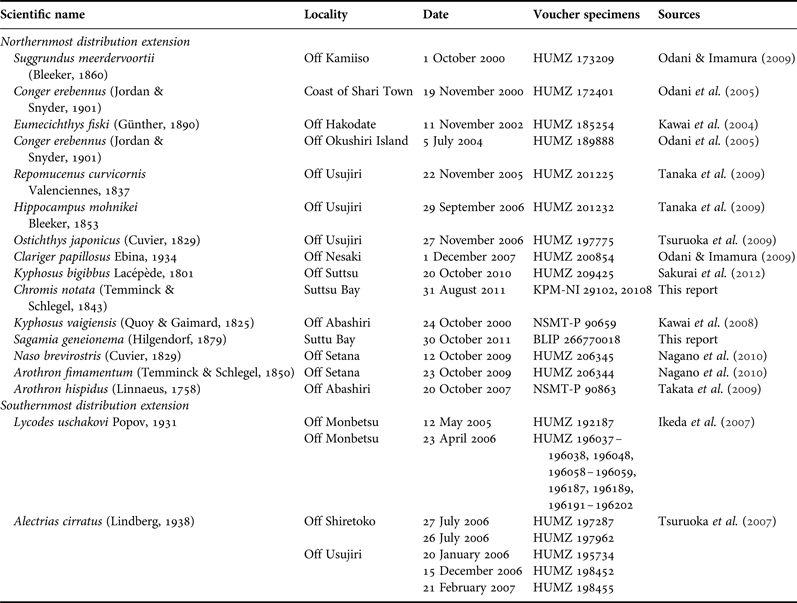
Several other species were also recently recorded as new to Hokkaido. Since 2000, most of the new records were of temperate species, which Amaoka et al. (Reference Amaoka, Nakaya and Yabe2011) attributed to the effects of warming of the sea surface temperature (Table 1). On the other hand, some widely distributed species of warm and temperate fishes that inhabit rocky shallow seas around Japan had already been recorded from the Sea of Japan in Hokkaido, particularly from the southern Shakotan Peninsula but not from other areas of Hokkaido (Nakabo, Reference Nakabo and Nakabo2013). Our present reports present additional range extensions of warm and temperate fishes into the southern Shakotan Peninsula, Sea of Japan in Hokkaido.
List of marine fishes with range extensions to Hokkaido from the year 2000.
Voucher specimens are deposited in: BLIP, the Biological Laboratory, Imperial Palace, Tokyo, Japan; HUMZ: the Hokkaido University Museum, Hakodate, Japan; KPM-NI: the Kanagawa Prefectural Museum of Natural History, Odawara, Japan; NSMT, the National Science Museum of Nature and Science, Tsukuba, Japan.
Survival limitation at low temperature is one of the most important factors for a marine organism's distributional extension and establishment (e.g. Thompson et al., Reference Thompson, Crowe and Hawkins2002; Senou et al., Reference Senou, Matsuura and Shinohara2006; Figueira & Booth, Reference Figueira and Booth2010; Weslawski et al., Reference Weslawski, Wiktor and Kotwicki2010; Kurihara et al., Reference Kurihara, Takami, Kosuge, Chiba, Iseda and Sasaki2011; Murase, Reference Murase2011; Takeuchi et al., Reference Takeuchi, Senou and Aoki2012; Nakamura et al., Reference Nakamura, Feary, Kanda and Yamaoka2013). Tropical and sub-tropical fishes in Japanese waters were estimated to be limited by temperatures of less than approximately 15°C, while temperate fishes can tolerate temperatures of up to about 10°C (Tanase et al., Reference Tanase, Araga, Ohta and Yamamoto1992). Thus, the water temperature of the coldest water season (i.e. winter in Japan) is an important factor for the establishment of temperate fishes into Hokkaido.
The Hokkaido coasts that face the Sea of Japan, particularly the southern Shakotan Peninsula including Suttsu Bay, are likely to be affected by warm currents and therefore by sea surface temperature warming (Ota et al., Reference Ota, Koike, Chinzei, Nogami, Machida and Matsuda2010; Figure 1). These regions are more likely than other areas of Hokkaido to experience significant change in fish communities. It is likely that the Shakotan Peninsula will function as a boundary for the extension and establishment of warm and temperate fishes into the Sea of Japan in Hokkaido. Further research is required to assess the aquatic environments, including fish communities, and to evaluate the fluctuations in abundance of warm and temperate fishes around the probable boundary.
ACKNOWLEDGEMENTS
We thank M. Wakami, N. Hatai, H. Suzuki, K. Takahashi and the staff of the Kuromatsunai Municipal Beech Tree Museum for their generous help in research, A. Murase for providing literature, and R. Takahashi and KPM's volunteers for specimen curation. We also thank G. Yearsley (Hobart, Tasmania) and anonymous reviewers for their critical reading of the manuscript. This report was partly supported by Grants-in-Aid from the Ministry of Education, Culture, Sports, Science and Technology of Japan (to Y. Miyazaki, no. 25 •11038; to H. Senou, no. 24501278).