Implications
Footbaths represent a potentially useful strategy for the prevention of claw infectious diseases. Nevertheless, footbath solutions are exposed to contamination and losses of volume after many cow passages. Across increasing number of cow passages, the organic matter (OM) concentration, the microbial load (ML) and the residual volumes were recorded in footbaths. The results suggested that beyond the concentration the contamination, to ensure the action of a footbath treatment, the renewal rates must be adapted to ensure a remaining solution sufficient to cover the entire foot. This volume capacity problem seems inherent to the footbaths currently commercialized. Footbaths should be built with a high step and at least 3-3.7 m in length. Ideally, they would also have sloped sidewalls.
Introduction
In ruminants, claw infectious diseases such as digital dermatitis and interdigital necrobacillosis, are important conditions associated with lameness, decreased production, and thereby economic and welfare concerns (Alban et al., Reference Alban, Lawson and Agger1995; Bruijnis et al., Reference Bruijnis, Beerda, Hogeveen and Stassen2012; Relun et al., Reference Relun, Lehebel, Chesnin, Guatteo and Bareille2013b). A classical strategy for the control of such diseases is the usage of disinfectant footbaths. Footbath solutions, in theory, limit the spread of infectious diseases by their bactericidal properties controlling the occurrence and persistence of foot lesions (Relun et al., Reference Relun, Lehebel, Bareille and Guatteo2012; Ariza et al., Reference Ariza, Relun, Bareille, Oberle and Guatteo2017; Solano et al., Reference Solano, Barkema, Pickel and Orsel2017). In practice, footbaths are implemented empirically at different frequencies and renewal rates (renewal of the entire footbath solution), as a possible consequence of the unclear guidelines for its usage (Relun et al., Reference Relun, Guatteo, Auzanneau and Bareille2013a). Thus, even if footbath solutions are frequently advised to be renewed every 150-200 cow passages, no major evidence in the scientific literature supports these renewal rates or evaluate the impact of the feet hygiene on the footbath contamination. Currently, the plastic baths commercialized for footbathing include diverse dimensions and designs, sometimes largely different from the scientific advised dimensions of 3 m long, 0.5 m wide and 0.28 m step-in height (Cook et al., Reference Cook, Rieman, Gomez and Burgi2012). In practice, footbath solutions are exposed to increasing concentrations of manure contamination. Manure is incorporated into footbaths by animal defecations or carried by the animal feet. Therefore, the OM concentrations could hugely differ from farm to farm depending on their management practices and their impact on the feet hygiene. The concentration of OM and the ML contained in manure can alter the bactericidal efficacy of the active compounds of footbath solutions (Hartshorn et al., Reference Hartshorn, Thomas, Anklam, Lopez-Benavides, Buchalova, Hemling and Döpfer2013). The European legislation restrains the market of disinfectant products (biocides) for the veterinary usage (Regulation EU. No. 528/2012). The current regulation requires biocides to be effective against Enterococcus hirae, Proteus vulgaris, Pseudomonas aeruginosa and Staphylococcus aureus after the exposure to soil conditions (20 g/l of OM) (EN 1656). Nevertheless, the bacteria and soil conditions from farms may be largely distant from those of the laboratory environment. Currently, the usage guidelines of footbaths are limited to indicate a renewal rate according to a certain number of animal passages. Therefore, a recent European directive requires footbath biocides to confirm their efficacy according to their claimed usage guidelines (European Chemicals Agency, 2017). Thus, footbath biocides should support their capacity to remain affective against proportional concentrations of OM and microbiological contamination related to the number of passages claimed (‘capacity test’). Finally, as the majority of lesions occur in hind feet (Relun et al., Reference Relun, Guatteo, Roussel and Bareille2011), and are often located over the heel bulb (Read and Walker, Reference Read and Walker1998), footbath solutions should assure the immersion of all feet and cover the entire foot to allow their bactericidal effect. In practice, it is unclear the degree in which the physical effect of the cow passages could alter the residual volume of the footbath solutions and, therefore their presumed efficacy. The objective of this study was to investigate under field conditions how footbath solutions might be impacted by the increasing number of cow passages, in terms of residual volume, OM and ML concentrations, and thereby how these factors might affect the renewal rates of footbath solutions.
Material and methods
Study population
The study was carried out in 2016, in six dairy cattle farms from western France (638 lactating cows). Each farm was visited once during a period when cows were housed without access to pastures to minimize the potential season effect on the feet hygiene. To reduce the stress and therefore the number of defecations produced by the first implementation of footbaths, in all six farms routine footbathing was practiced.
The main characteristics of the six farms included in the study are presented in Table 1.
Main characteristics of the six dairy cattle farms included in the study

AMS=automatic milking system.
1 Percentages of animals scored according to the feet hygiene (1=clean, 2=fair and 3=dirty). The hygienic status given to each farm is indicated in italic letters.
2 Dimension (length×width×depth).
Feet hygiene assessments
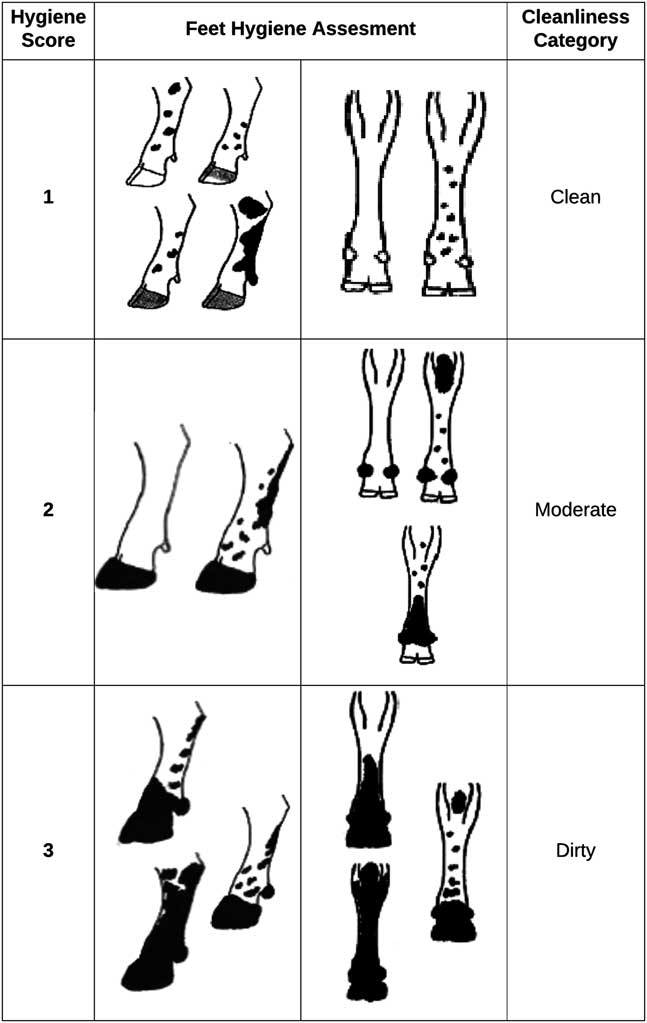
The feet hygiene (metatarsus and digit (phalanges)) of the lactating cows was assessed by scoring the dirtiness present at both hind feet of each animal during the milking previous to the first footbath sampling, using a three-point nominal scale, varying from clean (score 1) to dirty (score 3) (Figure 1) (Guatteo et al., Reference Guatteo, Arnoult, Ménard and Bareille2013). For each cow, the higher foot score was retained. The farms were classified according to the overall percentages of feet hygiene score in the following three hygienic status: clean (⩾50% of animals in score 1), fair (⩾50% of animals in scores 1 and/or 2) and dirty (⩾50% of animals in score 3).
Scoring grid implemented to assess the feet hygiene at cow and farm level (Guatteo et al., Reference Guatteo, Arnoult, Ménard and Bareille2013).

Footbaths assessments
The footbaths were filled with water sourced from the farm. Farmers were asked to fill the footbath as in the routine practice. Then, the initial volume was calculated according to the dimensions recorded (length×width×depth). In farms with milking parlors (n=5), the footbath was placed at the exit. In farms with automatic milking systems (AMS), all the animals were grouped beside the bath before being forced to pass through it all at once, as usually done by the farmer. To evaluate the variation in the OM concentration, in each farm the footbath solution was sampled three times at three different sites (500 ml/sample) after every 0, 50, 100, 150 and 200 cow passages, the content of the footbath was homogenized by agitation. The ML measurements were only performed for the samples related to 0, 50, 150 and 200 cow passages. At each sampling, the remaining liquid depth of the footbath was recorded and then the residual volume was calculated. Likewise, the timing and frequency (before 0, 50, 100, 150 or 200 cow passages) in which the cows defecated into the footbath were recorded to identify the main source of contamination (foot dirtiness and/or feces). In addition, changes in the pH and temperature were recorded to explore potential variations within and between farms. The cow passages were recorded by simple observation. A total of two investigators participate in the recordings. The first investigator exclusively recorded the number of cow passages and sampled the footbath. The second investigator recorded the defecations, the pH and the temperature of the footbath. The samples were stored in plastic bottles at 4°C and delivered to the laboratory for further analysis (within 24 h maximum). Depending on the herd size of each farm, a different number of milking was necessary to reach the 200 cows passages. When footbaths contents stayed more than 12 h, control samples were taken immediately before and after the stand period to determine the potential impact of the stand time on the OM concentration.
The ‘weight loss-on-ignition 550°’ (Houba et al., 1997) method was used to estimate the OM concentration of footbaths samples after 0, 50, 100, 150 and 200 cow passages. The method consists of drying the samples at 105°C to remove moisture, a procedure that enables the dry matter estimation. Then, the dry sample is heated at 550°C for 2 h to decompose the OM but not the carbonates. Before ignition the sample contains OM, but after ignition, all that remains is the mineral portion. The OM concentration in the samples was calculated by the difference in the weight before and after ignition, in grams by liter.
The ML was determined by the counting of heterotrophic bacteria through the pour plate method with yeast extract agar at 30°C for 48 h (International Organization for Standardization, 1999). The colonies present in each plate were counted to estimate the number of colony forming units (CFU) present in 1 ml of sample. Plates with >300 CFU, in the highest dilutions used, were considered to have a number of viable bacteria greater than the limit of reliable quantification and were therefore expressed as an approximate value.
Data analysis
According to the data collected in this study, the statistical analyses were performed using R software (R Core Team, 2017). Significance was set at P<0.05. First, the residual volumes calculated were corrected to account for the liquid removed during the sampling. Second, descriptive statistics were computed by calculating the volume reduction and the average contamination on footbaths, in terms of OM concentration and ML. Third, a non-parametric Kruskal–Wallis rank sum test was used to determine the differences between the hygienic status assigned to the farms and the average OM and ML contamination. Finally, non-parametric Kendall’s tau-b correlation analyses estimating the strength, direction and significance of the relations between the increasing number of cow passages and the number of cows that defecated into the footbaths, the residual volume and the average ML and OM contamination in the footbaths were conducted.
Results and discussion
In this study, three different milking systems were represented, five farms had milking parlors (three herringbones (# 2, 5 and 6), two carousels (# 1 and 4)) and one (# 3) had an AMS. Aside from the AMS farm, the cows were milked twice a day in the milking parlor farms. The average herd size was 106 cows and therefore the number of milkings to complete 200 cow passages varied between 2 and 3. Only the farm 5 had <100 animals (74 cows). Farms housed the animals in cubicles and use automatic scrapers. All six farms used plastic commercial baths, two (# 1 and 6) used split footbaths and the rest of them used conventional footbaths. The hygienic status of the farms was considered as ‘dirty’ in two farms (# 1 and 3), as ‘fair’ in three farms (# 4, 5 and 6) and as ‘clean’ in only one of the farms (# 2) (Table 1).
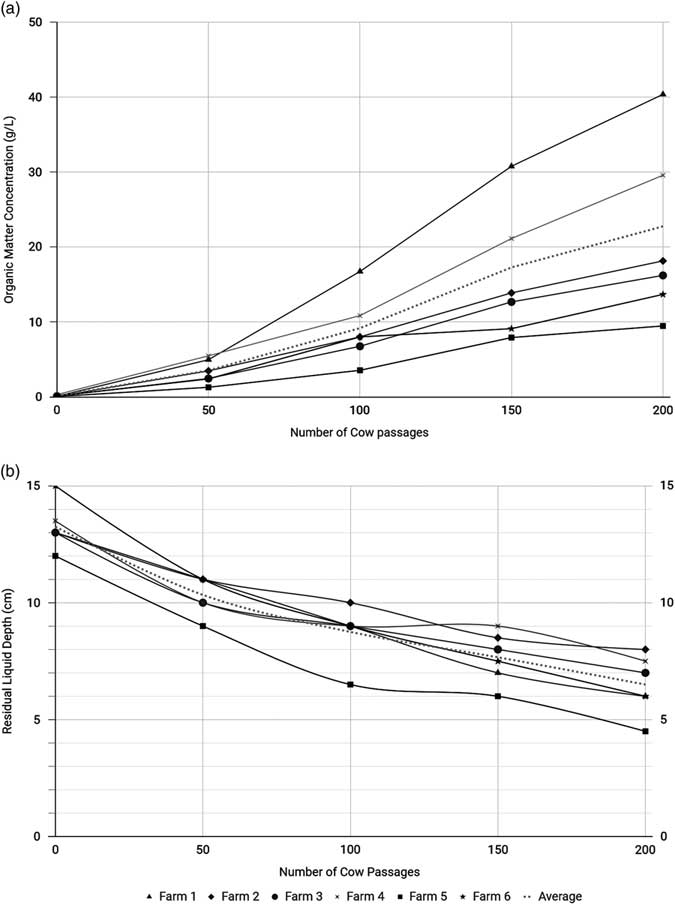
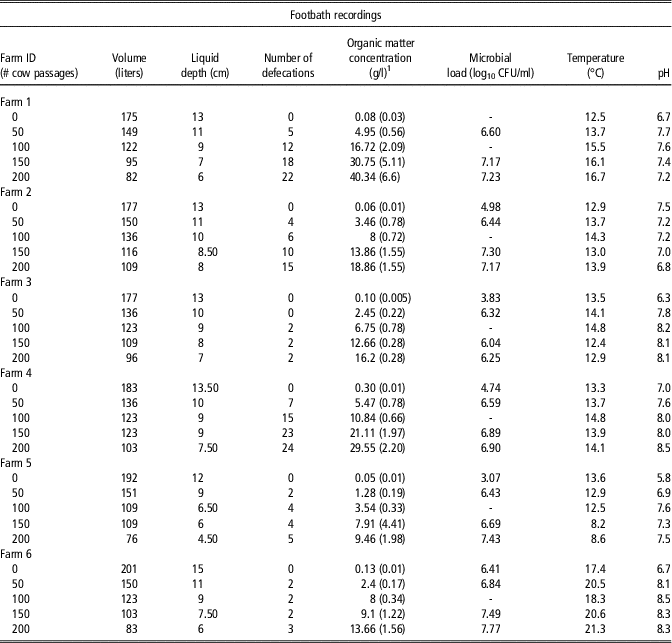
The OM concentration increased linearly with the number of passages of animals (r τ =0.78, P<0.0001) (Figure 2a), and with the number of defecations in the footbath (r τ =0.68, P<0.0001). However, among the different farm’s feet hygiene status no differences for the OM concentration were detected (P=0.76), suggesting that the increasing number of cow passages and defecations influenced more the OM concentration in footbaths than the feet hygiene. The OM concentration before the cow passages was on average 0.1 (SD 0.1) g/l and 21.2 (SD 11.2) g/l after complete 200 cow passages (Table 2). European policies (European Parliament, 2012) standardize disinfectants with a bactericidal indication in veterinary products which support contamination concentrations up to 20 g/l of OM (Figure 1a). According to our results, this concentration corresponds to the passage of 150-200 cows, which is the renewal rate often advised in practice. Nevertheless, due to the restricted indoors conditions of this study, the level of contamination found in the footbath samples might largely differ from footbaths administered to grazing herds where the cow feet might be benefited by the natural cleaning effect of the pasture contact (Ellis et al., Reference Ellis, Innocent, Mihm, Cripps, McLean, Howard and Grove-White2007; Nielsen et al., Reference Nielsen, Thomsen and Sørensen2011). Similarly, the type of facilities, the floor scrapping method, the bedding material used and the cow’s diet might influence the cow’s hygiene and thereby the contamination of footbaths. Therefore, future studies are needed to investigate the impact of these factors on the footbath contamination. No major differences were recorded in any of the farms when comparing the average OM concentrations before and after a stand time of more than 12 h (between milkings) (difference between means=−0.91 (SD 2.06) g/l (data not shown)). Similarly, during the stand time, no reduction on the bath’s volume (liquid depth) was recorded. Nevertheless, the number of passages before the stand time, the stand times and the temperatures during the stand time were highly variable between farms, restricting comparative analyses or any inferences with the small n collected.
Changes in the organic matter concentrations (a) and residual liquid depth (b) of footbaths after increasing number of cow passages (b).

Footbath recordings across increasing number of cow passages

CFU, colony forming unit.
1 Standard deviation is given in parentheses.
The ML of footbaths increased as well with the number of cow passages (r τ =0.59, P<0.001), and the number of defecations (r τ =0.49, P<0.001). Among the different farms’ feet hygiene status, no differences for the ML were detected (P=0.59). Depending on the herd size, a different number of milkings were needed to complete 200 passages (Table 1). Typical French farms with herds of <60 animals require at least four milkings (2 days) to complete 200 passages and then renew the footbath solution. Therefore, the changes in the OM and ML after different stand times and temperatures could be another factor of special interest to study in future studies. Depending on the type of biocide, changes in the pH and temperature may affect its efficacy in a different degree (Mcdonnell and Russell, 1999). Therefore, it was expected that the increasing levels of contamination impact the pH and the temperature of the footbaths. However, the small sample size of this study enabled to evaluate the variations of these parameters. From the records, slight variations on the pH measures were observed within and between the farms during the cow passages. The baseline pH measure differed between the sampled farms (Table 2). The variation on the temperatures recorded during the cow passages was evident and following the ambient temperature (data not shown). Further studies are necessaries to evaluate properly, if the initial pH from water sourced and the small variations on pH during the cow passages could affect the efficacy of specific biocides.
From the 1200 cow passages recorded, only one cow urinated and on average over 200 passages 6% of cows defecated in footbaths. These findings are similar to the results of Manning et al. (Reference Manning, Mahendran, Hurst, Blackmore and Bell2017) where the concentrations of contaminants in the prewash bath increased in parallel with the cow passages, and the defecation rate inside the footbaths over 100 passages was about 5.4%. Otherwise, the defecation rates of other studies were very low (Fjeldaas et al., Reference Fjeldaas, Bøe and Larssen2014). The stress caused by implementing a footbath can notably influence the defecation rates of cattle, especially when footbaths are administered for the first time. Therefore, the renewal rates might have to be adapted during the first administrations. During the visits, it was remarked that several animals defecated in the alleys between the milking parlor and the footbath location. Hence, in future studies, others variables such as the footbath passage flow, the walking distance between the parlor and the footbath and the number of defecations before the footbath passage might enhance the understanding of footbath contamination.
Footbaths of different types and dimensions were used among the farms, leading to a relatively broad range of initial water volumes (between 175 and 201 liters) (Table 1). Interestingly, the reduction of the residual volume was highly correlated to the increasing number of cow passages (r τ =0.86, P<0.0001). Moreover, after 200 cow passages the water volumes decreased drastically (average reduction=50 (SD 9)% and below the height required to cover entirely the feet (average liquid depth=6.5 (SD 2.06) cm) (Figure 1b). Contrary to the size recommendations (Cook et al., Reference Cook, Rieman, Gomez and Burgi2012), the footbaths of this study were of small dimensions (average 1.9 m long, 0.74 m wide and 0.15 m step-in height, volume 184.16 (SD 10.32) liters). One factor that would seem to intuitively impact the loss of fluid from the footbath would be the liquid splashing out of the bath as the animal passes through. Therefore, it is likely that in baths of small length and with a lower wall height in relation to the liquid depth, the losses would be greater. Alternatively, footbaths designed with sloped sidewall may help to reduce the volume depletion. This hypothesis seems to be confirmed by our findings, where in all the farms, the baths were filled to the top, the wall heights were under the size recommendations (average 13.25 (SD 0.98) cm) (Figure 2b), and barely tall enough to cover the feet (11 cm) (Cook et al., Reference Cook, Rieman, Gomez and Burgi2012). The large volume losses recorded in this study are contrary to the findings of similar studies, which used larger footbaths where the volumes were unchanged or possibly replaced by manure, urine and dirt (Holzhauer et al., Reference Holzhauer, Sampimon and Counotte2004). Disinfectant losses and volume replacements could lead to transforming the footbaths into slurry baths. The close and frequent contact of the feet with slurry might alter the skin permeability, and increase the risk of infection (Palmer et al., Reference Palmer, Donnelly, Garland, Majithiya and O’Connell2013). Altogether, these findings reflect a volume capacity problem inherent to the baths studied, and indicate the importance of following the recommended dimensions when implementing footbaths treatments. Based on our findings and according to the bath dimensions of the farms studied, to ensure at least the partial covering of the foot by the footbath solution, the content of the bath should be renewed at least after every 100 passages on average corresponding to an average liquid depth of 8.75 (SD 1.17) cm (Figure 2b).
This study reported the concentrations of OM and ML found in the footbath solutions of six different farms after exposure to increasing number of cow passages. Further studies over longer periods, using a large sample including different housing systems and farm managements are needed to determine with precision how footbath solutions are contaminated by OM and ML under field conditions. Furthermore, due to the known impact of contaminants over disinfectant solutions, future in vitro studies evaluating footbath solutions should incorporate into their design all the different physicochemical variables which might affect their bactericidal efficacy in practice (European Chemicals Agency, 2017).
Conclusion
The results of this study suggest that the concentrations of OM contamination reached after 150 and 200 passages match with the regulatory concentrations in which disinfectant products should demonstrate to still be effective (20 g/l), and coincide with the often advised renewal rates. Nevertheless, the significant reduction in the footbath solution volume after the increasing number of cow passages, highlight the importance of adapting renewal rates according to the remaining volume as the disinfectant solutions administered through footbaths should cover the entire foot to guarantee its topical action. To avoid volume depletion, footbaths should be built with a high step and at least 3-3.7 m in length. Ideally, they would also have sloped sidewalls. The findings of this study indicate the importance of the footbath designs for the successful implementation of these strategies in practice.
Acknowledgements
The authors acknowledge the farmers and veterinarians who have contributed to this study.
Declaration of interest
This study was funded as part of a PhD studentship by Qalian (Neovia Group, Segré, France) and the ‘Association Nationale de la Recherche et de la Technologie’ (Paris, France).
Ethics statement
None.
Software and data repository resources
None of the data were deposited in an official repository.