Introduction
Most angiosperms are hermaphroditic and produce only open (chasmogamous, CH) flowers that potentially can be outcrossed. In addition to producing CH, several hundred species produce closed (cleistogamous, CL) flowers that obligately self-fertilize. In the words of S.K. Jain (Reference Jain1976, p. 471), cleistogamy is ‘the extreme device for selfing’. With the exception of a few species that produce CL only, individuals of a cleistogamous species produce both CH and CL flowers, which facilitate a mixed-mating system, i.e. a mixture of selfing and outcrossing (Uphof, Reference Uphof1938; Lord, Reference Lord1981; Culley and Klooster, Reference Culley and Klooster2007; Oakley et al., Reference Oakley, Moriuchi and Winn2007).
With respect to the kind of diaspores produced, there are two broad groups of cleistogamous species (see Table 8.11 in Baskin and Baskin, Reference Baskin and Baskin2014). Monomorphic aerial, group B diaspores are produced from CH and CL that generally do not exhibit discrete (discontinuous) differences in size, morphology, dormancy or germination. Heteromorphic group B (subgroup a – amphicarpy sensu stricto) diaspores are produced from aerial CH (or both aerial CH and CL) and subterranean CL that do exhibit discrete (discontinuous) differences in size, morphology, dormancy and germination. Further, in contrast to monomorphic aerial CH and CL diaspores that are not expected to exhibit differences in dispersal due to their similarity in size and morphology, those of heteromorphic (amphicarpic) species can differ in dispersal, with the subterranean CL remaining close to the mother plant and the aerial CH (and aerial CL if present) likely to be dispersed away from the mother plant (Schoen and Lloyd, Reference Schoen and Lloyd1984; Cheplick, Reference Cheplick1987; Trapp, Reference Trapp1988; Zhang et al., Reference Zhang, Baskin, Baskin, Yang and Huang2015). The divergence in diaspore dispersal, along with divergence in dormancy breaking and germination requirements, are likely to result in differences in the ecology of plants that arise from CH and CL seeds (Schoen and Lloyd, Reference Schoen and Lloyd1984; Cheplick, Reference Cheplick1987).
The aim of this paper is threefold: (1) to review some theoretical aspects of mixed mating in relation to retention of both CH and CL in cleistogamous species; (2) to survey the literature on germination of seeds of CH vs CL; and (3) to determine if results of our survey support the notion (see Oakley et al., Reference Oakley, Moriuchi and Winn2007) that production of CL seeds by cleistogamous species is advantageous over that of CH. Some caveats concerning the results of comparison of the germination of CH vs CL seeds of amphicarphic sensu stricto species of Fabaceae, Commelina benghalensis and Danthonia spicata are discussed. A comparison of the germination of seven case studies of outcrossed vs selfed seeds of chasmogamous flowers of cleistogamous species also is included in the study. Germination is one of the components of the multiplicative fitness function used to calculate cumulative relative fitness through the life cycle, i.e. the product of relative fitness (W s/W o) of all stages in the life cyle. Therefore, relative fitness for germination can influence the lifetime fitness of plants (Culley et al., Reference Culley, Weller, Sakai and Rankin1999; Kephart et al., Reference Kepart, Brown and Hall1999; Sander and Matthies, Reference Sander and Matthies2016).
Theoretical considerations of cleistogamy
Before discussing some of the theory related to mixed mating and cleistogamy, it seems advisable to provide a bit of background information about the broad evolutionary relationships between outcrossing and selfing. It is widely assumed that outcrossing [self-incompatibility (SI)] is ancestral in angiosperms and thus that selfing [self-compatibility (SC)] is derived from it (Stebbins, Reference Stebbins1950, Reference Stebbins1974), and this long-held assumption has been supported by many recent empirical studies (e.g. Schoen et al., Reference Schoen, Johnston, L'Heureux and Marsolais1997; Goodwillie, Reference Goodwillie1999; Steinbachs and Holsinger, Reference Steinbachs and Holsinger2002; Igić et al., Reference Igić, Bohs and Kohn2006; Escobar et al., Reference Escobar, Cenci, Bolognini, Haudry, Laurent, David and Glémin2010; Busch et al., Reference Busch, Joly and Schoen2011; Busch and Urban, Reference Busch and Urban2011; Herman et al., Reference Herman, Busch and Schoen2012; Gamisch et al., Reference Gamisch, Fischer and Comes2015). In fact, the evolution of selfing from outcrossing lineages is one of the most frequent evolutionary transitions in plants, and it has arisen repeatedly in angiosperms (Stebbins, Reference Stebbins1974). Reproductive assurance (seed set assured in selfers) and the 3:2 (or 50%) gene transmission advantage (i.e. selfers self their own ovules and also contribute outcross pollen, whereas outcrossers do not self their own ovules and thus only contribute outcross pollen) are hypothesized to be the two general selective mechanisms that explain the shift from outcrossing to selfing. However, the primary advantage most often attributed to selfing is reproductive assurance. Inadequate cross-pollination and thus selection for selfing (reproductive assurance) can occur when (1) temperature, rainfall or other environmental factors are too extreme for pollinator activity during the flowering season, (2) population size/density is too low to attract pollinators and (3) there is loss of diversity at the ‘S (self-sterility)-locus’ in small or fragmented SI populations. Loss of S-locus diversity results in mate limitation (and thus low seed production) due to genetic incompatibility in SI species (Darwin, Reference Darwin1889 [1876]; Lloyd, Reference Lloyd1992; Schoen et al., Reference Schoen, Morgan and Bataillon1996; Busch and Schoen, Reference Busch and Schoen2008; Barrett et al., Reference Barrett, Arunkumar and Wright2014).
Two assumptions of Stebbins’ (Reference Stebbins1957) ‘selfing as an evolutionary dead end’ (SEDE) hypothesis are that selfing lineages will go extinct for one of two interdependent reasons. One, they cannot persist as a stable mating strategy due to their accumulation of deleterious mutations and/or limited potential for adaptation (lower genetic diversity). The implication is that net diversification rates (speciation minus extinction) in SI species are higher than they are in SC species. (This would counter the irreversible loss of SI and thus maintain its long-term persistence.) Two, selfers cannot (except perhaps rarely) revert to outcrossing because (1) outcrossing mechanisms are hard to re-evolve due to deterioration of complex genetic mechanisms involved in self-incompatibility, and (2) purging of deleterious alleles causes inbreeding depression in them to be too low to overcome the advantages of selfing. Overall, this hypothesis generally has been supported by both theoretical and empirical studies. However, the reasons for the higher rate of extinction in selfers than in outcrosses is still under debate (Takebayashi and Morrell, Reference Takebayashi and Morrell2001; Igić et al., Reference Igić, Bohs and Kohn2003, Reference Igić, Bohs and Kohn2006, Reference Igić, Lande and Kohn2008; Escobar et al., Reference Escobar, Cenci, Bolognini, Haudry, Laurent, David and Glémin2010; Goldberg et al., Reference Goldberg, Kohn, Lande, Robertson, Smith and Igić2010; Goldberg and Igić, Reference Goldberg and Igić2012; Barrett, Reference Barrett2013; Igić and Busch, Reference Igić and Busch2013 [see this reference for a critical evaluation of the SEDE hypothesis]; Wright et al., Reference Wright, Kalisz and Slotte2013; Barrett et al., Reference Barrett, Arunkumar and Wright2014; Lande and Porcher, Reference Lande and Porcher2015).
Mixed mating, a mating system with a blend of outcrossing and selfing in individuals and populations, may be visualized as occupying positions on a scale of outcrossing frequency (t) between the ancestral state of high outcrossing (low selfing) rates and the derived state of low outcrossing (high selfing) rates (see figures on the distribution of outcrossing rates [selfing (s) = 1 – t] in Schemske and Lande, Reference Schemske and Lande1985; Aide, Reference Aide1986; Vogler and Kalisz, Reference Vogler and Kalisz2001; Goodwillie et al., Reference Goodwillie, Kalisz and Eckert2005; Igić and Busch, Reference Igić and Busch2013). An ongoing issue in the study of the evolution of mixed-mating systems in plants is whether mixed mating is a stable strategy (Goodwillie et al., Reference Goodwillie, Kalisz and Eckert2005; Winn et al., Reference Winn, Elle, Kalisz, Cheptou, Eckert, Goodwillie, Johnston, Moeller, Ree, Sargent and Vallejo-Marin2011; Igić and Busch, Reference Igić and Busch2013). The theoretical aspects relating to cleistogamy in this section of our review paper are broadly concerned with mixed mating and its retention (i.e. of both CH and CL) as an evolutionary stable mating system in cleistogamous species. More specifically, this theoretical section is concerned with the retention of CH in cleistogamous species in light of the apparent overall fitness advantage of producing CL.
The remainder of this section of our review paper is based primarily on information in Lande and Schemske (Reference Lande and Schemske1985), Schemske and Lande (Reference Schemske and Lande1985), Lande et al. (Reference Lande, Schemske and Schultz1994), Goodwillie et al. (Reference Goodwillie, Kalisz and Eckert2005), Porcher and Lande (Reference Porcher and Lande2005), Oakley et al. (Reference Oakley, Moriuchi and Winn2007), Winn and Moriuchi (Reference Winn and Moriuchi2009) and Winn et al. (Reference Winn, Elle, Kalisz, Cheptou, Eckert, Goodwillie, Johnston, Moeller, Ree, Sargent and Vallejo-Marin2011). There is an automatic fitness advantage to mixed mating, such as occurs in cleistogamous species. An individual sires its own ovules as well as those of others, whereas a purely outcrosser can only sire ovules produced by others, and a purely selfer can only sire its own ovules. Thus mixed mating results in a 50% fitness advantage to an individual with a mixed-mating system.
The primary force countering (opposing) this automatic fitness advantage to individuals with a mixed-mating system is inbreeding depression (δ):
 $$\eqalign{{\rm \delta} &= {\rm} 1{\rm} -{\rm} \left( {W_{\rm s} /W_{\rm o}} \right),\ {\rm if}_{} \ W_{\rm s} \le W_{\rm o} \; {\rm and\ } \cr {\rm \delta} &= {\rm} \left( {W_{\rm o} /W_{\rm s}} \right)-1\ {\rm if}_{} \ W_{\rm s} \gt W_{\rm o},} $$
where W s is the phenotypic value of a trait (fitness) due to selfing and W o is the phenotypic value of the trait (fitness) due to outcrossing. This index ranges from −1 to + 1. Positive values indicate better performance of outbred offspring and negative values better performance of inbred offspring (Ågren and Schemske, Reference Ågren and Schemske1993; Barringer and Geber, Reference Barringer and Geber2008; Opedal et al., Reference Opedal, Armbruster and Pélabon2015). Assuming that mates are unrelated, if δ > 50% (with no pollen discounting, see below) in a population complete outcrossing is favoured, whereas if δ < 50% complete selfing is favoured, i.e. if selfed progeny are at least half as fit as outcrossed progeny. In which case, individuals with a mixed-mating system are in an evolutionary unstable transition stage between complete outcrossing and complete selfing. However, many species have a mixed-mating system. For example, 42% of 345 plant species in 78 families in a survey of mating systems by Goodwillie et al. (Reference Goodwillie, Kalisz and Eckert2005) were mixed maters, i.e. selfing rates between 20 and 80%, which suggests that mixed mating may be stable. However, see Igić and Busch (Reference Igić and Busch2013), who question the claim that frequency of occurrence of mixed mating is evidence for its stability. Cleistogamous species were not included in the survey of mating systems by Goodwille et al. (Reference Goodwillie, Kalisz and Eckert2005).
The automatic fitness advantage of a mixed-mating system is also reduced by the pollen (male gamete) discounting rate (PD) [eqn (3) from Busch and Delph, Reference Busch and Delph2012], i.e. reduction of amount of pollen (number of pollen grains) used by selfing that otherwise would have the potential to be used in outcrossing:
 $${\rm PD} = {\rm} \left( {P_{\rm x} -P_{\rm s}} \right)/Y,$$
where P x is number of outcrossed seeds sired by outcrossing morphs, P s is the number of outcrossed seeds sired by selfing morphs, and Y is the number of seeds produced by selfing. With no selfing, there is no seed discounting, and with complete selfing seed discounting is 100%.Thus CL flowers have 100% pollen discounting, i.e. 100% of the pollen is used for selfing and none for outcrossing. Pollen discounting lowers the threshold (to <0.5) for δ required for outcrossing to evolve as shown in Eqn (4) (Busch and Delph, Reference Busch and Delph2012):
 $${\rm \delta} \lt {\rm} \left[ {{\rm} 0.5{\rm} -{\rm} \left( {P_{\rm x} -P_{\rm s}} \right)/2Y} \right].$$
The 2 (in 2Y) means that selfers contribute two copies of the genetic material to formation of a seed.
The theory that mixed mating is evolutionarily unstable also predicts that when a population begins to self, rapid purging of the genetic load and loss of δ will quickly drive it to selfing. In which case, δ of mixed-mating taxa should be intermediate between the bimodal distribution of highly outcrossing and highly selfing taxa (Schemske and Lande, Reference Schemske and Lande1985; but see Aide, Reference Aide1986; Vogler and Kalisz, Reference Vogler and Kalisz2001; fig. 2 in Goodwillie et al., Reference Goodwillie, Kalisz and Eckert2005; Igić and Kohn, Reference Igić and Kohn2006). However, this was not the case in an analysis of δ and mixed mating in plants by Winn et al. (Reference Winn, Elle, Kalisz, Cheptou, Eckert, Goodwillie, Johnston, Moeller, Ree, Sargent and Vallejo-Marin2011). They found that δ was significantly lower in populations with a high primary selfing rate (r) (r > 0.8) than in those with mixed mating (0.2 ≤ r ≤ 0.8) and highly outcrossing (r < 0.2) mating systems, which did not differ from each other. The high δ and its lack of difference between mixed maters and outcrossers indicate that selfing in mixed-mating species is not sufficiently high to purge deleterious alleles (and thus not to reduce δ). Thus the prediction that species with a mixed-mating system are in transition from highly outcrossing to highly selfing is not supported for all taxa (Winn et al., Reference Winn, Elle, Kalisz, Cheptou, Eckert, Goodwillie, Johnston, Moeller, Ree, Sargent and Vallejo-Marin2011). Instead, these results suggest that a mixed-mating system can be evolutionarily stable.
The primary (true) selfing rate (r) referred to above corrects for unfit selfed individuals that did not survive the zygote stage and thus were not included in the measured selfing rate (r m) that was determined at an early stage in the life cycle. Thus when early inbreeding depression (δe) is >0, r > r m. Two formulae used to calculate the primary selfing rate that give equivalent results are shown below (Maki, Reference Maki1993; Lande et al., Reference Lande, Schemske and Schultz1994; Husband and Schemske, Reference Husband and Schemske1996):
 $$\eqalign{r &= r_{\rm m} /(1-{\rm \delta} _{\rm e} + r_{\rm m} {\rm \delta} _{\rm e} )\ {\rm or}\,\cr r &= r_{\rm m} /[1-{\rm} \left( {1-r_{\rm m}} \right){\rm \delta} _{\rm e} ],}$$
where δe is early inbreeding depression such as might occur for seed production and germination combined.
Cleistogamous species present a clear contrast to the prediction that the mixed-mating system is an evolutionary unstable state between complete outcrossing and complete selfing. Thus it is known to occur in at least 50 families (and 693 species) and to have evolved about 34 to 41 times in flowering plants, and it seems to have been lost only a relatively few times (Culley and Klooster, Reference Culley and Klooster2007). However, the reason for its stability is not known.
The economy (cheaper flowers, fruits and seeds in terms of amount of biomass required to produce them) and reliability [pollination and thus seed set assured, i.e. reproductive assurance, the proportion of seeds produced by autogamous self-pollination (Eckert et al., Reference Eckert, Kalisz, Geber, Sargent, Elle, Cheptou, Goodwillie, Johnston, Kelly, Moeller, Porcher, Ree, Vallejo-Marín and Winn2010), or increased fecundity if insufficient pollen import limits reproduction] provide advantages to selfing in cleistogamous species (dimorphic flowers) that do not occur in mixed-mating species with monomorphic flowers. Reproductive assurance (R) can be calculated as follows (Eckert et al., Reference Eckert, Kalisz, Geber, Sargent, Elle, Cheptou, Goodwillie, Johnston, Kelly, Moeller, Porcher, Ree, Vallejo-Marín and Winn2010):
 $$R = {\rm} \left( {P_{\rm o} -P_{{\rm oe}}} \right)/P_{{\rm o}\;} \left[ { = {\rm} 1{\rm} -{\rm} \left( {P_{{\rm oe}} /P_{\rm o}} \right)} \right],$$
where P o is seed production by intact open-pollinated flowers and P oe denotes seeds produced by open-pollinated flowers that were emasculated before they shed pollen. In the words of David Lloyd (Reference Lloyd1992), ‘Reproductive assurance is the net result of two components, a gain in selfed seeds and a loss of outcrossed seeds, the seed discount.’ Furthermore, δ is expected to be low for cleistogamous species, i.e. deleterious alleles that become homozygous via selfing are purged from the population.
Thus (1) economy, (2) reproductive assurance and (3) expected low δ suggest that complete selfing via CL should be selectively favoured. In a discussion of their results on maintenance of mixed mating by cleistogamy in Viola septemloba, Winn and Moriuchi (Reference Winn and Moriuchi2009) stated that ‘Our estimate of the biomass cost of producing germinated seedlings from each flower type [CH and CL] indicates a substantial advantage for reproduction from CL flowers, highlighting the question of why CH flowers continue to be produced once CL flowers evolve.’ The biomass cost of V. septemloba producing a CL seed was only a third of that of it producing a CH seed, and field germination percentage was considerably higher in CL seeds in three of four years (not significant in the other year).
Thus because selection favouring selfing will be particularly strong once cleistogamy arises, complete selfing (via CL) should be favoured by natural selection. So, what are the evolutionary forces that maintain CH in light of the reproductive advantage of CL? Based on results obtained via a mathematical model accounting for the joint evolution of inbreeding depression and plant mating systems in hermaphroditic species with monomorphic flowers, Porcher and Lande (Reference Porcher and Lande2005) suggest that mixed-mating systems with selfing rates (s) close to but less than 1.0 (0.9 < s < 1.0) could be maintained by the opposing effects of typical (natural) levels of pollen discounting and pollen limitation (PL):
 $${\rm PL} = {\rm} \left( {P_{\rm s} -P_{\rm o}} \right)/P_{{\rm max}} \left[ {P_{\rm s} \,{\rm or}\,P_{\rm o}} \right],$$
where P o is fruit/seed set in open-pollinated and not pollen-supplemented plants (control), P s is fruit/seed set in open-pollinated plus pollen-supplemented plants (treatment) and P max is the larger of the two values (P s or P o). At very high selfing rates, pollen discounting becomes a disadvantage and prevents selection for further increase in selfing. Total inbreeding depression (δ = 1.0) would lead to a decrease in reproductive success, i.e. sδ becomes δ when s = 1.0. Lande et al. (Reference Lande, Schemske and Schultz1994) explained the maintenance of strong δ in mixed maters by a phenomenon they called ‘selective interference’, by which the synergistic effects (multiplicative interactions) of deleterious alleles across loci cause δ to be so strong that selfed progeny are never recruited, thereby preventing purging until some upper threshold level of s is reached. Thus δ can be reduced only with selfing rates above a threshold value. In sum, then, the model predicts that at a very high selfing rate the combined effects of pollen limitation, pollen discounting and inbreeding depression generate selection against a further increase in selfing.
After evaluating the several other hypotheses (models) that have attempted to explain the evolutionary stability of mixed mating in cleistogamous species, Oakley et al. (Reference Oakley, Moriuchi and Winn2007; see also Winn and Moriuchi, Reference Winn and Moriuchi2009) concluded that none of them could satisfactorily explain the stable persistence of both CH and CL. By manipulating the season of flowering of CH and CL in Viola septemloba (in nature, spring for CH and autumn for CL), Winn and Moriuchi (Reference Winn and Moriuchi2009) tested the adaptive phenotypic hypothesis of Schoen and Lloyd (Reference Schoen and Lloyd1984) that for cleistogamy to be a stable mating system, CH (or CL) must be capable of contributing more to parental fitness in its season of production than CL (or CH) is in its season of production. In other words, CH must be capable of contributing more to parental fitness in spring than CL and CL must be capable of contributing more to parental fitness in autumn than CH. These authors ‘…found no support that adaptive phenotypic plasticity in response to seasonal environmental variation contributes to the maintenance of mixed mating in V. septemloba.’ In both flowering seasons of both years of the study, CL produced significantly more fruits. Oakley et al. (Reference Oakley, Moriuchi and Winn2007) suggested that a modified version of the Porcher and Lande (Reference Porcher and Lande2005) model, for example one that takes into account the low cost and reproductive assurance of CL, could be used to determine the likelihood that the joint effects of pollen limitation, pollen discounting and inbreeding depression could maintain CH in cleistogamous species.
Some caveats concerning cleistogamy and seed heteromorphism
More than 300 species of grasses (Poaceae) produce CL flowers (Campbell et al., Reference Campbell, Quinn, Cheplick and Bell1983). In some grass species, e.g. Amphibromus scabrivolis (Cheplick and, Clay Reference Cheplick and Clay1989) and Triplasis purpurea (Cheplick, Reference Cheplick1996; Cheplick and Sung, Reference Cheplick and Sung1988), CL flowers are formed in axillary spikelets with leaf sheaths at all nodes on the flowering culm, which is terminated by an inflorescence (panicle) of CH spikelets. In these two species, caryopsis mass decreases in a log-linear fashion from the lowermost to one of the upper leaf sheaths, above which there is little or no change in mass of caryopses, including those in the terminal CH spikelets. Cheplick and Clay (Reference Cheplick and Clay1989), Cheplick (Reference Cheplick1996), Cheplick and Grandstaff (Reference Cheplick and Grandstall1997) and Cheplick and Sung (Reference Cheplick and Sung1998) used the term ‘seed heteromorphism’ to describe this change in caryopsis size. However, this continuous variation (i.e. no distinct peak) in caryopsis size fits into our (Baskin and Baskin, Reference Baskin and Baskin2014) definition of monomorphic fruits/seeds (diaspores).
The agrostologist Agnes Chase used the term ‘cleistogene’ to describe the solitary sessile single floret, with palea and lemma but without glumes, in the lower leaf sheaths of T. purpurea (Chase, Reference Chase1908, Reference Chase1918) and several other grasses (Chase, Reference Chase1918). She (Chase, Reference Chase1918) applied the term ‘chasmogenes’ to the terminal (‘ordinary’) spikelets. Her illustrations clearly show that the caryopsis from the cleistogene is much larger than that from the chasmogene. Thus if only caryopses from the lowermost leaf sheath and from the terminal inflorescence are considered, then the diaspores may be said to be heteromorphic (dimorphic). However, this ignores the gradient of sizes between the lower and upper CL diaspores enclosed by leaf sheaths on the culm. Cleistogenes is one of the four types (type II) of cleistogamy recognized by Campbell et al. (Reference Campbell, Quinn, Cheplick and Bell1983). Dobrenz and Beetle (Reference Dobrenz and Beetle1966) used the term ‘rhizanthogenes’ to describe the subterranean CL flowers in amphicarpic grasses. Rhizanthogenes is one of the four major types (type III) of cleistogamy recognized by Campbell et al. (Reference Campbell, Quinn, Cheplick and Bell1983).
Three eudicot amphicarpic species that often have been referred to incorrectly as being cleistogamous are Catananche lutea (Kaul et al., Reference Kaul, Koul and Sharma2000; Culley and Klooster, Reference Culley and Klooster2007; Choo et al., Reference Choo, Kim, Nam and Kim2014), Emex spinosa (Clay, Reference Clay1983a; Venable Reference Venable1985a,Reference Venableb; Masuda and Yahara, Reference Masuda and Yahara1992; Le Corff, Reference Le Corff1993, Reference Le Corff1996; Le Corff and Horovitz, Reference Le Corff and Horvitz1995; Mattila and Salonen, Reference Mattila and Salonen1995; Kaul et al., Reference Kaul, Koul and Sharma2000; Culley and Klooster, Reference Culley and Klooster2007; Oakley et al., Reference Oakley, Moriuchi and Winn2007; Forrest and Thomson, Reference Forrest and Thomson2008; Sadeh et al., Reference Sadeh, Guterman, Gersani and Ovadia2009; Choo et al., Reference Choo, Kim, Nam and Kim2014) and Gymnarrhena micrantha (Schemske, Reference Schemski1978; Waller, Reference Waller1982; Lord, Reference Lord1981; Clay, Reference Clay1983a; Olivieri et al., Reference Olivieri, Swan and Pierre-Henri1983; Schoen and Lloyd, Reference Schoen and Lloyd1984; Venable, Reference Venable1985a,Reference Venableb; Jasieniuk and Lechowicz, Reference Jasieniuk and Lechowicz1987; Masuda and Yahara, Reference Masuda and Yahara1992; Le Corff, Reference Le Corff1993, Reference Le Corff1996; Le Corff and Horovitz, Reference Le Corff and Horvitz1995; Kaul et al., Reference Kaul, Koul and Sharma2000; Culley and Klooster, Reference Culley and Klooster2007; Choo et al., Reference Choo, Kim, Nam and Kim2014; Kim et al., Reference Kim, Nam and Kim2016). However, these three species are amphicarpic sensu lato (Baskin and Baskin, Reference Baskin and Baskin2014). Thus, the underground fruits of C. lutea (Ruiz de Clavijo, Reference Ruiz de Clavijo1995; Ruiz de Clavijo and Jiménez, Reference Ruiz de Clavijo and Jiménez1998), E. spinosa (Evenari et al., Reference Evenari, Kadouri and Gutterman1977; Ortiz et al., Reference Ortiz, Berjano, Talavera and Arista2009; Shaltout et al., Reference Shaltout, Al-Sodany, El-Keblawy and Ahmed2009; Berjano et al., Reference Berjano, Arista, Talavera, Ariza and Ortiz2014) and G. micrantha (Koller and Roth, Reference Koller and Roth1964) are produced from chasmogamous flowers that are pollinated above ground and then develop below ground. Furthermore, since E. spinosa is monoecious, i.e. separate male and female flowers on an individual plant (Weiss, Reference Weiss1980; Ortiz et al., Reference Ortiz, Berjano, Talavera and Arista2009; Berjano et al., Reference Berjano, Arista, Talavera, Ariza and Ortiz2014), it would be impossible to have cleistogamous flowers. Plitmann (Reference Plitmann1973) stated that of the 10 amphicarpic species in Israel, fruits of Catananche, Emex and Gymnarrhena are buried after the flowers are pollinated, whereas ‘… the whole development of flowers and fruits in the [amphicarpic] leguminous species takes place underground.’ However, Lev-Yadun (Reference Lev-Yadun2000) lists eight amphicarpic species for Israel: Catananche, Emex, Gymnarrhena and five legumes. Cheplick (Reference Cheplick1987) includes C. lutea, E. spinosa and G. micrantha in a list of 28 amphicarpic species (including Eremitis ca 4 species) in nine families. It is not clear, but he seems to be saying in the text and in Table 2 of his review paper that all 28 species are amphicarpic sensu lato.
Materials and methods
It should be noted that the comparison of selfed seeds from CL and naturally pollinated CH flowers is appropriate to estimate their contributions to parental fitness, but it does not provide a good basis for estimating inbreeding depression because CH flowers are often selfed. Thus CH seeds may represent a mixture of inbreeding and outcrossing, which explains why we did not include cleistogamous species in our survey of δgerm (Baskin and Baskin, Reference Baskin and Baskin2015). To get a clean estimate of inbreeding depression for a cleistogamous species requires comparing seeds from hand-selfed and hand-outcrossed CH flowers. This comparison also avoids the problem of different germination requirements for CH and CL seeds since only CH seeds are compared. The same problem exists when fitness of progeny of open-pollinated CH flowers of hermaphroditic plants is compared with that of inbred (hand-selfed) progeny, and the relative proportion of selfed and outcrossed pollen deposited on the stigma is unknown (Charlesworth and Charlesworth, Reference Charlesworth and Charlesworth1987; Alice Winn, personal communication, September 2016).
To compare germination (or seedling emergence) of CH and CL seeds, we used a relative performance (RP) index:
 $${\rm RP} = {\rm} \left( {W_{{\rm CH}} -W_{{\rm CL}}} \right)/W_{{\rm max}} \left[ {W_{{\rm CH}} \hbox{ or } W_{{\rm CL}}} \right],$$
where W CH and W CL are the percentages of seed germination (or of seedling emergence) of seeds produced by chasmogamous and cleistogamous flowers, respectively. The values of this index range from –1 to + 1. A positive value indicates that CH seeds germinated or emerged to a higher percentage and a negative value that CL seeds germinated (or emerged) to a higher percentage. The closer the value is to 1.0 (CH) or –1.0 (CL), the greater the RP between CH and CL. When W CH = W CL, RP = 0, i.e. CH and CL germinated or emerged to the same percentage. We used three categories in comparing germination of CH and CL: CH > CL, CH = CL and CH < CL. For assignment to CH > CL, RP had to be ≥0.10, and for assignment to CH < CL, RP had to be ≤ –0.10, i.e. –0.10 or more negative than –0.10. Thus RP values between –0.10 and + 0.10 were used for assignment to the CH = CL category. The same procedure was used to compare germination of outcrossed (CHo) and selfed (CHs) seeds of chasmogamous flowers:
 $${\rm RP} = {\rm} \left( {W_{{\rm CHo}} -W_{{\rm CHs}}} \right)/W_{{\rm max}} \left[ {W_{{\rm CHo}} \hbox{ or } W_{{\rm CHs}}} \right].$$
We define a case study as a treatment combination comparing germination of CH and CL seeds. For example, see below how the 21 case studies for Amphicarpum purshii and the 30 for Stipa leucotricha were derived.
Results and discussion
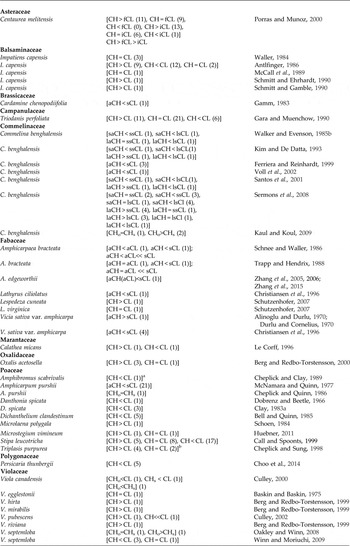
Our study identified 252 case studies of germination of CH vs CL seeds in 29 cleistogamous species in 21 genera and 11 angiosperm families (eight eudicots, three monocots, i.e. Commelinaceae, Marantaceae and Poaceae) (Table 1). The one species of Brassicaceae and the one of Commelinaceae, four of the six species of Fabaceae and one of the six species of Poaceae (Amphicarpum purshii) produce flowers and fruits both above and below ground (amphicarpic sensu stricto), and the other 22 species produce flowers and fruits only on stems above ground. Sixty-five of the 252 case studies are for amphicarpic species, and 187 are for species that produce only aerial flowers and fruits. In the seven case studies (four species, Table 1) that compared germination of seeds from hand-outcrossed and hand-selfed chasmogamous flowers, CHo > CHs, CHo = CHs and CHo < CHs in 3, 3 and 1 of them, respectively.
Comparison of the germination of seeds produced by chasmogamous and cleistogamous flowers (252 case studies) or of the germination of seeds produced by hand-outcrossed and hand-selfed chasmogamous flowers (7 case studies) of cleistogamous species

CH, chasmogamous; aCH, aerial chasmogamous (amphicarpic species); aCH(aCL), mixture of aerial chasmogamous and aerial cleistogamous; laCH, large aerial chasmogamous; saCH, small aerial chasmogamous; CL, cleistogamous; aCL, aerial cleistogamous (amphicarpic species); CHo, chasmogamous-hand crossed; CHs, chasmogamous-hand selfed; fCL, final cleistogamous; iCL, initial cleistogamous; sCL, subterranean cleistogamous; lsCL, large subterranean cleistogamous; ssCL, small subterranean cleistogamous. aCL seeds from lower 1–4 nodes, i.e. seeds with highest germination percentages. bCL at node with highest germination percentage, i.e. nodes 3, 5, 6 and 7; at node 5 germination was highest in 3 of the 6 case studies and at nodes 3, 6 and 7 it was highest in 1 of the 6 case studies each.
For germination, we found CH > CL in 81 of the 252 case studies, CH = CL in 64 and CH < CL in 107, a ratio of 1.27:1.00: 1.67. Thus in 42.5% of the case studies CL seeds germinated better than CH seeds, and in 67.9% CL seeds germinated better than (107) or equally as well (64) as CH seeds. Considering only the seven amphicarpic sensu stricto taxa, for 49 of the 65 (75.4%) case studies CH < CL, in seven CH = CL and in nine CH > CL. In the only other survey comparing germination of CH and CL seeds of which we are aware, Oakley et al. (Reference Oakley, Moriuchi and Winn2007) reported a germination probability (i.e. CL/CH) for 11 species, all of which are included in our survey. In that study, CL/CH ranged from 0.42 to 5.43, and CL/CH > 1.0 in six species and <1.0 in five species.
The (CH < CL):(CH > CL) ratio was 1.32, and in slightly more than two-thirds of the 252 case studies CL seeds germinated better than or equally as well as CH seeds, which is in general agreement with the rather limited number of studies reported by Oakley et al. (Reference Oakley, Moriuchi and Winn2007) in their review of cleistogamy. For germination, they reported a ratio of fitness of germinability of CL seeds to CH seeds of 1.5. Furthermore, not only do CL seeds germinate better, they are cheaper to produce in terms of biomass cost (Oakley et al., Reference Oakley, Moriuchi and Winn2007; Winn and Moriuchi, Reference Winn and Moriuchi2009) and give rise to plants (post-germination stages of life cycle) whose fitness in the various life history stages is about equal to that of CH seeds (Oakley et al., Reference Oakley, Moriuchi and Winn2007). Considering seed germinability and various other life history stages, Oakley et al. (Reference Oakley, Moriuchi and Winn2007) calculated a cumulative cleistogamous:chasmogamous fitness ratio of 1.09.
Baskin and Baskin (Reference Baskin and Baskin2015) published a rather exhaustive review (ca 750 case studies) of the effect of inbreeding depression on the seed germination stage of the plant life cycle, using RP to compare performance of outcrossed and inbred seeds. They pointed out that there were one or more pitfalls in procedures used in many of the germination studies. Among these were lack of giving the seeds a dormancy-breaking pre-treatment (preferably natural or simulated-natural conditions) and using a single temperature/light regime to test germination. Seeds of many species are dormant at maturity, and rate and percentage of germination, and thus δ, are environment (especially light and temperature) dependent. However, these pitfalls and some others pointed out by Baskin and Baskin (Reference Baskin and Baskin2015) do not appear to be as much of a problem in determining RP for germination in CH vs CL seeds as they were in determining RP for germination of outbred vs inbred seeds. In most studies, CH and CL seeds were exposed to natural seasonal temperature conditions for dormancy break and germination (seedling emergence), or they were subjected to simulated natural dormancy-breaking treatment [e.g. cold stratification, dry storage (after-ripening)] and then incubated at several temperatures, usually in light. In other words, the majority of the studies were done in such a way that the results seem to represent an adequate relative comparison of the germination of CH vs CL seeds. However, see discussion below about some caveats concerning germination of CH vs CL seeds of amphicarpic Fabaceae species and Commelina benghalensis and Danthonia spicata.
An example of a thoroughly and correctly done study on germination of CH vs CL seeds is the one by McNamara and Quinn (Reference McNamara and Quinn1977) on the amphicarpic sensu stricto grass species Amphicarpum purshii. The authors tested the effects of two well-known kinds of dormancy-breaking treatments, i.e. dry storage (after-ripening) and cold stratification, on subsequent germination of CH and CL seeds of this species, both of which have physiological dormancy (Baskin and Baskin, Reference Baskin and Baskin2014). Each of the two kinds of dormancy-breaking treatments was given for 0, 30, 60 and 90 days, after which the seeds were incubated at three daily-alternating temperature regimes in light/dark. Furthermore, McNamara and Quinn (Reference McNamara and Quinn1977) monitored seed viability in CH and CL seeds throughout the study, and they calculated germination percentage based on number of viable seeds. Thus seed viability was determined for each sublot of seeds before testing them for germination. Interestingly, for all 21 treatment combinations (four cold stratification periods × three incubation temperature regimes) + (four dry storage periods × three incubation temperature regimes) – [one storage period × three incubation temperature regimes (i.e. same 0 day control for dry storage and cold stratification tests)] CH < CL, both when germination percentage was based on total number of seeds used and only on those that were viable. Importantly, this study shows that one can get considerable variability in RP (which we calculated) among treatment combinations (case studies) for germination and that the values can depend on whether germination percentage is calculated based on total number of seeds (i.e. viability not tested), actual viability of seeds at the beginning of the study or viability at the time seeds are tested for germination, i.e. accounting for seeds that died during pre-treatment.
In the McNamara and Quinn (Reference McNamara and Quinn1977) study, seed viability of aerial (CH) and subterranean (CL) seeds at the start of the dormancy-breaking treatments was 79 and 95%, respectively, which declined thereafter. Based on actual viability, RP of seeds of A. purshii, for example, those cold stratified for 60 days and then incubated at 20/30°C, was –0.30 [(0.60–0.86)/0.86], i.e. CH and CL germinated to 60 and 86%, respectively. However, had it been assumed that 100% of the seeds were viable, RP would have been –0.46 [(0.418–0.775)/0.775]. This study can serve as a model of how to compare the germination of CH and CL seeds. It shows that in order to estimate the relative germinability of the two seed types accurately, one needs to take into account seed dormancy, seed viability and seed incubation conditions.
An informative example of variation in RP in germination of CH vs CL seeds is the study by Call and Spoonts (Reference Call and Spoonts1989) on Stipa (Nasella) leucotricha. At 0 MPa, for example, RP = –0.06 (CH = CL), –0.25 (CH < CL) and 0.48 (CH > CL) at 10/20, 15/25 and 20/30°C, respectively. Overall, for 30 treatment combinations (case studies) [two populations × three temperature regimes × five water potentials] for germination percentages of CH and CL seeds in this study: CH > CL = 5, CH = CL = 8 and CH < CL = 17. The ratio of (CH > CL):(CH = CL):(CH < CL) was 2:8:5 in one of their study populations (Caldwell) and 3:0:12 in the other population (McGregor).
In a recent paper published in Seed Science Research, Carta et al. (Reference Carta, Bedini, Giannotti, Savio and Peruzzi2015) made the point that researchers studying seed germination should pay attention to dormancy. These authors compared germination of inbred (I) and outbred (O) seeds of Hypericum elodes. Inbred seeds cold stratified for 0 and 3 weeks germinated better than outbred seeds (I > O), whereas there was no difference in seeds (I = O) of the two cross types stratified for 8 weeks. Their point was that if germination is the fitness measure, then inbreeding depression can be accurately determined only when both seed cross types are non-dormant. The same recommendation is applicable to studies comparing CH and CL seeds of cleistogamous species.
The above being said, some comments need to be made concerning the interpretations of germination of CH vs CL seeds in the four amphicarpic species of Fabaceae (Table 1). All four species are amphicarpic sensu stricto (Baskin and Baskin, Reference Baskin and Baskin2014). For the 11 case studies, CH < CL, CH = CL and CH > CL was nine, one and one case(s), respectively. These four species are the only ones in our survey whose seeds have a water-impermeable seed coat (physical dormancy, PY), and in addition they have physiological dormancy (PD), i.e. the seeds have (PY + PD) (Christiansen et al., Reference Christiansen, Abd El Monein, Cocks and Singh1996; Zhang et al., Reference Zhang, Baskin, Baskin, Yang and Huang2015).
The two Amphicarpaea species produce subterranean CL flowers and both aerial CH and CL flowers (Schively, Reference Schively1897; Schnee and Waller, Reference Schnee and Waller1986; Trapp, Reference Trapp1988; Trapp and Hendrix, Reference Trapp and Hendrix1988; Zhang et al., Reference Zhang, Yang and Rao2005, Reference Zhang, Yang and Rao2006). Subterranean CL seeds (sCL) are recalcitrant (desiccation sensitive) and have PD, whereas both aerial CH (aCH) and aerial CL (aCL) seeds are orthodox (desiccation tolerant) and have (PY + PD). Dormancy of sCL seeds can be broken by cold stratification, whereas aCH and aCL seeds require scarification followed by cold stratification or dry storage followed by scarification to break dormancy (Zhang et al., Reference Zhang, Baskin, Baskin, Yang and Huang2015). In the laboratory, fresh seeds subjected to these dormancy-breaking treatments germinate to equally very high percentages. In which case, aCH = aCL = sCL. However, aCH and aCL seeds form a persistent seed bank, whereas sCL seeds form only a transient seed bank, i.e. all seeds that germinate do so the next spring following dispersal. Thus one might argue that aCH = sCL. However, based on the fact that aCH is more dormant, i.e. both PD and PY, and forms a persistent seed bank, we made the assignment aCH < sCL. Note in Table 1 that Zhang et al. (Reference Zhang, Baskin, Baskin, Yang and Huang2015) did not distinguish between aerial CH and aerial CL seeds. However, almost all aerial seeds were dormant (PY + PD), and thus there is little or no difference in germination of these two morphs.
Notice that in A. bracteata aCH and aCL seeds are compared (Table 1): aCH < aCL (Schnee and Waller, Reference Schnee and Waller1986) and aCH = aCL (Trapp and Hendrix, Reference Trapp and Hendrix1988). In the Schnee and Waller study, germination of intact aCH and aCL seeds was 15.3 and 21.2%, respectively, thus RP = −0.24, i.e. aCH < aCL. In the Trapp and Hendrix study, germination of aCL, aCH (hand self-pollinated) and aCH (naturally pollinated) seeds was 6.5, 7.8 and 4.6%, respectively, and not statistically significant (P < 0.05). However, RP of aCL vs aCH (hand-pollinated) is 0.17 and RP of aCL vs aCH (naturally pollinated) is –0.29, and although these values are ≥0.10 and ≤–0.10, respectively (see ‘Materials and methods’), we made the assignment aCH = aCL, in this case based on statistically non-significant differences and the very low germination percentages of seeds from the three pollination treatments. Problems, such as this one, encountered in assignment of inbred (I) vs outbred (O) seeds to the germination categories I < O, I = O or I > O were discussed by Baskin and Baskin (Reference Baskin and Baskin2015), and as noted here they also apply to making assignments of germination of CH vs CL seeds.
In both Lathyrus ciliolata (one accession) and Vicia sativa var. amphicarpa (three accessions), two other amphicarpic sensu stricto taxa in the Fabaceae (Table 1), fresh seeds of aCH and sCL were dormant (PY + PD) at maturity in early summer in northern Syria. By November, >95% of the sCL seeds of all four accessions had softened (PY broken) compared with 5 and 40% of the aCH seeds of Vicia and Lathyrus, respectively. In all accessions, seeds that had become soft (water permeable) by November germinated from November to February. Germination percentages are not given, but based on the fact that a much higher percentage of sCL than of aCH had softened by November, and thus were likely to germinate thereafter, we made the assignment aCH < sCL for all four accessions (case studies).
In reference to C. benghalensis in Table 1, Walker and Evenson (Reference Walker and Evenson1985b), Kim and De Datta (Reference Kim and De Datta1993), Santos et al. (Reference Santos, Ferreira, Miranda and Santos2001) and Sermons et al. (Reference Sermons, Burton and Rufty2008) distinguished between small and large aerial and small and large subterranean seeds, whereas Ferreira and Reinhardt (Reference Ferreira and Reinhardt1999) and Voll et al. (Reference Voll, Brighenti, Gazziero and Adegas2002) recognized only aerial and subterranean seeds. However, various other studies on C. benghalensis have recognized the four seed types (Maheshwari and Maheshwari, Reference Maheshwari and Maheshwari1955; Walker and Evenson, Reference Walker and Evenson1985a; Kim, Reference Kim1998; Burns, Reference Burns2008; Riar et al., Reference Riar, Webster, Brecke, Jordan, Burton, Telenko and Rufty2012). In an anatomical study of the development of cleistogamous flowers, Hayden and Fagen (Reference Hayden and Fagan2016) noted that the seeds were dimorphic. Furthermore, comparison of germination of intact CH and CL seeds of this tropical/subtropical/warm temperate perennial/annual weed is based on both non-treated (Walker and Evenson, Reference Walker and Evenson1985b; Ferriera and Reinhardt, Reference Ferreira and Reinhardt1999; Voll et al., Reference Voll, Brighenti, Gazziero and Adegas2002; Sermons et al., Reference Sermons, Burton and Rufty2008) and on treated (stored) (Kim and De Datta, Reference Kim and De Datta1993; Santos et al., Reference Santos, Ferreira, Miranda and Santos2001) aerial and subterranean seeds. However, several studies on C. benghalensis have used only aerial seeds (Budd et al., Reference Budd, Thomas and Allison1979; Kim et al., Reference Kim, De Datta and Mercado1990; Matsuo et al., Reference Matsuo, Michinaga, Terao and Tsuzuki2004; Dias et al., Reference Dias, Carvalho, Brancalion, Novembre and Christoffolet2009).
Budd et al. (Reference Budd, Thomas and Allison1979) broke dormancy in 41–43% of the aerial seeds of C. benghalensis by rubbing them between two sheets of ‘abrasive paper’ and in 73% of the seeds by ‘pricking’ them with a steel needle to puncture the seed coat, i.e. two kinds of mechanical scarification. These authors concluded that evidently dormancy depends on the seed coat being intact. Kim et al. (Reference Kim, De Datta and Mercado1990), Kim and De Datta (Reference Kim and De Datta1993) and Sabila et al. (Reference Sabila, Grey, Webster, Vencill and Shilling2012) interpreted these results to mean that seeds of C. benghalensis were ‘hard’ (or exhibited ‘hardseededness’), i.e. water impermeable (Aiken, Reference Aitken1939; Argel and Paton, Reference Argel, Paton, Loch and Ferguson1999) and thus had PY. Kim et al. (Reference Kim, De Datta and Mercado1990) tested the effect of concentrated sulfuric acid, dry heat, hot water and 5.2% w/v NaOCl on germination of large and small aerial seeds. All four methods were effective in breaking dormancy in large seeds, but only immersion in sulfuric acid and in NaOCl was effective for small seeds. The most effective treatments for breaking dormancy in both morphs were emersion in sulfuric acid (60 and 100 min for large and small seeds, respectively) and NaOCl (30 and 40 min for large and small seeds, respectively). Sabila et al. (Reference Sabila, Grey, Webster, Vencill and Shilling2012) mechanically scarified aerial and subterranean seeds before testing them for germination and seedling emergence.
Kaul and Koul (Reference Kaul and Koul2009) compared germination of seeds of C. benghalensis derived from open-pollinated, hand self-pollinated, hand cross-pollinated, bagged and emasculated CH (aerial) flowers. Germination ranged from ca 75% (mean for three pollinations dates) for seeds from bagged flowers to >90% (mean for three pollination dates) for those open- and cross-pollinated flowers. Of the three comparisons that can be made for germination of seeds from hand-selfed and hand-crossed CH, CHo = CHs in one and CHo < CHs in two. The authors state that ‘Seeds harvested from each treatment were spread out for germination on moist filter paper in Petri dishes at room temperature (28–32°C).’ They do not mention giving the seeds a dormancy-breaking treatment, such as dry storage at room temperature (after-ripening period) or whether large and/or small aerial seeds were used in the germination test.
Walker and Evenson (Reference Walker and Evenson1985b) also seemed to think that seeds of C. benghalensis had PY, since dormancy in a very high percentage of all four seed morphs was broken by clipping the seed coat. They mention that the seeds have innate dormancy caused by the hard seed coat restricting the entrance of oxygen or water into the seed. This idea was tested on large and small aerial seeds of C. benghalensis by Kim and De Datta (Reference Kim and De Datta1993). Large seeds germinated to 0, 5 and 10%, and small seeds to 0, 0 and 1% in 0, 20 and 100% oxygen concentrations, respectively. For large seeds, the small increase in germination was significant. Both intact and ‘punctured’ large and small seeds imbibed water.
However, Budd et al. (Reference Budd, Thomas and Allison1979) did not say that the seeds of C. benghalensis had PY or that scarification was necessary for water uptake (imbibition). Furthermore, neither did they say that the seeds were ‘hard’, a term often used to describe water-impermeable seeds. No species of Commelinaceae is known to have PY (Baskin and Baskin, Reference Baskin and Baskin2014), and, in fact, Voll et al. (Reference Voll, Brighenti, Gazziero and Adegas2002) showed that both intact aerial and subterranean seeds of C. benghalensis readily imbibed water [see also results of Kim and De Datta (Reference Kim and De Datta1993)]. Interestingly, none of the studies in which seeds of C. benghalensis were scarified in order to promote germination compared imbibition of scarified and non-scarified seeds. The hallmark of identifying PY is imbibition in scarified seeds and lack of imbibition in intact seeds (Baskin and Baskin, Reference Baskin and Baskin2014). Scarification also has been shown to break dormancy in many species with water-permeable seeds. In seeds of these species, scarification promotes germination by weakening the mechanical resistance of the embryo covering layers, thus allowing the seed to germinate and not by overcoming a barrier to water uptake (Baskin and Baskin, Reference Baskin and Baskin2014). We speculate that this explains why mechanical and chemical scarification often promotes seed germination in C. benghalensis. Treatment with 0.1 M HCl (simulating stomach acidity of mourning doves, which feed on the seeds of C. benghalensis) also increased germination of aerial seeds over the control (subterranean seeds not tested) (Goddard et al., Reference Goddard, Webster, Carter and Grey2009).
In the study by Walker and Evenson (Reference Walker and Evenson1985b), fresh large subterranean seeds (lsCL) of C. benghalensis germinated to 90% and the other three types to 0–35%. However, clipped seeds (including all four types) germinated to 97–100%. This indicates that lsCL seeds (see notes for Table 1) were non-dormant at maturity, whereas the other three types were dormant (and viable). Exposure to heat at 90°C also was quite effective in breaking dormancy in the three dormant seed types. One could argue, then, that comparisons of germination of CH and CL seeds should be based on germination percentages after dormancy is broken. In which case, the relationship between germination of scarified CH and CL seeds would be saCH = ssCL, saCH = lsCL, laCH = ssCL and laCH = lsCL, i.e. CH = CL (4).
However, we do not envision that mechanical scarification or heating to 90°C are ways by which dormancy in seeds of C. benghalensis is broken in nature. Furthermore, it seems unlikely that such high proportions as 0.97 to 1.0 of the seeds would survive and germinate in the field (see Riar et al., Reference Riar, Webster, Brecke, Jordan, Burton, Telenko and Rufty2012). Finally, it would be surprising if equal proportions of the four seed types survive and germinate in the field, although Riar et al. (Reference Riar, Webster, Brecke, Jordan, Burton, Telenko and Rufty2012) did not detect a difference in survival between large and small subterranean seeds buried in the field in North Carolina (USA). (In this three-state seed survival study, only large and small subterranean seeds were buried in North Carolina and only large aerial seeds in Georgia and Florida.) The two methods mentioned above for overcoming dormancy in C. benghalensis are useful in determining seed viability and in getting plants for post-germination studies but not in acquiring information on seed dormancy break and germination in natural or agricultural systems.
Although not clear, it seems that Burns (Reference Burns2008) obtained high percentages of germination for all four types of seeds of C. benghalensis that had been stored at room temperature ‘for no more than seven months’, scarified and then incubated at 31/21 °C in a 14 h daily photoperiod. In her Appendix A, Burns reports that non-scarified large aerial seeds (what she called chasmogamous-dehiscent or CH-D [our saCH]) seeds germinated to 40 ± 3% and scarified seeds to 90 ± 3%. No such information was reported for the other three seed types. Burns reported that the four maternal environments (high nutrient–high water, high nutrients–low water, low nutrients–high water and low nutrients–low water) did not have a significant effect on germination. However, given her procedures, i.e. equalizing the chances of germination by relieving seed dormancy, the lack of differences due to maternal environment is not at all surprising.
The four case studies on CH and CL seeds of C. benghalensis by Kim and De Datta (Reference Kim and De Datta1993) and the four by Santos et al. (Reference Santos, Ferreira, Miranda and Santos2001) are for seeds that had been stored (3 months for aerial and subterranean seeds by Kim and De Datta and 4 months for aerial and 3 months for subterranean seeds by Santos et al. (Reference Santos, Ferreira, Miranda and Santos2001) (Table 1). That is, in these two studies the seeds had been given a treatment that is known to promote after-ripening and is a way in which dormancy in seeds of some species is overcome in nature (Baskin and Baskin, Reference Baskin and Baskin2014). Interestingly, all four outcomes for CH vs CL in both of these studies were the same: saCH < ssCL, saCH < lsCL, laCH > ssCL and laCH < lsCL. Comparing these case studies on stored intact seeds with those of Walker and Evenson (Reference Walker and Evenson1985b) on fresh intact seeds (Table 1), we see that the CH/CL relationship between three of the four cases, i.e. saCH < ssCL, saCH < lsCL and laCH < lsCL, are the same. In the other case, laCH = ssCL for fresh seeds (Walker and Evenson, Reference Walker and Evenson1985b) and laCH > ssCL in stored (after-ripened) seeds (Kim and De Datta, Reference Kim and De Datta1993; Santos et al., Reference Santos, Ferreira, Miranda and Santos2001).
Finally, a word of caution is needed concerning the results for the grass Danthonia spicata in Table 1. Clay (Reference Clay1982, Reference Clay1983b) assumed that all florets in the terminal (aerial) panicle of D. spicata were chasmogamous. However, this was shown not to be the case by Philipson (Reference Philipson1986). He examined florets in 122 aerial panicles of D. spicata and found that 68 were entirely cleistogamous, only one was entirely chasmogamous and 63 were a mixture of chasmogamous and cleistogamous florets. Furthermore, 42 of the panicles examined by Philipson (Reference Philipson1986) were those on 25 plants grown from seeds collected on the Duke University campus, Durham, North Carolina (USA), where Clay (Reference Clay1983a) obtained seeds for his germination studies. Of these 42 panicles, 18 contained only chasmogamous florets and 23 a mixture of chasmogamous and clesistogamous florets. Thus it seems possible that Clay's (Reference Clay1983a) CH seeds could have been a CH/CL mixture (see Table 1). Seemingly in contrast to Clay's results that CL seeds germinate better than CH seeds, Weatherwax (Reference Weatherwax1928) stated that ‘Seeds from both sources [i.e. terminal and axillary spikelets] germinate alike…’.
Conclusions
CL seeds are more likely to germinate to higher percentages than CH seeds than are CH seeds to germinate to higher percentages than CL seeds. Thus our data on germination of CH vs CL seeds lends support to the notion that the production of CL seeds is advantageous to cleistogamous species, i.e. on average CL seeds germinate better than CH seeds. Regarding the reason for maintenance of CH at all in cleistogamous species, if total selfing (s = 1.0) does decrease reproductive success compared with a species with a very high selfing rate (but s < 1.0), as predicted for mixed-mating hermaphrodite species with monomorphic flowers (Porcher and Lande, Reference Porcher and Lande2005), then it seems that an obvious reason for the maintenance of CH and thus production of CH seeds is a need for at least an occasional outcrossing , by which s, and thus sδ, is prevented from reaching a value of 1.0, i.e. total inbreeding depression. In which case, the maintenance of some outcrossing (via production of CH, even in light of the economy, reproductive assurance and low δ of CL) will be selectively favoured. We note that this explanation for the maintenance of CH in cleistogamous species seems to be parallel to a statement Charles Darwin (Reference Darwin1889 [1876], p. 6) made in The effects of cross and self fertilization in the vegetable kingdom ‘… that it is a general law of nature that flowers are adapted to be crossed, at least occasionally, by pollen from a distinct plant.’
Acknowledgement
We thank Alice A. Winn for her helpful suggestions that allowed us to improve the manuscript.