




No CrossRef data available.
Contextualizing Racial Disparities in American Welfare Reform: Toward a New Poverty Research
Published online by Cambridge University Press: 16 June 2005
Abstract
As a result of the 1996 reforms, the number of welfare recipients has declined precipitously, and the reform effort has been heralded a “success.” However, a growing body of research indicates racial disparities in client treatment and outcomes under welfare reform. These findings have inaugurated a debate about interpreting racial disparities under welfare reform and determining what corrective action, if any, is necessary. Some analysts contend that welfare reform, as a post–civil rights era, racially neutral public policy, can legitimately have differential outcomes for different racial groups. I argue that this claim must be countered with a new poverty research that goes beyond the limits of mainstream work by placing welfare reform in its historical and social context, thereby providing a more robust explanation of how and to what effect welfare reform is race-biased. I show how welfare reform contributes to what Loic Wacquant calls “racemaking” by being part of a racial policy regime that has developed from past policy but reinforces current racial inequalities.Sanford F. Schram teaches social theory and policy in the Graduate School of Social Work and Social Research, Bryn Mawr College (sschram@brynmawr.edu). He is the author of Praxis for the Poor, After Welfare, and Words of Welfare, which won APSA's Michael Harrington Award in 1996. His Welfare Discipline: Discourse, Governance, and Globalization is forthcoming. The author thanks Bruce Baum, Wesley Bryant, Tia Burroughs, Anne Dalke, Linda Dennard, Bonnie Thornton Dill, Richard Fording, Burnee Forsythe, Jocelyn Frye, Margaret Henderson, Jennifer Hochschild, Tallese Johnson, Vicki Lens, Amy McLaughlin, Anne Norton, Frances Fox Piven, Melania Popa, Dorit Roer, Corey Shdaimah, Roland Stahl, Roni Strier, Carl Swidorski, Tom Vartanian, Dvora Yanow, Iris Marion Young, and several anonymous reviewers for their helpful comments on earlier versions of this article. Joe Soss's invaluable suggestions were critical to the completion of this article.
Information
- Type
- Research Article
- Information
- Copyright
- © 2005 American Political Science Association
Welfare in the United States was overhauled in 1996, when the Personal Responsibility and Work Opportunity Reconciliation Act abolished the longstanding Aid to Families with Dependent Children (AFDC) program, originally enacted as part of the Social Security Act of 1935. It replaced AFDC with the Temporary Assistance for Needy Families (TANF) block grant. Many procedural safeguards for those accessing assistance were repealed. TANF emphasizes time limits and work requirements and allows states to set stricter options than specified by federal law. It also allows states greater latitude to use sanctions to reduce benefits and eliminate families from the rolls. It gave birth to a “work first” welfare reform agenda that establishes “get tough” policies designed to reduce the problem of “welfare dependency.”1
Welfare has been reformed to have as its main purpose promoting self-sufficiency by enforcing work and family values among the poor.The number of recipients receiving TANF fell from 13,242,000 in 1995 to 5,334,000 in 2002—a decline of 59.7 percent.2
Largely for this reason, welfare reform has been widely heralded by politicians, the media, and many researchers as a “success.”3See Schram and Soss 2002.
These findings have inaugurated a debate about how we should interpret racial disparities under welfare reform and what should be done. The U.S. Commission on Civil Rights issued a report that concludes that the growing number of statistical disparities indicates a need to revise welfare policy to prevent discriminatory practices.10
And legislation has been proposed in Congress to ensure racial fairness in administering welfare reform.11On April 3, 2003 U.S. Senator Russell Feingold (D-WI) reintroduced the Fair Treatment and Due Process Protection Act of 2003 (S. 770), designed to monitor the implementation of welfare reform to ensure racial fairness for applicants and clients.
Yet some analysts contend that welfare reform, as a post–civil rights era, racially neutral public policy, can legitimately have differential outcomes for different racial groups.12
Mead 1992, 111–15.
Mead 1999; Besharov 2003. Rector, Johnson, and Fagan 2001 emphasizes relatively high rates of female-headed families among blacks as the main reason not only for higher rates of welfare dependence, but also lower levels of education, lower employment rates and lower incomes.
[W]hen poverty was “rediscovered” in the 1960s, it was at first widely seen as a byproduct of the historical disadvantage suffered by black Americans. It was believed that by passing civil rights laws, the social problems linked to blacks, such as welfare and crime, would abate. Unfortunately, this did not happen…. And although racial bias remains in America, it has declined, and at the very same time that poverty has increased in the inner city…. [I]t is difficult today for policy makers to keep arguing that the public demand for order reflects prejudice and that some further social reform must be achieved first…. The idea is that the poor need support, but they also require structure—a combination of help and hassle…. The implications are particularly momentous for racial minorities, who are overrepresented among the poor. Understandably, federal policy toward these groups has emphasized the dismantling of barriers, because past denials of equal opportunity are central to their disadvantages. Paternalism applied to the black poor can easily seem like a return to slavery or Jim Crow, at least to critics. But although racism undoubtedly helped demoralize the ghetto, discrimination in the old sense is too minor a cause of poverty today to justify further anti-bias measures.14
Mead 1998, 104–9.
In this article I review the research on racial disparities under welfare reform in order to determine if welfare reform is racially biased, if so, how, and what can and should be done about it. I frame the issue with respect to different meanings of the term “race bias” and the ways in which welfare reform may in fact be race-biased.15
I use the term “race bias” rather than “racism” in order to explore the variety of practices that lead to producing racial disadvantage, including those that do not involve intentional acts by individuals. A noteworthy attempt to address this issue was when Stokely Carmichael and Charles Hamilton coined the term “institutionalized racism” in their 1967 book Black Power. See Ture and Hamilton 1992.
My analysis is framed as a response to the call of Sandra Morgen, Alice O'Connor, and others for a new poverty research17
that goes beyond the limitations of mainstream methodologies by recognizing the normative standards implicit in statistical measurements.18 I start by showing that the issue of race bias in welfare reform remains indefinite if we confine ourselves to conventional welfare policy research that deemphasizes the role of interpretation and focuses on isolated empirical findings.19 My approach lets us see, for instance, that different poverty measures provide not just different statistical baselines but also imply distinct understandings of the purpose of welfare and of which populations should be represented. It also points to ways of breaking the impasse that mute statistical disparities create on the question of racial bias by emphasizing the historical and social context of welfare reform. Context helps us decide which statistics to stress, thereby improving our ability to make normative assessments.This approach enables me to offer an alternative to Mead's account of the racial character of welfare reform. The available data, once contextualized, support an interpretation of welfare reform as ostensibly neutral but operating in a way that actively recreates racial disadvantage among the poor.
I emphasize that welfare has always been an inferior program, reserved for serving low-income families who are almost all female-headed.20
It was structured in the Social Security Act of 1935 to afford states substantial discretion in determining eligibility and setting benefits—largely to placate southern congressmen who wanted to be sure the program could be tailored to their discriminatory and arbitrary social and economic practices.21 By the 1960s welfare came to be seen as a “black program,” making it politically vulnerable and increasing calls for its contraction, which, after years of political gridlock, finally came in the 1990s.22 I argue that it is unlikely that had welfare been seen as a “white program” for traditional middle-class families it would have been attacked as it has been. Further, that the program's effects fall more harshly on nonwhites than whites does not significantly undermine the general assessment of welfare reform as a success. Welfare's implicit association with blacks facilitates its retrenchment, and its disproportionately negative impact on blacks leaves reform's reputation as a “success” unsullied.My analysis highlights how the very ways in which welfare policy is structured and implemented continue to reflect and contribute to the racial biases of society. As a policy regime, welfare reform actively fosters racial disadvantage through its treatment of black welfare recipients. From time limits to work requirements, sanctions policies, and limitations on benefits, welfare reform is administered in ways that make it less supportive of poor blacks who are concentrated in marginalized neighborhoods and confront race barriers. A policy regime that punishes welfare recipients who can not find work for reasons associated with historical legacies of race recreates the social disadvantage it seeks to ameliorate. If the ultimate purpose of welfare reform today is to promote self-sufficiency via the promotion of work and family, it is failing its black recipients and doing so in ways reminiscent of the welfare's racially charged history.
One might think that a reform that was neither explicitly discriminatory nor implemented in a manner that disadvantages blacks can not be called racist. However, race bias takes a variety of forms.23
That welfare reform policy fails to account for preexisting racial inequalities is certainly unhelpful. My argument however is that welfare reform not only fails in this regard, but also uncritically reflects and incorporates those biases in the policy's own structure and implementation. A reform policy that punishes blacks for failing to get jobs and create stable families as quickly as whites is profoundly biased and ends up reproducing racism in its treatment of clients. Welfare reform is therefore an ostensibly neutral public policy that is part of a vicious cycle of race bias: it grows out of and reinforces racially biased institutions and practices in the broader society with respect to education, jobs, housing, and other factors affecting life chances.24 Its ostensibly neutral, euphemistic discourse masks the fact that it perpetuates racial disadvantage in society.My brand of new poverty research better highlights welfare reform's relationship to race issues by providing a means for attributing a causal role to race in structuring welfare reform, while also assigning a causal role to welfare reform in producing and reproducing racial disparities.25
Racial division in our society creates the conditions that encourage reformers to crack down on an inferior program that also happens to be more important to nonwhites than to whites. At the same time, welfare reform perpetuates those same social and economic racial inequalities that make welfare an inferior “black” program and vulnerable to retrenchment.26 Contextualizing the racial character of reform lets us to move beyond the simple models of linear causality that plague conventional public policy research.27For a critique of linear models of causality, see Norton 2004. Abbott (2001) warns against allowing quantitative multivariate general linear analysis to trap us into believing in a “general linear reality” that seriously mischaracterizes the way the social world works. See also Mettler and Soss 2004 on policy feedback.
It is critical to get beyond the interpretive and normative limitations of conventional public policy research. By doing so, we can better interpret racial disparities under welfare reform and decide what steps policy makers must take to fix the system. We then provide a stronger empirical basis for avoiding a retrospective “fault model” that focuses on individuals and discrete acts of racial discrimination,28
Young 2003. The idea that racial injustice is a collective responsibility stemming from its structural roots parallels Carmichael and Hamilton's original argument about what to do about “institutionalized racism.” See Ture and Hamilton 1992. See Fogg-Davis 2003 on the importance of developing a pragmatic black political theory that can infuse empirical analysis with a normative dimension, suggesting what should be done to attack race bias.
It is important to address two related issues. First, most families receiving welfare are single mothers with children. On issues of gender bias in U.S. welfare policy, see Gordon 1994, Mink 2002, and Davis 2002. The intersection of race and gender in welfare policy so as to double the disadvantage of nonwhite single mothers who rely on public assistance; see Crenshaw 1989. Second, I mainly focus on black-white differences under welfare reform, with a primary concern for effects on African Americans. I also consider effects for Latinos, labeled in government statistics as Hispanics (who can be either white or nonwhite), and immigrants (who are disproportionately nonwhite). Nevertheless, while race is increasingly more than a black-white issue in the United States, the history of discrimination against African Americans continues to haunt welfare and creates an urgent need to focus on the effects of racial disparities for African Americans.
The Racial Character of Welfare Reform
Race bias has many manifestations. Individuals can be biased consciously or intentionally. They can also be implicated unconsciously or unintentionally in racially biased institutional settings—what has been called “institutionalized racism.”30
Policy too can be race-biased in different ways. It can explicitly invoke racial categories, making what the courts have called “invidious distinctions” based on race. It can also avoid such explicit distinctions but still lead foster racial disadvantage.31A parallel to examining racial disparities in outcomes under welfare reform is employment litigation that examines hiring and firing patterns rather than simply looking to see if employers intentionally make biased decisions that favor whites, males, and other privileged groups. See Brown et al. 2003.
In addition, when it comes to welfare as a policy regime in the federal system of the United States, it is important to account for the levels of policy making and implementation. The source of race bias can be national, state, or local. Its source may also be agency implementation more than policy-making deliberation.
It is also important to account for how different dimensions of racial bias may interact. Welfare reform could be explicitly biased in its stated policy as enacted at the federal level, or it could be biased through promulgation of a national policy that is implicitly detrimental to blacks rather than whites. It could be biased in the way states implement the program in terms of what policies they adopt for which populations. It could be biased in the ways caseworkers administer the program for individual clients. Bias could involve all these dimensions. For instance, a caseworker may, without consciously intending to discriminate, implement inherently unfair state or national policy choices such that the needs of nonwhite recipients for support are systematically dismissed to the point of discouraging recipients' self-sufficiency. These racially biased effects may be unintentional, but they end up reproducing racial disadvantage in the form of less economic opportunity and less overall well-being for nonwhites.
I review the available evidence on race bias in welfare reform based on three distinct interpretations: (1) welfare reform is not race-biased; (2) welfare reform is explicitly race-biased; and (3) welfare reform is race-neutral but structured and operating in ways that reproduce racial disadvantage. My argument is that whether the data reviewed here should be seen as supporting any of the three hypotheses depends on how well the data plus an interpretation fit together.
Evidence for the first hypothesis would include the absence of race-related categories in the stated policy, participation rates indicating equal access to the program by different racial groups (relative to need or some other pertinent standard), and other data suggesting that nonwhites are not singled out for disadvantage. Even evidence of racial disparities in treatment and outcome would be consistent with this interpretation if such disparities are interpreted as more a result of differences between clients than differential treatment by federal policy makers or state administrators.
Evidence supporting the second hypothesis might be found in the language and structure of federal welfare policy, in the way states choose options to participate in the program, and in the way state agencies and their contractors administer it. This interpretation would be credible if we found, for example, that the new welfare law specified differential treatment for white and black recipients, that states relied on race for deciding how to structure their programs, or that caseworkers and other administrators treated black recipients differently than whites. Data on differential outcomes for blacks and whites would provide supporting evidence if it could be shown that racially disparate outcomes result from race being invoked to structure welfare reform policy, state program choices, or agency administration.
Evidence for the third hypothesis would come from data indicating that the implementation of welfare reform treats black and white clients similarly but that this “equal” treatment results in blacks being systematically disadvantaged. Supporting evidence would show that welfare reform fails to ensure that its “equal” treatment of clients does not leave black families more likely to remain poor, unemployed, with lower wages, needing to cycle back into the system, and less able to improve their standard of living.
Welfare Reform as a Race-Neutral Policy Regime
This interpretation stems from the fact that welfare reform is a post–civil rights public policy, and neither the national legislation nor states' policies explicitly favor whites over blacks. Probably the best data showing that welfare reform is not race-biased can be found in participation rates. From the 1930s into the 1960s, states could discriminate against blacks seeking or receiving assistance with relative impunity. Southern states in particular did so, but they were not alone.32
Civil rights legislation and litigation attacked such practices, and in the post–civil rights era, there is less evidence that states erect barriers designed to systematically exclude nonwhites from receiving assistance. Welfare reform has focused on reducing the rolls, and states have used the increased latitude given them in the welfare reform period to establish “diversion” programs intended to discourage families from enrolling in the TANF program.33 Yet the available data do not provide strong evidence that indicates that welfare reform has led to blacks being systematically denied welfare at rates higher than whites.One way to assess whether blacks are underrepresented on the welfare rolls in the welfare reform period is to compare poverty and welfare rates by race. Poverty is unevenly distributed across the U.S. population. Nonwhites are overrepresented in the poverty population; therefore, in a racially unbiased welfare system, we would expect nonwhites to comprise a relatively large number of welfare recipients. The poverty rate for the U.S. population in 2003 was 12.5 percent, up from 11.7 percent in 2001.34
Census data reported in this section are from the U.S. Census Current Population Survey for 2003, the Annual Social and Economic Supplement, formerly called the March Supplement, available at http://pubdb3.census.gov/macro/032004/pov/new01_100_01.htm.
Schram 2002, 157–85.
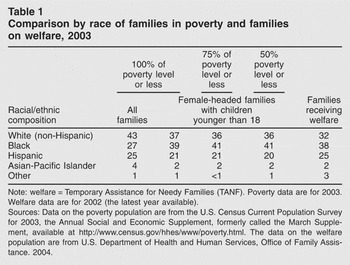
Table 1 compares the racial breakdown of families with incomes below the poverty line to the racial composition of families receiving welfare. Forty-three percent of all families with incomes below the poverty line in 2003 were non-Hispanic whites, compared to only 32 percent of the families receiving TANF in 2002.36
2002 is the latest year for which there are available data on the racial composition of the welfare population.
Comparison by race of families in poverty and families on welfare, 2003

Nonetheless, these data are hardly definitive. Welfare is a program largely for low-income female-headed families with children under 18. Therefore, the more relevant statistics concern the racial breakdown for these families. Comparing columns 2–4 to column 5, we see a different picture emerge: the poorer the population, the greater the proportion of nonwhites. The percentage of families with children under 18 and incomes below 100 percent of the poverty line in 2003 which were white was 37 percent, while it was 36 percent for both those below 75 percent of poverty and 50 percent of poverty. The percentage of families who were black increased from 39 to 41 percent for those below 1.00 of the poverty line compared to those below 0.75 of the poverty line, and remained at 41 percent for those families below 0.5 of the poverty line.
In addition, when we compare these data to the last column, which indicates the racial breakdown of families receiving TANF, we find that blacks are underrepresented. Only 38 percent of the families receiving welfare were black, while 39 percent of families with children were under the poverty line and 41 percent under 0.5 of the poverty line were black. Therefore, while there is reason to believe that in our post–civil rights era racial barriers to accessing welfare have been repealed, the data do not prove that black underrepresentation on welfare is a thing of the past. Instead, they suggest that blacks may still not be receiving assistance at a rate comparable to their level of need.
Yet, these data do not enable us to determine definitively whether blacks are underrepresented and, more importantly, whether systematic bias in policy and program implementation is involved. They do, however, show that each measure of poverty implicitly indicates a standard for evaluating the welfare program.37
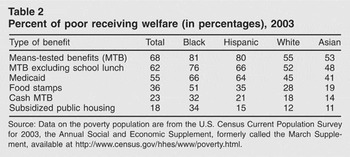
For instance, if we focus on the overall poverty rate, we imply that welfare is about assisting all poor persons. If, alternatively, we focus on the proportion of all families with children below 0.5 percent of the poverty line, then we imply a goal for the program that focuses on assisting the poorest of the poor. Which statistics are used determines what normative standard is assumed. As the data in table 1 suggest, blacks can be seen as under- or over-represented depending on which poverty standard is referenced. The decision of which statistic and standard to use is a normative issue that depends on who we decide should be the primary target population of the welfare program—poor people in general, or the only poorest families. Until we determine that, we cannot decide the issue of racial representation.Other evidence, however, can be used to suggest that welfare programs are open to nonwhites, such as statistics indicating that poor nonwhites are more likely to receive a variety of forms of government assistance compared to whites. Table 2 presents the percentage of poor persons in 2004 living in households where at least one member received some form of government assistance. According to these data, 68 percent of the poor lived in a household where at least one member was receiving some kind of means-tested benefit from the government, and 62 percent were in households that received a means-tested benefit other than school lunches. Fifty-five percent were in households that received Medicaid, and 36 percent lived in a household where someone was receiving food stamps. Only 23 percent were in households with means-tested cash assistance, and just 18 percent of the poor in 2004 were in a household that received subsidized public housing.
Percent of poor receiving welfare (in percentages), 2003

A similar pattern holds for blacks, but the rates of receiving were higher, suggesting that they are not being systematically prevented from receiving assistance more than whites. The rates for poor Hispanics fell between those for blacks and the total poverty population for most means-tested benefits, but lagged behind for Food Stamps, cash means-tested benefits and subsidized housing. Rates for whites and Asians were consistently below the rates for the population overall.
Table 2 indicates that nonwhites in the post–civil rights era can receive public assistance benefits at rates on par with or even exceeding whites. One possible interpretation is that there is less racial discrimination in welfare than several decades ago. Yet, these data are also not definitive. Table 1 showed that the proportion of the poor who are black rises, the further down the income scale we go. Poor black families have lower average incomes than poor white families and are more likely to be among the poor- est of the poor; therefore, they are more likely to have a greater need for public assistance. The higher public assistance participation rates for poor blacks may be an artifact of their lower incomes compared to poor whites. This also suggests that once we account for their lower incomes, we might find that poor blacks actually participate in public assistance programs at rates below those of poor whites.
Yet the issue of whether welfare policies enable eligible black families to access assistance at rates comparable to whites requires more refined measures than poverty and participation rates. We would need to measure whether eligible blacks participate at rates comparable to eligible whites, and also whether any differences in participation rates by race are due to policy and program administration, including, for instance, discrimination by intake workers. While there have been many studies on racial differences in welfare participation, only one accounts for racial differences in eligibility rates.38
Blank and Ruggles 1996 find that blacks are more likely than whites to be receiving welfare at the end of a spell of eligibility. Their study suggests that a number of risk factors, such as lack of access to informal sources of financial support, increase participation among black eligibles. See also Moffitt and Gottschalk 2001.
Additional evidence regarding racial bias in accessing welfare can be gleaned from data on changes in the racial and ethnic composition of the welfare population. Table 3 indicates that since the mid-1990s, the number of nonwhite welfare recipients has grown. In 1992, 39 percent of welfare families were white; by 2002 only 32 percent were. The percentage of black families increased slightly, from 37 to 38 percent, while the percentage of Hispanic families increased, along with its growing share of the overall population, rising from 18 percent in 1992 to 25 percent in 2002. Thus welfare rolls have become considerably less white since TANF was implemented. In particular, the gap between the percentage of recipients who are non-Hispanic whites and blacks has widened. If Hispanics were further subdivided into white and nonwhite, it is likely that the proportion of nonwhite recipient families would exceed 50 percent.40
See Proctor and Dalaker 2003 for a discussion of race differences among persons categorized by the government as Hispanic.
Racial composition of welfare families, 1992–2002

We could read these data as suggesting a growing racial liberalism in social welfare policies of the post–civil rights era—but that would be a mistake. There are good reasons to interpret these data as a sign that new welfare-to-work programs have worked better for whites than nonwhites, as I discuss later.41
Systematic racial barriers to welfare assistance and related government benefits have declined, and no available data on participation suggest that barriers have been rebuilt in the reform era. Yet the data do not allow us to dismiss the possibility that blacks are underrepresented in welfare programs; nor is it clear whether such underrepresentation, if it exists, results from race bias in policy and program implementation. The data offer an array of implicit normative standards and, in the end, are simply too porous to prevent multiple interpretations. Even evidence of the growing proportion of nonwhite welfare recipients can be used to support competing interpretations. A further issue, which the data cannot even begin to address, has to do with the limitations of the welfare program. Even if all eligible families were receiving welfare benefits, we would need to assess how the program missed ineligible but needy families. Such “target inefficiency” may itself be race-related. Therefore, while there may be good reasons to believe that welfare as reformed does not perpetuate the race-biased practices of earlier periods, it will take more than available statistical data to make this question as moot as it is often treated in public policy deliberations.
Welfare Reform as an Explicitly Race-Biased Regime
The available data on welfare participation do not prove that welfare in the reform period is either race-neutral or race-biased. To find evidence on the second hypothesis—that welfare reform is overtly race-biased—we must look elsewhere.
We can start with the welfare legislation itself. As a post–civil rights era public policy, we would not expect to find evidence of a Jim Crow–era distinction between black and white recipients. Yet the law explicitly invokes nationality and thereby indirectly reinscribes racial and ethnic otherness as a way of disqualifying whole categories of persons who might need assistance. The welfare law and the immigration reform law, both passed in 1996, restrict immigrants' access to welfare. Immigrant single mothers who entered the United States after 1996 are most often ineligible not only for TANF but also for food stamps and Medicaid. Where immigrants are eligible for assistance, states' welfare programs have often in recent years reduced access by not providing crucial support services. For example, not offering translation services to non-English speakers constitutes “equal” treatment that reinforces disparities in access to benefits.42
Also see Shelton and Owen 2003.
At least two factors, however, complicate the case of immigrants. First, immigrants are not citizens, and whether or not they should be accorded the same rights as citizens does not, at least in theory, necessarily have anything to do with race. Second, immigrants are not necessarily nonwhite, though increasingly they are Latino and Asian. Whether restricting immigrant access to welfare is tantamount to race bias is, then, still subject to interpretation.
At the state level, race may be more clearly seen as a salient factor in policy adoption. Elizabeth Lower-Basch notes that “to the extent that welfare recipients are perceived as predominantly of a different racial or ethnic group than the majority of the taxpaying/voting citizens of a state, lawmakers may be more ready to impose stringent conditions on welfare receipt.”43
Lower-Basch 2000, http://aspe.hhs.gov/hsp/leavers99.race.htm.
Fellowes and Rowe 2004; Gais and Weaver 2002; Soss et al. 2001. Prior research on AFDC has demonstrated the role of race in structuring state welfare policy making and local agency administration. Earlier studies on AFDC found a negative correlation between the black population and black welfare participation rates on the one hand, and welfare benefit levels on the other. On participation rates, see Lieberman and Lapinski 2001. On benefit levels, see Orr 1976; Wright 1977; and Howard 1999. Lieberman and Lapinski, however, also find that at the county level black population size interacts positively with political party organization to improve black welfare participation rates. More recent research by Keiser, Mueser, and Choi (2004) also shows that heavily black counties where blacks increase their political power are likely to have lower welfare reform sanction rates. Consistent with these two results, Fording 2003 finds a curvilinear relationship at the state level for black population and state welfare reform waivers in the pre-reform era of the early 1990s. In other words, a larger black population is correlated with more conservative welfare reform waivers up to a threshold above which higher black populations, and corresponding higher black political representation, translate into greater political power and less likelihood of the adoption of waivers.
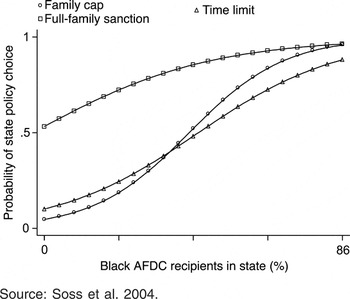
The probability curves in figure 1 are derived from the data in Soss et al. 2001. The graphs report the predicted probabilities for a state adopting “get-tough” policy options under welfare reform (the family cap, time limits and immediate, full-family sanctions), given the state's proportion of welfare recipients who are black and controlling for other state factors by holding them at their means. (The other major state policy option, work requirements, was not related to race.) Other factors accounted for are: the percentage of Latino recipients, the unemployment rate, the rate of increase in the incarceration rate, the ideology of state elected officials, interparty competition, low-income voter turnout, the recipient/population ratio, the out-of-marriage birth rate, and state initiation of program waivers from the federal government.

The effect of black caseload percentage on welfare policy choices in a hypothetical “average” state
In addition, nonwhites are more likely to live in states that adopt tough welfare policies.46
Soss et al. 2003, 245.
Lower-Basch 2000 notes that even within states with a uniform sanction policy, blacks are more likely to be sanctioned than whites. Also see Kalil, Seefeldt, and Wang 2002.
Yet whether the relationship between the racial composition of the welfare population and the state's choices is evidence of race bias is subject to interpretation. In one sense, that the racial composition of a state's welfare population is related to how tough a state chooses to be can itself be interpreted as a form of race bias. Yet white recipients in states where blacks comprise a relatively large proportion of recipients are subject to the same get-tough policies, making it harder to characterize states' structuring of reform policy choices as explicit bias. Perhaps a more nuanced interpretation is that the get-tough state choices are race-neutral public policies triggered by racial considerations. Even this interpretation needs further exploration, though, because, while race is correlated with state welfare reform policy choices, it may not be clear whether state policy makers have intentionally acted in a racially biased way. A more contextual understanding of the role of race bias in welfare reform may better explain the correlation.
Bureaucratic encounters between clients and caseworkers suggests additional evidence of explicit race bias. Susan Gooden has published a series of studies on racial discrimination in the administration of welfare reform.48
For an overview of her major findings see Gooden 2003.
Gooden 1998, 28.
Thus at each level of government there is evidence of explicit race bias. Yet in each case the data allow for multiple interpretations and therefore fail to provide a definitive evidentiary base that welfare reform is an explicitly race-biased policy regime.
Ostensibly Race-Neutral but Producing Racial Disadvantage
Much of the data already used to examine the first two hypotheses applies to the third as well. For instance, the growing preponderance of nonwhites on welfare reported in table 3 can be read to suggest that nonwhites needing public assistance are more vulnerable under an ostensibly neutral welfare reform regime that in fact fails to address the barriers they confront for leaving welfare. As a result, blacks on welfare might be treated equally to white welfare recipients in terms of work requirements, time limits, the imposition of sanctions, referrals for education and training, et cetera, but given their relative disadvantages in average education, readiness for employment, access to other sources of financial support, and other confounding factors, such as residential isolation and employer discrimination, “equal” treatment ends up producing more racial disadvantage.
Other data can be similarly reinterpreted. Blacks are more likely to be sanctioned off welfare than whites. Concern about racial disparity in sanction rates is heightened by other research that indicates that families forced off welfare do relatively poorly compared to families who leave for other reasons.50
Recipients, especially blacks, who leave welfare involuntarily have higher recidivism rates.51 One possible reading of these data is that sanctions are forcing off nonwhites who are generally not as prepared to secure jobs as other recipients are, for want of education, work experience, and skills, or because of greater personal problems, need to care for young children, and likelihood of confronting social barriers, such as employer discrimination.52 Blacks are also more likely to leave welfare because they have exhausted their time allowance under welfare reform;53 as a result, they may face serious economic jeopardy, further compounding the inequities they confront in the welfare system.The data on sanctions and time limits might be read as indicating that blacks do not try as hard as whites to succeed in the world of work.54
Mead 1992, 65.
Another possible reading of the same data is that white single mothers are more likely to marry or take up living arrangements with an employed man than are black single mothers who leave welfare. This interpretation points to disparities in employment rates between white and black single, low-income men. Low-income black males are much more likely than whites to be unable to support their families for a variety of reasons, ranging from incarceration to employer discrimination.56
On the relationship of welfare retrenchment to increased imprisonment of the poor population, see Fording 2001 and Wacquant 2002.
Recidivists, black or white, clearly have difficulty transitioning off welfare; between a fifth and a third of leavers return to welfare within a year. Parents who return have significantly less education and work experience as well as poorer health than parents who do not return.57
They are also less likely to have used transitional support services, and were more likely to have been sanctioned off welfare. One possible interpretation for this finding is that the punitive approach reflected in sanctions is frequently applied to families that continue to need assistance.Pamela Loprest found that nationwide while 22 percent of all leavers returned within a year of leaving welfare, the same was true for 32 percent of black and 24 percent of Hispanic leavers.58
Only 13 percent of white leavers returned within a year's time.59The “diverted,” that is, applicants who have been shunted away from receiving welfare, are an understudied population potentially important to understanding racial disparities. For instance, it is questionable to what extent the massive declines in the rolls from the mid-1990s through 2001 were due strictly to people leaving welfare. The rolls may have gone down in part because large numbers of people did not come onto the rolls. Some decline in new entrants might have been due to a relatively strong economy in the 1990s, making welfare less needed. Yet, this might have been due to the fact that welfare reform ended the entitlement of AFDC, replacing it with a more discretionary program that actively “diverts” families from needed assistance. Whether diversion is race-related is yet to be studied. See Schram and Soss 2002; Diller 2000.
Research on the effects of welfare reform on leavers was done while the economy was strong. We need further research to assess whether racial disparities in leaving and returning to welfare are exacerbated during economic downturn.
There is evidence that employer discrimination partly explains why black welfare recipients have on average a harder time leaving welfare for work without returning. Harry Holzer and Michael Stoll note that “[m]inority welfare recipients are hired somewhat less frequently than their representation in the population of poor female-headed households would lead us to predict. Conditional on hiring welfare recipients, the relative tendencies of establishments to hire minorities (especially African Americans) appear to be less closely related to overall demand conditions or employer skill needs than to location, and possibly to discriminatory employer preferences as well.”61
Holzer and Stoll 2002, http://www.urban.org/url.cfm?ID=310423. In experiments, Pager (2003) found that being black reduces a job applicant's chances of being called back to that of a white applicant who served 18 months for drug possession with an intent to sell. Bertrand and Mullainathan (2003) found that applicants were 50 percent more likely to be called for an interview if they had a white-sounding as opposed to a black-sounding name.
Informal hiring networks account for between 25 and 60 percent of hires and are a particularly important hiring mechanism for entry-level employment, jobs that do not require college education, blue-collar jobs, and jobs with small employers. Such networks tend to be tightly knit and ethnically homogeneous. African American workers, in particular, tend to be excluded from them…. Discrimination negatively affects employment rates of African Americans, even when differences in skills have been taken into account.62
Bernstein and Hartmann 2000, http://aspe.hhs.gov/hsp/lwlm99/bernhart.htm. See also Pager 2003; Bertrand and Mullainathan 2003.
Overall, there is good reason to believe that the data on racial disparities best support my third hypothesis. The case is further buttressed once we go beyond the limits of conventional public policy research and place welfare reform in historical and social context. Doing so, we see that welfare reform has turned a blind eye to how its own race-neutrality reinscribes racial subordination.63
See Skocpol 1992, 1–62, and Katznelson 1998 for arguments on behalf of the importance of taking the historical institutional context into account for explaining social welfare policy.
Post–Civil Rights Policy as Malign Neglect
As Frances Fox Piven and Richard A. Cloward have noted, welfare has historically been a secondary institution calibrated to serve the primary needs of the state and the market in the United States. It was always structured to serve two potentially conflicting goals: to reinforce the work ethic so that the poor would take whatever low-paying jobs the market provided, and to offer support to low-income families to recreate the conditions for maintaining the state's political legitimacy.64
It is important to add that welfare has also historically operated so as not to undermine the racial regime of white-dominated America.Mothers' pensions programs were the precursor of AFDC and were developed to reduce the numbers of children being placed in orphanages because their mothers could not care for them.65
Yet many of the reformers who championed these pensions did so in the name of safeguarding “republican motherhood” and fighting back the “race death” threatened by growing numbers of immigrant families who were then considered nonwhite.66 In addition, mothers' pensions operated more to Americanize immigrant mothers than to assist indigenous blacks, who were largely considered undeserving.67Gordon 1994, 48. See also Ward 2000.
AFDC was added to the Social Security Act of 1935, which was officially titled the Economic Security Act but rather quickly came to take on the name of its most popular program of old-age insurance for retirees.68
Its name underscores the important, if troubling, role that federalism has played in the American welfare state. The Social Security Act gave rise to a two-tiered welfare state that privileges national social insurance over state public assistance programs.69 In addition, this tiered system tends to reinforce differences in society along class, race, and gender lines, with the upper tier social insurance programs disproportionately benefiting families associated with more economically privileged white male workers, and the lower tier programs benefiting poorer female-headed families who were disproportionately nonwhite.As Robert Lieberman has amply demonstrated, the system developed in accord with the role of federalism in our policy-making system.70
Southern congressmen in particular lobbied hard to ensure that public assistance titles be federal programs that gave states substantial discretion in determining eligibility and setting benefits. They especially wanted to ensure that public assistance to poor families could be calibrated to the needs of the still powerful sharecropping system, which relied on impoverished black families to work the fields. With substantial discretion, southern states could ensure that these families could be moved on and off the welfare rolls with beginning and end of the planting and harvesting seasons. Public assistance could in that way take its place in the political economy of the ancien regime that arose in the apartheid of the south. As a result, the main public assistance program, AFDC, was a federal program that standardized and upgraded the limited mothers' pensions programs already in existence in many states. In addition, the top-tier social security program was originally structured to exclude coverage of those in certain occupations, such as agricultural workers and domestics, which disproportionately employed nonwhites. It thereby limited access to this privileged program in a way that favored whites. Though revised many times, both tiers of the Social Security Act still perpetuate class, race, and gender bias.As blacks began to gain rights to assistance in the 1960s, AFDC came to be seen as a “black program,” making it more politically vulnerable and increasing calls for its retrenchment, which finally came in the 1990s.71
Nonetheless, Americans now imagine that they are done with the civil rights struggle, that the battle to defeat racial injustice has been won, and that the nation no longer need to consider race in making public policy. This is a period when it is politically incorrect for public policy to explicitly invoke race to legislate either privileges for whites or disadvantages for blacks. In this period of “race blind” public policy, racial hierarchy must be recreated by stealth. The encoded discourse of welfare reform law is larded with euphemisms of “personal responsibility” and “self sufficiency” that implicitly suggest the undeservingness of welfare mothers who just happen to be disproportionately black. Such racially neutral euphemisms not so ironically discourage the idea that black recipients are much more likely to confront societal barriers when making the transition from welfare to work.72 Some of the major effects of welfare reform, therefore, arise from the ways in which its euphemistic discourse tends to be obtuse to the distinctive needs of disproportionately nonwhite low-income, single mothers.Welfare reform's work-first regime overlooks the fact that many low-income single mothers of all races and ethnicities lack what they need to make what welfare reformers call “rapid attachment” to the workforce and end a life of “welfare dependency.” Its assumption that all single mothers can leave welfare quickly, practice “personal responsibility,” and achieve “self sufficiency” by participating in the labor market is destined to fail many single mothers. Given society's overall racial inequalities—the fact that some are born in poverty, attend under-funded schools, grow up in poorer communities with fewer economic opportunities, and confront more barriers in looking for work—it just happens that the racially neutral but socially obtuse policies of welfare reform are likely to adversely affect blacks more than whites.
The concrete practices of welfare-to-work programs starkly illustrate how these programs produce racial disadvantage. Increasingly, welfare policy has focused on targeting resources to address what are euphemistically called “barriers” that prevent recipients from leaving welfare.76
Welfare-to-work programs concentrate substantial energy on screening, diagnosing, and treating clients for various personal deficiencies so that they can take jobs and reduce their reliance on public assistance. Yet, as the research reviewed has indicated, nonwhite welfare recipients confront discrimination in hiring,77In particular, see Bertrand and Mullainathan 2003.
Only California, Delaware, Kentucky, Louisiana, Michigan, Oregon, and Vermont list employer discrimination as a good cause for an exemption from sanctions. Other states leave this issue to the discretion of case managers. See Center on Law and Social Policy, State Policy Documentation Project: http://www.spdp.org/tanf/sanctions/goodcause2.PDF.
Such programs could be interpreted as a perversion of efforts to address the racial barrier confronting welfare recipients. To the extent that they can be interpreted as attempting to overcome the racial barrier to employment, they constitute yet another instance of welfare reform blaming individuals for the structural problems of society; these programs seek to solve social problems by making victims change their behavior.
The ostensibly race-neutral discourse of welfare reform makes racial bias a reality in the treatment of both individual clients and black recipients as a group.73
At the level of the individual client, even unbiased caseworkers who carry out ostensibly race-neutral policies are implicated in this self-defeating cycle of proving some recipients less personally responsible than others. Without saying so, caseworkers give welfare recipients an ultimatum: go to work or lose what little social support we offer. Given the organizational context in which they find themselves, they practice a latent race-biased form of what Herbert Simon once called “bounded rationality,” where they consider only certain factors and not others.74Simon 1957, xxiv.
The vicious cycle that blames black recipients as individuals and as a group also operates at the policy level. It is not just that the latent race bias of ostensibly race-neutral policies produces racial disadvantages, but, as the welfare population increasingly comes to be seen as a largely nonwhite population, the entire program itself is at risk of being marginalized to the point where program administrators cannot help black recipients even if they recognize the problem. With the darkening of the welfare rolls, welfare risks increasingly being seen as a program for those “other” people who are not conforming to the work and family rules of white middle-class society.79
Jill Quadagno (1994) has effectively argued that once a program comes to be seen as a “black program” it loses public support. Martin Gilens (1999) has provided extensive evidence of this from survey data. James Avery and Mark Peffley (2003) provide further evidence that when welfare is associated with blacks it loses public support.
Ultimately this cycle may keep spinning to the point that welfare reform's “success” in cracking down on the problem of “welfare dependency” becomes a rationalization for white neglect of what is seen as a black problem.80
Welfare reform's effect on white attitudes about race and poverty represent an example of policy's feedback effects. For a survey of literature on the impact policy has on politics, see Mettler and Soss 2004.
On reverse causality, see Norton 2004.
Conclusion
The data on racial disparities in contemporary welfare reform do not in the abstract tell us whether or not welfare reform is race-biased. Yet once we consider the historical and social context, a credible case can be made that the data indicate particular biases. Black recipients are punished for the persistence of social barriers that make it harder for them to succeed under welfare reform. Welfare reform operates in falsely neutral ways that reify racial disparities as if they were reflections of deep differences between whites and blacks. Without explicitly discriminating, welfare reform practices its own form of racemaking.
In order to understand how welfare reform is race-biased, we need to get beyond the limitations of conventional public policy analysis and its penchant to focus on statistical findings divorced from historical and social context. We need to practice a new poverty research that lets us understand how welfare reform has been calibrated to the economic and political biases of society.84
There is reason to think that due-process guarantees designed to ensure equal treatment of clients are not enough to defeat the systematic perpetuation of racial disparities outlined above; we must therefore take further steps. At a minimum, we must more scrupulously monitor state policies and administrative practices to ensure the enforcement of a race-neutral process. Yet we must also move beyond monitoring of isolated instances of discrimination to assume collective responsibility for the racial disadvantages that a falsely neutral public policy serves only to reinforce.85
References
Abbott, Andrew.
2001.
Time matters: On theory and method.
Chicago:
University of Chicago Press.
Avery, James M., and
Mark Peffley.
2003.
Race matters: The impact of news coverage of welfare reform on
public opinion. In
Schram,
Soss, and
Fording
131–50.
Race and the politics of welfare reform.
Ann Arbor:
University of Michigan Press.
Berg, Allison.
2002.
Mothering the race: Women's narratives on reproduction,
1890–1930.
Chicago:
University of Illinois Press.
Bernstein, Jared, and
Heidi Hartmann.
2000.
Defining and characterizing the low-wage labor market. In
The low-wage labor market: Challenges and opportunities for economic
self-sufficiency, ed.
Kelleen Kaye and
Demetra Smith Nightingale,
Washington, DC: Urban Institute.
http://aspe.hhs.gov/hsp/lwlm99/bernhart.htm.
Bertrand, Marianne, and
Sendhil Mullainathan.
2003.
Are Emily and Greg more employable than Lakisha and Jamal? A field
experiment on labor market discrimination.
Working Paper 9873.
Cambridge, MA:
National Bureau of Economic Research.
Besharov, Douglas J.
2003.
The past and future of welfare reform.
Public Interest
150:
4–21.Google Scholar
Blank, Rebecca, and
Patricia Ruggles.
1996.
When do women use aid to families with dependent children and food
stamps? The dynamics of eligibility versus participation.
Journal of Human Resources
31 (1):
57–89.Google Scholar
Brown, Michael K.
1999.
Race, money, and the American welfare state.
Ithaca, NY:
Cornell University Press.
Brown, Michael K.,
Martin Carnoy,
Elliot Currie,
Troy Duster,
David B. Oppenheimer,
Marjorie M. Shultz, and
David Wellman.
2003.
Whitewashing race: The myth of a color-blind society.
Berkeley:
University of California Press.
Crenshaw, Kimberlé
1989.
Demarginalizing the intersection of race and sex: A black feminist
critique of antidiscrimination doctrine, feminist theory and antiracist
politics.
University of Chicago Legal Forum
199:
139–67.Google Scholar
Crenson, Matthew A.
1998.
Building the invisible orphanage: A prehistory of the American
welfare state.
Cambridge:
Harvard University Press.
Danziger, Sandra,
Mary Corcoran,
Sheldon Danziger,
Colleen Heflin,
Ariel Kalil,
Judith Levine,
Daniel Rosen,
Kristin Seefeldt,
Kristine Siefert, and
Richard Tolman.
2000.
Barriers to the employment of welfare recipients. In
Prosperity for all? The economic boom and African Americans,
ed.
Robert Cherry and
William M. Rodgers III,
245–78.
New York:
Russell Sage Foundation.
Davis, Martha F.
2002.
Legislating patriarchy. In
From poverty to punishment, ed.
Gary Delgado,
147–54.
Oakland:
Applied Research Center.
Diller, Matthew.
2000.
The revolution in welfare administration: Rules, discretion, and
entrepreneurial government.
New York University Law Review
75 (5):
1121–1220.Google Scholar
Duncan, Greg J.,
Kathleen Mullan Harris, and
Johanne Boisjoly.
2000.
Time limits and welfare reform: New estimates of the number and
characteristics of affected families.
Social Service Review
74 (1):
55–75.Google Scholar
Esping-Andersen, Gosta.
1990.
The three worlds of welfare capitalism.
Princeton:
Princeton University Press.
Fellowes, Matthew C., and
Grethen Rowe.
2004.
Politics and the new American welfare states.
American Journal of Political Science
48 (2):
362–73.Google Scholar
Finegold, Kenneth, and
Sarah Staveteig.
2002.
Race, ethnicity, and welfare reform. In
Welfare reform: The next act, ed.
Alan Weil and
Kenneth Finegold,
203–24.
Washington, DC:
Urban Institute Press.
Fogg-Davis, Hawley.
2003.
The racial retreat of contemporary political theory.
Perspectives on Politics
1 (3):
555–64.Google Scholar
Fording, Richard C.
2001.
The political response to black insurgency: A critical test of
competing theories of the state.
American Political Science Review
95 (1):
115–31.Google Scholar
Fording, Richard C.
2003.
“Laboratories of democracy” or symbolic politics? The
racial origins of welfare reform. In
Schram,
Soss, and
Fording
72–100.
Race and the politics of welfare reform.
Ann Arbor:
University of Michigan Press.
Gais, Thomas, and
R. Kent Weaver.
2002.
State policy choices under welfare reform.
Welfare Reform and Beyond Brief 21. April. Washington, DC:
Brookings Institution.
http://www.brook.edu/wrb/publications/pb/pb21.pdf.
Gilens, Martin.
1999.
Why Americans hate welfare: Race, media, and the politics of
antipoverty policy.
Chicago:
University of Chicago Press.
Goode, Judith, and
Jeffrey Maskovsky.
2001.
The new poverty studies: The ethnography of power, politics, and
impoverished people in the United States.
New York:
New York University Press.
Gooden, Susan.
1998.
All things not being equal: Differences in caseworker support toward
black and white welfare clients.
Harvard Journal of African American Public Policy
4 (1):
23–33.Google Scholar
Gooden, Susan.
2003.
Contemporary approaches to enduring challenges: Using performance
measures to promote racial equality under TANF. In
Schram,
Soss, and
Fording
254–75.
Race and the politics of welfare reform.
Ann Arbor:
University of Michigan Press.
Gordon, Linda.
1994.
Pitied but not entitled: Single mothers and the history of welfare,
1890–1935.
New York:
Free Press.
Holzer, Harry J., and
Michael A. Stoll.
2002.
Employer demand for welfare recipients by race.
Assessing the New Federalism Report 01-07. Washington, DC:
Urban Institute. http://www.urban.org/url.cfm?ID
=310423.
Howard, Christopher.
1999.
Field essay: American welfare state or states?
Political Research Quarterly
52 (2):
421–42.Google Scholar
Kalil, Ariel,
Kristin S. Seefeldt, and
Hui-chen Wang.
2002.
Sanctions and material hardship under TANF.
Social Service Review
76 (4):
642–62.Google Scholar
Katz, Michael B.
2001.
The price of citizenship: Redefining the American welfare
state.
New York:
Metropolitan Books.
Katznelson, Ira.
1998.
The doleful dance of politics and policy: Can historical
institutionalism make a difference?
American Political Science Review
92 (1):
191–97.Google Scholar
Keiser, Lael R.,
Peter Mueser, and
Seung-Whan Choi.
2004.
Race, bureaucratic discretion and the implementation of welfare
reform.
American Journal of Political Science.
48 (2):
314–27.Google Scholar
Lieberman, Robert C.
1998.
Shifting the color line: Race and the American welfare state.
Cambridge:
Harvard University Press.
Lieberman, Robert C., and
John Lapinski.
2001.
American federalism, race and the administration of welfare.
British Journal of Political Science
31 (2):
303–29.Google Scholar
Loprest, Pamela.
1999.
How families that left welfare are doing: A national picture.
Assessing the New Federalism, B-01. Washington, DC:
Urban Institute.
http://www.urban.org/UploadedPDF/anf_b1.pdf.
Loprest, Pamela.
2002.
Who returns to welfare? Assessing the New Federalism.
Washington, DC:
Urban Institute.
http://www.urban.org/UploadedPDF/310548_B49.pdf.
Loury, Glenn C.
2002.
The anatomy of racial inequality.
Cambridge:
Harvard University Press.
Lower-Basch, Elizabeth.
2000.
TANF “leavers,” applicants, and caseload studies:
Preliminary analysis of racial differences in caseload trends and leaver
outcomes.
Washington, DC:
U.S. Department of Health and Human Services.
http://aspe.hhs.gov/hsp/leavers/race.htm.
Mead, Lawrence M.
1992.
The new politics of poverty: The nonworking poor in America.
New York:
Basic Books.
Mettler, Suzanne, and
Joe Soss.
2004.
The consequences of public policy for democratic citizenship:
Bridging policy studies and mass politics.
Perspectives on Politics
2 (1):
55–73.Google Scholar
Mink, Gwendolyn.
2002.
Violating women: Rights abuses in the welfare police state.
In
Lost ground: Welfare reform, poverty, and beyond, ed.
Randy Albelda and
Ann Withorn,
95–112.
Boston:
South End Press.
Moffitt, Robert, and
Jennifer Roff.
2000.
The diversity of welfare leavers: Welfare, children, and families: A
three-city study.
Working Paper 00-01.
Baltimore:
Johns Hopkins University.
http://www.jhu.edu/∼welfare/leav1a_all.pdf.
Moffitt, Robert A., and
Peter T. Gottschalk.
2001.
Ethnic and racial differences in welfare receipt in the United
States. In
America becoming: Racial trends and their consequences.
Vol. 2, ed.
Neil J. Smelser,
William Julius Wilson, and
Faith Mitchell.
152–73.
Washington DC:
National Academy Press.
Morgen, Sandra.
2002.
The politics of welfare and of poverty research.
Anthropological Quarterly
75 (4):
745–57.Google Scholar
Norton, Anne.
2004.
95 theses on politics, culture, and method.
New Haven:
Yale University Press.
Neubeck, Kenneth J., and
Noel A. Cazenave.
2001.
Welfare racism: Playing the race card against America's
poor.
New York:
Routledge.
O'Connor, Alice.
2001.
Poverty knowledge: Social science, social policy, and the poor in
twentieth-century U.S. history.
Princeton:
Princeton University Press.
Orr, Larry L.
1976.
Income transfers as a public good: An application to AFDC.
American Economic Review
66 (3):
359–71.Google Scholar
Pager, Devah.
2003.
The mark of a criminal record.
American Journal of Sociology
108 (5):
937–75.Google Scholar
Piven, Frances Fox.
2003.
Why welfare is racist. In
Schram,
Soss, and
Fording
323–36.
Race and the politics of welfare reform.
Ann Arbor:
University of Michigan Press.
Piven, Frances Fox, and
Richard A. Cloward.
1993.
Regulating the poor: The functions of public welfare.
2nd ed.
New York:
Vintage.
Proctor, Bernadette D., and
Joseph Dalaker.
2003.
Poverty in the United States: 2002.
Series P60-222. Washington, DC:
U.S. Bureau of the Census. September.
Quadagno, Jill.
1994.
The color of welfare: How racism undermined the war on
poverty.
New York:
Oxford University Press.
Rector, Robert,
Kirk A. Johnson, and
Patrick F. Fagan.
2001.
Understanding differences in black and white child poverty
rates.
Center for Data Analysis Report 01-04.
Washington, DC:
Heritage Foundation.
http://www.heritage.org/Research/Welfare/CDA01-04.cfm.
Schram, Sanford F.
1995.
Words of welfare: The poverty of social science and the social
science of poverty.
Minneapolis:
University of Minnesota Press.
Schram, Sanford F.
2000.
After welfare: The culture of postindustrial social policy.
New York:
New York University Press.
Schram, Sanford F.
2002.
Praxis for the poor: Piven and Cloward and the future of social
science in social welfare.
New York:
New York University Press.
Schram, Sanford F., and
Joe Soss.
2002.
Success stories: Welfare reform, policy discourse, and the politics
of research. In
Lost ground: Welfare reform, poverty, and beyond, ed.
Randy Albelda and
Ann Withorn,
57–78.
Boston:
South End Press.
Schram, Sanford F.,
Joe Soss, and
Richard C. Fording, eds.
2003.
Race and the politics of welfare reform.
Ann Arbor:
University of Michigan Press.
Shelton, Ellen, and
Greg Owen.
2003.
The issues behind the outcomes: For Somali, Hmong, American Indian,
and African American welfare participants in Minnesota.
St. Paul:
Wilder Foundation.
http://www.wilder.org/research/reports/pdf/welfareculturalissues4-03.pdf.
Simon, Herbert.
1957.
Administrative behavior: A study of decision-making processes in
administrative organization.
2nd ed.
New York:
Macmillan.
Skocpol, Theda.
1992.
Protecting soldiers and mothers: The political origins of social
policy in the United States.
Cambridge:
The Belknap Press of Harvard University Press.
Soss, Joe,
Sanford F. Schram,
Thomas P. Vartanian, and
Erin O'Brien.
2001.
Setting the terms of relief: Explaining state policy choices in the
devolution revolution.
American Journal of Political Science
45 (2):
378–95.Google Scholar
Soss, Joe,
Sanford F. Schram,
Thomas P. Vartanian, and
Erin O'Brien.
2003.
The hard line and the color line: Race, welfare and the roots of
get-tough reform. In
Schram,
Soss, and
Fording
225–53.
Race and the politics of welfare reform.
Ann Arbor:
University of Michigan Press.
Soss, Joe,
Sanford F. Schram,
Thomas P. Vartanian, and
Erin O'Brien.
2004.
Welfare policy choices in the states: Does the hard line follow the
color line?
Focus
23 (1):
9–15.Google Scholar
Stone, Deborah.
2002.
Policy paradox: The art of political decision making.
Rev. ed.
New York:
W. W. Norton.
Ture, Kwame, and
Charles V. Hamilton.
1992.
Black power: The politics of liberation in America.
New York:
Vintage Books.
U.S. Bureau of the Census.
2002.
Statistical abstract of the United States.
Washington DC.
http://www.census.gov/prod/www/statistical-abstract-04.html.
U.S. Commission on Civil Rights.
2002.
A new paradigm for welfare reform: The need for civil rights
enforcement.
Washington DC.
http://www.usccr.gov/pubs/prwora/welfare.htm.
U.S. Department of Health, and Human Services, Office of Family
Assistance.
2004.
Temporary assistance for needy families: Sixth annual report to
Congress.
Washington DC.
Wacquant, Loic.
2002.
From slavery to mass incarceration: Rethinking the “race
question” in the US.
New Left Review
13 (1):
41–60.Google Scholar
Ward, Deborah E.
2000.
Mothers' pensions: The institutional legacy of the American
welfare state.
PhD diss.,
Columbia University.
Wright, Gerald C.
1977.
Racism and welfare policy in America.
Social Science Quarterly
57 (4):
718–30.Google Scholar
Yanow, Dvora.
1999.
Conducting interpretive policy analysis.
Thousand Oaks, CA:
Sage Publications.
Young, Iris Marion.
2003.
Responsibility and structural injustice.
Prepared for presentation at the Political Theory Workshop,
Princeton University, December 4.
Comparison by race of families in poverty and families on welfare, 2003
Percent of poor receiving welfare (in percentages), 2003

Racial composition of welfare families, 1992–2002
The effect of black caseload percentage on welfare policy choices in a hypothetical “average” state
 You have
Access
- 29
- Cited by