Introduction
Laboratory mice are suitable, necessary and widely used experimental animals for much scientific research, mainly in the life sciences. However, parasitic nematodes such as the mouse pinworms Syphacia obvelata and Aspiculuris tetraptera can inhabit the caecum and colon of laboratory mice with high prevalence, and cause oxyuriasis, even in well-managed colonies and laboratory animal centres (Baker, Reference Baker1998; Hill et al., Reference Hill, Randolph and Mandrell2009; Chen et al., Reference Chen, Li, Lin, Deng, Fan, Yuan, Song, Liao and Zhu2011). Pinworm infection is a serious problem due to its worldwide distribution and potential untoward effects on the behaviour, growth, intestinal physiology and immunology of mice (Baker, Reference Baker1998; Bugarski et al., Reference Bugarski, Jovcic, Katic-Radivojevic, Petakov, Krstić, Stojanović and Milenković2006; Michels et al., Reference Michels, Goyal, Nieuwenhuizen and Brombacher2006; Hill et al., Reference Hill, Randolph and Mandrell2009; Chen et al., Reference Chen, Li, Lin, Deng, Fan, Yuan, Song, Liao and Zhu2011; Gaherwal et al., Reference Gaherwal, Solanki, Prakash and Wast2012).
In addition to morphological, epidemiological investigations and diagnostic studies, mitochondrial (mt) gene (cox1, nad1, nad5, cytb), internal transcribed spacer (ITS1 and ITS2) and 28S rDNA sequences are useful genetic markers for the identification and phylogenetic analysis of this parasite group (Okamoto et al., Reference Okamoto, Urushima, Iwasa and Hasegawa2007, Reference Okamoto, Urushima and Hasegawa2009; Parel et al., Reference Parel, Galula and Ooi2008; Lou et al., Reference Lou, Zhang, Qiu, Gao, Wang, Xiao, Chang and Wang2014; Wang et al., Reference Wang, Lou, Zhang, Wang, Zheng, Xu, Zhang, Tian, Na and Chang2014). Furthermore, ITS1 and ITS2 rDNA sequences are also useful genetic markers for studying the inter- and intrapopulation genetic variations in parasites, such as Angiostrongylus cantonensis and Clonorchis sinensis, Trichuris trichiura and T. suis, and Oesophagostomum asperum and O. colubianum (Tatonova et al., Reference Tatonova, Chelomina and Besprosvannykh2012; Liu et al., Reference Liu, Zhou, Nisbet, Xu, Zhou, Zhao, Wang, Song, Lin and Zhu2014; Zhao et al., Reference Zhao, Hu, Song, Jia, Li, Wang, Lin, Xu, Yu and Deng2014). However, there is a paucity of information on mouse pinworm rDNA (Parel et al., Reference Parel, Galula and Ooi2008; Okamoto et al. Reference Okamoto, Urushima and Hasegawa2009), and sequence variability in the ITS rDNA among populations of S. obvelata and A. tetraptera with different geographical origins has not yet been reported.
The purpose of this study was to examine sequence variability in ITS1 and ITS2 rDNA among S. obvelata and A. tetraptera isolates from laboratory mice with different geographical origins in China. The phylogenetic relationships of Oxyuridomorpha were also reconstructed.
Materials and methods
Molecular analysis of nematode isolates of S. obvelata and A. tetraptera
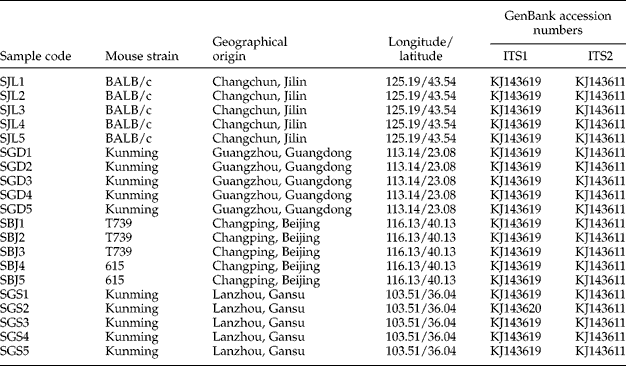
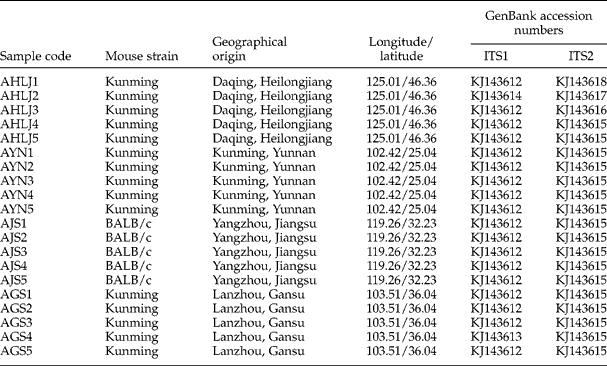
Adult pinworms of species S. obvelata (n= 20) and A. tetraptera (n= 20) were collected from the caecum and colon of various laboratory mice (BALB/c mice, Kunming mice, T739 mice and 615 mice) in seven provinces of China. The geographical locations were separated by significant distances (976–4049 km). The geographical origin, host, longitude and latitude and GenBank accession numbers for nuclear ITS1 and ITS2 rDNA sequences from S. obvelata and A. tetraptera are listed in table 1 and table 2. These adult pinworms were washed extensively with physiological saline, identified based on host preference, morphological characteristics and predilection sites (Taffs, Reference Taffs1976), and preserved in 70% (v/v) ethanol and stored at − 20°C until use.
Isolates of Syphacia obvelata from strains of laboratory mice from four provinces of China, including GenBank accession numbers of partial ITS1 and ITS2 rDNA sequences.

Isolates of Aspiculuris tetraptera from strains of laboratory mice from four provinces of China, including GenBank accession numbers of partial ITS1 and ITS2 rDNA sequences.
Total genomic DNA was extracted from each individual pinworm using a standard sodium dodecyl-sulphate/proteinase K treatment, followed by purification on a mini-column (TIANamp Genomic DNA Kit, Tiangen Biotech, Beijing, China). DNA was eluted into 35 μl double-distilled water. DNA samples were stored at − 20°C until use. The ITS1–5.8S–ITS2 rDNA fragment was amplified separately from each individual nematode DNA sample by polymerase chain reaction (PCR), using the primers NC5 (5′-GTAGGTGAACCTGCGGAAGGATCATT-3′) and NC2 (5′-TTAGTTTCTTTTCCTCCGCT-3′), as described by Parel et al. (Reference Parel, Galula and Ooi2008). One microlitre of DNA template was used in a 25 μl PCR reaction containing 5 μl of 5 × colourless Go Taq flexi buffer (pH 8.5), 2 μl MgCl2 (25 mm), 2 μl deoxynucleoside triphosphate (dNTP) mixture (2.5 mm), 0.5 μl of each primer (10 pmol/μl) and 0.13 μl Go Taq DNA polymerase (5 U/μl). The PCR cycling protocol used was 95°C for 2 min (initial denaturation), followed by 35 cycles of 95°C for 1 min (denaturation), 60°C for 1 min (annealing) and 72°C for 1 min (extension), followed by a final extension for 5 min at 72°C. Each amplicon was examined by agarose gel (1%) electrophoresis and ethidium bromide staining. The PCR products were purified using an Axyprep DNA Gel Extraction Kit (AXYGEN, Suzhou, China) and were ligated into the pGEM-T Easy plasmid vector (Promega, Madison, Wisconsin, USA) according to the manufacturer's instructions. The products were transformed into Escherichia coli TOP10 competent cells (BioMed, Beijing, China) and positive colonies were selected for colony PCR. The positive recombinant plasmids were sent to Life Technology Company (Beijing, China) for sequencing, using the same universal primers as in the primary amplification.
Phylogenetic analysis
Sequences of the ITS1 and ITS2 rDNA were aligned using Clustal X 1.83 (Thompson et al., Reference Thompson, Gibson, Plewniak, Jeanmougin and Higgins1997). The intraspecific sequence differences in S. obvelata and A. tetraptera were analysed. The interspecific sequence differences among members of the infraorder Oxyuridomorpha were determined by comparison with corresponding sequences from Enterobius vermicularis (HQ646164.1), Passalurus ambiguus (EF464552.1), Skrjabinema kamosika (AB699691.1), Syphacia muris (EU263106.2), A. tetraptera Taiwan isolate (EU263107.2) and S. obvelata Taiwan isolate (EU263105.2), using the program DNAstar 5.0 (Burland, Reference Burland2000). Sequence differences are calculated and presented based on average pairwise difference. The phylogenetic relationships between all S. obvelata and A. tetraptera samples and with other members of the infraorder Oxyuridomorpha were reconstructed based on the combined ITS1 and ITS2 sequences, using Trichuris muris (AJ299407.1), Adenophorea, as the outgroup. Trees were constructed using Bayesian inference (BI), maximum likelihood (ML) and maximum parsimony (MP) methods. BI was performed using MrBayes 3.1 (Ronquist & Huelsenbeck, Reference Ronquist and Huelsenbeck2003). The consensus tree was obtained after bootstrap analysis with 1000 replications. ML analyses were performed using PUZZLE 4.1 (Strimmer & Haeseler, Reference Strimmer and Haeseler1996). MP analyses were carried out using the PAUP 4.0 Beta 10 program (Swofford, Reference Swofford2002). Bootstrap probability (BP) was calculated from 1000 bootstrap replicates with ten random additions per replicate in PAUP. The phylogram was drawn using the Tree View program, version 1.65 (Page, Reference Page1996).
Results and discussion
The ITS rDNA sequences obtained from S. obvelata and A. tetraptera were 744 bp and 1032 bp, respectively. These included partial ITS1 rDNA sequences of 314 and 456 bp, complete 5.8S sequences of 157 bp, and partial ITS2 rDNA sequences of 273 and 419 bp, respectively. The sequences of ITS1 and ITS2 from S. obvelata and A. tetraptera have been deposited in GenBank under the accession numbers KJ143611–KJ143620 (tables 1 and 2). The sequence variations in the ITS1 rDNA from S. obvelata from different geographical locations (including S. obvelata Taiwan isolate EU263105.2) were 0–0.3%, including one T → G transition at sequence position 65. No intraspecific variations were detected in ITS2 rDNA among S. obvelata isolates. The intraspecific sequence differences among A. tetraptera isolates from different geographical locations were slightly higher, being 0–0.7% and 0–1.0% for ITS1 and ITS2, respectively (including A. tetraptera Taiwan isolate EU263107.2). Three transitions (A → G, A → T and T → C) were observed at sequence positions 37, 382 and 445 of ITS1; and four transitions (A → G, two of T → C, and G → A) at sequence positions 640, 821, 990 and 1030 of ITS2, respectively. Although samples of S. obvelata and A. tetraptera were collected from different types of laboratory mice (BALB/c, Kunming, T739 and 615 mice) and different regions of China, and the furthest distance between isolates was approximately 4049 km (between Daqing, Heilongjiang Province and Guangzhou, Guangdong Province), the intraspecific variations in ITS1 and ITS2 rDNA sequences among S. obvelata and A. tetraptera samples were small. This result is in accordance with other studies of mouse pinworms (S. obvelata and A. tetraptera) using mtDNA (Lou et al., Reference Lou, Zhang, Qiu, Gao, Wang, Xiao, Chang and Wang2014; Wang et al., Reference Wang, Lou, Zhang, Wang, Zheng, Xu, Zhang, Tian, Na and Chang2014). It is also consistent with analysis of nine species within the genus Syphacia using 28S rDNA (Okamoto et al., Reference Okamoto, Urushima and Hasegawa2009), and with results for other helminths (Dai et al., Reference Dai, Liu, Song, Lin, Yuan, Li, Huang, Liu and Zhu2012; Liu et al., Reference Liu, Zhou, Nisbet, Xu, Zhou, Zhao, Wang, Song, Lin and Zhu2014; Zhao et al., Reference Zhao, Hu, Song, Jia, Li, Wang, Lin, Xu, Yu and Deng2014).
The differences in ITS1 and ITS2 rDNA sequences from S. obvelata and A. tetraptera compared with those from other members of the infraorder Oxyuridomorpha, E. vermicularis, P. ambiguus, S. kamosika and S. muris, were significantly higher, being 54.0–58.1% and 57.7–65.6% for ITS1, and 55.3–62.4% and 55.7–64.1% for ITS2, respectively. These data are consistent with those from recent studies of S. obvelata and A. tetraptera mtDNA, of the 28S rDNA of nine species in the genus Syphacia, of tapeworm rDNA (Spirometra erinaceieuropaei, Taenia multiceps and T. hydatigena) and of nematode rDNA (Oesophagostomum asperum and O. columbianum; Trichuris trichiura and T. suis) (Okamoto et al., Reference Okamoto, Urushima and Hasegawa2009; Dai et al., Reference Dai, Liu, Song, Lin, Yuan, Li, Huang, Liu and Zhu2012; Liu et al., Reference Liu, Zhou, Nisbet, Xu, Zhou, Zhao, Wang, Song, Lin and Zhu2014; Lou et al., Reference Lou, Zhang, Qiu, Gao, Wang, Xiao, Chang and Wang2014; Wang et al., Reference Wang, Lou, Zhang, Wang, Zheng, Xu, Zhang, Tian, Na and Chang2014; Zhao et al., Reference Zhao, Hu, Song, Jia, Li, Wang, Lin, Xu, Yu and Deng2014).
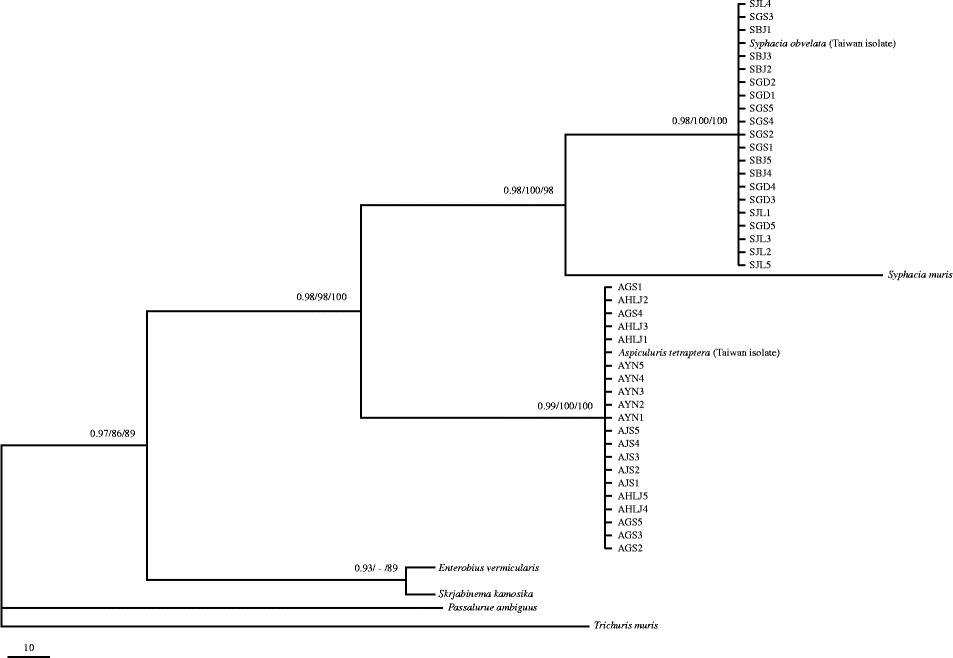
Phylogenetic relationships were reconstructed using combined sequences of the ITS1 and ITS2 rDNA, with T. muris as the outgroup to determine the genetic positions of S. obvelata and A. tetraptera. There were two main clades in the tree. One clade contained only P. ambiguus, while the other included E. vermicularis, S. kamosika, S. muris, A. tetraptera Taiwan isolate, S. obvelata Taiwan isolate, and all mouse pinworm samples from this study. In the mouse pinworm sample clade, all S. obvelata samples and S. obvelata Taiwan isolate clustered together, sistered to S. muris. All A. tetraptera samples and A. tetraptera Taiwan isolate clustered together, close to S. muris and S. obvelata (fig. 1), consistent with morphological classifications.
Phylogenetic relationships between Syphacia obvelata and Aspiculuris tetraptera isolated from strains of laboratory mice in seven provinces in China. The tree is constructed using the combined dataset (ITS1+ITS2), with Trichuris muris as the outgroup. Numbers along branches indicate bootstrap values from different analyses, in the order Bayesian inference/maximum parsimony/maximum likelihood. Values lower than 50% are shown as hyphens.
In conclusion, the present study reveals low sequence variability in ITS rDNA from S. obvelata and A. tetraptera from different geographical locations in China. These rDNA sequences can be used as genetic markers for identification and phylogenetic studies of different oxyurid nematodes.
Acknowledgements
The authors thank Miss J.Y. Zhang, Mr Y.C. Liu and Miss Y. Wang for helping us to obtain Syphacia obvelata and Aspiculuris tetraptera specimens.
Financial support
This work was supported by the Fund for Imported Talents in Heilongjiang Bayi Agricultural University (2013YB-42).
Conflict of interest
None.
Ethical standards
This research project was reviewed and approved by the Ethics Committee of Heilongjiang Bayi Agricultural University, China.