Introduction
The commercial poultry industry has been pelleting poultry diets in feed mills for years. Next to nutritional composition, pellet quality is often the most important factor of a finished feed. The most common method for producing a pelleted poultry diet is to propel the mash diet through a conditioner where steam is injected into the mash at a high temperature and pressure before the mash diet is forced through a pellet die. As a result of the temperature and moisture that the mash is subjected to in the conditioner, changes occur in the starch and protein portions of the diet to bring their respective binding properties into play to create a pellet. This is a simplistic description of what makes a pellet as there are many variables that contribute towards the physical quality of a finished pelleted feed. Other factors that affect pellet quality are conditioning time and temperature, particle size of the mash feed, production rate, diet formulation, ambient temperature, specifications of the pellet die, and cooling of the pellets. All factors must be considered when manufacturing feed to commercial poultry.
To run a feed mill requires a lot of energy consumption and can cost a major producer significant amounts of money. As a result, a lot of attention must be given to production rate of the mill as well as electrical energy usage at both the conditioner and the pellet mill. These are variables that can differ greatly from one mill to the next, depending on equipment used, formulation of the diet and even the operator of the mill, among others. Changes in any of the aforementioned parameters can lead to major changes in costs for a large scale feed operation.
Having mentioned all of these factors that can lead to changes in both how much it will cost to produce a pelleted feed and the physical quality of that feed, we will focus solely on the factor of diet formulation in this article. However, it is true that differences can exist between different batches of a single feedstuff that could affect pellet quality and manufacturing parameters.
Ingredients
grains
Corn (maize) is a very common feed grain used in commercial poultry diets and is the primary grain for US operations. However there are different varieties of corn. Zarate et al. (Reference ZARATE, MORAN and STILBORN2004) studied the differences in pellet quality among diets formulated with normal dent, waxy, high-oil, and waxy-high-oil corn. They concluded that diets with the waxy corn and high-oil corn improved pellet quality over that of the normal dent corn, although waxy corn showed the most improvement. They attribute these improvements to the increase in coarse particles found in the diet when using the waxy corn and the displacement of added fat seen when using the high-oil corn. When the waxy-high-oil corn was used, they did not see an improvement in pellet quality much beyond that of the waxy corn. In contrast, Briggs et al. (Reference BRIGGS, MAIER, WATKINS and BEHNKE1999) showed that poor quality pellets were the result of rations containing high-oil corn and mechanically expelled soybean meal. However, when combined with regular soybean meal and corn respectively, pellets of acceptable quality were produced. The authors attribute the poor quality pellets to a high oil content that exceeded their stated limit of 5.6% with a protein content of 20%. Zarate et al. (Reference ZARATE, MORAN and STILBORN2004) made no statement as to the type of soybean meal used in their rations.
Depending on geographical location, availability and current market prices, a producer may choose to incorporate a grain other than corn into their rations. One such alternative is pearl millet, and Dozier et al. (2005) tested if a pearl millet based diet would have acceptable grinding and pelleting properties when compared to those of a corn-soybean meal based diet. They tested a control corn-soybean meal diet against both 25 and 50% pearl millet diets. Their findings indicated no differences in pellet quality among any of the diets when all grain was ground through a 4.0 mm screen. However, they found that the pearl millet grain had an increased grinding rate which resulted in the use of less energy for grinding compared to corn.
by-products
Currently, a product known as distiller's dried grains with solubles (DDGS) has seen a dramatic rise in production in the United States, as reported by the Renewable Fuels Association (Reference RENEWABLE FUELS ASSOCIATION2010), as a result of increased ethanol production. Consequently, DDGS, the primary by-product of corn fermentation to yield ethanol, is more easily available to poultry integrators and is being seen on a more regular basis in commercial poultry diets. Srinivasan et al. (Reference SRINIVASAN, CORZO, KOCH and KIDD2009) reported that inclusion of conventional DDGS, at either 10% or 20% of the diet, in pelleted poultry diets caused pellet quality to suffer, while there was no effect on feed throughput at the mill.
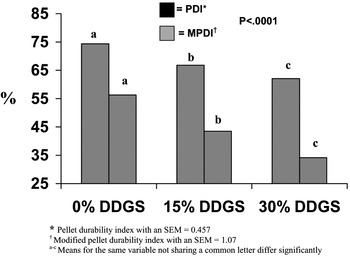
These results were further supported by the work of Loar et al. (2010) where pellet quality was shown to decrease when DDGS were included in the diet at 15 and 30% of the total diet compared to a conventional corn and soybean meal diet (Figure 1). Furthermore, Loar et al. (2010) showed that DDGS in the diet resulted in an increase in energy usage at the conditioner while decreasing energy expenditure at the pellet mill. Both are expected to be the result of added fat in the DDGS diets, necessary to keep the DDGS-containing diets isocaloric to the corn and soybean meal diet. The added fat is hypothesised to have resulted in a stickier, more viscous diet in the conditioner, thus requiring more energy to be pushed through the die, while at the pellet mill the added fat would aid in overall lubrication of the die thus requiring less energy for the feed to be pushed through the die holes. It should also be noted that starch is almost absent in DDGS, therefore the binding capability of this by-product should not be significant. Both of these researchers’ results agree with the suggestion of Behnke (Reference BEHNKE2007) that pellet quality will suffer once DDGS exceeds 5% to 7% of the diet.
Effects of varying levels of distiller's dried grains with soluble on physical pellet quality (adapted from Loar et al., 2010).

Another by-product that has received some attention in poultry diets is dried bakery product (DBP). Catala-Gregori et al. (Reference CATALA-GREGORI, GARCA, MADRID, ORENGO and HERNANDEZ2009) conducted a factorial study where they tested the effects of three different levels of added fat at the mixer in combination with 0% or 7% DBP in the ration. All diets contained a similar fat level as additional fat was applied via post-pellet liquid spray application to those diets that had lower fat levels added at the mixer. The researchers concluded that DBP increased physical pellet quality before any post-pellet fat application, but that once all diets were brought to similar fat levels, DBP did not affect final physical pellet quality.
minerals
There is little published research on the effects of dietary minerals in a poultry diet on the feed manufacturing parameters and finished feed quality. To our knowledge there is no peer reviewed publication on the subject. Behnke (Reference BEHNKE1981) reported that deflourinated (tricalcium) phosphate in the diet, at either regular or fine ground particle size, will increase production rate compared to dicalcium phosphate. Moritz (Reference MORITZ2010) performed preliminary investigations into the effects of feed phosphate source on milling variables, and tested four separate phosphate sources: monocalcium, monocalcium of a coarse texture, dicalcium, and deflourinated (tricalcium) phosphates. Moritz describes that deflourinated phosphate decreased electrical energy usage at the pellet mill compared to both monocalcium and dicalcium phosphates. Furthermore, dicalcium phosphate showed decreased energy usage at the pellet mill when compared to monocalcium phosphate. All sources yielded similar results for the physical quality of the pelleted diet, with the exception of the coarse monocalcium phosphate which led to decreased pellet quality compared to the other sources.
pellet binders
It has been widely accepted that increased physical pellet quality can lead to an increase in performance of growing birds. However, research concerning the economics surrounding the issue of manufacturing costs versus physical pellet quality is elusive to say the least. Binders are intended to increase physical pellet quality to meet whatever standards the manufacturer deems sufficient, in the case that the diet itself does not meet those standards without the binder. There is sufficient evidence available to validate the efficacy of long available binders such as bentonite or lignosulphonates. The contributing factors of pellet binders are limited to increasing binding capability of pellets, and no other benefits can be attributed to these.
In research concerning increasing physical pellet quality with binders, scientists have been evaluating the use of what they are referring to as possible nutritional binders. These binders are intended primarily to improve physical pellet quality and provide little to no nutritional contribution to the animals consuming the finished feed. As suggested by Gehring et al. (Reference GEHRING, JACZYNSKI and MORITZ2009) the efficacy of common commercial pellet binders could be offset somewhat by nutrient dilution. Both El-Deek and Brikaa (Reference EL-DEEK and BRIKAA2009) and Takemasa and Hijikuro (Reference TAKEMASA and HIJIKURO1984) have reported improved physical pellet quality with the use of seaweed in the diet. The use of seaweed in a pelleted diet as a binder would most likely be a decision based on geographical location and availability. Gehring et al. (Reference GEHRING, JACZYNSKI and MORITZ2009) proposed that another nutritive pellet binder, fish muscle proteins recovered using isoelectric solubilisation-precipitation, could provide increases in physical pellet quality. The researchers went on to discover that using 5% of the fish protein paste, but not the 2.5% level, resulted in increased energy usage at the pellet mill and decreased production rates. Once again, it seems that the use of this type of binder would be influenced primarily on the economics of location and availability.
feedstuff nutrients
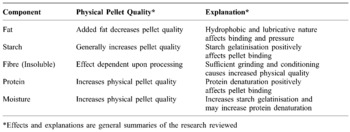
We have given several previous examples of how certain grains, by-products, and other ration components can affect pellet quality and feed manufacturing variables. These differences occur because of differences in the composition of the ingredients themselves, which can result in changes in the levels of other ingredients used to attain the desired nutrient levels. We wish to now take a much closer look at dietary constituents by reviewing the effects from a nutrient standpoint (Table 1) as opposed to the whole ingredient view we just discussed.
Effects of feedstuff components on physical pellet quality with possible explanations.

*Effects and explanations are general summaries of the research reviewed
fats
One component we have already mentioned is fat. Salmon (Reference SALMON1985) showed that added fat at the mixer decreased pellet quality. The likely explanation for this result is that because the binding of pellets involves water in the form of steam to aid degradation of native bonds in feedstuff particles, the hydrophobic nature of fats could potentially interfere with the binding. It is also probable that added fat can decrease pelleting pressure at the die as a result of its’ lubricating properties and thus possibly further decrease pellet quality. However, Richardson and Day (Reference RICHARDSON and DAY1976) showed that this same lubricating action led to increased production rates at the pellet mill, and added fat at the mixer resulted in a decrease in the energy needed to pellet the diet. It should be noted that these effects of fat occur with added fat and the research presented does not focus on naturally bound fats, such as those found in the cell walls.
In agreement with the effects of added fat in the diet, Catala-Gregori et al. (Reference CATALA-GREGORI, GARCA, MADRID, ORENGO and HERNANDEZ2009) found an increased physical pellet quality in diets with lower levels of fat added at the mixer, as compared to those with higher levels of fat. As previously stated, the authors assured all diets had similar fat levels by utilizing post-pellet liquid fat application. As a result of this, the researchers were further able to conclude that post-pellet fat application can lead to improvements in physical pellet quality.
starch
Arguably, the most common reaction that is spoken of when pelleting feed is starch gelatinisation. The general reaction describes that with sufficient heat and moisture starch will gelatinize, destroying the native bonds, and, upon cooling, new bonds form, aiding in holding a pellet together. Along with protein denaturation, starch gelatinisation is commonly accepted as one of the reactions in feed manufacturing that improves pellet quality as discussed by Maier et al. (Reference MAIER, BRIGGS and WATKINS1999).
Starch can either be modified during the feed manufacturing process where the steam is injected into the feed at the conditioner or it is done pre-manufacturing and the pre-gelatinised starch is included in the diet. Wood (Reference WOOD1987) showed that physical pellet quality is related to the level of pre-gelatinised starch used in the diet in such a way that as the starch increases, so does the physical quality of the pellet. Zimonja and Svihus (Reference ZIMONJA and SVIHUS2009) pelleted two diets with the only difference being that one diet contained 20% pure wheat starch and the other no pure wheat starch, and found that the starch containing diets exhibited reduced physical pellet quality. The increased binding properties of the non-starch diets were attributed to the proteins in these diets.
fibre
Fibre can be a more complex nutrient to deal with when it comes to pelleting feed. It is recognized that fibre can be either water soluble or insoluble. Water soluble fibre portions should be expected to increase viscosity and thus may affect our feed. Viscous materials may surround the larger particles in the diet creating a sort of coating action that causes everything to stick together, and thus the result is a more durable pellet. However, as is always the case in feed manufacturing, there are several processing variables such as heat, moisture, pressure, among others, that can affect the state of soluble fibres, and thus little to no research exists to elucidate the effects of soluble fibres. This is not the case for insoluble fibre. Zimonja et al. (Reference ZIMONJA, HETLAND, LAZAREVIC, EDVARDSEN and SVIHUS2008) found that by grinding oat hulls (insoluble fibre) to a fine texture, an improvement in physical pellet quality occurred that did not when the same oat hulls were coarsely ground. Furthermore, Buchanan and Moritz (Reference BUCHANAN and MORITZ2009) found that while small inclusions of cellulose (insoluble fibre) increased physical pellet quality over that of a corn and soybean meal diet, the same could not be said for oat hulls, which had a negative effect on physical pellet quality. It could be that the latter researchers did not grind their oat hulls to the extent of the former, or that the two researchers had different residence times in the conditioner. Mohsenin and Zaske (Reference MOHSENIN and ZASKE1976) showed that increase hold time in a wafering system caused further stress decay of the material and, as a result, a stronger wafer. Hence, one could argue the basic principles of the two machines are similar. It appears that insoluble fibres may be beneficial in a pellet if ground small enough or conditioned long enough in order to eliminate the structural properties of the fibre that lead to physical pellet quality issues. If not ground or conditioned sufficiently, it appears that the rigid structure of insoluble fibre could negatively affect the binding properties of the other feed constituents.
protein
As previously discussed, protein denaturation is one reaction that can aid in increasing pellet quality. Buchanan and Moritz (Reference BUCHANAN and MORITZ2009) used added protein in the form of soybean meal to increase physical pellet quality while Winowiski (Reference WINOWISKI1988) found that by increasing the wheat content of the diet, and thus the protein content compared to that of corn, the physical pellet quality also saw an increase. Briggs et al. (Reference BRIGGS, MAIER, WATKINS and BEHNKE1999) concluded that increasing dietary protein levels led to an increase in physical pellet quality. All of these results are in agreement with those of Wood (Reference WOOD1987) where it was believed that the processing (heat, moisture, pressure) of the feed caused denaturation of the proteins. This in turn led to increased physical pellet quality because once the pellets cool the proteins re-associate and bonds could be established between different constituents of the pellet. The effects of increased physical quality were found to be greater when the protein included was raw, rather than a denatured protein.
moisture
One other factor that has been repeatedly mentioned throughout this review is moisture. Every ingredient used in a common poultry diet will contain some amount of osmotically-bound moisture, and moisture is further increased with the addition of steam in the conditioner. Hott et al. (Reference HOTT, BUCHANAN, CUTLIP and MORITZ2008) tested two different inclusion levels of a mixture of moisture and mould inhibitor at both a pilot research feed mill and a commercial feed mill. The levels tested were 1 and 2% of the diet and the mixture was a 95:5 water to mould inhibitor blend. At the pilot feed mill, Hott et al. (Reference HOTT, BUCHANAN, CUTLIP and MORITZ2008) observed that relative electrical energy usage decreased numerically with increasing addition of the water-mould inhibitor blend, which they hypothesise as a possible decrease in pellet production cost. In addition, an increase in physical pellet quality was found with increasing levels of the water-mould inhibitor blend, but only for feed processed at the commercial feed mill. The authors felt this response could be the result of smaller corn particle size or larger die length: diameter ratio, post-pellet fat application, and a lower conditioning temperature, resulting in increased friction at the die and thus increased starch gelatinisation. All these conditions were seen at the commercial feed mill and not at the pilot feed mill, so it becomes evident that physical pellet quality improvements seen with addition of a water-mould inhibitor blend are dependent on additional feed milling variables.
Results of Buchanan and Moritz (Reference BUCHANAN and MORITZ2009) agree that physical pellet quality increases as moisture addition increases, however, at a moisture addition rate of 2% there were no differences in production rate over a control diet, while at 4% the researchers observed production rate decline. They suggest precautions taken by the mill operator in reaching optimal temperature, so as to prevent loss of frictional force between the die and the feed and thus “slipping”, as a possible explanation for this result. In further agreement with the effects of moisture, Fairchild and Greer (Reference FAIRCHILD and GREER1999) showed that by increasing the moisture by 3% in feed mash at the mixer that physical pellet quality was increased and pellet mill energy usage was decreased. A possible explanation for the positive effects seen on physical pellet quality comes from Moritz et al. (Reference MORITZ, BEYER, WILSON, CRAMER, MCKINNEY and FAIRCHILD2001) where the researchers reported an increase in starch gelatinisation of a diet with the addition of supplemental moisture. Furthermore, Buchanan and Moritz (Reference BUCHANAN and MORITZ2009) suggest that moisture may be the rate-limiting step in both starch gelatinisation and protein denaturation.
Conclusions
Published research has shown us that there are a multitude of factors within formulation alone that can affect both our physical pellet quality as well as the manufacturing of the pellets. In general, it seems that there are suitable alternatives, to varying extents, to the standard corn and soybean meal based diets where grain type is concerned. Also, provided the opportunity exists and the economics of the situation warrant their use, it may be beneficial for producers to incorporate alternative feed ingredients and by-products in their rations at low inclusion levels and experience some reduced production costs. However, the possibility for reduced physical pellet quality with the use of certain by-products was also discussed. It also appears that the simple choice of what feed phosphate to use could impact a producer's financial bottom line, although more research into the subject is certainly necessary.
When discussing the individual components that make up feedstuffs, it seems evident that fat will generally cause the physical pellet quality to suffer if it is included at high levels in the mixer, although it can lead to decreases in energy usage via its’ lubricating effects at the mill. Starch, in general, is one of the main players when it comes to pellet quality as starch gelatinisation leads to increased physical quality. Protein is another important factor to consider when addressing formulation strategies to maximise physical pellet quality, and thereby increasing protein in the diet either via increasing soybean meal, wheat, or even fish muscle protein can lead to increased pellet quality.
The effects of fibre seem to vary to a greater degree than those of the components already mentioned. While soluble fibre effects are admittedly tough to predict due to all the variables surrounding the processing of the fibres, insoluble fibre seems as though it could be either beneficial or detrimental. The effects of insoluble fibre seem to vary with source as well as particle size. Research has proven moisture to be a beneficial component, as in almost every case the addition of moisture resulted in increased physical pellet quality, as well as decreased energy usage at the mill. Furthermore, moisture is necessary for the activation of pellet binders which can be used to increase the physical quality of a feed and possibly as a nutrient source with some of the new binders being researched.