INTRODUCTION
The Qinghai-Tibetan Plateau, called the ‘roof of the world’, is the highest and largest plateau in the world. The plateau has a grassland area of 1·29 × 108 ha, which accounts for one-third of the total grassland in China (Long & Ma Reference Long, Ma, Miller, Craig and Rana1996; Wiener et al. Reference Wiener, Han and Long2003). About 50 million Tibetan sheep are raised on the plateau at altitudes between 3000 and 5000 m. This indigenous ruminant, like the yak, plays important roles in the ecology (grazing), productivity (milk, meat for food and dung for fuel) and livelihoods (wealth) of the Qinghai-Tibetan Plateau ecosystem (Long Reference Long2007, Long et al. Reference Long, Ding, Shang and Guo2008). The Tibetan sheep produce 1·0–2·5 kg of coarse carpet wool (11 cm length, 27–40 μm diameter) annually. Gansu Alpine fine-wool sheep, a crossbreed introduced to the plateau in the 1980s, are raised at altitudes between 2600 and 3500 m (Wang Reference Wang2012). This breed was developed by crossing Tibetan with Xinjiang fine-wool sheep and then with fine-wool breeds from USSR, such as Caucasian and Salsk (Cheng Reference Cheng1984). Breeding was completed in 1983 and, today, its genetic make-up is 1/16 of Tibetan sheep. They are raised for both wool and meat, and produce 3·5–6·6 kg of fine wool (9·5 cm length, 16–21 μm diameter) annually.
Due to the extremely harsh environment of the Qinghai-Tibetan Plateau, namely high altitude, severe cold, hypoxia, strong ultraviolet radiation and short growing season, herbage and nutrients for livestock are deficient in the long cold season, especially when raised under traditional grazing management (Wiener et al. Reference Wiener, Han and Long2003; Long et al. Reference Long, Dong, Hu, Shi, Dong and Han2004, Reference Long, Dong, Wei and Pu2005; Xin et al. Reference Xin, Long, Guo, Irvine, Ding, Ding and Shang2011). The saying ‘alive in summer, strong in autumn, thin in winter, tired in spring’ (Long et al. Reference Long, Ding, Shang and Guo2008) has been passed down from generation to generation by the local people. It is an accurate description of ruminants across the Qinghai-Tibetan Plateau, as food becomes sparse and of poor quality in the cold season. For example, daily feed intake in grazing Tibetan sheep decreased from 116 g/kg body weight (BW)0·75 in the warm season to 59 g/kg BW0·75 in the cold season, while N content of the forage decreased from 17·8 to 8·0 g/kg during this period (Dan et al. Reference Dan, Long, Zhang, Zhang and Ding2009). As Tibetan sheep have thrived and reproduced under these harsh conditions for thousands of years, it is assumed that they have evolved mechanisms that allow them to cope with the seasonally deficient ingestion of nutrients from natural grasslands.
In the current study, the effects of dietary N concentration on apparent digestibilities, rumen fermentation and N metabolism were investigated in indigenous Tibetan and imported fine-wool sheep. It was hypothesized that responses to different dietary N concentration would differ between breeds and it was predicted that the responses would favour Tibetan over fine-wool sheep to cope with low N intakes, which are common on the Qinghai Tibetan Plateau.
MATERIALS AND METHODS
Study site
The experiment was conducted at Wushaoling (37°12·4′ N, 102°51·7′ E, 3154 m a.s.l., located in the northeast of the Qinghai-Tibetan Plateau), Tianzhu Tibetan Autonomous County, Gansu Province, China, under a roofed shelter with three walls. It took place during the winter, from 9 November 2010 to 23 March 2011; air temperature within the shelter ranged between 2 and 6 °C and relative humidity ranged between 68 and 83%.
Animals and diets
Eight 20–24 months old wethers, four Tibetan coarse wool sheep and four Gansu Alpine fine-wool sheep, were purchased from nearby farmers and used in two concurrent 4 × 4 Latin square designs. There was no difference between breeds in live-weight; initial BW ± standard deviation (sd) was 48 ± 4·1 kg and final BW ± sd was 54 ± 3·3 kg. Animals were maintained in individual pens that allowed collection of total faeces. Sheep were provided with water ad libitum throughout the study. The experimental protocols were approved by the Animal Ethics Committee of Gansu Province, China. Prior to the study, a 30-day adaptation period allowed the sheep to familiarize themselves with the experimental procedures and urine-collection apparatus as well as with the staff.
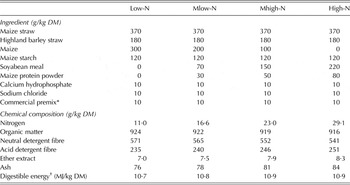
Each sheep was offered 990 g DM per day (nearly 0·02 BW) in two equal portions, at 08·00 and 18·00 h. A preliminary study indicated that this daily ration would be consumed completely, without leaving any feed refusals. The diets were composed of 370 g/kg DM maize straw, 180 g/kg DM highland barley straw and 450 g/kg DM concentrate. Four diets that differed in N content [Low, Medium-Low (MLow), Medium-High (MHigh), High N diets, with N contents of 11·0, 16·7, 23·1 and 29·2 g N/kg DM, respectively] were formulated by adding different N content ingredients (Table 1). The daily N intakes in the Low, MLow, MHigh and High N diets were similar to the daily N-intakes of the Tibetan sheep under traditional grazing management in spring, winter, autumn and summer, respectively, reported by Dan et al. (Reference Dan, Long, Zhang, Zhang and Ding2009). The diets were isoenergetic at 1·2 times the estimated digestible energy requirements for maintenance (480 kJ/kg BW0·75/day), and contained similar concentrations of neutral detergent fibre (NDF). The Low N diet provided less N than required for maintenance according to NRC (1985).
Ingredients and chemical composition of the four experimental sheep diets

DM, dry mater.
* Composition: Ca, 28%; P, 19·4%; Cu, 1340 mg/kg; Fe, 1680 mg/kg; Mn, 2100 mg/kg; Zn, 5160 mg/kg; Se, 18 mg/kg; Co, 110 mg/kg, I, 95 mg/kg.
† Calculated according to Tables of Feed Composition and Nutritive Values in China (Xiong et al. Reference Xiong, Pang and Luo2009).
Experimental procedure and sampling
Each experimental period consisted of 21 days: 15 days for dietary adaptation and 6 days for sample and data collection. Sheep were weighed before the morning feed at the beginning and end of each experimental period. For urine collection, a latex bag was fixed around the penis of each wether using elastic belts. Urine flowed via a polyethylene tube from the bag to a plastic container that contained sufficient 500 ml/l sulphuric acid (H2SO4) solution to keep the pH < 3.
Between days 16 and 21, faecal output was measured daily before the 08.00 h feed. An aliquot (100 g/kg) of faeces was sampled each day for digestibility determination and lyophilized to constant weight before analysis. The volume of urine was determined and a sub-sample (200 ml/l) retained daily for each animal and stored at −20 °C for later analysis. On day 21 of each period, blood, saliva and ruminal fluid were sampled before the morning feed. A stomach tube, consisting of a stainless steel top with small holes (12 cm length, 1·5 cm external diameter) and a 2·5 m polyethylene tube, was used to collect rumen fluid. To collect fluid, a hard, clean plastic pipe (2·5 cm diameter) was placed carefully into the sheep's mouth, and the stomach tube was inserted through the pipe into the rumen. The pipe reduced possible contamination of the stomach tube by saliva. Approximately 80 ml of ruminal fluid was collected under vacuum at each sampling. The fluid was strained through four layers of cheesecloth and pH measured immediately. An aliquot of ruminal fluid (5 ml) was added to 5 ml of deproteinizing solution (100 g metaphosphoric acid and 0·6 g crotonic acid/l) for volatile fatty acid (VFA) analysis and 2 ml was added to 2 ml of 0·5 mmol/l hydrochloric acid (HCl) solution for ammonia nitrogen (NH3-N) determination. The remaining rumen fluid was separated into at least four 5 ml centrifuge tubes, and then they were kept in liquid N for further determination of free amino acid-N, peptide-N, soluble protein-N and urea-N concentrations. Jugular blood was collected into heparinized vacutainer tubes, placed on ice and centrifuged at 1200 g for 15 min at 4 °C within 1 h after collection. Plasma samples were stored at −20 °C for determination of urea-N concentration. Saliva samples were collected according to Zhang et al. (Reference Zhang, Zhou, Guo, Cui, Ding, Wang, Li and Long2012). In brief, saliva was collected by using a latex tube stuffed with a sponge in one end. The tube had small holes so that saliva could enter and be absorbed by the sponge after the tube was placed in the sheep's mouth. About 5 ml saliva were collected, centrifuged at 1200 g for 10 min at 4 °C to eliminate food particles and then frozen at −20 °C. Care was taken to minimize contamination of the saliva and rumen fluid samples. The equipment was thoroughly cleaned and dried before use and separate equipment was prepared for each animal to eliminate cross-contamination. In addition, all samples were collected by one technician, who was experienced with the procedures, to minimize differences that may occur due to handling of the animals and while collecting samples. There was no noticeable difference in the ease of collecting samples between breeds. There was a possibility that rumen fluid contamination with other body fluids still existed; however, the large volume of fluid collected would minimize any errors in measurements.
Analytical procedures and calculations
Feed and faecal samples were lyophilized to a constant weight. The dried samples were ground to pass through a 1 mm screen and then stored in self-sealing plastic bags at room temperature until analysed. Dry matter was determined by drying at 105 °C for 48 h, N content by the Kjeldahl method, ether extract by Soxhlet extraction with diethyl ether and ash by complete combustion in a muffle furnace at 600 °C for 6 h (AOAC 1990). The NDF (assayed without a heat stable amylase and expressed inclusive of residual ash) and acid detergent fibre (ADF, expressed inclusive of residual ash) of feed and faecal samples were determined as described by Van Soest et al. (Reference Van Soest, Robertson and Lewis1991).
Rumen fluid samples were thawed in the refrigerator overnight, centrifuged at 20 000 g for 20 min at 4 °C and the supernatant was analysed for VFA by gas chromatography (SP-3420A, Beifenrili Analyzer Associates, Beijing, China) using a capillary column (AT-FFAP: 30 m × 0·32 mm × 0·5 μm, Lanzhou Institute of Chemical Physics, Lanzhou, China) with N2 as carrier gas (Erwin et al. Reference Erwin, Marco and Emery1961). Initial column temperature was 90 °C, increased to 120 °C at the rate of 10 °C/min and held for 3 min, and then increased to 180 °C, also at 10 °C/min, and held for 5 min. The NH3-N and total free amino acids-N in the ruminal fluid samples were determined as described by Hristov et al. (Reference Hristov, Ivan, Rode and McAllister2001). Ruminal fluid (5 ml) was centrifuged at 28 000 g at 4 °C for 15 min, and the supernatant was analysed for soluble protein-N using an automated Lowry assay (Oosta et al. Reference Oosta, Mathewson and Catravas1978). This assay detects not only protein N but also peptide N and any other reactive material in the supernatants. In addition, peptide-N concentration in the ruminal fluid was measured as described by Fu et al. (Reference Fu, Felton, Lehmkuhler and Kerley2001).
Statistical analysis
Data were analysed using the MIXED procedure of SAS (Version 9·2, SAS Inst. Cary, NC). Dietary N concentration and breed were considered as the fixed effects, and the experimental animal and period as the random effects. The polynomial contrasts for both the effect of N content as well as for the N content × breed interactions were used to evaluate treatment effects. Comparisons between breeds within each level of dietary N were made using T-tests when at least one of the contrasts of breed × dietary N content was significant. The T-tests were done to ensure that interpretations of the contrasts were valid and clear. Differences were considered as significant at P < 0·05 and as a trend at P < 0·10.
RESULTS
Digestibilities and nitrogen balance
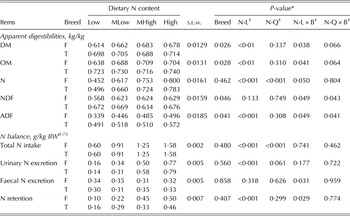
Apparent digestibilities of DM, organic matter (OM), NDF and ADF were higher in Tibetan than fine-wool sheep (Table 2, all P < 0·05), but there was no difference (P > 0·10) between breeds in N digestibility. Significant interactions were observed in the digestibilities of DM, OM, NDF and ADF (all P < 0·05), where the digestibilities were higher in the Tibetan than fine-wool sheep when fed the Low, MLow and High N diets, but no difference under the MHigh N diet. Dry matter, OM, N and ADF digestibilities increased linearly (P < 0·01 or P < 0·001) with increasing dietary N concentrations.
Apparent dietary digestibilities and Nitrogen (N) balance under the different N content diets in Tibetan (T) and fine-wool (F) sheep

DM, dry matter; OM, organic matter; NDF, neutral detergent fibre; ADF, acid detergent fibre.
* d.f. = 1 for breed and 3 for dietary N.
† N-L = linear effect of dietary N; N-Q = quadratic effect of dietary N; N-L × B = interaction of linear dietary N effect with breed; N-Q × B = interaction of quadratic dietary N effect with breed.
Nitrogen retention was greater in Tibetan than in fine-wool sheep when the animals were fed Low and MLow N diets (linear interaction, P < 0·05). However, there was no difference between breeds in urinary and faecal N excretion (Table 2, both P > 0·10). With an increase in the concentration of dietary N, urinary N and N retention increased linearly (both P < 0·001), but faecal N did not change (P > 0·10).
Rumen fermentation characteristics
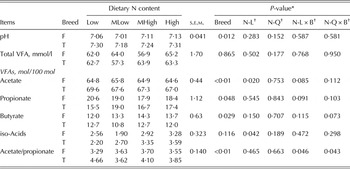
Rumen pH was greater in Tibetan than fine-wool sheep (Table 3, P < 0·05); however, total VFA concentrations were similar (P > 0·10). Molar proportions of acetate were higher (P < 0·01) but those of propionate and butyrate lower (both P < 0·05) in Tibetan than fine-wool sheep. The ratio of acetate to propionate was greater in Tibetan than fine-wool sheep except when the animals received the MLow N diet (linear interaction, P < 0·05).
Ruminal pH and volatile fatty acids produced during rumen fermentation in Tibetan (T) and fine-wool (F) sheep offered different nitrogen (N) content diets

VFA, volatile fatty acid.
* d.f. = 1 for breed and 3 for dietary N.
† N-L = linear effect of dietary N; N-Q = quadratic effect of dietary N; N-L × B = interaction of linear dietary N effect with breed; N-Q × B = interaction of quadratic dietary N effect with breed.
Rumen pH, acetate to propionate ratio and total VFA concentrations were not affected by dietary N (all P > 0·10). Molar proportions of branched VFAs increased linearly (P < 0·05) while acetate decreased linearly (P < 0·05) as dietary N increased, but molar proportions of propionate and butyrate did not change with dietary N (P > 0·10).
Ruminal nitrogen components and urea-nitrogen concentrations
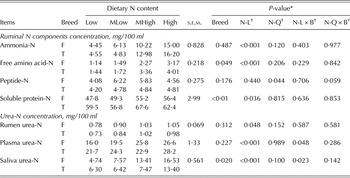
Concentrations of ruminal free amino acid-N and soluble protein-N were greater in Tibetan than fine-wool sheep (Table 4, P < 0·05 or P < 0·01), but concentrations of ammonia-N and peptide-N were similar in these two breeds (P > 0·10). Plasma urea-N was higher in Tibetan sheep under Low and MLow N diets, but higher in the fine-wool sheep under the MHigh N diet (linear interaction, P < 0·05). Saliva urea-N was greater in Tibetan sheep when the animals were fed the Low N diet, but was greater in the fine-wool sheep when fed the other three diets (linear interaction, P < 0·05). There was no difference in rumen urea-N concentration between breeds (P > 0·10).
Effect of dietary nitrogen (N) intake on body fluid N fractional concentrations in Tibetan (T) and fine-wool (F) sheep

* d.f. = 1 for breed and 3 for dietary N.
† N-L = linear effect of dietary N; N-Q = quadratic effect of dietary N; N-L × B = interaction of linear dietary N effect with breed; N-Q × B = interaction of quadratic dietary N effect with breed.
With an elevation of dietary N concentration, ruminal ammonia-N, free amino acid-N and soluble protein-N concentrations increased linearly (P < 0·05 or P < 0·001), and the peptide-N concentration increased quadratically (P < 0·05). Plasma, saliva and rumen urea-N concentrations increased linearly as dietary N content increased in both breeds (P < 0·05 or P < 0·001).
DISCUSSION
Both sheep breeds were adapted to the conditions of the Qinghai-Tibetan Plateau. However, under local husbandry conditions, indigenous Tibetan sheep only graze on the Qinghai-Tibetan Plateau, which is characterized by sparse vegetation of low protein content in the cold season, whereas fine-wool sheep must receive concentrate supplement during the cold winter in order to survive (Li Reference Li2011). It was predicted that Tibetan sheep would be better able to cope with low N and energy intakes than fine-wool sheep and, consequently, the main focus was to compare responses of the two breeds. Under natural grazing conditions, the sheep could encounter both low N and energy intakes concomitantly. However, in the current study, N intake differed among treatments while energy intake remained constant. Nonetheless, the results indicated that the predictions were supported. Tibetan sheep retained significantly more N than fine-wool sheep at the two lowest N intakes. This occurred even though the difference between breeds in either urine N or faecal N output did not reach significance; however, the combined outputs did. Nitrogen retention for Tibetan sheep was 0·16 g/kg BW0·75 and for fine-wool sheep was 0·10 g/kg BW0·75 when fed the Low N diet of only 0·60 g/kg BW0·75. This N content intake was lower than the 0·76 g/kg BW0·75 recommended by NRC (1985) to meet maintenance N requirements for growing sheep of 50 kg. In addition, apparent digestibilities of DM, OM, NDF and ADF were higher in Tibetan than fine-wool sheep, especially on the low N diets, which suggests that Tibetan sheep could cope better on lower energy feed. These higher digestibilities in Tibetan sheep than fine-wool sheep may have been due to differences such as microbial populations, cellulolytic activity in the micro-organisms (Kayouli et al. Reference Kayouli, Jouany, Demeyer, Ali-Ali and Dardillat1993), particle retention time in the rumen, rumen volume, turnover time and recycling of urea-N.
Apparent N, DM, OM and ADF digestibilities increased in both breeds with an increase in dietary N. Part of the increase in protein digestibility could have been due to the addition of soya at a greater level than maize. Protein in soya is highly degradable in the rumen whereas the protein in maize is relatively undegradable in the rumen. Increases in apparent DM and OM digestibilities with an increase in dietary N have also been reported in other sheep breeds, goats and dairy heifers (Hoffman et al. Reference Hoffman, Esser, Bauman, Denzine, Engstrom and Chester-Jones2001; Marini & Van Amburgh Reference Marini and Van Amburgh2003; Zanton & Heinrichs Reference Zanton and Heinrichs2009; Carro et al. Reference Carro, Cantalapiedra-Hijar, Ranilla and Molina-Alcaide2012). These results, however, were not unequivocal as some studies reported that apparent DM and OM digestibilities were not affected by dietary N intake (Molina-Alcaide et al. Reference Molina-Alcaide, Martín García and Aguilera2000; Fimbres et al. Reference Fimbres, Kawas, Hernández-Vidal, Picón-Rubio and Lu2002; Cantalapiedra-Hijar et al. Reference Cantalapiedra-Hijar, Yáñez-Ruiz, Martín-García and Molina-Alcaide2009). The increase in ADF digestibility with an increase in dietary N intake observed in the current study was also reported by Broderick (Reference Broderick2003), who concluded that the higher N resources enhanced hemicellulose digestibility and the activity of cellulose-decomposing microorganisms. It was reported that the optimal pH for maintaining normal cellulolysis ranged between 6·2 and 7·2 (Van Soest Reference Van Soest1994) and that cellulolytic bacteria were inhibited when pH decreased below 6·2 (Grant & Mertens Reference Grant and Mertens1992). The rumen pH of the fine-wool sheep (7·01–7·13) fell within the optimal range but that of the Tibetan sheep (7·18–7·31) was greater. Nonetheless, Tibetan sheep were able to digest NDF and ADF to a greater extent than the fine-wool sheep.
There was no difference between breeds in total VFAs. However, molar proportions of VFAs differed between breeds, even though they consumed the same diets and, consequently, should have produced the same molar proportions of VFAs. This suggests that a divergence in fermentation pathways occurred, which was also reported in intra-specific studies between Bedouin goats and Saanan goats (Silanikove et al. Reference Silanikove, Tagari and Shkolnik1993) and in inter-specific studies between deer and sheep (Hervás et al. Reference Hervás, Ranilla, Mantecón, Tejido and Frutos2005). Bedouin goats and deer, animals better adapted to sparse vegetation and low protein levels than their counterparts, had lower acetate/propionate ratios. This led Hervás et al. (Reference Hervás, Ranilla, Mantecón, Tejido and Frutos2005) to conclude that a lower acetate/propionate ratio in deer ‘reflect a more efficient microbial N assimilation and growth in this species’.
It was expected, therefore, that Tibetan sheep would have a lower acetate/propionate ratio than fine-wool sheep; however, this was not the case. Rumen cellulolytic bacteria activities increase with an increase in roughage intake (Huyen et al. Reference Huyen, Wanapat and Navanukraw2012). Acetate production is associated with fibre digestion (Bach et al. Reference Bach, Yoon, Stern, Jung and Chester-Jones1999) and the higher concentration in Tibetan sheep could be a result of their better cellulose digestibility. Propionate and butyrate concentrations increase when the concentrate to roughage ratio increases (Keady & Mayne Reference Keady and Mayne2001; Agle et al. Reference Agle, Hristov, Zaman, Schneider, Ndegwa and Vaddella2010; Felix et al. Reference Felix, Murphy and Loerch2012) and these VFAs were higher in the fine-wool than Tibetan sheep. Differences between breeds, that is, the higher acetate concentration in Tibetan sheep and higher propionate and butyrate concentrations in fine-wool sheep, could perhaps be traced to their husbandry. Tibetan sheep graze on the Qinghai-Tibetan Plateau grassland all year round but fine-wool sheep are offered some concentrate supplementation during the cold seasons. Thus, the microflora and the production of VFAs in fermentative processes may differ and this difference may still be apparent even when offered the same diets. Concentrations of total VFAs in the ruminal fluid did not vary within breeds among the four N content diets, which was in agreement with the study by Cao et al. (Reference Cao, Takahashi and Horiguchi2009). However, it was in contrast with the results of Ipharraguerre et al. (Reference Ipharraguerre, Clark and Freeman2005), who reported that the concentration of VFAs in the ruminal fluid increased with a high N content intake.
Concentrations of amino acid-N and soluble protein-N, which contribute between 0·20 and 0·50 of N for rumen microbial growth (Leng & Nolan Reference Leng and Nolan1984), were greater in Tibetan than fine-wool sheep and, therefore, Tibetan sheep had a larger resource for microbial growth. However, there was no difference between breeds in ruminal ammonia-N concentrations, another important N source for rumen microbial protein synthesis (Hristov & Broderick Reference Hristov and Broderick1994). It was reported that the optimal level of ruminal ammonia-N concentration for efficiency of microbial growth ranged from 5 to 25 mg/100 ml (Preston & Leng Reference Preston and Leng1987), and 15 to 30 mg/100 ml (Perdok & Leng Reference Perdok, Leng, Nolan, Leng and Demeyer1989; Wanapat & Pimpa Reference Wanapat and Pimpa1999). Satter & Slyter (Reference Satter and Slyter1974) found that 5 mg/100 ml ammonia-N were required for optimal efficiency of microbial growth. In general, both breeds were near or higher than 5 mg/100 ml and fell within the range reported by Preston & Leng (Reference Preston and Leng1987). However, concentrations of 20 mg/100 ml were reported to be required for optimal OM degradation (Mehrez et al. Reference Mehrez, Ørskov and McDonald1977).
Concentrations of plasma and saliva urea-N were higher in Tibetan than fine-wool sheep when fed the Low N diet. Plasma-N is related to the urea-N entry rate into the rumen (Kennedy & Milligan Reference Kennedy and Milligan1980) while saliva-N can contribute from 15% (Kennedy & Milligan Reference Kennedy and Milligan1978; Varady et al. Reference Varady, Tashenov, Boda, Fejes and Kosta1979) to 100% (Norton et al. Reference Norton, Murray, Entwistle, Nolan, Ball and Leng1978; MacRae et al. Reference MacRae, Milne, Wilson and Spence1979) of the entry rate. This implies greater urea recycling in Tibetan sheep than fine wool sheep when dietary N was low, which can be vital to their survival as urea recycling plays an important role under conditions of insufficient N and nutrient intakes (Marini & Van Amburgh Reference Marini and Van Amburgh2003; Reynolds & Kristensen Reference Reynolds and Kristensen2008). The higher digestibilities in the Tibetan than fine-wool sheep would provide more energy for recycled N in Tibetan sheep.
It is conceivable that some of the differences observed in N metabolism, rumen fermentation and nutrient digestibilities between breeds in the current study were a result of selection pressure for a certain trait. The most obvious difference between the Tibetan and fine-wool sheep is the wool: coarse and fine, respectively. Fine-wool sheep are selected both for their wool and meat while Tibetan sheep are mainly valued for their meat, and thus there exists different selective pressures for wool between breeds. This may explain some of the between-breed differences, as wool production ‘can influence the supply of nutrients to the host by altering the environment in the rumen to one in which the bacterial population is capable of producing more of a potentially limiting nutrient’ (Oddy Reference Oddy, Lobley, White and Macrae1999). In a within-breed study, sheep selected for high wool growth exhibited higher rumen microbial protein outflow and higher uptake of NH3-N in portal blood than sheep with low wool growth (De Barbieri et al. Reference De Barbieri, Hegarty, Oddy, Barnett, LI and Nolan2014), leading the authors to suggest that ‘genetic selection for wool growth may induce changes in foregut physiology’. Furthermore, sheep selected for high wool growth retained more energy in wool and wool-free body tissue and expended less energy than sheep with low wool growth. The selected sheep turned over, synthesized and degraded more whole body protein and retained more digested N in wool and body tissue than sheep with low wool growth, although these differences due to genotypes did not exist when expressed per N/kg BW0·75 (Li et al. Reference Li, Oddy and Nolan2008). The authors concluded that ‘genetic selection for wool growth has resulted in increased efficiency of dietary protein and energy use for wool production and body tissue growth in these sheep’. It is likely that the lower energy expenditure in the high-wool sheep allowed this group to allocate more protein and energy to wool and body reserves.
The effects on digestive parameters by other single traits, most notably residual feed intake (RFI), have also been examined. Residual feed intake is the difference between actual feed intake and expected feed intake based on maintenance and growth requirements and is considered a measure of feed efficiency, as the lower the RFI the less feed needed for maintenance and growth. Heifers with a low RFI had lower plasma urea N, lower acetate/propionate ratio, higher concentration of propionic acid and lower production of methane than heifers with a high RFI. However, no effect on rumen pH and on apparent in vivo digestibility was found between RFI groups (Fitzsimons et al. Reference Fitzsimons, Kenny, Deighton, Fahey and McGee2013).
All studies on the effects of selection for a single trait on digestive parameters have been done within breeds. Studies between breeds, or even between genera or between species, although perhaps difficult to design, would be of particular interest, as they would indicate whether responses to the trait are common and at what level.
CONCLUSION
It was concluded that Tibetan sheep were better able to cope with low dietary N intake than fine-wool sheep. At low N intakes, N digestibility and retained N were higher in Tibetan than fine-wool sheep. In addition, DM and fibre digestibilities were higher in Tibetan than fine-wool sheep and, consequently, Tibetan sheep had more energy available for recycled urea-N. Concentrations of ruminal free amino acid-N and soluble protein-N were higher in Tibetan than fine-wool sheep and, therefore, Tibetan sheep had a larger resource for microbial growth. Molar proportions of acetate were greater in Tibetan sheep as a result of greater fibre digestion. It was not ruled out that differences in responses between breeds, at least in part, may have been due to different selective pressures on the breeds.
We thank anonymous reviewers and Julian Wiseman for helpful comments and suggestions on an earlier draft. This work was supported by grants from the National Nature Science Foundation of China project 31170378. Thanks to colleagues of the International Centre for Tibetan Plateau Ecosystem Management for valuable help during the experiment. The authors thank D. L. Liu for his help in sampling.