Implications
Dairy cattle represent both economically important livestock species and unique biological models. The recent sequencing of the cattle genome opened a new era of cattle nutrition for applying genomic information to better understand metabolism and nutrition of cattle. Comparison of the cattle genome with other mammalian genomes allowed for detecting cattle-specific metabolic adaptations. Functional genomics (e.g. transcriptomics, proteomics, metabolomics) has proven to be a powerful tool to study the complex interactions as the animal adapts to changes in physiological state and nutritional management. Cattle genomics will be valuable for developing nutritional strategies to improve efficiency and sustainability of milk production as well as quality of dairy products.
Introduction
As animal agriculture has become highly competitive with narrow profit margins, research has focused on improving the quality and efficiency of meat and milk production. For both beef and dairy production enterprises, there is increased recognition that the overall efficiency of nutrient use during growth and lactation is a function of management and environmental factors that result in animal responses coordinated via an explicitly integrated system of genetics, nutrition, immune competence and physiological processes (Hocquette et al., Reference Hocquette, Lehnert, Barendse, Cassar-Malek and Picard2007 and Reference Hocquette, Gondret, Baéza, Médale, Jurie and Pethick2010; Loor, Reference Loor2010; Berry et al., Reference Berry, Meade, Mullen, Butler, Diskin, Morris and Creevey2011). Work in several groups across the world aims to integrate data at the molecular, tissue metabolic and whole-animal level to determine the key control mechanisms that allow dairy and beef animals to be more efficient under a range of nutritional management conditions.
In this regard, the recent sequencing of the cattle (Bos taurus) genome (The Bovine Genome Sequencing and Analysis Consortium, 2009) has opened a new era for studying cattle biology. The sequencing and analysis of the cattle genome revealed some unique biological features of ruminants. The comparative genomic analysis also showed that the cattle genome is a great resource for investigating mammalian genome evolution due to its unique genomic features formed during the course of speciation and adaptation.
The sequencing of the cattle genome has also provided the opportunity to systematically link genetic and metabolic traits of cattle and expand our understanding of ruminant metabolism and underlying mechanisms of metabolic regulation. Metabolic pathways encoded in the cattle genome have been reconstructed for the first time in a farm animal (Seo and Lewin, Reference Seo and Lewin2009), and a web-based cattle-specific pathway genome database and tool, CattleCyc, has been developed providing a platform for studying cattle metabolism using a systems biology approach. This will facilitate the functional analysis of various ‘omics’ data (e.g. transcriptome, proteome, metabolome).
This review consists of mainly three sections. First, our current knowledge of the cattle genome is summarized with emphasis on evolutionary aspects of chromosomal rearrangements occurred in the cattle genome. Second, we describe the current status of metabolic reconstruction of the cattle genome and how to link cattle genome to metabolism. Third, we present an update on nutrition-induced alterations in gene expression profiles aimed at highlighting some of the most recent works in the area of nutritional and physiological genomics in dairy cattle with emphasis on peripartal period and ruminal development, as an example of applying genomic knowledge and tools to cattle nutrition. The aim of this paper is not to summarize the literature in the functional genomics of cattle. Instead, we mainly focus on describing the genomic features relating with the unique biology of cattle that have been revealed by the whole-genome sequencing and analysis of the cattle genome and how the whole-genome information can be linked to the metabolism of dairy cattle in the post-genomic era of dairy cattle nutrition.
Decoding cattle genome
Sequencing of the cattle genome
In 2009, the cattle genome sequencing and assembly was completed (The Bovine Genome Sequencing and Analysis Consortium, 2009). This was the first whole-genome assembly of a species from the order Cetartiodactyla, a distinct order from the human and mouse lineage. Cetartiodactyls appeared about 60 million years ago (Springer et al., Reference Springer, Murphy, Eizirik and O'Brien2003) and show unique variety of adaptive features. For example, cetartiodactyls are the only mammals that are adapted to live in the ocean. In addition, the Tibetan antelope is adapted to survive in very high altitudes and is able to deal with extreme hypoxia. Other cetartiodactyls have interesting features related to genome organization, for example, Indian Muntjac has the lowest number of chromosomes among all karyotyped mammals (Tsipouri et al., Reference Tsipouri, Schueler, Hu, Dutra, Pak, Riethman and Green2008).
Among the livestock species cattle has one of the best and most detailed set of comparative maps available mostly due to their economical importance. Whereas somatic cell hybrid maps and cross-species chromosome painting with the human and other species DNA probes have provided an importantbut patched correspondence between the cattle, human, mouse and pig genomes (Womack and Moll, Reference Womack and Moll1986; Hayes, Reference Hayes1995; Chowdhary et al., Reference Chowdhary, Fronicke, Gustavsson and Scherthan1996; Schmitz et al., Reference Schmitz, Oustry, Vaiman, Chaput, Frelat and Cribiu1998), the real breakthrough in cattle comparative studies began with the introduction of high-resolution ordered radiation hybrid maps (Band et al., Reference Band, Larson, Rebeiz, Green, Heyen, Donovan, Windish, Steining, Mahyuddin, Womack and Lewin2000; Everts-van der Wind et al., Reference Everts-van der Wind, Kata, Band, Rebeiz, Larkin, Everts, Green, Liu, Natarajan, Goldammer, Lee, McKay, Womack and Lewin2004 and Reference Everts-van der Wind, Larkin, Green, Elliott, Olmstead, Chiu, Schein, Marra, Womack and Lewin2005). The cattle genome was assembled to chromosomes using IL-TX RH map at Baylor College of Medicine (Btau_4.0) and BCCRC (British Columbia Cancer Research Center)-integrated fingerprint map at the University of Maryland (UMD 3.1). These assemblies contain the same raw sequence data but differ in N50 contig size, amount of sequence reads placed on the chromosomes and also show a lot of small- and several large-scale chromosome structural differences. These regions represent intervals that need to be explored and fixed during further polishing of the assemblies.
The comparative analysis of the cattle genome has shown that it is a great resource for studying mammalian genome evolution. Unique genome features formed by cattle during the course of speciation and adaptation are reflected in the genome by gene mutations, sequence losses, duplications and repositions due to multiple chromosomal rearrangements that distinguish the cattle genome from other mammalian genomes and a putative mammalian ancestor (Murphy et al., Reference Murphy, Larkin, Everts-van der Wind, Bourque, Tesler, Auvil, Beever, Chowdhary, Galibert, Gatzke, Hitte, Meyers, Milan, Ostrander, Pape, Parker, Raudsepp, Rogatcheva, Schook, Skow, Welge, Womack, O'Brien S, Pevzner and Lewin2005; The Bovine Genome Sequencing and Analysis Consortium, 2009; Larkin et al., Reference Larkin, Pape, Donthu, Auvil, Welge and Lewin2009). On the other hand, when compared to other sequenced mammalian genomes, the cattle genome in some chromosomal regions still represents an ancestral organization, allowing for the detection of evolutionary events that happened in the course of genome evolution in other species (Murphy et al., Reference Murphy, Larkin, Everts-van der Wind, Bourque, Tesler, Auvil, Beever, Chowdhary, Galibert, Gatzke, Hitte, Meyers, Milan, Ostrander, Pape, Parker, Raudsepp, Rogatcheva, Schook, Skow, Welge, Womack, O'Brien S, Pevzner and Lewin2005).
Chromosomal rearrangements and gene evolution
The whole-genome ordered comparative maps identify ∼201 to 211 large homologous synteny blocks (HSBs) between the human and cattle chromosomes (Everts-van der Wind et al., Reference Everts-van der Wind, Larkin, Green, Elliott, Olmstead, Chiu, Schein, Marra, Womack and Lewin2005; The Bovine Genome Sequencing and Analysis Consortium, 2009). Comparable numbers are reported for the comparison of completely sequenced cattle and human genomes with the highest number of 268 HSBs being reported by Zimin et al. (Reference Zimin, Delcher, Florea, Kelley, Schatz, Puiu, Hanrahan, Pertea, Van Tassell, Sonstegard, Marcais, Roberts, Subramanian, Yorke and Salzberg2009). Within HSBs the gene content and order is generally the same between the genomes compared; therefore, the knowledge of the human and mouse gene functions and structures may be very helpful to resolve gene functions in cattle within these intervals. Comparison of the cattle genome with the genomes of other ferungulates (e.g. dog, pig) led to an identification of 124 evolutionary breakpoint regions (EBRs) in the cattle lineage of which 100 are putatively cattle/ruminant specific, 24 are shared by pig and cattle and could be cetartiodactyl/artiodactyl specific. There are nine additional breakpoint regions that are shared by cattle, pig and dog and may represent ancestral ferungulate breakpoint events. Interestingly, cattle chromosome 16 (BTA16) is populated with four ferungulate-specific rearrangements suggesting that those have originated in the common ancestor of Carnivora and Artiodactyla and the ancestral organization of the genomic interval is still preserved in human and other euarchontoglires (The Bovine Genome Sequencing and Analysis Consortium, 2009). Such a low number of superordinal chromosomal rearrangements is in agreement with the previous observation of a low rate of chromosomal rearrangements at the early stages of chromosomal evolution in Eutherian mammals, which is ∼0.1 to 0.2 rearrangement per million year (Murphy et al., Reference Murphy, Larkin, Everts-van der Wind, Bourque, Tesler, Auvil, Beever, Chowdhary, Galibert, Gatzke, Hitte, Meyers, Milan, Ostrander, Pape, Parker, Raudsepp, Rogatcheva, Schook, Skow, Welge, Womack, O'Brien S, Pevzner and Lewin2005) for both ferungulate and euarchontoglires lineages. This rate has significantly increased within different orders after C–T boundary, which marks the end of the Mesozoic era and the beginning of the Cenozoic era, ∼65 million years ago with the highest observed in murid rodents that accumulated ∼141 order-specific rearrangements.
It was shown that the EBRs are often associated with the lineage-specific changes, such as the positions of segmentally duplicated sequences (SDs) in the human genome (Bailey et al., Reference Bailey, Baertsch, Kent, Haussler and Eichler2004; Murphy et al., Reference Murphy, Larkin, Everts-van der Wind, Bourque, Tesler, Auvil, Beever, Chowdhary, Galibert, Gatzke, Hitte, Meyers, Milan, Ostrander, Pape, Parker, Raudsepp, Rogatcheva, Schook, Skow, Welge, Womack, O'Brien S, Pevzner and Lewin2005). Most likely SDs promote EBRs causing non-allelic homologous recombination (NAHR) between chromosomal intervals containing similar SDs. The cattle genome comparative analysis confirms this observation, showing that 10 Kb sequence intervals overlapping with cattle/ruminant evolutionary breakpoints contain approximately seven times more segmentally duplicated bases than the other intervals of the cattle genome. Strikingly, artiodactyl-specific EBRs (shared by the cattle and pig genomes) contained ∼14 times more segmental duplications than other genomic regions suggesting that there are hotspots for the insertion of SDs in atriodactyl genomes (The Bovine Genome Sequencing and Analysis Consortium, 2009).
Another possible source of sequence elements that could cause NAHR and lead to formation of chromosomal rearrangements are recent repetitive sequences in the genome that still hold high sequence similarity and are present in the genome in multiple copies. Indeed, when the density of lineage-specific retrotransposable elements was calculated in the EBRs and the rest of the genome, a strong positive correlation was observed for recent LINE (Long Interspersed Nuclear Elements)-L1 and LINE-RTE elements and EBRs. In the dog and mouse genomes, EBRs were found to be enriched for LTR-ERV1 elements that were recently active in each of these lineages. Another group of repeats, tRNAGlu-derived SINEs (Short Interspersed Nuclear Elements) originated from the common ancestor of all artiodactyls has higher than expected density in artiodactyl-specific breakpoint regions, but not in the cattle-specific breakpoints. This suggests that in mammals evolutionary breakpoints tend to happen in the regions with high density of repetitive elements that are still active and, therefore, have high sequence similarity between different copies required for an NAHR. In confirmation with this conclusion, a negative correlation between density of old retrotransposable elements (such as LINE-L2 and some SINEs) and EBRs in all mammalian genomes was observed suggesting that active insertion of new mobile elements either destroys old repetitive sequences or forms new regions of the genome. In the course of evolution these new intervals could be used as templates for NAHR and form material for chromosome structural changes. Over the evolutionary time different copies of the same mobile element will accumulate different mutations making the sequences not suitable for NAHR anymore. These observations support a recently proposed theory that chromosomal rearrangements in mammalian genomes are occurring in the fragile regions that are subject to birth and death process in different genomes(Alekseyev and Pevzner, Reference Alekseyev and Pevzner2010).
EBRs may be connected to the speciation due to changes in gene regulation and networks they may cause by moving genes to a new regulatory environment (Larkin et al., Reference Larkin, Pape, Donthu, Auvil, Welge and Lewin2009) or causing gene duplications or deletions. Therefore, the detection of lineage-specific features formed in the regions of EBRs could facilitate decoding of the lineage-specific genetics and eventually may be used for effective genomic selection in agricultural species. Indeed, analysis of the cattle and other amniote genomes provides support for the hypothesis of adaptive value of EBRs. For example, Everts-van der Wind et al. (Reference Everts-van der Wind, Kata, Band, Rebeiz, Larkin, Everts, Green, Liu, Natarajan, Goldammer, Lee, McKay, Womack and Lewin2004) reported that evolutionary breakpoints between the cattle and human genomes are significantly enriched for genes. Recently, this observation was confirmed by multi-species genome comparisons (Murphy et al., Reference Murphy, Larkin, Everts-van der Wind, Bourque, Tesler, Auvil, Beever, Chowdhary, Galibert, Gatzke, Hitte, Meyers, Milan, Ostrander, Pape, Parker, Raudsepp, Rogatcheva, Schook, Skow, Welge, Womack, O'Brien S, Pevzner and Lewin2005; Larkin et al., Reference Larkin, Pape, Donthu, Auvil, Welge and Lewin2009). Subsequently, Larkin et al. (Reference Larkin, Pape, Donthu, Auvil, Welge and Lewin2009) have shown that the amniote-specific EBRs are enriched for genes that involve an organism's response to external stimuli. In cattle, a cattle-specific EBR is associated with formation of a new bidirectional promoter that may affect control of expression of the CYB5R4 gene. Another striking connection between the evolutionary breakpoints and gene family expansions in the cattle genome is an expansion and reorganization of a β-defensin gene cluster that encodes antimicrobial peptides in BTA27 and is co-localized with an artiodactyl-specific EBR and large SD. Other genes that are overrepresented in the cattle genome compared to human and mouse include mature cathelicidin peptides, interferon genes (The Bovine Genome Sequencing and Analysis Consortium, 2009) and other genes involved in adaptive immune responses in cattle, suggesting that these adaptive changes could be connected to the microorganisms present in the rumen. Segmental duplications in the cattle genome are enriched for the genes involved in reproduction. These families encode the intercellular signaling proteins pregnancy-associated glycoproteins (on BTA29), trophoblast Kunitz domain proteins (on BTA13) and interferon tau (IFNT; on BTA8). The examples given above show an importance of genomics for understanding of the genomic (gene) features that are unique for cattle due to chromosomal rearrangements and other changes. This knowledge coupled with the appropriate methods of analysis will lead to better strategies for selection, effective nutrition and other improvements of the livestock species.
Linking cattle genome to ruminant metabolism
Metabolic reconstruction in the post-genomic era
Upon completion of genome sequencing, metabolic reconstruction of the sequenced genome is a necessary step toward understanding the metabolism and underlying mechanism of metabolic regulation. Metabolic reconstruction or reconstruction of metabolic pathways of a genome is a process of linking known enzymatic reactions and pathways to annotated genes of the genome (Seo and Lewin, Reference Seo and Lewin2009). There have been many attempts to reconstruct metabolic pathways for a wide variety of organisms, and various bioinformatic tools are available for reconstructing metabolic pathways automatically (see the review by Pitkänen et al. (Reference Pitkänen, Rousu and Ukkonen2010)). For example, the Pathway Tools software package (Karp et al., Reference Karp, Paley, Krummenacker, Latendresse, Dale, Lee, Kaipa, Gilham, Spaulding, Popescu, Altman, Paulsen, Keseler and Caspi2010) has been widely used to generate pathway genome database (PGDB) and reconstruct metabolic pathways for a specific organism. Using the PathoLogic algorithm, Pathway Tools computationally reconstructs organism-specific metabolic pathways and generates a new PGDB by matching the Enzyme Commission number, gene ontology terms and/or the name of the annotated gene product against enzymes in MetaCyc, a manually curated database containing over 1670 pathways from more than 2100 different organisms. BioCyc (http://biocyc.org) is a collection of PGDBs generated using Pathway Tools, and its current version 15.0 contains 1129 organism-specific PGDBs of which 35 PGDBs have been through intensive manual curation as of March, 2011. Most of PGDBs and metabolic reonstructions present in Biocyc are those from bacterial genomes. Among the mammals, PGDBs in BioCyc exist only for human, mouse and cattle, and Cattlecyc, cattle-specific PGDB, is the first metabolic reconstruction for the farm animals.
Although metabolic reconstruction using Pathway Tools is very useful for the initial step, a computationally generated metabolic reconstruction needs further manual review by a person to remove false-positive pathway predictions and fill the gaps that cannot be done only with computations. For example, Seo and Lewin (Reference Seo and Lewin2009) found that 53% of pathways in the initial automated reconstruction for cattle needed to be deleted or modified, and manually modified or created 66 mammalian-specific metabolic pathways from the reference pathways in MetaCyc. Accumulated knownledge about mammalian enzymatic reactions and metabolic pathways and deposition of these information in biological databases (e.g. MetaCyc) will reduce the time- and labor-intensive effort needed to reconstruct metabolic pathways for other mammals.
Metabolic reconstruction of the cattle genome
Seo and Lewin (Reference Seo and Lewin2009) reconstructed metabolic pathways of the cattle genome and developed cattle-specific PGDB based on Btau_3.1, named as CattleCyc. For the metabolic reconstruction, an amalgamated cattle genome database that incorporated all the available functional annotation information for cattle genes and proteins from multiple sources of biological databases, for instance, NCBI (http://www.ncbi.nlm.nih.gov), Ensembl (http://www.ensembl.org), UniProt (www.uniprot.org) and KEGG (www.genome.jp/kegg/). Metabolic pathways encoded in the cattle genome were then identified using Pathway Tools, followed by comprehensive manual curation based on scientific literature. To identify unpredicted metabolic pathways and fill the gaps of functional annotation of cattle genes due to lack of experimental evidence, a comparative and metabolic-centered approach was used (Seo and Lewin, Reference Seo and Lewin2009).
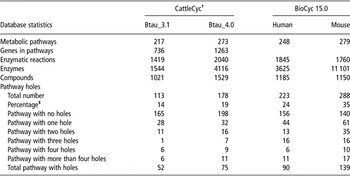
The CattleCyc consists of 217 metabolic pathways that contain 736 genes involving 825 distinct enzymatic reactions, 1544 enzymes, 1442 biochemical reactions and 1021 compounds. A total of 113 pathway holes, which are defined as reactions in which the organism-specific enzyme has not yet been identified, were present among 52 pathways. The total number of pathway holes as a percentage of total reactions in pathways was 14%, which was higher than EcoCyc 11.0 (5%), but lower than HumanCyc 11.0 (36%).
Comparative analysis of metabolic pathways revealed that core metabolic pathways are highly conserved at both the enzyme and functional levels in cattle and Escherichia coli. Most highly conserved pathways are related to nucleotide/nucleoside metabolism, lipid metabolism, glucose metabolism and energy-generating metabolism, whereas amino acids metabolism were relatively less conserved.
Another interesting finding from cattle metabolic reconstruction was that there was no evidence for the existence of mammalian genes encoding 22 metabolic enzymes for which activity was reported in the literature. As Seo and Lewin (Reference Seo and Lewin2009) suggested, this may be due to either incomplete functional annotation of mammalian genomes or contamination of samples with enzymes originating from other compartments of the cell or non-mammals.
Recently, CattleCyc has been updated with the current genome build Btau_4.0 (Kim et al., Reference Kim, Lee and Seo2010 and Reference Kim, Lee and Seo2011). They developed a new bioinformatic pipeline of constructing an amalgamated genome annotations with a revised matching algorithm. The CattleCyc based on Btau_4.0 contains more metabolic pathways and annotated genes to pathways than the old version (Table 1), and it is well curated compared to HumanCyc and MouseCyc considering the total number of pathway holes as a percentage of total reactions in pathways.
Comparison of selected organism-specific pathway genome databases

†Cattle-specific pathway genome database constructed based on Btau_3.1 and Btau_4.0.
‡Pathway holes as a percentage of total reactions in pathways.
Metabolic evolution of cattle by loss and gain of metabolic genes
Metabolic genes tend to be more retained than other non-metabolic genes during chromosomal evolution (Aury et al., Reference Aury, Jaillon, Duret, Noel, Jubin, Porcel, Ségurens, Daubin, Anthouard, Aiach, Arnaiz, Billaut, Beisson, Blanc, Bouhouche, Câmara, Duharcourt, Guigo, Gogendeau, Katinka, Keller, Kissmehl, Klotz, Koll, Le Mouël, Lepère, Malinsky, Nowacki, Nowak, Plattner, Poulain, Ruiz, Serrano, Zagulski, Dessen, Bétermier, Weissenbach, Scarpelli, Schächter, Sperling, Meyer, Cohen and Wincker2006; Gout et al., Reference Gout, Duret and Kahn2009), and loss of genes involving a metabolic pathway can inactivate the function of the specific pathway. Identification of evolutionary loss and gain of metabolic genes in the cattle genome may thus reflect cattle and ruminant metabolic adaptations.
To verify this hypothesis, we analyzed the distribution of the metabolic gene set (1263 genes) in Btau_4.0 regarding the positions of cattle/ruminant/artiodactyl EBRs and found a significant negative association between the positions of these genes and EBRs (P-value <0.00001, unpublished results by Seo S and Larkin DM). This suggests that the majority of matabolic genes in the cattle genome will be found in the chromosomal regions corresponding to the mammalian ancestral genome and have conserved function and regulation.
Comparative analysis of metabolic genes in mammals found that among 1032 genes in human metabolic pathways only five genes were deleted or extensively diverged in the cattle genome: PLA2G4C (phospholipase A2, group IVC), FAAH2 (fatty acid amide hydrolase 2), IDI2 (isopentenyl-diphosphate delta isomerase 2), GSTT2 (glutathione S-transferase theta 2) and TYMP (thymidine phosphorylase) (The Bovine Genome Sequencing and Analysis Consortium, 2009). PLA2G4C, for example, is involved in phospholipid metabolism and plays a pivotal role in inflammation and the development of neoplasms. Phylogenetic analysis indicated that PLA2G4C was deleted ∼87 to 97 million years ago in the Laurasiatherian lineages. Absence of these five genes may imply cattle-specific adaptions in phospholipid metabolism, fatty acid metabolism, the mevalonate pathway (synthesis of prenylated proteins, dolichols, vitamins A, D, E and K, steroid hormones, carotenoids, bile acids and cholesterol), detoxification and pyrimidine metabolism, respectively.
Duplication of metabolic genes was also found in the cattle genome compared to the human and mouse genomes (Kim et al., Reference Kim, Lee and Seo2011). Comprehensive analysis revealed seven single-copied metabolic genes in the human and mouse genomes are present in duplicate in the cattle genome: AANAT (arylalkylamine N-acetyltransferase), ACADM (acyl-coenzyme A dehydrogenase, C-4 to C-12 straight chain), BPGM (2,3-bisphosphoglycerate mutase), COASY (coenzyme A synthase), HAAO (3-hydroxyanthranilate 3,4-dioxygenase), ODC1 (ornitine decarboxylase 1), SOD1 (superoxide dismutase 1), which may impact on 13 metabolic pathways. For example, 2,3-bisphosphoglycerate mutase (BPGM) is involved in glucose metabolism (glycolysis and gluconeogenesis) and ACADM encodes an enzyme for branched-chain amino acid degradation, alanine biosynthesis and fatty acid β-oxidation. The duplicated metabolic genes in the cattle genome also suggest additional metabolic adaptations of cattle.
Metabolic reconstruction to biological insights
Although reconstructed metabolic pathways per se provide little biological insights, development of metabolic networks or metabolic reconstruction is a foundation for the use of genomic information toward understanding the metabolism and metabolic regulations using a systems biology approach. A systems biology approach integrates ‘-omics’ information holistically, and the networks and interactions are being investigated in silico, performed on computer or via computer simulation (Kitano, Reference Kitano2002). Integration and collaborative effort between modern molecular techniques and computational biology are thus critical in systems biology.
There are two ways of applying metabolic reconstruction to decipher underlying mechanism of metabolic regulations: (i) development of mathematical models to simulate the behavior of a specific cellular system with genetic or physiological pertubation (Thiele and Palsson, Reference Thiele and Palsson2010); and (ii) integration of high-throughput ‘-omics’ data to discover biological signatures in nutritional, physiological and/or pathological responses (Loor, Reference Loor2010; Peddinti et al., Reference Peddinti, Memili and Burgess2010). Ruminant nutritionists are familiar with the former approach; mathematical modeling of metabolism. Professor R. L. Balwin was a pioneer of dynamic modeling in ruminant metabolism (Baldwin, Reference Baldwin1995). His models, however, are a tissue level of integration and much dependent on the activities of enzymes in metabolic pathways. A genome-scale model that can elucidate metabolic regulation in a cellular level has not been developed for cattle or other farm animals. So far, the most active area of applying genomic information in cattle nutrition is the latter approach. There have been attemps to identify transcriptomic differences and changes in gene and metabolic networks for different nutritional or physiological states by profiling of gene expression using a DNA microarray or recently RNA sequencing. The analyses in this type of studies normally include statistical identification of differentially expressed genes (DEGs) based on false discovery rate (FDR; Benjamini and Hochberg, Reference Benjamini and Hochberg1995), identification of overrepresented gene sets defined based on prior biological knowledge (e.g. gene ontology, metabolic pathways) by Gene Set Enrichment Analysis (Subramanian et al., Reference Subramanian, Tamayo, Mootha, Mukherjee, Ebert, Gillette, Paulovich, Pomeroy, Golub, Lander and Mesirov2005) and clustering analysis for identifying a pattern of enriched gene sets (Eisen et al., Reference Eisen, Spellman, Brown and Botstein1998). The approach, however, is not suitable for identifying cause and effect relationships, but for accessing correlation or coexpression of genes.
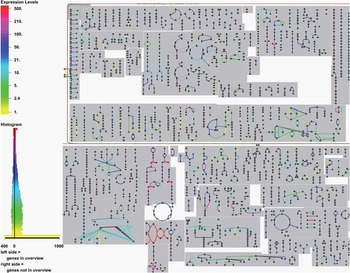
CattleCyc also provides the Omics Viewer to visualize overview of metabolic networks incorporating ‘omics’ data. Using this tool, the bovine milk transcriptome data using RNA-seq technology (Cánovas et al., Reference Cánovas, Rincon, Islas-Trejo, Wickramasinghe and Medrano2010) are incorporated into reconstructed metabolic pathways of the cattle genome build 4.0, and visualize over-expressed genes and pathways based on the average reads per kilobase per million mapped reads (Figure 1). Compared to 90 and 250 days in milk, milk transcriptome at 15 days in milk showed significant over-expression of lipid biosynthesis pathway (unpublished results).
The cellular overview diagram for Bos taurus from the CattleCyc based on Btau_4.0. Expression of mRNA, obtained from milk somatic cells of Holstein lactating dairy cows at 15 days in milk, was assessed by RNA-seq and visualized using the Omics Viewer. Expression ratios indicates the average reads per kilobase per million mapped reads of three cows for the corresponding gene. The top-right section is lipid biosynthesis pathways (unpublished results).

Applying genomics to understand nutrition and physiology of dairy cattle using a systems biology approach
The peripartal period: key stage of the lactation cycle
Achieving homeostasis during the transition from late pregnancy to lactation represents a monumental task in modern dairy cows. Changes in the direction and magnitude of various pathways of long-chain fatty acid (LCFA), glucose and amino acid metabolism, as cows go from late pregnancy through lactation have been well-described during the past 20 years (reviewed recently by Drackley et al., Reference Drackley, Donkin and Reynolds2006). Besides the well-established knowledge, more recent data have underscored the link between negative energy balance (NEB), oxidative stress and inflammation (Bertoni et al., Reference Bertoni, Trevisi and Lombardelli2009). This period of the lactation cycle clearly is one where inter-tissue coordination must be tightly regulated so the animal can make a smooth transition into lactation, that is, free of metabolic or infectious disease.
Nutrition and NEB effects on liver molecular adaptations
In non-ruminants, the differentiation of hepatocytes and the function of the adult liver are controlled through the coordinated expression of a large number of genes (Columbano and Ledda-Columbano, Reference Columbano and Ledda-Columbano2003). Therefore, transcriptomics analyzed through bioinformatics tools are ideal to help identify regulatory mechanisms in the bovine liver that are sensitive to nutrient balance during the transition from pregnancy to lactation.
A recent review from Loor (Reference Loor2010) has summarized findings from transcriptomics of liver and adipose in transition dairy cows up to the year 2009. More recently, McCarthy et al. (Reference McCarthy, Waters, Kenny, Diskin, Fitzpatrick, Patton, Wathes and Morris2010) evaluated transcriptional adaptations in liver of early postpartal cows classified as being under severe NEB (SNEB) relative to cows experiencing mild NEB. Loor et al. (Reference Loor, Bionaz and Invernizzi2011) also reanalyzed the combined data set from Loor et al. (Reference Loor, Dann, Everts, Oliveira, Green, Guretzky, Rodriguez-Zas, Lewin and Drackley2005 and Reference Loor, Dann, Guretzky, Everts, Oliveira, Green, Litherland, Rodriguez-Zas, Lewin and Drackley2006), which dealt with groups of cows fed diets ad libitum to exceed net energy requirements (∼140% of requirements), cows restricted to provide less than estimated requirements (∼80%) or cows fed to meet (∼100%) the calculated energy requirements during the dry period. When the individual data sets (Loor et al., Reference Loor, Dann, Everts, Oliveira, Green, Guretzky, Rodriguez-Zas, Lewin and Drackley2005 and Reference Loor, Dann, Guretzky, Everts, Oliveira, Green, Litherland, Rodriguez-Zas, Lewin and Drackley2006) were combined and reanalyzed statistically more than 4790 DEG (FDR ⩽ 0.05) due to the interaction of treatment × time were found (Loor et al., Reference Loor, Bionaz and Invernizzi2011).
The functional analysis of the clusters in the data set of Loor et al. (Reference Loor, Dann, Everts, Oliveira, Green, Guretzky, Rodriguez-Zas, Lewin and Drackley2005) and Loor et al. (Reference Loor, Dann, Guretzky, Everts, Oliveira, Green, Litherland, Rodriguez-Zas, Lewin and Drackley2006) identified several overrepresented functions (Loor et al., Reference Loor, Bionaz and Invernizzi2011). Among the responses observed it was evident that clusters characterized by a strong downregulation in both overfed and restricted-fed v. control cows were overrepresented with terms related to induction of inflammation, suggesting that both management approaches led to downregulation of genes involved in the inflammatory response and in particular the complement pathway (Loor et al., Reference Loor, Bionaz and Invernizzi2011). The Ingenuity Pathway Analysis® (IPA; Ingenuity Systems, Redwood City, CA, USA) also revealed an enrichment of the acute-phase response, including several signaling pathways involving nuclear receptors that control cholesterol synthesis (e.g. farnesoid X-activated receptor and liver X receptor-β). Those findings and the coordinated downregulation of inflammatory response-associated genes by either overfeeding or restricting dietary energy prepartum were novel (Loor et al., Reference Loor, Bionaz and Invernizzi2011). These results contrast with those of McCarthy et al. (Reference McCarthy, Waters, Kenny, Diskin, Fitzpatrick, Patton, Wathes and Morris2010) who reported a marked upregulation of inflammation-related and metabolic disease-related genes in cows under SNEB. The complement system components are synthesized (∼90%) by liver and participate in the activation of the immune system (Qin and Gao, Reference Qin and Gao2006). The biological consequence of downregulation of the complement system would be a reduction in inflammatory-like responses after parturition compared to control cows. The inflammatory-like conditions typical in peripartal cows have detrimental influence on performance (Bertoni et al., Reference Bertoni, Trevisi and Lombardelli2009); thus, the reduction of the complement system should have prevented or reduced the postpartal inflammatory-like response. It appears from the above studies that ‘nutritional stress’ and ‘metabolic stress’ seem to be characterized by widely different responses at the level of liver and likely encompass alterations in peripheral signals including cytokines, metabolites and/or hormones.
The functional analysis using DAVID, a freely accessible web-based bioinformatics tool (Huang et al., Reference Huang, Sherman, Zheng, Yang, Imamichi, Stephens and Lempicki2009), of the clusters with a greater temporal increase in expression in liver of energy-restricted v. energy-overfed or control cows highlighted a significant enrichment of terms related to catabolic activity of mitochondria (e.g. oxidative phosphorylation) and protein synthesis (Loor et al., Reference Loor, Bionaz and Invernizzi2011). Those results indicated a coordinated upregulation of catabolic activity by restricted energy feeding prepartum. In particular, genes such as carnitine palmitoyltransferase 1A, acyl-CoA dehydrogenase very long chain, acetyl-CoA acyltransferase 1 and cytochrome P450 family 3 subfamily A polypeptide 4 were upregulated by restricted energy feeding prepartum (Loor et al., Reference Loor, Bionaz and Invernizzi2011).
Those responses were similar to what was found by McCarthy et al. (Reference McCarthy, Waters, Kenny, Diskin, Fitzpatrick, Patton, Wathes and Morris2010) in liver of SNEB. However, because restricted-energy fed cows did not experience fatty liver relative to energy-overfed cows (Loor et al., Reference Loor, Dann, Guretzky, Everts, Oliveira, Green, Litherland, Rodriguez-Zas, Lewin and Drackley2006) it is apparent that different signals are capable of triggering the same metabolic adaptations in liver, for example, cows with severe nutrition-induced ketosis early postpartum also upregulate fatty acid catabolism pathways in liver (Loor et al., Reference Loor, Everts, Bionaz, Dann, Morin, Oliveira, Rodriguez-Zas, Drackley and Lewin2007). A novel observation in cows fed restricted-energy prepartum was the enrichment of antigen processing and presentation pathways enriched in a cluster of clearly upregulated genes. The coordinated increase in expression of genes involved in antigen processing and presentation indicates a significant degree of responsiveness of liver from energy-restricted cows to the presence of antigens, followed by an immune response (Loor et al., Reference Loor, Bionaz and Invernizzi2011). From a practical standpoint it can be concluded that energy under- and over-nutrition during the prepartal period can be equally effective in altering the hepatic transcriptome and particularly functions related with immune function.
Dietary lipid and liver molecular targets
A recent review highlighted the potential applicability of dietary LCFAs as management tools to alter functional pathways in peripartal liver in a positive fashion (Loor, Reference Loor2010). An initial characterization of liver transcriptional adaptations to saturated v. polyunsaturated fatty acid supplementation at −10, 1 and ∼14 days relative to parturition with a bovine microarray (Loor et al., Reference Loor, Everts, Bionaz, Dann, Morin, Oliveira, Rodriguez-Zas, Drackley and Lewin2007) has revealed some unique adaptations (Khan et al., Reference Khan, Schmitt, Ballou, DePeters, Rodriguez-Zas, Everts, Lewin, Drackley and Loor2010). Treatment diets were fed from 21 days before expected date of parturition until ∼10 days after parturition (Ballou et al., Reference Ballou, Gomes, Juchem and DePeters2009). The dose of lipid prepartum was 250 g/day, whereas the dose in the postpartum period was ∼0.9% of the previous day's dry matter intake.
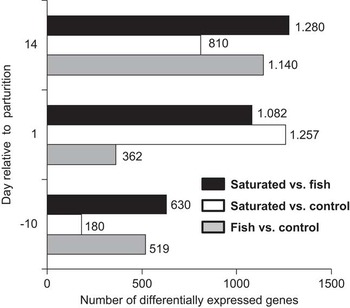
Preliminary data evaluation revealed that supplemental fish oil had a greater effect than saturated lipid v. control on the liver transcriptome before parturition (Figure 2). Quite surprisingly, the opposite was observed 1 day after parturition, when data indicated that saturated lipid v. control resulted in ∼1200 genes affected compared with only 362 in response to fish oil (Figure 2). It was remarkable that saturated lipid v. fish oil led to greater changes in gene expression that might have been expected. Furthermore, that response was consistent at each of the time points studied (Figure 2).
Differentially expressed genes (DEG; FDR < 0.04) in liver due to treatment × time in cows fed a control diet or a diet supplemented with saturated lipid or fish oil from −21 days through ∼10 days relative to parturition (Khan et al., Reference Khan, Schmitt, Ballou, DePeters, Rodriguez-Zas, Everts, Lewin, Drackley and Loor2010; FDR = false discovery rate).

Using IPA for the preliminary bioinformatics analysis has revealed that among the categories that were affected significantly at 1 day after parturition dietary fish oil v. control led to more marked upregulation of genes associated with cellular growth and proliferation compared with feeding saturated lipid, that is, despite eliciting a seemingly ‘minor’ effect overall the very long-chain polyunsaturated fatty acids (VLPUFA) characteristic of fish oil or their biohydrogenation intermediates (e.g. trans-18:1) were more potent in eliciting adaptations in ‘basic’ cellular responses. From a physiological standpoint it has been clearly established in non-ruminants that VLPUFA (or their metabolites, e.g. eicosanoids) can have dramatic effects on metabolic pathways in liver (Jump, Reference Jump2011). Whether similar effects are expected to occur in ruminants due to VLPUFA or their biohydrogenation intermediates remains unknown. From a practical standpoint, use of VLPUFA in peripartal diets may be challenging due to (i) the extensive biohydrogenation of these LCFA; (ii) lack of knowledge of the optimal dose to feed; and (iii) lack of adequate ruminal protection technologies for these LCFA. Despite these limitations, we believe that dietary lipids have potential applications in peripartal diets; however, more studies in this area will have to be performed.
The adipose transcriptome during the peripartal period
Relatively few nutrigenomics studies have been carried out in livestock using high-throughput technologies and most have made limited use of bioinformatics. A recent experiment from the University of Illinois (Janovick et al., Reference Janovick, Loor, Ji, Everts, Lewin, Rodriguez-Zas and Drackley2009; Loor et al., Reference Loor, Bionaz and Invernizzi2011) studied the transcriptomics adaptations of bovine subcutaneous adipose tissue from the beginning of pregnancy through early lactation in cows fed diets designed to meet (∼100% of net energy requirements; 1.21 Mcal/kg diet dry matter) or exceed (∼150%; 1.63 Mcal/kg diet dry matter, i.e. energy-overfed) energy requirements during the entire dry period (∼65 days; Janovick and Drackley, Reference Janovick and Drackley2010). The higher-energy diet led to greater accumulation of body fat, as measured by body condition score (Janovick and Drackley, Reference Janovick and Drackley2010), and robust transcriptional adaptations with more than 3000 DEG affected (FDR ⩽ 0.05) by the interaction of time × diet (Janovick et al., Reference Janovick, Loor, Ji, Everts, Lewin, Rodriguez-Zas and Drackley2009, Loor et al., Reference Loor, Bionaz and Invernizzi2011). In response to the higher-energy diet prepartum and using a cut-off of P ⩽ 0.01 for the comparison between diets at each time point plus the FDR-corrected P-value ⩽0.05 for the interaction effect, analysis uncovered >1500 DEG at 2 weeks prepartum, < 100 at 1 day after calving, and ∼200 DEG at 2 weeks postpartum compared to control (i.e. diet to meet 100% of energy requirements). These longitudinal adaptations suggested that the transcriptome responded quickly to prepartal energy overfeeding but there was little carryover effect after parturition (Loor et al., Reference Loor, Bionaz and Invernizzi2011). From a practical standpoint, these data suggest that energy overfeeding prepartum (as is common in the field) may lead to substantial fat accumulation not only in subcutaneous fat but also in visceral fat. The end result would be greater release of LCFA from these depots after parturition and a consequent increase in blood NEFA that could be deleterious to liver function.
Using bioinformatics tools it was evident that the higher-energy diet had a strong impact on metabolism and other cellular functions compared to the diet meeting energy requirements (Loor et al., Reference Loor, Bionaz and Invernizzi2011). In cows overfed energy compared to controls, analysis of pathways using the Kyoto Encyclopedia of Genes and Genomes (KEGG), the Database for Annotation, Visualization and Integrated Discovery (DAVID), and IPA indicated a large activation of energy metabolism and lipid synthesis, including de novo fatty acid synthesis (Loor et al., Reference Loor, Bionaz and Invernizzi2011). The analysis also indicated a pivotal role of PPAR signaling and a larger induction of protein synthesis in the adipose tissue of overfed cows. Interestingly, almost all the KEGG pathways were induced in adipose tissue of energy-overfed cows at 2 weeks before parturition but those pathways were strongly inhibited in the same group at parturition (i.e. +1 v. −14 days relative to parturition), suggesting that they are tightly controlled by homeorhetic adaptations required for energy repartitioning at the onset of lactation (Drackley et al., Reference Drackley, Donkin and Reynolds2006).
Network analysis uncovered large interactions among differentially expressed genes in the comparison of the higher energy to the requirement diet at −14 days from parturition. Among transcription factors in the network CCAAT/enhancer-binding protein-α and β (CEBPA and CEBPB), both upregulated by overfeeding energy at −14 days, produced the transcriptional networks with the largest number of DEG suggesting that these transcription factor are central in orchestrating prepartal adipose transcriptional adaptations to high-energy diet (Loor et al., Reference Loor, Bionaz and Invernizzi2011). The role of PPAR-γ appears to be central because of the large number of lipogenic target genes that were affected (see Loor (Reference Loor2010) for a description of them). A recent microarray study (Sumner-Thomson et al., Reference Sumner-Thomson, Vierck and McNamara2011) identified LPL and fatty acid-binding protein 4 (FABP4) as two of the most highly abundant genes in prepartum (approximately −30 days) adipose tissue of dairy heifers (Sumner-Thomson et al., Reference Sumner-Thomson, Vierck and McNamara2011). Among those genes increasing in expression postpartum were those controlling lipolysis, including ADRB2 and LIPE. Not surprisingly, expression of genes coding for enzymes controlling lipogenesis decreased including SREBF1, THRSP, LPL and ACACA. Rodent studies have shown that most of the affected genes in adipose around parturition are PPAR-γ targets and, as a whole, are required for adipocyte differentiation as well as lipid filling of the mature adipocyte (Rosen and MacDougald, Reference Rosen and MacDougald2006). From a practical standpoint, the finding that PPAR (a nutrient sensor) seems to play an important role in adipose tissue adaptations to dietary energy suggests that uncovering nutrients (e.g. LCFA) which can potentially regulate this pathway will be of value.
Bovine uterine transcriptional adaptations during negative energy balance
In addition to increased susceptibility for developing metabolic diseases postpartum, cows often develop persistent endometritis which in the long-term is associated with reduced fertility (Wathes et al., Reference Wathes, Cheng, Chowdhury, Fenwick, Fitzpatrick, Morris, Patton and Murphy2009). A recent study provided an initial evaluation of the uterine transcriptome in cows under SNEB postpartum. Using IPA it was observed that uterine tissue from SNEB cows had a marked enrichment of genes associated with immune response and inflammation (Wathes et al., Reference Wathes, Cheng, Chowdhury, Fenwick, Fitzpatrick, Morris, Patton and Murphy2009). Among the most affected genes within inflammation were matrix metalloproteinases, chemokines, cytokines and calgranulins. Expression of several interferon-inducible genes including ISG20, IFIH1, MX1 and MX2 also were markedly upregulated due to SNEB. Along with the marked activation of immune- and inflammation-related genes, they observed a marked reduction of white blood cell count and lymphocyte number in SNEB cows. These results provide evidence that cows in SNEB were still undergoing an active uterine inflammatory response 2 weeks postpartum; whereas, mild NEB cows had more fully recovered from their energy deficit, with their endometrium reaching a more advanced stage of repair (Wathes et al., Reference Wathes, Cheng, Chowdhury, Fenwick, Fitzpatrick, Morris, Patton and Murphy2009).
Several of the genes that were highly downregulated due to SNEB are involved in cell proliferation and in interactions between cells (e.g. NTRK2, CCNB1, MYB, NOV), suggesting that these animals likely suffered from an impairment in the ability for epithelial–mesenchymal interactions. Such a response is an essential feature of the postpartal uterus in order to replace the epithelium that has been lost following placental separation (Wathes et al., Reference Wathes, Cheng, Chowdhury, Fenwick, Fitzpatrick, Morris, Patton and Murphy2009). Furthermore, those events are important in re-establishing the innate defense system. Together with the above data in liver, data from transcriptomics studies clearly indicates that poor energy balance status may also hamper the ability of the cow to mount an effective immune response to the bacterial challenge experienced after calving. More importantly, this would also delay the general repair process within the endometrium, thus, prolonging the time required for the recovery phase (Wathes et al., Reference Wathes, Cheng, Chowdhury, Fenwick, Fitzpatrick, Morris, Patton and Murphy2009).
Nutritional genomics of ruminal epithelium
Tissues other than liver and adipose have received far less attention in terms of transcriptional responses elicited by specific nutrients or by plane of nutrition. The rumen has to develop efficiently in early life to ensure animal health, productivity and economic benefit for the farmer. To understand changes in energy metabolism of developing ruminal epithelium various aspects of metabolism have been explored including ketogenesis (Lane et al., Reference Lane, Baldwin and Jesse2002), volatile fatty acid absorption (Shen et al., Reference Shen, Seyfert, Lohrke, Schneider, Zitnan, Chudy, Kuhla, Hammon, Blum, Martens, Hagemeister and Voigt2004; Koho et al., Reference Koho, Maijala, Norberg, Nieminen and Poso2005), butyrate and glucose oxidation (Baldwin and Jesse, Reference Baldwin and Jesse1992), propionate metabolism (Weigand et al., Reference Weigand, Young and McGilliard1972), LCFA metabolism (Jesse et al., Reference Jesse, Solomon and Baldwin1992) and cell proliferation (Shen et al., Reference Shen, Seyfert, Lohrke, Schneider, Zitnan, Chudy, Kuhla, Hammon, Blum, Martens, Hagemeister and Voigt2004). Large-scale transcriptional adaptations during growth or in response to nutrition have only recently been explored.
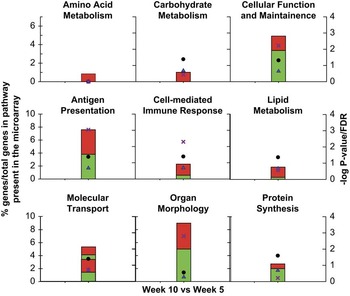
In one of the first studies of its kind, Naeem et al. (Reference Naeem, Drackley, Stamey, Rodriguez-Zas, Everts, Lewin and Loor2010) evaluated changes in the ruminal tissue transcriptome between weaning at ∼5 weeks of age and the subsequent 5 weeks of feeding solid feed. Over 500 genes were differentially expressed during this 5-week growing period. Analysis of enriched molecular functions using IPA revealed unexpected features of the bovine ruminal tissue during development into a fully ruminating animal including a marked upregulation of the innate immune response (antigen presentation, cell-mediated immune response) and molecular transport mechanisms (Figure 3). Not surprisingly, based on previous work, developing ruminal tissue appears to have a very active metabolic signature as indicated by enrichment of genes related to carbohydrate, lipid and amino acid metabolism. Ruminal tissue weight in these animals increased from ∼1 kg at 5 weeks of age to ∼2.5 kg at 10 weeks of age when animals were fed strictly solid feed (Naeem et al., Reference Naeem, Drackley, Stamey, Rodriguez-Zas, Everts, Lewin and Loor2010). A recent review has summarized preliminary results indicating that nutritional management of the newly weaned calf can alter mRNA expression patterns and likely affect normal development of the tissue (Connor et al., Reference Connor, Baldwin, Capuco, Evock-Clover, Ellis and Sciabica2010). For example, calves weaned to a grain-based diet had alterations in expression of genes related to apoptosis, organ morphogenesis and cell proliferation; whereas, calves weaned to a hay-based diet had alterations in expression of genes related to cellular differentiation (Connor et al., Reference Connor, Baldwin, Capuco, Evock-Clover, Ellis and Sciabica2010).
Subset of enriched molecular functions (Ingenuity Pathway Analysis®; IPA) within DEG in ruminal tissue male Holstein calves after 5 weeks of being weaned to a solid feed (Naeem et al., Reference Naeem, Drackley, Stamey, Rodriguez-Zas, Everts, Lewin and Loor2010). Symbols denote: marked downregulation (▴), modest downregulation (●) and marked upregulation (×). Y axis on right shows Fisher's log P-value from IPA analysis and denotes the significance of the genes within each pathway. Y axis on left shows the ratio of DEG to the total number of genes in the Ingenuity-curated pathway (DEG = differentially expressed genes).

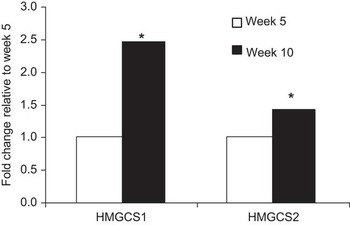
Another recent study also has evaluated the behavior of the ruminal transcriptome in response to a shift from a low-concentrate/high-forage diet to a high-concentrate/low-forage diet designed to induced subacute ruminal acidosis (Steele et al., Reference Steele, Vandervoort, Alzahal, Hook, Matthews and McBride2011). A total of 521 DEG (FDR P < 0.08) were uncovered after cattle had been on the high-grain diet for ∼3 weeks (Steele et al., Reference Steele, Vandervoort, Alzahal, Hook, Matthews and McBride2011). The subacute ruminal acidosis was diagnosed during the first week of feeding the high-grain diet (4.6 ± 1.6 h/day below pH 5.6) but not during weeks 2 and 3, thus, indicating ruminal adaption to the diet (Steele et al., Reference Steele, Vandervoort, Alzahal, Hook, Matthews and McBride2011). Using IPA revealed that enzymes involved in cholesterol synthesis were coordinately downregulated from the first to third weeks of the high-grain period. In addition, genes within the Liver-X-Receptor/Retinoid-X-Receptor pathway appeared to have been activated potentially to control intracellular cholesterol homeostasis (Steele et al., Reference Steele, Vandervoort, Alzahal, Hook, Matthews and McBride2011). Based upon pathway and network analysis the authors proposed a model linking transcriptional control of cholesterol metabolism via the transcription regulator SREBF2 which in non-ruminants is the major regulator of the enzymes associated with cholesterol synthesis (Steele et al., Reference Steele, Vandervoort, Alzahal, Hook, Matthews and McBride2011). In that context, it appears that cholesterol homeostasis is a key feature driving ruminal tissue development during the early post-weaning phase because (Naeem et al., Reference Naeem, Drackley, Stamey, Rodriguez-Zas, Everts, Lewin and Loor2010; Steele et al., Reference Steele, Vandervoort, Alzahal, Hook, Matthews and McBride2011) it showed a marked increase in mRNA expression of the rate-limiting enzyme in cholesterol synthesis HMGCS1 as well as the rate-limiting ketogenic enzyme HMGCS2 (Figure 4). Therefore, it appears that ruminal tissue has certain flexibility in the use of acetyl-CoA for cholesterol synthesis v. ketogenesis, that is, mitochondrial acetyl-CoA could generate cytosolic acetyl-CoA via carnitine acetyltransferase (Zammit, Reference Zammit1984).
Expression of 3-hydroxy-3-methylglutaryl-CoA synthase 1 (HMGCS1) and HMGCS2 in ruminal tissue after 5 weeks of feeding male Holstein calves with solid feed (Naeem et al., Reference Naeem, Drackley, Stamey, Rodriguez-Zas, Everts, Lewin and Loor2010); *P < 0.05 for time effect.

As a whole, the above studies clearly have provided a number of targets that could potentially be altered via nutrition to elicit a desired effect in terms of tissue development. From a functional standpoint it will be imperative that some of the targets identified are studied in greater depth.
Conclusion
Advances in high-throughput genomic technology and bioinformatics have opened a new era of analyzing expression of seveal hundred thousand genes and their interactions and networks, and integrating the interrelationship of DNA, RNA and protein as well as metabolites for understanding regulatory mechanism of animal metabolism.
In this regard, the recent sequencing of the cattle genome and improvement of biotechnology (e.g. DNA microarray) have revealed some molecular basis of genetic variation and transcriptional regulation of metabolic phenotypes in response to nutrition, physiological status and environment. Genomics encompasses powerful tools to decipher the interrelationships between genetic variation and nutrition and the role of nutrients as signals for controlling gene expression, particularly for the understanding of individual animal responses to nutritional management.
Although the sequenced cattle genome revealed a great amount of its potential applications, there are several challenges that we encounter when applying genomic technology in the cattle industry; for example, cost and technological hurdles. The estimated cost per 40-fold coverage for sequecing an individual mammalian genome has come down from around US$57 000 000 in 2007 to less than US$2000 in 2009 and even lower nowdays. The cost is still high for practical uses in animal agriculture, but it may be less of a problem in the near future. The biggest challenges are to assemble the high-throughput ‘omic’ data, integrate them with phenotypic data and interpret these information in a biological and practical sense. A holistic and systemic approach using systems biology will be very useful to overcome the challenge.
Acknowledgements
SS was supported by a Basic Science Research Program (No. 2009-0064205) through the National Research Foundation of Korea funded by the Ministry of Education, Science and Technology and by a grant from the Next-Generation BioGreen 21 Program (No. PJ008191), Rural Development Administration, Republic of Korea.