Introduction
Japan is the most rapidly aging country in the world. In 2006, the Japanese population reached 127.7 million, and the proportion of elderly people was 20.8%, the highest in the world (Kashiwagi et al., Reference Kashiwagi, Tamiya, Sato and Yano2013). By the year 2025, the proportion of elderly people is expected to reach 30% of the total population (Olivares-Tirado et al., Reference Olivares-Tirado, Tamiya and Kashiwagi2012). Care for the disabled elderly people can become stressful and exhausting, especially in cases of dementia, and, as a result, family caregivers may experience significant mental health problems as well as a deterioration of their own health. Thus, the alleviation of caregiver burden has become a primary public health goal (Arai and Zarit, Reference Arai and Zarit2011). To reduce the family caregiver burden for the disabled elderly people, a long-term care insurance program (LTCIP) has been implemented since 2000 in Japan. The main framework of the system consists of comprehensive evaluation of the elderly people and provision of care in kind or payments to help families secure care, according to the anticipated care requirement (Takechi et al., Reference Takechi2012).
Mild cognitive impairment (MCI) is considered to refer to a transitional condition between normal cognitive function and dementia. It may represent a complex heterogeneous condition (Kume et al., Reference Kume2011). Caregivers of patients with MCI already experience a need for increased services comparable to that of individuals caring for Alzheimer's disease (AD) patients (Ryan et al., Reference Ryan2010). Dementia caregiving has been associated with negative effects on caregiver health and early nursing home placement of dementia patients (Etters et al., Reference Etters, Goodall and Harrison2008). Given the heightened risk for dementia in persons with MCI, it is likely that many of these MCI caregivers will eventually become dementia caregivers (Garand et al., Reference Garand, Dew, Eazor, DeKosky and Reynolds2005). Thus, they may be ideal targets for selective preventive interventions to reduce the psychiatric morbidity and burden of dementia caregivers (Garand et al., Reference Garand, Dew, Eazor, DeKosky and Reynolds2005).
The behavioral and psychological symptoms of dementia are also common in MCI and caused caregiver burden (Muangpaisan et al., Reference Muangpaisan, Intalapaporn and Assantachai2008; Hashidate et al., Reference Hashidate2012). Patients’ behavior problems and the duration of cognitive symptoms explained the unique variance in the caregiver burden (Bruce et al., Reference Bruce, McQuiggan, Williams, Westervelt and Tremont2008). In the USA, more than 30% of the MCI caregivers experienced a clinically significant perceived burden (Zarit caregiver Burden Interview: ZBI score ≥21, full score 88; Bruce et al., Reference Bruce, McQuiggan, Williams, Westervelt and Tremont2008). Caregiver distress was higher in MCI groups than in normal controls in Thailand and Japan (Muangpaisan et al., Reference Muangpaisan, Intalapaporn and Assantachai2008; Hashidate et al., Reference Hashidate2012). In Norway, Blieszner and Roberto (Reference Blieszner and Roberto2010) reported that the burden of MCI caregivers was not low and that a greater burden corresponds to caregiver depressive symptoms. Having greater responsibility for nursing tasks was associated with higher depression levels, and a higher level of lifestyle constraint was uniquely associated with elevated anxiety symptoms among MCI caregivers in the USA (Garand et al., Reference Garand, Dew, Eazor, DeKosky and Reynolds2005). MCI patients’ neurobehavioral symptoms and motor frailty are related to a greater need for social support services among the MCI caregivers in the USA (Ryan et al., Reference Ryan2010).
One of the most commonly used caregiver stress models is the “stress process model of Alzheimer's caregivers’ stress” of Pearlin and colleagues (Pearlin et al., Reference Pearlin, Mullan, Semple and Skaff1990; Seeher et al., Reference Seeher, Low, Reppermund and Brodaty2012). The “stress process model” consists of four components (Pearlin et al., Reference Pearlin, Mullan, Semple and Skaff1990): (1) The background includes caregiver and patient demographics and social and economic characteristics. (2) The model evaluates primary and secondary stressors. Primary stressors are mainly disease related, while secondary stressors consist of role strains (family conflict) and intrapsychic strains (individual characteristics). (3) Mediators of stress consist of coping skills and social support. (4) Outcomes include psychological symptoms such as depression, anxiety, and caregiver burden (Pearlin et al., Reference Pearlin, Mullan, Semple and Skaff1990; Seeher et al., Reference Seeher, Low, Reppermund and Brodaty2012). In the present study, we examined the MCI caregiver burden in a larger number of consecutive outpatients than previously reported. Our primary purpose was to evaluate the presence of a caregiver burden in MCI. Second, we focused on the relationship of background variables and primary stressors to caregiver burden, and tried to clarify the associations between MCI caregiver burden and various patient characteristics.
Methods
Participants
The current study included 104 consecutive caregivers of individuals who had been referred to an outpatient memory clinic of Okayama University Hospital between September 2008 and February 2012 for neuropsychological evaluation and were diagnosed as having MCI.
Inclusion criteria for caregivers were (1) being the family caregiver of an outpatient with MCI, (2) living with the patient or visiting him or her every day, and (3) being cognitively intact. Exclusion criteria were (1) being unable to come to hospital with the patient, (2) having a history of mental illness or substance abuse, and (3) being treated with antipsychotics, antidepressants, or anxiolytic drugs.
The exclusion criteria for patients were (1) complications from other neurological diseases or illnesses; (2) history of mental illness or substance abuse prior to the onset of dementia; (3) any evidence of focal brain lesions on head MRI; and (4) treatment with antipsychotics, antidepressants, or anxiolytic drugs.
The patients all (1) underwent general physical and neurological examinations and extensive laboratory testing, including thyroid function tests, serum vitamin B12, and syphilis serology; (2) had a global Clinical Dementia Rating (CDR) of 0.5; (3) took the Mini-Mental State Examination (MMSE; Folstein et al., Reference Folstein, Folstein and McHugh1975), revised Addenbrooke's Cognitive Examination (ACE-R; Mioshi et al., Reference Mioshi, Dawson, Mitchell, Arnold and Hodges2006; Yoshida et al., Reference Yoshida2012), revised Wechsler Memory Scale (WMS-R; Wechsler, Reference Wechsler1987; Sugishita, Reference Sugishita2001), and Frontal Assessment Battery (FAB; Dubois et al., Reference Dubois, Slachevsky, Litvan and Pillon2000; Kugo et al., Reference Kugo2007); and (4) scored ≥1.5 standard deviations (SD) below the population mean on at least one of eight neuropsychological tests (five subscales of ACE-R, two subscales of WMS-R, and FAB).
Ethics
This study protocol was approved by the committee of Okayama University Hospital on human research. After giving a complete description of the study to the patients and their relatives, written informed consent was obtained.
Neuropsychological tests, behavioral symptoms, and activities of daily living
ACE-R was developed to provide a brief test sensitive to early stage dementia (Mioshi et al., Reference Mioshi, Dawson, Mitchell, Arnold and Hodges2006). ACE-R includes MMSE, but extends it to encompass important areas not covered by MMSE, such as frontal-executive functions and visuospatial skills. For this study, we used the Japanese version of ACE-R described by Yoshida et al. (Reference Yoshida2012). ACE-R has five subdomains, namely attention, language, word fluency, memory, and visuospatial cognition (Yoshida et al., Reference Yoshida2012).
WMS-R is the most widely used measure of adult memory in Japan (Wechsler, Reference Wechsler1987; Sugishita, Reference Sugishita2001). In this study, general memory and delayed recall scores were used. The mean value of both scores is 100, and a higher score indicates a better performance.
FAB consists of six items, and the score on each item ranges from 0 to 3. A lower score indicates a greater degree of executive dysfunction (Dubois et al., Reference Dubois, Slachevsky, Litvan and Pillon2000; Kugo et al., Reference Kugo2007).
The Neuropsychiatric Inventory (NPI) is a valid and reliable instrument for measuring behavior in dementia (Cummings et al., Reference Cummings, Mega, Gray, Rosenberg-Thompson, Carusi and Gornbein1994; Hirono et al., Reference Hirono1997). It is a caregiver-based tool that assesses ten common behaviors in dementia.
The Barthel Index consists of ten items that measure a person's daily functioning, specifically the basic activities of daily living and mobility (Wade and Collin, Reference Wade and Collin1988). The total score of the Barthel Index ranges from 0 to 100.
The Functional Assessment Questionnaire (FAQ) measures instrumental activities of daily living in older adults using the patient's partner as an informant (Pfeffer et al., Reference Pfeffer, Kurosaki, Harrah, Chance and Filos1982). FAQ consists of ten items, and the score on each item ranges from 0 to 3. A higher score indicates more severe impairment.
Caregiver assessment
Caregiver burden was measured using the short version of the Japanese version of the Zarit Burden Interview (sZBI; Kumamoto et al., Reference Kumamoto, Arai, Ueda and Washio2004), which consists of eight items. The caregivers were asked to rate the degree of their burden on a Likert scale from 0 (“never”) to 4 (“nearly always”) points. Pearson's correlation coefficient between sZBI and ZBI was 0.92 (Kumamoto et al., Reference Kumamoto, Arai, Ueda and Washio2004). Consistent with previously published reports, caregivers who scored ≥9 on sZBI were deemed to have a clinically elevated burden (Arai et al., Reference Arai, Tamiya and Yano2003) and a score ≥17 on sZBI was thought to be a severe burden (Kobayashi, Reference Kobayashi2008).
The ZBI is composed of two factors. Personal strain means how personally stressful the experience is, and role strain indicates the stress due to role conflict or overload (Whitlatch et al., Reference Whitlatch, Zarit and von Eye1991).
When the patient was living alone, the informant who visited the patient every day was regarded as the chief caregiver. The caregiver's age, sex, and relationship to the patient were investigated.
Statistics
Statistical analysis was performed using the SPSS 19.0J software program (SPSS Inc., Chicago, IL). The correlations of sZBI scores to age, duration of disease, education, number of relatives living with the patient, age of caregiver, five subscales of ACE-R, general memory, and delayed memory of WMS-R, FAB scores, NPI scores, Barthel Index, and FAQ scores were examined by Pearson's correlation coefficient. Multiple comparisons tend to cause false positive errors. Therefore, to identify which variables were significantly correlated with caregiver burden, we used a multiple linear regression with sZBI scores as a dependent variable. Independent variables were gender, age, duration of disease, education, number of relatives living with patient, gender of caregiver, age of caregiver, relationship of caregiver to patient, five subscale scores of ACE-R, general memory and delayed recall scores of WMS-R, FAB scores, NPI scores, Barthel Index, and FAQ scores. Subsequently, forward stepwise linear regression models (entrance criterion p = 0.05, exit p = 0.10) determined if disparate predictors accounted for a unique additive variance in the caregiver burden. The significance for the hypothesis testing analyses was set at p < 0.05.
Results
Participants
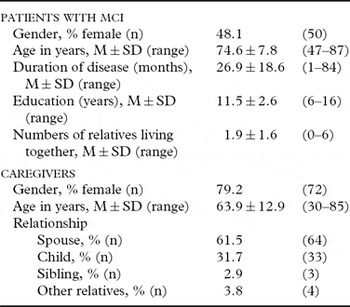
Clinical characteristics of participants are listed in Table 1. The proportion of participants who were living alone was 10.1% (n = 12). The mean age of caregivers was about ten years younger than the mean age of patients (patients: 74.6 years; caregivers: 63.9 years). Results of neuropsychological tests are shown in Table 2. Among the NPI subscales, high scores on indifference were the most frequent (mean score: 0.9 ± 1.5).
Clinical characteristics of patients and care-givers (n = 104)

MCI = mild cognitive impairment; n = number; M = mean; SD = standard deviation.
Neuropsychological tests, behavioral symptoms, and ADL (n = 104)
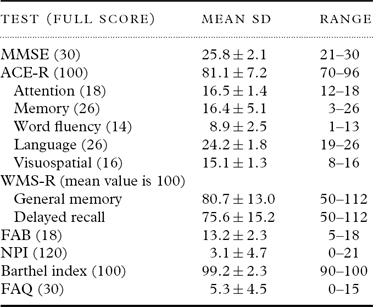
ADL = Activities of Daily Living; MMSE = Mini-Mental State Examination; ACE-R = revised Addenbrooke's Cognitive Examination; WMS-R = revised Wechsler Memory Scale; FAB = Frontal Assessment Battery; NPI = Neuropsychiatric Inventory; FAQ = Functional Assessment Questionnaire.
Caregiver burden
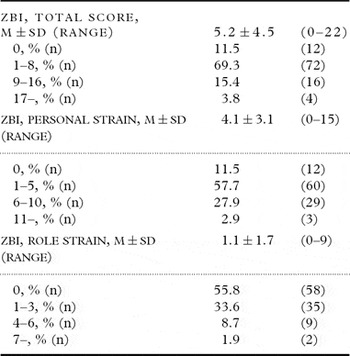
The numbers of caregivers with an sZBI total score ≥9 or ≥17 were 20 (19.2%) and 4 (3.8%), respectively (Table 3). Correlation analysis revealed a significant relationship of sZBI total scores to NPI total scores (r = 0.577, p < 0.001), memory scores of ACE-R (r = −0.260, p = 0.008), FAQ scores (r = 0.236, p = 0.016), visuospatial scores of ACE-R (−0.234, p = 0.017), general memory scores of WMS-R (r = −0.213, p = 0.032), and Barthel scores (r = −0.210, p = 0.040). sZBI personal strain scores had a significant correlation to NPI total scores (r = 0.541, p < 0.001), memory scores of ACE-R (r = −0.259, p = 0.008), Barthel scores (r = −0.221, p = 0.024), disease duration (r = 0.216, p = 0.027), visuospatial scores of ACE-R (r = −0.201, p = 0.041), FAQ scores (r = 0.198, p = 0.044), and attention/orientation scores on ACE-R (r = −0.197, p = 0.045). ZBI role strain scores had a significant correlation to NPI total scores (r = 0.527, p < 0.001), FAQ scores (r = 0.256, p = 0.009), visuospatial scores of ACE-R (r = −0.247, p = 0.012), general memory scores of WMS-R (r = −0.245, p = 0.013), and memory scores of ACE-R (r = −0.210, p = 0.032).
Caregiver burden, ZBI (n = 104)

M = mean; SD = standard deviation. ZBI = Zarit Burden Interview.
ZBI, total score, 8 items; ZBI, personal strain, 5 items; ZBI, role strain, 3 items.
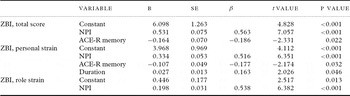
The multiple linear regression analysis showed that sZBI scores were predicted by NPI scores and ACE-R memory scores according to the following formula: the scores of sZBI = 0.531 (NPI scores) − 0.164 (ACE-R memory scores) + 6.098 (Table 4). The sZBI scores of personal strain and role strain were predicted by the following formula: the scores of sZBI personal strain = 0.334 (NPI scores) − 0.107 (ACE-R memory scores) + 0.027 (disease duration) + 3.968; the scores of sZBI role strain = 0.198 (NPI scores) + 0.446.
Stepwise multiple regression analysis for scores of ZBI (n = 104)

ZBI = Zarit Burden Interview; ACE-R = revised Addenbrooke's Cognitive Examination.
Discussion
MCI and caregiver burden
In Japan, several studies using sZBI have been reported. Arai et al. (Reference Arai, Tamiya and Yano2003) reported that the mean sZBI score among 36 caregivers encountering difficulties in caring for disabled elderly people (both with and without dementia) was 9.31 and that the mean sZBI score among 421 caregivers not encountering difficulties in caring for disabled elderly people was 3.45. Among 48 dementia (including severe dementia) patient caregivers, 34 (71%) scored 9 or higher on sZBI and 18 (38%) scored 17 or higher (Kobayashi, Reference Kobayashi2008). In this study, among 104 caregivers for MCI patients, 20 (19%) scored 9 or higher on sZBI and four (4%) scored 17 or higher. Thus, the ratio of MCI caregivers suffering from caregiver burden may be lower than that of dementia caregivers.
Recently, two studies using sZBI in MCI caregivers have been reported in Japan. Hashidate et al. (Reference Hashidate2012) reported that the mean score of sZBI was 6.4 ± 5.0 among 103 MCI caregivers (MCI, CDR = 0.5 and MMSE ≥ 24). Tatsumi et al. (Reference Tatsumi, Tanaka, Sugiyama, Hayakawa and Yamamoto2012) showed that the mean score of sZBI was 5.9 ± 7.3 among 47 MCI caregivers. In Norway, mean score of the 12-item version of ZBI among 86 MCI caregivers was 10.3 ± 7.6 (full score: 48; Blieszner and Roberto, Reference Blieszner and Roberto2010). In this study, the mean score of sZBI was 5.2 ± 4.5 among 104 MCI caregivers. These four studies all focused on outpatients and showed similar caregiver burden of MCI patients.
More than 30% of the MCI caregivers in the USA reported a clinically significant perceived burden (Zarit caregiver Burden Interview score: ≥21; full score: 88; Bruce et al., Reference Bruce, McQuiggan, Williams, Westervelt and Tremont2008). In our study, the numbers of caregivers with sZBI total scores ≥9 or ≥17 (full score 32) were 20 (19.2%) and 4 (3.8%), respectively. Bruce et al. (Reference Bruce, McQuiggan, Williams, Westervelt and Tremont2008) used the patient disruption part of the Revised Memory and Behavior Problems Checklist (RMBPC) to evaluate behavioral problems of MCI patients. The full score on the RMBPC disruption part is 32, and the mean score in their study was 3.3 ± 4.5. The full score on the NPI was 120, and the mean score in this study was 3.1 ± 4.7. It is of course difficult to compare the scores of different scales, but the fewer behavior and psychological symptoms of dementia in our study group may contribute to a lower frequency of significant perceived burden.
Patient characteristics for caregiver burden
In many studies on dementia caregiver burden, behavioral disturbances were reported to be closely correlated with caregiver burden (Sink et al., Reference Sink, Holden and Yaffe2005; Gort et al., Reference Gort2007; Etters et al., Reference Etters, Goodall and Harrison2008). Among caregivers of MCI patients, patients’ behavioral problems were reported to be significantly associated with caregiver burden (Bruce et al., Reference Bruce, McQuiggan, Williams, Westervelt and Tremont2008; Hashidate et al., Reference Hashidate2012). In the MCI group, caregiver's service need was related to neurobehavioral symptoms (Ryan et al., Reference Ryan2010). Our results are consistent with previous studies.
The ZBI covers both personal strain and role strain. Our study clarified that behavioral disturbance was closely related to both personal and role strain among MCI caregivers. An increased understanding of behavior disturbance among MCI patients may lead to improvements in treatment and prevention of caregiver burden in MCI (Bruce et al., Reference Bruce, McQuiggan, Williams, Westervelt and Tremont2008).
Surprisingly, the severity of cognitive impairment does not have a strong effect on caregiver burden among dementia patients in many studies (Etters et al., Reference Etters, Goodall and Harrison2008). In Japan, a cross-sectional study showed that there was no difference in caregiver burden between caregivers of dependents with and without dementia (Hirakawa et al., Reference Hirakawa, Kuzuya, Enoki, Hasegawa and Iguchi2008). In our study, ACE-R memory scores showed a weak but significant relationship to sZBI total scores and sZBI personal strain scores among MCI caregivers. Memory disturbance very often induces repetitive questioning (Ornstein and Gaugler, Reference Ornstein and Gaugler2012), but the NPI scale does not include repetitive or stereotypical behavior. Therefore, we cannot state conclusively, but the cause of burden for MCI caregivers seems to be related to neuropsychiatric symptoms that are not measured on the NPI, which would include early symptoms such as repetitive questioning behavior.
The duration of disease was also significantly associated with personal strain on sZBI. Bruce et al. (Reference Bruce, McQuiggan, Williams, Westervelt and Tremont2008) also found that the duration of cognitive symptoms explained a unique variance in caregiver burden. Among dementia patients, the duration of care is inversely related to the likelihood of nursing home placement (Gaugler et al., Reference Gaugler, Kane, Kane, Clay and Newcomer2005), suggesting that possibly adaptation happened over time. Because MCI is a so-called pre-dementia stage, adaptation may not have occurred yet.
One finding that differed from other studies was that we found no significant connection between the relationship of caregivers to patients and caregiver burden (Gort et al., Reference Gort2007). Similarly, we failed to find a significant relationship between patients’ activities of daily living (ADL) and caregiver burden. In the MCI group, the need for caregiver's services was related to neurobehavioral symptoms and frailty, whereas the need for service among the AD caregivers was related to functional disability and frailty (Ryan et al., Reference Ryan2010). The mean Barthel Index score in this study group was 99.2. Therefore, MCI patients in this study showed no or minimal impairment in ADL. The smallness of the variation may cause the failure to show a significant relationship with ADL. Of course, cultural variations might affect the differences in risk factors for caregiver burden in different studies (Gort et al., Reference Gort2007). Culture shapes one's perceptions of familial responsibilities and thus also influences the caregiver burden (Etters et al., Reference Etters, Goodall and Harrison2008).
Limitation
Our study's cross-sectional design limits any conclusions in a causal or predictive direction. It will be important in future work to examine these relationships longitudinally in order to more fully characterize the direction of cause and effect.
Our study did not include underlying characteristics of caregivers such as caregivers’ emotional well-being, educational level, employment, coping style, and household income. It is certainly possible that such caregiver characteristics affect the perceived burden (Bruce et al., Reference Bruce, McQuiggan, Williams, Westervelt and Tremont2008). The presence or absence of depression was also unevaluated. Depression was taken as a primary outcome because it was shown to be the main reason that caregivers abandon home care (Schoenmakers et al., Reference Schoenmakers, Buntinx and Delepeleire2010). In the future, research in which those factors are evaluated will be needed.
Conclusion
About 20% of the caregivers of MCI patients reported a clinically significant burden. The caregiver burden of MCI patients should receive more attention. The management of patients’ neurobehavioral symptoms may be important to reduce the burden on caregivers of MCI patients.
Conflict of interest
None.
Description of authors’ roles
Satoshi Hayashi was involved in the design of the study and data analysis. He wrote the paper with Seishi Terada. Seishi Terada designed the study and analyzed the data with Satoshi Hayashi. Shigeto Nagao, Chikako Ikeda, Aki Shindo, Etsuko Oshima, and Osamu Yokota collected data. Yosuke Uchitomi supervised the study design, participated in data analysis, and assisted in writing the paper.
Acknowledgments
We thank Ms. Horiuchi, Ms. Imai, Ms. Yabe, and Ms. Tsuchiyama for their skillful assistance for this study. This work was supported by a grant from the Japanese Ministry of Education, Culture, Sports, Science and Technology (21591517) and the Zikei Institute of Psychiatry.