


1 Introduction
For a Hausdorff topological space X, a homeomorphism T of X is said to be distal (equivalently, T acts distally on X) if for every pair of distinct elements
 $x,y \in X$
, the closure of the double orbit
 $\{(T^n(x), T^n(y)) \mid n\in {\mathbb Z}\}$
in
 $X \times X$
does not intersect the diagonal, that is, for
 $x,y \in X$
with
 $x \neq y $
,
 $\overline {\{(T^n(x), T^n(y))\mid n \in {\mathbb Z}\}} \cap \{(a,a)\mid a \in X\}=\emptyset $
. David Hilbert introduced the notion of distality to study nonergodic actions on compact spaces (see [Reference Ellis16] and [Reference Moore30]). Distal actions on compact spaces, Lie groups as well as on locally compact groups have been studied by many mathematicians in different contexts (for example, Choudhuri et al. [Reference Choudhuri, Faraco and Yadav10], Furstenberg [Reference Furstenberg18], Palit et al. [Reference Palit, Prajapati and Shah31], Raja and Shah [Reference Raja and Shah35], Shah [Reference Shah38], and the references cited therein).
For a locally compact (Hausdorff) group G with the identity e, let
 $\mathrm {Sub}_G$
denote the set of all closed subgroups of G endowed with the Chabauty topology. Recall that
 $\mathrm {Sub}_G$
is compact and Hausdorff, and it is metrisable if G is second countable [Reference Benedetti and Petronio6]. Let
 $\mathrm {Aut}(G)$
denote the group of all automorphisms of G; an automorphism is both a homomorphism and a homeomorphism. There is a canonical group action of
 $\mathrm {Aut}(G)$
on
 $\mathrm {Sub}_G$
; namely,
 $(T,H)\mapsto T(H)$
,
 $T \in \mathrm {Aut}(G)$
,
 $H\in \mathrm {Sub}_G$
; this action gives a homomorphism from
 $\mathrm {Aut}(G)$
to
 $\mathrm {Homeo}(\mathrm {Sub}_G)$
. As the image of
 $\mathrm {Aut}(G)$
under this action is a large subclass of homeomorphisms of
 $\mathrm {Sub}_G$
, it is important to study the dynamics of the action of this special subclass in terms of distality.
In [Reference Shah and Yadav42], Shah and Yadav studied the action of automorphisms of a connected Lie group G on
 $\mathrm {Sub}_G$
extensively and showed in particular that for a large class of G, which does not have any compact central subgroups of positive dimension, an automorphism T of G acts distally on
 $\mathrm {Sub}^a_G$
, the space of closed abelian subgroups of G, if and only if T generates a relatively compact subgroup in
 $\mathrm {Aut}(G)$
. A similar characterisation also holds for T belonging to the class (NC), that is, those T for which the closure of the T-orbit of any discrete cyclic group does not contain the trivial group
 $\{e\}$
. Note that
 $\mathrm {Sub}^a_G$
is very large for many groups G; for example, it is the same as
 $\mathrm {Sub}_G$
if G is abelian. It also contains all discrete cyclic subgroups. Shah, with Palit in [Reference Palit and Shah32], and with Palit and Prajapati in [Reference Palit, Prajapati and Shah31], has studied distal actions of automorphisms of a discrete group G on
 $\mathrm {Sub}^a_G$
, where G is either polycyclic or a lattice in a connected Lie group.
The question arises whether one can characterise distal actions of automorphisms on other smaller invariant subspaces of
 $\mathrm {Sub}^a_G$
for a connected Lie group G. Most of the techniques used to obtain earlier results mentioned above involve study of the actions on a class of discrete abelian subgroups. Here, we consider the class of smallest closed connected abelian subgroups, namely, closed one-parameter subgroups of G, and study the dynamics of distal actions of automorphisms on it. Let
 $\mathrm {Sub}^p_G$
denote the smallest closed subset of
 $\mathrm {Sub}_G$
containing all closed one-parameter subgroups of G. Note that
 $\mathrm {Sub}^p_G$
is compact and it is invariant under the action of
 $\mathrm {Aut}(G)$
. We get a characterisation for a large class of G as follows.
Theorem 1.1. Let G be a connected Lie group without any nontrivial compact connected central subgroup and let T be an automorphism of G. Then, the following hold.
-
(1) If G is abelian, then G is isomorphic to
 ${\mathbb R}^d$
for some
$d\in {\mathbb N}$
, and T acts distally on
$\mathrm {Sub}^p_G$
if and only if
$T \in {\mathcal K}{\mathcal D}$
, where
${\mathcal K}$
is a compact subgroup of
$\mathrm {GL}(d,{\mathbb R})$
and
${\mathcal D}$
is the centre of
$\mathrm {GL}(d,{\mathbb R})$
.
-
(2) If G is not abelian, then T acts distally on
$\mathrm {Sub}^p_G$
if and only if
$T \in {\mathcal K}$
, a compact subgroup of
$\mathrm {Aut}(G)$
.


Note that the condition on the centre in Theorem 1.1 holds if G is simply connected or, more generally, its nilradical is simply connected. It also holds for
 $G/M$
for any connected Lie group G, where M is the maximal central torus in G (the maximal compact connected central subgroup in G). The result in the case of nonabelian groups G in statement (2) as above gives a similar characterisation as in [Reference Shah and Yadav42, Theorem 4.1], even though the space
 $\mathrm {Sub}^p_G$
is much smaller than
 $\mathrm {Sub}^a_G$
. In the case where G as above is abelian, then
 $G={\mathbb R}^d$
, a vector group, and
 $\mathrm {Sub}^p_G$
is homeomorphic to
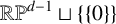 ${\mathbb {RP}}^{d-1}\sqcup \{\{0\}\}$
and Theorem 1.1(1) shows that a larger class of T acts distally on
 $\mathrm {Sub}^p_G$
.
In [Reference Shah and Yadav42], it is shown for a connected Lie group G without any compact central subgroup of positive dimension that if T acts distally on
 $\mathrm {Sub}^a_G$
, then it acts distally on G (more generally, see [Reference Shah and Yadav42, Theorem 3.6 and Corollary 3.7]). We generalise this for Lie groups that are not vector groups; as in the later case, Theorem 1.1(1) shows that it is possible to have automorphisms that act distally on
 $\mathrm {Sub}^p_G$
but not on G.
Theorem 1.2. Let G be a connected Lie group that is not a vector group and let
 ${T\in \mathrm {Aut}(G)}$
be such that it acts distally on the largest compact connected central subgroup of G. If T acts distally on
 $\mathrm {Sub}^p_G$
, then T acts distally on G.
An automorphism T of a connected Lie group G is said to be unipotent if all the eigenvalues of
 ${d\,} T$
are equal to 1, where
 ${d\,} T$
is the corresponding Lie algebra automorphism of the Lie algebra of G. It is known that T acts distally on G if and only if all the eigenvalues of
 ${d\,} T$
have absolute value 1 (see [Reference Abels1]). Any unipotent automorphism acts distally on G and if it belongs to a compact subgroup of
 $\mathrm {Aut}(G)$
, then it is trivial. Theorem 4.3 of [Reference Shah and Yadav42] shows that no nontrivial unipotent automorphism acts distally on
 $\mathrm {Sub}^a_G$
; generalising this statement, we prove the following.
Theorem 1.3. Let G be a connected Lie group and let
 $T\in \mathrm {Aut}(G)$
be unipotent. Then, T acts distally on
 $\mathrm {Sub}^p_G$
if and only if
 $T=\mathrm {Id}$
, the identity map.
In particular, Theorem 1.3 illustrates that the converse of Theorem 1.2 does not hold as the nontrivial unipotent automorphisms do not act distally on
 $\mathrm {Sub}^p_G$
.
Let
 $\mathrm {Sub}^c_G$
denote the set of all discrete cyclic subgroups of G. It is invariant under the action of
 $\mathrm {Aut}(G)$
and so is its closure in
 $\mathrm {Sub}_G$
. In [Reference Palit, Prajapati and Shah31, Reference Palit and Shah32], distal actions of automorphisms of
 $\mathrm {Sub}^c_\Gamma $
have been characterised, where
 $\Gamma $
is a certain type of discrete group, for example, a discrete polycyclic group or a lattice in a connected Lie group. In a connected Lie group G, any closed one-parameter subgroup
 $H=\{x_t\}_{t\in {\mathbb R}}$
is the limit of
 $\{H_n\}_{n\in {\mathbb N}}$
as
 $n\to \infty $
in
 $\mathrm {Sub}_G$
, where
 $H_n=\{x_{m/n}\mid m\in {\mathbb Z}\}$
,
 $n\in {\mathbb N}$
, are discrete cyclic groups. Thus,
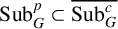 $\mathrm {Sub}^p_G\subset \overline {\mathrm {Sub}^c_G}$
(the closure of
 $\mathrm {Sub}^c_G$
in
 $\mathrm {Sub}_G)$
and the latter is contained in
 $\mathrm {Sub}^a_G$
. We should note that
 $\overline {\mathrm {Sub}^c_G}$
is much bigger than
 $\mathrm {Sub}^p_G$
as the former contains all discrete cyclic subgroups (see Lemma 2.2). If T acts distally on
 $\overline {\mathrm {Sub}^c_G}$
, then
 $T\in $
(NC). It is easy to see that Theorems 1.1(2), 1.2 and 1.3 remain valid if
 $\mathrm {Sub}^p_G$
is replaced by
 $\overline {\mathrm {Sub}^c_G}$
in the respective statements.
The following generalises a part of [Reference Shah and Yadav42, Theorem 4.1] and also extends Theorem 1.1(2).
Theorem 1.4. Let G be a connected Lie group such that it is not a vector group. Let
 $T\in \mathrm {Aut}(G)$
be such that it acts distally on the largest compact connected central subgroup of G. Then the following are equivalent:
-
(1) T acts distally on
$\mathrm {Sub}^p_G$
; -
(2) T acts distally on
$\overline {\mathrm {Sub}^c_G}$
; -
(3) T acts distally on
$\mathrm {Sub}^a_G$
; -
(4) T acts distally on
$\mathrm {Sub}_G$
; -
(5) T is contained in a compact subgroup of
$\mathrm {Aut}(G)$
.


We may note that in the case where G is a vector group, Theorem 1.1(1) shows that statements (1) and (5) above are not equivalent; however, in this case, statements (2)–(5) above are equivalent by [Reference Shah and Yadav42, Theorem 4.1] as statement (2) implies that
 $T\in (\mathrm {NC})$
.
Recall that a group
 $\Gamma $
of homeomorphisms of a (Hausdorff) topological space X acts distally on X if
 $\overline {\{(\gamma (x),\gamma (y))\mid \gamma \in \Gamma \}}\cap \{(d,d)\mid \ d\in X\}=\emptyset $
for any
 $x,y\in X$
with
 $x\ne y$
. In particular, a homeomorphism T of X acts distally on X if and only if the cyclic group
 $\{T^n\mid n\in {\mathbb Z}\}$
acts distally on X. For a Lie group G, any compact subgroup of
 $\mathrm {Aut}(G)$
acts distally on
 $\mathrm {Sub}_G$
(see, for example, [Reference Shah and Yadav40, Lemma 2.2]). It follows from [Reference Abels2, Theorem 1.1] that for a subgroup
 ${\mathcal H}$
of
 $\mathrm {Aut}(G)$
,
 ${\mathcal H}$
acts distally on G if and only if
 ${\mathcal H}$
acts distally on the Lie algebra of G, and these statements are equivalent to the statement that every element of
 ${\mathcal H}$
acts distally on G (see also [Reference Conze and Guivarc’h11]). Let
 $\overline {{\mathcal H}}$
denote the closure of
 ${\mathcal H}$
in
 $\mathrm {Aut}(G)$
. It is easy to see using Abel’s results in [Reference Abels1, Reference Abels2] that
 ${\mathcal H}$
acts distally on G if and only if
 $\overline {{\mathcal H}}$
does. It follows from Ellis’ result in [Reference Ellis16] that
 ${\mathcal H}$
acts distally on any compact
 ${\mathcal H}$
-invariant subspace of
 $\mathrm {Sub}_G$
if and only if
 $\overline {{\mathcal H}}$
does.
Using Theorems 1.1 and 1.4, we get the following theorem for the action of any subgroup
 ${\mathcal H}$
of
 $\mathrm {Aut}(G)$
. If
 ${\mathcal H}$
is closed, the theorem shows that
 ${\mathcal H}$
acts distally on
 $\mathrm {Sub}^p_G$
if and only if every element of
 ${\mathcal H}$
does.
Theorem 1.5. Let G be a connected Lie group. Let
 ${\mathcal H}$
be a subgroup of
 $\mathrm {Aut}(G)$
such that it acts distally on the largest compact connected central subgroup of G. Consider the following statements.
-
(1) Every element of
$\overline {{\mathcal H}}$
acts distally on
$\mathrm {Sub}^p_G$
. -
(2)
${\mathcal H}$
acts distally on
$\mathrm {Sub}^p_G$
. -
(3)
${\mathcal H}$
acts distally on
$\overline {\mathrm {Sub}^c_G}$
. -
(4)
${\mathcal H}$
acts distally on
$\mathrm {Sub}^a_G$
. -
(5)
${\mathcal H}$
acts distally on
$\mathrm {Sub}_G$
. -
(6)
$\overline {{\mathcal H}}$
is a compact group.


Then, statements (1) and (2) are equivalent and statements (3)–(6) are equivalent.
If G is not a vector group, then statements (1)–(6) are equivalent.
If G is a vector group, that is, if
 $G={\mathbb R}^d$
, for some
 $d\in {\mathbb N}$
, then statements (1) and (2) are equivalent to the following:
-
(7)
${\mathcal H}\subset {\mathcal K}{\mathcal D}$
, where
${\mathcal K}$
is a compact subgroup of
$\mathrm {GL}(d,{\mathbb R})$
and
${\mathcal D}$
is the center of
$\mathrm {GL}(d,{\mathbb R})$
.


Note that in Theorem 1.5, one can also have equivalent statements similar to statements (1) and (2), where
 $\mathrm {Sub}^p_G$
is replaced by any of
 $\overline {\mathrm {Sub}^c_G}$
,
 $\mathrm {Sub}^a_G$
or
 $\mathrm {Sub}_G$
. We may note here that one cannot replace
 $\overline {{\mathcal H}}$
by
 ${\mathcal H}$
in statement (1) of Theorem 1.5, as there is a subgroup
 ${\mathcal H}$
of
 $\mathrm {SL}(4,{\mathbb C})$
in which every element of
 ${\mathcal H}$
is contained in a compact subgroup of
 $\mathrm {SL}(4,{\mathbb C})$
, but the closure of
 ${\mathcal H}$
in
 $\mathrm {SL}(4,{\mathbb C})$
is connected and contains unipotent elements (see [Reference Bass5]). The condition that T (respectively a subgroup
 ${\mathcal H}$
of
 $\mathrm {Aut}(G)$
) acts distally on the maximal compact connected central subgroup (maximal central torus) of G is satisfied easily if
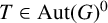 $T\in \mathrm {Aut}(G)^0$
, (respectively
 ${\mathcal H}\subset \mathrm {Aut}(G)^0$
), as
 $\mathrm {Aut}(G)^0$
acts trivially on any compact central subgroup. It is also satisfied if
 ${T^n\in \mathrm {Aut}(G)^0}$
for some
 $n\in {\mathbb N}$
(respectively
 ${\mathcal H}$
or
 ${\mathcal H}\mathrm {Aut}(G)^0$
has finitely many connected components). Here,
 $\mathrm {Aut}(G)^0$
denotes the connected component of the identity in
 $\mathrm {Aut}(G)$
.
Let
 $\mathrm {Inn}(G)$
denote the group of inner automorphisms of G. It is a (not necessarily closed) normal subgroup of
 $\mathrm {Aut}(G)$
. The following corollary generalises the first part of [Reference Shah and Yadav42, Corollary 4.5].
Corollary 1.6. Let G be a connected Lie group. Then, the following are equivalent:
-
(1) Every inner automorphism of G acts distally on
$\mathrm {Sub}^p_G$
. -
(2) Every inner automorphism of G acts distally on
$\mathrm {Sub}_G$
. -
(3)
$\mathrm {Inn}(G)$
acts distally on
$\mathrm {Sub}^p_G$
. -
(4)
$\mathrm {Inn}(G)$
acts distally on
$\mathrm {Sub}_G$
. -
(5) G is compact or
$G={\mathbb R}^n\times K$
for some
$n\in {\mathbb N}$
and the maximal compact normal subgroup K of G.


In Corollary 1.6, one can also write equivalent statements involving the action on
 $\overline {\mathrm { Sub}^c_G}$
.
Note that
 $\mathrm {Sub}^p_G$
is contained in a larger compact set
 $\mathrm {Sub}^{co}_G$
, which is the closure in
 $\mathrm {Sub}_G$
of the set of all closed connected subgroups of G. Hence, it is easy to show that Theorems 1.1–1.3 are all valid if
 $\mathrm {Sub}^p_G$
is replaced by
 $\mathrm {Sub}^{co}_G$
. In Theorems 1.4 and 1.5 and Corollary 1.6, the action of a given automorphism or a subgroup of
 $\mathrm {Aut}(G)$
is distal on
 $\mathrm {Sub}^{co}_G$
if and only if it is so on
 $\mathrm {Sub}^p_G$
, under the condition on the group and the action on the central torus.
Let us note some related known results. Ellis [Reference Ellis16] has shown that a semigroup
 $\Gamma $
of homeomorphisms of a compact space X acts distally on X if and only if the closure of
 $\Gamma $
in
 $X^X$
is a group. Note that minimal distal actions on compact metric spaces are characterised by Furstenberg [Reference Furstenberg18]. For many groups G, compact spaces
 $\mathrm {Sub}_G$
, Sub
 $^a_G$
and
 $\mathrm {Sub}^c_G$
are identified (see Baik and Clavier [Reference Baik and Clavier3, Reference Baik and Clavier4], Bridson et al. [Reference Bridson, de la Harpe and Kleptsyn8], Hamrouni and Kadri [Reference Hamrouni and Kadri20], Kloeckner [Reference Kloeckner28], and also Pourezza and Habbard [Reference Pourezza and Hubbard33]); one can also identify
 $\mathrm {Sub}^p_G$
for some groups G. The action of
 $\mathrm {Aut}(G)$
on some subspaces of
 $\mathrm {Sub}_G$
for the three-dimensional Heisenberg group G has also been described in detail [Reference Bridson, de la Harpe and Kleptsyn8]. The space of G-invariant measures on Sub
 $_G$
and, in particular, ergodic G-invariant measures on Sub
 $_G$
for some G have also been studied extensively (see Gelander [Reference Gelander19] and the references cited therein). Moreover, the study of the action of
 $\mathrm {Aut}(G)$
on
 $\mathrm {Sub}_G$
and on its closed (compact) invariant subspaces leads to a better understanding of dynamics on these spaces.
We now fix some notation. Let G be a connected Lie group. Let R (respectively N) denote the radical (respectively nilradical) of G, that is, the largest connected solvable (respectively nilpotent) normal subgroup of G. Both these subgroups are characteristic in G. Recall that G is said to be semisimple if its radical is trivial. In particular,
 $G/R$
is semisimple unless G is solvable. For a closed subgroup H of G, let
 $H^0$
denote the connected component of the identity e in H and
 $[H,H]$
denote the commutator subgroup of H. Note that
 $H^0$
,
 $[H,H]$
and its closure
 $\overline {[H,H]}$
are characteristic in H. Let
 ${\mathfrak g}$
denote the Lie algebra of the connected Lie group G. There is an exponential map
 $\exp :{\mathfrak g}\to G$
that is a continuous map and its restriction to a small open neighbourhood of
 $0$
in
 ${\mathfrak g}$
is a homeomorphism onto an open neighbourhood of the identity e in G. Given
 $T\in \mathrm {Aut}(G),$
there exists a corresponding Lie algebra automorphism
 ${d\,} T : {\mathfrak g}\to {\mathfrak g}$
such that
 $\exp \circ \,{d\,} T =T\circ \,\exp $
. The map
 ${d\,}: \mathrm {Aut}(G) \rightarrow \mathrm {Aut}({\mathfrak g})$
,
 $T \mapsto {d\,} T$
is an injective continuous homomorphism and its image is closed, and in fact,
 ${d\,}$
is a homeomorphism onto its image (see [Reference Chevalley9]; see also [Reference Hochschild22]). It is known that
 $\mathrm {Aut}({\mathfrak g})$
is a closed subgroup of
 $\mathrm {GL}({\mathfrak g})$
and we can view
 $\mathrm {Aut}(G)$
as a closed subgroup of
 $\mathrm {GL}({\mathfrak g})$
. The topology on
 $\mathrm {Aut}(G)$
, when considered as a subspace topology of
 $\mathrm {GL}({\mathfrak g})$
, coincides with the (modified) compact-open topology (see [Reference Stroppel44]). We refer the reader to [Reference Hochschild23] for the basic structure theory of Lie groups.
In Section 2, we study general properties of
 $\mathrm {Sub}_G$
and prove some elementary results about the structure of
 $\mathrm {Sub}^p_G$
. In Section 3, we discuss some properties and actions of automorphisms of a connected Lie group G on G as well as
 $\mathrm {Sub}^p_G$
and discuss some preliminary results. In Section 4, we prove the main results stated above.
2 Properties and structure of
${\mathbf {Sub}}_{\boldsymbol {G}}$
and
${\mathbf {Sub}}^{\boldsymbol {p}}_{\boldsymbol {G}}$


In this section, we discuss some basic properties of the Chabauty topology on the space
 $\mathrm {Sub}_G$
. We also discuss some elementary results about the structures of
 $\mathrm {Sub}_G$
and
 $\mathrm {Sub}^p_G$
.
Let L be a locally compact Hausdorff topological group. For a compact set K and an open set U in L, let us consider the sets
 $U_1(K)=\{ H \in \mathrm {Sub}_L \mid H \cap K = \emptyset \}$
and
 $U_2(U)= \{ H \in \mathrm {Sub}_L \mid H \cap U \neq \emptyset \}$
. Here,
 $\{ U_1(K) \mid K \mbox { is compact} \} \cup \, \{ U_2(U) \mid U \mbox { is open} \}$
is a sub-basis of the Chabauty topology on
 $\mathrm {Sub}_L$
. As mentioned earlier,
 $\mathrm {Sub}_L$
is compact and Hausdorff, and if L is second countable, then
 $\mathrm {Sub}_L$
is metrisable (see [Reference Benedetti and Petronio6, Lemma E.1.1]). In particular,
 $\mathrm {Sub}_L$
is metrisable if L is a connected Lie group. For a closed subgroup H of L, it is easy to see that
 $\mathrm {Sub}_H$
carries the subspace topology of
 $\mathrm {Sub}_L$
. The following lemma is known (see, for example, [Reference Benedetti and Petronio6, Proposition E.1.2]).
Lemma 2.1. Let G be a connected Lie group. A sequence
 $\{H_n\}\subset \mathrm {Sub}_G$
converges to
 $H\in \mathrm {Sub}_G$
if and only if the following hold.
-
(I) For
$g\in G$
, if there exists a subsequence
$\{H_{n_k}\}$
of
$\{H_n\}$
with
$h_k\in H_{n_k}$
,
$k\in {\mathbb N}$
, such that
$h_k\to g$
in G, then
$g\in H$
. -
(II) For every
$h\in H$
, there exists a sequence
$\{h_n\}_{n\in {\mathbb N}}$
such that
$h_n\in H_n$
,
$n\in {\mathbb N}$
and
$h_n\to h$
.


The following lemma is a consequence of the well-known result that the set of discrete subgroups of a connected Lie group G is open in
 $\mathrm {Sub}_G$
. We give a short proof for the sake of completeness.
Lemma 2.2. Let G be a connected Lie group. Then, the trivial subgroup
 $\{e\}$
is isolated in
 $\mathrm {Sub}^{co}_G$
and so in
 $\mathrm {Sub}^p_G$
. Moreover,
 $\mathrm {Sub}^{co}_G$
does not contain any nontrivial discrete subgroup.
Proof. Let
 $\mathfrak {C}$
be the set of closed connected subgroups of G. We have
 $\overline {\mathfrak {C}} = \mathrm {Sub}^{co}_G$
. By [Reference Benedetti and Petronio6, Proposition E.1.5] (see also [Reference Bridson, de la Harpe and Kleptsyn8, Proposition 3.4(iii)] or also [Reference Wang45, Corollary of Lemma 1.2]), the set
 $\mathfrak {D}$
of discrete subgroups of G is open in
 $\mathrm {Sub}_G$
and so
 ${\{\{e\}\} \subseteq \mathfrak {D}\cap \mathrm {Sub}^{co}_G =\mathfrak {D} \cap \overline {\mathfrak {C}}\subseteq \overline {\mathfrak {D}\cap \mathfrak {C}} = \{\{e\}\}}$
. Hence, the assertions hold.
Note that the action of
 $\mathrm {Aut}(G)$
on
 $\mathrm {Sub}_G$
is continuous for connected Lie groups G (see [Reference Shah and Yadav42, Lemma 2.4]). In particular, if T generates a relatively compact group in
 $\mathrm {Aut}(G)$
, then it acts distally on G as well as on
 $\mathrm {Sub}_G$
(see, for example, [Reference Palit and Shah32, Lemma 4.2] for the latter statement).
A (continuous real) one-parameter subgroup in G is the image of a continuous homomorphism from
 $\mathbb {R}$
to G. Any one-parameter subgroup is of the form
 $\{\exp tX\}_{t\in {\mathbb R}}$
for some X in the Lie algebra
 ${\mathfrak g}$
of G. Moreover, if H is a one-parameter subgroup in G, then so is
 $T(H)$
for any
 $T\in \mathrm {Aut}(G)$
. Let
 $$ \begin{align*} {\mathcal{P}}_1(G):= \{ A \mid A \mbox{ is a closed one-parameter subgroup of } G \}.\end{align*} $$
Now,
 $\mathrm {Sub}^p_G$
is the closure (in
 $\mathrm {Sub}_G$
) of the set
 ${\mathcal {P}}_1(G)$
, that is,
 $\mathrm {Sub}^p_G : = \overline {{\mathcal {P}}_1(G)}$
, which is compact and invariant under the action of
 $\mathrm {Aut}(G)$
.
Note that if any one-parameter subgroup in a connected Lie group is not closed, then its closure is compact and isomorphic to an n-dimensional torus
 $\mathbb {T}^n=(\mathbb {S}^1)^n$
for some
 $n\in {\mathbb N}$
with
 $n\geq 2$
. If it is closed and bounded (compact), then it is isomorphic to
 $\mathbb {S}^1$
. If it is unbounded (not relatively compact), then it is closed and isomorphic to
 ${\mathbb R}$
.
For
 $\{x_t\}_{t\in {\mathbb R}}$
, which may be a continuous one-parameter set or a one-parameter subgroup, we may just write
 $\{x_t\}$
for brevity, that is, we may omit the parameter set if there is no ambiguity.
Now, we prove some elementary results about the structure of
 $\mathrm {Sub}^p_G$
. The following lemma shows that if G contains any nontrivial compact connected abelian subgroups of dimension at least 2, then
 ${\mathcal {P}}_1(G)$
is not closed in
 $\mathrm {Sub}_G$
.
Lemma 2.3. Let G be a connected Lie group. Then, the following hold.
-
(1) All compact connected abelian subgroups of G belong to
$\mathrm {Sub}^p_G$
. -
(2) If
$\{x_t\}\in {\mathcal {P}}_1(G)\subset \mathrm {Sub}^p_G$
and if K is a compact connected abelian subgroup of G that is centralised by each
$x_t$
, then
$\{x_t\}K\in \mathrm {Sub}^p_G$
.




Proof. Let K be a compact connected abelian subgroup of G. Then, the set F of all finite order elements in K is dense in K and each such element of F is contained in a closed one-parameter subgroup of K. Since K is monothetic (that is, it has a dense cyclic subgroup), we get that K is a limit of a sequence of compact one-parameter subgroups of K in
 $\mathrm {Sub}_K$
. Therefore,
 $K\in \mathrm {Sub}^{p}_K\subset \mathrm {Sub}^p_G$
. Thus, statement (1) holds.
Let
 $\{x_t\}\in {\mathcal {P}}_1(G)\subset \mathrm {Sub}^p_G$
be such that each
 $x_t$
centralises K. If
 $\{x_t\}$
is compact, then
 $\{x_t\}K$
is a compact connected abelian subgroup of G and hence
 $\{x_t\}K\in \mathrm {Sub}^p_G$
from statement (1). Now, suppose
 $\{x_t\}$
is isomorphic to
 ${\mathbb R}$
. Let
 $k\in K$
be such that it generates a dense cyclic subgroup in K. Since K is exponential, there exists a one-parameter subgroup
 $\{k_t\}$
that is dense in K and
 $k=k_1$
. Let
 $A_n=\{a_t(n)=x_{t/n}k_t\}_{t\in {\mathbb R}}$
. Then, each
 $A_n$
is a closed one-parameter subgroup in G and, passing to a subsequence if necessary, we get that
 $A_n\to A$
for some subgroup
 $A\in \mathrm {Sub}^p_G$
. Note that
 $\{x_t\}\times K$
is a closed subgroup of G and it contains each
 $A_n$
. Therefore,
 $A\subset \{x_t\}\times K$
. Let
 $t\in {\mathbb R}$
be fixed. Since
 $a_t(n)=x_{t/n}k_t\to k_t$
as
 $n\to \infty $
, we get that
 $k_t\in A$
, and hence
 $K\subset A$
. Let
 $b_n=a_{tn}(n)=x_tk_{tn}\in A_n$
,
 $n\in {\mathbb N}$
. Passing to a further subsequence of
 $\{b_n\}$
if necessary, we get that
 $b_n\to x_th$
for some
 $h\in K$
, and hence,
 $x_t\in A$
, as
 $K\subset A$
. Now,
 $\{x_t\}\subset A$
. Hence,
 $A=\{x_t\}\times K$
and statement (2) holds.
The following lemma relates the set
 $\mathrm {Sub}^{p}_{G/K}$
and a compact subset of
 $\mathrm {Sub}^p_G$
that is invariant under the action of
 $\mathrm {Aut}(G)$
.
Lemma 2.4. Let G be a connected Lie group, K be a compact connected central subgroup of G and let
 $\pi :G\to G/K$
be the natural projection. Then the following hold.
-
(1)
$\{HK\mid H\in \mathrm {Sub}_G\}$
is a closed (compact) subset of
$\mathrm {Sub}_G$
and
$\{HK\mid H\in \mathrm {Sub}^p_G\}$
is a closed (compact) subset of
$\mathrm {Sub}^p_G$
, and they are T-invariant if
$T(K)=K$
, where
$T\in \mathrm {Aut}(G)$
. -
(2)
${\mathcal {P}}_1(G/K)=\{\pi (A)\mid A\in {\mathcal {P}}_1(G)\}$
. -
(3)
$\mathrm {Sub}^p_{G/K}=\{\pi (H)\mid H\in \mathrm {Sub}^p_G\}$
. -
(4)
$\mathrm {Sub}^p_{G/K}$
is homeomorphic to
$\{HK\mid H\in \mathrm {Sub}^p_G\}$
, and the latter is the same set as
$\{H\in \mathrm {Sub}^p_G\mid HK=KH=H\}$
.











Proof. Let K and
 $\pi $
be as above. Note that
 $K\in \mathrm {Sub}^p_G$
by Lemma 2.3. If
 $G=K$
, then it is easy to see that statements (1)–(4) are trivially satisfied.
Now, suppose that
 $G\ne K$
. Since K is compact and central in G,
 $HK$
is a closed subgroup of G for any closed subgroup H of G. If
 $H_nK\to L$
in
 $\mathrm {Sub}_G$
, then since both
 $\mathrm {Sub}_G$
and K are compact, it is easy to show that for any limit point H of
 $\{H_n\}$
,
 $L=HK$
. Therefore,
 $\{HK\mid H\in \mathrm {Sub}_G\}$
is closed. Now, if
 $H\in \mathrm {Sub}^p_G$
, then there exists
 $\{A_n\}\subset {\mathcal {P}}_1(G)$
, such that
 $A_n\to H$
. By Lemma 2.3(2),
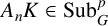 $A_nK\in \mathrm {Sub}^p_G$
. As
 $A_nK\to HK$
and
 $\mathrm {Sub}^p_G$
is closed, we get that
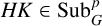 $HK\in \mathrm {Sub}^p_G$
. Now, arguing as above, it is easy to show that
 $\{HK\mid H\in \mathrm {Sub}^p_G\}$
is a closed subset of
 $\mathrm {Sub}^p_G$
. Moreover, if
 $T\in \mathrm {Aut}(G)$
with
 $T(K)=K$
, then
 $T(HK)=T(H)K$
for any
 $H\in \mathrm {Sub}_G$
. Therefore, the sets mentioned in statement (1) are invariant under the action of
 $\mathrm {Aut}(G)$
if
 $T(K)=K$
. Thus, statement (1) holds.
If
 $A\in {\mathcal {P}}_1(G)$
, then
 $AK$
is closed and
 $\pi (A)\in {\mathcal {P}}_1(G/K)$
. Conversely, suppose
 ${B\in {\mathcal {P}}_1(G/K}$
) is nontrivial. It is easy to see that
 $B_1:=\pi ^{-1}(B)$
is a closed connected nilpotent Lie subgroup of G. There exists a neighbourhood U of e such that every element of U is contained in a one-parameter subgroup and
 $U\setminus K$
is nonempty. Choose any
 $x\in U\setminus K$
. There exists a one-parameter subgroup
 $\{x_t\}$
with
 $x_1=x$
. Then,
 $\pi (\{x_t\})=B$
and
 $B_1=\{x_t\}K$
. As K is central in G, we get that
 $B_1$
is, in fact, abelian. If
 $\{x_t\}$
is closed, then it belongs to
 ${\mathcal {P}}_1(G)$
and
 $\pi (\{x_t\})=B$
. Now, suppose it is not closed, then its closure is compact and, hence,
 $B_1$
is compact. This implies that the set of torsion elements is dense in
 $B_1$
. Since
 $U\setminus K$
is open, we can choose
 $y\in B_1\cap (U\setminus K)$
such that
 $y^n=e$
for some
 $n\in {\mathbb N}\setminus \{1\}$
. Let
 $\{y_t\}$
be a one-parameter subgroup in
 $B_1$
such that
 $y_1=y$
. Then,
 $\pi (\{y_t\})=B$
. Here,
 $\{y_t\}$
is closed as
 $y_1^n=e$
. Therefore,
 ${\mathcal {P}}_1(G/K)=\{\pi (A)\mid A\in {\mathcal {P}}_1(G)\}$
, that is, statement (2) holds.
Let
 $\pi ':\mathrm {Sub}^p_G\to \mathrm {Sub}^{p}_{G/K}$
be the map induced by
 $\pi $
. Then,
 $\pi '$
is a continuous closed map. From statement (2), we get that
 $$ \begin{align*}\mathrm {Sub}^{p}_{G/K}= \overline {{\mathcal {P}}_1(G/K)}=\pi '(\overline {{\mathcal {P}}_1(G)})=\pi '(\mathrm {Sub}^p_G)=\{\pi (H)\mid H\in \mathrm {Sub}^p_G\}. \end{align*} $$
Thus, statement (3) holds.
Let
 ${\mathcal S}(K):=\{HK\mid H\in \mathrm {Sub}^p_G\}$
. By statement (1),
 ${\mathcal S}(K)$
is closed in
 $\mathrm {Sub}^p_G$
and, hence, it is compact. Observe that
 ${\mathcal S}(K)=\{H\in \mathrm {Sub}^p_G\mid HK=KH=H\}$
. By statement (3),
 $\pi '({\mathcal S}(K))=\pi '(\mathrm {Sub}^p_G)=\mathrm {Sub}^{p}_{G/K}$
and it is obvious that
 $\pi '|_{{\mathcal S}(K)}$
is continuous and bijective, and hence, it is a homeomorphism. Thus, statement (4) holds.
3 Some properties of automorphisms and their actions on
$\boldsymbol {G}$
and
${\mathbf {Sub}}^{\boldsymbol {p}}_{\boldsymbol {G}}$


In this section, we discuss some properties and actions of automorphisms of a connected Lie group G on G as well as
 $\mathrm {Sub}^p_G$
and discuss some preliminary results which are useful.
For convenience, we introduce a class
 ${\mathcal {C}'}$
of Lie groups as follows.
Definition 3.1. A connected Lie group G is said to be in class
 ${\mathcal {C}'}$
if G has no compact central subgroup of positive dimension (that is, if G has no nontrivial compact connected central subgroup).
The notation is inspired by the fact that the class
 ${\mathcal {C}'}$
is a subset of the class
 $\mathcal {C}$
defined by Dani and McCrudden in [Reference Dani and McCrudden13]. The class
 $\mathcal {C}$
consists of connected Lie groups that admit a (real) linear representation with discrete kernel. Proposition 2.5 of [Reference Dani and McCrudden13] shows that G is in class
 $\mathcal {C}$
if and only if for the radical R of G, the intersection of
 $\overline {[R,R]}$
with the centre of G has no nontrivial compact subgroup. Therefore, the class
 ${\mathcal {C}'}$
is a subset of the class
 $\mathcal {C}$
. Note that any connected Lie group G admits a maximal compact connected central subgroup M, and
 $G/M$
has no nontrivial compact connected central subgroup and, hence, it belongs to class
 ${\mathcal {C}'}$
. We may recall a result of Dani in [Reference Dani12] that if G belongs to class
 ${\mathcal {C}'}$
, then
 $\mathrm {Aut}(G)$
is almost algebraic, that is, it is a(n open) subgroup of finite index in an algebraic subgroup of
 $\mathrm {GL}({\mathfrak g})$
and, in particular, it has finitely many connected components.
It is known that
 $T\in \mathrm {Aut}(G)$
acts distally on G if and only if
 ${d\,} T$
acts distally on the Lie algebra
 ${\mathfrak g}$
of G, and the latter statement is equivalent to the statement that all the eigenvalues of
 ${d\,} T$
have absolute value 1 (see [Reference Abels2]). It is also known that if G admits an automorphism T such that
 ${d\,} T$
has no eigenvalue of absolute value 1 (equivalently, if T is expansive; see [Reference Shah37] and also [Reference Bhattacharya7]), then G must be nilpotent (this is well known, see; for example, [Reference Shah37]). We need the following lemma, which is slightly stronger. The lemma may be known, but we give a short proof for the sake of completeness.
Lemma 3.2. Let G be a connected non-nilpotent Lie group and let T be an automorphism of G. Then, at least one eigenvalue of
 ${d\,} T$
is a root of unity.
Proof. Let M be the largest compact connected central subgroup of G. Then,
 $G/M$
is in class
 ${\mathcal {C}'}$
. As G is not nilpotent,
 $G/M$
is also not nilpotent. Since M is characteristic in G, we may replace G by
 $G/M$
and assume that
 $G\in {\mathcal {C}'}$
. If T has finite order, then
 $({d\,} T)^n=\mathrm {Id}$
for some
 $n\in {\mathbb N}$
, and the assertion follows in this case. Now, suppose T does not have finite order.
Since
 $G\in {\mathcal {C}'}$
,
 $\mathrm {Aut}(G)$
is almost algebraic (see [Reference Dani12]) and, hence, it has finitely many connected components. Now, we may replace T by its suitable power and assume that
 $T\in \mathrm {Aut}(G)^0$
, the connected component of the identity in
 $\mathrm {Aut}(G)$
, and that T is contained in a nontrivial one-parameter subgroup (say)
 $\{T_t\}$
of
 $\mathrm {Aut}(G)^0$
as
 $T=T_1$
. We show that 1 is an eigenvalue of
 ${d\,} T$
.
Suppose G is solvable. Let
 $H=\{T_t\}\ltimes G$
. Then, H is solvable and the nilradical of H, being contained in G, is the same as the nilradical N of G. Therefore,
 $H/N$
is abelian. Thus, T acts trivially on
 $G/N$
. As G is not nilpotent,
 $G\ne N$
, and, hence, 1 is an eigenvalue of
 ${d\,} T$
.
Now, suppose G is not solvable. Let R be the radical of G. Then, R is characteristic in G and let
 $\overline {T}_t$
be the automorphism of
 $G/R$
induced by
 $T_t$
for each t. It is enough to prove that 1 is an eigenvalue of
 ${d\,} \overline {T}$
. Hence, we may replace G by
 $G/R$
and
 $\{T_t\}$
by
 $\{\overline {T}_t\}$
and assume that G is semisimple. Now,
 $\mathrm {Aut}(G)^0$
consists of inner automorphisms of G and
 $T_t=\mathrm {inn}(x_t)$
,
 $t\in {\mathbb R}$
, for some one-parameter subgroup
 $\{x_t\}\subset G$
. If
 $x_1=e$
, then
 $T=T_1=\mathrm {Id}$
. Now, suppose
 $x_1\ne e$
. Then,
 $\{x_t\}$
is nontrivial. Let
 $X\in {\mathfrak g}$
be such that
 $\exp tX=x_t$
,
 $t\in {\mathbb R}$
. As
 $T(x_t)=x_t$
,
 $t\in {\mathbb R}$
, we have that
 ${d\,} T(X)=X$
and 1 is an eigenvalue of
 ${d\,} T$
.
Remark 3.3. The proof above also shows that for a connected solvable Lie group G with the nilradical N, for any
 $T\in \mathrm {Aut}(G)$
,
 $\overline {T}$
has finite order, where
 $\overline {T}$
is the automorphism of
 $G/N$
induced by T. In particular, all the eigenvalues of
 ${d\,}\overline {T}$
on the Lie algebra of
 $G/N$
are roots of unity.
For a connected Lie group G and
 $T\in \mathrm {Aut}(G)$
, let
 $C(T)$
denote the contraction group of T and it is defined as
 $$ \begin{align*} C(T):=\{x\in G\mid T^n(x)\to e\mbox{ as } n\to\infty\}.\end{align*} $$
Note that
 $C(T)$
is a connected nilpotent subgroup of G and if it is closed in G, then it is simply connected (see [Reference Siebert43]; see also [Reference Hazod and Siebert21]). Both
 $C(T)$
and
 $C(T^{-1})$
are trivial if and only if T acts distally on G (see [Reference Raja and Shah35, Theorem 4.1]). Note also that
 $C(T)$
is trivial if and only if all the eigenvalues of
 ${d\,} T$
have absolute value greater than or equal to 1 (see [Reference Abels2, Reference Raja and Shah35]).
We need the following lemma which can be proven easily by using [Reference Dani, Shah, Budzban, Feinsilver and Mukherjea14, Theorem 1.1] and of [Reference Hazod and Siebert21, Theorem 2.4 and Corollary 2.7]; we give a sketch of the proof. Note that the largest compact connected central subgroup of G is characteristic in G. The lemma generalises a part of the statement in [Reference Raja and Shah35, Proposition 4.3].
Lemma 3.4. Let G be a connected Lie group and let
 $T\in \mathrm {Aut}(G)$
. Then, the following are equivalent.
-
(1) T acts distally on the largest compact connected central subgroup of G.
-
(2) The contraction groups
$C(T)$
and
$C(T^{-1})$
are closed, simply connected and nilpotent subgroups of G. -
(3) T acts distally on every compact T-invariant subgroup of G.


Proof. Let M be the largest compact connected central subgroup of G. If
 $G=M$
, then it is easy to see that statements (1)–(3) are equivalent. Now, suppose
 $G\ne M$
. Let
 $\pi :G\to G/M$
be the natural projection and let
 $T'\in \mathrm {Aut}(G/M)$
be the automorphism induced by T on
 $G/M$
. As
 $G/M\in {\mathcal {C}'}$
, using [Reference Dani, Shah, Budzban, Feinsilver and Mukherjea14, Theorem 1.1], one can show that
 $C(T')$
is closed (see the proof of [Reference Raja and Shah35, Proposition 4.3] for more details). Hence,
 $\pi ^{-1}(C(T'))=C_M(T):=\{x\in G\mid T^n(x)M\to M\mbox { in }G/M\}$
is closed. Suppose statement (1) holds, that is, T acts distally on M. Then,
 $C(T)\cap M=C(T|_M)=\{e\}$
. As
 $C_M(T)$
is closed, by [Reference Hazod and Siebert21, Corollary 2.7],
 $C(T)$
is closed. Similarly,
 $C(T^{-1})$
is closed. The rest of the assertion in statement (2) follows from [Reference Siebert43, Corollary 2.4]. This proves
 $(1)\implies (2)$
.
Now suppose statement (2) holds, that is,
 $C(T)$
is closed. Let K be any compact T-invariant subgroup of G. Then,
 $C(T|_K)=C(T)\cap K$
is a compact subgroup of
 $C(T)$
. Hence,
 $C(T|_K)$
is trivial (see [Reference Hazod and Siebert21, Corollary 2.5]). Similarly,
 $C((T|_K)^{-1})$
is trivial and T acts distally on K (see [Reference Jaworski26]). Thus, statement (3) holds. Then,
 $(3)\implies (1)$
is obvious.
We note the following useful proposition that enables us to work on a quotient Lie group that belongs to class
 ${\mathcal {C}'}$
.
Proposition 3.5. Let G be a connected Lie group and let
 $T\in \mathrm {Aut}(G)$
. Let K be a T-invariant compact connected central subgroup of G and let
 $\overline {T}$
denote the automorphism of
 $G/K$
induced by T. If T acts distally on
 $\mathrm {Sub}^p_G$
, then
 $\overline {T}$
acts distally on
 $\mathrm {Sub}^{p}_{G/K}$
.
Proof. Let
 $T\in \mathrm {Aut}(G)$
and let
 $\pi :G\to G/K$
be the natural projection. Here,
 $\overline {T}(\pi (H))=\pi (T(H))$
for any
 $H\in \mathrm {Sub}_G$
, and
 $\mathrm {Sub}^{p}_{G/K}$
is
 $\overline {T}$
invariant. Consider the set
 ${\mathcal S}(K)=\{H\in \mathrm {Sub}^p_G\mid HK=H\}$
. It is a compact T-invariant subset of
 $\mathrm {Sub}^p_G$
and it is homeomorphic to
 $\mathrm {Sub}^{p}_{G/K}$
under the map induced by
 $\pi $
on
 ${\mathcal S}(K)$
(see Lemma 2.4(4)). Suppose T acts distally on
 $\mathrm {Sub}^p_G$
. Then, the T-action on
 ${\mathcal S}(K)$
is distal. As
 $\pi \circ T=\overline {T}\circ \pi $
, we get that
 $\overline {T}$
acts distally on
 $\mathrm {Sub}^{p}_{G/K}$
.
We also need the following elementary lemma.
Lemma 3.6. Let G be a simply connected nilpotent Lie group with the Lie algebra
 ${\mathfrak g}$
and let
 $T\in \mathrm {Aut}(G)$
. Then, the set
 ${\mathcal {P}}_1(G)$
consisting of all closed one-parameter subgroups of G is closed in
 $\mathrm {Sub}_G$
and is the same as
 $\mathrm {Sub}^p_G$
. Moreover, T acts distally on
 $\mathrm {Sub}^p_G$
if and only if
 ${d\,} T$
acts distally on
 $\mathrm {Sub}^{p}_{\mathfrak g}$
.
Proof. In a simply connected nilpotent Lie group, all one-parameter subgroups are closed and there is a one-to-one correspondence between nontrivial (closed) one-parameter subgroups of G and one-dimensional subspaces of
 ${\mathfrak g}$
. The correspondence is via the exponential map
 $\exp : {\mathfrak g}\to G$
with
 $\log $
as its inverse. Namely, for
 $\{x_t\}$
,
 $x_t=\exp tX$
, for some
 $X\in {\mathfrak g}$
and
 $\log x_t=tX$
,
 $t\in {\mathbb R}$
. Also, the exponential map induces a homeomorphism from
 ${\mathcal {P}}_1({\mathfrak g})\to {\mathcal {P}}_1(G)$
. As
 $\exp \circ \,{d\,} T=T\circ \exp $
, it follows that T acts distally on
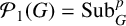 ${\mathcal {P}}_1(G)=\mathrm {Sub}^p_G$
if and only if
 ${d\,} T$
acts distally on
 ${\mathcal {P}}_1({\mathfrak g})=\mathrm {Sub}^{p}_{\mathfrak g}$
.
4 Proofs of the main results
In this section, we prove the main results stated in Section 1. Additionally, we get some corollaries which are derived from the main results. We give some examples of Lie groups G with a nontrivial central torus on which all automorphisms act distally, which is stronger than one of the conditions in Theorems 1.2, 1.4 and 1.5.
Proof of Theorem 1.1
$(1)$
and
$(2)$
for nilpotent groups.


Let G be a (nontrivial) connected Lie group without any nontrivial compact connected central subgroup, that is, G belongs to class
 ${\mathcal {C}'}$
. Let
 $T\in \mathrm {Aut}(G)$
.
 $(1):$
Suppose G is abelian. Then, it is a vector group isomorphic to
 ${\mathbb R}^d$
for some
 ${d\in {\mathbb N}}$
. Note that
 ${\mathcal D}=\{r\,\mathrm {Id}\mid r\in {\mathbb R}\setminus \{0\}\}$
, where
 $\mathrm {Id}$
is the identity matrix in
 $\mathrm {GL}(d,{\mathbb R})$
. If
 $d=1$
, then
 $\mathrm {GL}(1,{\mathbb R})$
is abelian and the assertion follows trivially. Now, suppose
 $d\ge 2$
. Then,
 $\mathrm {Sub}^p_G$
is isomorphic to
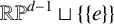 $\mathbb {RP}^{d-1} \sqcup \{\{e\}\}$
and
 $T\in \mathrm {GL}(d,{\mathbb R})$
. Both
 $\mathbb { RP}^{d-1}$
and
 $\{\{e\}\}$
are compact and T invariant. Hence, T acts distally on
 $\mathrm {Sub}^{p}_{{\mathbb R}^d}$
if and only if T acts distally on
 $\mathbb {RP}^{d-1}$
. One can define an action of T on
 $\mathbb S^{d-1}$
, the boundary of the unit sphere in
 ${\mathbb R}^d$
, as
 $\overline {T}(x)=T(x)/\|T(x)\|$
, where
 $\|\cdot \|$
denotes the usual norm on
 ${\mathbb R}^d$
. Here,
 $\overline {T}$
is a homeomorphism and
 $\overline {T}(-x)= -\overline {T}(x)$
. As
 ${\mathbb {RP}}^{d-1}$
is a quotient space of
 $\mathbb S^{d-1}$
, the action of T on
 ${\mathbb {RP}}^{d-1}$
is the same as the action of
 $\overline {T}$
on
 ${\mathbb S}^{d-1}/\sim $
, where
 $\sim $
is the equivalence relation that identifies x with
 $-x$
for each
 $x\in \mathbb S^{d-1}$
. It is easy to see that T acts distally on
 ${\mathbb {RP}}^{d-1}$
if and only if
 $\overline {T}$
acts distally on
 $\mathbb S^{d-1}$
. The latter statement is equivalent to the following:
 $T \in {\mathcal K} {\mathcal D}$
, where
 ${\mathcal K}$
is a compact subgroup of
 $\mathrm {GL}(d,{\mathbb R})$
and
 ${\mathcal D}$
is the centre of
 $\mathrm {GL}(d,{\mathbb R})$
(this follows from [Reference Shah and Yadav39, Theorem 1]; see also [Reference Shah and Yadav41]).
Conversely, for
 $G={\mathbb R}^d$
and
 $T\in {\mathcal K}{\mathcal D}$
, with a compact subgroup
 ${\mathcal K}$
of
 $\mathrm {GL}(d,{\mathbb R})$
and the centre
 ${\mathcal D}$
of
 $\mathrm {GL}(d,{\mathbb R})$
, the action of T on
 $\mathrm {Sub}^p_G$
is the same as that of S on
 $\mathrm {Sub}^p_G$
for some
 $S\in {\mathcal K}$
since
 ${\mathcal D}$
acts trivially on
 $\mathrm {Sub}^p_G$
. As the compact subgroups of
 $\mathrm {Aut}(G)$
act distally on any closed invariant subspace of
 $\mathrm {Sub}_G$
(
 $\mathrm {Sub}^p_G$
in this case), we have that T acts distally on
 $\mathrm {Sub}^p_G$
. This completes the proof of Theorem 1.1(1).
 $(2):$
Suppose G belongs to the class
 ${\mathcal {C}'}$
and it is nonabelian and nilpotent. Then, G is simply connected as G has no compact central subgroup of positive dimension. Suppose T acts distally on
 $\mathrm {Sub}^p_G$
. We want to show that T is contained in a compact subgroup of
 $\mathrm {Aut}(G)$
. Since G belongs to the class
 ${\mathcal {C}'}$
,
 $\mathrm {Aut}(G)$
is almost algebraic as a subgroup of
 $\mathrm {GL}({\mathfrak g})$
(see [Reference Dani12]).
As G is simply connected and nilpotent, by Lemma 3.6,
 ${d\,} T$
acts distally on
 $\mathrm {Sub}^{p}_{\mathfrak g}$
. Then, from statement (1) above, we have that
 ${d\,} T\in {\mathcal K}\{r\,\mathrm {Id}\mid r\ne 0\}$
for some compact subgroup
 ${\mathcal K}$
of
 $\mathrm {GL}({\mathfrak g})$
and
 $\mathrm {Id}$
is the identity map on
 ${\mathfrak g}$
. Here,
 ${d\,} T=\psi \,\circ \, r\,\mathrm {Id}$
for some
 $r\in {\mathbb R}\setminus \{0\}$
and
 $\psi \in {\mathcal K}$
. If
 $r=\pm 1$
, then
 ${d\,} T^2\in {\mathcal K}$
and T generates a relatively compact subgroup of
 $\mathrm {Aut}(G)$
. If possible, suppose
 $r\ne \pm 1$
. Since
 $\mathrm {Aut}(G)$
is almost algebraic, there exists
 $n\in {\mathbb N}$
such that
 ${d\,} T^n$
is contained in a connected almost algebraic subgroup
 ${\mathbb R}\times \mathbb T^k$
of
 $\mathrm {Aut}(G)^0$
(which is identified with its image in
 $\mathrm {GL}({\mathfrak g})$
), where
 $\mathbb T^k=(\mathbb S^1)^k$
for some
 $k\in {\mathbb N}$
. Therefore,
 $\psi ^n\,\circ \, r^n\,\mathrm {Id}\in {\mathbb R}\times \mathbb T^k\subset \mathrm {Aut}(G)^0$
. Hence, both
 $\psi ^n$
and
 $r^n\,\mathrm {Id}\in \mathrm {Aut}(G)^0$
. However,
 $r^n\,\mathrm {Id}$
is not a Lie algebra automorphism of
 ${\mathfrak g}$
as
 $r^n\ne 1$
; otherwise,
 $r^n[X,Y]=r^n\mathrm {Id}[X,Y]=[r^n\mathrm {Id}(X),r^n\mathrm {Id}(Y)]=r^{2n}[X,Y]$
, which would imply that
 $[X,Y]=0$
for all
 $X,Y\in {\mathfrak g}$
, which leads to a contradiction as G is not abelian. Thus,
 $r=\pm 1$
and T is contained in a compact subgroup of
 $\mathrm {Aut}(G)$
. The converse statement is obvious. Thus, statement (2) holds if G is nilpotent.
We continue with the proof of Theorem 1.1 after proving Theorems 1.2 and 1.3.
Proof of Theorem 1.2.
Let G be a connected Lie group that is not a vector group. Let M be the largest compact connected central subgroup of G. Suppose
 $T\in \mathrm {Aut}(G)$
be such that it acts distally on M. Suppose T acts distally on
 $\mathrm {Sub}^p_G$
. Then, we want to show that T acts distally on G. The assertion holds trivially if
 $G=M$
.
Step 1: Suppose G is simply connected and nilpotent. Since G is not a vector group, G is nonabelian and by the proof of Theorem 1.1(2) for the nilpotent case, T is contained in a compact subgroup of
 $\mathrm {Aut}(G)$
. Hence, T acts distally on G.
Step 2: Now suppose G is not a simply connected nilpotent group. By [Reference Raja and Shah35, Theorem 4.1], it is enough to prove that the contraction groups
 $C(T)$
and
 $C(T^{-1})$
are trivial. As T acts distally on the maximal compact connected central subgroup M, by Lemma 3.4, both
 $C(T)$
and
 $C(T^{-1})$
are closed, simply connected and nilpotent subgroups. Suppose
 $C(T)$
is nontrivial. If possible, suppose
 $C(T)$
is nonabelian. As it is T-invariant and
 $T|_{C(T)}$
acts distally on
 $\mathrm {Sub}^{p}_{C(T)}$
, we get from Step 1 that
 $T|_{C(T)}$
acts distally on
 $C(T)$
, which is a contradiction. Thus,
 $C(T)$
is abelian and
 $C(T)$
is isomorphic to
 ${\mathbb R}^d$
as it is simply connected. By Theorem 1.1(1),
 $T_1=T|_{C(T)}=\phi \circ \alpha \,I$
for some
 $\phi $
contained in a compact subgroup of
 $\mathrm {GL}(d,{\mathbb R})$
and
 $\alpha \in {\mathbb R}$
,
 $0< |\alpha |<1$
; here, I denotes the identity matrix in
 $\mathrm {GL}(d,{\mathbb R})$
, replacing T by
 $T^2$
, we may assume that
 $\alpha>0$
.
Step 3: Suppose G is nilpotent but not simply connected. Then, M as above is nontrivial. Since T acts distally on M, by [Reference Abels2, Lemma 2.5], we have that
 $T^k|_M$
is unipotent for some
 $k\in {\mathbb N}$
, that is,
 ${d\,} T$
has an eigenvalue that is a root of unity. If G is not nilpotent, by Lemma 3.2,
 ${d\,} T$
has an eigenvalue that is a root of unity. We may replace T by
 $T^m$
, for some
 $m\in {\mathbb N}$
and assume that 1 is an eigenvalue of
 ${d\,} T$
. Let
 $X\in {\mathfrak g}$
,
 $X\ne 0$
be such that
 ${d\,} T(X)=X$
and let
 $A=\{\exp tX\}$
, a one-parameter subgroup, which is either closed or its closure
 $\bar A$
is compact. Since
 $T|_A=\mathrm {Id}$
, we have that
 $T|_{\bar A}=\mathrm {Id}$
and it follows that
 $\bar A$
normalises
 $C(T)$
and
 $\bar A\cap C(T)=\{e\}$
.
We now show that
 $C(T)$
normalises
 $\bar A$
, which would imply that
 $\bar A\, C(T)$
is abelian as
 $C(T)$
and A are so. Here,
 $T(\bar A)=\bar A$
and
 $\bar A\in \mathrm {Sub}^p_G$
. Now, for any nonzero
 $c\in C(T)$
, we have that
 $$ \begin{align*} T^n(c\bar A c^{-1})=T^n(c)\,\bar A\,T^n(c^{-1})\to\bar A.\end{align*} $$
Since T acts distally on
 $\mathrm {Sub}^p_G$
, we get that
 $c\bar Ac^{-1}=\bar A$
for all
 $c\in C(T)$
. Thus,
 $C(T)$
normalises
 $\bar A$
and, hence,
 $\bar A\, C(T)$
is abelian.
Let
 $H=\overline {A\times C(T)}$
. Then, H is a closed T-invariant abelian subgroup and
 $\bar A\subset H$
. First, suppose H is a vector group. By Theorem 1.1(1),
 $T|_H\in {\mathcal K}{\mathcal D}$
for some compact subgroup
 ${\mathcal K}$
in
 $\mathrm { GL}(H)$
and the centre
 ${\mathcal D}$
of
 $\mathrm {GL}(H)$
, and thus all the eigenvalues of
 $T|_H$
have the same absolute value. Since
 $T|_{\bar A}=\mathrm {Id}$
and
 $T|_{C(T)}$
have eigenvalues of absolute value
 $\alpha \ne 1$
, this leads to a contradiction. Thus,
 $C(T)$
must be trivial in this case.
Step 4: Now suppose H is not a vector group. Since
 $C(T)$
is closed and the image of A is dense in
 $H/C(T)$
, we get that
 $H=K\times C(T)$
for the maximal compact subgroup K of H. As T acts trivially on
 $H/C(T)$
and K is T-invariant, we get that
 $T|_K=\mathrm {Id}$
.
Let
 $\psi , S: H\to H$
be such that
 $S|_K=\mathrm {Id}$
,
 $S|_{C(T)}=\alpha \,\mathrm {Id}$
,
 $\psi |_K=\mathrm {Id}$
and
 $\psi |_{C(T)}=\phi $
, where
 $\alpha $
and
 $\phi $
are as in Step 2. Now,
 $T|_{H}=S\psi =\psi S$
and
 $\psi $
is contained in a compact subgroup of
 $\mathrm {Aut}(H)$
. Therefore, S acts distally on
 $\mathrm {Sub}^{p}_{H}$
(see [Reference Shah and Yadav40, Lemma 2.2]) and
 $C(S)=C(T)$
.
Let
 $\{z_t=x_tc_t\}$
be a closed one-parameter subgroup, where
 $\{x_t\}\subset K$
is closed and isomorphic to
 ${\mathbb S}^1$
and
 $\{c_t\}\subset C(S)=C(T)$
is a nontrivial (closed) one-parameter subgroup such that
 $S(c_t)=c_{\alpha t}$
,
 $t\in {\mathbb R}$
(as addition is the group operation on
 $C(T)={\mathbb R}^d$
, we choose
 $c_t=tc$
,
 $t\in {\mathbb R}$
, for some nonzero
 $c\in {\mathbb R}^d$
). Let
 $\{n_k\}$
be an unbounded sequence in
 ${\mathbb N}$
such that
 $S^{n_k}(\{z_t\})\to C$
for some C in
 $\mathrm {Sub}^{p}_{H}$
. Note that
 $\{z_t\}\subset \{x_t\}\times \{c_t\}$
and the latter is closed and S-invariant. So,
 $C\subset \{x_t\}\times \{c_t\}$
. For a fixed
 $t\in {\mathbb R}$
, as
 $c_t\in C(S)$
, we get that
 $$ \begin{align*} S^{n_k}(z_t)=x_t S^{n_k}(c_t)\to x_t,\end{align*} $$
as
 $n_k\to \infty $
. Therefore,
 $\{x_t\}\subset C$
. Again, for a fixed
 $t\in {\mathbb R}$
,
 $$ \begin{align*}S^{n_k}(z_{\alpha^{-n_k}t})= x_{\alpha^{-n_k}t}S^{n_k}(c_{\alpha^{-n_k}t})=x_{\alpha^{-n_k}t}c_t\to x_sc_t\end{align*} $$
along a subsequence of
 $\{n_k\}$
for some
 $s\in {\mathbb R}$
. Therefore,
 $x_sc_t$
and, hence,
 $c_t$
belongs to C. Thus,
 $\{c_t\}\subset C$
and
 $C=\{x_t\}\times \{c_t\}$
and, hence, C is S-invariant. This implies that
 $S^{n_k}(S(\{z_t\}))\to C$
and, hence, that
 $S(\{z_t\})=\{z_t\}$
since S acts distally on
 $\mathrm {Sub}^p_G$
. As
 $\{z_t\}$
is isomorphic to
 ${\mathbb R}$
, there exists
 $\beta \in {\mathbb R}\setminus \{0\}$
such that for all
 $t\in {\mathbb R}$
,
 $$ \begin{align*} S(z_t)=z_{\beta t}=x_{\beta t}c_{\beta t}\ \mbox{ and }\ S(z_t)=S(x_tc_t)=x_tc_{\alpha t}.\end{align*} $$
As
 $\{x_t\}\times \{c_t\}$
is a direct product and
 $\{c_t\}$
is isomorphic to
 ${\mathbb R}$
, it follows that
 $\beta =\alpha $
and
 $x_t=x_{\alpha t}$
, that is,
 $x_{(1-\alpha )t}=e$
for all
 $t\in {\mathbb R}$
. As
 $\alpha \ne 1$
,
 $x_t=e$
for each t, which is a contradiction. Therefore,
 $C(T)$
is trivial.
Similarly, we can show that
 $C(T^{-1})$
is trivial and, hence, T acts distally on G.
In view of [Reference Abels2, Theorem 1.1], the following corollary is an easy consequence of Theorem 1.2. We omit the proof.
Corollary 4.1. Let G be a connected Lie group that is not a vector group and let
 $\mathcal{H}$
be a subgroup of
 $\mathrm {Aut}(G)$
that acts distally on the largest compact connected central subgroup of G. If
 $\mathcal{H}$
acts distally on
 $\mathrm {Sub}^p_G$
, then
 $\mathcal{H}$
acts distally on G.
Before proving Theorem 1.3, we first prove the following proposition, which is a special case of the theorem.
Proposition 4.2. Let G be a connected Lie group,
 $T\in \mathrm {Aut}(G)$
and let L be a closed connected nilpotent normal T-invariant subgroup of G. Suppose T acts trivially on both L and
 $G/L$
. If T acts distally on
 $\mathrm {Sub}^p_G$
, then
 $T=\mathrm {Id}$
.
Proof. Since T acts trivially on
 $G/L$
and L, we have that T acts distally on G. In fact, all the eigenvalues of
 ${d\,} T$
are equal to 1 and T is unipotent. Suppose T acts distally on
 $\mathrm {Sub}^p_G$
. Let U be a neighbourhood of the identity e such that every element of U is contained in a one-parameter subgroup. Since G is connected, U generates G and it is enough to show that
 $T(x)=x$
for all
 $x\in U$
.
Step 1: If possible, suppose
 $T(x)\ne x$
for some
 $x\in U$
. There exists a one-parameter subgroup
 $\{x_t\}$
in G such that
 $x_1=x$
. Let
 $H=\overline {\{x_t\}L}$
. Then, H is a closed connected solvable T-invariant subgroup of G and
 $H/L$
is abelian. Let
 $\pi :G\to G/L$
be the natural projection. Then,
 $\pi (H)=\overline {\pi (\{x_t\})}$
. If
 $\pi (\{x_t\})$
is unbounded, it is closed and it is isomorphic to
 ${\mathbb R}$
and in this case,
 $\{x_t\}$
is also unbounded and closed. Moreover,
 $H=\{x_t\}L$
.
Now, suppose
 $\pi (\{x_t\})$
is relatively compact. As H is solvable, there exists a maximal compact (connected, abelian) subgroup K in H such that
 $H=KL$
. As
 $T(x)\ne x$
and
 $T|_L=\mathrm {Id}$
, we have that
 $T(h)\ne h$
for some
 $h\in K$
, and hence,
 $T(h)\ne h$
for some finite order element h in
 $K\cap U$
. There exists a closed (compact) one-parameter subgroup
 $\{h_t\}$
in K such that
 $h_1=h$
. Replacing
 $\{x_t\}$
by
 $\{h_t\}$
, we have in this case too that H is closed and
 $H=\{x_t\}L$
.
Now, we have that
 $H=\{x_t\}L$
is closed, where either
 $\pi (\{x_t\})$
(as well as
 $\{x_t\}$
) is isomorphic to
 ${\mathbb R}$
or
 $\{x_t\}$
is isomorphic to
 ${\mathbb S}^1$
and
 $T(x_1)\ne x_1$
. As T acts trivially on
 $G/L$
, we have that
 $T(H)=H$
and
 $T(x_t)=x_ty_t$
for some
 $y_t\in L$
,
 $t\in {\mathbb R}$
, where
 $y_1\ne e$
.
Step 2: Let
 $A:=\{x_t\}$
and let
 $\{n_k\}\subset {\mathbb N}$
be an unbounded sequence such that
 $T^{n_k}(A)\to B$
for some
 $B\in \mathrm {Sub}^{p}_H$
. By Lemma 2.2, B is not discrete as A is connected and nontrivial. Let
 $b\in B$
be such that
 $b\ne e$
. There exist
 $t_k\in {\mathbb R}$
,
 $k\in {\mathbb N}$
, such that
 $$ \begin{align*} T^{n_k}(x_{t_k})=x_{t_k}y_{t_k}^{n_k}\to b.\end{align*} $$
As
 $y_t\in L$
,
 $t\in {\mathbb R}$
, we get that
 $\pi (x_{t_k})\to \pi (b)$
. If
 $H/L$
is isomorphic to
 ${\mathbb R}$
, then we get that the sequence
 $\{t_k\}$
is bounded. In the second case where
 $\{x_t\}$
is compact, we can choose
 $\{t_k\}$
to be bounded. Passing to a subsequence if necessary, we may assume that
 $t_k\to t_0$
. Therefore,
 $x_{t_k}\to x_{t_0}$
and
 $y_{t_k}\to y_{t_0}$
, and
 $b=x_{t_0}y'$
, where
 $y_{t_k}^{n_k}\to y'$
in L.
Step 3: We first assume that L is simply connected. We show that
 $y_{t_0}=e$
in this case. Let
 ${\mathfrak l}$
be the Lie algebra of L. Since L is simply connected and nilpotent,
 $\exp : {\mathfrak l}\to L$
is a homeomorphism with
 $\log $
as its inverse. Let
 $y_{t_k}=\exp Y_k$
for some
 $Y_k\in {\mathfrak l}$
. Then,
 $y_{t_k}^{n_k}=\exp (n_kY_k)$
and as
 $y_{t_k}^{n_k}\to y'$
, we have that
 $n_kY_k\to \log y'$
in
 ${\mathfrak l}$
. As
 ${\mathfrak l}$
is isomorphic to
 ${\mathbb R}^d$
for some
 $d\in {\mathbb N}$
, it follows that
 $Y_k\to 0$
in
 ${\mathfrak l}$
and, hence,
 $y_{t_k}\to e$
, that is,
 $y_{t_0}=e$
. Now,
 $$ \begin{align*} T(b)=T(x_{t_0})y'=x_{t_0}y_{t_0}y'=x_{t_0}y'=b.\end{align*} $$
Thus,
 $T(B)=B$
. As T acts distally on
 $\mathrm {Sub}^p_G$
, we have that
 $T(A)=A$
. Since A is a one-parameter subgroup in G and T is unipotent, we get that
 $T(x_t)=x_t$
,
 $t\in {\mathbb R}$
. This leads to a contradiction as
 $T(x_1)\ne x_1$
. Therefore,
 $T(x)=x$
for all
 $x\in U$
and, hence, for all
 $x\in G$
. Thus,
 $T=\mathrm {Id}$
if L is simply connected.
Step 4: Suppose that L is not simply connected. Let M be the maximal compact (normal) subgroup of L. Then, M is central in G and
 $L/M$
is simply connected. Let
 $\varrho :G\to G/M$
be the natural projection and let
 $\overline {T}$
be the automorphism on
 $G/M$
induced by T. Then,
 $\overline {T}$
acts trivially on both
 $\varrho (L)$
and
 $\varrho (G)/\varrho (L)$
. By Proposition 3.5,
 $\overline {T}$
acts distally on
 $\mathrm {Sub}^{p}_{G/M}$
. From Step 3, we get that
 $\overline {T}$
acts trivially on
 $G/M$
, that is,
 $T(g)\in gM$
,
 $g\in G$
. In particular, for
 $\{x_t\}$
as above,
 $T(x_t)=x_ty_t$
, where
 $y_t\in M$
for all
 $t\in {\mathbb R}$
and
 $y_1\ne e$
. Since M is central in G,
 $y_tx_s=x_sy_t$
,
 $t, s\in {\mathbb R}$
, and
 $\{y_t\}$
is a one-parameter subgroup of the compact central subgroup M. Note that
 $\{y_t\}$
is closed if
 $\{x_t\}$
is compact.
As
 $\mathrm {Sub}^p_G$
is compact, there exists an unbounded sequence
 $\{n_k\}$
in
 ${\mathbb N}$
such that
 $T^{n_k}(\{x_t\})\to C$
for some
 $C\in \mathrm {Sub}^p_G$
. We show that
 $C=\{x_t\}\times \overline {\{y_t\}}$
. As
 $\{x_t\}\subset \{x_t\}\times \overline {\{y_t\}}$
and the latter is T-invariant, we get that
 $C\subset \{x_t\}\times \overline {\{y_t\}}$
. For a fixed
 $t\in {\mathbb R}$
,
 $$ \begin{align*} T^{n_k}(x_{t/n_k})=x_{t/n_k}y_{t/n_k}^{n_k}=x_{t/n_k}y_t\to y_t\end{align*} $$
as
 $n_k\to \infty $
. Therefore,
 $y_t\in C$
for each t, and
 $\overline {\{y_t\}}\subset C$
as C is closed. Also, note that
 $T^{n_k}(x_t)=x_ty_t^{n_k}\to x_ty$
along a subsequence of
 $\{n_k\}$
for some
 $y\in \overline {\{y_t\}}\subset C$
. Hence,
 $x_t\in C$
,
 $t\in {\mathbb R}$
. Thus,
 $\{x_t\}\times \overline {\{y_t\}}\subset C$
. Now,
 $T(C)=C$
and we get that
 $T^{n_k}(T(\{x_t\}))\to C$
. As T acts distally on
 $\mathrm {Sub}^p_G$
, we have that
 $T(\{x_t\})=\{x_t\}$
and since T is unipotent,
 $T(x_t)=x_t$
for each t. However,
 $T(x_1)=x_1y_1\ne x_1$
. This leads to a contradiction. Therefore,
 $T(x)=x$
for each
 $x\in U$
and, hence, for each
 $x\in G$
. Thus,
 $T=\mathrm {Id}$
.
Proof of Theorem 1.3.
Let G be a connected Lie group and let
 $T\in \mathrm {Aut}(G)$
. Suppose T is unipotent and it acts distally on
 $\mathrm {Sub}^p_G$
. We show that
 $T=\mathrm {Id}$
.
Step 1: Suppose G is nilpotent. If possible, suppose
 $T\ne \mathrm {Id}$
. Since T is unipotent, by [Reference Shah and Yadav42, Proposition 3.10], there exists an increasing sequence of closed connected normal T-invariant subgroups
 $\{e\} = G_0 \subset G_1 \subset \cdots \subset G_n = G$
,
 $n \geq 2$
, such that T acts trivially on each successive quotient group
 $G_i/G_{i-1}$
,
 $1\leq i\leq n$
, and T does not act trivially on
 $G_{i+1}/G_{i-1}$
,
 $1\leq i \leq n -1$
. Then,
 $G_2\ne G_1$
. As T acts distally on
 $\mathrm {Sub}^p_G$
, it acts distally on
 $\mathrm {Sub}^{p}_{G_2}$
. Now, by Proposition 4.2,
 $T|_{G_2}=\mathrm {Id}$
, which leads to a contradiction. Therefore,
 $T=\mathrm {Id}$
when G is nilpotent.
Step 2: Suppose G is not nilpotent. Let N be the nilradical of G. As T acts distally on
 $\mathrm {Sub}^{p}_N$
, it follows from Step 1 that
 $T|_N=\mathrm {Id}$
. Suppose G is solvable. As noted in Remark 3.3, we have that the automorphism induced by T on
 $G/N$
is a finite order automorphism and it is trivial since it is unipotent. Now, by Proposition 4.2,
 $T=\mathrm {Id}$
.
Step 3: Suppose G is not solvable. Let R be the radical of G. Then, as T acts distally on
 $\mathrm {Sub}^{p}_R$
, we have from Step 2 that
 $T|_R=\mathrm {Id}$
.
Now,
 $G/N$
is reductive. Let
 $\pi :G\to G/N$
be the natural projection. Then,
 ${\pi (G)=SR'}$
, an almost direct product of a semisimple Levi subgroup S of
 $\pi (G)$
and the radical
 $R'=\pi (R)$
of
 $\pi (G)$
, where
 $R'$
is central in
 $\pi (G)$
. Let
 ${\overline {T}}$
be the automorphism of
 $\pi (G)$
induced by T. Then,
 ${\overline {T}}$
acts trivially on
 $R'$
. Also,
 ${\overline {T}}$
keeps S invariant as it is the commutator subgroup of
 $\pi (G)$
. Now, if
 ${\overline {T}}$
acts trivially on
 $\pi (G)=G/N$
, then by Proposition 4.2,
 $T=\mathrm {Id}$
. If possible suppose
 ${\overline {T}}$
does not act trivially on
 $\pi (G)$
. As
 ${\overline {T}}$
is unipotent, there exists a nontrivial unipotent element u in S such that
 ${\overline {T}}=\mathrm {inn}(u)$
. Considering the Iwasawa decomposition
 $S=KAU$
, where
 $u\in U$
, we have that u is not in the centre of
 $AU$
(see [Reference Knapp29, Lemma 6.50]). Now,
 $AUR'$
is connected, solvable and
 ${\overline {T}}$
invariant. Let B be the closure of
 $\pi ^{-1}(AUR')$
. It is a closed connected solvable T-invariant subgroup of G. As T acts distally on
 $\mathrm {Sub}^{p}_B$
, by Step 2,
 $T|_B=\mathrm {Id}$
. This implies that
 ${\overline {T}}$
acts trivially on
 $AU$
and that u centralises
 $AU$
, which is a contradiction. Thus,
 ${\overline {T}}$
acts trivially on
 $\pi (G)=G/N$
, and as noted above, by Proposition 4.2, we get that
 $T=\mathrm {Id}$
.
The converse statement in the theorem is obvious.
Proof of Theorem 1.1(2) for non-nilpotent case.
Let G be a connected Lie group in class
 ${\mathcal {C}'}$
. Then,
 $\mathrm {Aut}(G)$
is almost algebraic as a subgroup of
 $\mathrm {GL}({\mathfrak g})$
(via the correspondence
 $T\leftrightarrow {d\,} T$
) (see [Reference Dani12]). Suppose
 $T\in \mathrm {Aut}(G)$
acts distally on
 $\mathrm {Sub}^p_G$
. Suppose G is not nilpotent. In particular, it is not a vector group. By Theorem 1.2, T acts distally on G. Then, for some
 $n\in {\mathbb N}$
,
 $T^n$
is contained in a connected abelian almost algebraic subgroup of
 $\mathrm {Aut}(G)$
and it has the form
 ${\mathcal K}\times \,{\mathcal U}$
, where
 ${{\mathcal K},\,{\mathcal U}\subset \mathrm {Aut}(G)}$
,
 ${\mathcal K}$
is an abelian compact connected group and
 ${\mathcal U}$
is an abelian unipotent connected group; that is, it consists of unipotent elements (see [Reference Abels1, Corollaries 2.3 and 2.5]). Now,
 $T^n=S\circ \psi =\psi \circ S$
, where
 $S\in {\mathcal U}$
is unipotent and
 $\psi \in {\mathcal K}$
. Hence, S acts distally on
 $\mathrm {Sub}^p_G$
(see [Reference Shah and Yadav40, Lemma 2.2]). By Theorem 1.3,
 $S=\mathrm {Id}$
. Thus,
 $T^n=\psi \in {\mathcal K}$
and, hence, T is contained in a compact subgroup of
 $\mathrm {Aut}(G)$
. The converse is obvious (see [Reference Palit and Shah32, Lemma 4.2]).
Now, we want to prove Theorem 1.4. We need an elementary result about certain automorphisms keeping a maximal compact connected abelian subgroup (maximal torus) invariant. In a connected Lie group G, all maximal tori are conjugate to each other. Any compact abelian subgroup of G is contained in a maximal torus, as any maximal compact abelian subgroup of G is connected. If A is a maximal torus in G, then so is
 $T(A)$
, for any
 $T\in \mathrm {Aut}(G)$
, and
 $T(A)$
is conjugate to A. Any maximal compact subgroup of a connected solvable Lie group is abelian (see [Reference Iwasawa25]).
In [Reference Dani and Shah15], any subgroup of
 $\mathrm {Aut}(G)$
that fixes elements of a maximal torus is shown to be almost algebraic. Given any automorphism T of G, it need not keep any torus invariant. However, this is the case if T is contained in a compact connected abelian subgroup of
 $\mathrm {Aut}(G)$
, as shown in the following elementary lemma. The lemma also holds if we replace the radical R by any closed connected characteristic subgroup of G.
Lemma 4.3. Let G be a connected Lie group. If
 ${\mathcal K}$
is a compact connected abelian subgroup of
 $\mathrm {Aut}(G)$
, then there exists a maximal torus of G (respectively of the radical of G) on which every automorphism in
 ${\mathcal K}$
acts trivially.
Proof. Let A be any maximal torus in a connected Lie group G. It is easy to see that for any closed connected normal subgroup L of G,
 $A\cap L$
is a maximal torus of L.
Let
 ${\mathcal K}$
be a compact connected abelian subgroup of
 $\mathrm {Aut}(G)$
and let
 $H={\mathcal K}\ltimes G$
; where the action of
 ${\mathcal K}$
on G is by automorphisms. Then, H is a connected Lie group and G is normal in H. Let R be the radical of G. Then, R is characteristic in G and, hence, normal in H. Let A be a maximal torus in H containing
 ${\mathcal K}$
. Arguing as above, we get that
 $A\cap G$
(respectively
 $A\cap R$
) is a maximal torus in G (respectively R). As
 ${\mathcal K}\subset A$
and A is abelian, we get that every automorphism in
 ${\mathcal K}$
acts trivially on
 $A\cap G$
(respectively
 $A\cap R$
).
Proof of Theorem 1.4.
Let G be a connected Lie group and let
 $T\in \mathrm {Aut}(G)$
. The statements
 $(5)\implies (4)\implies (3)\implies (2)\implies (1)$
are obvious. Now, it is enough to show that
 $(1)\implies (5)$
when G is not a vector group and T acts distally on the largest compact connected central subgroup (say) M of G. Suppose statement (1) holds, that is, T acts distally on
 $\mathrm {Sub}^p_G$
. Then, we want to show that T is contained in a compact subgroup of
 $\mathrm {Aut}(G)$
. If M is trivial, then G belongs to the class
 ${\mathcal {C}'}$
and the assertion follows from Theorem 1.1(2). Now, suppose M is nontrivial. By Theorem 1.2, T acts distally on G. Then, by [Reference Raja and Shah34, Theorem 3.1],
 $\overline {T}$
acts distally on
 $G/M$
, where
 $\overline {T}$
is the automorphism of
 $G/M$
induced by T.
Suppose
 $G=M$
. Since T acts distally on M, by [Reference Abels2, Lemma 2.5],
 $T^n$
is unipotent for some
 $n\in {\mathbb N}$
. As T acts distally on
 $\mathrm {Sub}^p_G$
, so does
 $T^n$
, and by Theorem 1.3,
 $T^n=\mathrm {Id}$
. Hence, the assertion holds when G is compact and abelian.
Now, suppose M is nontrivial and
 $G\ne M$
. We show that there exists a maximal torus of G that is
 $T^k$
-invariant for some
 $k\in {\mathbb N}$
. Let
 $\pi :G\to G/M$
be the natural projection. By Proposition 3.5,
 $\overline {T}$
acts distally on
 $\mathrm {Sub}^{p}_{G/M}$
.
Suppose
 $G/M$
is a vector group. Then by Theorem 1.1(1),
 $\overline {T}=\psi \circ \,\alpha \,\mathrm {Id}$
for some
 $\alpha \in {\mathbb R}\setminus \{0\}$
, and
 $\psi $
generates a relatively compact subgroup in
 $\mathrm {Aut}(G/M)$
. Since
 $\overline {T}$
acts distally on
 $G/M$
, we get that
 $|\alpha |=1$
and, hence,
 $\overline {T}$
is contained in a compact subgroup of
 $\mathrm {Aut}(G/M)$
. Now, suppose
 $G/M$
is not a vector group. As
 $G/M$
belongs to the class
 ${\mathcal {C}'}$
, by Theorem 1.1(2),
 $\overline {T}$
is contained in a compact subgroup of
 $\mathrm {Aut}(G/M)$
. So, in either case, we have that
 $\overline {T}$
is contained in a compact subgroup of
 $\mathrm {Aut}(G/M)$
.
Let
 ${\mathcal K}$
be the connected component of the identity in the closed (compact) subgroup generated by
 $\overline {T}$
in
 $\mathrm {Aut}(G/M)$
. Then,
 $(\overline {T})^k\in {\mathcal K}$
for some
 $k\in {\mathbb N}$
. Now, by Lemma 4.3,
 $(\overline {T})^k$
keeps a maximal torus (say) A of
 $G/M$
invariant and it acts trivially on A. Let
 $K=\pi ^{-1}(A)$
. Then, K is a maximal torus of G and
 $T^k(K)=K$
.
Note that K is compact, connected and abelian. Moreover, as T acts distally on G, so does
 $T^k$
and the restriction of
 $T^k$
to K is also distal. Arguing as above for K instead of M, we get that for some
 $m\in {\mathbb N}$
,
 $T^m|_K$
is unipotent and, as it acts distally on
 $\mathrm {Sub}^{p}_K$
, it acts trivially on K (by Theorem 1.3). Without loss of any generality, we may replace T by
 $T^m$
and assume that T fixes every element of K, that is,
 $T\in F_K(G) $
, where the set
 $F_K(G) :=\{\varrho \in \mathrm {Aut}(G)\mid \varrho (x)=x \mbox { for all } x\in K\}$
. We know that
 $F_K(G)$
is almost algebraic (see [Reference Dani and Shah15]). As T acts distally on G and
 $T\in F_K(G)$
, for some
 $n\in {\mathbb N}$
,
 $T^n$
is contained in a connected almost algebraic subgroup
 ${\mathcal B}\times {\mathcal U}$
of
 $F_K(G)$
, where
 ${\mathcal B}$
is a compact group and
 ${\mathcal U}$
consists of unipotent elements (see [Reference Abels1, Corollaries 2.3 and 2.5]). Now, we have that
 $T=\phi \circ S=S\circ \phi $
such that
 $\phi \in {\mathcal B}$
and
 $S\in {\mathcal U}$
. As
 ${\mathcal B}$
is compact, we have that S acts distally on
 $\mathrm {Sub}^p_G$
. By Theorem 1.3,
 $S=\mathrm {Id}$
. Then,
 $T=\phi \in {\mathcal B}$
and statement (5) holds.
Using Theorems 1.1 and 1.4 and some known results, we prove Theorem 1.5.
Proof of Theorem 1.5.
Let G be a connected Lie group and let
 ${\mathcal H}$
be a subgroup of
 $\mathrm {Aut}(G)$
. Suppose
 ${\mathcal H}$
acts distally on the largest compact connected central subgroup of G. Then, so does
 $\overline {{\mathcal H}}$
. Note that
 ${\mathcal H}$
acts distally on a compact
 ${\mathcal H}$
-invariant subspace of
 $\mathrm {Sub}_G$
if and only if
 $\overline {{\mathcal H}}$
does (both the above statements follow from [Reference Ellis16, Theorem 1]). Also, statement (7) holds for
 ${\mathcal H}$
if and only if it holds when
 ${\mathcal H}$
is replaced by
 $\overline {{\mathcal H}}$
, as
 ${\mathcal K}{\mathcal D}$
is closed in
 $\mathrm {GL}(d,{\mathbb R})$
for
 ${\mathcal K},{\mathcal D}$
as in statement (7). Therefore, to prove the assertions, we may assume that
 ${\mathcal H}$
is closed.
Note that every compact subgroup of
 $\mathrm {Aut}(G)$
acts distally on
 $\mathrm {Sub}_G$
(see, for example, [Reference Shah and Yadav40, Lemma 2.2]). Now
 $(6)\implies (5)\implies (4)\implies (3)\implies (2)\implies (1)$
are obvious.
First, suppose that G is not a vector group. We show that
 $(1)\implies (6)$
. Suppose statement (1) holds, that is, every
 $T\in {\mathcal H}$
acts distally on
 $\mathrm {Sub}^p_G$
. By Theorem 1.4, every
 $T\in {\mathcal H}$
is contained in a compact subgroup of
 $\mathrm {Aut}(G)$
. Recall that
 $\mathrm {Aut}(G)$
is identified with a closed subgroup of
 $\mathrm {GL}({\mathfrak g})$
via the map
 $T\mapsto {d\,} T$
, where
 ${\mathfrak g}$
is the Lie algebra of G and it is a d-dimensional vector space for some
 $d\in {\mathbb N}$
(see [Reference Chevalley9]; see also [Reference Hochschild22]). Therefore,
 ${\mathcal H}$
is also a closed subgroup of
 $\mathrm {GL}({\mathfrak g})$
and the latter is isomorphic to
 $\mathrm { GL}(d,{\mathbb R})$
, and we get by [Reference Fresnel and van der Put17, Theorem 1.1] (see also [Reference Shah and Yadav39, Proposition 2]) that
 ${\mathcal H}$
is compact. Thus statement (6) holds and statements (1)–(6) are equivalent. Thus, if G is not a vector group, the assertions in the theorem hold for this case.
Now, suppose
 $G={\mathbb R}^d$
for some
 $d\in {\mathbb N}$
. Suppose statement (3) holds, that is,
 ${\mathcal H}$
acts distally on
 $\overline {\mathrm {Sub}^c_G}$
. Then,
 $T\in \rm {(NC)}$
for every
 $T\in {\mathcal H}$
. Since G belongs to the class
 ${\mathcal {C}'}$
, by [Reference Shah and Yadav42, Proposition 2], T is contained in a compact subgroup of
 $\mathrm {Aut}(G)$
for every
 $T\in {\mathcal H}$
. Since
 ${\mathcal H}$
is closed, arguing as above using [Reference Fresnel and van der Put17, Theorem 1.1] or [Reference Shah and Yadav39, Proposition 2], we get that
 ${\mathcal H}$
is compact. Hence, statement (6) holds. Thus, statements (3)–(6) are equivalent when G is a vector group. Now we show that statements (1), (2) and (7) are equivalent. Suppose statement (7) holds. Note that
 ${\mathcal D}=\{r\,\mathrm {Id}\in \mathrm {GL}(d,{\mathbb R})\mid r\in {\mathbb R}\setminus \{0\}\}$
. Therefore,
 ${\mathcal D}$
acts trivially on
 $\mathrm {Sub}^p_G$
and the action of
 ${\mathcal K}{\mathcal D}$
on
 $\mathrm {Sub}^p_G$
is the same as that of the compact group
 ${\mathcal K}$
on
 $\mathrm {Sub}^p_G$
. Therefore, the action of
 ${\mathcal K}{\mathcal D}$
and, hence, the action of
 ${\mathcal H}$
on
 $\mathrm {Sub}^p_G$
are distal. Thus,
 $(7)\implies (2)$
. We have already noted that
 $(2)\implies (1)$
.
Now, we show that
 $(1)\implies (7)$
. Suppose every
 $T\in {\mathcal H}$
acts distally on
 $\mathrm {Sub}^p_G$
. Let
 $T\in {\mathcal H}$
be fixed. By Theorem 1.1(1),
 $T\in {\mathcal B}{\mathcal D}$
for some compact group
 ${\mathcal B}\subset \mathrm {GL}(d,{\mathbb R})$
. Let
 ${\mathcal H}_1:=\overline {[{\mathcal H},{\mathcal H}]}$
. Then,
 ${\mathcal H}_1\subset {\mathcal H}$
as the latter is closed. Now, let
 $T\in {\mathcal H}_1$
. Then,
 $\det T=1$
. From above, we have that
 $T=\phi \,\circ \,r\,\mathrm {Id}$
for some
 $\phi \in {\mathcal B}$
and some
 $r\in {\mathbb R}\setminus \{0\}$
. Since
 ${\mathcal B}$
is a compact group,
 $\det \phi =\pm 1$
and, hence,
 $r=\pm 1$
. Therefore, T generates a relatively compact group for every
 $T\in {\mathcal H}_1$
. As
 ${\mathcal H}_1$
is a closed subgroup of
 $\mathrm {GL}(d,{\mathbb R})$
by [Reference Fresnel and van der Put17, Theorem 1.1] or [Reference Shah and Yadav39, Proposition 2],
 ${\mathcal H}_1$
is compact. Let
 $N({\mathcal H}_1)$
be the normaliser of
 ${\mathcal H}_1$
in
 $\mathrm {GL}(d,{\mathbb R})$
. Then,
 $N({\mathcal H}_1)$
is a closed algebraic subgroup of
 $\mathrm {GL}(d,{\mathbb R})$
and
 ${\mathcal H},{\mathcal D}\subset N({\mathcal H}_1)$
. Moreover,
 $N({\mathcal H}_1)\subset N({\mathcal H}_1{\mathcal D})$
. Being algebraic,
 $N({\mathcal H}_1)$
has finitely many connected components and, hence, so does
 $N({\mathcal H}_1)/{\mathcal H}_1{\mathcal D}$
. In particular, any closed abelian subgroup of
 $N({\mathcal H}_1)/{\mathcal H}_1{\mathcal D}$
is compactly generated (see [Reference Hofmann and Neeb24]). Let
 ${\rho : N({\mathcal H}_1)\to N({\mathcal H}_1)/{\mathcal H}_1{\mathcal D}}$
be the natural projection. Then,
 $\rho ({\mathcal H})$
is abelian and, hence, so is
 $\overline {\rho ({\mathcal H})}$
. Therefore,
 $\overline {\rho ({\mathcal H})}$
is compactly generated and it has a unique maximal compact subgroup, say
 $\mathcal {L}$
.
Now, let
 $T\in {\mathcal H}$
. Then,
 $T=\psi \,\circ \,r\,\mathrm {Id}$
for some
 $r\in {\mathbb R}\setminus \{0\}$
and some
 $\psi $
, which generates a relatively compact group and
 $r\,\mathrm {Id}\in {\mathcal D}$
. Then,
 $\rho (T)=\rho (\psi )$
also generates a relatively compact group in
 $\overline {\rho ({\mathcal H})}$
and, hence, it is contained in
 $\mathcal {L}$
. Thus,
 $\rho ({\mathcal H})\subset \mathcal {L}$
and
 $\overline {\rho ({\mathcal H})}$
is compact. As
 ${\mathcal H}_1$
is compact, it follows that
 $\overline {{\mathcal H}{\mathcal D}}/{\mathcal D}$
is compact. Since
 ${\mathcal D}$
has two connected components, we get that
 $\overline {{\mathcal H}{\mathcal D}}/{\mathcal D}^0$
is also compact and it is a Lie group. As
 ${\mathcal D}^0$
is a vector group that is central in
 $\overline {{\mathcal H}{\mathcal D}}$
, by [Reference Iwasawa25, Lemma 3.7],
 $\overline {{\mathcal H}{\mathcal D}}={\mathcal K}\times {\mathcal D}^0$
, where
 ${\mathcal K}$
is the maximal compact subgroup of
 $\overline {{\mathcal H}{\mathcal D}}$
. In particular,
 ${\mathcal H}\subset {\mathcal K}{\mathcal D}^0$
. Hence, statement (7) holds. Thus, if G is a vector group, statements (1), (2) and (7) are equivalent. This completes the proof.
Now, we state two corollaries, which are easy to deduce using results proven above and a result in [Reference Abels1].
Corollary 4.4. Let G be a connected Lie group and let
 ${\mathcal H}$
be a subgroup of
 $\mathrm {Aut}(G)$
. Then,
 ${\mathcal H}$
acts distally on both G and
 $\mathrm {Sub}^p_G$
if and only if
 $\overline {{\mathcal H}}$
is compact.
Corollary 4.4 is a direct consequence of Theorem 1.5 in the case where G is not a vector group. If G is a vector group, then as
 ${\mathcal H}$
acts distally on G, the eigenvalues of every element in
 $d({\mathcal H})$
have absolute value 1 (see [Reference Abels1]), and this, together with statement (7) in Theorem 1.5, is equivalent to the statement that
 $\overline {{\mathcal H}}$
is compact. We omit the details.
The following corollary is an extension of Corollary 4.6 in [Reference Shah and Yadav42] for a particular class of Lie groups. It can be proven easily using Theorems 1.1 and 1.5 and Proposition 3.5. We omit the proof.
Corollary 4.5. Let G be a connected Lie group such that
 $G/M$
is not a vector group, where M is the maximal compact connected central subgroup of G. Let
 $T\in \mathrm {Aut}(G)$
(respectively
 ${\mathcal H}$
be a subgroup of
 $\mathrm {Aut}(G)$
). If T (respectively
 ${\mathcal H}$
) acts distally on
 $\mathrm {Sub}^p_G$
, then T (respectively
 ${\mathcal H}$
) has bounded orbits; that is,
 $\{T^n(x)\mid n\in {\mathbb Z}\}$
(respectively
 ${\mathcal H} x$
) is relatively compact in G for every
 $x\in G$
.
Now, we prove Corollary 1.6. The statement in the corollary that requires a proof is
 $(1)\implies (5)$
and can be proven along the lines of proof of
 $(1)\implies (5)$
of [Reference Shah and Yadav42, Corollary 4.5]; instead of Corollary 3.9 and Theorem 4.3 there, one has to use Theorems 1.2 and 1.3. We give a proof here for the sake of completeness.
Proof of Corollary 1.6.
Let G be a connected Lie group. Statement (5) implies that
 $\mathrm {Inn}(G)$
is compact and, hence, it follows that
 $(5)\implies (4)$
. Also,
 $(4)\implies (3)\implies (1)$
and
 $(4)\implies (2)\implies (1)$
are obvious. It is enough to show that
 $(1)\implies (5)$
.
Suppose statement (1) holds; that is, every inner automorphism of G acts distally on
 $\mathrm {Sub}^p_G$
. If G is either compact or a vector group, then statement (5) holds trivially. Now, suppose G is neither compact nor a vector group. Since every inner automorphism acts trivially on the centre of G, we have by Theorem 1.2 that it acts distally on G. Therefore, G is distal (see [Reference Rosenblatt36]), that is, the action of
 $\mathrm {Inn}(G)$
on G is distal. It follows from [Reference Rosenblatt36, Theorem 9] and [Reference Jenkins27, Corollary 2.1(ii)] that
 $G/R$
is compact, where R is the radical of G. Let N be the nilradical of G and let
 $x\in N$
. Then,
 $\mathrm {inn}(x)$
is unipotent and by Theorem 1.3,
 $\mathrm {inn}(x)=\mathrm {Id}$
. This implies that x belongs to the centre of G for every
 $x\in N$
. Thus, N is abelian and central in G. Now, for the radical R, we know that
 $[R,R]\subset N$
is central in G and, hence, R is nilpotent and it is the same as N and it is abelian and central in G. Now,
 $G/N$
is compact, where N is central in G, that is,
 $N={\mathbb R}^n\times M$
for some
 $n\in {\mathbb N}$
, where M is compact. Here,
 $V:={\mathbb R}^n$
is a vector subgroup, which is central. By [Reference Iwasawa25, Lemma 3.7],
 $G={\mathbb R}^n\times K$
, where K is the maximal compact subgroup of G. Thus, statement (5) holds.
The distal actions of automorphisms T of a connected Lie group G on
 $\mathrm {Sub}^a_G$
were studied earlier if G is in class
 ${\mathcal {C}'}$
or T is unipotent. Here, we study a more general case when T acts distally on the maximal central torus of G and the action is considered on
 $\mathrm {Sub}^p_G$
, a smaller subspace of
 $\mathrm {Sub}^a_G$
. More generally, we also study the actions of subgroups
 ${\mathcal H}$
of
 $\mathrm {Aut}(G)$
on
 $\mathrm {Sub}^p_G$
under the condition that the
 ${\mathcal H}$
-action on the maximal central torus of G is distal. This latter condition is satisfied if
 ${\mathcal H}$
is contained in
 $\mathrm {Aut}(G)^0$
or, more generally, if it is contained in an almost algebraic subgroup of
 $\mathrm {Aut}(G)$
.
The following example of a connected solvable Lie group G, known as the Walnut group, is not covered by Theorem 1.1 or any earlier theorems for the distal action of a general automorphism on
 $\mathrm {Sub}^a_G$
, as it has nontrivial central torus and
 $\mathrm {Aut}(G)$
is not almost algebraic (see [Reference Dani and Shah15]). However, it is covered by theorems proven here.
Example 4.6. Let
 $\mathbb {H}$
be the three-dimensional Heisenberg group consisting of
 $3\times 3$
real strictly upper triangular matrices. There is a canonical action of
 $SL(2,{\mathbb R})$
on
 $\mathbb {H}$
that fixes elements of its centre, which is isomorphic to
 ${\mathbb R}$
. Let
 $N=\mathbb {H}/D$
, where D is a discrete central subgroup isomorphic to
 ${\mathbb Z}$
. Then, N is a connected 2-step nilpotent group and the
 $\mathrm {SL}(2,{\mathbb R})$
-action on
 $\mathbb {H}$
carries over to the action on N. Let
 ${G=SO(2,{\mathbb R})\ltimes N}$
, the Walnut group. Since the centre of G is isomorphic to
 ${\mathbb S}^1$
,
 $\mathrm {Aut}(G)$
acts distally on it. Thus, Theorems 1.2 and 1.4 hold for the action of any
 $T\in \mathrm {Aut}(G)$
and Theorem 1.5 holds for any subgroup
 ${\mathcal H}$
of
 $\mathrm {Aut}(G)$
.
One can also take a nonsolvable group
 $G=SL(2,{\mathbb R})\ltimes N$
for N mentioned as above, whose automorphism group is almost algebraic (see [Reference Dani and Shah15]). Theorems mentioned in the above example hold also for this group. This group G is mentioned in [Reference Shah and Yadav42, Remark 4.8], although it has a maximal torus of dimension 2,
 $\mathrm {Aut}(G)$
is almost algebraic (see [Reference Dani and Shah15]), and the conclusion in [Reference Shah and Yadav42, Theorem 4.1] mentioned in the [Reference Shah and Yadav42, Remark 4.8] holds for this G.
It would be interesting to characterise general automorphisms of any connected Lie group G that act distally on
 $\mathrm {Sub}_G$
or its closed invariant subspace without any condition involving the action on the central torus.



