Introduction
Libya is a North African country with an area of 1,759,540 km2. According to the World Health Organization (WHO; Geneva, Switzerland),Reference Oun, Hadida and Stewart 1 its population in 2013 was approximately 6,202,000. Its gross national income in 2009 (purchasing power parity international $) was $28,110, and total expenditure on health in 2012 was 3.9% of gross domestic product. Life expectancy at birth for both sexes was estimated at 73 and 77 years for males and females, respectively. The under-five mortality rate decreased from 42 per 1,000 live births in 2000 to 15 per 1,000 in 2013.Reference Oun, Hadida and Stewart 1 Nevertheless, over many years, the health care system was criticized by the general public and health professionals alike. For example, the National Health Systems Conference held in Tripoli (capital city Libya) in August 2012 and attended by 500 health and medical professionals concluded that the workforce was not properly distributed and that there was no credible workforce development program. 2
The Libyan health system was threatened by an internal conflict during the Libyan Revolution of 2011. The health services were badly disrupted, and access to health services remains problematic for many vulnerable people. Libyan surgeons, who had not been trained to deal with war injuries, as well as those from non-surgical specialties, found themselves involved in the management of blast injuries in field hospitals with limited facilities. In 2012, the International Committee of the Red Cross (ICRC; Geneva, Switzerland) removed from the heavily contaminated areas in Libya about 11,000 mines and explosive remnants of war and 13,500 pieces of small arms ammunition.Reference El Oakley, Ghrew and Aboutwerat 3 The armed conflicts and various types of bombings continue, and no one can predict the end of the problem. 4 These bombings place severe demands on prehospital and in-hospital systems. The challenges become even more daunting when exposure to Hazardous Material (HAZAMAT) occurs. 5
Proper hospital response to blast injuries is based on improving surge capacity for hospitals through the three surge system elements: staff, stuff, and structure.Reference Severance 6 The pre-event plan must be able to mobilize and manage the appropriate number of the relevant types of staff, both volunteer and regular.Reference Severance 6 It is important to have frequent drills on the disaster response plan, the use of communications tools, personal protective equipment, and the logistics of medical evaluation, stabilization, disposition, and reporting. Continuous education and training is needed to strengthen and build capacities.Reference Hick, Koenig, Barbisch and Bey 7 In most medical and nursing school curricula, disaster preparedness and response education are not included. Thus, health care providers are often not prepared to provide clinical care during a disaster. Educational efforts must include an all-hazards approach that addresses the most predictable events. 8
In the context of the surge system, hospital structure refers to both the organizational infrastructure and the location of patient care. 9 The hospital structure should be adaptable to an increase in patient admissions, and plans should be in place to respond to mass-casualty incidents.Reference Kaji, Koenig and Lewis 10 An established, functional leadership structure in which clear organizational responsibilities are defined is required to ensure effective preparedness and response. 8 The presence of key clinical and support staff in the health care facility command center is required for efficient coordination.Reference Severance 6
It also is important to protect the staff and the environment from assaults, aggression, contamination, and other effects of overcrowding and public panic.Reference Hick, Koenig, Barbisch and Bey 7 In Libya, there are many safety obstacles facing the hospitals and staff, on the top of which is the risk of functional collapse due to fuel shortages and frequent electrical shutdowns. Security is another issue. Those who work in accident and emergency departments are repeatedly faced with life-threatening situations due to the weakness or lack of security at the hospitals.
Within the Libyan health care community, it is believed that Libyan hospitals are not well prepared and personnel are not trained to deal with blast injuries. This study aimed to assess the needs for knowledge, skills, and preparedness for the management of blast injuries among physicians working in Tripoli hospitals.
Methods
Population and Sample
The study covered all departments in all 13 hospitals in Tripoli. The number of physicians in each department in each hospital was obtained from the respective hospital administrations, and the number of physicians corresponding to 15% of the physicians in each department was calculated. On the day of recruitment and data collection, the required number of physicians at the targeted department was obtained by convenience sampling. Physicians with less than one year of experience were excluded. Actual sampling resulted in the recruitment of 607 physicians (16.0%) out of the 3,799 physicians working in Tripoli hospitals. Ethical approval for the study was obtained from the Libyan National Committee for Biosafety and Bioethics (Tripoli, Libya). Informed consent was obtained from all participants.
Questionnaire Design
A questionnaire was designed, consisting of 29 questions, covering aspects of hospital preparedness and professional knowledge and training related to disasters. Twenty local experts from different medical specialties and different scientific backgrounds contributed to question selection and questionnaire design. The survey was carried out by a structured interview.
The staff’s preparedness was addressed by asking if the physicians had received professional training in the management of blast injury, if the hospital had participated in training programs for blast injuries management, and if the hospital adopts or coordinates the training courses (related to medical support during disasters) listed in the questionnaire. If no specialized training programs were available at their hospitals, they were asked what they thought was the reason.
There were also questions about the physicians’ experience in the management of blast injuries, and how frequently they were seeing blast injuries, as well as about their knowledge and experience in the management of blast injuries and about awareness of the major physical findings in such cases. Information also was sought on whether they follow specific guidelines in the management of blast injuries, which triage system they use, and which training they feel is needed.
There were also questions about whether patient safety was one of the hospital administration’s priorities, and if a specialized decontamination area was available, as well as about the availability of personal protection equipment and training in its use.
The questionnaire was validated in a pilot study of 20 physicians from different hospitals.
Statistical Analysis
The data were analyzed by using the Statistical Package for the Social Sciences version 14.0 (SPSS, IBM Corp.; Armonk, New York USA). Internal consistency of the questionnaire was tested using Cronbach’s alpha. The data are presented as numbers, frequencies, and percentages.
Results
Validation of the questionnaire on 20 physicians showed good internal consistency (Cronbach’s alpha coefficient=0.75). The questionnaire was then used on the 607 physicians sampled proportionately from the 13 hospitals.
Hospital and Staff Preparedness
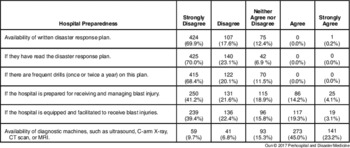
Of the 607 physicians, only one agreed or strongly agreed with the statement that there was a written disaster response plan at the hospital, and none of them agreed or strongly agreed that they had read such a plan or that there were frequent drills (Table 1). Only 111 (18.3%) agreed or strongly agreed that their hospitals were prepared for receiving and managing blast injuries, 136 (22.4%) agreed or strongly agreed that their hospitals were equipped and facilitated to receive blast injuries, and 414 (68.2%) agreed or strongly agreed that different diagnostic radiology machines were available. According to 568 physicians (93.6%), no triage system was in use at their hospitals.
Distribution of the Answers to Questions about Preparedness

Abbreviations: CT, computerized tomography; MRI, magnetic resonance imaging.
Physicians Training
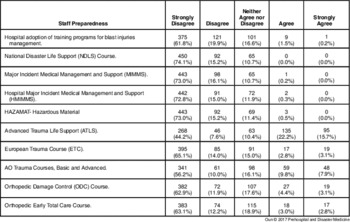
Due to absence of basic training in disaster medicine in Libyan medical schools and continued medical education for the physician after graduations, only 10 physicians (1.7%) either agreed or strongly agreed that their hospitals adopted training programs for blast injuries, and 230 (37.9%) agreed or strongly agreed that their hospitals adopted the Advanced Trauma Life Support (ATLS) course (Table 2). None of the respondents agreed or strongly agreed that their hospitals adopted the National Disaster Life Support (NDLS) course. Few of interviewed doctors (39; 6.4%) agreed or strongly agreed that they had received professional blast injuries management training, and only 6.4% of them agreed or strongly agreed that they had received professional training related to trauma and blast injuries management (Table 3). The most frequently attended course was Basic Life Support (BLS), attended by 2.0% of the study participants.
Distribution of the Responses to Questions about the Adoption of Professional Training Courses at the Hospitals

Distribution of Answers to Question about Previous Training in Professional Blast Injuries Management

When asked about what they thought was the reason for any lack in professional training, the participants were split almost evenly between pointing to lack of specialized persons in this area and citing the lack of enough knowledge of this specialty (Table 4). When the physicians were asked in more detail using a different set of criteria, 72.7% of them expressed no knowledge of the reason behind the lack of specialized training, and though 9.2% of them blamed this on the absence of planned training programs and motivation, none of the various proposed reasons garnered sufficient responses to stand out.
Distribution of Interviewed Doctors’ Answers about the Suggested Causes for the Lack of Specialized Training

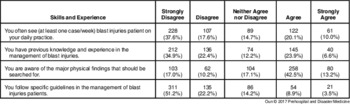
Approximately one-third (183; 30.1%) of the physicians either agreed or strongly agreed that they were seeing at least one case of blast injury per week in their daily practice, 185 (30.5%) agreed or strongly agreed that they had previous knowledge and experience in the management of blast injuries, and 338 (55.7%) agreed or strongly agreed that they were aware of the major physical findings that should be searched for. However, only 75 (12.4%) agreed or strongly agreed that they were following specific guidelines in the management of blast injuries patients (Table 5).
Distribution of the Answers to Questions about the Skills and Experience Possessed by the Interviewed Physicians in Blast Injury Management

Staff and Patient Safety
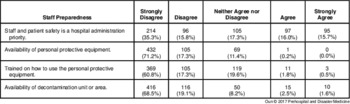
The staff, stuff, and structure preparedness cannot be achieved effectively under unsafe circumstances. Over one-half of the physicians (310; 51.1 %) either disagreed or strongly disagreed with the statement that staff and patient safety was a priority of the hospital administrations (Table 6). Moreover, 537 physicians (88.5%) disagreed or strongly disagreed that protective equipment was available, training in its use was almost absent, and that there were almost no decontamination units or areas.
Distribution of Answers to Questions about Staff and Patient Security

Discussion
This study investigated aspects of staff and hospital preparedness for blast injuries and the status of staff and patient safety at the Tripoli hospitals. These findings show clear deficiencies in all aspects of preparedness for dealing with blast injuries. With only one of the 607 physicians agreeing that the hospital had a written disaster response plan, and none of them agreeing that they had read a response plan, there is clearly a need for improvement (Table 1). This is a deficiency that should be addressed by the health care authorities.
In 2012, a post-conflict assessment of Libyan hospitalsReference Hoyle 11 reported that there were major defects in all Libyan hospitals in organizational structure and management, and that only a few hospitals had job descriptions and terms of references for the medical director (only 43%) and the administrative director (only 59%). Even fewer hospitals (23%) had job descriptions and terms of references for the other employees. The report also shows that only two-thirds of Libyan hospitals had written hospital organizational structures and only one-third of them had a management board. Though that report is four years old, there is no reason to suspect that this situation has improved.
Only approximately one-fifth of the physicians (111; 18.3%) agreed or strongly agreed that their hospitals were prepared for receiving and managing blast injuries. Likewise, only 136 physicians (22.4%) agreed or strongly agreed that their hospitals had the equipment and facilities needed for blast injuries. These and other answers show that Tripoli hospitals are not prepared, equipped, or facilitated to receive and manage blast injuries (Table 1). The 2012 hospital assessment shows that the general surgery departments at Libyan hospitals have severe shortages in the availability or functionality of basic equipment. The functions of all hospital departments are affected by this shortage, and not a single hospital had all the basic general surgery equipment. Moreover, not all the available equipment was functioning. This shortage was particularly serious in rural hospitals. As for availability of diagnostic machines for emergency response, most physicians (414; 68.2%) reported that ultrasound, C-arm X-ray, computerized tomography scan, and magnetic resonance imaging were available in Tripoli hospitals.
Hospital preparedness remains a main concern in many countries worldwide, though to different degrees. A 2005 study in Australia following the 2002 bombing in Bali showed that Australian hospitals need to be prepared to deal with mass casualties from terrorist strikes, including bomb blasts and chemical, biological, and radiation injury. 12 As staff preparedness is important in the response to different disasters, the participants were asked different types of questions to assess their needs for knowledge, experience, and skills, and also were inquired about the availability of resources. Only a few of the physicians (10; 1.7%) agreed or strongly agreed that training programs for blast injuries management were available at their hospitals. The answers show that such courses were not widely available and that some courses (NDLS, Major Incident Medical Management and Support [MIMMS], Hospital Major Incident Medical Management and Support [HMIMMS], and HAZAMAT) were rare or unavailable. In fact, the “favorite” course was ATLS, yet only 230 of the physicians (37.9%) agreed or strongly agreed that it was available at their hospitals (Table 2). The Libyan post-conflict hospital assessment conducted in 2012 shows that in-service training was being provided regularly by only one-third of the Libyan hospitals and that only 31% of those hospitals have specific budgets for training.Reference Hoyle 11 In the current study, only 39 physicians (6.4%) agreed or strongly agreed that they had received professional training related to blast injuries management (Table 3). The courses included BLS, Advanced Cardiac Life Support (ACLS), Intermediate Life Support (ILS), ATLS, Pediatric Life Support (Ped.LS), and cardiopulmonary resuscitation and airway management courses. Clearly, there is a deficiency in specialized training courses in general, and interest in disaster-related courses seems to rank very low. Unfortunately, and despite the importance of the ATLS and Advanced Life Support (ALS) courses in improving patient survival, these courses are not compulsory for physicians in Libya.Reference Rosenfeld, Fitzgerald and Kossmann 13 Physicians should take it upon themselves to continue their education by optimizing, if not maximizing, use of available resources. Though Libya is quite free of natural disasters and, before 2011, there was neither armed conflict nor bombings, the last few years have shown individual physicians and health care authorities that preparedness in general and for mass casualties in particular is an essential component of a health care system.
As for the causes of the absence of specialized training programs, of the 607 interviewed physicians, 374 (61.6%) agreed or strongly agreed that the cause for the absence of specialized training programs was the lack of professionals in disaster medicine, and 390 (64.3%) that the cause was lack of enough knowledge about this specialty (Table 4). When the 607 physicians were asked to propose training courses that were needed, 124 of them (20.4%) responded “I do not know” and 134 (22.1%) selected the catch-all answer “all explosion and blast injuries related courses.”
Regarding staff experience in the management of blast injuries in hospitals, 183 (30.1%) of the physicians agreed or strongly agreed that they were seeing one or more cases of blast injuries per week in their daily practice, 185 (30.5%) that they had previous knowledge and experience in management of blast injuries, and 338 (55.7%) that they were aware of the major physical findings they should be searching for. But only 75 (12.4%) agreed or strongly agreed that they were following specific guidelines (Table 5). Taken together, these results show that not all physicians at the hospitals in Tripoli are aware and have knowledge and experience in blast injuries management and that most of them are not following specific guidelines while managing blast injuries patients. Staff preparedness is a particularly important issue in countries living with armed conflicts or terrorist attacks. A 2007 study in Pakistan showed that no simulated drills or courses had been conducted for disaster management in the emergency departments of the hospitals surveyed in Karachi.Reference Ahmed 14 The results of that study resemble those in this study.
Staff and patient safety also was deficient. They are not among the priorities of many hospital administrations, and there was a severe shortage in personal protective equipment and in training on its use. Only 192 physicians (31%) agreed or strongly agreed that staff and patient safety was one of the hospital administration’s priorities (Table 6). Moreover, personal protective equipment for chemical and nuclear blast injuries seems to be non-existent, with only one physician reporting its availability and 14 (2.3%) agreeing or strongly agreeing that they had training in its use. The few who did receive training probably did so during their postgraduate studies abroad. Likewise, only 25 physicians (4.1%) agreed or strongly agree that a decontamination unit or area was available at the hospitals. These results clearly show that Tripoli hospitals and staff are not prepared to deal with chemical or nuclear blast injuries. A 2001 study in the USA on hospital preparedness for weapons of mass destruction incidents showed that there were significant gaps in knowledge and skills concerning mass decontamination, mass medical response, and awareness of the effects of weapons of mass destruction among health care and health communications professionals, and facility security personnel.Reference Siddiqui, Jawad, Minhas, Ansari, Siddiqui and Mehtab 15
Limitations
This study faced major difficulties due to the ongoing conflicts during its execution. With spots of armed conflict springing up haphazardly, physicians were frequently unable to attend to their duties according to the schedule and others had to fill in according to needs and calls on a daily basis. The researcher also faced the same mobility challenge. For these reasons, it was not possible to plan a randomized sample, and a convenience sampling approach was used. A follow-up study under better circumstances is advised, and it is expected that such a study would corroborate the strong deficiencies observed here.
The study also could have benefited from an objective assessment of the availability and the capacity of facilities and equipment for dealing with blast injuries and mass casualties in general. Such as assessment would have been very difficult under the circumstances, and with the available resources, it would not have been possible to cover all the facilities and elements.
Much work needs to be done at the national level in Libya to develop and implement the health care strategies and capabilities needed in times of disaster. Disaster committees and medical disaster response plans should be created for all hospitals. Moreover, disaster training programs should be implemented and all physicians working in accident and emergency programs should be obliged to attend specific courses, such as ATLS and HAZAMAT.
Conclusion
Physicians at Tripoli hospitals do not have the training needed for dealing with blast injuries and hospital management of mass casualties, and the hospitals do not seem to have the plans or the facilities needed for dealing with mass-casualty incidents. In view of the volatile situation in the region, urgent measures are needed to remedy these deficiencies.