Introduction
Although wide variations exist internationally, dementia is probably under-diagnosed and under-treated, with an estimated half of primary care patients aged over 65 years not diagnosed by their primary care physicians (Boustani et al., Reference Boustani, Peterson, Hanson, Harrison and Lohr2003). Currently there is an international consensus favoring earlier and more timely diagnosis of dementia (Waldemar et al., Reference Waldemar2007). While some people may find being diagnosed with dementia distressing, reported advantages include a better understanding of the situation, an end to uncertainty, access to pharmacological treatments and practical and emotional support, the ability to plan ahead and undertake care planning discussions, and the chance to develop positive coping strategies (Bamford et al., Reference Bamford, Lamont, Eccles, Robinson, May and Bond2004).
Previous reviews on the process of disclosure of a diagnosis of dementia revealed wide variability in reported practice (Bamford et al., Reference Bamford, Lamont, Eccles, Robinson, May and Bond2004), and theoretical “guidelines” that did not reflect practice (Carpenter and Dave, Reference Carpenter and Dave2004). Disclosure was rated by primary care physicians as one of the most difficult areas in the management of people with dementia, with this group of clinicians less likely to use the correct terminology than psychiatrists (Bamford et al., Reference Bamford, Lamont, Eccles, Robinson, May and Bond2004). Also family members were more likely to be told the diagnosis than the individuals with dementia, with general, rather than specific, terms used more commonly with the latter than with their relatives (Bamford et al., Reference Bamford, Lamont, Eccles, Robinson, May and Bond2004). The authors concluded that research which seeks to better understand the individual's perspective of becoming a person with dementia has been considerably neglected (Bamford et al., Reference Bamford, Lamont, Eccles, Robinson, May and Bond2004). A more recent review summarized current knowledge on living with dementia from the individual's perspective and covered all aspects of dementia including the transition from independent living to nursing home care; the authors concluded that the process of disclosure was a “more subtle picture than the assumptions made by the general public” (de Boer et al., Reference de Boer, Hertogh, Droes, Riphagen, Jonker and Eefsting2007).
The aim of this systematic review was to update an earlier review of empirical data regarding diagnostic disclosure in dementia (Bamford et al., Reference Bamford, Lamont, Eccles, Robinson, May and Bond2004), but also to build upon this work by focusing solely on the perspectives of people with dementia and their families and also by including evidence on the process of receiving a diagnosis of Mild Cognitive Impairment (MCI). Thus this paper aimed to synthesize empirical evidence of the experiences of patients and carers during the transition from being a person with cognitive difficulties to one receiving a diagnosis of dementia.
Methods
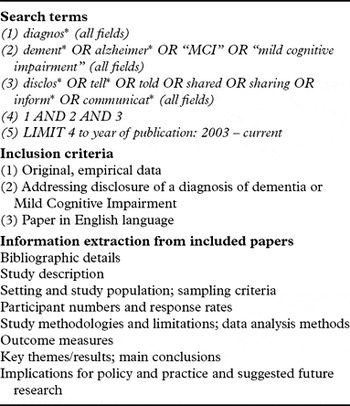
The review utilized the search strategy and search terms used in systematic review by Bamford et al. (Reference Bamford, Lamont, Eccles, Robinson, May and Bond2004) with the inclusion of additional terms specific to MCI (see Table 1). Key electronic databases were searched for relevant sources including OVID Medline, CINAHL, Web of Science, EMBASE and Sociological Abstracts. The results of this search were supplemented by hand searching the reference lists of the articles retrieved and consultation with experts in the field. The literature search for the previous review was conducted in September 2003, consequently a date limit was imposed and papers published in 2003 which had been included by Bamford et al. (Reference Bamford, Lamont, Eccles, Robinson, May and Bond2004) were excluded.
Systematic review: search terms, inclusion criteria and information extraction

Abstracts identified by this search were assessed against predefined inclusion criteria (see Table 1). They were scrutinized by two independent reviewers (AG, LR), with disagreements resolved through discussion or via a third reviewer (CA), with a presumption of inclusion in cases of doubt. Full text copies of the papers included were then assessed by the two reviewers (AG, LR) against the inclusion criteria, with disagreements resolved as described for the assessment of abstracts.
Data abstraction and quality assessment of included studies
The data abstraction form was adapted from the template used in the review of subjective experiences undertaken for the NICE/SCIE dementia guidelines (National Institute for Clinical Excellence/Social Care Institute of Excellence, 2006). Data abstraction from the included papers followed the principles of the original review by Bamford et al. (Reference Bamford, Lamont, Eccles, Robinson, May and Bond2004) and was carried out by two of the authors (AG, LR).
There is currently a lack of consensus on how best to assess the quality of qualitative studies included in a systematic review, with various tools and approaches available (Centre for Reviews and Dissemination, 2009). One approach provides a 32-item checklist for the assessment of quality of qualitative studies (Tong et al., Reference Tong, Sainsbury and Craig2007); however, as this review included a large number of studies and sought to follow best practice recommendations (Centre for Reviews and Dissemination, 2009), a selection of key items of bias were chosen to provide a pragmatic overview of the quality of included studies. The data abstraction forms were adapted to include the selected quality assessment criteria, including theoretical framework and methodological orientation, participant selection (sampling techniques, participant approach and sample size), setting, data collection (interview development, participant validation and data saturation) and data analysis methods.
Data synthesis
As the majority of included papers were qualitative studies, a narrative review was selected as the method for data synthesis (Centre for Reviews and Dissemination, 2009). Included papers were read at least twice or more by two of the authors (AG, LR), with data findings from the primary studies independently coded and organized into the key themes used in the original review (Bamford et al., Reference Bamford, Lamont, Eccles, Robinson, May and Bond2004). A draft narrative summary of the findings was written by two of the team (AG, LR); this draft was then reviewed by the wider project team covering a range of different professions and disciplines (JB, JK, JM, KS, CA, SC) and a final version agreed upon.
Results
Type and quality of included evidence
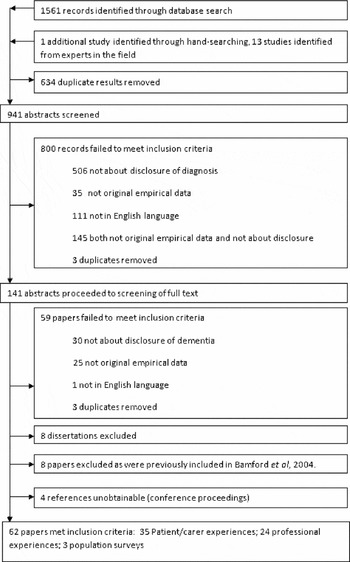
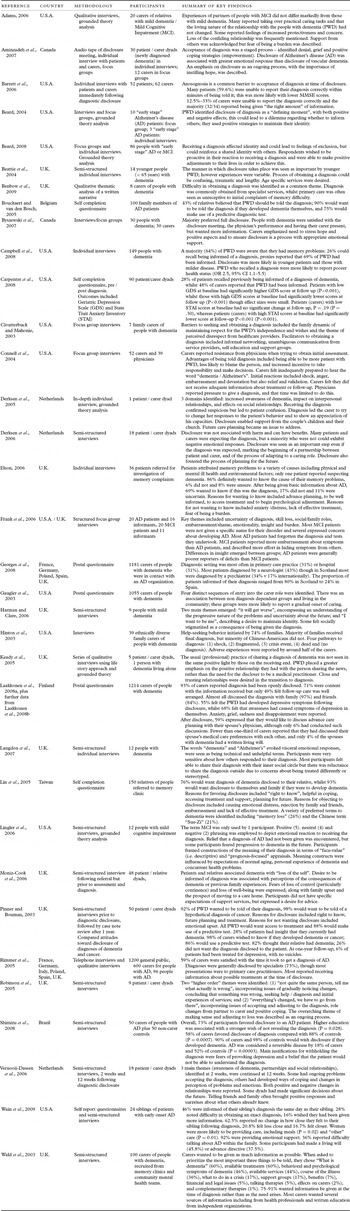
The search strategy yielded 941 articles of which 62 papers met the inclusion criteria (Figure 1). Of these 62 papers, 35 reported the views and experiences of people with dementia and their family members (usually described as carers or carergivers); 24 reported the views/experiences of health and social care professionals, and three the views of the general public. Table 2 summarizes the 35 papers included in the review.
Study flowchart.

Papers included in the review reporting empirical research on patient and carer experiences of disclosure of a diagnosis of dementia

Eighteen studies reported research carried out in Europe and 17 were from the U.S.A. and Canada. The majority of studies (15) included carers only, whilst 11 studies included both persons with dementia and their carers. Nine studies focused solely on the person with memory problems/dementia; only one included younger people with dementia aged under 65 years.
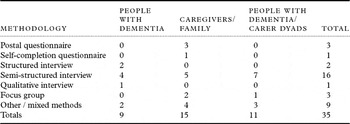
The majority of included studies used individual interviews and focus groups to collect data (22 studies), four employed questionnaire completion, eight used mixed methods and one study employed narrative analysis of written life stories (Table 3). Only two papers, reporting data from the same research study, included empirical evidence on the actual process of disclosure (Aminzadeh et al., Reference Aminzadeh, Byszewski, Molnar and Eisner2007; Byszewski et al., Reference Byszewski, Molnar, Aminzadeh, Eisner, Gardezi and Bassett2007). Two studies used validated outcome measures to assess the impact of disclosure on the person with dementia's health (Pinner and Bouman, Reference Pinner and Bouman2003; Carpenter et al., Reference Carpenter2008). Most of the studies accessed study samples from specialist dementia services and some from pre-existing research registers of people with dementia; no study included a sample drawn solely from a primary care population.
Details of methodology of included studies

The methodological quality of the included papers was found to be variable (Tong et al., Reference Tong, Sainsbury and Craig2007). Of the studies examining the views of people with dementia, the overall median sample size was 30, with a range between 1 and 149. Studies of family members or carers had a slightly larger overall median sample size of 43, range 1–1214. Only nine studies reported response rates/participation rates; these ranged from 38.4% (Gaugler et al., Reference Gaugler, Wackerbarth, Mendiondo, Schmitt and Smith2003) to 96.2% (Wald et al., Reference Wald, Fahy, Walker and Livingston2003). Of the studies which presented qualitative data, the median sample size was 18 for people with dementia, and 23 for carers or family members. Qualitative studies reported purposive sampling techniques in nine studies, convenience or consecutive samples in seven studies, whilst the remainder did not clearly describe the sampling techniques used.
Many of the studies provided limited descriptions of the methodology employed (Tong et al., Reference Tong, Sainsbury and Craig2007). Of the studies which employed a structured or semi-structured interview method, 12 gave details of the questions or interview schedule used (Cloutterbuck and Mahoney, Reference Cloutterbuck and Mahoney2003; Pinner and Bouman, Reference Pinner and Bouman2003; Wald et al., Reference Wald, Fahy, Walker and Livingston2003; Beard, Reference Beard2004; Beattie et al., Reference Beattie, Daker-White and Gillard2004; Connell et al., Reference Connell, Boise, Stuckey, Holmes and Hudson2004; Derksen et al., Reference Derksen, Vernooij-Dassen, Gillisen, Olde-Rickkert and Scheltens2005; Reference Derksen, Vernooij-Dassen, Gillisen, Olde-Rikkert and Scheltens2006; Elson, Reference Elson2006; Moniz-Cook et al., Reference Moniz-Cook, Manthorpe, Carr, Gibson and Vernooij-Dassen2006; Langdon et al., Reference Langdon, Eagle and Warner2007; Campbell et al., Reference Campbell, Stocking, Hougham, Whitehouse, Danner and Sachs2008) and eight gave a detailed description of how the interview schedule was developed (Wald et al., Reference Wald, Fahy, Walker and Livingston2003; Beard, Reference Beard2004; Derksen et al., Reference Derksen, Vernooij-Dassen, Gillisen, Olde-Rickkert and Scheltens2005; Reference Derksen, Vernooij-Dassen, Gillisen, Olde-Rikkert and Scheltens2006; Lingler et al., Reference Lingler2006; Moniz-Cook et al., Reference Moniz-Cook, Manthorpe, Carr, Gibson and Vernooij-Dassen2006; Vernooij-Dassen et al., Reference Vernooij-Dassen, Derksen, Scheltens and Moniz-Cook2006; Aminzadeh et al., Reference Aminzadeh, Byszewski, Molnar and Eisner2007).
In terms of data analysis, 11 studies stated use of grounded theory analysis (Beard, Reference Beard2004; Beattie et al., Reference Beattie, Daker-White and Gillard2004; Derksen et al., Reference Derksen, Vernooij-Dassen, Gillisen, Olde-Rickkert and Scheltens2005; Reference Derksen, Vernooij-Dassen, Gillisen, Olde-Rikkert and Scheltens2006; Keady et al., Reference Keady, Williams and Hughes-Roberts2005; Lingler et al., Reference Lingler2006; Adams, Reference Adams2006; Vernooij-Dassen et al., Reference Vernooij-Dassen, Derksen, Scheltens and Moniz-Cook2006; Aminzadeh et al., Reference Aminzadeh, Byszewski, Molnar and Eisner2007; Beard and Fox, Reference Beard and Fox2008; Wain et al., Reference Wain, Uhlmann, Heidebrink and Roberts2009), four used the method of interpretive phenomenological analysis (Robinson et al., Reference Robinson, Clare and Evans2005; Harman and Clare, Reference Harman and Clare2006; Moniz-Cook et al., Reference Moniz-Cook, Manthorpe, Carr, Gibson and Vernooij-Dassen2006; Langdon et al., Reference Langdon, Eagle and Warner2007) and the remainder used other methods or gave little detail of methods. Only six studies explicitly stated that data saturation was achieved (Beard, Reference Beard2004; Derksen et al., Reference Derksen, Vernooij-Dassen, Gillisen, Olde-Rikkert and Scheltens2006; Lingler et al., Reference Lingler2006; Moniz-Cook et al., Reference Moniz-Cook, Manthorpe, Carr, Gibson and Vernooij-Dassen2006; Vernooij-Dassen et al., Reference Vernooij-Dassen, Derksen, Scheltens and Moniz-Cook2006; Beard and Fox, Reference Beard and Fox2008). Eleven studies reported independent analysis of data by two or more researchers (Connell et al., Reference Connell, Boise, Stuckey, Holmes and Hudson2004; Hinton et al. Reference Hinton, Franz and Friend2004; Derksen et al., Reference Derksen, Vernooij-Dassen, Gillisen, Olde-Rickkert and Scheltens2005; Reference Derksen, Vernooij-Dassen, Gillisen, Olde-Rikkert and Scheltens2006; Robinson et al., Reference Robinson, Clare and Evans2005; Harman and Clare, Reference Harman and Clare2006; Lingler et al., Reference Lingler2006; Moniz-Cook et al., Reference Moniz-Cook, Manthorpe, Carr, Gibson and Vernooij-Dassen2006; Vernooij-Dassen et al., Reference Vernooij-Dassen, Derksen, Scheltens and Moniz-Cook2006; Langdon et al., Reference Langdon, Eagle and Warner2007).
Of the questionnaire-based studies, four gave details of the questions which were included (Gaugler et al., Reference Gaugler, Wackerbarth, Mendiondo, Schmitt and Smith2003; Barrett et al., Reference Barrett, Keller, Damgaard and Swerdlow2006; Laakkonen et al., Reference Laakkonen2008a; Georges et al., Reference Georges, Jansen, Jackson, Meyrieux, Sadowska and Selmes2008) and two described in detail how the questionnaire was developed (Laakkonen et al., Reference Laakkonen2008a; Shimizu et al., Reference Shimizu, Raicher, Takahashi, Caramelli and Nitrini2008). One study used validated symptom measurement tools to assess the psychological effects of disclosure, for example the Geriatric Depression Inventory and State/Trait Anxiety Inventory (Carpenter et al., Reference Carpenter2008).
Findings of the review
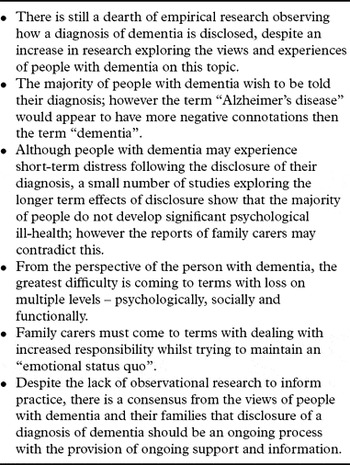
A detailed narrative, synthesizing the findings of the included empirical evidence, is provided below. Table 4 summarizes the key findings to emerge since the earlier review by Bamford et al. (Reference Bamford, Lamont, Eccles, Robinson, May and Bond2004).
Key points summarizing the findings of the review.

Should people with dementia be told their diagnosis?
In common with findings from the previous review (Bamford et al., Reference Bamford, Lamont, Eccles, Robinson, May and Bond2004), the majority of people with dementia are in favor of open disclosure, with up to 92% preferring to be told the cause of their symptoms (Pinner and Bouman, Reference Pinner and Bouman2003; Elson, Reference Elson2006; Byszewski et al., Reference Byszewski, Molnar, Aminzadeh, Eisner, Gardezi and Bassett2007), compared to 98% wanting to be informed of a hypothetical diagnosis of cancer (Pinner and Bouman, Reference Pinner and Bouman2003). A wish to be informed of the diagnosis may be associated with pre-existing knowledge of the consequences of dementia or with previous family experiences (Moniz-Cook et al., Reference Moniz-Cook, Manthorpe, Carr, Gibson and Vernooij-Dassen2006). Fewer people with dementia (69%) expressed a desire to be told of a specific diagnosis e.g. “Alzheimer's disease”, compared with more generic explanations of memory problems, and a small minority desired not to be told the diagnosis at all (Elson, Reference Elson2006; Langdon et al., Reference Langdon, Eagle and Warner2007). People with dementia appear to believe that they should have a choice about being told, and that information should be available to support disclosure (Harman and Clare, Reference Harman and Clare2006).
From the perspective of the family member or carer, most studies indicated that the majority of carers are in favor of disclosure but to a lesser degree than the persons with dementia (39–97% of carers) (Pinner and Bouman, Reference Pinner and Bouman2003; Lin et al., Reference Lin, Lia, Wang and Liu2005; Shimizu et al., Reference Shimizu, Raicher, Takahashi, Caramelli and Nitrini2008; Pucci et al., Reference Pucci, Belardinelli, Borsetti and Guiliani2009). As has been reported previously (Bamford et al., Reference Bamford, Lamont, Eccles, Robinson, May and Bond2004), there exists some discrepancy between what carers think their relative with dementia should be told compared to what they would like to be told if they were to develop dementia. Over 90% of carers, in three separate studies, reported a wish to be informed of a dementia diagnosis for themselves (Pinner and Bouman, Reference Pinner and Bouman2003; Bouckaert and van den Bosch, Reference Bouckaert and van den Bosch2005; Lin et al., Reference Lin, Lia, Wang and Liu2005) but in two studies, only between 43% (Bouckaert and van den Bosch, Reference Bouckaert and van den Bosch2005) and 76% (Lin et al. Reference Lin, Lia, Wang and Liu2005) favored disclosure to the person with dementia. Examination of sociodemographic and carer characteristics in relation to views on disclosure yielded mixed results; one study found no significant associations (Lin et al. Reference Lin, Lia, Wang and Liu2005), whereas in other samples higher education in carers was associated with greater reluctance to disclose a diagnosis to a relative with moderate to severe dementia (Shimizu, Reference Shimizu, Raicher, Takahashi, Caramelli and Nitrini2008), and carers of people with psychotic or depressive symptoms were more likely to wish to withhold a diagnosis of dementia (Bouckaert and van den Bosch, Reference Bouckaert and van den Bosch2005).
There would appear to be considerable variation cross-nationally, with up to 97% of caregivers in a Finnish sample (Laakkonen et al., Reference Laakkonen2008a) and 76% of a Taiwanese group (Lin et al., Reference Lin, Lia, Wang and Liu2005) favoring full disclosure, whilst a Belgian study reported that only 43% of relatives supported disclosure (Bouckaert and van den Bosch, Reference Bouckaert and van den Bosch2005). A study conducted in Brazil (Shimizu et al., Reference Shimizu, Raicher, Takahashi, Caramelli and Nitrini2008) found that 58% of carers of people with dementia believed that the diagnosis should be disclosed to patients, as opposed to 88% of controls who were not carers (p = 0.0007).
With the increased emphasis in many countries on early detection and diagnosis of dementia, and the possibility in the future of a pre-symptomatic predictive test for various causes of dementia, some researchers have examined the likelihood of a predictive test to be used if it were available. In one study, the majority of people with dementia (88%), and also their carers (75–86%) said they would make use of such a test for Alzheimer's disease (Pinner and Bouman, Reference Pinner and Bouman2003; Bouckaert and van den Bosch, Reference Bouckaert and van den Bosch2005).
Reasons for and against diagnostic disclosure
There was little difference from the findings of the earlier review (Bamford et al., Reference Bamford, Lamont, Eccles, Robinson, May and Bond2004) in reported benefits to disclosing a diagnosis of dementia (Pinner and Bouman, Reference Pinner and Bouman2003; Connell et al., Reference Connell, Boise, Stuckey, Holmes and Hudson2004; Lin et al., Reference Lin, Lia, Wang and Liu2005; Derksen et al., Reference Derksen, Vernooij-Dassen, Gillisen, Olde-Rickkert and Scheltens2005; Reference Derksen, Vernooij-Dassen, Gillisen, Olde-Rikkert and Scheltens2006; Elson, Reference Elson2006; Byszewski et al. Reference Byszewski, Molnar, Aminzadeh, Eisner, Gardezi and Bassett2007).) These included: the right to know; confirmation of suspicions and better understanding; allowing opportunities for future care planning; facilitating a focus on the abilities rather than disabilities of the person with dementia; positive adaptations within family and spouse relationships; access to early treatments, both pharmacological and psychological; and participation in research studies. Reasons given for not wanting disclosure included: would cause emotional upset; prior distressing experience; rejection by family and friends, social stigma and embarrassment; no effective medical care available; may cause suicide ideation in patients; and not wishing to cause burden to family (Pinner and Bouman, Reference Pinner and Bouman2003; Connell et al., Reference Connell, Boise, Stuckey, Holmes and Hudson2004; Derksen et al., Reference Derksen, Vernooij-Dassen, Gillisen, Olde-Rickkert and Scheltens2005; Reference Derksen, Vernooij-Dassen, Gillisen, Olde-Rikkert and Scheltens2006; Lin et al., Reference Lin, Lia, Wang and Liu2005; Elson, Reference Elson2006).
The process of disclosing and receiving a diagnosis of dementia
By the time people arrive at the point of being told of their diagnosis, they may have been through an often lengthy and confusing process of assessment and investigation (Beattie et al. Reference Beattie, Daker-White and Gillard2004; Hinton et al., Reference Hinton, Franz and Friend2004; Robinson et al., Reference Robinson, Clare and Evans2005). However, it appears that some people would appreciate a discussion of the possibility of dementia before the diagnosis is “officially” confirmed, so that the revelation is not perceived as a shock (Derksen et al., Reference Derksen, Vernooij-Dassen, Gillisen, Olde-Rickkert and Scheltens2005; Reference Derksen, Vernooij-Dassen, Gillisen, Olde-Rikkert and Scheltens2006; Vernooij-Dassen et al., Reference Vernooij-Dassen, Derksen, Scheltens and Moniz-Cook2006; Aminzadeh et al., Reference Aminzadeh, Byszewski, Molnar and Eisner2007). For people who have less insight into their symptoms, the experience of receiving a diagnosis of dementia is commonly associated with negative emotions such as shock, fear and sorrow (Vernooij-Dassen et al., Reference Vernooij-Dassen, Derksen, Scheltens and Moniz-Cook2006; Aminzadeh et al., Reference Aminzadeh, Byszewski, Molnar and Eisner2007; Byszewski et al. Reference Byszewski, Molnar, Aminzadeh, Eisner, Gardezi and Bassett2007; Carpenter et al., Reference Carpenter2008; Laakkonen et al., Reference Laakkonen2008a). From the carer perspective (Hinton et al., Reference Hinton, Franz and Friend2004), half of the family carers in one study reported adverse experiences in the pathway to receiving a diagnosis, reporting discrimination and uncaring attitudes by professionals; in addition, diagnostic pathways could be fragmented and unsatisfactory, ending without a diagnosis being given (“dead-end” pathways).
The term “Alzheimer's disease” was more likely to be associated with an initial negative emotional response than other causes of memory loss and dementia, with persons with dementia and carers both reporting concerns around stigmatization associated with the term (Derksen et al., Reference Derksen, Vernooij-Dassen, Gillisen, Olde-Rickkert and Scheltens2005; Reference Derksen, Vernooij-Dassen, Gillisen, Olde-Rikkert and Scheltens2006; Aminzadeh et al., Reference Aminzadeh, Byszewski, Molnar and Eisner2007; Langdon et al., Reference Langdon, Eagle and Warner2007). Where a diagnosis of vascular dementia was disclosed, this tended to be explained in lay terms, for example, using the term “strokes” (Aminzadeh et al., Reference Aminzadeh, Byszewski, Molnar and Eisner2007). In studies of patients informed of a diagnosis of Mild Cognitive Impairment (MCI), participants commonly expressed relief that they had not been given a diagnosis of Alzheimer's disease, though some expressed a fear that it could lead to Alzheimer's disease (Frank et al., Reference Frank2006; Lingler et al., Reference Lingler2006). Most people with MCI were not aware of a specific name for their diagnosis (Frank et al., Reference Frank2006).
Little empirical research has been undertaken to explore the process by which a diagnosis of dementia is shared and explained. Only one research study, with data reported in two of the included papers, was identified which attempted to capture data on the diagnostic disclosure process as it occurred (Aminzadeh et al., Reference Aminzadeh, Byszewski, Molnar and Eisner2007, Byszewski et al. Reference Byszewski, Molnar, Aminzadeh, Eisner, Gardezi and Bassett2007). Aminzadeh et al. (Reference Aminzadeh, Byszewski, Molnar and Eisner2007) found that the majority of people given a diagnosis of dementia demonstrated obvious signs of shock and distress as a result, expressed both verbally and through body language. They observed that this immediate emotional reaction to the diagnosis could be so powerful as to impede cognitive intake of any other information delivered. A smaller proportion responded to the revelation of the diagnosis more positively, with relief at the confirmation of their expectations. Some carers reported that their relative exhibited more distress in the days following the disclosure than at the time (Aminzadeh et al., Reference Aminzadeh, Byszewski, Molnar and Eisner2007). Byszewski et al. (Reference Byszewski, Molnar, Aminzadeh, Eisner, Gardezi and Bassett2007) reported that although people with dementia often could not recall their diagnostic label, other information given at the time of diagnostic disclosure, such as advice on driving and medication, was more frequently retained.
In a study of younger people with dementia, participants reported feeling unprepared to hear the diagnosis (Beattie et al., Reference Beattie, Daker-White and Gillard2004). This was also reported by Byszewski et al. (Reference Byszewski, Molnar, Aminzadeh, Eisner, Gardezi and Bassett2007), with persons with dementia and carers both expressing a preference for “progressive” disclosure, with a degree of initial forewarning (Byszewski et al. Reference Byszewski, Molnar, Aminzadeh, Eisner, Gardezi and Bassett2007). It has been suggested that physicians should explore both patient and carer views and experiences of dementia prior to disclosure in order to determine how best to communicate the diagnosis to the individuals concerned (Connell et al., Reference Connell, Boise, Stuckey, Holmes and Hudson2004). From a carer's perspective a range of preferences exist; some favor a direct approach whilst others wish to be “eased into the results” (Connell et al., Reference Connell, Boise, Stuckey, Holmes and Hudson2004). There appeared to be “professional” consensus among the included papers that the disclosure of a diagnosis of dementia should be an ongoing process, with an emphasis on positive aspects of a person's life, and provision of information and ongoing support tailored to an individual's needs (Keady et al. Reference Keady, Williams and Hughes-Roberts2005; Elson, Reference Elson2006; Moniz-Cook et al., Reference Moniz-Cook, Manthorpe, Carr, Gibson and Vernooij-Dassen2006; (Byszewski et al., Reference Byszewski, Molnar, Aminzadeh, Eisner, Gardezi and Bassett2007; Langdon et al., Reference Langdon, Eagle and Warner2007).
In terms of who disclosed the diagnosis, one survey of carers (n = 600) reported that the diagnosis was disclosed by a specialist practitioner in 73% of cases as opposed to 19%, where the diagnosis given by primary care practitioners (Rimmer et al., Reference Rimmer, Wojciechowska, Stave, Sganga and O'Connell2005). However, Keady et al. (Reference Keady, Williams and Hughes-Roberts2005) reported that persons with dementia and carers both placed more emphasis on the importance of a positive relationship with the professional sharing the diagnosis, rather than an expectation that this person should be an expert medical practitioner. In addition, key family members should be present at the discussion if possible (Pinner and Bouman, Reference Pinner and Bouman2003), together with other professionals, for example nurses, acknowledged for their empathic role (Byszewski et al., Reference Byszewski, Molnar, Aminzadeh, Eisner, Gardezi and Bassett2007). The environment in which the diagnosis is disclosed, the way in which choice is offered, especially where cognitive testing occurs, and the existence of a “reliable, close and trusting relationship” appear to be influential in the disclosure process (Keady et al., Reference Keady, Williams and Hughes-Roberts2005; Byszewski et al., Reference Byszewski, Molnar, Aminzadeh, Eisner, Gardezi and Bassett2007).
In terms of post diagnostic support, studies have confirmed that people with dementia and their carers feel let down by the lack of follow-up after the diagnosis is disclosed (Robinson et al., Reference Robinson, Clare and Evans2005). In one study of carers of people with Alzheimer's disease in Finland (n = 1943), where the carers were present when the diagnosis was shared with the person with dementia, most were happy with the amount of information given to them at diagnosis but only 50% were satisfied with the arrangement of follow-up care (Laakkonen et al., Reference Laakkonen2008a).
Information provision
The amount of information provided about dementia also influenced the disclosure process. Only one of the included studies explored what people with dementia felt about the information provided to them, with participants stating that they required more information in general and that it should be provided in a variety of different forms (Byszewski et al., Reference Byszewski, Molnar, Aminzadeh, Eisner, Gardezi and Bassett2007). Some people with dementia may experience a dilemma between wanting to find out more about their illness and a wish to avoid thinking about the future as a way of coping with the diagnosis (Harman and Clare, Reference Harman and Clare2006).
Several of the included studies found that carers wished to be given as much information as possible and were generally satisfied with the amount provided during the disclosure process (Wald et al., Reference Wald, Fahy, Walker and Livingston2003; Barrett et al., Reference Barrett, Keller, Damgaard and Swerdlow2006; Laakkonen et al., Reference Laakkonen2008a). Findings from a large international postal survey of 1181 carers of people with dementia found that almost half (46%) were fairly or very happy with the information they were given; this is despite the fact that 19% reported receiving no information at the point of diagnosis, 50% received no information on dementia as a disease and 48% no information on drug treatments. The most commonly desired information was about disease progression and availability of services (Georges et al., Reference Georges, Jansen, Jackson, Meyrieux, Sadowska and Selmes2008). A telephone survey of carers reported that 78% had received information about treatments at the time the diagnosis was given; most commonly this was medication but other therapies and services such as cognitive stimulation, psychotherapy, day care and support groups, were also mentioned (Rimmer et al., Reference Rimmer, Wojciechowska, Stave, Sganga and O'Connell2005). However in a U.S. study comparing the experiences of family carers and the primary care physicians involved in the diagnostic process, carers felt they had received too little information and expressed a sense of urgency and frustration in their attempts to seek a diagnosis (Connell et al., Reference Connell, Boise, Stuckey, Holmes and Hudson2004). This contradicted the clinicians’ views, who further reported feeling pressurized to make a diagnosis by family carers and considered that they provided sufficient support and information (Connell et al., Reference Connell, Boise, Stuckey, Holmes and Hudson2004).
Only one study explored in detail the nature and type of information that was considered useful during the process of becoming a person with dementia and the appropriate timing to provide this in primary care; however, only carers were included in the sample (Wald et al., Reference Wald, Fahy, Walker and Livingston2003). During the diagnostic period, carers felt they needed to know what dementia is, information about medication and the behavioral and psychosocial problems that could arise in the illness. At the first follow-up meeting, they wished to have more detail about the range of social care services available, the course of the disease and what to do should a crisis occur. Later on, information about financial and legal issues became more relevant (Wald et al., Reference Wald, Fahy, Walker and Livingston2003).
Factors influencing disclosure and recall of a diagnosis of dementia
The information that people with dementia and their carers retain following the diagnostic disclosure varies (Barrett et al., Reference Barrett, Keller, Damgaard and Swerdlow2006; Campbell et al., Reference Campbell, Stocking, Hougham, Whitehouse, Danner and Sachs2008). Between one fifth and one third of people with dementia can recall their diagnostic label accurately (Pinner and Bouman, Reference Pinner and Bouman2003; Elson, Reference Elson2006; Campbell et al., Reference Campbell, Stocking, Hougham, Whitehouse, Danner and Sachs2008), although many more are able to recall some elements of the process of disclosure (Byszewski et al. Reference Byszewski, Molnar, Aminzadeh, Eisner, Gardezi and Bassett2007). Not surprisingly, recall of the diagnosis is associated with a higher Mini-mental State Examination (MMSE) score (Folstein et al., Reference Folstein, Folstein and McHugh1975), as well as younger age and higher levels of education; however, people with dementia who recalled their diagnosis were more likely to report poorer health status (Campbell et al., Reference Campbell, Stocking, Hougham, Whitehouse, Danner and Sachs2008).
Recall of the diagnosis can be equally impaired in people with AD and those with MCI; in a study comparing both groups, both expressed uncertainty about what they had been told and had difficulty reporting their diagnosis (Frank et al., Reference Frank2006). With respect to MCI, one small study revealed that only one out of 12 people with MCI were accurately aware of their “diagnosis”, although most understood and were aware of the changes occurring. Factors influencing how the “diagnosis” was processed included participants’ prior experience of dementia, their current health and their expectations of normal aging (Lingler et al., Reference Lingler2006). Pre-diagnostic views of older people attending a memory clinic found the diagnosis of dementia to be associated with “malignant societal attitudes”, with their desire to know the diagnosis chiefly related to their previous personal and family experience of dementia (Moniz-Cook et al., Reference Moniz-Cook, Manthorpe, Carr, Gibson and Vernooij-Dassen2006). In addition, people with mild dementia were concerned others might think them “demented” and mad (Langdon et al., Reference Langdon, Eagle and Warner2007)
Cultural factors may be influential in shaping carers’ views towards diagnostic disclosure. In one very small qualitative study with African-American carers of people with dementia (n = 7), the cultural tradition of respecting elders’ autonomy and independence appeared to delay presentation, as carers perceived their role to be to protect their loved ones and respect their dignity (Cloutterbuck and Mahoney, Reference Cloutterbuck and Mahoney2003). A study from Taiwan revealed family carers to favor disclosure of a diagnosis of dementia but to prefer use of a “softer term” like memory loss rather than the actual word “dementia”, as some Chinese terms for dementia have had pejorative connotations (Lin et al., Reference Lin, Lia, Wang and Liu2005). A study comparing pathways to diagnosis across different cultural groups within the U.S.A. found that Chinese-Americans were more likely to have cognitive impairment recognized by professionals than for health seeking behavior to be initiated by their families (Hinton et al., Reference Hinton, Franz and Friend2004).
Impacts of disclosure: person with dementia's perspective
From the perspective of a person with dementia, the greatest difficulty with which they have to deal appears to be the prospect of losses, both contemporary and prospective. Such losses may include loss of self-esteem, loss of social status and roles, and loss of function and activities of daily living, particularly driving (Beard, Reference Beard2004; Robinson et al., Reference Robinson, Clare and Evans2005; Derksen et al., Reference Derksen, Vernooij-Dassen, Gillisen, Olde-Rikkert and Scheltens2006; Frank et al., Reference Frank2006; Vernooij-Dassen et al., Reference Vernooij-Dassen, Derksen, Scheltens and Moniz-Cook2006; Aminzadeh et al., Reference Aminzadeh, Byszewski, Molnar and Eisner2007; Langdon et al., Reference Langdon, Eagle and Warner2007; Beard and Fox, Reference Beard and Fox2008;). In addition, people with dementia describe a feeling of stigmatization or “social demotion” as a result of their diagnosis (Harman and Clare, Reference Harman and Clare2006; Beard and Fox, Reference Beard and Fox2008), but for some this may be counterbalanced by reinforcement of a shared group identity via, for example, access to support groups (Beard and Fox, Reference Beard and Fox2008). People with dementia also highlight the dilemma between balancing their private world (the “self”) and their public world (how others view them) (Beard, Reference Beard2004; Vernooij-Dassen et al., Reference Vernooij-Dassen, Derksen, Scheltens and Moniz-Cook2006; Langdon et al., Reference Langdon, Eagle and Warner2007); a desire to be treated “as normal” helps maintain this balance (Langdon et al., Reference Langdon, Eagle and Warner2007). However, they are aware of the burden (real or prospective) that their illness places on their families (Frank et al., Reference Frank2006), with this awareness being more acute in people in the early stages of the illness (Frank et al., Reference Frank2006; Lingler et al., Reference Lingler2006; Moniz-Cook et al., Reference Moniz-Cook, Manthorpe, Carr, Gibson and Vernooij-Dassen2006).
Following disclosure of a diagnosis, people with dementia develop a variety of coping mechanisms from positive responses, such as feeling empowered, to difficulty in accepting the diagnosis and active denial (Beard, Reference Beard2004; Robinson et al., Reference Robinson, Clare and Evans2005; Vernooij-Dassen et al., Reference Vernooij-Dassen, Derksen, Scheltens and Moniz-Cook2006; (Aminzadeh et al., Reference Aminzadeh, Byszewski, Molnar and Eisner2007; Langdon et al., Reference Langdon, Eagle and Warner2007). An oscillating process has been described with a slow realization of their difficulties balanced against a gradual adjustment to their losses (Robinson et al., Reference Robinson, Clare and Evans2005). For some, receiving the diagnosis appears to offer an opportunity to reconsider their priorities and make positive changes, such as spending more time with family, focusing on positive tasks which bring enjoyment (Beard and Fox, Reference Beard and Fox2008), undertaking future care planning and sharing the diagnosis with the outside world (Beard, Reference Beard2004; Robinson et al., Reference Robinson, Clare and Evans2005; Vernooij-Dassen et al., Reference Vernooij-Dassen, Derksen, Scheltens and Moniz-Cook2006; Aminzadeh et al., Reference Aminzadeh, Byszewski, Molnar and Eisner2007; Langdon et al., Reference Langdon, Eagle and Warner2007). People with MCI also exhibit the same variability in coping strategies as people with dementia and have awareness of their difficulties (Lingler et al., Reference Lingler2006; Moniz-Cook et al., Reference Moniz-Cook, Manthorpe, Carr, Gibson and Vernooij-Dassen2006); such insight is gradually, though invariably, lost in those who progress to dementia (Frank et al., Reference Frank2006). Factors that influence coping strategies include peoples’ perceptions of normal aging and their prior experience of people with dementia (Lingler et al., Reference Lingler2006; Langdon et al., Reference Langdon, Eagle and Warner2007). As previously stated, people find the term “Alzheimer's disease” more difficult to cope with than dementia or memory loss (Lingler et al., Reference Lingler2006; Langdon et al., Reference Langdon, Eagle and Warner2007).
Several studies (Pinner and Bouman, Reference Pinner and Bouman2003; Derksen et al., Reference Derksen, Vernooij-Dassen, Gillisen, Olde-Rickkert and Scheltens2005; Vernooij-Dassen et al., Reference Vernooij-Dassen, Derksen, Scheltens and Moniz-Cook2006; Byszewski et al., Reference Byszewski, Molnar, Aminzadeh, Eisner, Gardezi and Bassett2007; Carpenter et al., Reference Carpenter2008) explored participants’ views over a period of time, with two attempting to define the longer-term impact on the health of the person with dementia (Pinner and Bouman, Reference Pinner and Bouman2003; Carpenter et al., Reference Carpenter2008). Carpenter et al (Reference Carpenter2008) measured anxiety and depression levels using validated outcome measures, including the Geriatric Depression Scale, three months after a disclosure of a diagnosis of dementia with a sample of 90 patient/carers dyads. The study found that, in general, symptoms of anxiety and depression remained stable and the majority of participants did not experience adverse psychological reaction following disclosure; factors such as age, sex, levels of education and severity of dementia did not affect this outcome. In addition, individuals who were experiencing high levels of anxiety before disclosure appeared to exhibit relief afterwards. Interestingly participants who had received “informal” feedback about the possible diagnosis prior to actual disclosure were less anxious. Further supporting evidence that disclosure of a diagnosis of dementia does not precipitate a catastrophic psychological reaction comes from a small study by Pinner and Bouman (Reference Pinner and Bouman2003). They reviewed the case notes of 50 patients with dementia, one year after diagnostic disclosure and only three (6%) had been diagnosed and treated for depression but there were no recorded catastrophic reactions or suicides. However, in a large survey (n = 1214) of caregivers of people with dementia, 55% felt that awareness of having dementia had caused symptoms of depression in their spouses (Laakkonen et al., Reference Laakkonen2008a).
Impacts of disclosure: carer's perspective
Family members of people with dementia also undergo a gradual transition to the social status of carers, experiencing a variety of losses and emotions and employing a range of coping strategies (Gaugler et al., Reference Gaugler, Wackerbarth, Mendiondo, Schmitt and Smith2003; Derksen et al., Reference Derksen, Vernooij-Dassen, Gillisen, Olde-Rickkert and Scheltens2005; Adams, Reference Adams2006; Frank et al., Reference Frank2006; Vernooij-Dassen et al., Reference Vernooij-Dassen, Derksen, Scheltens and Moniz-Cook2006; Aminzadeh et al., Reference Aminzadeh, Byszewski, Molnar and Eisner2007; Benbow et al., Reference Benbow, Ong, Black and Garner2009). Those that progress gradually into a caregiving role appear to continue to provide practical care and support for their relatives for longer (Gaugler et al., Reference Gaugler, Wackerbarth, Mendiondo, Schmitt and Smith2003). Whilst their relatives are coming to terms with personal “loss”, carers of people with dementia are principally faced with increased responsibilities with a focus on decision-making and dealing with the practicalities of life (Derksen et al., Reference Derksen, Vernooij-Dassen, Gillisen, Olde-Rickkert and Scheltens2005; Reference Derksen, Vernooij-Dassen, Gillisen, Olde-Rikkert and Scheltens2006; Robinson et al., Reference Robinson, Clare and Evans2005; Adams, Reference Adams2006; Vernooij-Dassen et al., Reference Vernooij-Dassen, Derksen, Scheltens and Moniz-Cook2006).
In addition, some feel required to take on the role of “emotional cheerleader” (Adams, Reference Adams2006). This comprises attempting to come to terms with changes in their relationship with the person with dementia (possible loss of closest confidante and loss of intimacy) and also managing the emotional interface between personal and public worlds (Benbow et al., Reference Benbow, Ong, Black and Garner2009), despite often feeling considerably upset and distressed themselves (Derksen et al., Reference Derksen, Vernooij-Dassen, Gillisen, Olde-Rickkert and Scheltens2005; Reference Derksen, Vernooij-Dassen, Gillisen, Olde-Rikkert and Scheltens2006; Adams, Reference Adams2006; Benbow et al., Reference Benbow, Ong, Black and Garner2009). However, by focusing on the positive abilities of the person with dementia, rather than their disabilities, couples (who comprised a major group of carers included in the studies in this review) can be assisted to make positive joint constructions to enable them to make sense of the illness (Derksen et al., Reference Derksen, Vernooij-Dassen, Gillisen, Olde-Rickkert and Scheltens2005; Reference Derksen, Vernooij-Dassen, Gillisen, Olde-Rikkert and Scheltens2006; Robinson et al., Reference Robinson, Clare and Evans2005). Positive adjustments to the illness appear to facilitate future care planning for both people with dementia and their carers (Derksen et al., Reference Derksen, Vernooij-Dassen, Gillisen, Olde-Rickkert and Scheltens2005; Reference Derksen, Vernooij-Dassen, Gillisen, Olde-Rikkert and Scheltens2006; Derksen et al., Reference Derksen, Vernooij-Dassen, Gillisen, Olde-Rickkert and Scheltens2005; Robinson et al., Reference Robinson, Clare and Evans2005; Adams, Reference Adams2006; Vernooij-Dassen et al., Reference Vernooij-Dassen, Derksen, Scheltens and Moniz-Cook2006).
None of the included studies directly measured the long-term impact on carers’ health and well-being after disclosure, although several reported the increased responsibilities and day-to-day tasks that carers were having to take on (Adams, Reference Adams2006; Derksen et al., Reference Derksen, Vernooij-Dassen, Gillisen, Olde-Rikkert and Scheltens2006; Vernooij-Dassen et al., Reference Vernooij-Dassen, Derksen, Scheltens and Moniz-Cook2006). In one large survey (n = 1214) of caregivers of people with dementia (mean age 78 years; 63% female), 68% developed “depressive symptoms” following disclosure (Laakkonen et al., Reference Laakkonen2008a).
Two studies explored whether carers or family members had completed any formal advance care planning documents in their own right. In a large survey (n = 1214) only 4% of elderly spouse carers had made a living will or advance decision about care and treatment (Laakkonen et al., Reference Laakkonen2008a; Reference Laakkonen, Raivio, Eloniemi-Sulkava, Tilvis and Pitkala2008b), whilst in a smaller study of siblings of younger people with dementia (n = 25), 11 had completed living wills and three had undergone genetic testing (Wain et al., Reference Wain, Uhlmann, Heidebrink and Roberts2009).
Discussion
One of the key messages of an earlier systematic review in the area of disclosure of a diagnosis of dementia (Bamford et al., Reference Bamford, Lamont, Eccles, Robinson, May and Bond2004) was that recommendations around the process were not informed by a detailed observation of practice and were thus not grounded in the “lived experiences” of people with the condition. This review aimed to address this deficiency through identifying and evaluating evidence focused solely on the experiences of people with dementia and their relatives in the transition from having memory problems to receiving, and thus living with, a diagnosis of dementia. Although we found that research is slowly emerging which allows the views of people with dementia to be heard, there is still a dearth of research observing the process of disclosure in dementia. The experiences documented in the included papers reveal that the vast majority of people with dementia wish to know their diagnosis, although the majority cannot accurately recall their diagnosis afterwards. There was consensus that the disclosure of a diagnosis of dementia should be an ongoing process with an emphasis on the positive aspects of a person's life and the provision of continued support and information tailored to individual needs. The use of the term “Alzheimer's disease” would appear to have more negative connotations than the word “dementia”; in some countries, non-specific terms like “memory loss” are preferred by relatives.
Despite recommendations from the earlier review for detailed scrutiny of the process of diagnostic disclosure in dementia (Bamford et al., Reference Bamford, Lamont, Eccles, Robinson, May and Bond2004), only two of the included papers, reporting data from one research study, attempted to do this (Aminzadeh et al., Reference Aminzadeh, Byszewski, Molnar and Eisner2007; Byszewski et al., Reference Byszewski, Molnar, Aminzadeh, Eisner, Gardezi and Bassett2007) and only two evaluated the effects of disclosure on the health of the person with dementia (Pinner and Bouman, Reference Pinner and Bouman2003; Carpenter et al., Reference Carpenter2008). How a diagnosis is disclosed often appears to be as a single event and not a managed process, where the possibility of dementia is raised and discussed before the actual confirmatory diagnosis (Iliffe and Manthorpe, Reference Iliffe and Manthorpe2004). The results of the studies reviewed would suggest that although there may be short-term distress, the majority of people with dementia generally do not experience long-term negative effects on their psychological health, with low levels of depression recorded (Pinner and Bouman, Reference Pinner and Bouman2003; Carpenter et al., Reference Carpenter2008) despite family carers’ concerns that diagnostic disclosure to their relatives would provoke significant emotional distress (Bamford et al., Reference Bamford, Lamont, Eccles, Robinson, May and Bond2004; Laakkonen et al., Reference Laakkonen2008a).
There are several limitations to this review that should be acknowledged. Owing to funding and time constraints, included papers were limited to those full papers written in the English language. Thus, studies that could have provided valuable data on different cultural perspectives to the disclosure of a diagnosis of dementia may have been excluded. Notwithstanding this, it would appear from our findings that there is still an urgent need for research into the cultural understanding and experiences of people receiving a diagnosis of dementia which explores the needs of different cultural groups. In addition, the quality of the included studies was variable, with generally small sample sizes and limited detail on sampling techniques and data collection and analysis methods. No study recruited people from primary care settings, with most set in memory clinics or similar specialist services, which may not be accessed by some groups of people such as those living in care homes. The restricted sampling frames in most studies led to some uncertainty in generalizing data to all people with dementia and their carers, rather than just those who were already accessing a specialist dementia service. Recall bias was also a possibility in some studies as data collection often took place several months after disclosure of the diagnosis, and sometimes as long as two years (Robinson et al., Reference Robinson, Clare and Evans2005).
The findings of this review may have implications for practice and service delivery. Before disclosing a diagnosis of dementia, health professionals should explore the concerns of both the patient and their family as to what they think the cause of their cognitive difficulties may be and identify any particular individual concerns around diagnosis. The consensus from the papers included in this review is that the process of disclosure should be just that, a process, with protected time for follow-up and to ensure exploration of subsequent concerns and possible coping strategies. Ideally, the diagnosis should be communicated by a professional who will have an ongoing relationship with the person with dementia and their carers. Health professionals involved in this task should have a thorough knowledge of key subjects, including the ability to discuss planning for the future, as currently few studies have addressed this topic (Laakkonen et al., Reference Laakkonen, Raivio, Eloniemi-Sulkava, Tilvis and Pitkala2008b; Robinson et al., Reference Robinson2010a). Surprisingly, there is little research exploring the views of people with dementia on the type and nature of information they would wish to receive around the time of and after diagnostic disclosure. In England, the introduction of the new dementia advisor role (one of the recommendations of the National Dementia Strategy) may be one means of providing post-diagnosis support and information (Department of Health, 2009).
In terms of carers’ needs, becoming the main decision-maker and adjusting to increased levels of responsibility were common concerns alongside trying to maintain the emotional status quo (Adams, Reference Adams2006) and coping with changes in their relationship with the person with dementia, despite often experiencing negative and distressing emotions themselves. Family carers thus require individualized assessment and the provision of appropriate support to help them come to terms with living with dementia. The greatest difficulty for people with dementia was coming to terms with losses on multiple levels – psychologically, socially and functionally. More timely identification of the levels of emotional distress and difficulty in coping with the illness is required among people with dementia and their family carers, with earlier referral for specialist psychological support (Iliffe et al., Reference Iliffe2009; Moniz-Cook et al., Reference Moniz-Cook, Gibson, Harrison, Wilkinson, Moniz-Cook and Manthorpe2009). Due to a shortage of such specialist services in some countries, psychological therapies may not be easily accessible or available to all people needing them in the early stages of dementia (Robinson et al., Reference Robinson2010b). Alternative sources of support may be accessible via peer support groups or a stepped care model of psychological interventions. In the latter, interventions of different intensities are delivered across primary and secondary care, and may afford a more cost effective way of delivering psychological therapies to those who most need them (van't Veer-Tazelaar et al., Reference van't Veer-Tazelaar2009); further research in this area is urgently needed in view of the key findings highlighted in this review.
Conflict of interest
None.
Description of authors' roles
L. Robinson (LR), J. Bond (JB), J. Keady (JK) and J. Manthorpe (JM) designed the review. A. Gemski (AG) performed the literature searching. AG and LR carried out data abstraction and quality assessment of included papers and indentified key concepts. AG and LR drafted the paper and all authors contributed to critical review and writing of the paper.
Acknowledgments
We thank Claire Bamford for her advice with this review and other co-investigators of this study: Steve Iliffe, University College London; Claire Goodman, University of Hertfordshire; Vari Drennan, St George's University of London; and James Warner, Central and North West London Foundation Trust, and members of the study's national and local advisory groups. This project was funded by the National Institute for Health Research (NIHR) Service Delivery and Organization Programme (project number 08/1809/229). The views and opinions expressed herein are those of the authors and do not necessarily reflect those of the NIHR.