


Introduction
Worry and rumination may both be characterized as forms of repetitive negative thinking (Ehring and Watkins, Reference Ehring and Watkins2008). Rumination can be experienced in both verbal and imaginal form (Papageorgiou, Reference Papageorgiou, Davey and Wells2006), is indicated by the tendency to dwell repeatedly on the self, upsetting events, and personal concerns, and typically has a past focus (Watkins, Reference Watkins2004). Worry is predominantly verbal in nature, more often future-focused and involves themes of potential catastrophe (Borkovec, Robinson, Pruzinsky and Depree, Reference Borkovec, Robinson, Pruzinsky and Depree1983). Both occur on a continuum, and some degree of worry and rumination are experienced by many people from time to time.
There are extensive data to suggest that worry and rumination share much in common and are central cognitive components in anxiety and depression (Papageorgiou, Reference Papageorgiou, Davey and Wells2006; Watkins, Reference Watkins2008) and growing evidence that they are implicated in the maintenance of a broad range of different anxiety disorders (Harvey, Watkins, Mansell and Shafran, Reference Harvey, Watkins, Mansell and Shafran2004) and “difficult to treat” conditions, such as paranoia (e.g. Startup, Freeman and Garety, Reference Startup, Freeman and Garety2007). Effective treatments to target specifically worry and rumination have been developed with encouraging results (e.g. Foster, Startup, Potts and Freeman, Reference Foster, Startup, Potts and Freeman2010). Thus, across disorders, identifying those individuals for whom worry and rumination are significant problems, and targeting these in treatment, may have far reaching implications for well-being.
Anorexia nervosa (AN) has traditionally been considered a “difficult to treat” condition characterized by self-starvation, weight loss, hyperactivity and extreme concerns about weight, shape and eating (DSM-IV, American Psychiatric Association, 1994). A recent randomized controlled trial of two treatments for AN highlighted the need for further exploration of mediators and moderators in order to better target treatments (Schmidt et al., in press). To date, worry and rumination have been given minimal consideration within the AN literature. This study reports a systematic investigation of the presence and severity of worry and rumination in individuals with AN. In addition, the relationship of these variables to eating disorder pathology is explored.
Worry and rumination in eating disorders
In a prominent maintenance model of AN, perfectionism/cognitive rigidity and experiential avoidance represent two key factors thought to maintain AN (Schmidt and Treasure, Reference Schmidt and Treasure2006). What is less clear is what mediates between these anorexic traits and the core AN pathology (most notably low body weight). One possibility is that negative thought processes, such as worry and rumination, may mediate the relationship between experiential avoidance and cognitive rigidity and the core AN pathology. Worry and rumination about eating disorder specific material (such as how much one has eaten and how one will cope with the next family meal) and about non-eating disorder specific material (such as how one managed a social situation or worry about upcoming exams) might function to keep the individual narrow in cognitive focus, especially as these information processing styles negate successful problem solving, whilst at the same time suppressing and “numbing” an individual's emotional state. Whilst the current study is not designed to test specific hypotheses regarding causality or mediation, it represents a step in the direction of establishing whether these thinking styles are indeed a problem for individuals with AN and whether they relate to core AN pathology.
With this model in mind, there are at least three reasons to examine the processes of rumination and worry in AN. First, by definition eating disorders involve a preoccupation with issues of weight and shape. Thus, it can be argued that we know much about the “content” of this preoccupation. What is less known, however, are those thought “processes” responsible for bringing this information to mind and keeping it there. It thus seems a potentially useful line of enquiry to investigate the form of this thinking in more detail.
Second, cognitive models of eating disorders emphasize the escape and avoidant function of eating disordered behaviours (Corstorphine, Mountford, Tomlinson, Waller and Meyer, Reference Corstorphine, Mountford, Tomlinson, Waller and Meyer2007). For individuals with AN, extreme restriction can function to allow a sufferer to avoid the activation and experience of emotions (Schmidt and Treasure, Reference Schmidt and Treasure2006), while bulimic behaviours (bingeing and purging) may function to enable escape from aversive emotions once they have been activated and are being experienced by the sufferer (Cooper, Wells and Todd, Reference Cooper, Wells and Todd2004). It is of note that negative affect is a risk factor for AN (Pike et al., Reference Pike, Hilbert, Wilfley, Fairburn, Dohm and Walsh2008) and emotional intolerance is a core feature (e.g. Hambrook et al., Reference Hambrook, Oldershaw, Rimes, Schmidt, Tchanturia and Treasure2011). Rumination and worry have been proposed as transdiagnostic cognitive processes that serve an emotionally avoidant function (Sibrava and Borkovec, Reference Sibrava, Borkovec, Davey and Wells2006; Watkins, Reference Watkins2004). This therefore may be prominent in patients with AN. Specifically, Watkins (Reference Watkins2004) suggests that rumination by an individual on one level may function to avoid emotional processing on another.
Third is the feature of psychological inflexibility. Merwin et al. (Reference Merwin, Timko, Moskovich, Ingle, Bulik and Zucker2011) present a model of AN in which psychological inflexibility, defined as “an inability to behave flexibly in the presence of difficult thoughts, feelings, and bodily sensations” (p.63), is considered a key motivation behind the rule-driven and rigid behaviours of the AN sufferer. Indeed, it is well known that individuals with AN have difficulty shifting set in light of changing rules (Tchanturia et al., Reference Tchanturia, Harrison, Davies, Roberts, Oldershaw and Nakazato2011, Reference Tchanturia, Davies, Harrison, Roberts, Nakazato and Schmidt2012). In addition, they demonstrate a tendency to focus on the detail at the expense of the “bigger picture”, referred to in the literature as central coherence (Lopez, Tchanturia, Stahl and Treasure, Reference Lopez, Tchanturia, Stahl, Happe, Booth and Holliday2008; Harrison, Tchanturia, Neumann and Treasure, Reference Harrison, Tchanturia, Naumann and Treasure2012). Rumination and worry have been conceptualized as forms of psychological inflexibility (Whitmer and Banich, Reference Whitmer and Banich2007; Startup and Davey, Reference Startup and Davey2001) and thus it is also possible that rumination and worry play a role in the maintenance of the psychological rigidity characteristic of individuals with AN, and help to maintain the disorder in this way.
Evidence looking specifically at worry and rumination in individuals with eating disorders is sparse. However, there is some suggestion that rumination (e.g. Rawal, Park and Williams, Reference Rawal, Park and Williams2010) and worry (e.g. Sternheim, Startup and Schmidt, Reference Sternheim, Konstantello, Startup and Schmidt2011; Sternheim, Startup, Saeidi et al., Reference Sternheim, Startup, Saeidi, Morgan, Hugo and Russell2012) may be relevant for onset and maintenance processes in eating disorders. Furthermore, recent research from our group suggests that a concept closely associated with worry - intolerance of uncertainty - is a significant concern for individuals with eating disorders (Sternheim, Konstantello, Startup and Schmidt, Reference Sternheim, Startup and Schmidt2011; Sternheim, Startup and Schmidt, Reference Sternheim, Konstantello, Startup and Schmidt2011).
Study aims
This study had three main aims. The first was to explore the presence and severity of worry and rumination in a large sample of individuals with AN. This included gathering a richer appreciation of the quality of rumination by using a new measure designed to tap the broader features of rumination (CERTS, Barnard, Watkins, Macintosh and Nimmo-Smith, Reference Barnard, Watkins, Mackintosh and Nimmo–Smith2007). Comparisons were made with normative data available for healthy controls and relevant psychiatric groups. Second, regression analysis was used to explore the relationship of worry and rumination to core eating disorder pathology, over and above the contributions of anxiety and depression. Third, the relationship of worry and rumination with neuropsychological features known to be associated with AN was examined.
We predicted that worry and rumination scores would be elevated in individuals with AN compared with healthy control data and data previously reported from other clinical groups. Further, it was hypothesized that worry and rumination scores would significantly predict core eating disorder pathology, above and beyond the effects of anxiety and depression. Finally, it was hypothesized that worry and rumination scores would significantly predict neuropsychological correlates of AN.
Method
Participants
Sixty-two consecutively referred adult AN outpatients (58 females) were recruited from the South London and Maudsley NHS Foundation Trust (SLaM) Eating Disorder Service. For inclusion in the study, participants had to have a Body Mass Index (BMI) below 18.5kg/m2 and be categorized by a trained eating disorder specialist according to DSM IV criteria (American Psychiatric Association, 2000) into diagnoses of Anorexia Nervosa (n = 41) or Eating Disorder Not Otherwise Specified, AN type (n = 21), including both restrictive and binge-purge subtypes. Exclusion criteria were poor literacy, non-fluency in English, history of head injury, co-morbid illness aside from anxiety or depression or unsuitability for outpatient treatment. No lower BMI limit was set to determine suitability for outpatient treatment; however, participants were excluded and referred for inpatient care if severe medical risk was present. Participants were all part of a larger randomized controlled treatment trial.
Procedure
All measures and tasks were completed as part of a wider assessment. Questionnaires were posted to participants in the week prior to their assessment appointment, and completed measures were brought to the testing session. Tasks requiring administration were completed in a meeting with the researcher at the outpatient clinic. The study was approved by the Joint Institute of Psychiatry and South London and Maudsley NHS Trust Research Ethics Committee. Informed consent was collected from all participants.
Measures
Core clinical and demographic data. These included demographic and background details such as age, education and medical history, obtained using a self-report questionnaire.
Hospital Anxiety and Depression Scale (HADS; Zigmond and Snaith, Reference Zigmund and Snaith1983). The HADS is a widely used self-report measure. It consists of 14 items split into seven tapping depression and seven tapping anxiety. Participants rate agreement with items from 0 to 3, based on their feelings and behaviour during the previous week, with higher scores representing greater pathology. A maximum score of 21 is obtainable for each subscale. Factor analysis across studies indicates the HADS has strong psychometric properties and reliably supports the two factors of anxiety and depression (Cronbach's α 0.82 and 0.83 respectively). Sensitivity and specificity of the measure (r = 0.80 for both subscales) sufficiently detects caseness and severity of anxiety and depression within a wide range of psychosomatic, psychiatric and healthy populations (Bjelland et al., Reference Bjelland, Dahl, Haug and Neckelmann2002).
Eating Disorder Examination Schedule, 12th Edition (EDE; Fairburn and Cooper, Reference Fairburn, Cooper, Fairburn and Wilson1993). The EDE is a semi-structured interview carried out by a trained interviewer to assess psychopathological features of eating disorders to obtain a comprehensive picture of symptomatology and behaviours. It is considered the Gold Standard in eating disorders research. Items pertaining to a variety of eating-disordered cognitions, beliefs and behaviours are rated by a trained interviewer from 0 (not at all) to 6 (most severely or frequently), resulting in scores across four subscales (Restraint, Weight concern, Shape concern, Eating concern). The subscales give rise to a Global Score reflecting overall illness severity. The maximum score for all scales is six. The EDE also records frequency of bulimic episodes (subjective and objective) and of compensatory behaviours (i.e. self-induced vomiting, laxative or diuretic abuse or intense exercise).
Each subscale has been reported to have a satisfactory degree of internal consistency with α co-efficient ranging from 0.67 to 0.90 (Cooper, Cooper and Fairburn, Reference Cooper, Cooper and Fairburn1989).
Worry and rumination: Penn State Worry Questionnaire (Meyer, Miller, Metzger and Borkovec, Reference Meyer, Miller, Metzger and Borkovec1990). The PSWQ is the most established measure of trait worry style and has been used in non-clinical and clinical populations and has very good psychometric properties (see review by Startup and Erickson, Reference Startup, Erickson, Davey and Wells2006). Each of the 16 items is rated on a 5-point scale; higher scores indicate a greater tendency to worry.
Cambridge Exeter Repetitive Thought Scale (CERTS; Barnard et al., Reference Barnard, Watkins, Mackintosh and Nimmo–Smith2007). The CERTS is a 90-item questionnaire designed to assess four aspects, or “scales”, of ruminative thinking, each of which includes several subscales. The first of these scales is Patterns of Thinking (Negative Mood Independent rumination, Savouring of Progress, and Intrusions Across Contexts subscales). This scale assesses the frequency, duration, controllability and repetition of thoughts across a range of contexts, e.g. sad, anxious, happy, angry. A sample item from Intrusion Across Contexts subscale: “When thoughts about myself, feelings, situations or events do come to mind, it seems as if I come back to the same or similar ideas again and again”.
The second scale is Products of Thoughts (Resolving, Unresolved, Unaffected subscales), which assesses the outcome of repetitive thought about the self. Sample item from the Resolving subscale: “When I dwell on myself, my feelings, situations and events I get new insights about myself”.
The third scale is Attributes of Thought Processes (Affective Interlock, Dendritic Thinking, Analytic Relational Thinking, Fast Non-analytic thinking subscales). This scale assesses the characteristics of thoughts about the self. Sample item from the Affective Interlock subscale: “When thoughts about myself, feelings, situations or events do come to mind my thinking tends to get stuck in a rut, involving only a few themes”.
The final scale is Awareness of Thought Processes (Reactive Awareness, Observing World and Body, Diversity of Options, Latent Meanings subscales), which assesses an individual's awareness of different types of experiences and responses associated with their thoughts. Sample item: “When I think about my stream of consciousness over the last 2 weeks, I have reacted on gut feelings and instinct”.
The CERTS is a fairly new measure. Initial validation studies support its soundness (Barnard et al., Reference Barnard, Watkins, Mackintosh and Nimmo–Smith2007; Douilliez et al., Reference Douilliez, Philippot, Baeyens, Heeren, Watkins and Barnard2009).
Cognitive style: set-shifting. Three measures of the set-shifting factor of executive function were employed. Research suggests that individuals with AN demonstrate impaired set-shifting on each of these tasks relative to healthy controls (Tchanturia et al., Reference Tchanturia, Harrison, Davies, Roberts, Oldershaw and Nakazato2011, Reference Tchanturia, Davies, Harrison, Roberts, Nakazato and Schmidt2012).
Wisconsin Card Sorting Task (WCST; Psychological Assessment Resources, 2003). A computerized version of the WCST was administered to assess set-shifting as a reflection of executive function. The task requires participants to match different test cards featuring pictures of shapes to one of four key cards that remain constant during the task. Three criteria are used to match the cards: colour, shape, or number. Participants are not told how to match cards, but are given feedback after each one: the word “right” or “wrong” is presented audibly and on-screen. After a fixed number of correct matches, the matching criteria changes and participants must adjust to the new rule in order to continue correctly matching. Thus, the WCST assesses ability to adjust or be flexible in the face of changing circumstances. The number of perseverative errors (i.e. the number of times one persists with an old rule once a new rule has been introduced) gives a reflection of set-shifting ability. Therefore higher scores indicate poorer set-shifting ability. The WCST is an advantageous measure of set-shifting as it is widely published and its computerization eliminates experimenter bias (Tchanturia et al., Reference Tchanturia, Davies, Harrison, Roberts, Nakazato and Schmidt2012).
Brixton Spatial Anticipation Task (Burgess and Shallice, Reference Burgess and Shallice1997). The Brixton Spatial Anticipation task requires participants to predict the movement of a blue dot, which changes according to certain patterns after each response. Occasionally the pattern of movement varies and the participant must adapt their expectations accordingly to continue to predict correctly. A computerized version of the task was administered (Tchanturia et al., Reference Tchanturia, Harrison, Davies, Roberts, Oldershaw and Nakazato2011). The total number of errors is recorded, with higher scores reflecting poorer set-shifting.
Trail Making Task (TMT; Kravariti, Morris, Rabe-Hesketh, Murray and Frangou, Reference Kravariti, Morris, Rabe-Hesketh, Murray and Frangou2003). The TMT is a computerized task comprised of Trails A and B. Completion of Trail A involves connecting dots in alphabetical order, while Trail B introduces letters and requires the dots to be connected alternately in numerical/alphabetical order (i.e. 1-A-2-B-3-C). Time taken to complete Trail B is indicative of shifting ability as it requires shifting from the old rule and also between numbers and letters.
Detail focus. The Group Embedded Figure Test (GEFT; Oltman, Raskin and Witkin, Reference Oltman, Raskin and Witkin2003). The GEFT was the only measure of detail focus employed. It requires participants to locate a hidden simple shape within a complex, non-meaningful geometric design. Participants are provided with an image of the simple shape, which appears as the same size and orientation as within the complex design. Time taken to correctly identify the shape is recorded, with a maximum of 60 seconds allocated. Previous research indicates that patients with AN have significantly quicker completion times on the GEFT than healthy controls reflecting high levels of detail focus in this group (Lopez et al., Reference Lopez, Tchanturia, Stahl and Treasure2008; Harrison et al., Reference Harrison, Tchanturia, Naumann and Treasure2012).
Statistical analysis
All data were assessed for normality. Where significant skew was observed, data were transformed using square (negative skew) or log (positive skew) transformations. Following transformation, CERTS subscales “negative mood independent rumination” and “unaffected” remained skewed and were therefore treated with non-parametric analyses.
Worry. The AN sample was compared against previously well-defined PSWQ norms using t-tests with a .05 two-tailed significance level and conducted with statistical software Stata 9 (Stata Corporation, College Station, TX, USA) which enables t-tests to be completed when only the sample sizes, means and standard deviations are available.
Rumination. CERTS factor scores were all standardized with respect to the reference population such that each factor has a mean of zero and standard deviation of one. The reference population was a sample of 371 predominately female (296, 80%) Open University students with a mean age of 37.9 (SD 10.9, range 17–66) (Barnard, personal communication). Mean values on CERTS subscales for this AN sample are discussed relative to this reference population norm (i.e. relative to 0). Therefore significantly high CERTS scores are those significantly greater than 0 and significantly low CERTS scores are those significantly less than 0.
The relationship between worry and rumination
The link between worry and rumination variables was examined using two-tailed Pearson's or Spearman's correlation co-efficients as appropriate. Significance was initially set at .05, but following Bonferoni corrections the threshold for significance was corrected to .004 (i.e. .05/14 rumination subscales).
Regression analyses
Planned regression analyses were completed to determine whether worry or “affective interlock” subscale of the CERTS predicted eating disorder pathology. To examine whether worry and rumination predicted eating disorder severity over and above the influence of anxiety and depression, HADS scores were entered in the first step and worry and rumination scores entered in the second step. It is recommended for regression analyses that there should be at a minimum of 10 to 15 participants per predictor (Babyak, Reference Babyak2004). Therefore it was not possible to use all CERTS sub-scales as predictors, and a decision was taken on the most theoretically meaningful subscale. “Affective interlock” was selected as it was considered most representative of what we considered previous research indicated to be the key element of a ruminative thinking style relevant to AN: getting “stuck in a rut”. Also, it is the sub-scale of most relevance to the type of “cognitive rigidity” (poor set-shifting and becoming focused on details) being explored within this study.
To assess whether the assumption of no multicollinearity was maintained, the variance inflation factor (VIF) and tolerance statistics were first examined. An average VIF close to 1 (with no values exceeding 10) and tolerance > .2 were considered acceptable (Field, Reference Field2005).
Results
Participant characteristics
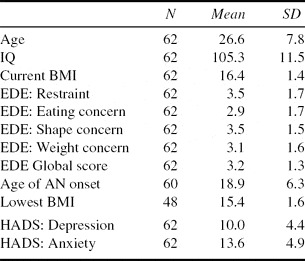
Table 1 reports demographic and clinical characteristics of the AN sample. The sample was predominantly comprised of women (58; 95%). BMI and EDE data indicate that the sample was acutely ill with high levels of eating disorder pathology. HADS anxiety and depression scale scores both exceed clinical threshold, with HADS anxiety score indicative of “caseness” (≥ 8 points (Bjelland, Dahl, Haug and Neckelmann, Reference Bjelland, Dahl, Haug and Neckelmann2002).
Demographic and clinical details of the AN participants

Notes: BMI = body mass index; EDE = Eating Disorder Examination; HADS = Hospital Anxiety and Depression Scale
Are worry and rumination features of AN?
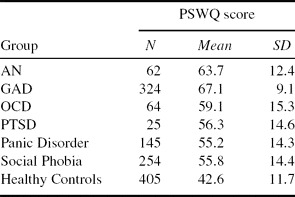
Presence and severity of worry in AN. Mean worry scores for AN, and for clinical samples included for comparison, are provided in Table 2. AN participants had significantly higher PSWQ scores than healthy controls [t(465) = 13.06, p < .000]. AN PSWQ means were statistically similar to means reported in OCD [t(124) = 1.82, p > .05] and were significantly greater than those reported in PTSD [t(85) = 2.39, p < .02], panic disorder [t(205) = 4.06, p < .000] or social phobia [t(314) = 3.97, p < .000]. As a whole sample, AN patients reported significantly less worry on the PSWQ than GAD samples [t(384) = −2.55, p = .006]. However, 90.3% of the AN scores fell above the suggested PSWQ GAD cut-off of 45 as suggested by Startup and Erickson (Reference Startup, Erickson, Davey and Wells2006) and adopted by previous authors exploring clinical norms of this nature (cf. Startup et al., Reference Startup, Freeman and Garety2007), indicating that almost all of the AN sample fell in a range comparable to that of those seeking treatment for GAD.
Means and standard deviations of PSWQ scores for AN and other diagnostic groups

Notes: AN = Anorexia Nervosa; GAD = generalized anxiety disorder; OCD = obsessive compulsive disorder; PTSD = post traumatic stress disorder
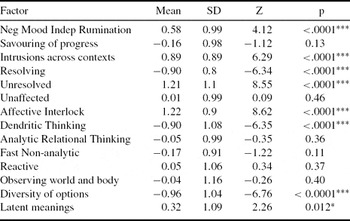
Presence and severity of rumination in AN. As Table 3 indicates, the group of AN patients had significantly elevated scores on four subscales of the CERTS: Negative Mood Independent Rumination, Intrusions Across Contexts, Unresolved Products, and Affective Interlock subscales. They had significantly low scores on three subscales: Resolving Products, Dendritic Thinking Factors, and Diversity of Options. In addition, they scored highly on the Latent factor; however, after applying a Bonferroni correction for possible inflated Type I error, this factor ceased to be significant.
Scores on factors of the CERTS for those with AN (n = 50)

*p < .05 ***p < .0001
N.B. CERTS factor scores are all standardized with respect to the reference population such that each factor has a mean of zero and standard deviation of one.
Relationship between worry and rumination
PSWQ scores were significantly correlated with the CERTS subscales Negative Mood Independent Rumination (rs = .43, p < .002), indicating that greater levels of worry were associated with a measure of ruminative thinking. They also correlated with the Affective Interlock subscale (r = .41, p < .003) indicating that greater levels of worry were associated with increased sense of feeling stuck in a rut. PSWQ scores also negatively correlated with CERTS Diversity of Options subscale (r = −.45, p < .001), suggesting that increased levels of worry were associated with reduced perception of options and possibilities.
Relationship of worry/rumination with clinical or neuropsychological variables. Worry and rumination both significantly correlated with EDE scores (both ps < .01), but not BMI. There were no significant correlations between any of the neuropsychological measure variables and either worry or rumination.
Specificity of worry and rumination to eating disorder pathology
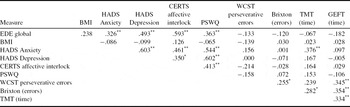
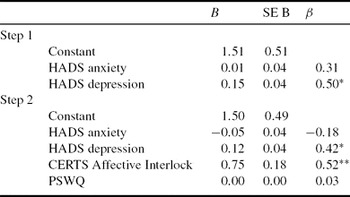
VIF and tolerance scores indicated that the assumption of multicollinearity was maintained and therefore the regression analysis to examine specificity of worry/rumination to ED pathology was feasible. The regression demonstrated that anxiety and depression were significant predictors of EDE global scores [F(2, 47) = 8.67, p < .001] accounting for 26.9% of the variance; however, including worry and rumination in the model saw the predicted variance rise to 48% [F(2,47) = 10.37, p < .000], indicating that worry and rumination predicted ED pathology over and above the influence of mood. Specifically, the CERTS “affective interlock” (t(45) = 4.2, p < .000) and HADS depression scores (t(45) = 2.98, p < .005) were both significant predictors of eating disorder pathology (EDE global score; results presented in Table 5 and see Table 4 for relevant correlations). Notably, neither of the HADS subscales nor the PSWQ or “affective interlock” subscales predicted BMI.
Correlations between all variables included in regression analyses (n = 50)

Notes: EDE = Eating Disorder Examination; BMI = body mass index; HADS = Hospital Anxiety and Depression Scale; CERTS = Cambridge Exeter Ruminative Thinking Scale; PSWQ = Penn State Worry Questionnaire; WCST = Wisconsin Card Sorting Task; TMT = Trail Making Task; GEFT = Group Embedded Figures Task
*p < .05 and **p < .01
Linear regression analysis of factors predicting EDE global scores (n = 50)

Notes: R 2 = 0.27 for step 1; R 2 = 0.48 for step 2; ΔR 2 = 0.211 (ps < .001). *p < .005 and **p < .000; PSWQ = Penn State Worry Questionnaire; CERTS = Cambridge Exeter Ruminative Thinking Scale; HADS = Hospital Anxiety and Depression Scale
Discussion
The principal objectives of this study were, first, to examine the extent of worry and rumination in a sample of individuals with AN, and second, to explore relevant associations between these cognitive processes and eating disorder pathology. Several factors suggested that repetitive negative thinking in the form of worry or rumination may be an important cognitive style for individuals with eating disorders.
Worry was significantly elevated in AN compared to healthy controls. Furthermore, our AN group's worry was more severe than that reported for a range of other (primarily anxiety disordered) clinical groups (Startup and Erickson, Reference Startup, Erickson, Davey and Wells2006). The severity of the worry scores reported here are in line with other recent data exploring worry in those with AN and BN (Sternheim, Startup, Saeidi et al., Reference Sternheim, Startup, Saeidi, Morgan, Hugo and Russell2012). As might be expected, our sample had significantly lower worry scores than a sample of individuals meeting (stringent) criteria for Generalized Anxiety Disorder (GAD) and they scored at a similar level to those with a diagnosis of OCD (Startup and Erickson, Reference Startup, Erickson, Davey and Wells2006).
Rumination was also found to be significantly elevated in the AN group. On four subscales of the CERTS the AN group scored significantly higher than the reference population: Negative Mood Independent Rumination (NMIR), Intrusions Across Contexts (IAC), Unresolved Products and Affective Interlock. According to the explanations of the subscales laid out by Barnard et al. (Reference Barnard, Watkins, Mackintosh and Nimmo–Smith2007), the NMIR subscale suggests that our AN sample had very high overall levels of rumination, independent of negative mood. The elevated IAC scores indicate that they experience “sameness” in their thoughts and a general sense of lack of control over their thinking. The high scores on the Unresolved Products subscale show that they tend to experience a lack of resolution when dwelling, such that they find it hard to form a plan of action and feel as if more thinking may be required. The group's scores are particularly high on the Affective Interlock subscale, meaning that their thoughts are characterized by a tendency to get “stuck in a rut” on a few repetitive themes, and involve frequent comparison with others and a negative self-model. They are extremely low on the Dendritic Thinking subscale, suggesting that their thoughts tend not to move quickly between ideas and involve a significantly low level of exploratory and/or novel thinking. In addition, they are very low on the Diversity of Options subscale, suggesting a particularly low perception of alternative possibilities both when they are on their own and in the company of others.
These findings suggest not only that rumination is a significant feature within AN, but that there are specific facets of the thinking styles of such individuals that are particularly affected and warrant closer attention. Some of these features are consistent with what we already know clinically about sufferers of AN. Preoccupation with eating disorder specific material such as weight and shape is of course diagnostic and may explain the high score for rumination that is independent of negative mood. This implies a somewhat different quality of rumination than that typical of depression (e.g. Nolen-Hoksema and Morrow, Reference Nolen-Hoeksema and Morrow1991). Evidence also suggests that individuals with AN have low self-esteem and struggle in interpersonal relationships, making frequent negative comparisons with others (Schmidt and Treasure, Reference Schmidt and Treasure2006). This is consistent with the elevated Affective Interlock scores demonstrated by the AN participants. Furthermore, evidence from the neuropsychology literature suggests that individuals with AN lack flexibility in their thinking (e.g. Tchanturia et al., Reference Tchanturia, Harrison, Davies, Roberts, Oldershaw and Nakazato2011, Reference Tchanturia, Davies, Harrison, Roberts, Nakazato and Schmidt2012), and have difficulties with problem solving (e.g.Troop, Holbrey and Treasure, Reference Troop, Holbrey and Treasure1998; Sternheim, Startup, Pretorius et al., Reference Sternheim, Startup, Saeidi, Morgan, Hugo and Russell2012). Our AN participants’ low scores on the CERTS Dendritic Thinking, Diversity of Options and Affective Interlock would certainly concord with this, as would their raised Unresolved Products scores. These findings in many ways extend the conceptualization of AN as a disorder of “psychological inflexibility” (Merwin et al., Reference Merwin, Timko, Moskovich, Ingle, Bulik and Zucker2011; Tchanturia et al., Reference Tchanturia, Harrison, Davies, Roberts, Oldershaw and Nakazato2011, Reference Tchanturia, Davies, Harrison, Roberts, Nakazato and Schmidt2012) with not only behavioural and neuropsychological manifestations, but also manifestations within the cognitive information processing style of AN sufferers.
As predicted, worry and general rumination (NMIR) were correlated. This is a finding replicated across many disorders (Harvey et al., Reference Harvey, Watkins, Mansell and Shafran2004), and these results lend further support to the suggestion that they might be co-occurring cognitive styles that share much in common.
In exploring the specificity of worry and rumination to eating disorder pathology our predictions were also supported. The Affective Interlock sub-scale was chosen for this analysis because of its ability to represent broadly the core ingredients of rumination: getting “stuck in a rut”, whilst also seeming most relevant to the type of “cognitive rigidity” relevant to AN sufferers. Anxiety and depression were found to be significant predictors of eating disorder symptomatology, and worry and rumination predicted eating disorder pathology over and above the effects of this negative mood. Thus, the thinking styles of worry and rumination made a unique contribution to eating disorder symptomatology.
This is an interesting but perhaps unsurprising finding. Across disorders it is now recognized that these negative thinking styles are involved in the maintenance of a range of psychological disorders (Harvey et al., Reference Harvey, Watkins, Mansell and Shafran2004), because in effect they bring troublesome information to mind and keep it there. However, to date, this link has not been given due consideration within the eating disorders literature. The design of the current study does not enable causal links to be made. However, there are a number of hypotheses that can be formed regarding the role of these thinking styles in eating disorders. First, with emotional intolerance being a core feature of eating disorders, worry and rumination - recognized to inhibit emotional processing - may maintain the “emotional numbness” typical of AN sufferers. Furthermore, worry and rumination seem likely to impede successful problem solving, such as is involved in the generation of alternative solutions to life problems. Deficits in social problem solving are a known feature of eating disorder pathology (Sternheim, Startup, Pretorius et al., Reference Sternheim, Startup, Pretorius, Johnson-Sabine, Schmidt and Channon2012) and so too is the tendency to catastrophize when faced with life challenges (Sternheim, Startup, Saeidi et al., Reference Tchanturia, Davies, Harrison, Roberts, Nakazato and Schmidt2012). It also seems possible that these thinking styles may contribute to the cognitive rigidity characteristic of AN sufferers, and as such may warrant closer consideration within core models of AN (cf. Merwin et al., Reference Merwin, Timko, Moskovich, Ingle, Bulik and Zucker2011; Schmidt and Treasure, Reference Schmidt and Treasure2006).
Contrary to our hypothesis, worry and rumination were not associated with any of the typical neuropsychological correlates of AN (reported in systematic reviews Roberts, Tchanturia, Stahl, Southgate and Treasure, Reference Roberts, Tchanturia, Stahl, Southgate and Treasure2007; Lopez et al., Reference Lopez, Tchanturia, Stahl and Treasure2008). We chose to include measures that would highlight perseveration and detail focus; however, despite our hypotheses, these were not associated with worry or rumination. One potential explanation for the lack of a positive association between these variables is that the outpatients in the current study were not as severe or chronic as some patient groups within previous studies (cf. Roberts et al., Reference Roberts, Tchanturia, Stahl, Southgate and Treasure2007 and Lopez et al., Reference Lopez, Tchanturia, Stahl and Treasure2008).
Clinically, this study is of significant interest. In recent years, substantial evidence has accumulated on the importance of cognitive processing styles such as worry and rumination in the maintenance of other disorders such as depression (Watkins and Baracaia, Reference Watkins and Baracaia2002). Treatments in these areas have evolved from a more traditional focus purely upon the content of cognition to a recognition that addressing the processes of repetitive negative thinking more directly may be advantageous (cf. Teasdale, Reference Teasdale and Yiend2004). Within eating disorders, there has understandably been a focus on the main presenting features and cognitive content of the disorders. However, there has been less focus on addressing some of the cognitive processing styles that may be central in the maintenance of the disorders. This study provides a strong rationale for turning the spotlight more directly on the processes of worry and rumination within AN, and examining within a clinical context the part played by such processes in the disorder.
Of particular strength in this study was the nature of the participant group. The sample enabled a robust test of our hypotheses in that they were a representative group of mainly female participants with AN who were acutely unwell with high levels of eating disorder pathology. A further strength is in being able to report on the interplay between both worry and rumination within a clinical sample, especially given their transdiagnostic status. However, often when the two processes are explored it is within analogue samples (Watkins, Moulds and Mackintosh, Reference Watkins, Moulds and Mackintosh2005). Another strength was our use of the CERTS, a measure of rumination that has the capacity to capture the presence of a ruminative thinking style independently of depressed mood and to capture rumination typical of “cognitive rigidity”, and to assess not only the presence and extent of rumination but a number of its key clinical characteristics.
Nonetheless, there were some limitations to the inferences that may be drawn. Despite having a large sample of individuals with AN there was no control group recruited as part of the current study and comparisons were made with previously published data. Furthermore, the CERTS is a relatively new and complex measure where only non clinical student reference data are available and tests of psychometric robustness are lacking.
Future research needs to address the question of whether worry and rumination in anorexia are “state” variables, likely to dissipate on recovery, or “trait” characteristics of anorexic individuals that may act as part of a wider vulnerability to developing the illness. This is of particular interest, as is whether interventions directly targeting these processes have a beneficial effect on core eating disorder pathology.
Acknowledgements
This article presents independent research commissioned by the NIHR Biomedical Research Centre for Mental Health, South London and Maudsley NHS Foundation Trust and Institute of Psychiatry, King's College London and the National Institute for Health Research (NIHR) under its Programme Grants scheme (RP-PG-0606–1043). The views expressed in this publication are those of the authors and not necessarily those of the NHS, the NIHR or the Department of Health. Anna Oldershaw was supported by the Psychiatry Research Trust. Ulrike Schmidt receives salary support from the National Institute for Health Research (NIHR) specialist Biomedical Research Centre for Mental Health award at South London and Maudsley NHS Foundation Trust and Institute of Psychiatry, King's College London.
We would like to thank the authors of the CERTS for use of their measure and in particular Professor Barnard for his assistance with the CERTS data analyses and for his helpful comments on an earlier draft of this paper.
The first two authors contributed equally to this work.



Comments
No Comments have been published for this article.