1. Introduction
Natural languages encode anaphoric dependencies in a number of ways. Safir (Reference Safir2004, Reference Safir2008) introduces the term coconstrual as a theory-neutral label for any identity relation between two elements, pronounced or not. Coconstruals include antecedent–anaphor relations, filler–gap dependencies, control relations, variable binding, and independent coreference, among others, as illustrated in (1).
- (1)
(a) Mike hurt himself.
(b) What will college cost what in 2020?
(c) Sandy tried PRO to water ski.
(d) No waitress should ignore her customers.
(e) A man walked in. He smiled.
Coconstruals can be encoded in the syntax, in the semantics, or in the discourse. Narrow syntax (NS) is the core of the syntactic computational system. Within Chomsky's Minimalist Program (Chomsky Reference Chomsky1995, Reference Chomsky, Martin, Michaels and Uriagereka2000, Reference Chomsky and Kenstowicz2001), narrow syntax, also called the computational system of human language (Chomsky Reference Chomsky1995), is invariant across languages and builds syntactic representations. The mechanisms involved in structure building include Agree, Merge, and Move. Coconstruals formed in the narrow syntax include at least movement relations (Safir Reference Safir2008) and co-argument reflexives (Reuland Reference Reuland2011).
Reuland (Reference Reuland2011: 30–34), following Reinhart (Reference Reinhart2006), uses the term logical syntax to refer to the output of narrow syntax augmented with vocabulary required for the structure to be read by the semantic inference system, Chomsky's (Reference Chomsky1995) Conceptual–Intentional (C–I) interface. It corresponds to logical form in Principles & Parameters frameworks – the syntactic representation enriched by further vocabulary to fully represent logical structure.Footnote 2 A prominent element of logical syntax is the representation of bound variable relations, or logical syntax binding (Reuland Reference Reuland2011: 31). In logical syntax, pronouns are translated as variables that become operator-bound. Safir (Reference Safir2008) argues that bound variable anaphora is not represented in narrow syntax representations but is done by interpretive mechanisms at the C–I interface. For simplicity, we will call logical syntax coconstruals semantic dependencies, to distinguish them from (narrow) syntactic and discourse construals, but they will not play a significant role here.
The discourse component of the grammar situates the logical syntax in the larger context that includes world knowledge, speaker intent, and the full linguistic context. Discourse is where reference relations are established and thus it determines coconstruals that are not part of the grammar, such as coreference relations across sentences.Footnote 3
Reuland (Reference Reuland2011: 125), building on Reinhart (Reference Reinhart1983, Reference Reinhart2006), Grodzinsky & Reinhart (Reference Grodzinsky and Reinhart1993), and others, proposes the following hierarchy in the economy of the encoding of coconstruals:
(2) Narrow syntax < logical syntax (C–I interface) < discourse
According to Koornneef (Reference Koornneef2008) and Reuland (Reference Reuland2011), coconstruals formed in components farther to the left on the hierarchy in (2) are favored because they are, in some sense, less costly than those towards the right. For example, narrow syntax coconstruals such as movement relations are favored over discourse-formed coconstruals such as coreference. The economy behind the hierarchy in (2) translates into processing preferences; the processing of construals farther to the left should be easier than those to the right. Koornneef (Reference Koornneef2008: 46) formulates the following hypotheses stemming from Reuland's proposals:
- (3)
(a) The construction of syntactic coconstruals requires less effort than the construction of semantic coconstruals.
(b) The construction of semantic coconstruals requires less effort than the construction of discourse coconstruals.
(c) The construction of syntactic coconstruals requires less effort than the construction of discourse coconstruals.
One challenge in testing these claims is to find coconstruals of the different types that nonetheless represent minimal pairs. The goal is to avoid differences in the constructions that might influence the time course of processing, independent of the coconstrual type of interest, so that any processing differences can be attributed to the form of the coconstrual and not some irrelevant, interfering factor.
For example, Koornneef investigates the processing of English VP ellipsis examples as in (4) to test (3b). Such examples are ambiguous between sloppy and strict readings, in (5a) and (6a), respectively.
(4) The acrobat likes his jokes and the clown does too.
- (5)
(a) The acrobati likes hisi jokes and the clownk likes hisk jokes too.
(b) the acrobat (λx (x likes x's jokes)) & the clown (λx (x likes x's jokes))
- (6)
(a) The acrobati likes hisi jokes and the clownk likes the acrobati's jokes too.
(b) the acrobat (λx (x likes the acrobat's jokes)) & the clown (λx (x likes the acrobat's jokes))
The sloppy reading, in which the acrobat likes his own jokes and the clown likes his own jokes, represents a semantic coconstrual of the pronoun his with respect to its antecedent, the acrobat. There is a bound variable dependency informally represented as in (5b). Such a representation is required to obtain the appropriate interpretation of the missing pronoun in the second clause, which is interpreted with a referent different than in the first clause. The strict reading is the interpretation in which the acrobat likes his own jokes and the clown likes them too. It represents a simple coreference, a discourse coconstrual. In this representation, the pronoun picks up as its antecedent the acrobat and this referent is carried over into the unpronounced VP, as in (6b). Such examples are optimal to investigate from a processing perspective because the meanings and coconstrual types are distinct but the surface forms are identical. Thus, any processing differences can be attributed to the form of the coconstrual. Koorneef (Reference Koornneef2008) discusses various studies, including his own, showing that speakers prefer the sloppy (bound variable) reading and process it more quickly compared to the strict reading (Shapiro & Hestvik Reference Shapiro and Hestvik1995, Frazier & Clifton Reference Frazier and Clifton2000, Shapiro et al. Reference Shapiro, Hestvik, Lesan and Garcia2003, Vasić Reference Vasić2006). This supports the hypothesis in (3b) that the construction of semantic coconstruals requires less effort than the construction of discourse coconstruals.
Other studies, testing the prediction in (3c), have looked at the processing of reflexives (Burkhardt Reference Burkhardt2005, Piñango & Burkhardt Reference Piñango, Burkhardt, Branco, McEnery and Mitkov2005, Schumacher et al. Reference Schumacher, Piñango, Ruigendijk and Avrutin2010). As these studies discuss, languages like English and Dutch allow more than one coconstrual type for anaphors. The interpretive mechanism for reflexives varies between a syntactic coconstrual when they are in argument position, (7a), versus a non-syntactic (semantic or discourse) coconstrual when in non-argument positions, (7b, c).Footnote 4 The relevant point is that there is more than one way in which a reflexive can find its antecedent: syntactically in (7a) versus extra-syntactically in (7b, c).
- (7)
(a) The cellist defended herself.
(b) The ballerina put a turban next to herself.
(c) Max boasted that the queen invited Lucie and himself to tea.
These works confirm the prediction in (3c), showing that examples such as (7b, c) incur increased processing cost compared to the cost of computing the syntactic coconstrual as in (7a). However, one could question these results by arguing that the sentences vary in length; the distance between the antecedent and the reflexive is greater in those cases where the reflexive is used extra-syntactically in (7b, c), which may explain the effect.
Finally, Santi & Grodzinsky (Reference Santi and Grodzinsky2012) investigated the processing of a parasitic gap (pg) versus an A′-bound unstressed pronoun, as in (8a, b):
- (8)
(a) Which paperi did the tired student submit __i after reviewing pg?
(b) Which paperi did the tired student submit __i after reviewing it?
They find that a parasitic gap like that in (8a) is processed more efficiently than the A′-bound pronoun in (8b). In principle this could support the conceptions in (3), with the syntactic dependency again processed more efficiently than the anaphoric dependency. However, the difference in their results could also be due to the somewhat degraded nature of (8b) (see Ross Reference Ross1967 and Postal Reference Postal, Culicover and Postal2001 for a discussion).
Thus, while the overall idea behind (3) is clear, it has not yet received experimental support. The goal of this paper is to test the prediction in (3c) in a novel experimental way. The hypothesis in (3c) predicts, perhaps counter-intuitively, that constructions involving movement will be easier to process than similar constructions with no movement. We introduce two syntactic constructions in Russian that will bear on this issue; they appear minimally different on the surface but involve distinct structures.
The contrast is illustrated in (9).
- (9)
(a) Sobor-a v gorodke bylo trisobor-a.
cathedral-paucal in town was three.paucal
(b) Sobor-ov v gorodke bylo tripro.
cathedral-gen.pl in town was three.paucal
‘As for cathedrals, there were three in that town.’
A nominal is fronted, stranding a modifying numeral. The nominal can appear in a form that agrees in number with the numeral, (9a), or it can appear in a non-agreeing plural form, (9b). We will show that the construction in (9a) involves A′-movement of the fronted element, and thus instantiates a syntactic coconstrual between the nominal and the empty category indicated as a struck-through copy. In contrast, (9b) involves coreference between the fronted element and a base-generated empty category, which we propose is a null pronoun; hence (9b) represents a discourse coconstrual.
These constructions are ideal for investigating the processing predictions informed by the hierarchy in (2). They are minimally different from each other, maintaining parity in linear and structural distance between the antecedent and the gap, the grammatical role of the antecedent, and the lexical items involved. Only the morphology on the fronted element distinguishes them. Thus, any processing differences at the numeral can reasonably be associated with the coconstrual mechanism involved.
The results of a self-paced reading experiment confirm the processing predictions. The reading time profile for the two constructions is the same until some time shortly after the numeral. At this point, there is a statistically significant increase in reading time in the base-generated construction as opposed to the movement construction. We take this to be an indicator of the effort required to retrieve a discourse referent for the null pronoun and to support Reuland's (Reference Reuland2011) overall approach.
The remainder of the paper is organized as follows. Section 2 provides background information on Russian numerical expressions and analyzes the contrast above as a difference between movement and base generation. This contrast has not been analyzed before, so the section contributes to our understanding of Russian syntax. Section 3 provides evidence for the syntactic analyses. Section 4 discusses the study investigating the processing of the Russian constructions. This study provides experimental evidence in support of increased processing cost for discourse coconstruals over syntactic coconstruals, showing that (9a) is processed more quickly than (9b); thus movement relations are less costly than coreference relations. Section 5 presents our conclusions.
2. Russian topic constructions
2.1 Left Dislocation
Left Dislocations (LDs) are constructions in which a phrase appears at the left edge of a clause, dislocated from its canonical position, and is related to some clause-internal anaphoric element. English examples are in (10), with the left dislocated phrase and the anaphoric element, if pronounced, bold-faced.
- (10)
(a) Carambolas, I don't like __.
(b) Carambolas, I don't like them.
There is much work on LD in the generative literature (see, for example, the collection of papers in Anagnostopoulou, van Riemsdijk & Zwarts Reference Elena, van Riemsdijk and Zwarts1997, Alexiadou Reference Alexiadou, Everaert and van Riemsdijk2006, and references therein) and there is clear consensus that LD constructions are not a unitary phenomenon syntactically or semantically. This is the case both across languages and within a single language. Although our primary concern here is LD in Russian, it will be helpful to survey the LD constructions in some better-analyzed languages to understand the range of options. Cross-linguistically, there are two relevant parameters of morphosyntactic variation: (i) the form of the clause-internal anaphoric element and (ii) the analysis of the construction as movement or base generation.
Regarding the first, the form of the anaphor varies between a zero, some kind of pronominal element, and an epithet. Example (11a) illustrates English Topicalization, in which the anaphor is a null element. (11b) illustrates Clitic Left Dislocation (CLLD) in Romance, in which the anaphoric element is a preverbal pronominal clitic. CLLD has been very widely discussed and analyzed (Cinque Reference Cinque1977, Reference Cinque1990, Reference Cinque and Anagnostopoulou1997[1983]; Anagnostopoulou Reference Anagnostopoulou1994, Reference Anagnostopoulou and Anagnostopoulou1997; Escobar Reference Escobar and Anagnostopoulou1997; Rizzi Reference Rizzi and Haegeman1997; Cecchetto Reference Cecchetto2000; Benincà & Poletto Reference Benincà, Poletto and Rizzi2004; Lopez Reference Lopez2009; Aoun, Benmamoun & Choueiri Reference Aoun, Benmamoun and Choueiri2010, and numerous other works). The example in (11c) illustrates Germanic Contrastive Left Dislocation (CLD), in which the anaphoric element is a (displaced) demonstrative pronoun (see Ross Reference Ross1967, van Riemsdijk & Zwarts Reference van Riemsdjik, Zwarts and Anagnostopoulou1997[1974], Vat Reference Vat and Anagnostopoulou1997[1981], Wiltschko Reference Wiltschko and Anagnostopoulou1997, Zaenen Reference Zaenen and Anagnostopoulou1997, and others). In (11d), the anaphoric element is a full pronoun. The construction illustrated in (11d) is called Hanging Topic Left Dislocation (HTLD),Footnote 5 see Cinque (Reference Cinque1977), Thráinsson (Reference Thráinsson1979), van Riemsdijk & Zwarts (Reference van Riemsdjik, Zwarts and Anagnostopoulou1997[1974]), Vat (Reference Vat and Anagnostopoulou1997[1981]). Finally, (11e) illustrates the use of an epithet as the anaphoric element, an option selectively allowed by some languages, such as French, Lebanese Arabic, and Spanish (Alexiadou Reference Alexiadou, Everaert and van Riemsdijk2006).
- (11)
(a) Carambolas, I don't like __.
(b) A Gianni, Maria gli ha parlato recentemente.
to Gianni Maria 3sg.dat has speak.ptcp recently
‘To Gianni, Maria spoke to him recently.’(Italian; Rizzi Reference Rizzi and Haegeman1997: 294)
(c) Die man, die ken ik niet.
that man dem know I not
‘That man, I don't know.’(Dutch; Vat Reference Vat and Anagnostopoulou1997: 70)
(d) Carambolas, I don't like them.
(e) Paul, Pierre vient de se battre avec cet idiot.
Paul Pierre come C refl fight with this idiot
‘Paul, Peter has just fought with that idiot.’
(French; Hirschbühler Reference Hirschbühler and Anagnostopoulou1997[1974]: 56)
The second parameter of variation concerns the actual analysis of the construction. LD can be split into movement analyses, in which some element has been dislocated from a clause-internal position, and base-generation analyses, in which the left dislocated element is base-generated and no movement is involved. In the latter, the left dislocated element is linked to its clause-internal position via interpretive mechanisms. HTLD is typically analyzed as base generation (see, for example, Hirschbühler Reference Hirschbühler and Anagnostopoulou1997[1974] and de Cat Reference De Cat2007 on French) while CLLD/CLD receive movement analyses.
The distinction between HTLD and movement has been widely explored in Romance and Germanic languages (see Grewendorf Reference Grewendorf, Shaer, Cook, Frey and Maienborn2008 for a comparison of Romance and Germanic). The distinction has also been explored in Mayan (Aissen Reference Aissen1992 and subsequent work on individual Mayan languages which builds on this paper). Surprisingly, there has been very little work on LD in Slavic. Sturgeon (Reference Sturgeon2008) discusses the situation in Czech, noting a contrast between HTLD and scrambling with respect to syntax, semantics, and prosody. It is hard to find any other detailed discussion of the contrast in Slavic.
This paper begins to fill that gap in Slavic linguistics by exploring the contrast between base-generated and moved LD elements in Russian. Russian shows a difference between HTLD and movement, which replicates the phenomena seen in better-studied languages (Bailyn Reference Bailyn2012):
- (12)
(a) Mark zanimaetsja jogoj každyj den′.
Mark.nom practices yoga.instr every day
‘Mark does yoga every day.’(Bailyn Reference Bailyn2012: 268)
(b) Movement
Jogoj Mark zanimaetsja__ každyj den′.
yoga.instr Mark.nom practices every day
‘Yoga Mark does every day.’(Bailyn Reference Bailyn2012: 268)
(c) HTLD
Joga, Mark zanimaetsja eju každyj den′.
yoga.nom Mark.nom practices it.instr every day
‘Yoga, Mark does it every day.’(Bailyn Reference Bailyn2012: 268)
Unlike some other languages, Russian does not use clitics, so the overt expression of the contrast between base-generated and moved LD is minimal.
The following subsections start with an overview of relevant aspects of Russian grammar and the constructions under investigation. We then turn to the syntax of these constructions and demonstrate that Russian has both types of LD elements, although the difference is sometimes obscured by morphology.
2.2 Russian numerical expressions
The form of a Russian noun co-occurring with a numeral varies depending on the numeral. When a noun co-occurs with lower numerals – ‘one-and-a-half’, ‘two’, ‘three’ and ‘four’, and the expression ‘both’ – it obligatorily takes a special form which is different from the form co-occurring with higher numerals – ‘five’ and up. The nominal form co-occurring with lower numerals is usually the same as the genitive singular; however, a few nouns, some of them frequent, have a different form, for example, čas ‘hour’, is časá with lower numerals and čása in the genitive singular (Zaliznjak Reference Zaliznjak1968, Bailyn & Nevins Reference Bailyn, Nevins, Bachrach and Nevins2008). Such a difference indicates that the nominal form co-occurring with lower numerals is distinct from the genitive singular. The morphological form has received several analyses (see Xiang et al. Reference Xiang, Harizanov, Polinsky and Kravtchenko2011 for an overview) but, for our purposes, it is sufficient to identify it as pauc(al). With numerals ‘five’ and up, Russian requires nouns in the gen(itive) pl(ural). The difference is morphologically visible when the modified expression appears in the nominative (and in the accusative for inanimates, which is homophonous with the nominative). It is obscured in all other instances. The distinct morphology is shown in (13) for the numerals ‘three’ versus ‘five’. ‘Three’ requires paucal morphology on the noun while ‘five’ requires genitive plural morphology.Footnote 6
- (13)
(a) V gorodke bylo tri sobor-a/*ov.
in town was three.nom cathedral-pauc/gen.pl
‘There were three cathedrals in that town.’
(b) V gorodke bylo pjat′ sobor-ov/*a.
in town was five.nom cathedral-gen.pl/pauc
‘There were five cathedrals in that town.’
The numeral and the nominal can be separated; for instance, the nominal can front stranding the numeral. The fronting has the effect of creating a topic, which we will often translate using English ‘as for’. When the stranded numeral is a higher numeral, the left dislocated noun must be in the genitive plural form:
- (14)
(a) Sobor-ov v gorodke bylo pjat′.
cathedral-gen.pl in town was five
‘As for cathedrals, there were five in that town.’
(b) *Sobor-a v gorodke bylo pjat′.
cathedral-pauc in town was five
(‘As for cathedrals, there were five in that town.’)
When the stranded numeral is a lower numeral, however, both the expected paucal and genitive plural are possible:Footnote 7
- (15)
(a) Sobor-a v gorodke bylo tri.
cathedral-pauc in town was three
(b) Sobor-ov v gorodke bylo tri.
cathedral-gen.pl in town was three
‘As for cathedrals, there were three in that town.’
The generalization is as follows:
(16) Left Dislocation and stranded numerals
A left dislocated nominal that strands a numeral can show number connectivity – the number that would be appropriate were it not left dislocated – or it can appear in the (genitive) plural form.
The behavior of ‘one’ conforms to this pattern. A noun modified by the numeral ‘one’ must appear in the singular, see (17).
- (17)
(a) Maša kupila odin kalendar′.
Masha bought one.acc calendar.sg.acc
‘Masha bought one calendar.’
(b) *Maša kupila odin kalendarja/kalendarej
Masha bought one.acc calendar.pauc/calendar.gen.pl
When the noun is left dislocated, it can remain in the singular form or appear in the genitive plural form, as is shown in (18a, b). It may not be in the paucal form, see (18c).
- (18)
(a) Kalendar′ Maša kupila odin.
calendar.acc.sg Masha bought one.acc
‘As for calendars, Masha bought one.’
(b) Kalendarej Maša kupila odin.
calendar.gen.pl Masha bought one.acc
‘As for calendars, Masha bought one.’
(c) *Kalendarja Maša kupila odin.
calendar.pauc Masha bought one.acc
Analytically, the presence of number connectivity with paucal in the above data points towards a movement analysis while the absence of connectivity with genitive plural suggests a base-generated HTLD analysis. In what follows we will provide evidence for the following:Footnote 8
- (19)
(a) For lower numerals, the left dislocated nominal has undergone
movement when there is number connectivity (paucal) and it is HTLD
when there is no connectivity (genitive plural).
(b) For higher numerals, the left dislocation construction is structurally
ambiguous between movement and HTLD.
To make these proposals concrete, we assume a structure for numeral-modified nominals in Russian as in (20) (Bošković Reference Bošković and Boeckx2006).
(20) [FP QP [F′ F NP]]
The numeral is a QP in the specifier of a functional projection FP that dominates NP. One might identify FP as NumP.
Under the movement analysis, the NP complement to the functional head F° moves to a clause-initial position. We take this to be an instance of the widely-discussed Russian scrambling (Bailyn Reference Bailyn1995, Reference Bailyn2001, Reference Bailyn and Karimi2003, Reference Bailyn and Compton2007, Reference Bailyn2012; King Reference King1995; Sekerina Reference Sekerina1997, and others) and an instance of A′-movement. We assume that scrambled elements adjoin to any maximal projection. To generate a left-peripheral element, scrambling of NP can target CP or TP. In the case of a base-generated hanging topic, we propose that the topic phrase can adjoin only to CP (Alexiadou Reference Alexiadou, Everaert and van Riemsdijk2006) and the complement of F° position is occupied by a null pronominal, pro: [FP QP [F′ F pro]].
In terms of the earlier discussion, the relationship between the scrambled paucal phrase and its trace is subject to syntactic coconstrual. The relationship between the hanging topic phrase and pro belongs to discourse coconstrual. The interpretation of pro is not determined until the discourse component, where pronouns receive their referents. At this point, pro takes as its antecedent a salient entity, the hanging topic. The alternative would be that the hanging topic construction represents a variable binding configuration and thus instantiates a semantic coconstrual, but we believe that this is not the case for two reasons.Footnote 9 First, pro following a numeral need not have a binder. The antecedent may be in another sentence in the discourse, see (21). Pro here cannot be a bound variable.
- (21)
(a) A: U vas est′ žurnaly?
by you is magazine.nom.pl
B: Da, četyre/odin/devjat′ pro.
yes four/one/nine
‘A: Do you have magazines?
B: Yes, four/one/nine.’
(b) A: Ja obyčno kladu desjat′ ogurcov
1sg usually put ten cucumber.gen.pl
B: A ja vsego dva/šest′/odin pro.
and 1sg only two/six/one
‘A: I usually use ten cucumbers (for this recipe).
B: And I only use two/six/one.’
Second, the genitive plural hanging topic need not have a bindee. It can be what van Riemsdijk (Reference van Riemsdjik, Zwarts and Anagnostopoulou1997:4) calls a loose aboutness left dislocation. Although such examples seem somewhat difficult to construct, they are possible. Some examples in (22) are based on Choo, Hong & Hwang (Reference Choo, Hong and Hwang2007); see also Crockett (Reference Crockett1976: 318–335) and Franks (Reference Franks1995: 187).
- (22)
(a) Podrug v to vremja u menja ostalos′
girlfriend.gen.pl in that time by me remained
vsego liš′ odna Tanja.
only one.nom.fem Tanya
‘Of girlfriends at that time I was just friends with Tanya alone.’
(b) Vremeni prošlo dve nedeli.
time.gen.sg passed two weeks.pauc
‘The amount of time that passed was two weeks.’
(c) Klientov bylo devjat′ čelovek.
client.gen.pl was nine person.gen.pl
‘The number of customers was nine persons.’
(d) Živnosti u nix dve zolotye rybki.
animals.coll.gen by them two gold fish.pauc
‘Of pets, they have two goldfish.’
To summarize, our analyses can be represented as follows:
(23) Lower numerals
(a) Left Dislocation with number connectivity: movement
Sobor-a v gorodke bylo tri sobor-a.
cathedral-pauc in town was three
(b) Left Dislocation without number connectivity: HTLD
Sobor-ovi v gorodke bylo tri pro i.
cathedral-gen.pl in town was three
‘As for cathedrals, there were three in that town.’Footnote 10
(24) Higher numerals: structural ambiguity
(a) Movement
Sobor-ov v gorodke bylo pjat′ sobor-ov.
cathedral-gen.pl in town was five
(b) HTLD
Sobor-ovi v gorodke bylo pjat′ pro i.
cathedral-gen.pl in town was five
‘As for cathedrals, there were five of them in that town.’
In what follows, we will explore the proposal in (19) above as it relates to lower numerals – the contrast in (23) – because number morphology on the dislocated element unambiguously identifies the construction involved.Footnote 11
3. Syntactic evidence
The evidence in favor of the proposal in (19) comes from a wide range of phenomena. The arguments form two sets. One set is based on diagnostics for movement (Section 3.1). These phenomena, which include island effects, reconstruction, and parasitic gaps, confirm that the left dislocated paucal construction involves A′-movement while the genitive plural one does not. The second set of arguments in Section 3.2 appeals to characteristics of HTLD to conversely show that the genitive plural construction is HTLD, while the paucal construction is not. Some of the data used in our discussion in this section are rather nuanced, so we have checked the relevant examples with five naive native speakers of Russian; the average ratings on a 1–5 scale (1: completely unacceptable, 5: fully acceptable) are presented in brackets.
3.1 Movement diagnostics
3.1.1 Island sensitivity
Island (in)sensitivity is a classic diagnostic for movement (Ross Reference Ross1967) and it is widely used in the LD literature to help decide between movement and HTLD. HTLD is generally insensitive to islands, being a base-generated structure.Footnote 12 Russian generally shows sensitivity to wh-islands, complex noun phrase islands, and the Coordinate Structure Constraint, as well as some other types of islands that we will not discuss below (Kazenin Reference Kazenin1997; Sekerina Reference Sekerina1997; Testelets Reference Testelets2001: 548–551, 603–604; Abels Reference Abels2003: 160–161; Grebenyova Reference Grebenyova2006, Reference Grebenyova2007; Stepanov Reference Stepanov2007; Bailyn Reference Bailyn2012: 101–102). Therefore the expectation for the constructions under investigation is that paucal LD elements should not be able to relate to gaps inside syntactic islands but the corresponding genitive plural forms should be able to do so. The data confirm this prediction. The examples in (25) and (26) illustrate weak factive islands and wh-islands, respectively.
- (25)
(a) Udivitel′no, čto oni našli vsego dva slučaja.[4.2]
surprising that they found only two case.pauc
‘It is surprising that they found only two instances.’
(b) *Slučaja udivitel′no, čto oni našli vsego dva.[1.5]
case.pauc surprising that they found only two
(c) Slučaev udivitel′no, čto oni našli vsego dva.[4.1]
case.gen.pl surprising that they found only two
‘Of instances, it is surprising that they found only two.’
- (26)
(a) Maša sprosila, gde my našli tri čemodana.[4.7]
Masha asked where we found three suitcase.pauc
‘Masha asked where we found three suitcases.’
(b) *Čemodana Maša sprosila, gde my našli tri.[1.9]
suitcase.pauc Masha asked where we found three
(c) Čemodanov Maša sprosila, gde my našli tri.[3.8]
suitcase.gen.pl Masha asked where we found three
‘Masha asked where we found three suitcases.’
Example (27) illustrates a strong complex noun phrase island.Footnote 13
- (27)
(a) Ty pomniš′ [vremja, [kogda u nee bylo tri ženixa]]?[4.1]
2sg remember time when by her was three suitor.pauc
‘Do you remember the time when she had three suitors?’
(b) *Ženixa ja pomnju vremja, kogda u nee bylo tri.[1.2]
suitor.pauc 1sg remember time when by her was three
(c) Ženixov ja pomnju vremja, kogda u nee bylo tri.[3.9]
suitor.gen.pl 1sg remember time when by her was three
‘Speaking of suitors, I remember the time when she had three.’
3.1.2 Coordinate Structure Constraint and across-the-board movement
Although coordinate structures are often categorized as strong islands, the unique behavior of extraction from coordinate structures allows us to construct a slightly more nuanced argument for our analyses. Ross (Reference Ross1967) first formulated the Coordinate Structure Constraint (CSC), in (28) below, as prohibiting movement from coordinating conjuncts but he observed that violations of clause (ii) of the CSC could be voided if the same element was extracted from both conjuncts – so called across-the-board (ATB) movement (Williams Reference Williams1978, Bošković & Franks Reference Bošković and Franks2000).
(28) Coordinate Structure Constraint (Ross Reference Ross1967)
In a coordinate structure, (i) no conjunct may be moved, (ii) nor may any element contained in a conjunct be moved out of the conjunct.
With respect to the Russian LD construction, if the number of the fronted element is appropriate for both conjunct positions, the result is grammatical:
- (29)
(a) Derev′jev Maša kupila tri, a posadila dva.
tree.gen.pl Masha bought three and planted two
(b) Dereva Maša kupila tri, a posadila dva.
tree.pauc Masha bought three and planted two
‘As for trees, Masha bought three but planted two.’
Under our analysis, (29a) is base-generated, as shown in (30a). The hanging topic is coreferential with pro in each of the conjuncts. Example (29b) is derived by ATB movement with the derivation in (30b).
- (30)
(a) Derev′jev [[Maša kupila tri pro], a [posadila dva pro]].
tree.gen.pl Masha bought three and planted two
(b) Dereva [[Maša kupila tri dereva] a [posadila dva dereva]].
tree.pauc Masha bought three and planted two
‘As for trees, Masha bought three but planted two.’
The difference between these two derivations can be seen when the fronted element relates to a gap in only one of the conjuncts. The derivation is licit in the case of base generation, in (31a), with the derivation shown in (32a); however, movement, in (31b), is illicit because the CSC is violated, as shown in (32b).
- (31)
(a) Derev′jev Maša kupila tri, a potom posadila vsego
tree.gen.pl Masha bought three but then planted only
dva jasenja.
two ashes
‘As for trees, Masha bought three but then planted only two ashes.’
(b) ?/*Dereva Maša kupila tri, a potom posadila vsego
tree.pauc Masha bought three but then planted only
dva jasenja.
two ashes
(‘As for trees, Masha bought three but then planted only two ashes.’)
- (32)
(a) Derev′jev [[Maša kupila tri pro], a potom [posadila
tree.gen.pl Masha bought three but then planted
vsego dva jasenja]].
only two ashes
(b) *Dereva [[Maša kupila tri dereva], a potom [posadila
tree.pauc Masha bought three but then planted
vsego dva jasenja]].
only two ashes
The contrast also appears when the numerals in the two conjuncts differ. Our analyses again correctly lead us to expect a difference in grammaticality. Genitive plural should still be acceptable because both pros are bound by the hanging topic, see (33a). Paucal is unacceptable, as is seen in (33b), because movement out of one conjunct only violates the Coordinate Structure Constraint, as shown in (34).
- (33)
(a) Derev′jev Maša posadila tri pro, a Petja pjat′ pro. [4.2]
tree.gen.pl Masha planted three but Petya five
‘As for trees, Masha planted three and Petya five.’
(b) *Dereva Maša posadila tri, a Petja pjat′.[1.7]
tree.pauc Masha planted three but Petya five
(‘As for trees, Masha planted three and Petya, five.’)
(34) *Dereva [[Maša posadila tri dereva], a [Petja pjat′ pro]].
tree.pauc Masha planted three but Petya five
(‘As for trees, Masha planted three and Petya, five.’)
A relevant restriction on ATB movement is that, despite certain exceptions (Kasai Reference Kasai2004), gaps created by ATB movement should normally occupy syntactically parallel positions (Franks Reference Franks1993). This restriction holds for the gaps created by movement of the paucal nominal. In (35a), both gaps are in the object position and the result is acceptable, if marginally. In (35b), the first gap is in the object position and the second is in the subject position and the resulting sentence is unacceptable.
- (35)
(a) Želanija ja ešče včera tri želanija zagadala,
wish.pauc 1sg still yesterday three made
a segodnja ešče dva želanija pridumala. [3.8]
and today still two thought.up
‘I made three wishes yesterday and thought of two more today.’
(b) *Želanija ja tol′ko včera tri želanija zagadala,
wish.pauc 1sg only yesterday three made
a segodnja dva želanija uže ispolnilos′. [1.9]
and today two already came.true
(‘I made three wishes only yesterday, and today two already came true.’)
In contrast, hanging topics can strand numerals even if they are not in syntactically parallel positions:
(36) Želanij ja tol′ko včera tri zagadala,
wish.gen.pl 1sg only yesterday three made
a segodnja dva uže ispolnilos′. [3.9]
and today two already came.true
‘I made three wishes only yesterday, and today two already came true.’
The behavior of coordinate structures thus yields the expected differences between movement and base generation.
3.1.3 Number connectivity
Reconstruction, or connectivity, is another hallmark of movement. The term refers to phenomena in which a moved element behaves as though it were in its unmoved (i.e. reconstructed) position for various morphological, syntactic, semantic, and thematic purposes. The appearance of paucal morphology on an LD element, which we used as motivation for proposing a movement analysis, is an instance of number connectivity. The appearance of paucal morphology is determined by the position of nominal before movement. Similarly, the lack of connectivity for number in HTLD argues against movement in that construction; genitive plural morphology is not licensed on the nominal in its post-numeral position, suggesting that the dislocated element did not originate there.
A particularly clear case supporting our contention that the paucal marking on left dislocated elements arises from reconstruction comes from pluralia tantum. These are nouns, such as nožnicy ‘scissors’, sani ‘sled’, or brjuki ‘pants’, which have no morphologically singular form and only occur in the plural, as illustrated in (37).
(37) Na stole ležali odni/*odna nožnicy/*nožnica.
on table lay one.pl/one.sg scissor.pl/scissor.sg
‘A pair of scissors was on the table.’
In Russian, such nouns are incompatible with paucal morphology as well, as would be required by ‘three’ in (38a).Footnote 14
- (38)
(a) *Na stole ležalo tri nožnicy.
on table lay three scissors.pauc
(b) *Na stole ležalo tri nožnic.
on table lay three scissors.gen.pl
(‘Three pairs of scissors were on the table.’)
Given this morphological restriction, we correctly expect that a left dislocated paucal element will be impossible with such nouns because the paucal number arises from reconstruction on our analysis. The example in (39a) is unacceptable precisely because (38a) is, and (39b) is acceptable but can only receive an HTLD analysis. The movement analysis is ruled out because (38b) above is ungrammatical.
- (39)
(a) *Nožnicy na stole ležalo tri.[0.4]
scissors.pauc on table lay three
(b) ?Nožnic na stole ležalo tri.Footnote 15[3.6]
scissors.gen.pl on table lay three
‘As for scissors, there were three on the table.’
3.1.4 Binding Theory reconstruction
Binding Theory reconstruction also supports our analyses. Principle C of the Binding Theory (Chomsky Reference Chomsky1981) requires that R-expressions such as names be free. Russian obeys Principle C. Only the non-coreferential interpretation is allowed in (40b) (see Testelets (Reference Testelets2001: 609–610) for similar examples).
- (40)
(a) Mašai stesnjaetsja, kogda eei,k xvaljat.
Masha is.embarrassed when she.acc praise.3pl
‘Mashai feels embarrassed when shei,k gets praised.’
(b) Onak,*i stesnjaetsja, kogda Mašui xvaljat.
she is.embarrassed when Masha.acc praise.3pl
‘Shek,*i is embarrassed when Mashai gets praised.’
Now compare the following facts involving LD:
- (41)
(a) Onak,*i nasčitala tri [raza, kogda Mašui xvalili].
she counted three time.pauc when Masha.acc praised.pl
‘Shek,*i found three times when Mashai got praised.’
(b) [Raza, kogda Mašui xvalili] onak,*i nasčitala tri.
time.pauc when Masha.acc praised she counted three
‘As for times when Mashai got praised, shek,*i counted three.’
(c) [Raz, kogda Mašui xvalili] onak,i nasčitala tri.
time.gen.pl when Masha.acc praised she counted three
‘As for times when Mashai got praised, shek,i counted three.’
The example in (41a) confirms a Principle C violation triggered by the pronominal subject c-commanding a name in the number-modified nominal in brackets. In (41b), the paucal nominal is fronted and coreference is still impossible. This can be accounted for because the pronominal subject c-commands the R-expression under reconstruction, again yielding a Condition C violation.Footnote 16 In (41c), however, coreference between the name and the pronoun is possible with the genitive plural HTLD element. This is permitted because neither the pronoun nor the name c-commands the other and, in addition, there is no reconstruction to restrict the interpretation, because HTLD does not involve movement.Footnote 17
3.1.5 Weak Crossover (WCO)
Weak Crossover prohibits a moving element from crossing over a non-c-commanding pronoun which it is coindexed with:
(42) ??Mikei, I told hisi mother that the police caught Mike smoking pot.
We can explore weak crossover in the Russian LD constructions by including another number preceding a pronoun higher in the clause. This is shown schematically in (43).
(43) NPi [ … [ # pro i] … [ # __ i]]
There are two possibilities for the identification of the empty category in (43), pro or trace/copy. If both empty categories are pro, then we have HTLD and the result is expected to be grammatical with a genitive plural topic. There is no movement, and the hanging topic is simply coreferential with both null pronominals:
(44) NP.gen.pli [ … [ # pro i] … [ # pro i]]
The data confirm this prediction:
(45) Muzejev oni vse pjat′ pro proinformirovali,
museum.gen.pl they all five informed
čto delegacija posetit vsego dva pro. [3.75]
that delegation will.visit only two
‘As for museums, they informed all five that the delegation will visit only
two.’
If the left dislocated element is paucal, the representation is as follows:
(46) NP.pauci [ … [ # pro i] … [ # NP.pauci]]
We correctly expect that the result will be ungrammatical because (46) involves a weak crossover violation. The moved NP crosses over the null pronominal that it is coindexed with.
(47) *Muzeja oni vse pjat′ proinformirovali,
museum.pauc they all five informed
čto delegacija posetit vsego dva. [1.1]
that delegation will.visit only two
(‘As for museums, they informed all five that the delegation will visit only two.’)
3.1.6 Parasitic gaps
Parasitic gaps are another standard diagnostic of movement (Engdahl Reference Engdahl1983, Culicover Reference Culicover, Culicover and Postal2001). Several researchers suggest that Russian has parasitic gaps (Franks Reference Franks1992, Culicover Reference Culicover and Postal2001, Ivlieva Reference Ivlieva and Compton2007), although their appearance is more limited than in English. For example, Russian parasitic gaps are constrained by the surface identity of case forms such that both extracted elements must be phonologically identical (Franks Reference Franks1992, Reference Franks1993, Reference Franks1995). An example is given in (48b). As observed in Ross (Reference Ross1967), when a parasitic gap is possible, it is preferred to an overt pronoun, see (48c).
- (48)
(a) Kritiki otpravil etot romank v izdatel′stvo,
critic sent this novel in publishing.house
do togo kak pro i/oni pročital egok.[4.3]
before read it
‘The critic sent the novel to the publisher before he read it.’
(b) Kakoj roman otpravil kritik kakoj roman v
what novel sent critic in
izdatel′stvo, do togo kak pročital pg? [4.0]
publishing.house before read
‘Which novel did the critic send to the publisher before reading?’
(c) ???Kakoj roman otpravil kritik kakoj roman v
what novel sent critic in
izdatel′stvo, do togo kak pročital ego? [2.3]
publishing.house before read it
‘Which novel did the critic send to the publisher before reading it?’
Our analysis leads to the expectation that only paucal left dislocated elements will license a parasitic gap. The data confirm this prediction:
- (49)
(a) Kostjuma on otložil srazu tri kostjuma, daže ne
suit.pauc he set.aside at.once three even not
merjaja pg. [4.3]
trying.on
(b) Kostjuma on otložil srazu tri kostjuma, daže ne
suit.pauc he set.aside at.once three even not
merjaja ix. [3.1]
trying.on them
‘As for suits, he picked three right away without even trying them on.’
On the assumption that (49a) involves movement, as shown, the parasitic gap in the gerundial adjunct is licensed and a pronoun in place of the parasitic gap in (49b) is only inconsistently accepted by Russian native speakers. In contrast, in (50), with a fronted genitive plural, the gap inside the adjunct clause is a null pronoun, as suggested by the fact that an overt pronoun is equally possible.
- (50)
(a) Kostjumov on otložil srazu tri pro,
suit.gen.pl he set.aside at.once three
daže ne merjaja pro. [3.9]
even not trying.on
(b) Kostjumov on otložil srazu tri pro,
suit.gen.pl he set.aside at.once three
daže ne merjaja ix. [4.4]
even not trying.on them
‘As for suits, he picked three right away without even trying them on.’
3.2 HTLD diagnostics
In this section, we capitalize on cross-linguistic properties of hanging topics to support our contention that left dislocated genitive plural nominals are hanging topics. These characteristics include resumption/doubling, the loose aboutness relation, and peripheral positioning.
3.2.1 Doubling
Because hanging topics relate to a null pronominal, it is expected that they can be replaced by overt expressions, whereas traces generally cannot be.Footnote 18 This predicts that the hanging topic should be resumable by an overt pronoun, a count word, or an epithet but the moved element should not allow such doubling. This prediction is confirmed by the data. Examples (51), (52), and (53) show that the gap can be replaced by a count word, an epithet, or a pronoun, respectively, only in the HTLD construction with the fronted genitive plural.
- (51)
(a) U Peti bylo tri želanija.
by Petya was three wish.pauc
‘Petya had three wishes.’
(b) Želanija u Peti bylo tri (*štuki).
wish.pauc by Petya was three piece.pauc
(c) Želanij u Peti bylo tri (štuki).
wish.gen.pl by Petya was three piece.pauc
‘Wishes, Petya had three.’
- (52)
(a) U generala bylo četyre soldata.
by general was four soldiers.pauc
(b) Soldata u generala bylo četyre (*bugaja).
soldier.pauc by general was four yokel.pauc
(c) Soldat u generala bylo četyre (bugaja).
soldier.gen.pl by general was four yokel.pauc
‘The general commanded four soldiers.’
- (53)
(a) U etogo korolja ostalos′ četyre soldata.
by this king remained four soldier.pauc
‘This king had four soldiers left.’
(b) Soldata u etogo korolja ostalos′ (*ix) četyre.
soldier.pauc by this king remained them four
(c) Soldat u etogo korolja ostalos′ (ix) četyre.
soldier.gen.pl by this king remained them four
‘Of soldiers, this king had four left.’
3.2.2 Loose aboutness relation
As we saw in Section 2.2, hanging topics may introduce a loose aboutness relation (Reinhart Reference Reinhart1982, van Reimsdijk Reference van Riemsdijk and Anagnostopoulou1997) in which they do not bind a pronoun, see (54a) and (55). This is not possible for movement-derived topics, which must bind a trace, see (54b).
- (54)
(a) Podrug/druzej v to vremja u menja
girlfriend.gen.pl/friend.gen.pl in that time by me
ostalos′ vsego liš′ odna Tanja.
remained all only one.nom.fem Tanya
‘Of (girl)friends at that time I was just friends with Tanya alone.’
(b) *Podrugi/*druga v to vremja u menja
girlfriend.pauc/friend.pauc in that time by me
ostalos′ vsego liš′ odna Tanja.
remained all only one.nom.fem Tanya
(‘Of (girl)friends at that time I was just friends with Tanya alone.’)
(55) Živnosti u nix dve zolotye rybki.
animals.mass.gen by them two gold fish.pauc
‘Of pets, they have two goldfish.’
3.2.3 Peripheral positioning
Further differences between the movement and HTLD constructions appear when we consider the linear positions of the LD elements. An investigation of linear order is complicated by the fact that Russian is extremely generous with scrambling. Assuming a constituent is left dislocated, it is always possible that another constituent can scramble over it, placing the LD element in a non-peripheral position. Nevertheless, certain patterns appear when we look at the position of LD elements with respect to wh-phrases. Such examples are rather hard to construct, and most of them sound marginal, but inasmuch as they are interpretable, the preference is for the LD element to precede the wh-phrase:
- (56)
(a) Maše nado segodnja posmotret′ celyx
Masha.dat necessary today see.inf entire
tri fil′ma. [4.2]
three movie.pauc
‘Masha has to watch an entire three movies today.’
(b) Fil′m-a/ov komu segodnja nado posmotret′
movie-pauc/gen.pl who.dat today necessary see.inf
celyx tri? [3.7]
entire three
‘Of movies, who has to watch an entire three today?’
(c) Fil′m-a/ov kogda Maše nado posmotret′
movie-pauc/gen.pl when Masha.dat necessary see.inf
celyx tri? [3.5]
entire three
‘Of movies, when does Masha have to watch an entire three?’
Such data indicate that both hanging topics and moved elements can occur quite high in the clause. Assuming that wh-phrases are in spec,CP, they are above that position. We hypothesize they are both adjoined to CP. Where the two constructions differ is in the possibility of the LD element appearing in positions further to the right. Moved elements, but not hanging topics can occur after the wh-phrase. For instance, given the baseline example in (57), the hanging topic is degraded after a wh-phrase, as shown in (58a), and unacceptable after the subject, in (58b). These positions are permitted for the paucal nominal, in (59).
(57) Maša dala Pete tri apel′sina i dva banana. [4.7]
Masha gave Petja.dat three orange.pauc and two banana.pauc
‘Masha gave Petya three oranges and two bananas.’
- (58)
(a) Komu apel′sinov Maša dala tri,
who.dat orange.gen.pl Masha gave three
a banana tol′ko dva? [3.5]
but banana only two
(b) *Komu Maša apel′sinov dala tri,
who.dat Masha orange.gen.pl gave three
a banana tol′ko dva? [2.1]
but banana only two
‘Whom did Masha give three oranges but only two bananas?’
- (59)
(a) Komu apel′sina Maša dala tri,
who.dat orange.pauc Masha gave three
a banana tol′ko dva? [4.2]
but banana only two
(b) Komu Maša apel′sina dala tri,
who.dat Masha orange.pauc gave three
a banana tol′ko dva? [3.9]
but banana only two
The freedom of positioning for the paucal element follows if it has undergone scrambling, which can target numerous adjunction positions in the clause, including positions after a fronted wh-phrase and after the subject. In contrast, the hanging topic is restricted to the clause-peripheral position under our assumptions. The marginal acceptability of (58a) is likely due to the ability of wh-phrases to undergo scrambling themselves.
3.3 Interim summary
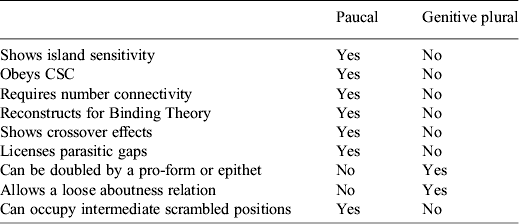
To conclude, we have examined arguments from a number of quarters that show a systematic difference between left dislocated paucal nominals and genitive plural nominals which strand a low numeral. These differences are summarized in Table 1.
Syntactic properties of paucal vs. genitive plural forms appearing at the left edge of a clause.

The directionality and systematicity of these diagnostics confirm that the paucal form stranding a numeral is derived with movement, while the genitive plural form is base-generated. Hence, our initial proposal, repeated below, is validated.
(60) For lower numerals, the left dislocated nominal has undergone movement when there is number connectivity (paucal) and it is HTLD when there is no connectivity (genitive plural).
(61) Lower numerals
(a) Left Dislocation with number connectivity: movement
Sobor-a v gorodke bylo tri sobor-a.
cathedral-pauc in town was three
(b) Left Dislocation without number connectivity: HTLD
Sobor-ov v gorodke bylo tri pro.
cathedral-gen.pl in town was three
‘As for cathedrals, there were three in that town.’
Thus, Russian, like a number of other languages, shows a difference between base-generated and scrambled left dislocated elements, and this difference has a very clear morphological exponent in some contexts. Syntactically, the difference between these two constructions mirrors differences observed in other languages.
The minimal surface difference in (61) above also makes this Russian contrast a promising object for a processing study. In particular, these constructions are suitable for testing the processing hypothesis in (3c), repeated here:
(62) The construction of syntactic coconstruals requires less effort than the construction of discourse coconstruals.
4. Experimental evidence: Self-paced reading
The minimal morphosyntactic differences between the scrambling and HTLD constructions analyzed in Section 3 above provide an ideal testing ground for the relative processing ease of different coconstruals. What we will see from the self-paced reading study is that the movement construction is indeed processed more quickly than the base-generated HTLD construction. We attribute this difference to the coconstrual type. As predicted, discourse coconstruals are processed more slowly than syntactic coconstruals. We reject an alternative explanation according to which the mismatch in number connectivity is the source of the increased processing load.
4.1 Materials
We conducted a self-paced reading study of Russian sentences contrasting examples such as the following pair, repeated from (9) above:
- (63)
(a) Scrambled topic
Sobor-a v gorodke bylo tri sobor-a.
cathedral-pauc in town was three
(b) Base-generated topic
Sobor-ov v gorodke bylo tri pro.
cathedral-gen.pl in town was three
‘As for cathedrals, there were three in that town.’
Sentences were embedded under an introductory sequence so that the paucal/plural word appeared as the fourth word (W4) in reading. The material preceding this word (W1–W3) consisted of the matrix subject, predicate and complementizer (note that embedded clauses introduced by ‘that’ in Russian have room for topics, which is very helpful because that allows us to move the first target word away from the beginning of the sentence read in the experiment). The target nominal was separated by the numeral at W9 by four words, and the spillover after the numeral included at least four more words (W10–W14). Thus:
(64) Maša skazala, čto sobor-a/ov zdes′ snačala sobiralis′
Masha said that cathedral-pauc/gen.pl here at.first intended
W1 W2 W3 W4 W5 W6 W7
postroit′ dva, no potom ne xvatilo sredstv.
to.build two but then not sufficed means
W8 W9 W10 W11 W12 W13 W14
‘Masha said that at first they were planning to build two cathedrals here but
then they ran out money.’
The data were presented in Cyrillic, and the stimuli maintained the Russian punctuation (see the commas in (64)). In choosing the nouns for comparison, we used only masculine inanimates in an effort to minimize the number of morphological variables; the restriction to masculine inanimates allowed us to use numerical expressions in both the nominative and in the accusative case (these forms are homophonous for masculine inanimates), and our stimuli had a roughly equal number of nominative and accusative forms. Based on the Russian National Corpus http://ruscorpora.ru/index.html, we selected the most common nouns that appeared in both paucal and genitive plural. The noun choice was further narrowed down in such a way that each noun occurred a comparable number of times in the phonological forms corresponding to the paucal form and to the genitive plural. We excluded nouns which occurred mostly in one form or the other.
We would like to note that, as far as the corpus data are concerned, the use of genitives (singular or plural) with numerals is quite rare. The most common context in which both types of genitives occur is that of adnominal genitive or the genitive of possession (about 70% of all occurrences), followed by the complement of a preposition such as do ‘toward’, iz ‘out of’, etc. (about 20% of corpus occurrences), and the genitive of negation (about 4% of occurrences). This means that the appearance of either form at the beginning of a sentence does not immediately prime the reader to expect a numerical expression; even more importantly, there is no difference between the paucal (genitive singular) and genitive plural form in terms of the expectation of a particular numeral.
The stimuli were normed by 27 naive native speakers of Russian who were asked to rate them on a 1–5 scale (these normers did not participate in the experiment). All stimuli with average ratings below 3.5 were excluded. Crucially, there was no difference in rating between the stimuli with a scrambled topic (as in (63a) above) and ones with a base-generated topic (as in (63b)). We used 24 pairs of stimuli accompanied by 36 grammatical fillers of comparable length. The stimuli (with norming ratings) are presented in Appendix A.
Each sentence was followed up by a comprehension question. The self-paced reading experiment was conducted using the platform LINGER (http://tedlab.mit.edu/~dr/Linger/), with a high sensitivity keyboard. Subjects were tested in a quiet room.
4.2 Subjects
We tested 37 subjects. Out of these, eight subjects were below the 85% threshold of correct answers on the comprehension questions and were therefore excluded from the analysis. This left us with 29 subjects, average age 26.6 years, all right-handed, 17 females.
4.3 Results
Self-paced reading times were analyzed using linear mixed models with random intercepts for subjects and items and log(raw reading time) as the dependent variable. Tokens more than two standard deviations away from the mean raw reading time of all subjects were excluded from the analysis (89 tokens, 2.1%). Reading time was predicted using the contrast between paucal (scrambled topic) and genitive plural (base-generated topic).
Individual models were fitted for log(residual reading time) of the right edge of the left dislocated nominal (W4), the intervening material (W5–W8), the numeral (critical word = W9), and the spill-over region (W10 and W11). The reason for including a two-word spillover region is that in self-paced reading, it is common for effects – especially stronger ones – to be delayed by a word or to spread over onto later regions (Ueno & Garnsey, Reference Ueno and Garnsey2008: 665; Xiang et al. Reference Xiang, Harizanov, Polinsky and Kravtchenko2011; Polinsky et al. Reference Polinsky, Gomez-Gallo, Graff and Kravtchenko2012). Such a delay is particularly relevant for highly literate readers who go through words very quickly in a self-paced reading paradigm, so that effects are often delayed one or two words (Mitchell Reference Mitchell, Kieras and Just1984, Reference Mitchell, Carreiras and Clifton2004). Additionally, in the case of our stimuli, the possibility of a delay is particularly likely because the critical word (W9) is very short (between three and six letters) and the next word (W10) is also extremely short (between two and four letters).
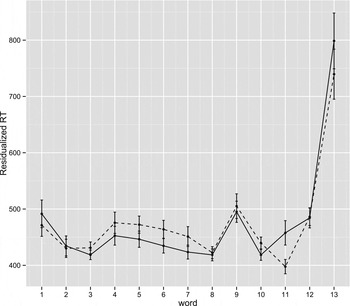
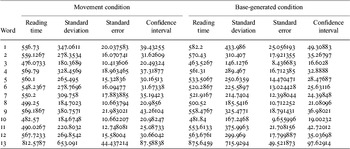
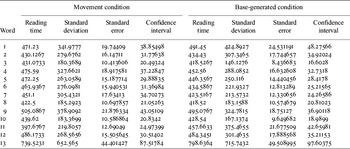
Average word-by-word residualized reading times are shown in Figure 1, with the full data in Appendix B.
Word-by-word reading times (in ms) for hanging topic constructions with scrambling and base generation (29 subjects).Dotted line: scrambling (paucal condition); solid line: base generation (genitive plural condition).

At the left dislocated nominal (W4), there was no statistically significant difference in reading times between the two case forms (β = − 23.44, t = 0.979, p = .32). This lack of effect confirms that our efforts to equalize the frequency of the two case forms were successful. The lack of effect at W4 also suggests that the parser cannot anticipate the remainder of the sentence based on the case form. The differences in the W5–W8 regions were also not significant (W5: β = − 25.25, t = − 1.2, p = .19; W6: β = − 28.27, t = − 1.50, p = .13; W7: β = − 27.2, t = − 1.37, p = .17; W8: β = − 5.567, t = − 0.42, p = .72). At the numeral (W9), there was again no difference between the two conditions (β = − 10.83, t = − 0.41, p = .68).Footnote 19 We also computed aggregate statistics over the W4–9 regions (testing the possibility that this is the region of the active search which can be visible from the aggregate reading times), and the difference was again not significant (β = − 123.71, t = − 1.70, p = .09). Likewise, there was no difference in reading time between nominative and accusative forms of the numerical expressions.
At the first spillover word (W10) there was no effect (β = − 25.53, t = − 2.05, p = .14), which is probably due to the fact that it was very short (two or three letters). At the second spillover word (W11), there was a strong effect of the case difference (β = 46.54, t = − 2.19, p = .0248), with the genitive plural (base-generated) condition being read much more slowly than the paucal (movement) condition. The effect did not continue after W11.
4.4 Discussion
We attribute the slower processing in the HTLD case to the discourse coconstrual involved, in contrast to the syntactic coconstrual in the scrambling case. Thus, our initial hypothesis is confirmed. However, before accepting our conclusion regarding processing differences between the two left dislocation strategies, it is important to consider alternative explanations of the increased reading time for HTLD over movement. We are grateful to the anonymous JL referees for suggesting a number of these possibilities.
4.4.1 Morphological mismatch
Our results may have a morphological explanation, namely, that the base-generation condition represents a morphological mismatch, which causes increased reading times. Once the reader reaches the numeral ‘two’, ‘three’ or ‘four’, s/he realizes that s/he needs the paucal form of the nominal but instead has the genitive plural. This mismatch causes the slowdown reported above.
The effects of morphological mismatches on processing have been noted by a number of studies (see Molinaro, Barber & Carreiras Reference Molinaro, Barber and Carreiras2011 for a summary of the ERP literature on agreement mismatches). Hartsuiker et al. (Reference Harstuiker, Schriefers, Bock and Kikstra2003) and Wagers, Lau & Phillips (Reference Wagers, Lau and Phillips2009), among others, document slowdowns in behavioral measures for subject–verb agreement mismatches in person, number, and/or gender; Fanselow & Frisch (Reference Fanselow, Frisch, Fanselow, Féry, Schlesewsky and Vogel2006) document effects of disagreement in number within German discontinuous nominals. An explanation according to which a morphological mismatch causes a slowdown would make our own explanation superfluous. At present, however, we do not know enough about the effect of morphological mismatches on processing. Our understanding of how morphological mismatches influence processing is insufficient to clearly connect the two. Further experimentation is needed to determine whether mismatches result in processing difficulty independent of grammaticality.
We will nevertheless suggest that acceptability ratings speak against a mismatch explanation for our data. Recall that our normers rated all the sentences as comparable, and we did not include any sentences rated lower than 3.5 on a five-point scale. That is, despite the apparent mismatch, the sentences are in fact grammatical. This is different from the agreement mismatch data reported in the above studies, where the mismatch results in significantly lower acceptability ratings (see particularly Fanselow & Frisch Reference Fanselow, Frisch, Fanselow, Féry, Schlesewsky and Vogel2006 for German).Footnote 20
4.4.2 Frequency effects
It is possible that the movement construction may be processed more quickly if the movement construction is more frequent in the language than the HTLD construction. Corpus data indicate that this is not the case. We took the first 100 cases from the Russian National Corpus (http://www.ruscorpora.ru/index.html) of a fronted genitive corresponding to a post-numeral context. Of these, 80% contained a fronted genitive plural while only 20% contained a fronted paucal. Thus, the base-generated construction is four times more frequent, and yet it causes a larger slowdown in reading. A frequency-based explanation is thus not supported.
4.4.3 Syntactic indeterminacy
A third possibility is that the fronted genitive plural element might be more difficult to process because it introduces a higher degree of syntactic indeterminacy compared to the fronted paucal. The logic is as follows. When the reader encounters an initial genitive plural, this DP is compatible with a gap following ‘many’, ‘few’, and all the numerals. Thus, few expectations/predictions are made about the following material. On the other hand, when the reader encounters an initial paucal element, this DP is compatible with a gap following only the handful of numbers that select the paucal (‘one-and-a-half’, ‘two’, ‘three’, ‘four’, and ‘both’). The reader thus has a high expectation of what will follow with a low amount of syntactic indeterminacy.
A number of recent studies have shown that linguistic material that creates an early structural or lexical expectation facilitates the processing of later material. For example, preverbal adverbs indicating that a verb is about to arrive cause faster verb reading (see Boston et al. Reference Boston, Hale, Vasishth and Kliegl2011 for English and German, Vasishth Reference Vasishth2003 for Hindi); pronouns in those environments that make cataphora likely facilitate the subsequent processing of a name (see van Gompel & Liversedge Reference van Gompel and Liversedge2003 for English); and contexts where a possessor predicts a following noun yield faster or stronger early detection of syntactic anomalies than contexts where the same possessor does not predict a following noun (see Lau et al. Reference Lau, Stroud, Plesch and Phillips2006).
With respect to the contrast discussed in this paper, the specific hypothesis is that the gap associated with a genitive plural leads to greater uncertainty and does not allow the parser to make an early commitment to an interpretation as compared to the gap corresponding to a paucal fronted element. The greater uncertainty brought about by the gap associated with a genitive plural translates into heavier processing costs.
A consideration of the full distribution of fronted genitive phrases in the language suggests to us that this is not the right way to look at things. Recall that the paucal form is usually homophonous with the genitive singular. Genitives, both singular and plural, participate in numerous constructions beyond the context where they strand a numeral. Bailyn (Reference Bailyn2012: 199–205) discusses a number of such uses:
(65) Contexts in which the genitive can appear
(a) adnominal genitive
(b) genitive of negation
(c) quantificational genitive (with words like ‘many’, ‘few’, and numerals)
(d) complement of a preposition
(e) complement of an intensional predicate
(f) partitive genitive
Genitives can be fronted with all of these constructions with the majority of cases involving (65a, b), adnominal genitives and the genitive of negation. Table 2 shows a count from the Russian National Corpus of the statistical distribution of fronted genitives according to these contexts.
Statistical distribution of fronted genitives by context (Russian National Corpus).

The data indicate that fronted genitive singular and plural occur with about equal frequency overall (2117 tokens versus 2448 tokens). The data also indicate that the lion's share of these fronted genitives do not involve a stranded numeral: 97–98% involve a fronted adnominal genitive or a fronted genitive of negation, and only 2–3% involve other uses, which subsume the uses in (65c–f) above, including the stranded numeral case. Thus, the number of tokens involving fronted genitives stranding a numeral is extremely small in the context of all constructions with a fronted genitive. In the larger context of the Russian grammar then, the low syntactic indeterminacy of a fronted paucal in the stranded numeral construction is completely overshadowed by the other uses, as the appearance of left dislocated genitive form is not giving the reader an expectation of a later numeral – lower or higher. Given this, the indeterminacy of expectations is about the same for both forms and is an unlikely explanation for the results we report.
4.4.4 Information structure
Finally, the results may be a consequence of information structure. The two constructions may have different discourse functions, and the HTLD construction may be more difficult to process in the context-less, out-of-the-blue environments given to our subjects (as compared to the movement construction). Embedding the data in appropriate discourses might eliminate the difference. Two considerations argue against this proposal. First, we were unable to see any information-structural difference between the two constructions tested. Both signal a topic. Although Sturgeon (Reference Sturgeon2008) discusses differences between the two constructions concerning contrastiveness in Czech (see footnote 7 above), we do not know if the same differences exist in Russian, and our test sentences did not invite a contrastive interpretation. Second, grammaticality judgments also did not indicate that the HTLD construction was degraded without a discourse context.
5. Conclusions
In this paper we analyzed a contrast in Russian between two constructions with a clause-initial nominal and a stranded paucal numeral. In one, the nominal appears in a non-agreeing (plural) form; in the other, the nominal shows number connectivity (paucal) with a gap following the numeral:
- (66)
(a) cathedral-plural, there were three.paucal pro
(b) cathedral-paucal, there were three.paucal __
We have shown, using numerous syntactic diagnostics, that in the absence of connectivity, the construction involves a hanging topic related via discourse mechanisms to a base-generated null pronoun. Under number connectivity, the nominal has been fronted via A′-movement, creating a syntactic dependency. Thus, the two constructions constitute an excellent syntactic minimal pair.
We used the Russian contrast to test the hypothesis that syntactic dependencies require less processing effort than discourse-derived dependencies do (Reuland Reference Reuland2001, Reference Reuland2011; Koornneef Reference Koornneef2008), in particular, that movement is less burdensome for processing than pronominalization (see also Hornstein Reference Hornstein2001). We conducted a self-paced reading study using sentences that instantiate the contrast in (66) and found a statistically significant slowdown after the gap in constructions with the hanging topic as opposed to the moved nominal. This supports the claim that a syntactic A′-chain is more easily processed than an anaphoric dependency involving a null pronoun; the latter must be resolved by discourse-based mechanisms which require relatively more resources.
APPENDIX A
Stimuli
The number following each stimulus indicates its rating based on a 1–5 norming scale as determined by an assessment provided by native speaker normers. The English translations are intended to convey the general meaning of the sentences and should not be taken as literal translations.
- (A1)
(a) Экскурсовод рассказал, что музея здесь должны были построить три но средств не хватило.3.78
(b) Экскурсовод рассказал, что музеев здесь должны были построить три но средств не хватило.3.67
‘The tour guide said that they had been planning to build three museums, but they ran out of money.’
- (A2)
(a) Мы же решили, что шара на детском празднике должно быть три, а ты принес один.4.07
(b) Мы же решили, что шаров на детском празднике должно быть три, а ты принес один.3.92
‘We had agreed on having three helium balloons at the children's party, but you only brought one.’
- (A3)
(a) Маша считает, что парка в этом районе может быть два или возможно даже больше.3.72
(b) Маша считает, что парков в этом районе может быть два или возможно даже больше.3.66
‘Masha thinks that there may be two or even more parks in this neighborhood.’
- (A4)
(a) Дед рассказывал, что острова в этом море могло быть три, но нашли пока только два.3.75
(b) Дед рассказывал, что островов в этом море могло быть три, но нашли пока только два.3.84
‘Grandfather was saying that there could be three islands in this sea, but so far only two have been discovered.’
- (A5)
(a) Дима утверждает, что способа решения задачи должно быть два, но я вижу только один.3.56
(b) Дима утверждает, что способов решения задачи должно быть два, но я вижу только один.3.73
‘Dima asserts that there should be two ways to solve this problem, but I only see one solution.’
- (A6)
(a) Меня удивило, что слога в каждом слове оказалось всего три, мне послышалось четыре.4.07
(b) Меня удивило, что слогов в каждом слове оказалось всего три, мне послышалось четыре.3.80
‘I was surprised that there were only three syllables in this word because I had counted four.’
- (A7)
(a) В учебнике написано, что дворца у этого царя было всего два, один летний, другой теплый.3.66
(b) В учебнике написано, что дворцов у этого царя было всего два, один летний, другой теплый.3.78
‘According to the textbook, this king had only two palaces, a summer one and a winter one.’
- (A8)
(a) Я-то думал, что парохода по Каме всегда плавало только два, но здесь написано пять.4.12
(b) Я-то думал, что пароходов по Каме всегда плавало только два, но здесь написано пять.3.93
‘I used to think that there were only two steamships sailing on the Kama river, but it says here that there were five of them.’
- (A9)
(a) Я не подозревала, что гастронома на этой остановке окажется целых четыре, ведь здесь немноголюдно.4.06
(b) Я не подозревала, что гастрономов на этой остановке окажется целых четыре, ведь здесь немноголюдно.3.89
‘I had no idea that there were four grocery stores at this stop, it does not seem like a very populous place.’
- (A10)
(a) Миша боялся, что рюкзака у них дома окажется всего два, вот он и принес свой, проверенный.4.11
(b) Миша боялся, что рюкзаков у них дома окажется всего два, вот он и принес свой, проверенный.3.93
‘Misha was worried that they might have only two backpacks at home, so he brought his own time-tested backpack.’
- (A11)
(a) Мама говорит, что апельсина у нас дома осталось только три, так что купи еще килограмм.4.17
(b) Мама говорит, что апельсинов у нас дома осталось только три, так что купи еще килограмм.4.20
‘Mother says that we only have three oranges left, so buy a kilo of oranges.’
- (A12)
(a) В рецепте сказано, что банана в эти оладьи надо положить два, но я положила один.3.89
(b) В рецепте сказано, что бананов в эти оладьи надо положить два, но я положила один.3.93
‘According to the recipe, these pancakes require two bananas, but I used just one.’
- (A13)
(a) Учительница написала, что театра в этом году мы посетим два, но пока неизвестно, когда.3.69
(b) Учительница написала, что театров в этом году мы посетим два, но пока неизвестно, когда.3.84
‘The teacher wrote that we were going to visit two theaters this year, but the time of the trips remained to be determined.’
- (A14)
(a) Нина обещала, что стакана она вечером принесет еще три, так что посуды хватит.3.72
(b) Нина обещала, что стаканов она вечером принесет еще три, так что посуды хватит.3.86
‘Nina promised to bring three more glasses tonight, so we will have enough glassware.’
- (A15)
(a) Мне кажется, что батона на вечер надо купить всего два, потому что хлеба много.3.91
(b) Мне кажется, что батонов на вечер надо купить всего два, потому что хлеба много.4.03
‘I think we only need to buy two baguettes for tonight because we already have plenty of bread.’
- (A16)
(a) У Молоховец написано, что ножа с этой стороны полагается класть три, а поперек еще один.3.63
(b) У Молоховец написано, что ножей с этой стороны полагается класть три, а поперек еще один.3.81
‘According to the Molokhovets cookbook, there should be three knives on this side of the plate, and one more across the plate.’
- (A17)
(a) Доктор сказал, что пирожка больному ребенку можно дать два, в крайнем случае три.4.07
(b) Доктор сказал, что пирожков больному ребенку можно дать два, в крайнем случае три.3.85
‘The doctor said that the sick child could have two, at most three buns.’
- (A18)
(a) Рыболов хвастался, что карпа ему вчера удалось поймать три, а щуку пока одну.3.64
(b) Рыболов хвастался, что карпов ему вчера удалось поймать три, а щуку пока одну.3.81
‘The fisherman was boasting that he had managed to catch three carps and one pike.’
- (A19)
(a) Дима сетовал, что рыжика он пока нашел только два, а уже пора идти домой.3.78
(b) Дима сетовал, что рыжиков он пока нашел только два, а уже пора идти домой.3.86
‘Dima was complaining that he had found only two milky cap mushrooms, and it was already time to go home.’
- (A20)
(a) Старик расстроился, что подвигa рыбка может совершить всего два, ему хотелось больше.3.69
(b) Старик расстроился, что подвигов рыбка может совершить всего два, ему хотелось больше.3.73
‘The old man was disappointed that the magic fish could only work two miracles; he wanted to see more.’
- (A21)
(a) Мне рассказывали, что перехода здесь собирались прорыть еще три, но не хватило денег.3.97
(b) Мне рассказывали, что переходов здесь собирались прорыть еще три, но не хватило денег.4.03
‘I was told that they had been planning to have three underground walkways here, but there was not enough money for their construction.’
- (A22)
(a) На митинге кричали, что закона новая власть опубликовала уже четыре, а исполнять их некому.3.67
(b) На митинге кричали, что законов новая власть опубликовала уже четыре, а исполнять их некому.3.74
‘At the demonstration, they were shouting that the new administration had already issued four decrees, but nobody was implementing them.’
- (A23)
(a) Мне кажется, что дивана в этот салон надо поставить два, один у стены, другой посередине.4.10
(b) Мне кажется, что диванов в этот салон надо поставить два, один у стены, другой посередине.3.96
‘I think that there should be two couches in this living room, one by the wall, and the other in the middle of the room.’
- (A24)
(a) Ходили слухи, что дома у нее еще до войны было три, а не один, как ты говоришь.3.71
(b) Ходили слухи, что домов у нее еще до войны было три, а не один, как ты говоришь.3.98
‘There were rumors that she used to own three houses before the war, not just one, like you are claiming.’
APPENDIX B
Reading time data
Raw reading times by word, averaged in ms.

Residualized reading times by word, averaged in ms.