One of the most effective ways to mitigate the effects of a disaster is through proper household emergency preparedness.Reference Falkiner 1 , Reference Keim 2 Official recommendations from the American Red Cross (ARC), the US Federal Emergency Management Agency (FEMA), and the US Department of Homeland Security (DHS) call for the assembly of a disaster preparedness kit containing essential supplies such as food, water, and prescription medications in sufficient quantities for 3 days for each member of the household, as well as having an established disaster plan. Despite these recommendations, only 25% of US households currently adhere to the minimum ARC, FEMA, and DHS preparedness guidelines, including a 3-day supply of food, water, and medication and a written household evacuation plan.Reference DeBastiani and Strine 3
Social, economic, and demographic characteristics influence the likelihood that an individual or household has sufficiently prepared for a disaster. Older age and higher education and income are associated with increased emergency preparedness in US and international samples.Reference Ablah, Konda and Kelley 4 - Reference Norris, Smith and Kaniasty 10 Higher socioeconomic status variables (eg, higher income, home ownership) have been consistently associated with completion of disaster preparedness tasks such as storing food, water, or first-aid supplies.Reference Ablah, Konda and Kelley 4 , Reference Edwards 6 , Reference Mishra and Suar 8 - Reference Norris, Smith and Kaniasty 10 In multiple large studies, racial/ethnic minority status was associated with lower scores on multi-item scales assessing possession of specific disaster items.Reference Edwards 6 , Reference Eisenman, Zhou and Ong 7 , Reference Murphy, Cody and Frank 9 , Reference Smith and Notaro 11 Whereas minorities tend to be less prepared before a disaster, these groups may demonstrate greater increases in preparedness after an event.Reference Norris, Smith and Kaniasty 10 , Reference Eisenman, Wold and Fielding 12 , Reference Page, Rubin and Amlot 13 Other studies have noted that having medical vulnerabilities such as disabilities and chronic medical conditions correlates with a lack of disaster preparedness. Persons with disabilities are less likely to have emergency supplies on hand and to evacuate following a mandatory evacuation order.Reference Smith and Notaro 11 , Reference Bethel, Foreman and Burke 14 Similarly, persons with perceived poor general health are less prepared for disasters and are less likely to have an emergency communication plan than are those who perceive their health as being excellent.Reference Eisenman, Zhou and Ong 7 , Reference Bethel, Foreman and Burke 14 , Reference Edwards 15 Strine et al found that people with inadequate social and emotional support are less likely to be prepared.Reference Strine, Neff and Crawford 16 Studies have also found that persons with serious mental illness or frequent mental distress are less likely to be prepared.Reference Eisenman, Zhou and Ong 7 , Reference Strine, Neff and Crawford 16
The present study examined whether prior trauma affects personal preparedness for future disasters. In the literature, the association between prior disaster experience and preparedness is not clearly established. Some studies show a correlation between prior disaster experience and increased preparedness.Reference Mishra and Suar 8 , Reference Boscarino, Adams and Figley 17 - Reference Sattler, Kaiser and Hittner 20 Intensity of exposure to the September 11, 2001 (9/11), World Trade Center attack as well as greater lifetime exposure to traumatic events were both shown to be predictive of greater personal preparedness in a random sample of New York City adults.Reference Boscarino, Adams and Figley 17 However, other studies showed no difference in preparedness after a major disaster.Reference Chen, Banerjee and Liu 21 - Reference Rincon, Linares and Greenberg 23 As part of the 2009 National Hurricane Survival Initiative, a survey found that 66% of people living in Atlantic and Gulf Coast states, areas with hurricane exposure, had no hurricane survival kit and 55% had no family disaster plan.Reference Morgan 22 There are several proposed explanations for this finding. First, this may be attributed to a ceiling effect of an already high level of preparedness among the population.Reference Chen, Banerjee and Liu 21 Second, having experienced previous disasters may create an optimistic bias, where individuals minimize the need for extensive preparation.Reference Sattler, Kaiser and Hittner 20 In addition, when each preparedness task (eg, planning, stockpiling) received separate consideration, experience was not clearly related to both types of preparedness actions.Reference Page, Rubin and Amlot 13 , Reference Farley 24 After the 2005 London subway bombings, Page et al found that emergency planning increased from 51% to 90%, but the number of respondents who gathered emergency supplies before and after the event did not increase.Reference Page, Rubin and Amlot 13
Disaster survivors who experience higher levels of property loss and psychological distress may be more attentive to news reports and have a better understanding of the destructive consequences of disasters and therefore be more prepared.Reference Sattler, Kaiser and Hittner 20 , Reference Greenberg, Dyen and Elliott 25 - Reference Meyer 27 Sattler et al found that among participants with hurricane experience, distress as a result of the hurricane accounted for a significant portion of preparation variance.Reference Sattler, Kaiser and Hittner 20 Another study found that people with stronger negative memories of past disasters engaged in more disaster preparedness.Reference Greenberg, Dyen and Elliott 25 Preparedness for earthquakes and hurricanes has been associated with the amount and cost of damage experienced during a previous disaster.Reference Heller, Alexander and Gatz 26 , Reference Meyer 27 Nevertheless, few studies have assessed the ability of individuals seriously affected by one disaster to prepare for subsequent events.
On October 29, 2012, Hurricane Sandy struck a heavily populated area of the northeastern United States. It was the largest and second costliest hurricane in US history, and resulted in numerous deaths and an estimated $50 to $65 billion in damages. 28 , Reference Blake, Kimberlain, Berg, Cangialosi and Beven 29 Sandy occurred 11 years after the terrorist attacks of 9/11, which killed nearly 3000 people, injured thousands more, and had profound effects on the psychological status of area residents.Reference Brackbill, Hadler and DiGrande 30 , 31 Hurricane Sandy thus subjected thousands of people to a second life-threatening disaster in a relatively short period of time. It also occurred shortly after the World Trade Center Health Registry’s (Registry) completion of a follow-up health survey of over 43,000 enrollees in an ongoing cohort study of 9/11 responders and survivors, over 60% of whom resided in the New York City area. This provided the opportunity to study the effects of Hurricane Sandy in a population with well-documented exposure to a prior disaster.
In the present study, we used data from the Registry to assess, in a population with prior exposure to the 9/11 disaster which had well-recognized, serious health and life consequences, the subsequent level of preparedness for a new disaster (Hurricane Sandy). In addition, we examined (1) the impact of 9/11-related post-traumatic stress disorder (PTSD) on a person’s ability to prepare, (2) the role of social support in preparedness among people exposed to 9/11, and (3) the relationship between preparedness and knowledge of evacuation zones for Hurricane Sandy.
Methods
Data Source
The Registry, a longitudinal cohort study of 71,431 people exposed to the 9/11 disaster in New York City, provided the sampling pool for this study. Details on recruitment methods and Registry findings have been published elsewhere.Reference Brackbill, Hadler and DiGrande 30 , Reference Farfel, DiGrande and Brackbill 32 Briefly, Registry enrollees belong to 1 or more of 5 eligibility groups: rescue/recovery workers and volunteers; lower Manhattan residents; area workers; passersby; and schoolchildren and staff. There were 2 modes of enrollment into the Registry: list-identified enrollees (30%) were actively recruited from lists provided by governmental agencies, organizations, and employers, whereas self-identified enrollees (70%) contacted the Registry via phone or pre-registered on a website in response to intensive outreach efforts.Reference Farfel, DiGrande and Brackbill 32 The Wave 1 baseline survey (2003–2004) included 68,805 adults and elicited information on 9/11-related exposures and indicators of physical and mental health.Reference Farfel, DiGrande and Brackbill 32 The Wave 2 (2006–2007) and Wave 3 (2011-2012) surveys obtained additional information on 9/11-related exposures and provided an update on health status (46,602 [68%] for Wave 2 and 43,134 [63%] for Wave 3 of the original adult enrollees).Reference Brackbill, Hadler and DiGrande 30 Since Hurricane Sandy occurred shortly after completion of the third wave of Registry data collection, selection for the Sandy substudy was restricted to those enrollees who had completed the Wave 3 survey and resided in the tri-state area (New York, New Jersey, and Connecticut). Approximately 5 months after Hurricane Sandy (March 2013), selected enrollees were contacted via mail or e-mail with a letter that described the study and invited their participation.Reference Brackbill, Caramanica and Maliniak 33 Those with valid e-mail addresses were invited to participate in a web survey (n=7367). Three weeks after the launch of the web-based portion of data collection, paper surveys were mailed to study subjects who did not have a valid e-mail address (n=1503) or who did not complete the web-based survey. Multiple mail and e-mail reminders were sent to nonrespondents, as well as multiple rounds of paper questionnaires. At the close of data collection (November 2013), 4558 surveys had been completed (51.4% response rate). The study protocol was approved by the New York City Department of Health and Mental Hygiene’s Institutional Review Board.
Study Sample
The study sample included all 4558 people who submitted surveys except the 62 people with incomplete information on Hurricane Sandy preparedness, resulting in a final sample size of 4496.
Dependent Variable
The study outcome was derived from responses to the following question, “Which of the following did your household have prepared before Sandy happened? Don’t include things you did during or after the storm.” Similar to a previous report, respondents were deemed to be “prepared” if they had no less than 1 item missing of the 8 preparedness action items.Reference Ablah, Konda and Kelley 4 This definition was chosen among different possible options because being prepared is an ongoing process, rather than a destination.Reference Subbarao, Lyznicki and Hsu 34 Allowing for one missing item on the preparedness checklist acknowledged the reality of preparedness as a process and the ambiguity inherent in the lack of a universal definition of preparedness, while also allowing those clearly in the process of becoming prepared to be included among the prepared. This methodology also allowed us to refrain from attempting to define an interval measure for preparedness derived from weighting the relative importance of the 8 disparate preparedness checklist items to overall preparedness.Reference Ablah, Konda and Kelley 4 The 8 preparedness checklist items were as follows:
-
∙ Supply of food
-
∙ Three-day supply of water
-
∙ First aid kit
-
∙ Battery-operated radio
-
∙ Needed medications
-
∙ Flashlight
-
∙ Personal care and hygiene items (eg, toothpaste, diapers, and toilet paper)
-
∙ Evacuation plan
Demographic Variables
Ethnic and racial groups were categorized as Hispanic, white non-Hispanic, black non-Hispanic, Asian, and other. Age at the time of the Hurricane Sandy survey was categorized as 18 to 44 years, 45 to 64 years, and 65 years or older. Annual household income in 2010 was categorized as less than or equal to $75,000 and greater than $75,000.
Medical Factors
Individuals with medical conditions may be more vulnerable during disasters because of their dependence on prescription medications, potential need for additional medical attention at a shelter, potential reliance on electricity for medical equipment or refrigeration of medications, or their hindered mobility, which may make complying with evacuation orders difficult. Victims displaced by Hurricane Katrina frequently required acute or preventive medical care at shelters, including prescription medications and durable medical goods.Reference Currier, King and Wofford 35 , Reference Jenkins, McCarthy and Kelen 36 Self-reported physician-diagnosed asthma, diabetes, and coronary heart disease at Wave 3 were therefore included as medical risk factors in the analysis.Reference Currier, King and Wofford 35 - Reference Torabi and Seo 38
9/11-Related Post-Traumatic Stress Disorder
Probable PTSD was assessed at Wave 3 by using the PTSD Checklist-Civilian Version (PCL). The PCL is a self-reported, 17-item scale corresponding to the criteria in the Diagnostic and Statistical Manual of Mental Disorders, 4th edition (DSM-IV),Reference Blanchard, Jones-Alexander and Buckley 39 , Reference Ruggiero, Del Ben and Scotti 40 that is commonly used in epidemiologic research. Selected symptoms were queried as specific to 9/11 and all were current (within the past 30 days). Psychometric properties of the PCL used in this manner in other settings and with other traumatized populations have reported sensitivity ranging from 0.94 to 0.97, specificity from 0.86 to 0.99, positive predictive value from 0.70 to 0.97, and diagnostic efficiency from 0.83 to 0.96.Reference Blanchard, Jones-Alexander and Buckley 39 - Reference Ventureyra, Yao and Cottraux 41 Because studies have shown that the diagnostic efficiency of the PCL is improved when using a cutoff of 44 as opposed to 50,Reference Blanchard, Jones-Alexander and Buckley 39 in this study, as in previous Registry studies,Reference Brackbill, Hadler and DiGrande 30 , Reference Farfel, DiGrande and Brackbill 32 , Reference Debchoudhury, Welch and Fairclough 42 , Reference Welch, Caramanica and Maslow 43 enrollees with a PCL score of 44 or greater at Wave 3 were considered to have probable PTSD.
Social Support
An index of social support was created by summing 5 Wave 3 items that pertain to perceived or received support, including how often someone is available to take the respondent to the doctor, have a good time with them, hug them, prepare meals if they are unable to do it themselves, and understand their problems. The five items were scored on a scale of 0 (none of the time) to 4 (all of the time). Items were summed with the total index ranging from 0 to 20. Scores were classified as low or no social support (0-6), medium (7-11), high (12-15), and very high social support (16-20). This social support scale has been used in previous Registry studies and is a strong predictor of unmet mental health care need.Reference Ghuman, Brackbill and Stellman 44
9/11 Exposure
Exposure to 9/11 was defined with a 12-item summary measure used in previous Registry reportsReference Brackbill, Stellman and Perlman 45 that is modeled after work by Adams et al.Reference Adams, Boscarino and Galea 46 On the basis of the score distribution, exposure was categorized as none/low (0–1 experiences), medium (2–3), high (4–5), and very high (6 or more). This scale covers several dimensions of 9/11-related exposure, and each item has been shown to be associated with physical or mental health outcomes in previous Registry studies.Reference Brackbill, Hadler and DiGrande 30 , Reference Farfel, DiGrande and Brackbill 32
Knowledge of Evacuation Zone
The Hurricane Sandy survey queried whether participants knew if they lived in an evacuation zone prior to Sandy. These zones are part of New York City’s hurricane contingency plan and are areas of the city that may be inundated by storm surge or isolated by storm surge waters. 47 There are 6 zones of varying levels of likelihood of inundation, which can be identified for a given address with a single web query. Response options were, “Yes, I knew I lived in an evacuation zone,” “Yes, I knew I did not live in an evacuation zone,” and “No, I did not know whether I lived in an evacuation zone.”
Statistical Analysis
Univariate analysis was conducted to describe preparedness in the study population and demographic, medical, mental health, and 9/11 exposure factors. Cochran-Armitage tests were used to detect trends between social support and preparedness and 9/11-exposure category and preparedness in the full sample and when stratified by PTSD. Using logistic regression, unadjusted and adjusted odds ratios (aORs) were calculated to estimate the strength of the association between selected covariates and preparedness. According to the results of preliminary analyses, the adjustment variables were as follows: sex, age group, race/ethnicity, household income in 2010, asthma, diabetes, coronary heart disease, social support, 9/11 exposure, 9/11-related PTSD at Wave 3, and knowledge of evacuation zone. Previous Registry studies have shown that PTSD acts as a modifier in several 9/11-related health outcomes;Reference Welch, Caramanica and Maslow 43 , Reference Caramanica, Brackbill and Liao 48 - Reference Nair, Ekenga and Cone 50 therefore 9/11-related PTSD was examined as a potential modifier of the relationship between 9/11 exposure and preparedness. The final model assessed the association between 9/11 exposure and preparedness stratified by 9/11-related PTSD status. All analyses were conducted by using SAS 9.2 (Cary, NC).
Results
Respondent Characteristics
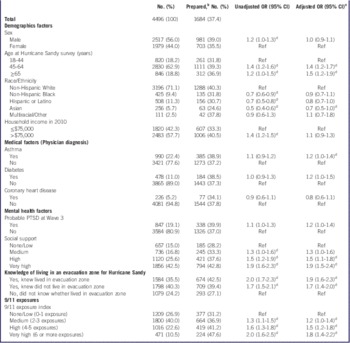
As shown in Table 1, the majority of the respondents were male (56.0%), 45 to 64 years of age (62.9%), non-Hispanic white (71.1%), and had a 2010 annual income of greater than $75,000 (57.7%). With respect to medical conditions, the highest proportion of respondents reported having asthma (22.4%). Less than one-fifth (19.1%) of respondents had probable PTSD at Wave 3. Only 15.0% reported having none/low social support. The majority knew whether they lived (35.5%) or did not live (40.3%) in an evacuation zone. Almost three-quarters (73.1%) had at least two 9/11 exposures, and 10.5% had very high 9/11 exposure (6 or more exposures).
Study Population and Association Between Disaster Preparedness and Selected Demographic Characteristics, Medical Factors, Mental Health Characteristics, and 9/11 ExposuresFootnote a

a Abbreviations: CI: confidence interval; OR, odds ratio; PTSD, post-traumatic stress disorder.
b Reported having at least 7 of 8 preparedness items.
c Adjusted for sex, age group, race/ethnicity, household income, asthma, diabetes, coronary heart disease, social support, World Trade Center exposure, PTSD, and knowledge of evacuation zone.
d P≤0.05.
On the basis of the study criteria, a total of 1684 respondents were considered “prepared” for the arrival of Hurricane Sandy (37.5%). A total of 845 respondents (18.8%) reported having all 8 preparedness items (Table 2). Only 4.8% reported that they did not prepare anything before the storm. A flashlight was the most commonly reported item (91.7%), followed by personal care and hygiene kits (80.5%) and nonperishable food or snacks (76.8%) (Table 3). The item that respondents were least likely to have prepared was an evacuation plan (30.2%).
Distribution of Total Preparedness Items in the Sample

Frequencies of Preparedness Items Checked

Factors Associated With Preparedness
Preparedness varied with race/ethnicity, from 24.6% of Asians to 40.3% of non-Hispanic whites (Table 1). Fewer respondents with an income of $75,000 or less were prepared (33.3%) compared to those with income of greater than $75,000 (40.5%). Of those with 9/11-related PTSD, 39.9% were prepared compared with 37.0% of those without PTSD. Only 28.2% of those with the lowest social support score were prepared compared to 42.8% in the group with the highest social support score. Those who knew they lived in an evacuation zone had the highest frequency of being prepared (42.5%) compared to 27.1% who did not know if they lived in an evacuation zone. Respondents with very high 9/11 exposure (6 or more exposures) had the largest frequency of preparedness (47.6%) compared to 31.2% of the respondents with none/low 9/11 exposure (0-1 exposure) (Table 1).
In unadjusted analyses, sex, age, race/ethnicity, income, social support, knowledge of living in an evacuation zone, and 9/11 exposure were all significantly associated with Hurricane Sandy preparedness (Table 1). In adjusted analyses, sex and income were no longer significant and only Asians compared to non-Hispanic whites were significantly less likely to be prepared. Of the medical factors, only asthma was significant in the adjusted model; those with asthma were 20% more likely to be prepared than were those without asthma (aOR: 1.2; 95% confidence interval [CI]: 1.0-1.4).
Compared to those who did not know whether they lived in an evacuation zone, those who knew they lived in an evacuation zone were almost twice as likely to be prepared (aOR: 1.9; 95% CI: 1.6-2.3); those who knew they did not live in an evacuation zone were also more likely to be prepared (aOR: 1.7; 95% CI: 1.4-2.0). 9/11-related PTSD was not significantly associated with preparedness in either the unadjusted or the adjusted analysis. There was a relationship between social support and Hurricane Sandy preparedness in the adjusted model (P<0.0001). Compared to those with none/low social support, those with high social support were 50% more likely to be prepared (aOR: 1.5; 95% CI: 1.1-1.8) and those with very high social support were almost twice as likely to be prepared (aOR: 1.9; 95% CI: 1.5-2.4) (Table 1).
With respect to 9/11 experiences, there was also a strong relationship between 9/11 exposure and preparedness. Compared to those with none/low 9/11 exposure (0-1 exposure), those who were most highly exposed (6 or more exposures) were nearly twice as likely to be prepared (aOR: 1.8; 95% CI: 1.4-2.2) (Table 1).
Association of 9/11 Exposures and Preparedness by 9/11-Related PTSD Status
Although nearly 1 in 5 study participants had probable PTSD at Wave 3, this condition was not predictive of preparedness (Table 1). Nevertheless, it was of interest to determine whether the experiences of 9/11 exposure were associated with preparedness, and if so, whether that association differed among those with and without 9/11-related PTSD. Table 4 shows the aORs for disaster preparedness in relation to 4 levels of the 9/11 exposure index, using none/low (0-1 exposure) as the common reference for those with and without 9/11-related PTSD. aORs increased with increasing degree of 9/11 exposure (P value <0.0001). The OR at each level of exposure was slightly higher among people with PTSD than without, but these differences were not significant. Compared to those who had none/low 9/11 exposure (0-1 exposure) and no PTSD, those with medium (2-3 exposures) and high (4-5 exposures) exposure and 9/11-related PTSD were 50% (aOR: 1.5; 95% CI: 1.1-2.0) and 70% (aOR: 1.7; 95% CI: 1.2-2.3) more likely to be prepared, respectively. Those with very high exposure (6 or more exposures) and 9/11-related PTSD were twice as likely to be prepared (aOR: 2.0; 95% CI: 1.4-2.9).
Association Between Disaster Preparedness and 9/11 Exposures Stratified by 9/11-Related PTSD at Wave 3Footnote a

a Abbreviations: CI: confidence interval; OR, odds ratio; PTSD, post-traumatic stress disorder.
b Adjusted for sex, age group, race/ethnicity, household income, asthma, diabetes, coronary heart disease, social support, World Trade Center exposure, and knowledge of evacuation zone.
c P≤0.05.
Discussion
In this study we found that a lower proportion (18.8%) of Registry enrollees had all 8 preparedness items when compared to the general US population (25%).Reference DeBastiani and Strine 3 Respondents with very high 9/11 exposure had the highest frequency of preparedness compared to the respondents with none/low 9/11 exposure. Moreover, 9/11 exposure was associated with preparedness irrespective of 9/11-related PTSD status; however, the association was slightly stronger among those with 9/11-related PTSD than among those without PTSD. Findings on the association between previous disaster experience and preparedness are mixed. While several studies have shown that distress over a prior disaster experience is associated with increased preparedness,Reference Sattler, Kaiser and Hittner 20 , Reference Greenberg, Dyen and Elliott 25 - Reference Meyer 27 a study conducted after the 2005 London subway bombing found that the degree of psychological distress from a prior disaster experience does not clearly predict preparedness behaviors.Reference Page, Rubin and Amlot 13 Faupel and Styles found that psychological stress correlated with increased household disaster planning.Reference Faupel and Styles 51 Ultimately, it is an individual’s perceived risk of future disasters that impacts the likelihood of preparedness. Higher perceived risk has been associated with greater rates of personal preparedness activities.Reference Lemyre, Clement and Corneil 52 , Reference Rohrmann 53 This is likely due to a complex relationship between sociodemographic and medical characteristics, prior disaster experiences, temporal spacing between experiences, and negative disaster outcomes. Regardless of a negative outcome (PTSD), the 9/11 experiences of enrollees may have been so impactful on their perception of risk that it led to an increase in their own preparedness activity.
We found that having strong social support was positively associated with preparedness. Previous studies have shown that having high social capital or social support are associated with increased preparedness.Reference Hausman, Hanlon and Seals 18 , Reference Heller, Alexander and Gatz 26 Considerable evidence also indicates that people who have social support are generally in better mental and physical health than are those without.Reference Eisenman, Zhou and Ong 7 , Reference Cohen 54 , Reference Krause 55 The more confident people are about their ability to successfully respond to an emergency, the more likely they are to engage in preparedness behaviors. Peers and families are valued means to create self-efficacy and confidence; people are more likely to prepare if those around them believe in being prepared.Reference Levac, Toal-Sullivan and O’Sullivan 56 - Reference Bandura 58 This means that people who experience strong social support may have the importance of preparation conveyed to them personally, as well as reinforced numerous times. Although people can learn how to prepare from media sources, information alone is rarely sufficient to change behavior. If social support networks reiterate preparedness, specifically demonstrating investment in a person’s well-being before, during, and after an emergency, this may elevate preparedness as important enough to undertake.Reference Heller, Alexander and Gatz 26
Similar to other studies, we found that individuals are less likely to create an evacuation plan than to assemble a supply kit.Reference Ablah, Konda and Kelley 4 , Reference Bethel, Foreman and Burke 14 , Reference Strine, Neff and Crawford 16 We also found that older age and higher socioeconomic status are associated with increased emergency preparedness; this finding has been observed in other US and international studies.Reference Ablah, Konda and Kelley 4 , Reference Edwards 6 , Reference Murphy, Cody and Frank 9 Similar to our findings, several large studies found that racial/ethnic minority status is associated with lower preparedness.Reference Edwards 6 , Reference Eisenman, Zhou and Ong 7 , Reference Murphy, Cody and Frank 9 , Reference Smith and Notaro 11
Although it was encouraging to find that less than one-quarter of participants did not know whether they lived in an evacuation zone, we observed that those participants were less likely to be prepared than were those who knew whether they did or did not live in an evacuation zone. It is possible that individuals who are knowledgeable about their evacuation zone also tend to be aware of what preparedness actions need to be completed. This finding has important implications for preparedness communications and response operations; future campaigns should consider combining information on evacuation zones 59 with preparedness messaging and instructions on how to establish an evacuation plan.
Strengths and Limitations
This study is subject to several limitations. Although the 8 objective measures of Hurricane Sandy preparedness included in the analysis were derived from previously published studies,Reference Ablah, Konda and Kelley 4 , Reference Strine, Neff and Crawford 16 the mere possession of these items does not suggest that they are located in a “go-bag” or that they are current and functional. A future refinement of preparedness questions to include a focus on stockpiling goods and materials specifically for a future disaster is needed. Sensitivity analyses were performed on a preparedness outcome with no missing items and with no more than 2 missing items and the associations were similar in magnitude to our a priori definition of being prepared. We did not measure whether participants had any knowledge of how to prepare. Future research should assess knowledge of how to prepare in addition to questions about items on hand. Because data were collected 5 to 12 months after the event, our findings may be subject to recall bias. In addition, all data collected were self-reported. The absence of an observable association between PTSD and preparedness could be attributed to the time between data collection for the Wave 3 and Sandy surveys. Furthermore, the findings presented may not be generalizable to other populations because the sample was limited to those who experienced the 9/11 disaster and may not be representative of the entire population impacted by Hurricane Sandy or applicable to those with other previous disaster experience. Despite these limitations, the Registry provided a unique opportunity to rapidly study a large number of people previously exposed to a disaster and their level of preparedness for a subsequent disaster. Additionally, this study assessed preparedness for an actual disaster event and not preparedness in general with no imminent disaster. For future storms, framing of preparedness messages can be based on findings from this study, especially targeting those with weak or no social support and encouraging all to have specific evacuation plans.
Conclusions
Understanding how previous disaster experiences and possible mental health outcomes affect preparedness can be important for future preparedness planning. Future research is needed to develop messaging techniques that encourage supply-gathering behaviors in general, but especially evacuation planning. Emergency planners should consider developing preparedness messaging to target providers and community outreach groups who may have contact with vulnerable populations and individuals characterized by low social support (eg, undocumented immigrants, homebound older adults) who could benefit from increased preparedness awareness.
Acknowledgments
This study was supported by Cooperative Agreement Numbers 5U50/OH009739 and 1E11/OH009630 from the National Institute for Occupational Safety and Health (NIOSH) of the Centers for Disease Control and Prevention (CDC); U50/ATU272750 from the Agency for Toxic Substances and Disease Registry (ATSDR), CDC, which included support from the National Center for Environmental Health, CDC; and by the New York City Department of Health and Mental Hygiene (NYC DOHMH). Its contents are solely the responsibility of the authors and do not necessarily represent the official views of NIOSH-CDC.