Heart transplantation is an important treatment modality for end-stage heart failure in children who have failed medical and surgical therapy. In properly selected patients, heart transplant outcomes are excellent with median heart transplant survival of nearly 20 years in infants, 15 years in 1- to 10-year olds, and 12 years in 11- to 17-year olds.Reference Dipchand, Edwards and Kucheryavaya 1 Although the number of heart transplants performed in children in the United States exceeded 400 in 2013, the number of available cardiac donors has been decreasing (Organ Procurement and Transplantation Network (OPTN) data as of 23 January, 2015). Although paediatric cardiac donor utilisation rates hover around 50%, significantly above the 30% utilisation for adult donors aged 18–35, heart transplantation remains a supply-limited therapy (OPTN data as of 23 January, 2015). Therefore, it is incumbent upon the paediatric cardiology community to continue to innovate in order to find effective therapies for heart failure in children, to improve patient selection for heart transplantation, and to maximise post-transplant outcomes. This article will focus on recent innovations in the field of paediatric heart transplantation with particular attention to donor availability and utilisation, heart allocation policy, allosensitisation, diagnostics for acute rejection and cardiac allograft vasculopathy, and the need for prospective trials in order to continue to improve post-transplant outcomes.
Paediatric heart donor availability and utilisation
Paediatric organ donation in the United States peaked in the early 1990s with over 1000 donors of any type per year (Organ Procurement and Transplantation Network (OPTN) data as of 23 January, 2015). Since that time, the number of paediatric organ donors has decreased, but the overall number of paediatric organ transplants has increased.Reference Easterwood, Singh and McFeely 2 It is difficult to confidently state the reasons for the decrease in organ donors, although some have hypothesised that improved paediatric critical care for those with neurological injury and public health efforts to understand and limit traumatic injuries have played a role.Reference Easterwood, Singh and McFeely 2 , Reference MacKenzie 3 Paediatric donor cardiac utilisation rates remain around 50%, yet there is still room for improvement. A recent study by Khush et alReference Khush, Menza, Nguyen, Zaroff and Goldstein 4 demonstrated that selected adult donor characteristics were able to predict the likelihood of cardiac donor utilisation, but that those same characteristics had poor correlation with post-transplant clinical outcomes. These data suggest that we do not truly understand which donor risk factors impact patient outcomes.
A recent paediatric analysis of the United Network for Organ Sharing (UNOS)/OPTN data set demonstrated that cardiac donors with moderate dysfunction, left ventricular ejection fractions of 45–54%, and severe dysfunction, left ventricular ejection fraction <45%, whose hearts were ultimately transplanted did not have worse outcomes than those donors with normal ejection fractions.Reference Rossano, Lin and Paridon 5 This analysis is limited by the UNOS/OPTN data set as patients are classified based on the numeric value entered into the left ventricular ejection fraction field when the organ is offered. Some of these donors have had multiple echocardiograms that demonstrated improved function during the course of their donor management. In addition, the study is vulnerable to selection bias, as donors who had left ventricular dysfunction at some point in their care but were ultimately transplanted are likely to be different than donors who had left ventricular dysfunction and were not transplanted. Studying donor selection issues using the UNOS/OPTN database is problematic, as the data are designed to facilitate rapid donor evaluation by multiple transplant centres for individual patients. The data collection is not designed to allow for prospective evaluation of marginal donors in order to increase donor utilisation. A recent study proposal funded by the National Institutes of Health will address some of these methodological limitations with the ultimate goal of increasing cardiac donor utilisation (National Institutes of Health RePORTGrant: 1R01HL125303-01 PI: Khush, KK).
In addition to optimising donor selection practices, improved recovery of marginal donor hearts and limiting ischaemia-reperfusion injury at the time of transplantation must be a priority. The TransMedics Organ Care System is a new medical device that is capable of providing warm blood perfusion to donor hearts during transportation from the donor to recipient hospital. The PROCEED and PROCEED II trials have been presented in abstract form and demonstrate similar recipient outcomes despite longer ischaemic times for standard criteria donors.Reference McCurry, Jeevanandam and Mihaljevic 6 , Reference Esmailian, Kobashigawa and Naka 7 Animal studies using the Organ Care System have demonstrated promise for recovery and viability assessment of donation after circulatory death hearts.Reference Iyer, Gao and Doyle 8 The Organ Care System represents a potentially disruptive technology that could shift the donor selection paradigm, improve donor heart assessment, and increase utilisation. The device is designed for the transport of adult donor hearts, is awaiting Food and Drug Administration approval for use in the United States, and will require modification for use in smaller donor hearts.
Changes to the United States paediatric heart allocation policy
The United States paediatric heart allocation policy was last changed in 2009 when broader sharing of paediatric donor hearts was implemented.Reference Webber and Rogers 9 Stratified analysis of waiting-list deaths before and after the allocation change among recipients aged between 0 and 17 years revealed a decrease in deaths from 30.1/100 patient years waiting to 23.1.Reference Webber and Rogers 9 This compares with a more modest reduction in deaths among recipients over 18 years of age from 14.9/100 patient years waiting to 12 over the same time period. Although this policy change may have contributed to a decrease in wait-list mortality, it has come at the expense of longer wait-list times. Wait-list times for children in the 10–25 kg weight range began to increase relative to all other children starting in 2005;Reference Almond, Smoot and VanderPluym 10 however, in 2009, median wait times increased from ~100 days to over 140 days for recipients weighing between 10 and 25 kg.Reference Almond, Smoot and VanderPluym 10
On 15 March, 2013, the UNOS/OPTN Thoracic Committee submitted a “Proposal to Change Pediatric Heart Allocation Policy” for public comment. The proposal focused on four main areas: re-definition of paediatric heart status 1A and 1B criteria, change in criteria to be listed for ABO-incompatible heart transplant, change in allocation priority for ABO-incompatible heart transplant, and elimination of the option to register candidates as in utero.
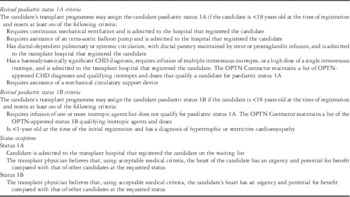
The Thoracic Committee reviewed OPTN data and noted significantly lower wait-list mortality for children with dilated cardiomyopathy compared with other diagnoses. In addition, there were differences in wait-list mortality among the various 1A/1B sub-categories. Patients on mechanical circulatory support, particularly those on ECMO, remain at high risk for wait-list mortality. Based on these data, the Thoracic committee recommended limiting the status 1A inotrope criteria to patients with haemodynamically significant CHD (Table 1).Reference Webber and Rogers 9 Under the revised allocation system, patients with dilated cardiomyopathy can only qualify as status 1A if they require mechanical ventilation, intra-aortic balloon pump, or mechanical circulatory support. Following public comment, the Thoracic Committee also added a requirement that patients be admitted to the listing hospital for every status 1A criteria, except for mechanical circulatory support. Finally, in order to bring the listing by exception criteria in line with the adult exception criteria, patients now have to have urgency and potential for benefit comparable with other candidates at the requested status. Previously, status 1A by exception required the candidate to have a life expectancy of <14 days.
Revised criteria for paediatric heart allocation status; accepted by the UNOS/OPTN Board of Directors in June, 2014.

OPTN=Organ Procurement and Transplantation Network; UNOS=United Network for Organ Sharing
Implementation of policy change is pending and may happen in early 2016. Adapted from the OPTN policy notice entitled “June 2014 board meeting actions” dated 23 July, 2014 (released 24 July, 2014)
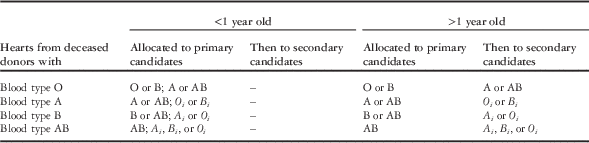
ABO-incompatible heart transplantation was first introduced as a way to reduce wait-list mortality in infants.Reference West, Pollock-Barziv and Dipchand 11 By overcoming the ABO-compatibility barrier in infants who had not yet developed iso-haemagglutinins against blood group antigens, the potential donor pool was expanded. Recent analyses of the Pediatric Heart Transplant Study dataReference Henderson, Canter and Mahle 12 and UNOS/OPTN dataReference Almond, Gauvreau and Thiagarajan 13 have demonstrated equivalent outcomes between ABO-compatible and ABO-incompatible heart transplants in infants. As a result of this data, the Thoracic Committee was able to eliminate blood type as a criterion for allocation of heart donors to infants <1 year of age (Table 2). With this policy change, the likelihood of infant donor heart utilisation should increase, and allocation of organs to infants will be more equitable as it will be based on clinical status rather than on blood type.
Revised criteria for paediatric heart allocation by blood type; accepted by the UNOS/OPTN Board of Directors in June 2014.
OPTN=Organ Procurement and Transplantation Network; UNOS=United Network for Organ Sharing
Items displayed in italics represent changes from the current United States heart allocation policy. Implementation of policy change is pending and may happen in early 2016. Adapted from OPTN policy notice entitled “June 2014 board meeting actions” dated 23 July, 2014 (released 24 July, 2014)
With each policy change, there are always practical issues that are worth watching. Based on current workload and programming requirements, it is expected that the new paediatric heart allocation policy will be implemented in early 2016. Now that admission to the listing hospital is a requirement in order to qualify for all status 1A criteria, except for mechanical circulatory support, it will be important to determine whether rates of admission to the listing hospital change among children listed for heart transplantation. There is also a potential incentive for placement of mechanical circulatory support devices as this would allow patients to remain as status 1A patients and wait at home. Given the development of smaller ventricular assist devices with improved morbidity profiles, it may be difficult to discern whether practice changes are due to clinical progress in the selection and use of these devices or in response to the policy change itself. As data become available on the use of implantable ventricular assist devices in children and the effects on wait-list mortality, it is likely that future paediatric heart allocation policy will re-classify some patients on implantable ventricular assist devices to a lower status, similar to the present allocation policy for adults. It is important to note that the UNOS Thoracic Committee is at present engaged in a national discussion about modifying the adult heart allocation policy.Reference Meyer, Rogers and Edwards 14 , Reference Kobashigawa, Johnson and Rogers 15 The current proposal involves six allocation tiers for adult recipients and the possibility of broader regional sharing of donor hearts. At this time, it is unclear how the paediatric allocation system would interact with the proposed six-tier model.
Antibodies, sensitisation, and crossmatches
Human leucocyte antigen sensitisation has long been a concern in paediatric heart transplantation, particularly in patients who have undergone congenital heart surgery utilising homograft material.Reference Shaddy, Hunter and Osborn 16 Recently, sensitisation has been on the rise in paediatric heart transplant recipients. The International Society for Heart and Lung Transplantation (ISHLT) data demonstrate that the percentage of patients with a panel-reactive antibody screen of >10% of the donor population has increased from 20% in 2005 to 32% in 2012.Reference Dipchand, Edwards and Kucheryavaya 1 This may be due to increased human leucocyte antigen -sensitisation, a greater tolerance for transplantation in the presence of anti-human leucocyte antigen antibody, or the use of increasingly sensitive diagnostic tests for the recognition of anti-human leucocyte antigen antibody.
Reports from the 1990s demonstrated that the presence of a positive donor-specific crossmatch led to worse early allograft survival after adult heart transplantation.Reference Lavee, Kormos and Duquesnoy 17 , Reference Smith, Danskine, Laylor, Rose and Yacoub 18 A recent analysis of the UNOS/OPTN data has demonstrated that a positive T-cell complement-dependent cytotoxicity donor-specific crossmatch was associated with worse allograft survival in a propensity-matched paediatric heart transplant cohort.Reference Daly, Singh, Piercey, Gauvreau and Almond 19 In the absence of a positive complement-dependent cytotoxicity crossmatch, a positive T-cell flow crossmatch was not associated with worse allograft survival.Reference Daly, Singh, Piercey, Gauvreau and Almond 19 As a result, some paediatric heart transplant centres have devised a strategy for peri-operative desensitisation in patients with a positive donor-specific crossmatch, which has resulted in a 1-year post-transplant survival of 75–85%;Reference Daly, Chandler and Almond 20 , Reference Holt, Lublin and Phelan 21 one series demonstrated that freedom from allograft loss was not statistically worse among the crossmatch-positive patients compared with crossmatch-negative controls, although the study was underpowered to detect small differences in survival.Reference Daly, Chandler and Almond 20 In this same cohort, the incidence of treated infection was higher in the crossmatch-positive group, most likely due to a combination of plasmapheresis and augmented maintenance immunosuppression. Among the group of patients who did well following crossmatch-positive heart transplant, there was a significant decrease in both the number of the donor-specific anti-human leucocyte antigen antibodies and the mean fluorescent intensity values for each individual antibody. This suggests an ability to accommodate the allograft over time, which may be due to the development of regulatory B-cells or other regulatory mechanisms.Reference Daly, Chandler and Almond 20 An ongoing National Institutes of Health-funded multi-centre cohort study in paediatric heart transplantation should help us better understand how allosensitisation and the presence of a positive complement-dependent cytotoxicity T-cell crossmatch affect post-transplant outcomes (https://clinicaltrials.gov/ct2/show/NCT01005316).
Even when patients and donors are carefully selected to avoid pre-formed anti-human leucocyte antigen antibodies, antibody-mediated rejection is an increasingly well-recognised complication after heart transplantation. In 2013, the ISHLT updated its consensus document for standard pathological grading of antibody-mediated rejection.Reference Berry, Burke and Andersen 22 Standardisation in the diagnosis of antibody-meditated rejection is an important step forward in order to prospectively study treatment options. The current treatment protocols are diverse and include plasmapheresis, immunoabsorption, phototherapy, IVIG, rituximab, bortezomib, and eculizumab. Rituxumab is a humanised anti-CD20 antibody that targets B-cells and can decrease antibody production. Unfortunately, memory plasma cells do not express CD20 on their cell surface, thus limiting its efficacy in targeting established anti-human leucocyte antigen antibodies. As a result, bortezomib has gained recent attention. Bortezomib is a small-molecule proteasome inhibitor that was developed for the treatment of multiple myeloma. By inhibiting the breakdown of misfolded proteins, bortezomib can induce apoptosis in cells that produce large amounts of protein. As a result, antibody-producing plasma cells and peripheral neurons are particularly sensitive to its effects. Although limited paediatric data exist supporting its use in heart transplant recipients,Reference Morrow, Frazier and Mahle 23 a 20–30% incidence of peripheral neuropathy may limit its broad application. Finally, eculizumab is an exciting new antibody that inhibits activity of the terminal complement system. The Newcastle group has used eculizumab to treat haemodynamically significant cases of suspected antibody-mediated rejection in order to avoid the need for mechanical circulatory support (R. Kirk, personal communication).
Biomarkers in paediatric heart transplantation
Biomarkers of acute rejection
Developing robust, widely accepted non-invasive biomarkers for heart transplant rejection has been a constant pursuit of transplant clinicians. Although many different biomarkers have shown potential in single-centre studies, few have been rigorously tested in multi-centre cohort studies and clinical trials. The AlloMap peripheral blood mononuclear cell gene profiling test is the most rigorously evaluated screening test for transplant recipients above 15 years of age.Reference Deng, Eisen and Mehra 24 Unfortunately, this test was not developed or validated for children. Several paediatric studies have examined the use of troponin-T or -I, B-type natriuretic peptide, and/or tissue Doppler imaging to either screen for or diagnose acute rejection.Reference Sparks, Boston, Eghtesady and Canter 25 – Reference Lunze, Colan and Gauvreau 29 All are small cohort studies that correlate the predictive ability of individual biomarkers with biopsy-based rejection grades. No prospectively studied biomarker-based rejection screening protocols have been demonstrated to safely reduce protocol biopsy frequency in children.
Cell-free donor-specific DNA is a novel class of biomarkers, which may prove useful in screening transplant recipients for rejection. The recent study by De Vlaminck et alReference De Vlaminck, Valantine and Snyder 30 has laid out the performance characteristics of donor-specific cell-free DNA for the identification of acute cellular rejection and antibody-mediated rejection in a cohort of 65 paediatric and adult heart transplant recipients. The authors performed deep sequencing (1.2 giga-base pairs) of circulating cell-free DNA in the plasma of transplant patients. By comparing single-nucleotide polymorphisms at loci that differed between donor and recipient, and adjusting for the expected rate of baseline error, the percentage of circulating cell-free donor-specific DNA was determined. The donor-specific cell-free DNA percentage rapidly reached a stable baseline of 0.06%±0.11 by 1 week after transplantation. The donor-specific cell-free DNA fraction was significantly higher in patients with rejection compared with those without rejection. The c-statistic for identifying biopsy-confirmed rejection in the entire cohort was 0.83; however, in the paediatric cohort, the c-statistic was even better at 0.91.Reference De Vlaminck, Valantine and Snyder 30 A separate study in a paediatric heart transplant cohort also demonstrated the potential utility of cell-free donor-specific DNA fraction to identify multiple types of allograft injury.Reference Hidestrand, Tomita-Mitchell and Hidestrand 31 This study suggests that injury caused by rejection, cardiac allograft vasculopathy, and infection may all alter the cell-free donor-specific DNA fraction.Reference Hidestrand, Tomita-Mitchell and Hidestrand 31 Neither study has demonstrated the cellular source of the donor-specific DNA. As the donor endothelium is the primary target of the cellular and antibody-based alloimmune responseReference Bruneau, Woda and Daly 32 and the DNA content is relatively higher in endothelial cells than in cardiomyocytes, it may turn out that most of the donor-specific DNA is derived from the endothelium.
VEGF-A as a predictive biomarker for cardiac allograft vasculopathy in children
Cardiac allograft vasculopathy remains a leading cause of allograft failure in adults and children after heart transplantation.Reference Dipchand, Edwards and Kucheryavaya 1 By 10 years after heart transplantation, between 30 and 45% of children have been diagnosed with cardiac allograft vasculopathy, and within 2 years of report of cardiac allograft vasculopathy approximately one-third of children experience cardiac allograft loss.Reference Dipchand, Edwards and Kucheryavaya 1 Proteins involved in angiogenesis, including VEGF-A, VEGF-C, and PF-4, have been associated with the presence of cardiac allograft vasculopathy by coronary angiography in adults.Reference Daly, Seifert and Chandraker 33 Recently presented data at the World Transplant Congress demonstrated that plasma concentrations of VEGF-A can be used to stratify cardiac allograft vasculopathy risk in paediatric heart transplant recipients.Reference Daly, Stack and Eisenga 34 The 44-patient cohort had minimal vascular disease at enrolment (ISHLT cardiac allograft vasculopathy Grade 0 or 1). A total of eight patients went on to develop moderate or severe cardiac allograft vasculopathy (Grade 2 or 3), which was highly associated with death, re-transplant, myocardial infarction, or listing for re-transplantation. Freedom from moderate or severe cardiac allograft vasculopathy was significantly higher in patients with VEGF-A concentrations below the median (p=0.02).Reference Daly, Stack and Eisenga 34 Prospective validation of a VEGF-A screening protocol to reduce the frequency of coronary angiography is needed to demonstrate that non-invasive cardiac allograft vasculopathy screening is safe and effective.
Trials in paediatric heart transplantation
In 2010, the ISHLT published guidelines for the care of heart transplant recipients.Reference Costanzo, Dipchand and Starling 35 Nearly all the recommendations were based on consensus opinion, case studies, or standard of care, with notable exceptions in the area of the use of statins, ABO-incompatible heart transplantation, and corticosteroid minimisation.Reference Costanzo, Dipchand and Starling 35 This highlights the need for a stronger evidence base in the management of paediatric heart transplant recipients. A search of Clinicaltrials.gov on 20 January 2015, revealed that 20 interventional trials and 20 observational studies involving paediatric heart transplant recipients have been registered on the site. Of those trials, half of the observational studies were focused on identifying biomarkers of acute rejection. Although seven trials purported to study maintenance immunosuppression, these studies mostly involved pharmacokinetic studies or comparisons of different dose formulations of tacrolimus. There are no well-powered randomised control trials to guide post-transplant medical therapy in paediatric heart transplant recipients.
The field of paediatric heart transplantation has made tremendous strides in patient selection, optimising peri-transplant surgical outcomes, and preventing acute cellular rejection in the early post-transplant period; however, in order to change the slope of the long-term survival curve, paediatric transplant clinicians must design and perform rigorous randomised controlled trials that measure clinically relevant long-term outcomes. The limited number of paediatric heart transplant recipients makes powering a study with an allograft survival end point problematic, yet no validated composite clinical outcome measure has been developed. Clinical registries such as the Pediatric Heart Transplant Study and the UNOS/OPTN database can be used to validate composite clinical trial end points and generate point estimates for randomised clinical trial design. In addition, performing such a trial will necessitate standardisation of clinical protocols across paediatric transplant centres. Randomised controlled trials would serve as a vital evidence base and improve long-term clinical outcomes for paediatric heart transplant recipients.
Conclusion
Paediatric heart transplantation is an established therapy for end-stage heart disease and is associated with long-term allograft survival. The new UNOS policy aims to allocate paediatric hearts justly and to those children most likely to benefit from transplantation; however, the effect of these changes must be re-assessed and refined as new data become available. Donor management and selection remain key areas of focus to address the shortage of available organs. Human leucocyte antigen allosensitisation is a continued challenge for the paediatric heart transplant community, despite the use of standardised protocols for the management of highly sensitised children. Non-invasive diagnostic tests to rule out rejection and cardiac allograft vasculopathy are likely to decrease the need for invasive procedures in the coming years, but their use in clinical practice needs systematic study. Well-designed randomised controlled trials are necessary to take the next step forward in improving post-transplant survival and should measure end points that account for the multiple complications that can lead to poor post-transplant outcomes.
Acknowledgement
The author would like to acknowledge Dr. Elizabeth Blume and Dr. Joan Daya-Daly for their thoughtful comments regarding this manuscript.
Financial Support
Dr Daly has been supported by National Institutes of Health grants L40 HL110356, T32 HL07572, and K12 HD052896-06, the Alexia Clinton Research Fund, the Boston Children’s Hospital Heart Transplant Research and Education Fund, and Diacoff Heart Failure Symposium funding.
Conflicts of Interest
None.
Authorship
Dr Daly takes full responsibility for this work.