Introduction
Mass-casualty incident (MCI) algorithms are used in disaster settings to rapidly sort large numbers of victims, based on level of severity. While MCI algorithms use different terminology, they generally organize patients into four basic categories: green – patients with only minimal injuries who are likely safe to be discharged from the scene; yellow – patients who do not need an immediate life-saving intervention but need evaluation and likely need treatment to prevent loss of function; red – patients who need a rapid life-saving intervention to prevent death; and black – patients who are dead or unlikely to survive.
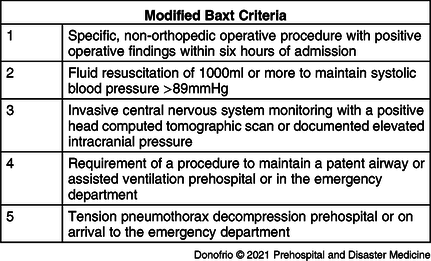
Integral to an MCI algorithm is its ability to triage into each category correctly. As this is often difficult to test in the context of an actual MCI, surrogate measures have been applied to test the algorithms in groups of simulated or actual patients for which hospital outcome data are available. Just as the triage tools categorize patients into black, red, yellow, and green using immediately available triage data, the outcome tool places patients into these categories retrospectively, using the eventual outcomes to determine which category the patient should have been classified, utilizing full knowledge of survival and interventions performed. The most frequently used outcome measure to test MCI algorithms has been the modified Baxt criteria. These are a list of major interventions (Table 1) initially created to test the Injury Severity Score (ISS)’s ability to correlate with resource requirements in major trauma centers that classify a patient as red triage or non-red triage appropriate.Reference Garner, Lee, Harrison and Schultz1,Reference Baxt and Upenieks2 The modified Baxt criteria have been widely used to test an MCI algorithm’s ability to correctly identify red (severely injured) patients.Reference Garner, Lee, Harrison and Schultz1,Reference Challen and Walter3–Reference Kahn, Schultz, Miller and Anderson6 Wallis, et al made a pediatric modification to these criteria, utilizing a fluid requirement of >20ml/kg instead of 1000ml.Reference Wallis and Carley4,Reference Wallis5 Other outcome measures that have been used to determine accuracy of red triage have included both ISS >15 and any ventilator use during hospitalization.Reference Wallis and Carley4,Reference Wallis5,Reference Price, Brace-McDonnell, Stallard, Bleetman, Maconochie and Perkins7,Reference Cross and Cicero8 Differentiation of accurate yellow and green designation has been considered an area of uncertainty. Kahn, et al defined correct yellow triage as “modified Baxt criteria negative with length-of-stay (LOS) 24 hours” and correct green triage as “modified Baxt negative with LOS <24 hours.”Reference Kahn, Schultz, Miller and Anderson6 This compares to Cross, et al who used an ISS of 10 as a cutoff point to distinguish between green and yellow.Reference Cross and Cicero8,Reference Cross, Petry and Cicero9 Accuracy of triage into the black category has been evaluated using mortality and death in the emergency department (ED).Reference Cross and Cicero8 To date, there is no consensus on which outcome measure is best for testing MCI algorithms in adult or pediatric patients.
Modified Baxt Criteria

In 2016, the Criteria Outcomes Tool (COT) was published for use in evaluating triage tools in the pediatric MCI population. The COT was developed by a modified Delphi approach using a panel of pediatric emergency medicine experts to test how well an MCI algorithm triages pediatric disaster patients into black, red, yellow, and green categories using known outcomes and interventions.Reference Donofrio, Kaji and Claudius10 The COT (Appendix 1; available online only) is a far more extensive list of interventions and outcomes than previously utilized tools. No studies have directly compared existing outcomes used to test the performance of MCI algorithms in the pediatric population.
Importance
This is the first study to compare mortality, modified Baxt criteria, modified Baxt criteria plus other features (ambulatory, LOS), and ISS to the COT.
Goals of this Investigation
Given the COT is a more extensive evaluation specifically developed to test the performance of an MCI algorithm in each of the four triage categories, the aim is to evaluate how each of the previously published measures used for black, red, yellow, and green outcomes compared to the COT.
Methods
This is a retrospectively collected patient sample prospectively categorized using a number of different algorithms for evaluating trauma triage categories in order to assess agreement between different MCI algorithms. This study was approved by the University of California at San Diego institutional review board (San Diego, California USA; IRB number 170467).
Patients
A previously prepared and de-identified collection of 247 patients under 14 years of age brought in by ambulance as a trauma activation to a single Level I trauma center from July 2010 through November 2013 was utilized. All pediatric trauma team activations from September 2012 through November 2013 were included. To include sufficient numbers of more severely injured patients, the dataset included all pediatric trauma activations requiring endotracheal intubation from May 2012 through November 2013 and pediatric trauma activations who died before hospital discharge from July 2010 through November 2013.
This de-identified dataset included demographics, prehospital field data including ambulatory status, and all in-hospital: ED, ward, intensive care unit (ICU), or operating room (OR) imaging; procedures including time and location; diagnoses; outcomes; trauma scores; and outcomes data. Patients had previously been categorized into black, red, yellow, or green based on the COT by two reviewers (JDO and AS) after having a 90% concordance in 25 patients. Patients with questionable categorization were discussed between the two reviewers. If needed, cases could be brought before an expert group; however, no cases required escalation to group review.
Data Collection
To compare agreement and explore direction of non-agreement between the COT and existing algorithms, the following outcomes were collected for each patient, in addition to the COT: mortality, modified Baxt criteria positive/negative, ISS score, LOS, and prehospital ambulatory status. The modified Baxt/Wallis was used to include >20ml/kg intravenous fluid bolus to maintain systolic blood pressure >(70 + age in years [2]) or >89mmHg. Since many MCI algorithms use ambulatory status to designate green triage, this criterion was independently evaluated as well.
Patients were assigned categories independently using the following tools:
-
1. Black:
-
a. Mortality;
-
b. COT black criteria.
-
-
2. Red:
-
a. Modified Baxt positive;
-
b. Modified Baxt positive and alive to hospital discharge;
-
c. ISS >15;
-
d. ISS >15 and alive to hospital discharge;
-
e. COT red criteria.
-
-
3. Yellow:
-
a. Modified Baxt negative and LOS >24 hours;
-
b. Modified Baxt negative and non-ambulatory;
-
c. ISS 10-15;
-
d. COT yellow criteria.
-
-
4. Green:
-
a. Modified Baxt negative and LOS <24 hours;
-
b. ISS <10;
-
c. Ambulatory prehospital;
-
d. COT green criteria.
-
Analysis
A pre-existing database of cases was used. The number in the database had been determined to be 220 (253 were ultimately collected) to compare two triage algorithms, giving a power of 90%. A distinct power calculation was not performed for this paper, as these are pilot data without any proceeding papers establishing standards or potential agreement.
Each outcome in each of the black, red, yellow, and green categories were compared to the corresponding COT outcome for that color. Agreement was confirmed if the outcome measure tested matched the COT color. For patients in whom there was not agreement, whether the tool deemed a more-severe (higher) or less-severe (lower) triage category was reported as a percentage. Demographics were analyzed using native SASv9.3 (SAS Institute; Cary, North Carolina USA), format using DBMS/Copy (Dataflux Corporation; Cary, North Carolina USA), and descriptive statistics were performed using Microsoft Excel for Mac Version 16.22 (Microsoft Corp.; Redmond, Washington USA).
Results
A total of 247 patients were included in the analysis. These patients ranged in age from 25 days to 13 years with a median age of six years. The majority (66%) were male and 81% had blunt trauma mechanisms. Of the 247 patients, 0.4% died, 8.5% went from the ED to the OR, 14% were admitted to a ward bed, and 24.9% went to an ICU or step-down unit.
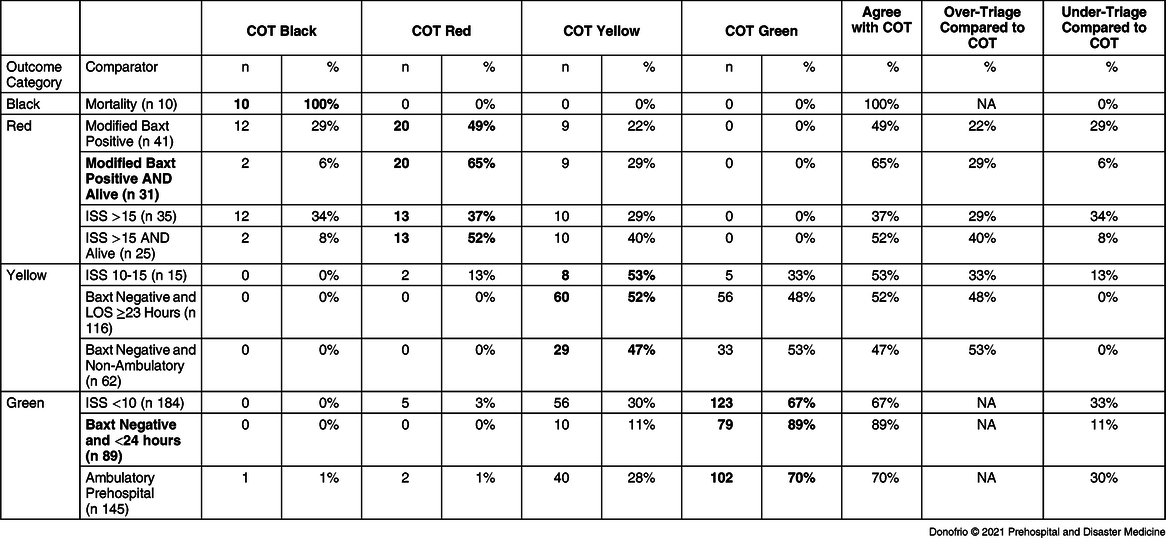
Results are detailed in Table 2. For a black categorization, the COT was found to have 100% agreement with mortality. For a red categorization, there was a range of agreement from 37% for ISS >15 to 65% for “Modified Baxt positive and alive.” For “Modified Baxt positive and alive,” six percent of the cases represented a lower triage category than the COT and 29% represented a higher triage category. In the yellow category, agreement between the COT and all three comparators hovered around 50%, with most non-agreements representing a higher triage level than the COT. For green, agreement with the COT ranged from 67%-89%.
Comparison of Previously Published Outcomes to the Criteria Outcomes Tool

Abbreviations: COT, Criteria Outcomes Tool; ISS, Injury Severity Score; LOS, length-of-stay.
Discussion
This is the first comparison of a series of tools to categorize MCI patients into triage designations based on eventual outcomes. The COT is a newer tool that has the advantage of allowing evaluation of all four triage categories: black, red, yellow, and green. Comprised of a total of 47 components, the COT is more likely to identify patients requiring urgent or emergent interventions. However, it may not be as practical in large-scale studies given the amount of chart abstraction required. The long-term goal is to find an accurate, user-friendly outcome measure with which to compare MCI triage tools for pediatric patients. This study represents an early step in this process of evaluation of the agreement of the currently existing outcome tools. The fact that agreement within the red and yellow categories was approximately 50% raises concern regarding the reliability of current options for evaluating MCI triage tools.
The original Baxt criteria were developed to test the ISS and MCI algorithms. Garner, et al further modified the Baxt criteria to identify patients as red in testing MCI algorithms.Reference Garner, Lee, Harrison and Schultz1 A unique addition to these outcomes in the red category was the evaluation of both the modified Baxt criteria and the ISS >15 as solo outcomes and as combinations with the addition of “alive.” Previous literature has not assessed this combination.Reference Garner, Lee, Harrison and Schultz1,Reference Wallis5,Reference Price, Brace-McDonnell, Stallard, Bleetman, Maconochie and Perkins7 This is the first study to compare the modified Baxt to outcomes other than ISS and mortality. While the ISS is an easily attainable piece of information, it was not created to assess the immediate needs of patients and is not the ideal outcome to test an MCI algorithm.
It was found that the outcome measures with the highest agreement with the COT in each category were: mortality for black; “modified Baxt positive and alive” for red; “modified Baxt negative and LOS 24 hours” for yellow; and “modified Baxt negative and <24-hour LOS” for green. The COT and ISS did not show substantial agreement, with the ISS triaging a number of patients to lower categories. The “ambulatory” prehospital green outcome had the same performance as ISS <10 with one-third of patients under-triaged when compared to the COT. Testing of the yellow cohort remains difficult. All previously published outcomes demonstrated an approximate 50% agreement with the COT yellow with significant over-triage compared to the COT.
Limitations
This study uses a previously retrospectively collected dataset of patients from a single center who were brought in by ambulance as a trauma activation. The majority of the patients were not involved in an MCI. Resources, from prehospital to through hospital discharge, were not limited as they might be in the event of a true disaster. Thus, the outcomes of this cohort may be different than expected in the event of strained resources. Additionally, this study involved urban pediatric trauma activations, mostly motor vehicle collision or fall victims. This, along with the retrospective design, may limit the generalizability of the results to disasters involving chemical, biologic, or nuclear events. Further research would need to be performed to determine the degree of external validity of the results.
Conclusions
Variability was found between outcome tools, particularly in the red and the yellow category. Establishing a criterion-standard outcomes tool is necessary, and applying the COT, ISS, and Baxt in actual pediatric MCIs may be the next step to establishing a gold standard.
Conflicts of interest/funding
none
Supplementary Material
For supplementary material accompanying this paper visit https://doi.org/10.1017/S1049023X2100100X