INTRODUCTION
Few issues in marine management have received as much attention and stimulated such a protracted discussion as the two decade debate on the potential of no-take marine reserves (MRs) to make significant contributions to the conservation and management of fisheries. In reviewing the first decade's (1990–2001) progress, Willis et al. (Reference Willis, Millar, Babcock and Tolimieri2003a) highlighted a lack of rigorous empirical study of MR effects and the abundance of reviews and theoretical analyses orientated towards advocacy of MRs for parts of the world or habitats that lacked them.
Since 2001, the literature on MRs has burgeoned, yet there has been little assessment of its ecological or geographical representativeness. Establishment of marine protected areas (MPAs), of which MRs are a highly restricted subset (Agardy et al. Reference Agardy, Bridgewater, Crosby, Day, Dayton, Kenchington, Laffoley, McConney, Murray, Parks and Peau2003), has continued at pace and there has been an increasing uptake of MPA-based management in temperate waters. Almost a decade on, has the call of Willis et al. (Reference Willis, Millar, Babcock and Tolimieri2003a ) for more empirical research been heeded, and how is the literature foundation placed to support the expanding use of MPAs, in particular MRs? How extensive is the empirical literature on MRs in temperate ecosystems, and how representative are these studies of the available habitats?
METHODS
We assessed these questions by analysing peer-reviewed literature of the period 1970–2010 inclusive, identified using the ISI Web of Science (see http://thomsonreuters.com/content/science/pdf/Web_of_Science_factsheet.pdf). As the term ‘reserve’ has different meanings depending on country (for example, marine reserves are a less restrictive measure in Kenya), we used a comprehensive search string that picked up on all papers that had studied areas where all fishing has been permanently banned. Using the search term ‘Marine AND (‘reserve*’ OR ‘protected area*’ OR ‘park*’ OR ‘sanctuar*’ OR ‘no take zone*’ OR ‘conservation zone *’ OR ‘refugia’ OR ‘closed area*’)’, we identified 819 studies after manually checking through abstracts to confirm that the study was concerned with the biological effects of MRs; all socioeconomic and governance literature was excluded.
We classified literature by type, ecoregion and habitat. Literature type was categorized as empirical, theoretical or review (as per Willis et al. Reference Willis, Millar, Babcock and Tolimieri2003a ). Ecoregions were based on the Marine Ecoregions of the World (MEOW) biogeographic framework (Spalding et al. Reference Spalding, Fox, Halpern, McManus, Molnar, Davidson, Jorge, Lombana, Lourie, Martin, McManus, Recchia and Robertson2007); these were defined as ‘tropical’, where coral reefs were present within the eco-region, ‘warm temperate’, when average winter sea surface temperatures (SSTs) exceeded 10°C, ‘cold temperate’, where average winter SSTs were < 10°C and < 60o latitude, and ‘polar’, where ≥ 60o latitude.
Habitat was categorized in terms of the dominant substratum, as hard or soft. This classification perhaps does not account for the few examples that examined more than one habitat type, but most studies concentrated on one of these two gross habitat types. Occasionally studies did not explicitly state habitat type. In these cases, we inferred habitat type from the study species (for example, we assumed lobsters were associated with reef) and/or areas (for example we considered estuarine and offshore areas to be soft).
RESULTS
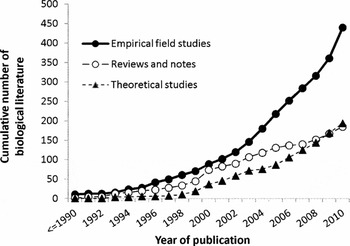
While the total literature continues to expand exponentially, the proportion of empirical studies has increased relative to review and note-type literature (Fig. 1). The annual publication rate of theory seems to have been increasing at the same rate as that of empirical studies since 2000, following a leap in the publication of modelling studies in 1999–2000.
Publications concerned with the effects of marine reserves in the literature, 1990–2010: comparison of the number of field and desktop studies. For the sake of easy visualization, papers 1977–1989 (n = 8) were categorized as 1990.

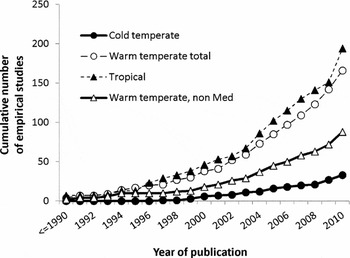
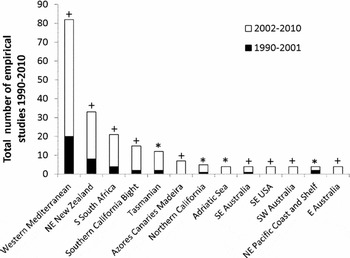
When the empirical literature is broken down by ecosystem type, more studies have been undertaken in the tropics and an almost equal research effort (194 studies) has been applied to warm temperate ecosystems, although nearly half of this research effort has been undertaken in 25 MRs in the Western Mediterranean (Figs 2–3).
Number of empirical field studies undertaken in MRs by ecosystem type. The subset of warm temperate studies conducted outside the western Mediterranean Sea are indicated as a separate category.

Research effort per temperate marine ecoregion where the total number of published field studies is > 4, ‘+’ indicates ecoregions defined as warm temperate, and ‘*’ indicates ecoregions defined as cold temperate.

The publication rate of cold temperate research lags well behind that of tropical and warm temperate ecosystems (Fig. 2) (though had we included large-scale seasonal fisheries closures in the analysis, there would have been c. 45% more studies in this category). We failed to identify any polar MPA studies.
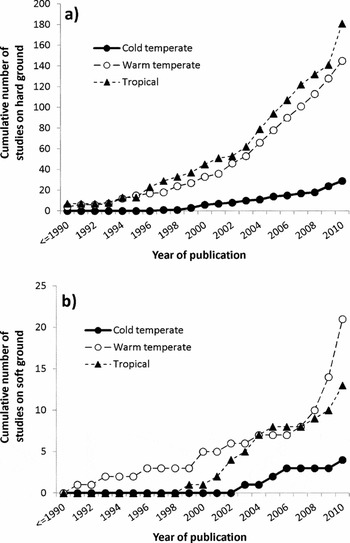
Eighty-five per cent of all empirical studies on MRs derived from reef habitat (rock and coral) globally (Fig. 4 a). MR studies of soft habitats were more abundant in tropical and warm temperate ecosystems than elsewhere, in line with the greater volumes of research conducted there (Fig. 4 b), but predominantly focused on vegetated habitats, such as seagrass beds.
Number of field studies undertaken in MRs: (a) in hard habitat by ecosystem type, and (b) in soft habitats by ecosystem type. Note the different scales for the y axes.

DISCUSSION
The evidence base
Provisionally, the pleas of Willis et al. (Reference Willis, Millar, Babcock and Tolimieri2003a ) for more empirical research on MRs seem to have been realized. The proportion of empirical studies has increased relative to review and note type literature, suggesting a more balanced knowledge gain than in previous years. However, an increase in the quantity of empirical evidence does not necessarily reflect an improvement in scientific rigour. Despite earlier calls for more rigour in experimental design (namely spatial and temporal replication) when empirically assessing MR effects (see for example Guidetti Reference Guidetti2002; Willis et al. Reference Willis, Millar, Babcock and Tolimieri2003a ), many studies continue to use flawed designs and consequently lack generality, although moves in the right direction are occurring, for example the application of fully replicated asymmetric monitoring (Hoskin et al. Reference Hoskin, Coleman, von Carlshausen and Davis2011). Some recent reviews have attempted to mitigate such design-related bias by weighting studies according to the strength of their experimental design (see Claudet et al. Reference Claudet, Osenberg, Benedetti-Cecchi, Domenici, Garcia-Charton, Perez-Ruzafa, Badalamenti, Bayle-Sempere, Brito, Bulleri, Culioli, Dimech, Falcon, Guala, Milazzo, Sanchez-Meca, Somerfield, Stobart, Vandeperre, Valle and Planes2008), however they cannot counter the effect of publication bias on the results; there is a preponderance of studies showing positive effects of MRs over those showing neutral or negative MR effects.
Differences between temperate and tropical
The dominance of tropical and warm temperate MRs in the literature (Fig. 2) indicates that understanding the effects of MRs in cold temperate ecosystems and polar ecosystems may be problematic, because the ecology changes with latitude as a function of climatic and biogeographic patterns, and environmental governance regimes also differ.
Many temperate fish species demonstrate extensive seasonal movement (Willis et al. Reference Willis, Millar and Babcock2003b ), gene flow and connectivity are likely to be higher with the extended larval duration observed at higher latitude, while many life history characteristics, such as growth rate, age at maturity, longevity and maximum body size, are often correlated with latitude (Blanck & Lamouroux Reference Blanck and Lamouroux2007; Hutchings & Griffiths Reference Hutchings and Griffiths2010; Sumpton & Jackson Reference Sumpton and Jackson2010). Similar latitudinal differences also exist in marine management, because the more limited financial, human and information resources available in developing countries diminish their capacity to do fisheries research and management in the tropics (Jones et al. Reference Jones, Fitzgerald, Sale, Hart and Reynolds2002, Sale et al. Reference Sale and Sale2002). Thus, some authors argue that MRs have been established in the tropics because it is relatively simple to manage a MR rather than enforce restrictions on gear or impose effort and catch controls, as traditionally happens in many high latitude countries (Sale et al. Reference Sale and Sale2002; Shipp Reference Shipp2003).
Lester et al. (Reference Lester, Halpern, Grorud-Colvert, Lubchenco, Ruttenberg, Gaines, Airame and Warner2009) suggested that biological effects of marine reserves may be similar between tropical and temperate regions; however their meta-analysis examined few highly mobile or migratory species, and the vast majority of reserves were protecting nearshore rocky or coral reef habitat. Thus the scientific support for temperate MPAs is strongest for similar hard complex nearshore habitats.
Soft sediment marine reserves
This study confirms the observation that data from soft sediment systems at temperate and tropical latitudes is severely lacking in MR science (Lester et al. Reference Lester, Halpern, Grorud-Colvert, Lubchenco, Ruttenberg, Gaines, Airame and Warner2009). This is even more alarming, given the predominance of such habitat in all seas. The majority of continental shelf seabed is sediment; in the Antarctic, sediment covers 90% of the shelf, c. 95% of the Great Barrier Reef marine park and > 99% of the proposed English North Sea Marine Conservation Zones network.
Interestingly, whilst the majority of published studies of tropical or warm temperate MRs have focused on fish assemblages, studies on cold temperate MRs have focused predominantly on invertebrates. The current lack of information on MR effects on fish assemblages over soft habitats and low-topography continental shelf systems (which are important to large-scale fisheries) is particularly worrying. The advocacy for the wider use of MRs by many environmental organizations and some marine scientists thus far appears to have little empirical basis. That said, without the establishment of MRs in such habitats, the potential effectiveness of spatial protection measures in soft sediment systems cannot be measured.
A number of factors that vary between sediment and reef-based systems may influence MR effects. Fish species associated with reefs are generally more site attached (Barrett Reference Barrett1995; Zeller Reference Zeller1997; Tolimieri et al. Reference Tolimieri, Andrews, Williams, Katz and Levin2009), as are individuals within species that range over both soft and hard bottoms (Attwood & Bennett Reference Attwood and Bennett1994; Willis et al. Reference Willis, Parsons and Babcock2001), and they are therefore likely to experience greater protection than those of sedimentary systems. This site attachment is a function of multiple behaviours, including territoriality, aggregation around structure (Grossman et al. Reference Grossman, Jones and Seaman1997; Franks Reference Franks, Gall, Cayre and Taquet2000) or predator avoidance. The greater uniformity of habitat in soft-sediment systems may also increase the likelihood of transboundary movements, whereas reserve boundaries that fall along discontinuities in habitat are more likely to retain habitat-dependent species (Freeman et al. Reference Freeman, MacDiarmid and Taylor2009). These factors may mean either that less effort has been put into soft-sediment systems because of preconceptions that such habitats will not retain biomass, or that studies conducted have not yielded statistically significant differences between protected and unprotected areas, and have therefore not been published (see Edgar Reference Edgar2011 for a discussion of such publication bias).
It can also be argued that the lack of MRs established over soft sediment bottoms in cold temperate ecosystems may be the main reason why studies on reserve effects are limited to fauna associated with reefs (Lester et al. Reference Lester, Halpern, Grorud-Colvert, Lubchenco, Ruttenberg, Gaines, Airame and Warner2009). Another methodological problem could be the difficulty of making direct observation in cold temperate waters due to poor visibility, and also the fact that soft bottom communities are often found in deeper water or intertidal areas. Fishes not associated with structure tend to move over much wider areas, meaning soft sediment habitats need surveys over much larger spatial scales (see Rotherham et al. Reference Rotherham, Underwood, Chapman and Gray2007 for discussion).
It is probably much easier to show an effect of protection on a relatively sedentary invertebrate species associated with reefs than on more mobile fish species where a more intense (and costly) sampling effort will be needed to overcome high spatial and temporal variability in the fish assemblage (Rotherham et al. Reference Rotherham, Underwood, Chapman and Gray2007). Indeed, perhaps large seasonal closures (Dinmore et al. Reference Dinmore, Duplisea, Rackham, Maxwell and Jennings2003) and partially protected areas (Frank et al. Reference Frank, Shackell and Simon2000; Murawski et al. Reference Murawski, Brown, Lai, Rago and Hendrickson2000; Sweeting et al. Reference Sweeting, Badalamenti, D'Anna, Pipitone and Polunin2009) are more common in cold temperate ecosystems than MRs owing to the increased mobility of exploited species (Shipp Reference Shipp2003), and also because it is currently not politically feasible to designate such large areas as no-take MRs.
CONCLUSIONS
Empirical evidence on biological effects of cold temperate and polar MRs is scarce, although this may reflect the general lack of MPAs and MRs in these regions (Spalding et al. Reference Spalding, Wood, Fitzgerald, Gjerde, Toropova, Meliane, Laffoley, Matthews and Spalding2011) and the difficulty of carrying out field work in such locations (due to inclement weather, seasonality, increased sampling effort or logistical costs). We argue that this lack of evidence should be of concern and highlight a disconnect between the existing literature base on MRs and the information requirements for cold-water MRs that all too frequently differ in their social, economic and ecological objectives, the management regime within which they exist and the characteristics and behaviour of the species and habitats for which they were established. We highlight that, although the number of studies completed in warm temperate regions approaches that from the tropics, a large proportion of these are from one region (the western Mediterranean Sea), and should not be assumed to predict MR responses in other ecoregions. To date, the available data supporting establishment of cold temperate MRs are weak, yet scientists can scarcely improve that knowledge until MRs are established in these areas. From this empirical perspective, there is merit in establishing MRs in cold temperate ecosystems, although monitoring work needs to be in place for full scientific benefit to be derived from such interventions.
ACKNOWLEDGEMENTS
A joint UK NERC-ESRC PhD studentship provided funding. Estelle Jones and three anonymous reviewers provided useful advice.