Introduction
The residential aged care industry faces significant challenges in terms of attracting and sustaining a competent and stable workforce, partly due to a negative societal image of long-term care and an expected labor shortage in this sector (Vernooij-Dassen et al., Reference Vernooij-Dassen2009). In June 2008, Australia had 160,250 residential aged care residents, 70% of whom received high level care. Future demographic trends suggest that there will be a 56% increase to about 250,000 residents in Australian residential aged care by 2020 (Australian Nursing Federation, 2009). The strongest growth will be in the most complex needs group aged 85 years and above. Thus, the demand for residential aged care is rapidly increasing. However, estimates suggest that the total number of staff working in residential aged care will only increase by around 14% by 2020, in contrast to the 56% increase in demand. In addition, trends show that skilled staff are being increasingly replaced by unskilled staff in the Australian residential aged care workforce (Australian Nursing Federation, 2009). Similar projections of increased demand for aged care has been described for the USA (Beverly et al., Reference Beverly, Burger, Maas and Specht2010), the People's Republic of China (Chen et al., Reference Chen, Yu, Song and Chui2010) and Sweden (Statistics Sweden, 2006). It seems reasonable to expect similar trends in other countries with similar residential aged care systems.
A recent literature review into why people quit or avoid jobs in dementia care showed that the main reason for leaving a dementia care job was: lack of job satisfaction on the basis of a lack of resources to provide good care; staff not feeling appreciated; and staff members’ own dissatisfaction about the quality of care they could provide (Vernooij-Dassen et al., Reference Vernooij-Dassen2009). It is also known that annual turnover rates in residential aged care have been reported to be as high as 96% (Cohen-Mansfield, Reference Cohen-Mansfield1997), and job satisfaction has been identified as a key area of concern for attracting and retaining staff in residential aged care (Drebing et al., Reference Drebing, McCarty and Emerson Lombardo2002; Vernooij-Dassen et al., Reference Vernooij-Dassen2009). Providing professional care for older people in residential aged care settings is perceived as demanding and challenging (Edvardsson et al., Reference Edvardsson, Sandman, Nay and Karlsson2009), and it has been shown that while staff members in the beginning of their professional aged care career exhibit highly person-centered attitudes and ambitions, these attitudes become significantly less prevalent when staff have worked in the profession for a long time (Zimmerman et al., Reference Zimmerman2005). It has also been shown that staff with negative attitudes towards people with dementia report less job satisfaction (Brodaty et al., Reference Brodaty, Draper and Low2003), and studies suggest that the job strain and satisfaction of staff is associated with the well-being of the people receiving care (Edvardsson et al., Reference Edvardsson, Sandman, Nay and Karlsson2008a).
Staff job satisfaction has been positively related to the amount of time spent working directly with patients (Drebing et al., Reference Drebing, McCarty and Emerson Lombardo2002) and being able to find interventions for difficult situations such as implementing multi-sensory environments (van Weert et al., Reference van Weert, van Dulmen, Spreeuwenberg, Bensing and Ribbe2005). It has also been found that job satisfaction is influenced by aspects such as perceiving a positive psychosocial climate in units, being part of a reflective practice environment, and having access to clinical supervision (Berg et al., Reference Berg, Welander-Hansson and Hallberg1994; Edberg and Hallberg, Reference Edberg and Hallberg1996; Edvardsson et al., Reference Edvardsson, Sandman, Nay and Karlsson2009). In addition, interviews with community-based dementia care workers have indicated that organizational support was a key factor for job satisfaction (Ryan et al., Reference Ryan, Nolan, Enderby and Reid2004), and Kitwood (Reference Kitwood1997) asserted that a supportive organization was a prerequisite for person-centered care provision. Nolan and co-workers (Reference Nolan, Davies, Brown, Keady and Nolan2004) presented the senses framework in which they showed that the job satisfaction of staff is related to working in a therapeutic environment and supportive culture, and being able to provide good care. This is further supported by studies indicating that staff in group living homes for older people with dementia have higher job satisfaction, lower job strain, and lower risk of burnout compared with staff in traditional nursing homes, thus providing tentative evidence that staff will benefit from person-centered care which involves satisfying the wishes and needs of residents, by providing meaningful activities and interactions to promote a normal daily life of the residents, rather than concentrating on tasks that need to be performed (Morgan et al., Reference Morgan, Stewart, D'Arcy, Forbes and Lawson2005; te Boekhorst et al., Reference te Boekhorst, Willemse, Depla, Eefsting and Pot2008).
Person-centered care has been described as the gold-standard model for care of older people and people with dementia disorders (Edvardsson et al. Reference Edvardsson, Winblad and Sandman2008b). Person-centered care involves shifting focus from the task to the person, from disease to illness, from the objective and medicalized interests of medicine and other health professions to the subjective perspective of the person living with the disease or impairment (McCormack and McCance, Reference McCormack and McCance2006; Edvardsson et al., Reference Edvardsson, Fetherstonhaugh and Nay2010a). Several studies have recently reported beneficial effects of person-centered care provision on various outcomes among residents (Fossey et al., Reference Fossey2006; Hoeffer et al., Reference Hoeffer2006; Chenoweth et al., Reference Chenoweth2009; McCormack et al., Reference McCormack2010; Palese et al., Reference Palese, Granzotto, Broll and Carlesso2010), and others have described how person-centered care can be implemented in clinical practice (Kontos et al., Reference Kontos, Mitchell, Mistry and Ballon2010; McKeown et al., Reference McKeown, Clarke, Ingleton, Ryan and Repper2010). However, even though studies have suggested that person-centered care might benefit staff as well as residents (te Boekhorst et al., Reference te Boekhorst, Willemse, Depla, Eefsting and Pot2008), no studies have been found that have used valid and reliable measurements of person-centered care and job satisfaction explicitly to explore the role of person-centered care provision in relation to job satisfaction of residential aged care staff. The aim of this study was to explore the association between staff perceptions of person-centered care provision and job satisfaction in residential aged care facilities.
Research question
Are perceptions regarding the provision of person-centered care associated with increased job satisfaction in aged care staff, and if so, to what extent can perceived person-centeredness predict job satisfaction of staff?
Methods
Context and participants
A cross-sectional convenience sample (n = 297) of residential aged care staff was recruited within seven aged care facilities in Victoria, Australia. Participating aged care facilities were not-for-profit or charitable, and had Christian or Jewish connections. All levels of aged care staff at these facilities were considered eligible for participation. Staff were invited to participate voluntarily and were informed about the process and aim of the study. Participants’ confidentiality was assured through anonymous return of questionnaires. Written informed consent was not obtained, consent to participate being implied by return of a completed questionnaire. The collection of data was performed during four weeks in August and September 2009.
Measurements of person-centeredness and job satisfaction
The questionnaire used for the study contained demographic information about the participants such as age; gender; position and employment status; length of work experience within the facility; and English as a first or second language. Furthermore, two standardized measures were used to collect data regarding (a) the perceived provision of person-centered care at the facility, and (b) job satisfaction.
The person-centered care assessment tool (P-CAT)
The 13-item P-CAT was constructed to evaluate the extent to which staff in residential aged care perceive the care provided as being person-centered (Edvardsson et al., Reference Edvardsson, Fetherstonhaugh, Gibson and Nay2010b). The P-CAT consists of three subscales covering the following dimensions of person-centredness: extent of personalizing care; amount of organizational support; and degree of environmental accessibility. Completion of the P-CAT involves asking members of staff to provide self-report ratings on items regarding aspects of person-centeredness on a five-point Likert-scale ranging between “1 = disagree completely” and “5 = agree completely”. Items within each of the three subscales can be summed to generate subscale scores, as well as summing the total 13 items to generate a total score between 13 and 65, where higher scores indicate higher person-centeredness. The P-CAT has satisfactory estimates of reliability (Cronbach's α = 0.84) as well as tentative validity (Edvardsson et al., Reference Edvardsson, Fetherstonhaugh, Gibson and Nay2010b).
The measure of job satisfaction (MJS)
The MJS measures the job satisfaction of staff in residential aged care (Chou et al., Reference Chou, Boldy and Lee2002). Comprising 22 questions, the MJS generates self-report data regarding the job satisfaction experienced by residential aged care staff. Responses to each question are provided on a five-point Likert-scale ranging between “1 = very dissatisfied” and “5 = very satisfied”. The following five subscales have been suggested to cover key aspects of job satisfaction: personal satisfaction, satisfaction with workload, satisfaction with team spirit, satisfaction with training, and satisfaction with professional support. Scoring the MJS involves subscale level and/or total level scores, and the total MJS job satisfaction score can range between 22 and 110, where higher scores indicate higher job satisfaction. Psychometric evaluation of the MJS has provided satisfactory results (Chou et al., Reference Chou, Boldy and Lee2002).
Statistics
The study analytic procedure involved using descriptive statistics for sample characteristics, univariate analyses (Pearson product-moment correlation) for evaluating relationships between variables, and independent t-test to explore differences within the sample. A median split of P-CAT scores was used to dichotomize respondents into high and low levels of person-centeredness for the t-test. In addition, multiple linear regression analysis was employed to explore the extent to which the perceived person-centeredness could predict the job satisfaction of staff. P-values of 0.05 or less (two-tailed) were regarded as statistically significant. All analyses were conducted using PASW software for Windows (Version 18.0).
Ethics
La Trobe University Faculty of Health Sciences Human Ethics Committee approved the study, which in all its parts adhered to the Helsinki Declaration of 1975, as revised in 1983.
Results
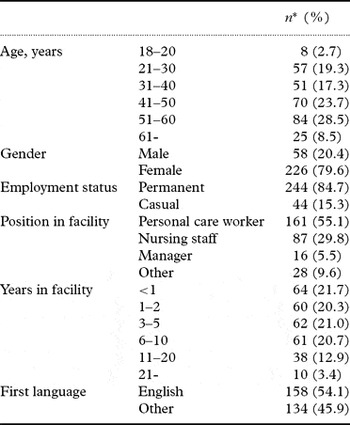
The eligible sample size was 500 care staff, of whom 297 (59.4%) returned completed questionnaires by the end of the study. As shown in Table 1, the final sample consisted mostly of female staff members (79.6%) aged 40 years and over (60.7%). The majority of participants worked as personal care workers (55.1%) and had permanent positions in the facilities (84.7%). Most participating staff members had five years or less work experience in the facility (63%), and only a small majority of participating staff had English as their first language (54.1%).
Participant characteristics (n = 297)

*n does not add up to 297 in all variables due to missing data.
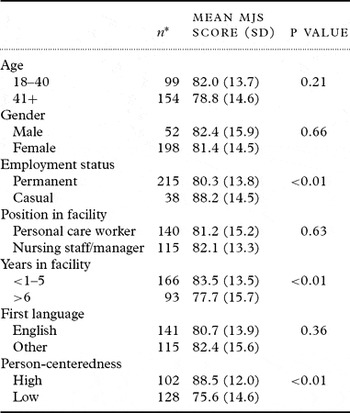
As illustrated in Table 2, participants employed on a casual basis, with five years or less work experience at the facility in question, as well as participants rating the person-centeredness of the facility as being higher reported significantly higher job satisfaction as compared with participants with permanent positions, with six years or more work experience, and who rated the person-centeredness as being lower.
Differences in job satisfaction scores between groups

*n does not add up to 297 in all variables due to missing data.
MJS = measure of job satisfaction.
No significant differences in job satisfaction were found for age, gender, position, or English as first or second language. Assessments of reliability of the included scales were satisfactory in the study sample as evidenced by a Cronbach's α of 0.81 and 0.92 for the P-CAT and MJS respectively.
Associations between perceived provision of person-centered care and increased job satisfaction
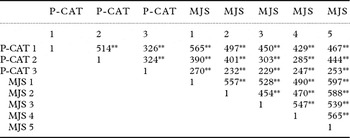
Bivariate correlation analyses were performed to explore associations between aspects of person-centeredness (P-CAT subscales) and aspects of job satisfaction (MJS subscales). As presented in Table 3, these analyses revealed that “personalizing care” had the overall strongest association with four out of five key aspects of job satisfaction: high estimates of “personalizing care” were associated with higher “personal satisfaction” (r = 0.57, p<0.01), a dimension of job satisfaction which includes feelings of making a worthwhile accomplishment in work, the quality of work with residents, and the amount of personal growth and development received from work. “Personalizing care” was also associated with “satisfaction with workload” (r = 0.50, p<0.01), which includes time available for resident care, and being able to care for residents in a preferred way. “Personalizing care” was also associated with higher estimates of “team spirit” (r = 0.47, p<0.01), and this includes the value placed on one's work by colleagues and being part of a team. The fourth aspect of job satisfaction that was strongly associated with possibilities of “personalizing care” was receiving “professional support” (r = 0.45, p<0.01), and this dimension of job satisfaction includes opportunities to discuss concerns, supportive structures available, and fair treatment from superiors. Regarding the remaining two dimensions of person-centeredness within the P-CAT, “organizational support” was significantly correlated with all five aspects of job satisfaction (r-values ranging between 0.30 and 0.44, p<0.01), and so was “environmental accessibility”, even if these associations were less strong (r-values ranging between 0.23 and 0.27, p<0.01). As also presented in Table 3, the correlation coefficients between predictor variables ranged between a mere 0.32 and 0.51, and thus multicollinearity problems in the regression model were not present.
Bivariate correlations between the P-CAT and the MJS subscales

** Correlation is significant at the 0.01 level (2-tailed).
P-CAT = person-centered care assessment tool; MJS = measure of job satisfaction.
Person-centeredness as a predictor of staff job satisfaction
A regression model was constructed to explore the extent to which perceived person-centeredness could predict staff job satisfaction. The model consisted of the three subscales of the P-CAT as predictor variables, and the job satisfaction total score as the continuous dependent variable. Initial explorative analyses showed that data met the assumptions of multiple linear regression as few outliers were detected, and data were normally distributed with a straight-line relationship between expected and observed values.
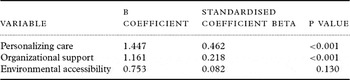
As presented in Table 4, the regression model comprising the three P-CAT subscale predictor variables accounted for 40% of the variance in job satisfaction scores (p<0.001). “Personalizing care” had the largest independent influence on job satisfaction, followed by “amount of organizational support” and “degree of environmental accessibility”. The first two predictor variables, “personalizing care” and “amount of organizational support”, had a statistically significant unique influence (p<0.001) in predicting job satisfaction.
Multiple linear regression analysis for P-CAT subscale variables predicting job satisfaction

R = 0.64, R2 = 0.41, Adj R2 = 0.40.
Discussion
This study aimed to explore if staff perceptions of the provision of person-centered care was associated with increased job satisfaction, and if so, to what extent perceived person-centredness could predict job satisfaction. It was found that perceived person-centered care provision was significantly associated with job satisfaction in staff, and that person-centered care provision could explain nearly half of the variation in job satisfaction among residential aged care staff.
Perceptions that care provided was person-centered were significantly associated with increased job satisfaction of staff in all five job satisfaction dimensions studied: increased personal satisfaction, having a more balanced work load, higher estimates of team spirit, receiving more professional support, and enhanced satisfaction with training. This means that personalized care provision (i.e. using the life history of the resident in care, focusing on the relationship with residents ahead of care tasks, altering work routines in favor of residents’ preferences, and involving residents in individualized everyday activities) is strongly associated with increased feelings of worthwhile accomplishment, increased quality of work and personal growth, but also with being increasingly able to care for residents in their preferred way and increased value placed on one's work by colleagues. These findings make a significant contribution to the literature by presenting a statistical model that explains such a large amount of job satisfaction among staff in residential aged care. The findings also support the notion that being able to provide person-centered care (i.e. focusing on needs and wishes of the residents and promoting meaningful activities and a good and normal everyday life) is significantly related to increased job satisfaction for staff (Drebing et al., Reference Drebing, McCarty and Emerson Lombardo2002; Morgan et al., Reference Morgan, Stewart, D'Arcy, Forbes and Lawson2005; te Boekhorst et al., Reference te Boekhorst, Willemse, Depla, Eefsting and Pot2008). It seems that to prevent dissatisfaction among staff, and to prevent staff from abandoning their important job in residential aged care, organizational models built on a person-centered philosophy of care, flexible management principles, and staff support structures, need to be developed. This can enable a shift of focus from the tasks and routines in residential aged care towards making possible the implementation of person-centered care at the individual, environmental, and organizational levels of care provision (Cohen-Mansfield and Bester, Reference Cohen-Mansfield and Bester2006; Vernooij-Dassen et al., Reference Vernooij-Dassen2009).
Furthermore, the aging population in combination with the negative image and low job satisfaction in the residential aged care sector risks escalating the expected mismatch between demand and supply for residential aged care services (Drebing et al., Reference Drebing, McCarty and Emerson Lombardo2002; Australian Nursing Federation, 2009; Vernooij-Dassen et al., Reference Vernooij-Dassen2009). Thus, to promote job satisfaction and to attract and retain staff in residential aged care staff should be provided with the opportunity to provide the care they want to provide: person-centered care in which the residents and their needs, habits, interests and wishes are given highest priority. Previous studies have shown that such care has beneficial outcomes for residents (Fossey et al., Reference Fossey2006; Hoeffer et al., Reference Hoeffer2006; Chenoweth et al., Reference Chenoweth2009; McCormack et al., Reference McCormack2010; Palese et al., Reference Palese, Granzotto, Broll and Carlesso2010), and the findings of this study suggest that such care is also associated with increased job satisfaction of care staff.
Also in line with previous studies, this study found that staff who are relatively young in the aged care industry (with less work experience and in casual employment) had significantly higher job satisfaction. Zimmerman and colleagues (Reference Zimmerman2005) found similar trends, and it seems that new members of staff who enter the aged care work sector with person-centered attitudes might face a system often based on routine work and task-oriented attitudes to care and as a result their person-centered care attitudes might erode over time. There seems to be evidence enough in the literature to indicate that staff throughout their professional career need to be provided with support systems and a reflective practice setting in which ongoing discussions can occur as to how best to reconcile the sometimes competing demands of completing basic care tasks and having valuable and meaningful social interactions. Clinical supervision, reflective practice sessions and/or continuous quality assessments have previously been suggested (Hallberg and Norberg, 1993; Berg et al., Reference Berg, Welander-Hansson and Hallberg1994; Edberg and Hallberg, Reference Edberg and Hallberg1996; Olsson et al., Reference Olsson, Björkhem and Hallberg1998; Edvardsson et al., Reference Edvardsson, Sandman, Nay and Karlsson2009).
In addition to contributing to literature on the work situation of residential aged care staff, the findings of this study also add insights into the literature on person-centered care and its associated outcomes. To date, most empirical studies on person-centered care have either focused upon its potential outcomes for residents/patients (i.e. the people for whom care is being provided) in different contexts, or focused on qualitative descriptions of the concept, its content and possible associations (e.g. Nolan et al., Reference Nolan, Davies, Brown, Keady and Nolan2004; Ryan et al., Reference Ryan, Nolan, Enderby and Reid2004; McCormack and McCance, Reference McCormack and McCance2006). However, this study provides preliminary evidence to suggest that providing person-centered care can also have beneficial outcomes for staff in terms of increased satisfaction with their work. Thus, the findings represent a significant contribution to the current knowledge base of person-centered care, as this concept has been criticized for being merely a politically correct buzz word in contemporary health policy rhetoric for which statistical evidence of outcomes have remained scarce (Packer, Reference Packer, Keady, Clarke and Adams2003; Edvardsson et al., Reference Edvardsson, Sandman, Nay and Karlsson2008a).
Limitations
The study has some limitations that need consideration when interpreting the findings. The convenience sampling strategy limits the ability to make solid external generalizations based on rigorous demands for representative sampling. However, it seems reasonable to interpret the findings as having theoretical generalizability as they highlight an issue of much contemporary interest even though empirical studies are limited. Nevertheless, the findings from the regression model need to be applied with caution until further evidence has been presented from replication studies. In addition, the cross-sectional nature of collected data limits causal interpretations, and it is not known whether person-centeredness increases job satisfaction or if high job satisfaction increases the person-centeredness of residential aged care. This underscores the necessity of testing these findings in other samples from other settings to confirm or challenge the regression model. In addition, even though the regression model explained 40% of job satisfaction, this means that there are still additional factors influencing the job satisfaction of residential aged care staff that remain to be explored. It should also be noted that as the study relies on self-report data, it is not known whether or not staff reports correspond to that what is actually happening in the clinical setting. The study would have been strengthened by combining the self-report measures of the P-CAT and the MJS with direct observation of staff behaviors to examine the extent to which clinical practice corresponds with that reported. In addition, as the P-CAT and the MJS are theoretical constructs and to some extent depict ideal care and work satisfaction, it could be questioned how far it is possible to fully achieve their content in a complex aged care setting. It would be interesting to see future studies that further operationalize these measures and map preferences and service viability using choice modeling.
Conclusion
The significant association between perceived person-centered care provision and job satisfaction of aged care staff has clear clinical implications, as it is well-known that aged care staff have a demanding and challenging job and experience high levels of job strain. The findings indicate that providing person-centered care is not just an ideal expressed in policy documents for political correctness, but represents the care that residential aged care staff want to provide, and high levels of person-centered care was quite strongly associated with higher job satisfaction. The findings of this study can also be interpreted as indicating that a focus on tasks and routines is associated with lower job satisfaction of staff. There is a need to provide aged care staff with possibilities to provide the care they want to provide: a humanistic and person-centered care that focuses on promoting quality of life of residents as well as completing care tasks and adhering to organizational routines. Attention needs to be given to staff members entering the residential aged care work force to nurture their satisfaction with work by providing possibilities to provide the high quality, person-centered care that they want to provide throughout their professional career. These issues are in urgent need of attention given the demographic changes and the difficulties in attracting and retaining skilled staff who seek to provide a good level of service for older people in residential care.
Conflict of interest
None.
Description of authors’ roles
D. Fetherstonhaugh and R. Nay designed the study, supervised data collection and wrote the paper. L. McAuliffe collected the data and wrote the paper, with some initial exploratory data analysis assistance by C. Chenco. D. Edvardsson carried out the statistical analyses and wrote the paper.
Acknowledgments
The study was supported by the JO and JR Wicking Trust – Medical and Scientific Research Grants (ANZ Trustees).