Introduction
PM 2.5 and PM 10 that arose from the stationary sources are major factors for the formation of haze.[ Reference Choi and Kang 1 – Reference Wang, Xing, Mathur, Pleim, Wang, Hogrefe, Gan, Wong and Hao 3 ] The technology of polymer filter materials absorption has been widely used for the abatement of above particles. On account of the good corrosion resistance, chemical stability, and thermal stability,[ Reference Saleem, Krammer, Khan and Tahir 4 – Reference Saleem, Krammer and Tahir 6 ] polyphenylene sulfide (PPS) is widely applied in precipitator field of stationary sources. However, the stationary sources are usually existence of the nitrogen oxides emission, which can induce acid rain, photochemical smog, ozone depletion, greenhouse effects, and so on.[ Reference Francesco, Yasser, Isabella and William 7 , Reference Schill, Putluru, Jensen and Fehrmann 8 ] Therefore, development of a kind of PPS filter materials with denitration function is necessary.
Recently, researchers have fabricated a series of the PPS filter materials with the denitration function, and the resultant PPS catalytic filter materials, such as Mn–CeO x /PPSN,[ Reference Liu, Zheng and Wang 9 ] Mn–La–Ce–Ni–O x /PPS,[ Reference Yang, Zheng, Shen, Qiu, Li, Zeng, Shen and Zhu 10 ] and MnO2/PPS,[ Reference Zheng, Zang, Wang, Xu, Liu, Lu and Fan 11 ] exhibit outstanding catalytic activity at low temperature. However, the impregnation method, vacuum suction method, and ultrasonic method were usually used to prepare PPS catalytic filter materials, which are all bad for the dispersion of activity component, the operation, as well as the binding strength between activity components and PPS. Hence, it is necessary to develop a simple in situ synthesis method for the preparation of PPS catalytic filter materials with well-dispersed activity component and high binding strength.
Given this, a novel in situ synthesis method for the Mn-CeO x /PPS catalytic filter material was initiated, and the preparation procedures were as follows: PPS filter was first activated by nitric acid, which would introduce oxygen functional groups, and be favor of the adsorption of Ce3+ due to the ionization of CeCl3. Then the Ce(OH)3 and HCl were generated on PPS filter due to the part hydrolyzation of CeCl3. Subsequently, the MnO2 was in situ formed on PPS filter attributing to the redox reduction between KMnO4 and HCl, and the Ce(OH)3–MnO2/PPS samples were synthesized. Finally, the Mn-CeO x /PPS denitration filter materials were fabricated through a heating dehydration treatment of Ce(OH)3-MnO2/PPS samples; and the as-prepared PPS denitration filter materials were denoted as y Mn–CeO x /PPS, where y represents the quality ratio of KMnO4/PPS.
Results and discussion
Catalytic activity
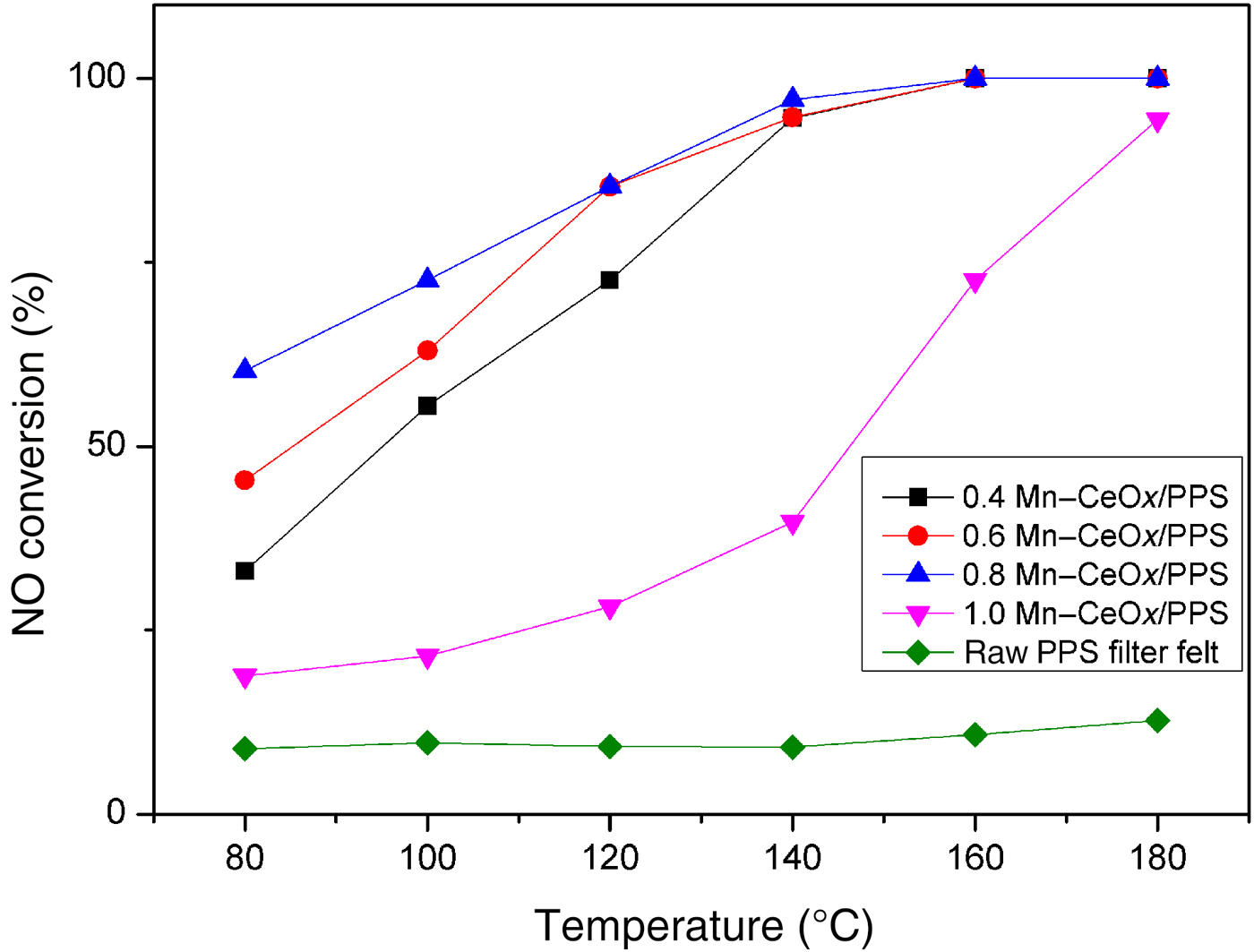
The SCR activity tests were evaluated in a fixed-bed quartz reactor and gas composition included 440 ppm NH3, 440 ppm NO, and 5% O2, which are all balanced by N2. The NO conversion versus temperature for PPS catalytic filter materials was displayed in Fig. 1. As shown in Fig. 1, the pristine PPS filter felt shows 8–15% NO conversion in the test temperature range. The 0.4, 0.6, and 0.8 Mn–CeO x /PPS filter felt present better denitration activities in the test temperature range of 140–180 °C, and the denitration efficiencies could almost reach 100% at 160 °C at a high space velocity of 210,000 mL/gcat/h. It should be noted that denitration activity of the 0.8 Mn–CeO x /PPS filter is optimum in the test temperature range (80–180 °C), and could achieve 100% NO conversion at 140 °C. However, the catalytic activity of 1.0 Mn–CeO x /PPS filters is lower in the test temperature range, which may be ascribed to the excessive loading of activity components.
Effect of reaction temperature on NO conversion of the raw PPS filter felt and y Mn–CeO x /PPS filter felt. Reaction conditions: [NO] = [NH3] = 440 ppm, [O2] = 5%, N2 as balance gas, weight hourly space velocity (WHSV) = 210,000 mL/gcat/h.

Field emission scanning electron microscopy (FESEM) images
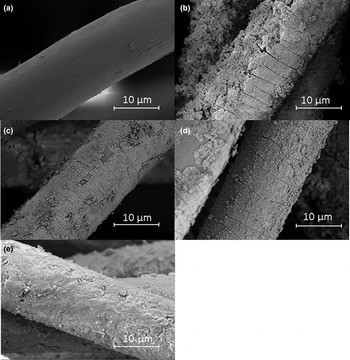
In Fig. 2(a), it is evident that pristine PPS exhibits regular morphology. For Mn–CeO x /PPS samples [Figs. 2(b)–2(e)], the nanospecies could be observed on PPS external surface after the introduction of activity components, revealing the formation of activity components on the surface of PPS. It can be also seen that the surface of the PPS filter where the catalyst gradually appeared crack and massive spalling with the growth of y. With the increase in the loading, compound PPS bag filter displays dehiscent external surface. The above results may be resulted from the aggregate activity of the components. Generally, the agglomerate components were not good for the catalytic activity, which was consistent with the conclusions of NO conversion.
FESEM images of PPS filter felt (a), 1.0 Mn–CeO x /PPS (b), 0.8 Mn–CeO x /PPS (c), 0.6 Mn–CeO x /PPS (d), and 0.4 Mn–CeO x /PPS (e).

X-ray photoelectron spectroscopy (XPS) results
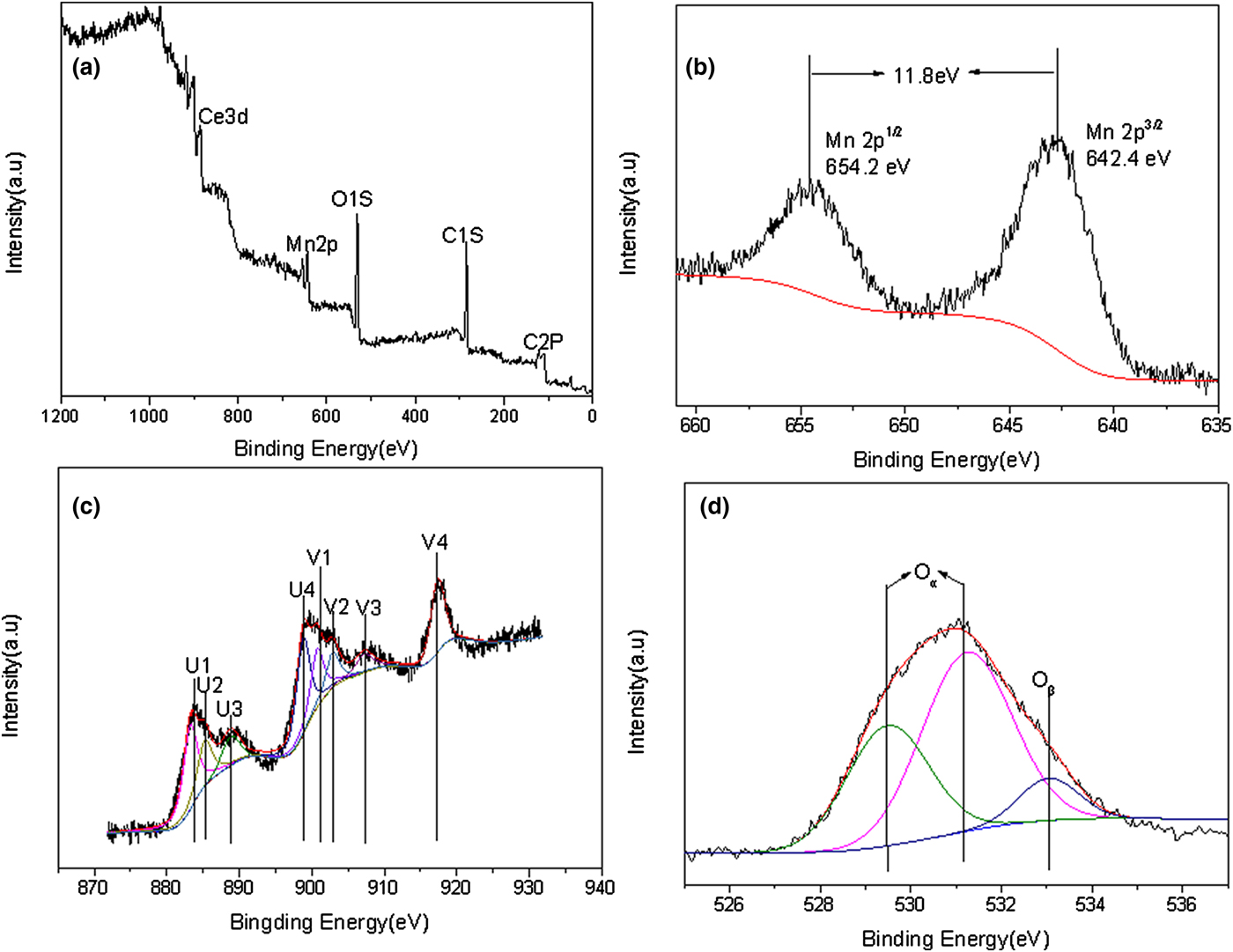
The XPS was used to analyze the concentration of atoms and the chemical states of elements in the near-surface region of 0.8 Mn–CeO x /PPS catalytic filter material. According to the XPS total spectrum, the signals of Mn, Ce, C, and O could be detected, indicating the presence of Mn, Ce, C, and O elements. The binding energy of Mn 2p 3/2 for MnO2 is 641.1–642.2 eV, which is in line with the previous studies[ Reference Wang, Zheng, Xu, Wang and Chen 12 ]. Besides, the energy gap of 11.8 eV between Mn 2p 3/2 (643 eV) and Mn 2p 1/2 (654.8 eV) could be found in Fig. 3(b), further evidencing the formation of MnO2.
(a) XPS full spectrum and (b) Mn 2p spectrum of 0.6 Mn–CeO x /PPS; (c) Ce 3d and (d) O 1s spectra for 0.6 Mn–CeO x /PPS.
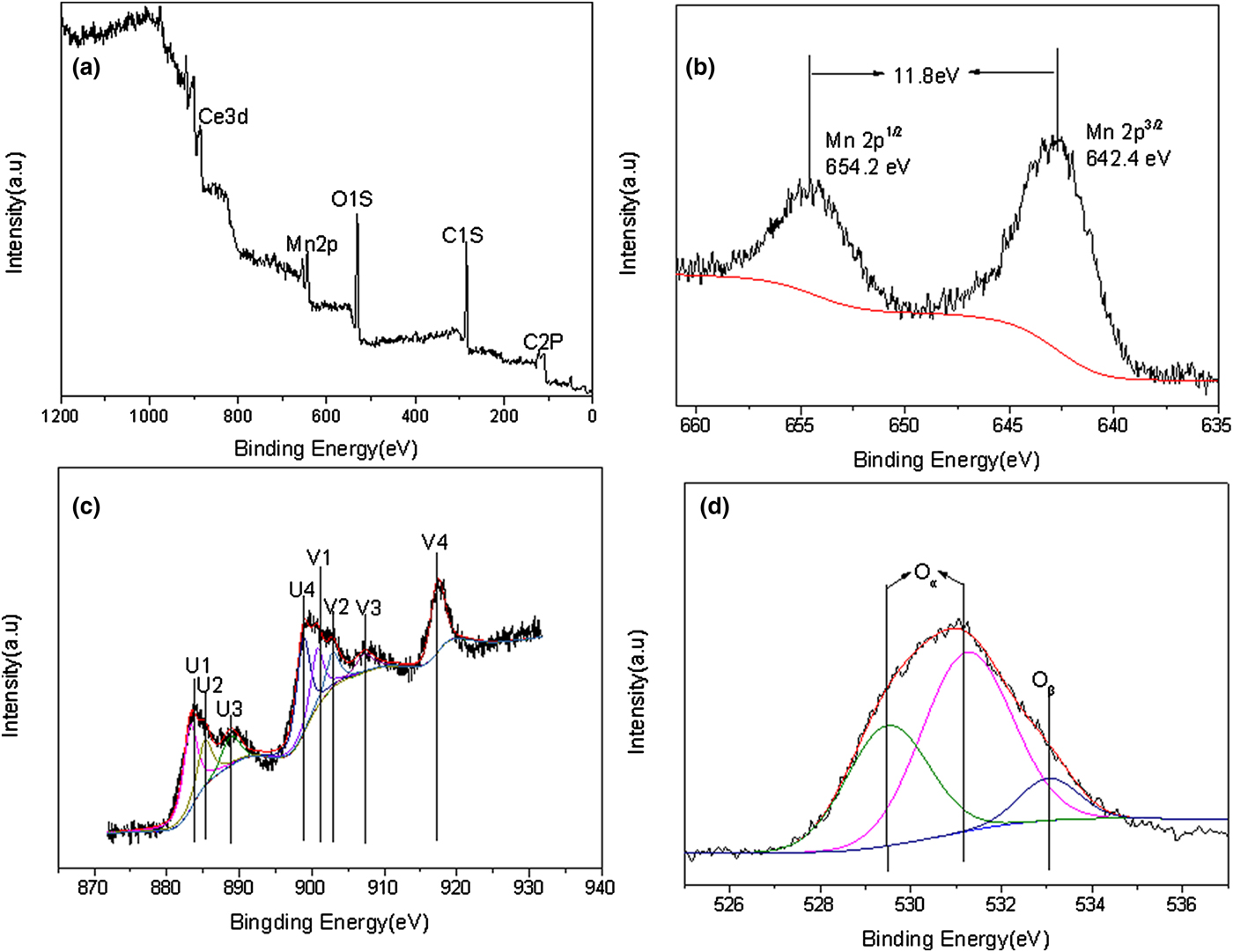
By the peak-fitting deconvolution, eight characteristic peaks originated from the Ce 3d spectra [Fig. 3(c)] of PPS catalytic filter felt could be obtained. The peaks denoted as U1 (883 eV), U3 (888.6 eV), U4 (898.6 eV), V1 (901.3 eV), V3 (907.3 eV), and V3 (916.9 eV) were indexed to Ce4+ species, whereas U2 (885.2 eV) and V2 (902.9 eV) were correlated to the Ce3+ species. In light of the above results, it could infer the coexistence of Ce3+ and Ce4+ species.[ Reference Wu, Jin, Liu and Wang 13 , Reference Qiu, Meng, Pang, Zhang and OuYang 14 ] The O 1s spectrum [Fig. 3(d)] of catalytic filter felt was fitted into three peaks. The peak located at 531.5 eV was corresponded to the lattice oxygen (O β ), and the binding energies between 529.5 and 532.2 eV were ascribed to the surface oxygen (O α ).[ Reference Shen, Ma, He and Zhang 15 ]
Transmission electron microscopy (TEM) images
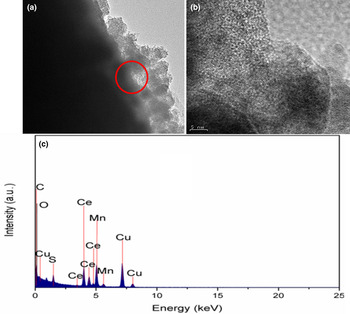
The morphologies of PPS catalysts filter materials were listed in Fig. 4. Nanoflake-like species could be seen on the surface of acid-treated PPS after being supported by Mn–Ce mixed oxide catalysts [Fig. 4(a)]. Moreover, Fig. 4(b) revealed that the inapparent lattice fringe of manganese oxides or cerium oxides observed from high-resolution TEM (HRTEM) of 0.6 Mn–CeO x /PPS, implying weakly crystalline Mn–Ce mixed oxide catalysts. Normally, MnO x with weakly crystalline structure is in favor of the low-temperature catalytic activity.[ Reference Jin, Liu, Wu, Wang and Gu 16 – Reference Min, Park, Kom and Yie 19 ] Furthermore, Fig. 4(c) corresponding to the energy dispersive X-ray spectroscopy (EDX) spectrum presents the signals of Mn, Ce, O, S, and C elements, demonstrating the formation of Mn–Ce mixed oxide catalysts on the surface of PPS.
TEM and HRTEM of PPS-based catalysts: (a) and (b) 0.6 Mn–CeO x /PPS; (c) EDX spectrum of 0.6 Mn–CeO x /PPS from the annular region of Fig. 4(a).

X-ray diffraction (XRD) patterns
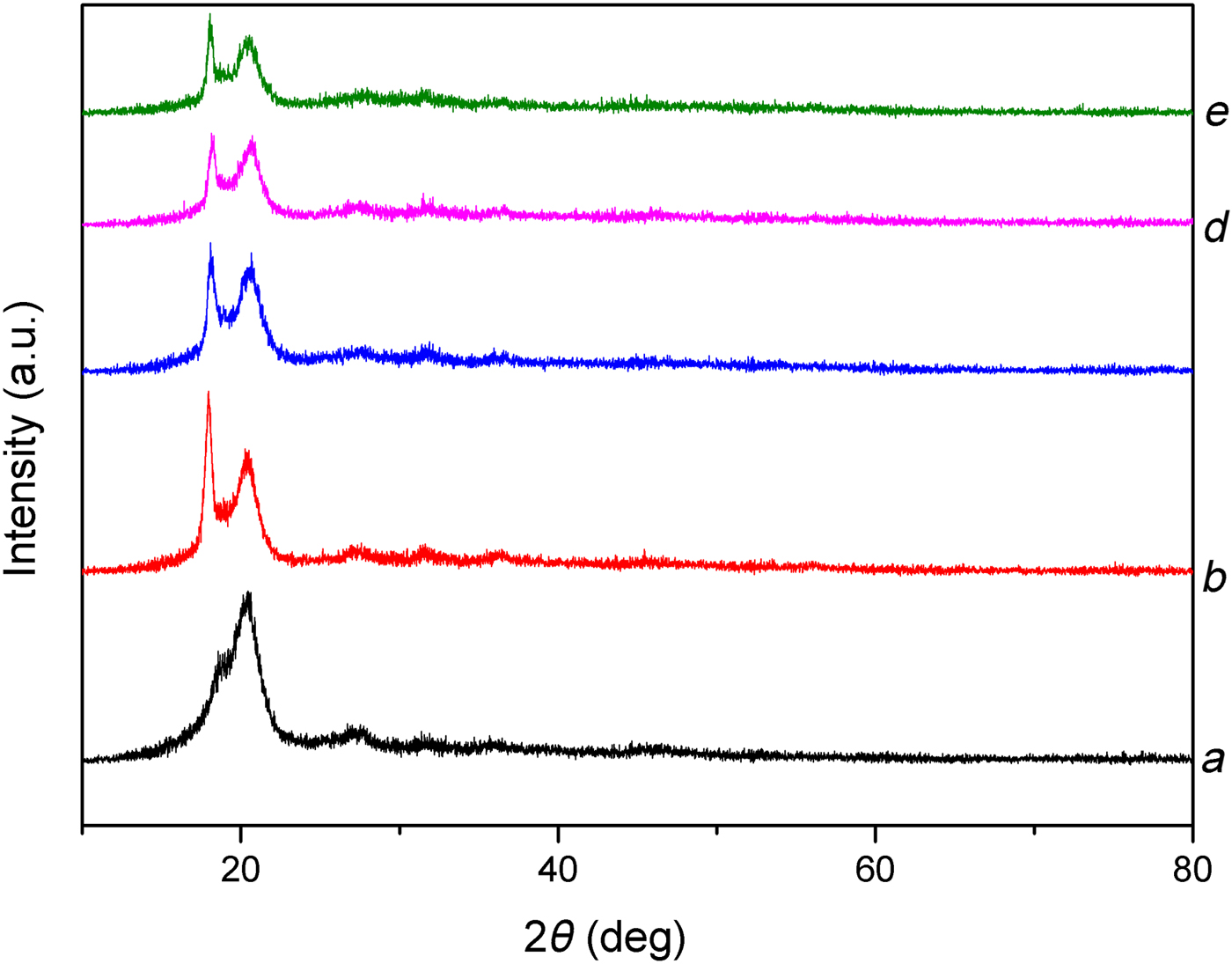
Figure 5 illustrates the XRD patterns of the acid-treated PPS filter, 0.4 Mn–CeO x /PPS, 0.6 Mn–CeO x /PPS, 0.8 Mn–CeO x /PPS, and 1.0 Mn–CeO x /PPS. It was observed from Fig. 5 that all samples presented two sharp and some weaker typical PPS peaks. After being loaded by Mn–Ce mixed oxide activity components, the diffraction peak intensity corresponding to PPS became weaker, which may be resulted from the interaction between active components and PPS. It should be pointed out that the typical peaks of MnO2 could not be detected, suggesting its highly dispersed or weak crystalline characteristic, which was related to the HRTEM results.[ Reference Guo, Liu, Pan, Zhen, Chen, Chen, Ding and Yang 20 , Reference Wang, Peng, Peng, Yu and Yang 21 ]
XRD patterns of (a) acid-treated PPS filter; (b) 0.4 Mn–CeO x /PPS; (c) 0.6 Mn–CeO x /PPS; (d) 0.8 Mn–CeO x /PPS; (e) 1.0 Mn–CeO x /PPS.

Conclusions
A novel in situ synthesis strategy was employed to fabricate the Mn–CeO x /PPS denitration filter materials, and the resultant Mn–CeO x /PPS denitration filter materials possessed outstanding denitration activity in the test temperature range (80–180 °C). Among them, the 0.6 Mn–CeO x /PPS sample exhibits the optimal low-temperature denitration activity, which was benefited from its good low-temperature reducibility, weak crystallinity, and highly dispersed properties.
Supplementary material
The supplementary material for this article can be found at https://doi.org/10.1557/mrc.2017.120
Acknowledgment
This work was supported by the Scientific and Technological Program-Funded Project of Fuzhou City (Grant No. 2015H0016).