Introduction
The Atka mackerel Pleurogrammus monopterygius is an important commercial fishing species in the North Pacific (Lowe et al., Reference Lowe, Ianelli, Wilkins, Aydin, Lauth and Spies2008; Antonov et al., Reference Antonov, Klovatch, Orlov, Datsky, Lepskaya, Kuznetsov, Yarzhombek, Abramov, Alekseev, Moiseev, Evseeva and Sologub2016). It is an iteroparous species with batch spawning and complicated mating and brooding behaviour (Gorbunova, Reference Gorbunova1962; McDermott and Lowe, Reference McDermott and Lowe1997; Cooper and McDermott, Reference Cooper and McDermott2011). Atka mackerel have separate feeding and spawning areas. Spawning takes place from the end of May until August near Komandor and the Aleutian Islands, from June to September near East Kamchatka and the North Kuril Islands, and from September to the end of November in the Gulf of Alaska. After spawning, males migrate from deep water to coastal areas and aggregate on rocky ground to compete for territories within nesting colonies. Females spawn demersal and adhesive eggs, while males with bright nuptial coloration stay near the nest to guard clusters of eggs (Zolotov, Reference Zolotov1993; Lauth et al., Reference Lauth, Guthridge, Nichol, McEntire and Hillgruber2007, Reference Lauth, Guthridge, Cooper and McEntire2010). The Atka mackerel is gonochoristic: with individuals developing into males or females only, and remaining the same sex throughout their life spans (McDermott and Lowe, Reference McDermott and Lowe1997).
Intersexuality is defined as the presence of female and male tissue in the same gonad. The occurrence of bisexual gonads has been described in many marine fishes from the families Muraenidae, Clupeidae, Gobiidae, Labridae, Nototheniidae, Lethrinidae, Serranidae, etc. (Devlin and Nagahama, Reference Devlin and Nagahama2002; Bahamonde et al., Reference Bahamonde, Munkittrick and Martyniuk2013), but has not been confirmed for species of the family Hexagrammidae.
In recent year, histological analyses of large-scale annual commercial catches have detected a presence of intersex in Atka mackerel. The purpose of this study is to describe the morphology and histology of ovotestis and report the possibility of intersexuality in this species.
Materials and methods
Specimen with intersexual gonads were caught on 14 April 2019, near the south-east coast of the Kamchatka peninsula (54°51.3′N, 162°17.0′E, 190 m depth), during commercial fishing by the vessel FV Kamlayn. All fish from the trawl were freshly dead as a result of long-term trawling operations. No experiments were conducted on live fish using chemical agents or surgery, and no procedures causing distress or harm were used.
Biological data from 880 normal males and females were used for comparison. These fish were caught from the same area (54°36.8′N–55°05.8′N, 162°10.7′E–162°17.2′E) during the same period (13–17 April 2019).
Individual Atka mackerel were measured for total length and total weight, gutted, and gonadal weight. Gonadosomatic index (GSI, %) was calculated as the ratio of gonad mass to body weight without viscera. Fulton’s condition factor (K, %) was defined as the ratio of body weight without viscera to cubic length. Age was determined by the otoliths.
For histological analysis, the gonads were fixed in Bouin’s fluid. The samples were then dehydrated, cleared with xylol, embedded in paraffin and sectioned at 4 µm, then stained with haematoxylin and Ehrlich’s eosin (H&E). Histological sections were viewed under a light microscope (Olympus BX45) equipped with a digital camera (Leica DC 100) and staged according to methods described by Brown-Peterson et al. (Reference Brown-Peterson, Wyanski, Saborido-Rey, Macewicz and Lowerre-Barbieri2011).
Results
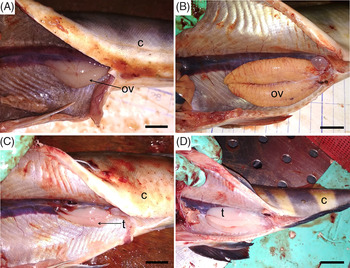
The intersex fish were caught from pre-spawning schools with a sex ratio of 75% females to 25% males. The gonads of all Atka mackerels were in the immature (3%) or developing (97%) phases (Fig. 1). Individual with ovotestes had olive-grey body coloration, comparable with other females in the same catch (Fig. 2a). In contrast, males were yellow with dark stripes, consistent with a nuptial appearance (Fig. 1d).
Atka mackerel Pleurogrammus monopterygius with normal gonads: immature (a) and developing (b) ovaries; immature (c) and developing (d) testes. c, body coloration; ov, ovaries; t, testes. Scale bars, 1 cm (a, c, d), 2 cm (c).

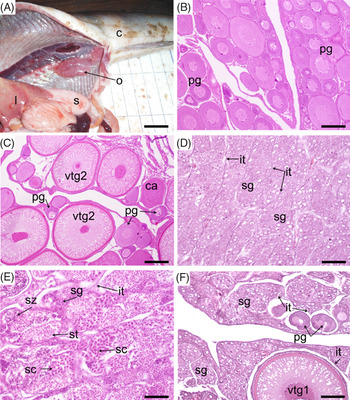
Atka mackerel Pleurogrammus monopterygius bisexual (a, f) and normal (b–e) gonads. (a) Bisexual gonads: o, ovotestis; l, liver; s, stomach; c, body coloration. (b) Immature ovary. (c) Developing ovary. (d) Immature testis. (e) Developing testis. (f) Ovotestis cross-sections. ca, cortical alveolar; H&E, haematoxylin–eosin stain: it, interstitial tissue; pg, primary growth; sg, spermatogonia; st, spermatids; sz, spermatozoa; vtg1, primary vitellogenic; vtg2, secondary vitellogenic oocytes; sc, spermatocytes. Scale bars, 2 cm (a); 100 μm (b, f); 200 μm (c); 50 μm (d, e).

Fish with normal developing gonads have an average length of 39.6 cm ± 2.0 standard deviation (SD), age 7.9 years ± 1.4 SD, weight 741.4 g ± 120.0 SD, and K factor 1.11 % ± 0.1 SD. The intersex fish were relatively small and young (34 cm and 5 years old) and were similar in size and age to immature males and females (35 cm ± 4.2 SD, 5.6 years ± 1.5 SD). However, both weight (550 g) and K factor (1.3 %) were greater than in individuals with immature gonads (422.3 g ± 115.6 SD; 1.0 ± 0.1 SD).
The ovotestis appeared macroscopically normal ovary of early developing subphase and visually this fish was determined as a female (Fig. 2a). It was relatively small; the GSI was 0.4%. The GSI of other females with immature and developing ovaries was 0.8 % ± 0.4 SD and 2.2 % ± 0.7 SD, respectively.
In gonads of immature females, only primary growth oocytes were presented in the ovaries (Fig. 2b). The most advanced germ cells in developing ovaries were represented by vitellogenic oocytes. Also observed were primary growth and cortical alveolar oocytes (Fig. 2c). Immature male gonads contained cysts with spermatogonia (Fig. 2d). Spermatogonia, spermatocytes, spermatids and spermatozoa were observed in developing testes. This indicates that active spermatogenesis was ongoing (Fig. 2e).
Histological analysis revealed the presence of both male and female germ tissue mixed inside the ovotestis. Only thin connective and interstitial tissue layers separated the female and male germ cells. The female portion was in the developing phase, consisting of primary growth, cortical alveolar and primary vitellogenic oocytes. The testis part contained only cysts with spermatogonia (Fig. 2f).
Discussion
The gonadal morphology of Atka mackerel and the clearly presence of ovarian and testicular tissue confirmed that it is an intersexual individual. This sexual pattern is uncommon in all the Hexagrammidae family. Moreover, the most representative of families from the order Scorpaeniformes (which includes Hexagrammidae) are gonochoric, as individuals develop into females or males at birth and do not change sex throughout their life span. Protogyny, protandry and bi-directional sex changes have been recorded in some species of the families Caracanthidae and Platycephalidae (Sadovy de Mitcheson and Liu, Reference Sadovy de Mitcheson and Liu2008). However, an Atka mackerel accidental case is a phenomenon of intersexuality (Yamamoto, Reference Yamamoto, Hoar and Randall1969) or abnormal hermaphroditism (Atz, Reference Atz, Armstrong and Marshall1964). Unusual occasional intersexes have been reported in some wild populations of marine fishes (Devlin and Nagahama, Reference Devlin and Nagahama2002; Bahamonde et al., Reference Bahamonde, Munkittrick and Martyniuk2013; Zhukova and Privalikhin, Reference Zhukova and Privalikhin2015; Tancioni et al., Reference Tancioni, Caprioli, Dawood, Khafaji, Mancini, Boglione, Ciccotti and Cataudella2016; Zhukova et al., Reference Zhukova, Gordeev and Kuznetsova2018).
The intersex fish were young and small compared with the age and size of sexually mature Atka mackerel from our catches and elsewhere (McDermott and Lowe, Reference McDermott and Lowe1997; Cooper et al., Reference Cooper, McDermott and Ianelli2010), and it is likely that they had not had the opportunity to spawn in previous years.
Both weight and Fulton’s condition factor were greater than in fish with the same length and normal gonads. This increase in nutritional condition may be the result of increased somatic growth as the intersex fish did not spend energy on sex cell development: no spermatogenesis or active vitellogenesis in gametes occurred (McBride et al., Reference McBride, Somarakis, Fitzhugh, Albert, Yaragina, Wuenschel, Alonso-Fernandez and Basilone2015). Coloration of intersex was peculiar for female or nonbreeding male (Lauth et al., Reference Lauth, Guthridge, Cooper and McEntire2010).
The ovotestes were characterized by normal conditions of oocytes and spermatogonia (Fig. 2f). The composition and condition of the female and male germ cells were comparable with those of the normal developing ovary (Fig. 2с) and immature testis (Fig. 2d), respectively. According to Sadovy and Shapiro (Reference Sadovy and Shapiro1987), bisexual gonads display an undelimited type of ovotestis in which male and female tissue is not separated by a thick layer of connective tissue.
The appearance of ovotestes in gonochoristic fish populations has been linked to environmental factors and serves as an indicator of environmental stress load on the population (Jobling et al., Reference Jobling, Nolan, Tyler, Brighty and Sumpter1998; Blazer, Reference Blazer2002). However, the observed prevalence of intersex fish was low at less than 0.1%, which most likely indicates a natural level of intersexuality in the Atka mackerel population.
Acknowledgements
We would like to thank the staff of FV Kamlayn (Rosrybflot company) for their assistance with collecting the material.
Financial support
This study was supported by Russian Federal Agency for Fisheries (grant number 076-00005-20 PR ‘Applied research’).
Conflict of interest
None.
Ethical standards
Not applicable.