Whetstones are humble objects, but essential for the maintenance of every kind of edge tool. They occur on most archaeological sites in Roman Britain, but are rarely given systematic, scientific attention as regards their geological character and provenance. This note describes the typology and lithology of a large whetstone ‘bar’ found during a recent evaluation at Tackley, Oxon. (NGR SP 48 20), carried out by Oxford Archaeology South. The evaluation uncovered evidence for early Roman buildings and probable later Roman post-holes, pits and ditches. Within one of these pits was a complete and very large whetstone bar. The pit was dated to the Roman period by a single sherd of Roman pottery. However, the bulk of activity on the site is of Roman date, and there is no reason to suspect any other date for the pit or the whetstone within it. The large size of the bar is highly unusual. An initial assessment indicated that it had similarities in both form and lithology with those from the remarkable group of 100 whetstones recovered from the portico gutter of the forum at Wroxeter,Footnote 93 and it was felt that it warranted further detailed analysis.
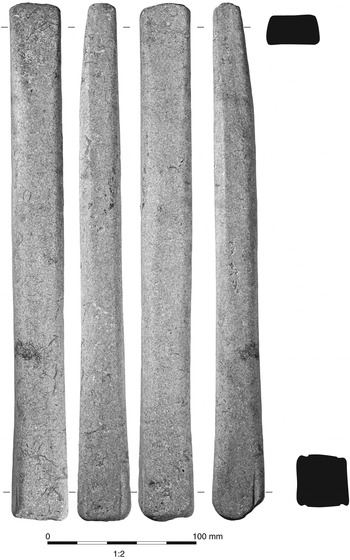
The whetstone measures 337 mm long, with a square section at the unused end measuring 35 by 37 mm ( fig. 5). Both ends are rough, but unbroken, indicating that the object as survives was the whetstone's original length. There are longitudinal scratches towards each end, but the stone has mostly been used for sharpening across one half of its length as demonstrated by distinct bevels across two of the arrises at this end of the stone. The thickness of the bar at the utilised end is approximately half the thickness of the lesser used end ( fig. 5). The large rectilinear shape of the whetstone is comparable to those from Wroxeter, where over 100 examples probably indicate an abandoned market stall.Footnote 94 The Tackley whetstone is marginally longer (the Wroxeter whetstones are between 290 and 305 mm in length) and wider (the Wroxeter whetstones measure 15–18 by 22–24 mm), but of the same general size. Evidence surviving on three short sections of the Tackley whetstone also shows that it was produced by the same method as the Wroxeter whetstones, usefully described by Atkinson thus:
A slab of the stone having been produced and cut to the approximate width of a Roman foot, parallel grooves were cut about 1 inch apart on each side, sufficiently deep to enable the bars to be successively snapped off by a sharp blow.
The rebates that record this cutting are present only towards the ends of the Tackley bar, either because they were partially removed during further finishing or because they were worn away during its life. Unlike the Wroxeter whetstones, the Tackley example has been extensively used, showing that the bars excavated at Wroxeter were not merely for trading as a raw material, but were intended to be utilised as tools in their own right. In light of the similarity in form and size between the Tackley bar and those from Wroxeter, and because of very recent work determining the source of the Wroxeter examples,Footnote 95 it was decided to analyse the Tackley example in more detail.
The Tackley whetstone showing all four long sections and two cross sections.

LITHOLOGY
In hand-specimen the whetstone is superficially iron-stained, but the natural colour, visible locally, appears to be light olive grey (Munsell 2.5GY6/1-7/1). The rock is a fine- to medium-grained quartz sandstone with a very strong calcareous cement, the bar emitting a musical note when suspended from one end by the fingers and lightly struck half way down. No traces of sedimentary lamination could be found. Scattered fossils are present. Two centimetre-scale, strongly curved bivalve mollusc shells can be seen at the smaller end of the whetstone. A few ostracod valves are scattered over the surface of the bar. Dispersed through the rock are dark grains up to 2 mm across, which could be carbonaceous. Mica flakes are occasionally seen.
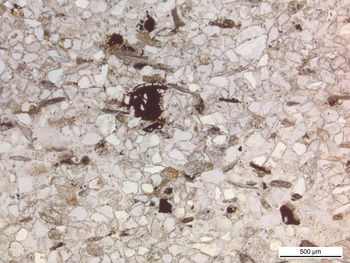
Removing the minimum of material from the narrow end of the bar, a thin-section was prepared for examination under a petrographic microscope ( fig. 6). The rock is an extremely well-sorted, calcareous sandstone dominated by angular–subangular, commonly etched simple quartz, with occasional compound grains showing a stretched fabric, some with parallel muscovite flakes. Grains of finely to coarsely microcrystalline chert are rare to common. Feldspars (orthoclase, microcline) are very rare, as are grains of yellowish-green to dark green glauconite. Muscovite flakes are scattered throughout the rock. Bioclastic debris is common. It includes very occasional foraminifera and grains of echinoderm origin, but is overwhelmingly dominated by straight to curved shell fragments a small fraction of a millimetre thick that probably represent ostracods. There is a scattering of phosphatic fragments, probably fish bones, teeth and scales. Thinly dispersed throughout the rock are dark grains similar to or larger in size than the associated quartz sand. In transmitted light these are opaque, but occasional examples exhibit anatomical structure; reflected light shows this property to be much more prevalent, and also reveals that the opaque particles are heavily pyritised. Some bioclastic grains also exhibit pyritisation and tiny pyrite framboids prove to be common throughout the thin-section from the whetstone. The opaque grains are interpreted as charred plant material. The detrital grains are firmly bonded by a continuous calcite cement that is lustre-mottled on a millimetre scale.
The Tackley whetstone in thin-section as viewed in ordinary light. Note the anatomical structure in the opaque fragment of charred plant material in the upper-middle of the field of view.

The Tackley whetstone is closely comparable in hand-specimen and thin-section appearance with the large group of whetstones recovered by Donald Atkinson from Roman Wroxeter. These have recently been the subject of detailed scientific examination.Footnote 96 The Tackley and Wroxeter specimens are similar in colour, cementation, quality of sorting, and grade, the former being slightly the coarser grained. The main detrital components are quartz with a little chert and very rare feldspar, but each carries a significant proportion of very thin-shelled bioclastic material, interpreted as ostracods, together with charred plant material and a scattering of glauconite. The Wroxeter whetstones most closely resemble in their petrography and detrital mineralogy the sandstones present in the Weald Clay Formation (early Lower Cretaceous) of the western/north-western Weald,Footnote 97 and are quite distinct from the Kentish Rag (Hythe Beds, Lower Cretaceous) to which they have so far been attributed.Footnote 98
DISCUSSION
Although sandstones from the Weald Clay formation have only recently been identified as a source for whetstones, the identification of the Tackley bar as being of the same lithology as those from Wroxeter is highly significant. It lends credence to Atkinson's theory that there was an organised industry producing and supplying whetstones.Footnote 99 Only a few examples of Wealden sandstone whetstones have yet been conclusively identified and whetstones of comparable size are rare, probably because they could easily have been broken down and reformed into smaller whetstones for other types of sharpening when they wore out. There are, however, a small number of comparable examples including one from New Fresh Wharf in London (thought to be Kentish Rag)Footnote 100 and two from Fiskerton in Lincolnshire, now identified as Wealden sandstone.Footnote 101 The two Fiskerton examples are particularly significant because their dimensions match those of the Tackley bar very closely at 328 by 33 by 31 mm and 350 by 35–37 by 25–27 mm. Although this longer length indicates that the use of the Roman foot as a measurement was not strictly adhered to, the Roman foot may have been a general guide to workshop practice.
It is difficult to analyse the original lengths of these bars because so few of them survive in a complete form, but it is possible to investigate the variation in width and thickness through the presence of the manufacturing rebates. A rapid scan of examples in the published literature with the same shaped rebates reveals slightly more variation in size than within the Wroxeter assemblage. A fragment from the Wroxeter baths is comparable with the Tackley example measuring 28 by 32 mm,Footnote 102 but thicker than the Wroxeter forum range. A fragment from Asthall, some 20 km south-west of Tackley, however, retains all the rebated edges revealing it was only 10 mm thick by 21 mm wide — significantly more slender than either the Tackley or Wroxeter examples.Footnote 103 This limited sample indicates that the thickness and width of whetstones was not strictly controlled. The consistency of the Wroxeter examples would suggest that it was possible to produce whetstones fairly accurately within a single consignment, but the thickness of the whetstones may have been controlled by the characteristics of the material. The stone of many of the whetstones is laminated to a greater or lesser degree and these laminations would have provided an obvious surface along which to separate slabs from one another. However, laminations are not always precisely parallel and can taper. In that case, a slab could be broken into whetstones of varying thicknesses or, if breaking in a different direction, to produce whetstones naturally thinner at one end than at the other. This may, in part, explain the difference between the two ends of the Tackley whetstone.
Whetstone manufacture has been scantily researched, but the Wroxeter and Tackley whetstones provide enough surviving evidence to make some comparison with the evidence of production practice at Usk.Footnote 104 The whetstones from Usk clearly show that they were marked out with a mason's point on the surviving slabs, resulting in a V-shaped profile to the rebates. This is in stark contrast to the examples discussed here, which have square or occasionally U-sectioned rebates; the profile and neatness of which indicates that they were cut with a saw.Footnote 105 In addition to the different marking-out techniques, the whetstones and slabs at Usk are smaller and the slabs had apparently been reduced in length prior to the removal of the whetstones.Footnote 106 They were also less systematically produced with, on occasion, whetstones being removed from two separate (and not parallel) edges.Footnote 107 The smaller size of the Usk whetstones probably relates to the production techniques used. The marking out of whetstones with the use of a point, rather than a saw, may have made the slab more prone to breaking, with the repeated blows putting pressure on the slabs. The manufacture of longer whetstones was probably more complex with this method and probably not worth the risk of breaking the stone.
Comparison between the Usk whetstone slabs and the Wroxeter whetstones indicates that, despite the significant numbers produced, the former were less systematically made, utilising slabs of various shapes, and the resulting whetstones were smaller. The latter were produced in a more controlled way and resulted in whetstones of more standardised (if not absolutely prescribed) sizes. This consistency in comparison with the Usk whetstones, continues to support Atkinson's view of a whetstone industry. It is not clear if the production of larger whetstones would have been considered a technological advancement, but the very early date of the Usk whetstones in comparison with the mid-second-century date of those from Wroxeter, may indicate that the Wroxeter method is later in date and a development of the earlier, and cruder Usk method.
Only further work dating whetstones with manufacturing marks or the recovery of production sites will test this hypothesis, but the evidence indicates that the Tackley whetstone is a part of a much bigger picture. It stems from an industry that managed its product carefully and distributed it over some distance. Further clear recording of whetstones with manufacturing marks will be required to advance our understanding of the range of whetstone sizes likely to have been produced. This should go hand in hand with the detailed analysis required to precisely identify lithology.
ACKNOWLEDGEMENTS
We would like to thank John Jack, University of Reading, for making the thin section and Magdalena Wachnik, Oxford Archaeology South, for the illustration of the whetstone.