

INTRODUCTION
Radiocarbon dates are routinely performed on tree rings of archaeological and naturally deposited wood as a dating tool and/or for determining past atmospheric 14C concentration. When wood remnants are discovered at construction sites and in rivers, lake, and bog sediments, the absolute age often remains completely unknown until a dendrochronological and/or 14C date can be established. The same is true when the date of historical artifacts (e.g. wooden art objects or construction time of buildings) is to be established. 14C dating is of special importance as dendrochronological dating is subjected to many requirements (existence of chronologies, minimum number of rings, species, etc.) and is therefore often not immediately applicable (Cook and Kairiukstis Reference Cook and Kairiukstis2013). While 14C dates are typically applicable, conventional 14C analysis by accelerator mass spectrometry (AMS) is relatively time consuming and expensive.
Conventional 14C AMS measurements of wood involve chemical treatments to extract cellulose (Hoper et al. Reference Hoper, McCormac, Hogg, Higham and Head1998; Brock et al. Reference Brock, Higham, Ditchfield and Bronk Ramsey2010; Němec et al. Reference Němec, Wacker and Gäggeler2010). The cellulose is then converted to graphite by combustion and reduction, which can take several hours (Vogel et al. Reference Vogel, Southon, Nelson and Brown1984; Xu et al. Reference Xu, Trumbore, Zheng, Southon, McDuffee, Luttgen and Liu2007; Wacker et al. Reference Wacker, Němec and Bourquin2010a). The graphitized samples are then analyzed by using an AMS fitted with Cs sputter sources (Vogel et al. Reference Vogel, Southon, Nelson and Brown1984; Fifield Reference Fifield1999; Synal et al. Reference Synal, Stocker and Suter2007; Synal Reference Synal2013), which are capable of high-precision measurements down to 2‰ on a modern sample (Calcagnile et al. Reference Calcagnile, Quarta and D’Elia2005; Wacker et al. Reference Wacker, Bonani, Friedrich, Hajdas, Kromer, Němec, Ruff, Suter, Synal and Vockenhuber2010b, Reference Wacker, Güttler, Goll, Hurni, Synal and Walti2014). This entire process is expensive and it can take over a week to prepare and measure 25 samples along with standards and blanks. As 14C analysis by AMS requires an extraordinary amount of work, many samples that are collected are never dated and remain in storage. Advances in gas measurements of CO2 by AMS (Bronk Ramsey et al. Reference Bronk Ramsey, Ditchfield and Humm2004; Fahrni et al. Reference Fahrni, Wacker, Synal and Szidat2013; Ruff et al. 2007) and coupling of an elemental analyzer (EA) to an AMS (Kieser et al. Reference Kieser, Leung, Krestina, Zhao, Litherland and Cornett2010; Ruff et al. Reference Ruff, Fahrni, Gäggeler, Hajdas, Suter, Synal, Szidat and Wacker2010; Salazar et al. Reference Salazar, Zhang, Agrios and Szidat2015) offer a novel way to 14C date wood samples.
Here, we present a new method, called Speed Dating, that supersedes chemical preparation and graphitization to quickly 14C date wood material. The objective of Speed Dating is to quickly determine (1) if the material falls into a time period interest of where data are scarce and, consequently, (2) whether the site where the material was discovered should be revisited to collect more samples.
METHOD
Sample Preparation and Measurement
All samples, standards, and blanks contained approximately 200 µg of carbon and were wrapped in aluminum capsules (4×4×11 mm, Elementar, Germany). For a standard, we used oxalic acid II (OXII, NIST SRM 4990C), for a chemical blank we used phthalic anhydride (PhA, Sigma-Aldrich, PN-320064-500 g), and as wood process blanks we used brown coal and kauri wood that are both older than 100,000 yr BP. The wrapped material is placed into an EA (vario MICRO cube, Elementar) where the material is combusted by flushing with oxygen for 50 s and the CO2 produced is fed with helium carrier gas into a gas interface system (GIS, Ionplus).
In the GIS, the CO2 is collected in a zeolite trap and then released into a gas syringe. The syringe is used to slowly inject CO2 mixed with helium as carrier gas, into the ion source of a Mini Carbon Dating System (MICADAS, Ionplus) (Ruff et al. Reference Ruff, Fahrni, Gäggeler, Hajdas, Suter, Synal, Szidat and Wacker2010; Wacker et al. Reference Wacker, Fahrni, Hajdas, Molnar, Synal, Szidat and Zhang2013). The carbon concentration is kept consistent for all materials at 100 µg by pumping away excess CO2. The initial setup and tuning is done on CO2 combusted from OXII standard mixed with helium (1:20 v/v). In a procedure of about 15 min, we tune the ionization extraction potential, beam steerers in the x and y direction on the low-energy end, and the low- and high-energy magnets. More details about tuning a MICADAS can be found in Wacker et al. (Reference Wacker, Bonani, Friedrich, Hajdas, Kromer, Němec, Ruff, Suter, Synal and Vockenhuber2010b). The flow rate of CO2 in helium carrier gas is adjusted to obtain maximum 12C– current (Fahrni et al. Reference Fahrni, Wacker, Synal and Szidat2013; Wacker et al. Reference Wacker, Fahrni, Hajdas, Molnar, Synal, Szidat and Zhang2013). Typically, a flow rate of 2.5 µg carbon per minute is supplied to the ion source and a 12C+ current of 6–10 µA is measured in a Faraday cup placed after the accelerator. Detailed measurement parameters of an EA-GIS-MICADAS can be found in Fahrni et al. (Reference Fahrni, Wacker, Synal and Szidat2013). These measurements require minimal supervision.
Approximately 75 samples along with standards and blanks can be analyzed in a day. The EA can hold up to 120 samples at a time and samples can be continuously loaded while measurements are running. The gas cathodes used for the measurement are exchanged in a magazine every 38th sample while the measurement is running. A single sample is measured for 10–12 min, while the total time from combustion in the EA to the end of the 14C analysis takes 13–15 min. The measurement of a single sample can be repeated in case a higher counting statistic, and thus a potentially higher measurement precision, is desired. Samples were bracketed by standards to detect any potential time-dependent variation. The estimated cross-contamination for an EA-AMS setup is less than 0.4% (Ruff et al. Reference Ruff, Fahrni, Gäggeler, Hajdas, Suter, Synal, Szidat and Wacker2010). To limit correction from cross-contamination between samples with large differences in 14C concentration (e.g. measurements of a standard followed by a blank), a duplicate was measured and the first measurement was considered void. Data reduction for Speed Dates and conventional AMS dates were done with the BATS program as described by Wacker et al. (Reference Wacker, Christl and Synal2010c), in compliance with data processing for conventional AMS measurements.
During the course of a measurement, it seldom occurred that a sampled had to be remeasured. This could occur when an aluminum capsule becomes stuck in the EA sampler holder and fails to drop into the combustion tube or the inlet for CO2 on a cathode is closed (Fahrni et al. Reference Fahrni, Wacker, Synal and Szidat2013). These samples could be easily repeated by adding a duplicate at the end.
To evaluate the difference between Speed Dates and conventional AMS dates, samples from AD 770 were cellulose extracted using base-acid-base-acid-bleaching (BABAB) (Němec et al. Reference Němec, Wacker and Gäggeler2010), and graphitized using an EA-AGE-3 (Wacker et al. Reference Wacker, Němec and Bourquin2010a).
DISCUSSION
Blanks and Standards
We measured the carbon content of aluminum capsules (Elementar, Germay) to be ~1 µg by combusting multiple capsules in an EA and measuring the resulting CO2 concentration. To limit the effect of constant contamination from the Al capsules, we used sample weights of 200 µg of carbon. The measured 14C content for the kauri and brown coal process blanks and the phthalic anhydride (PhA) process blank are given in Table 1. The kauri and brown coal process blanks showed a marginally higher level of contamination with a larger standard deviation than the PhA blanks. All blanks were weighed and wrapped in aluminum capsules at the same time and one would expect the same blank value for PhA and the process blanks. However, PhA comes from a stock bottle and the kauri and brown coal blanks are from relatively large pieces of wood that had to be cut into smaller sample sizes. By cutting these pieces of wood, we may have introduced minor 14C contamination that explains the marginally higher 14C content. As all woods were cut, the brown coal and kauri were considered to be appropriate for blank subtraction.
Mean 14C ages for three different blanks: a chemical blank (phthalic anhydride) and two process blanks (kauri and brown coal).

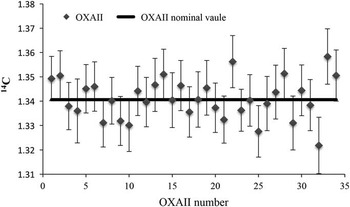
Three measurement campaigns of the standard OXII using the EA-GIS-MICADAS show a scatter that is in good accordance with the quoted measurement uncertainties (Figure 1). Standards were analyzed for 10–12 min until roughly 25,000 counts of 14C were measured. The standard deviation was 0.008. This is due to counting statistics and the additional 0.4% uncertainty we add as sample scatter to account for variability of gas measurements by AMS (Bronk Ramsey et al. Reference Bronk Ramsey, Ditchfield and Humm2004; Fahrni et al. Reference Fahrni, Wacker, Synal and Szidat2013; Wacker et al. Reference Wacker, Fahrni, Hajdas, Molnar, Synal, Szidat and Zhang2013).
Fraction modern (14C) values for 34 OXII samples that were analyzed by EA-GIS-MICADAS. Measurement times were between 10 and 12 min (25,000 counts of 14C).

Measurements and Uncertainties
The uncertainties associated with AMS measurements arise from counting statistics, and the stability of the measurement over time (Wacker et al. Reference Wacker, Christl and Synal2010c). In addition, Speed Dating of untreated wood may have an additional offset compared to conventional AMS dates of cellulose because lignin and other parts of the wood (Gaudinki et al. Reference Gaudinski, Dawson, Quideau, Schuur, Roden, Trumbore, Sandquist, Oh and Wasylishen2005) or contamination from the matrix where samples were stored, which may have younger or older 14C content than cellulose of a specific year.
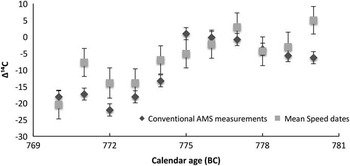
We tested for any offsets of Speed Dating on annually resolved wood samples for the period AD 770–780, i.e. relatively modern wood. We measured this 10-yr period in triplicate and the same samples were dated conventionally (Figure 2). The mean Speed Date uncertainty was ±0.5% (±40 yr).
Mean Speed Dates and conventional AMS measurements for annual resolution between 770 and 780 BC. Speed Dates were done in triplicates.

Two Speed Dates showed a slightly younger 14C age than that of conventional AMS dates of cellulose. This is could be due to lignin or other parts of the wood that change over time as these compounds would introduce younger 14C (Gaudinki et al. Reference Gaudinski, Dawson, Quideau, Schuur, Roden, Trumbore, Sandquist, Oh and Wasylishen2005). If the sample uncertainty is increased to 0.8%, Speed Dates and conventional AMS dates are within 2 standard deviations. In any case, Speed Dating provides a rapid estimate of 14C age for relatively 14C modern samples with acceptable precision.
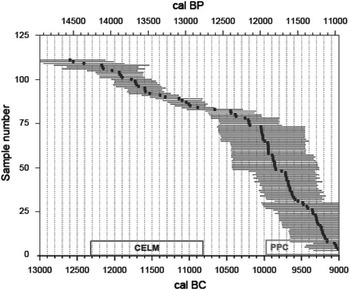
Speed Dating was used to analyze 110 undated subfossil trees that were never 14C dated as a contribution to the ongoing construction and extension of early Holocene and Late Glacial tree-ring chronologies (>10,000 BP). The samples age were determined to be between 14,500 to 11,000 BP with uncertainties of 1–2% (80–160 yr) (Figure 3). These are acceptable uncertainties when the aim is to add a time constraint to material with no chronological context.
Calibrated Speed Dates using IntCal13 (Reimer et al. Reference Reimer, Bard, Bayliss, Beck, Blackwell, Bronk Ramsey, Grootes, Guilderson, Haflidason, Hajdas, Hatté, Heaton, Hoffmann, Hogg, Hughen, Kaiser, Kromer, Manning, Niu, Reimer, Richards, Scott, Southon, Staff, Turney and van der Plicht2013) for 110 samples plotted with two Northern Hemisphere tree chronologies, CELM and PPC (see text). The span of a data point indicates the calibrated calendar age range based on Speed Dating results.

In addition, through Speed Dating we were able to suggest a rough chronological placement for trees that were older than 10,000 BP. The trees were placed around the Central European Lateglacial Master chronology (CELM) (Kaiser et al. Reference Kaiser, Friedrich, Miramont, Kromer, Sgier, Schaub, Boeren, Remmele, Talamo, Guibal and Sivan2012), and the Preboral Pine Chronology (PPC) (Friedrich et al. Reference Friedrich, Remmele, Kromer, Hofmann, Spurk, Kaiser, Orcel and Küppers2004) (Figure 3). Consequently, Speed Dating eliminated a vast majority of samples that were not of interest because these trees overlapped with CELM and PPC where already a large number of trees exist (Friedrich et al. Reference Friedrich, Remmele, Kromer, Hofmann, Spurk, Kaiser, Orcel and Küppers2004; Kaiser et al. Reference Kaiser, Friedrich, Miramont, Kromer, Sgier, Schaub, Boeren, Remmele, Talamo, Guibal and Sivan2012). However, 17 trees fell within the range of 12,700–11,100 BP, a period of time where Northern Hemisphere data are lacking in IntCal13 (Hogg et al. 2013; Reimer et al. Reference Reimer, Bard, Bayliss, Beck, Blackwell, Bronk Ramsey, Grootes, Guilderson, Haflidason, Hajdas, Hatté, Heaton, Hoffmann, Hogg, Hughen, Kaiser, Kromer, Manning, Niu, Reimer, Richards, Scott, Southon, Staff, Turney and van der Plicht2013).
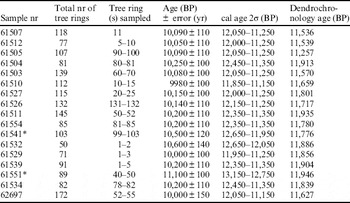
These were then dendrochronology matched (Table 2) with the expectation that the material could strengthen the tree-ring chronologies, possibly filling gaps in the Northern Hemisphere IntCal13 data set (Reimer et al. Reference Reimer, Bard, Bayliss, Beck, Blackwell, Bronk Ramsey, Grootes, Guilderson, Haflidason, Hajdas, Hatté, Heaton, Hoffmann, Hogg, Hughen, Kaiser, Kromer, Manning, Niu, Reimer, Richards, Scott, Southon, Staff, Turney and van der Plicht2013) and/or potential link the floating CELM chronology to the absolutely dated European master chronology. Out of the 17 samples that were subsequently successfully dendrochronologically matched, two Speed Dates did not fall within the measurement uncertainty of the 14C calendar range and were older than the dendrochronology date. This is not likely due to lignin or other parts of the wood that change over time as those compounds would introduce younger 14C (Gaudinki et al. Reference Gaudinski, Dawson, Quideau, Schuur, Roden, Trumbore, Sandquist, Oh and Wasylishen2005). We speculate that theses samples have traces of older 14C because of oil/gas residue, e.g. from when they were sampled in the field with a chainsaw or chalk used to mark the tree-ring numbers. Additionally, for sample ETH-61541, the outermost rings were sampled; thus, these rings may have had contact with carbonates or old carbon compounds from the surrounding soil. Normally, all of these contaminants would be removed by chemical pretreatment. Still, Speed Dating was capable to date those trees within ±400 yr of the true age determined with the dendrochronology.
Speed Dates on subfossils pines from Breitenthal, southern Germany, compared to the respective dendrochronology dates on the same tree ring(s). *Indicates Speed Dates that do not agree within 2σ of the dendrochronology date. 14C dates were calibrated with BATS using IntCal13 (Reimer et al. Reference Reimer, Bard, Bayliss, Beck, Blackwell, Bronk Ramsey, Grootes, Guilderson, Haflidason, Hajdas, Hatté, Heaton, Hoffmann, Hogg, Hughen, Kaiser, Kromer, Manning, Niu, Reimer, Richards, Scott, Southon, Staff, Turney and van der Plicht2013).

Time Consumption and Costs
Up to 75 unknown samples can be analyzed with Speed Dating per day. The measurements require minimal user input (at least every 3 hr) and is extremely efficient compared to conventional dating techniques. Conventional AMS dating requires the subsequent processes of (a) cellulose preparation (2 days), (b) graphitization (2–5 days), and (c) measurement (1–2 days). Meanwhile, Speed Dating can yield results in a single day. We estimate the cost of Speed Dating samples to be less than one-third that of conventional AMS dating.
CONCLUSIONS
Speed Dating offers a rapid way to estimate the 14C date for wood material as it is faster than conventional AMS measurements at roughly one-third the cost. Up to 75 wood samples can be analyzed within a day. The achieved measurement uncertainties were with 0.5–2% (60–160 yr), depending on the age of the wood. In this respect, Speed Dating is not an application to replace or be used in substitute for conventional high-precision measurement. Rather, Speed Dating can be used to add in an efficient way a time constraint to previously undated material to determine if the sample(s) or a site(s) warrants further investigation.
ACKNOWLEDGMENTS
The research was funded by the D-A-CH Lead-Agency agreement of the Swiss National Science Foundation (SNF) and the German Research Foundation (DFG).