


Introduction
As the world’s population ages, ensuring healthy ageing, that is, ‘developing and maintaining the functional ability that enables well-being in older age’ (World Health Organization [WHO] 2015, p. 28), is becoming more important, particularly for older adults who experience social exclusion across the lifecourse. Defined as ‘a lack of social relationships and low levels of participation in social activities’ (Cornwell and Waite Reference Cornwell and Waite2009, p. 32), social exclusion must consider the role of individuals, community and societal structural factors (Keating and Cheshire-Allen Reference Keating, Cheshire-Allen, Walsh, Scharf, Van Regenmortel and Wanka2021). To this end, Walsh and collaborators (Reference Walsh, Scharf and Keating2017) described six interconnected domains that can lead to the social exclusion of older adults: neighbourhood and community (e.g. social aspects or services); social relations (e.g. isolation or loneliness); services and mobility (e.g. transportation or mobility problems); material and financial resources (e.g. income or deprivation); socio-cultural aspects (e.g. identity or symbolic exclusion); and civic participation (e.g. voting or civic participation). These six domains are also influenced by several mechanisms, such as geographic location, lifecourse risk pathways, failure to recognize and address group-specific needs, constrained choice and control, diminished power and social marginalization of groups. Marginalization is considered to contribute to the reinforcement of social exclusion (Grant et al. Reference Grant, Blue and Harpham2000; Walsh et al. Reference Walsh, Scharf and Keating2017) and ‘refers to a context-dependent social process of “othering” where certain individuals or groups are systematically excluded based on societal norms and values’ (Fluit et al. Reference Fluit, Cortés-García and von Soest2024, p. 7). Marginalization refers not to isolated individual characteristics but to social positions that place certain groups in minority status within dominant social structures (Conerly et al. Reference Conerly, Holmes and Tamang2021). As a result, older adults who experience marginalization often belong to one or more minority groups, including those characterized by advanced age, disabilities, ethnic minority status or sexual and gender diversity, low income or social isolation (Walsh et al. Reference Walsh, Scharf, Van Regenmortel, Wanka, Walsh, Scharf, Van Regenmortel and Wanka2021). For these groups, social participation plays a critical role in fostering social inclusion, access to resources and recognition, yet their intersecting social positions frequently limit opportunities for meaningful participation.
A key determinant of healthy and active ageing (WHO 2002, 2023), social participation can be defined as ‘a person’s involvement in activities that provide interaction with others’ (Levasseur et al. Reference Levasseur, Richard, Gauvin and Raymond2010, p. 2148) within community life and collective spaces. It evolves according to available time and resources, societal context and the person’s own values and interests (Levasseur et al. Reference Levasseur, Lussier-Therrien, Biron, Raymond, Castonguay, Naud, Fortier, Sévigny, Houde and Tremblay2022). According to the Human Development Model – Disability Creation Process (HDM-DCP; Fougeyrollas Reference Fougeyrollas2021), social participation results from dynamic interactions between personal factors (e.g. age, gender, health, socio-economic status) and environmental factors (e.g. accessibility, transportation, neighbourhood cohesion), which can accentuate social and health inequalities and foster social exclusion (Townsend et al. Reference Townsend, Chen and Wuthrich2021; Wilding et al. Reference Wilding, Munford and Sutton2023). Social participation operates along a continuum ranging from optimal engagement to restricted participation (Rochette et al. Reference Rochette, Korner-Bitensky and Levasseur2006), the latter being associated with an increased risk of social exclusion. As humans are social beings, social interaction is a necessity comparable to air, food or shelter. Globally, higher levels of social participation have been associated with lower risk of mortality or morbidity (Holt-Lunstad et al. Reference Holt-Lunstad, Smith and Layton2010), greater functional independence (Avlund et al. Reference Avlund, Damsgaard and Osler2004) and improved quality of life (Levasseur et al. Reference Levasseur, Desrosiers and St-Cyr Tribble2008)), particularly within significant shared spaces (Levasseur et al. Reference Levasseur, Lussier-Therrien, Biron, Raymond, Castonguay, Naud, Fortier, Sévigny, Houde and Tremblay2022; Nguyen and Levasseur Reference Nguyen and Levasseur2023). A socially engaged person maintains a network of contacts and regularly takes part in social activities, whereas a person facing participation restrictions experiences limited social interaction and a reduced sense of belonging (Nicholson Reference Nicholson2009). By fostering psychological wellbeing and nurturing social support, social participation also helps individuals cope with challenges related to reduced social networks, isolation and loneliness, and health-related issues associated with ageing (Löfgren et al. Reference Löfgren, Larsson, Isaksson and Nyman2022).
Previous research has documented interventions designed to foster social participation and reduce isolation among older adults. Systematic reviews have highlighted the effectiveness of leisure education (Smallfield and Molitor Reference Smallfield and Molitor2018), multi-component community-based programmes that enhance both social engagement and physical activity (Tcymbal et al. Reference Tcymbal, Abu-Omar, Hartung, Bußkamp, Comito, Rossmann, Meinzinger and Reimers2022) and technology-based or animal-assisted interventions aimed at mitigating loneliness (Hoang et al. Reference Hoang, King, Moore, Moore, Reich, Sidhu, Tan, Whaley and McMillan2022). However, these studies have given limited attention to marginalization (Tcymbal et al. Reference Tcymbal, Abu-Omar, Hartung, Bußkamp, Comito, Rossmann, Meinzinger and Reimers2022) and, to our knowledge, no review has specifically examined how to promote social participation among marginalized older adults (Adekpedjou et al. Reference Adekpedjou2023). Although older adults at risk of marginalization remain under-represented in research on social participation, existing studies highlight numerous barriers they face when trying to engage socially. For example, financial constraints, such as participation fees, can discourage involvement among individuals with low incomes (Feng et al. Reference Feng, Cramm, Jin, Twisk and Nieboer2020; Jalali et al. Reference Jalali, Sarikhani, Askarian, Marzaleh, Najibi and Delavari2023). Limited access to private or public transportation also reduces opportunities for those with severe mobility disabilities (Dahlberg et al. Reference Dahlberg, Andersson, McKee and Lennartsson2015; Robins et al. Reference Robins, Hill, Finch, Clemson and Haines2018). Furthermore, older adults belonging to an ethnic minority or sexual and gender diversity groups may encounter discrimination and stigma, which can further restrict their opportunities for meaningful engagement (Burholt et al. Reference Burholt, Winter, Aartsen, Constantinou, Dahlberg, Feliciano, De Jong Gierveld, Van Regenmortel and Waldegrave2020; Srithumsuk et al. Reference Srithumsuk, Thummapol and Bhatarasakoon2024). Strengthening the social participation of socially marginalized older adults is essential to reducing the risk of isolation and loneliness and to promoting independence, dignity, wellbeing and equal rights and opportunities across all areas of life (WHO 2002). To better guide policies and practices, specific efforts are needed to integrate knowledge on interventions aimed at fostering social participation among this population and, ultimately, to prevent further health inequalities (Foster and Boxall Reference Foster and Boxall2015). Without such a scoping review, knowledge in this area remains fragmented, making it difficult to guide future research and inform the development of inclusive interventions. The present study therefore aims to provide a comprehensive understanding of interventions that foster the social participation of older adults at risk of marginalization in the community.
Method
To synthesize and disseminate current knowledge on interventions that foster the social participation of older adults at risk of marginalization, this study used the framework for conducting scoping studies outlined by Arksey and O’Malley (Reference Arksey and O’Malley2005), along with the recommendations of Levac et al. (Reference Levac, Colquhoun and O’Brien2010). Scoping reviews differ from narrative reviews in that they require structured search methodologies for identification, selection and reporting of studies, following established PRISMA guidelines (Page et al. Reference Page, McKenzie, Bossuyt, Boutron, Hoffmann, Mulrow, Shamseer, Tetzlaff, Akl, Brennan, Chou, Glanville, Grimshaw, Hróbjartsson, Lalu, Li, Loder, Mayo-Wilson, McDonald, McGuinness, Stewart, Thomas, Tricco, Welch, Whiting and Moher2021). The scoping methodology is recommended for describing and mapping findings and knowledge gaps in existing literature (Munn et al. Reference Munn, Pollock, Khalil, Alexander, Mclnerney, Godfrey, Peters and Tricco2022). Based on the five steps detailed in the following paragraphs, this rigorous method encompasses both quantitative and qualitative research, summarizing study results to provide comprehensive, evidence-based knowledge without pooling data or assessing study quality (Arksey and O’Malley Reference Arksey and O’Malley2005).
Step 1: identifying the research question(s)
Three specific research questions were addressed:
(1) What is known about the outcomes of interventions aimed at fostering the social participation of older adults at risk of marginalization?
(2) What facilitators and barriers influence older adults’ participation in such interventions?
(3) What recommendations exist to foster the social participation of older adults at risk of marginalization?
Step 2: identifying relevant literature
The search strategy was developed with the support of a documentalist at the [university name in Quebec (Canada)] library, using keywords that included combinations of Medical Subject Headings (MeSH) terms specific to each database. Key concepts included ‘older adults’, ‘marginalisation’, ‘social participation’ and ‘intervention’ (Table 1). Literature searches were conducted in the following electronic databases for studies published between January 2000 and September 2024: MEDLINE (with Full Text), Abstracts in Social Gerontology, AgeLine, SocINDEX (with Full Text), Social Work Abstracts, and PsycInfo (Table 1).
Search strategies

Table 1 Long description
Search strategy is organized into four numbered concept sets, each paired with a list of relevant keywords joined by OR. Concept 1 targets older adults using terms such as elder, geriatr, geronto, senior, ageing or aging, and phrases for old age, old people, old person, and old adult. Concept 2 targets marginalisation with extensive socioeconomic and exclusion terms, including deprivation, low income, disadvantage, vulnerability, welfare, poverty, inequality, marginalisation, stigma, discrimination, underserved groups, LGBT, ethnic minority, loneliness, and social exclusion. Concept 3 targets social participation with community and civic participation terms plus related concepts such as social engagement, social contact, social activities, social inclusion, social interaction, social isolation, and social integration. Concept 4 targets interventions using broad terms such as intervention, action, prevention, and program. Keywords frequently use truncation to capture multiple word endings and include both spelling variants where relevant. The structure implies combining the four concept sets together in a final search to narrow results to studies at the intersection of all concepts.
#1 AND #2 AND #3 AND #4
Step 3: study selection
Titles and abstracts were screened by at least two independent reviewers (A1, A2 and A3) to determine eligibility based on the predefined inclusion and exclusion criteria. Any uncertainty at this first stage resulted in the article being transferred to the second stage for further scrutiny. Inclusion criteria were based on the population–concept–context mnemonic. Full texts were selected if studies included:
• Population – Adults aged 60 and over living in the community, with at least one characteristic increasing the risk of marginalization as defined in the present study, that is, being aged 80 or over, isolated, having a low income or disabilities, or belonging to minority ethnic, linguistic or sexual and gender diversity groups. Studies involving younger older adults were also included if two-thirds of the sample were aged 60 or over, or if the focus was on results for adults aged 60 or over.
• Concept. To include the full spectrum of interventions fostering social participation, studies aiming to foster concepts associated with the social participation continuum were also included (i.e. isolation, loneliness, social interaction, social support, belonging and social activities). These interventions, however, had to explicitly aim to enhance engagement in social activities, social roles or interactions involving others.
• Context – Community-based interventions situated within real-world social and environmental settings that shape opportunities for older adults’ social participation.
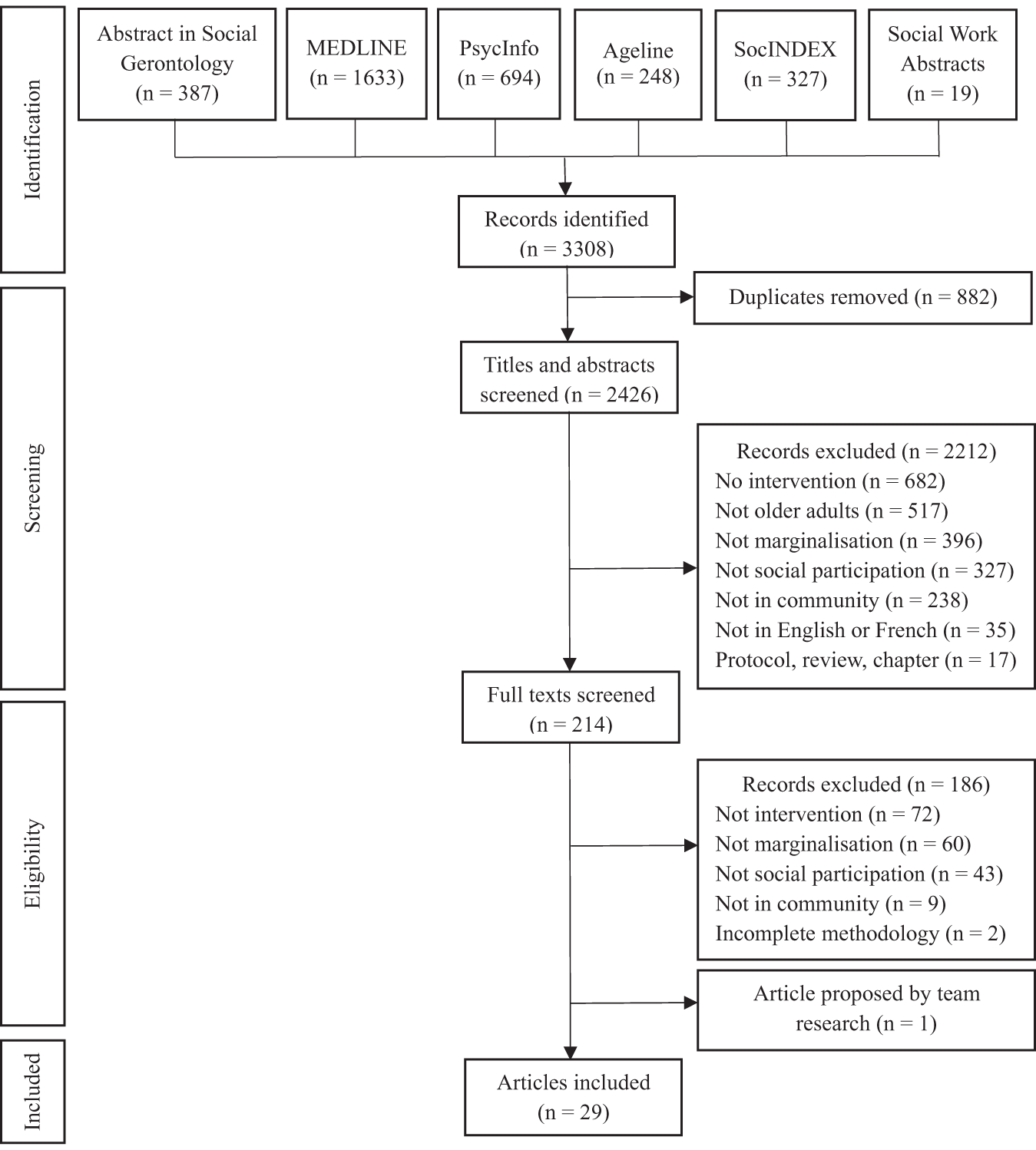
Studies were eligible if they were peer-reviewed articles written in English or French and used quantitative, qualitative or mixed methods to provide a comprehensive overview of interventions aimed at fostering social participation among older adults at risk of marginalization. Studies were excluded if the populations were too specific (e.g. end of life with multiple disorders or in situations of vulnerability following a natural disaster), if the intervention was conducted in a long-term care home or if methodological details were incomplete (e.g. lack of information on participant selection, measurements or data analysis). Literature reviews and documents other than articles (protocols, book chapters, book reviews, commentaries or editorials) were also excluded. Zotero was used to classify records imported from EBSCOhost search results into four subfolders: (1) included after title and abstract selection; (2) included after full-text reading; (3) excluded after full-text reading; (4) uncertain after full-text reading. Reference lists of all included studies were also searched to identify any additional eligible articles. During the screening and selection process mapped using a PRISMA flow diagram (Figure 1), two authors met to discuss uncertainties regarding inclusion, and a third author was consulted for one article to determine final inclusion. Finally, eligible studies included one additional relevant article recommended by members of the research team, which had been published very recently and met our eligibility criteria.
PRISMA flow of research articles.

Figure 1 Long description
The flowchart outlines the PRISMA process for selecting research articles. It begins with the identification phase, listing sources such as Abstract in Social Gerontology (387), MEDLINE (1633), PsycInfo (694), Ageline (248), SocINDEX (327) and Social Work Abstracts (19). A total of 3308 records were identified, with 882 duplicates removed. During the screening phase, 2426 titles and abstracts were screened, resulting in the exclusion of 2212 records for reasons such as no intervention (682), not older adults (517), not marginalisation (396), not social participation (327), not in community (238), not in English or French (35) and protocol, review, chapter (17). The eligibility phase involved screening 214 full texts, excluding 186 records for reasons including no intervention (72), not marginalisation (60), not social participation (43), not in community (9) and incomplete methodology (2). Finally, 29 articles were included, with one article proposed by team research.
Steps 4 and 5: charting the data and collating, summarizing and reporting the results
Following the methodological framework of scoping reviews (Arksey and O’Malley Reference Arksey and O’Malley2005), a double extraction was carried out. The main characteristics of the studies were first organized in an Excel file to obtain an overview of the current state of knowledge: authors and year of publication, target population, country, study objective, research design and participants, intervention, target mechanisms, outcomes, facilitators of and barriers to social participation, and authors’ recommendations. These characteristics were analysed to answer the research questions, and a narrative synthesis of the facilitators of and barriers to social participation was then carried out manually and guided by the HDM-DCP. The model’s distinction between personal factors, environmental factors and social participation outcomes provided a structured and theory-informed approach to categorizing intervention targets, mechanisms and reported outcomes. Using the HDM-DCP enabled a comprehensive and coherent synthesis of knowledge from heterogeneous interventions, consistent with the exploratory and mapping objectives of the scoping review methodology.
Results
Among the 29 selected studies, all were published after 2006, and the majority (n = 18; 62.1%) were published within the last five years (Table 2). The studies were mainly conducted in North America (n = 15; 51.7%) and Europe (n = 11; 37.9%), with two in Oceania (6.9%) and one in Africa (3.5%). The studies essentially used a qualitative design (n = 10; 34.5%) or a mixed methods design (qualitative and pre- or quasi-experimental, n = 9; 31%). Five studies (17.2%) had a pre-experimental design, four (13.8%) were randomized controlled trials (RCTs) and one was quasi-experimental. Interventions were almost equally distributed between individualized (n = 14; 48.3%) and collective activities in the community (n = 15; 51.7%), with two papers in each category examining the same intervention. Among the broad domains of social exclusion, interventions rarely targeted neighbourhood and community or civic participation, but mainly addressed material and financial resources (n = 11; 37.9%), socio-cultural aspects (n = 8; 30.8%), services and mobility (n = 5; 17.2%), as well as social relations (n = 5; 17.2%).
Characteristics of the studies (n = 29)

Table 2 Long description
Study characteristics for 29 interventions aimed at reducing loneliness or social isolation in older adults are summarized by objective, design and sample, intervention dose, outcomes, and implementation recommendations. Individualised approaches commonly used peer or volunteer mentors (often matched by culture, gender, or interests) and typically reported increased social interaction and social support with reduced loneliness; examples include AgeWell (212 participants) and a year-long US peer program (74 participants). Evidence was mixed in more rigorous trials: the UK Upstream Healthy Living Centre showed improvements in some pre-experimental follow-ups, but the related randomized trial reported no clear changes in social support, participation, mental health, or physical health. Psycho-education plus activity planning programs frequently improved social connection outcomes; PEARLS (320 participants) reported increased interaction and support with reduced isolation and loneliness, while a tailored physical-activity advice trial (585 participants) showed loneliness unchanged at six months but reduced at twelve months. Collective programs such as health education groups, community mobility training, gardening, arts, choirs, and men’s sheds generally reported increased belonging and social interaction and decreased isolation, mostly from qualitative or pre-experimental designs. Physical health outcomes were less consistently improved than social outcomes, and several studies reported no change in physical health. Common implementation lessons included adapting programs to participants, pairing or grouping by sociocultural affinity, partnering with community organizations, planning transport and sustainability, and adding qualitative data to capture perceived benefits.
Notes: Ø = not mentioned; ≥ more; EG = experimental group; CG = control group; RCT = randomized controlled trial; ↓ = decrease; → = no change; ↑ = increase
1 Sample size of older adults, age in years, mean (minimum-maximum) or (standard deviation).
2 Duration of intervention (frequency or number of sessions, duration of each session); description of intervention; a quantitative result; b qualitative result; (±) lever or barrier.
Most studies focused on low-income older adults (n = 11; 37.9%), seven of which offered collective activities. Six other studies (20.7%) were carried out with older adults from an ethnic minority, all of whom also had a low income or were isolated. Older adults who were isolated or had disabilities were each targeted in five studies (17.2%), four of which involved individualized interventions. Only two studies (6.9%), one individualized and one collective intervention, involved older adults from sexual and gender diversity groups. In addition to measuring social participation (n = 8; 30.8%), the interventions were evaluated according to the following dimensions: social support (n = 17; 58.6%), social interaction (n = 14; 48.3%), loneliness (n = 12; 41.4%), isolation (n = 9; 31%), belonging (n = 8; 27.6%) and social activities (n = 5; 17.2%). Studies also assessed the effects of interventions on participants’ mental (n = 19; 65.5%) and physical (n = 9; 31%) health, wellbeing (n = 11; 37.9%), knowledge of activities (n = 3; 10.3%), compensatory mobility strategies (n = 2; 6.9%), resilience (n = 1; 3.4%), new technologies (n = 1; 3.4%) and ageing (n = 1; 3.4%).
Results of interventions
Proportionally, studies reported more positive effects from collective interventions compared to individualized activities. The individualized interventions mainly offered the assistance of a mentor to encourage older adults to participate more in meaningful activities, reduce their isolation or become more independent. Matched to older adults based on interests, age or shared community, mentors provided home visits, helped with daily activities or assisted them with community activities (Table 2). According to one RCT (3.4%) and seven pre-experimental or qualitative studies (24.1%), these interventions improved the health, wellbeing, resilience and social participation of participants, while reducing their loneliness. However, one controlled trial found no significant difference. In six other articles (20.7%), the mentor’s assistance was preceded by psycho-educational training, that is, coaching that combines psychological and educational aspects to improve knowledge and skills for better management of psychological or behavioural difficulties, to enhance participants’ motivation to engage in activities, manage loneliness, build problem-solving skills, use social networks, learn compensatory mobility strategies or receive health and safety advice. Mixed results were observed when social participation was measured quantitatively, but increases were noted in the number of social activities and interactions, and loneliness decreased in follow-up or qualitative measures.
Six collective interventions (20.7%) aimed at increasing participants’ participation in more activities or reducing their isolation were also supported by psycho-educational training. The training aimed to foster volunteering, healthy ageing or safety in the environment and in mobility. These interventions improved social participation, health and wellbeing, as well as participants’ knowledge about community activities and mobility strategies (Table 2). Based on qualitative results and a pre-experimental study, creative and artistic activities (dance, choir, crafts, theatre, gardening, artistic creations) improved feelings of belonging, social support and social interactions, and reduced isolation. Finally, two multi-component interventions (6.9%), that is, a mix of physical and social activities, were found to reduce loneliness and increase physical health.
Depending on the characteristics of marginalization experienced, several underlying processes appeared to be targeted to foster social participation. For instance, among the five interventions with older adults from ethnic minorities, two (40.0%) focused on culturally tailored activities that respected participants’ customs and traditions, which may have created culturally safe spaces for interaction. The other three fostered belonging by bringing together participants who shared the same cultural background, thereby strengthening intra-group ties and mutual understanding. Similarly, the two interventions involving participants from sexual and gender diversity groups (100.0%) focused on fostering a sense of belonging by creating opportunities to build close relationships within their own community. For older adults with disabilities, all five studies (100.0%) prioritized enhancing the perceived accessibility of activities by providing information and guidance on how to join and participate. Nearly all interventions with low-income participants (ten out of 11; 90.9%) aimed to provide knowledge of available resources and offer practical support to strengthen participants’ ability to identify, access and participate in community activities and services. Finally, for socially isolated older adults, four of the five studies (80.0%) relied on mentor assistance, offering personalized encouragement and guidance to help them re-engage in meaningful activities and reduce loneliness.
Facilitators and barriers: personal, environmental and social elements
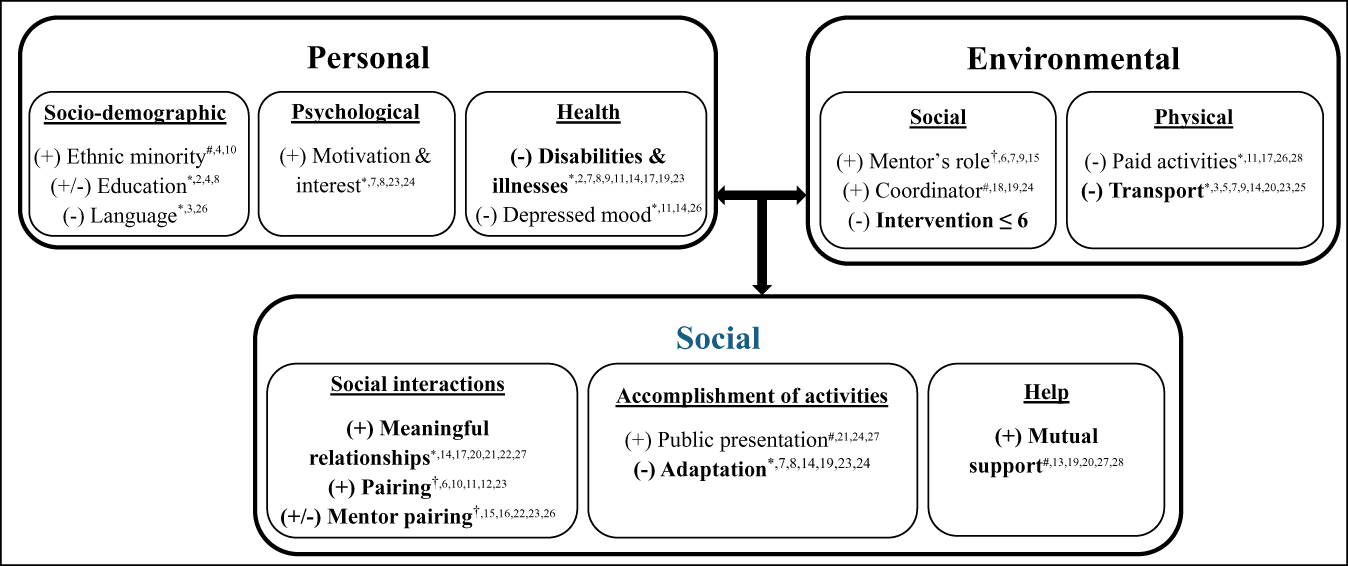
While globally there were as many facilitators of as barriers to participation in the interventions identified (Figure 2), the studies also identified these factors as equally distributed between personal and environmental factors, as well as social participation. Facilitators and barriers were equally distributed between individualized and collective interventions, with social participation being the most identified category and the one with the most facilitators (Figure 2). Although barriers were more often cited, personal and environmental factors included as many facilitators as barriers.
Facilitators (+) and barriers (−) to the participation of older adults at risk of marginalization in interventions.

Figure 2 Long description
Personal and Environmental are shown in two separate boxed sections across the top. Social is shown in one boxed section below. A two-way arrow connects Personal and Environmental. A downward arrow points from the top sections to Social. Personal Socio-demographic: plus Ethnic minority. plus or minus Education. minus Language. Psychological: plus Motivation and interest. Health: minus Disabilities and illnesses. minus Depressed mood. Environmental Social: plus Mentor’s role. plus Coordinator. minus Intervention less than or equal to 6. Physical: minus Paid activities. minus Transport. Social Social interactions: plus Meaningful relationships. plus Pairing. plus or minus Mentor pairing. Accomplishment of activities: plus Public presentation. minus Adaptation. Help: plus Mutual support.
Personal elements
Socio-demographic, psychological and especially health characteristics of the participants influenced the participation of older adults at risk of marginalization in the interventions (Figure 2). While participants from ethnic minorities faced a language barrier in two studies (6.9%), they were more likely to engage in volunteering than other participants in two collective interventions. According to two studies, low educational attainment could be a barrier to participation, but one individualized intervention (3.4%) found a higher drop-out rate among more educated older adults. Four studies (three individualized and one collective; 13.8%) reported that participant motivation and interest fostered continued participation, while three studies (two collective and one individualized; 10.3%) specified that depressed mood could lead participants not to attend all sessions of an intervention. Finally, nine papers (31.0%), including six individualized interventions, identified disability and worsening illness as major barriers to participation in interventions.
Environmental elements
Social and physical environments, mainly identified as barriers, were factors influencing the participation of older adults at risk of marginalization (Figure 2). In three collective interventions (10.3%) the presence of a coordinator from outside the project proved useful in supporting older adults in carrying out and continuing activities, while ensuring the sustainability of the project. Four papers (13.8%) evaluating individualized interventions described the mentor’s role as a key catalyst for connecting older adults to society. Five individualized interventions (17.2%) lasting less than six months did not lead to the expected effects, and paid activities (two individualized and two collective) hindered participants’ involvement, whether they had low income, were from an ethnic minority or had disabilities. Finally, lack of access to transport was often cited by authors and participants as a barrier to continued participation in both individualized (n = 4; 13.8%) and collective (n = 3; 10.3%) interventions.
Social elements
With few barriers overall, social interactions, the accomplishment of social activities and mutual help among participants were factors found in previous studies (Figure 2). Creating meaningful relationships during the activities was a key determinant of older adults’ continued participation in five collective (17.2%) and one individualised (3.4%) intervention. In individualized interventions, a poor mentor match was reported as a barrier to participation in one study involving older adults from sexual or gender minority backgrounds. However, successful pairings in ten other studies (34.5%), including five with older mentors, fostered quality social interactions and a sense of belonging. In three artistic activities (10.3%), presenting a collective work to the public served as a facilitative element for continued participation by giving participants a shared goal. However, the unsuitability of activities in relation to the participants’ culture, abilities and preferences played a decisive role in the refusal or cessation of participation in three individualized and three collective interventions (Figure 2). Finally, linked to the meaningful relationships engendered during the activities, five collective interventions (17.2%) indicated that mutual support encouraged participants to return to each session.
Recommendations
Five main areas of recommendations were identified based on the key lessons, including both recommendations explicitly identified as such in the original studies and general insights reported by the study authors: (1) providing meaningful activities adapted to participants’ needs and contexts; (2) ensuring accessibility and transportation to activities; (3) grouping participants who share common experiences and cultures; (4) focusing on partnerships to ensure the sustainability of interventions; and (5) refining recruitment and methods to reflect participants’ realities (Table 2). For both types of intervention, and to provide meaningful activities and foster regular participation, nine studies (31.0%) explained that it would be important to adapt activities to the social needs and physical abilities of each older adult. Exampled are involving the children and grandchildren of participants from ethnic minority backgrounds; removing gendered roles from dance activities to support the inclusion of people from sexual and gender diversity groups; and adapting activities to accommodate participants’ disabilities (Table 2). Activities must also be accessible and close to the target population. In this context, four papers (13.8%) recommended implementing interventions in the heart of disadvantaged neighbourhoods to reach vulnerable people and consolidate belonging. In cases where opportunities for social participation are not nearby, four studies (three individualized and one collective intervention) recommended developing a plan to provide affordable and accessible transportation from participants’ homes, especially for older adults with disabilities. In ten papers (eight individualized and two collective interventions; 34.5%), the authors advised bringing together participants who share socio-cultural affinities, particularly in peer interventions (Table 2). As part of three individualized interventions (10.3%), intergenerational pairing is perceived as a sustainable solution to the loneliness of older adults and an opportunity to offer reciprocal social support for people with similar life experiences. Finally, five papers (17.2%) recommend providing participants with information that is easily transferable to everyday life so that they can apply and maintain their participation.
Close collaboration with community organizations and health-care systems would not only connect older adults to society but also provide local resources and services, enabling sustainable interventions in ten studies (34.5%; Table 2). This sustainability should be considered from the beginning of an intervention to enable older adults to maintain social participation despite the termination of activity funding. Four other papers (13.8%) reported that opting for a participatory approach from the design to the implementation of an intervention could also facilitate its sustainability as well as optimize its effects (Table 2). By targeting older adults solely based on isolation or widowhood, without assessing their actual loneliness, three studies (10.3%) failed to achieve the intended effects of an intervention on reducing loneliness. To avoid such biased outcomes, researchers encourage distinguishing between isolation (the lack of social contact) and loneliness (the subjective feeling of being alone) when recruiting participants and assessing interventions (Table 2). Finally, three papers (10.3%) recommend using qualitative designs to complement quantitative data to explore in-depth participants’ experiences and contextual information on interventions’ effects, as well as facilitators and obstacles to participation, while also suggesting possible avenues for improvement.
Discussion
The aim of this study was to provide a comprehensive understanding of interventions fostering the social participation of older adults at risk of marginalization in the community. While a variety of outcomes and concepts were reported in the included studies, this review specifically focused on social participation as its main outcome. Interventions addressing related constructs such as loneliness or belonging were included only if they also presented a social participation outcome. Based on 29 studies, the review identified a diversity of individualized or collective interventions to help and encourage older adults to participate in activities that were more meaningful for them, sometimes coupled with psycho-educational training, creative and artistic activities or other components, such as physical or social activities. Overall, collective interventions reported more promising results in social interaction, social support, belonging, social participation and a reduction in isolation and loneliness. Despite encouraging results from paired assistance, the individualized interventions faced challenges, possibly owing to differences in the choice of mentors (students, older adults, community volunteers, health professionals, research assistants) or the inclusion criteria for disabilities (minimal score on questionnaires, presence of a disabling chronic illness, need for assistance with daily activities) or isolation and loneliness (widowhood, self-reported loneliness, reduced social activity).
Compared with those designed for the general older population, social participation interventions targeting older adults at risk of marginalization often address structural and material barriers, such as transport difficulties or financial constraints, by offering free or low-cost activities and situating programmes in disadvantaged neighbourhoods to enhance accessibility (Buffel et al. Reference Buffel, De Donder, Phillipson, De Witte, Dury and Verte2014). Although positive tendencies appeared in most studies included in this review, the conclusions of this scoping review should be interpreted with caution owing to the heterogeneity of study designs and populations. Nevertheless, several features consistently associated with promising outcomes emerged across the studies: (1) relevance and meaningfulness of activities; (2) sustainability and strong partnerships with community organizations; and (3) accessibility and transportation.
First, a strong emphasis is placed on the relevance and meaningfulness of activities, notably through cultural and identity adaptations, including the use of linguistically appropriate materials, the integration of culturally meaningful practices and the creation of safe spaces (Gasteiger et al. Reference Gasteiger, Collens and du Preez2024; Guruge et al. Reference Guruge, Sidani and Hanley2025). These interventions often prioritize fostering belonging before aiming to expand social networks, recognizing that previous experiences of discrimination or symbolic exclusion can hinder participation. In addition, mentoring or peer-support approaches, sometimes involving culturally matched mentors, are used more often than in mainstream programmes to provide personalized encouragement and support. These distinctive characteristics suggest that designing interventions specifically for groups at risk of marginalization, rather than merely adapting mainstream programmes, appears critical for reducing participation gaps and addressing social inequalities in ageing. One other key element fostering the participation of older adults at risk of marginalization in interventions was the adaptation of activities to reflect the diverse characteristics of the participants. When social participation activities are meaningful and meet the needs of older adults, they appear more likely to increase their interest, motivation and persistence (Michaelsen and Esch Reference Michaelsen and Esch2023). With a greater diversity of older adults, this adaptation represents a greater challenge for collective interventions and requires a flexible approach. The difficulty lies in finding the right balance between adapting activities to the culture, disabilities and preferences of each participant and maintaining the motivation of a heterogeneous group of participants (Zetterlund et al. Reference Zetterlund, von Thiele Schwarz, Hasson and Neher2022). As with individualized interventions, one possibility is to group together older adults with common interests, life experiences or health characteristics. In addition to generating meaningful relationships, this approach was described in some studies as a way to address loneliness, particularly when interventions lasted for at least six months (Hoang et al. Reference Hoang, King, Moore, Moore, Reich, Sidhu, Tan, Whaley and McMillan2022). The predominantly short duration of the interventions included in the present scoping review may contribute to the limited quantitative results observed regarding loneliness and highlight the importance of their sustainability to influence behaviours.
Second, paying attention to the sustainability of interventions right from the project conception is one of the main recommendations that emerge from this review, particularly when the activities depend on short-term funding (National Academies of Sciences, Engineering, and Medicine et al. 2020). Facilitated by a strong partnership with community organizations, such sustainability requires ensuring that they have sufficient human resources and a safe and accessible space in which to provide the interventions (Castellon-Lopez et al. Reference Castellon-Lopez, Carson, Ward, Ramirez, Vo, Kuo, Seeman, Vassar, Trejo, Eidem, Aranda and Brown2024).
Third, accessibility is an essential facilitator for ensuring the regular participation of older adults (Levasseur et al. Reference Levasseur, Généreux, Bruneau, Vanasse, Chabot, Beaulac and Bédard2015), particularly adults with disabilities, and it can be hampered by transport difficulties and the associated costs (Koster et al. Reference Koster, Patel, Visser, van Eijk, Kanaya, de Rekeneire, Newman, Tylavsky, Kritchevsky and Harris2008; Jones et al. Reference Jones, Jhangri, Yamamoto, Hogan, Hanson, Levasseur, Morales and Légaré2023). It is therefore imperative to consider low-cost transport options to enable older adults, including those at risk of marginalization, to remain socially active. Otherwise, interventions could also be implemented in disadvantaged neighbourhoods to reach the most vulnerable older adults more easily and strengthen their community belonging (Kharicha et al. Reference Kharicha, Iliffe, Manthorpe, Chew-Graham, Cattan, Goodman, Kirby-Barr, Whitehouse and Walters2017), especially among older adults from ethnic minorities (Neville et al. Reference Neville, Wright-St Clair, Montayre, Adams and Larmer2018). In addition to being an essential component in addressing loneliness, belonging strengthens the exchange of knowledge about activities and resources within the neighbourhood between older adults (Noone and Yang Reference Noone and Yang2022), thus improving the likelihood of increasing their social participation (Jones et al. Reference Jones, Jhangri, Yamamoto, Hogan, Hanson, Levasseur, Morales and Légaré2023). To design a social environment in disadvantaged neighbourhoods, municipalities and community organizations must work together to foster the social participation of the most vulnerable older adults and contribute to a more inclusive society.
Finally, the pre-experimental or qualitative designs of these studies limit the ability to draw conclusions about the transferability of the results to similar contexts or settings. Further studies are therefore needed to better understand how to foster the social participation of older adults at risk of marginalization, especially among minority groups, which are under-represented in this review. While low-income older adults were the most targeted population in this review, only two studies focused on older adults from sexual and gender minorities. Interventions are also needed among older adults at the intersection of multiple characteristics of marginalization (e.g. gender and sexual diversity combined with disabilities), who are more at risk of social exclusion. Consistent with other studies (Walsh et al. Reference Walsh, Scharf and Keating2017; Serrat et al. Reference Serrat, Scharf, Villar and Gómez2020), these results nevertheless underline the need to conduct more studies among marginalized populations to better understand their social needs and propose inclusive, adapted and effective interventions. Similarly, the concentration of existing studies in high-income countries underscores the need for research in low- and middle-income countries to better understand how resource limitations and cultural contexts shape the barriers and facilitators to social participation. Future research should also investigate the underlying mechanisms of interventions, such as strengthening social support, fostering a sense of belonging or boosting self-efficacy, and how these processes may vary based on participants’ social, cultural and health characteristics, ultimately influencing intervention outcomes (Fredriksen-Goldsen et al. Reference Fredriksen-Goldsen, Kim, Bryan, Shiu and Emlet2017; Michaelsen and Esch Reference Michaelsen and Esch2023). The growing and increasingly diverse older population presents unique opportunities to deepen our understanding of cultural differences and common experiences of ageing throughout life.
Strengths and limitations
This scoping review is, to our knowledge, the first to focus on interventions aimed at fostering the social participation of older adults at risk of marginalization. By including all methodological designs, this review provides a holistic and complete overview of interventions targeting an under-represented population in studies of ageing. Differences in methodology among the included studies and the inclusion of different populations at risk of marginalization, each with their own characteristics and distinct mechanisms of marginalization and social exclusion, limit the integration of results. To evaluate the effectiveness of these mechanisms, future research should build on realist reviews or meta-analyses to better understand how interventions can effectively foster social participation among marginalized groups. Although a rigorous and innovative two-person procedure was used to analyse the content of the literature, grey literature was not considered owing to time constraints. Nevertheless, the present integration of knowledge represents a unique contribution that will ultimately support the decisions and development of innovative and inclusive interventions, clear guidelines and best practices to foster the social participation of older adults at risk of marginalization.
Implications for practice
This scoping review provides an integrated view of the interventions available to foster the social participation of older adults at risk of marginalization. While both collective and individualized interventions appear promising, it is important to collaborate with community organizations to offer sustainable activities that are adapted to the diversity of participants. In individualized interventions, proximity between mentors and participants also encourages involvement in activities. The accessibility of activities and transportation options should also be considered to support social participation. Since initiatives that enhance social participation have the potential to support healthy ageing while fostering more inclusive societies, this scoping study represents an important first step in this area of research. Given the heterogeneity of practices and methodological designs, additional studies are needed to evaluate the effectiveness of interventions, particularly among older adults from sexual and gender diversity groups. To enable community organizations, health-care providers and policy makers to foster social participation, it is important to implement interventions based on the best possible evidence.
Acknowledgements
The authors wish to thank Nathalie St-Jacques for her work and assistance on the study’s search strategy.
Author contributions
SM and ML were responsible for the conception and design of the study, data analysis and interpretation, and drafting the manuscript. ML was also responsible for supervising the analysis and obtaining and administering funding. THTN and AA determined the eligibility of studies. All authors read and approved the final manuscript.
Financial support
This work was supported by the Fonds de recherche en santé du Québec – Société et culture [grant numbers: 294918]. At the time of the study, Stéphanie Meynet and Mélanie Levasseur were respectively supported by salary awards from the Research Lab Connect and Research Centre on Ageing, and Senior 1 Fonds de Recherche du Québec – Santé Researcher (298996). Professor Levasseur now holds a Tier 1 Canadian Research Chair in Social Participation and Connection for Older Adults (CRC-2022-00331; 2023-2030).
Competing interests
The authors declare no potential conflicts of interest with respect to the research, authorship and/or publication of this article.



 Open access

