

In addition to mood symptoms, functioning and quality of life (QoL) are dimensions of outcome now routinely assessed in bipolar disorder (Reference Michalak, Yatham, Kolesar and Lam1). In cross section, the general finding is that symptoms, QoL and functioning will correlate to some degree (Reference Gazalle, Andreazza and Hallal2,Reference Gazalle, Hallal and Andreazza3). A common view, thus, is that these domains are related and similar. Nonetheless, more complex associations may underlie these simple findings. Dimensions may correlate and still be discernible. This, in fact, is often the case with psychiatric instruments (Reference Fabrigar, Wegener, MacCallum and Strahan4).
Although disability during euthymia has been identified, the focus has habitually been on its relation with residual symptoms. Although symptoms and functioning clearly fluctuate together (Reference Sanchez-Moreno, Martinez-Aran, Tabares-Seisdedos, Torrent, Vieta and Ayuso-Mateos5), the extent to which these dimensions are linked has not been thoroughly explored. In this report, we use data from a placebo-controlled trial investigating N-acetyl cysteine (NAC) as an adjunctive treatment for bipolar disorder to test how measures of depression, functioning and QoL change and how these scores cluster. Given that NAC was highly effective in both depression and functioning, we further aimed to assess how much of the change in functioning brought on by the treatment was mediated via change in depression (Box 1).
Box 1. Methods and Results of Clinical Trial
A thorough description of the study has been published (Reference Berk, Copolov and Dean6). Briefly, this was a double-blind placebo-controlled trial of NAC in addition to treatment as usual. Participants fulfilled DSM-IV criteria for bipolar disorder and were on stable therapy for at least 1 month prior to the study. There was no minimum rating scales score at inclusion. Only people with currently uncontrolled medical conditions and pregnant or lactating women were excluded. All participants provided written informed consent. The participating institutions' ethics committees approved the trial, which was registered with the Australian and New Zealand Clinical Trials Registry (ACTRN12605000362695).
Participants received NAC (1000 mg) twice daily or matching placebo. Outcomes were assessed at baseline and up to week 24. Participants were assessed using the Montgomery- Asberg Rating Scale [MADRS, (Reference Montgomery and Asberg7)], the Young Mania Rating Scale [YMRS, (Reference Young, Biggs, Ziegler and Meyer8)] and the Bipolar Depression Rating Scale [BDRS, (Reference Berk, Malhi and Mitchell9,Reference Berk, Malhi and Cahill10)]. Functioning and QoL were assessed with the Global Assessment of Functioning [GAF, (Reference Jones, Thornicroft, Coffey and Dunn11)], the Social and Occupational Functioning Assessment Scale [SOFAS, (Reference Morosini, Magliano, Brambilla, Ugolini and Pioli12)], the Streamlined Longitudinal Interview Clinical Evaluation (SLICE-LIFE), the Range of Impairment Functioning Tool [LIFE-RIFT, (Reference Keller, Lavori and Friedman13)] and the Quality of Life Enjoyment and Satisfaction Questionnaire [Q-LES-Q, (Reference Endicott, Nee, Harrison and Blumenthal14)]. Here we do not report on (hypo)manic symptoms, as both the baseline and change scores were low in this sample.
Exploratory factor analysis is a method aimed at simplifying complex data sets. Unlike simple correlations, data loading in factors can be seen as a statement of the relationship between variables. It is in this sense that it is used here. We used alpha factoring with Oblimin rotation to extract factors. The number of factors was selected both by inspecting the
Scree plot and the most parsimonious solution to the data. The distribution acceptable for factor analysis. A simple mediation model (Reference Preacher and Hayes15) was employed to test the proportion of the effect of NAC on functioning that was mediated by change in depressive symptoms (BDRS). The functioning measure we used on the model was the LIFE-RIFT, on which NAC had the largest effect size.
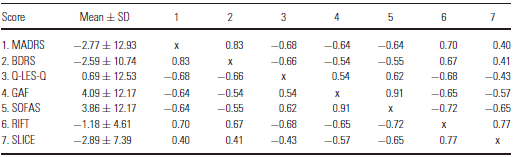
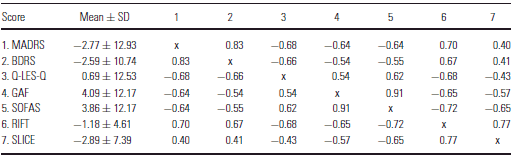
A total of 74 participants were included in the trial. All bivariate associations between change scores were highly significant (p < 0.001 for all; Table 1). The Kaiser–Meyer–Olkin measure was 0.82, indicating factorability. The two-factor solution, in which distinct dimensions emerged, best accounted for the data. It explained 81% of the variance. The first factor included the GAF, the SOFAS, the SLICE-LIFE and the LIFE-RIFT and accounted for 68% of the variance. The second factor included the depression scales and the Q-LES-Q and explained a further 13% of the variance. The factors correlated at 0.68.
Correlation matrix showing coefficients for associations between change scores in rating scales in participants in a clinical trial (n = 74)
In the mediation model, change in depression mediated the impact of NAC on functioning (i.e. there was a significant indirect effect; Coef = 1.78, SE = 0.71, p = 0.012). The proportion of the treatment (NAC) effect on functioning mediated through depressive symptoms change was 55%. The remaining proportion of the effect was direct (i.e. unaccounted for by change in depressive symptoms).
Change in interviewer-rated functioning scores and depressive symptoms (along with QoL) clustered into two discernible factors. This replicates cross-sectional data, where functioning and QoL clustered in separate dimensions (Reference Brieger, Rottig, Rottig, Marneros and Priebe16). Furthermore, in a simple mediation model, a considerable proportion of the impact of NAC on functioning was not associated with change in depression.
Interventions may affect functional status via pathways not exclusively related to symptom change. Other mechanisms, such as cognition and biological rhythms, have been associated with functioning independently of symptoms (Reference Giglio, Magalhaes, Kapczinski, Walz and Kapczinski17). These are interesting targets for novel interventions. Perhaps because the data in clinical trials tend to be highly correlated, change too often is seen as unidimensional. Functional data should be viewed as outcomes in their own right and not only serve to accentuate the relevance of residual symptoms.
Acknowledgements
This trial was supported by a grant from the Stanley Medical Research Institute as well as the Mental Health Research Institute of Victoria. Trial registration: Australian Clinical Trials Registry 12605000362695, www.actr.org.au.
Dr Magalhães is supported by a split doctoral scholarship from Conselho Nacional de Desenvolvimento Científico e Tecnológico (CNPq), Brazil. Professor Bush is a shareholder and consultant for Prana Biotechnology Ltd and a shareholder in Cogstate Ltd. Professor Malhi has served on a number of international and national pharmaceutical advisory boards, received funding for research and has been in receipt of honoraria for talks at sponsored meetings worldwide involving the following companies: Astra Zeneca, Eli Lilly, Janssen Cilag, Lundbeck, Organon, Pfizer, Ranbaxy, Servier and Wyeth. Professor Berk has received research support from Stanley Medical Research Foundation, MBF, NHMRC, Beyond Blue, Geelong Medical Research Foundation, Bristol Myers Squibb, Eli Lilly, Glaxo SmithKline, Organon, Novartis, Mayne Pharma, Servier. He has been a Speaker for Astra Zeneca, Bristol Myers Squibb, Eli Lilly, Glaxo SmithKline, Janssen Cilag, Lundbeck, Merck, Pfizer, Sanofi Synthelabo, Servier, Solvay and Wyeth. He has been a consultant for Astra Zeneca, Bristol Myers Squibb, Eli Lilly, Glaxo SmithKline, Janssen Cilag, Lundbeck and Servier.