INTRODUCTION
Scholars argue that decentralization may be a crucial way for states to deepen democracies (Fung and Wright Reference Fung and Wright2003; Heller Reference Heller2001), and social movement theorists suggest that a state's “degree of vertical territorial decentralization” is an element of political opportunity structure (Van Der Heijden Reference Van Der Heijden1997, 28; see also Kriesi et al. Reference Kriesi, Koopsman, Duyvendak and Giugni1992) or that it may be a key to making the polity more open to social movement claims (Tarrow Reference Tarrow1998). If they are correct, the growing importance of decentralization in the world today (see Watts Reference Watts1999) may bode well for female citizens and feminist movements alike. Decentralization may provide new avenues for women's participation, bringing the state closer to local feminists, and thereby encouraging subnational institutions to enact feminist policy measures.
Conversely, development scholars have noted the pitfalls of decentralization. Patrick Heller recognizes the current popularity of decentralized structures, stating that “decentralization [has become] an article of faith.” However, he counters this by arguing that decentralized states are also subject to “bureaucratic control” (2001, 132). A parallel can be drawn with women, politics, and policymaking. Research demonstrates that feminists are at risk of co-optation by national bureaucracies and that national policy outputs are not always gendered in a feminist fashion (Staudt Reference Staudt1997). With these realities in mind, gender scholars must seriously question whether decentralization should serve as “an article of faith” for feminist movements and consider the circumstances under which subnational governments provide deeper democracy and feminist policymaking, rather than bureaucratic control of feminist issues and organizations.
In this article, I begin to address these pressing and complex concerns by examining regional equality policies, namely, measures taken by governments to further women's social and political status. I specifically ask whether and why decentralization has facilitated locally salient, feminist policy outputs in the regions of Andalusia in southern Spain and Galicia in northwestern Spain. By feminist policy outputs, I mean equality policies that impact gender relations and challenge patriarchal practices (Mazur Reference Mazur2002).Footnote 1 To answer this question, I examine three variables. I ask whether leftist parties in new regional institutions are political allies who adopt feminist policy outputs. Moreover, I question how policy outputs improve over time as subnational institutions develop. Finally, I ask whether regional feminist organizations, because of an open and decentralized context, collaborate with bureaucracies, thus facilitating feminist policy outputs.
As a recently consolidated democracy in Western Europe, Spain holds implications for advanced democracies and democratizing countries alike. Spanish feminists experienced success following the country's transition to democracy (1978–82). Article 14 of the 1978 Constitution established equality for women and men under the law, divorce was legalized in 1981, and abortion options were granted in 1985. However, the position of Spanish feminists relative to the state has become complex due to decentralization during the 1980s and the various political tendencies of the Spanish regions (Linz and Miguel Reference Linz, de Miguel, Merritt and Rokkan1966). Whereas the authoritarian Franco regime (1939–75) enforced centralization, the 1978 Constitution grants regions power over important policies of interest to feminists, such as health and education (Newton and Donaghy Reference Newton and Donaghy1997). Due to decentralization, regional administrations have become “the main political reference for many feminists” (Valiente Reference Valiente, Lee Ann Banaszak and Rucht2003, 44) and regions have gained sufficient power to pursue policies that are both feminist and regionally salient.
The Spanish regional cases of Andalusia and Galicia, presented here through a longitudinal, comparative case study, offer many lessons about decentralization. First, I show distinct policy outputs in the two regions, demonstrating that some subnational administrations advance feminist policies whereas others do not, even after two decades of developing regional autonomy. Although I conclude that leftist political allies greatly contribute to feminist policy outputs in Andalusia, I explain that subnational administrations, led by both left and right parties, do not intensely engage feminists in the policymaking process. Finally, I conclude by problematizing subnational women's policy agencies, for in both regions, women's policy agencies have promoted women's civil society while arguably disadvantaging feminist voices.
Advantages and Disadvantages of Subnational Politics for Feminism
Although the impact of subnational institutions on women citizens has been addressed (see Alvarez Reference Alvarez1990; Banaszak, Beckwith, and Rucht Reference Banaszak, Beckwith and Rucht2003; Schmitter Reference Schmitter, Jaquette and Wolchik1998), the ability of decentralization to engender feminist policy outputs has not been thoroughly established within gender and politics research. On the one hand, decentralization may be seen as a means to ensure locally salient, feminist policy outputs. If subnational institutions are more knowledgeable about local identities and officials seek “the wants of the inhabitants” (de Tocqueville [1835] Reference de Tocqueville2000, 91; see also Ostrom Reference Ostrom1996), they may yield policy outputs that fit the identities of the local female population. A national administration could establish job training, nonsexist education, and gender-violence response programs in the subnational sphere; however, subnational administrations, equipped with better information, could design programs that integrate women into local economies, utilize regional languages, and position women's help centers in places easily accessible to local populations. Furthermore, decentralization allows subnational administrations to be policy innovators, making it likely that some subnational administrations will pursue feminist policies, which may in turn encourage other administrations to do the same.
Because of the close physical proximity of subnational institutions to local populations, decentralization also provides distinct advantages for feminists seeking to influence policy. Comparative feminist policy literature shows that “strategic partnerships” between women inside and outside the state (Halsaa Reference Halsaa, à Nijeholt, Vargas and Wieringa1998, 183), alternatively termed “feminist advocacy coalitions” (Mazur Reference Mazur2002, 44), have the potential to gender the state and its policy outputs in a feminist manner (Outshoorn Reference Outshoorn2004; Stetson Reference Stetson2001; Stetson and Mazur Reference Stetson and Mazur1995). Such coalitions originate from communication and shared “gender expertise” among politicians, bureaucrats, and feminist movements (Halsaa Reference Halsaa, à Nijeholt, Vargas and Wieringa1998, 183). Subnational administrations, because of their proximity and “small-scale nature” (Schmitter Reference Schmitter, Jaquette and Wolchik1998, 225), may be the ideal setting in which feminists access policymakers, become part of coalitions, and join in the policy process. If local feminist coalitions form and facilitate feminized and localized policy discourses, the decentralized state may prove to be “more responsive to women's movement demands than centralization of power” (Banaszak, Beckwith, and Rucht Reference Banaszak, Beckwith and Rucht2003, 26).
On the other hand, there is a distinct possibility that subnational actors and institutions will act as closed structures. Decentralization, because it affords policy diversity, permits conservative regions to use their newfound power to avoid progressive changes, contributing to uneven policy outputs throughout a country (Banaszak, Beckwith, and Rucht Reference Banaszak, Beckwith and Rucht2003). Furthermore, subnational administrations may ignore feminist voices, just as national ones sometimes do (Friedman Reference Friedman1998; Staudt Reference Staudt1997). Lee Ann Banaszak, Karen Beckwith, and Dieter Rucht argue that interactions between women's movements and the state often “legitimize” certain women's voices while eliminating others (2003, 24). Arguably, the context of decentralization could exacerbate the state's reluctance to defend strong feminist claims. Equality discourses will naturally proliferate with the increased number of institutions and actors in a decentralized context, thus crowding out feminist discourses and leading to state discourses and policies unrelated to feminist demands. Alternatively, feminist policy outputs may emerge without strategic partnerships between local officials and feminist movements, thereby demonstrating that other assorted allies are similarly if not more important to the policy process than feminists themselves (Mazur Reference Mazur2002, 191).
CASE SELECTION AND COMPARATIVE RESEARCH DESIGN
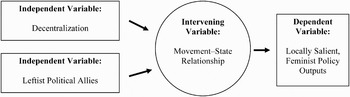
In this article, I test whether this positive theoretical understanding of decentralization holds true for the regional cases of Andalusia and Galicia. Ideally, decentralization produces locally salient, feminist policy outputs, which are facilitated through the input of feminist movement organizations. The dependent variable, therefore, is feminist policy outputs. Movement–state relationship, namely cooperation between the feminist movement and state, is an intervening variable facilitating policy outputs. I argue that the intervening and dependent variables rest on two independent variables, decentralization and political allies (see Figure 1). Decentralization involves a formal institutional change (the granting of regional autonomy) and the informal devolution of responsibility for the development of equality policies from the national administration to subnational administrations. I hypothesize that subnational feminist policy outputs are more likely to follow the latter. I also hypothesize that leftist political allies provide a context in which feminist voices are heard and feminist policy outputs are realized.
Theoretical model.

Recognizing that the terms feminism and feminist policy are highly contested both in academia (see Beckwith Reference Beckwith2000; Gottfried and Reese Reference Gottfried and Reese2003) and among Spanish feminists (see Escario, Alberi, and López-Accotto 1996; Valiente Reference Valiente2001), I use Amy Mazur's definition of feminist policy as a benchmark. Mazur recognizes policies as feminist when three of “five ideas” are met (i.e., the policy improves women's rights, challenges patriarchy, recognizes public and private spheres, focuses “on both men and women,” and can be associated with feminist organizations) (2002, 30–31). My dependent variable is threefold and focuses on outputs. First, I ask whether policies seek to change gendered relations in society and politics, implying that the lives of men and women may be altered in order for women to gain equal status. Second, I emphasize policy outputs that have the potential to confront the ill effects of patriarchy in women's lives (Beckwith Reference Beckwith2000).Footnote 2 Third, I maintain that the most ideal subnational feminist outputs will be those that are salient to women's local identities. Therefore, feminist policy outputs may include job training that offers women new public identities and economic status, nonsexist education initiatives that teach girls and boys the various empowering identities they can explore, and women's centers offering reproductive services and/or legal assistance to women fighting gender violence. These outputs become regionalized, and thus distinct from national policies, when they relate to regional economies, languages, cultures, and identities. Finally, my definition focuses on policy outputs, rather than on policy effectiveness and/or large-scale social changes. Like Robert Putnam, I seek to “measure [government] action,” yet acknowledge that “social outcomes [from policies] are influenced by many things besides government” (Reference Putnam1993, 66).
The intervening variable of movement-state relationship is defined as the extent of cooperation between bureaucrats and feminist movements. The goal here is to determine whether cooperative relations, physically feasible in small-scale contexts provided by decentralization, do, in fact, facilitate feminist policy outputs. For each region, I document the extent to which relationships are cooperative and whether they lead to feminist policy outputs. Evidence for cooperation, or “partnerships,” may be found in the basic nature of relations, that is, whether all actors maintain “a friendly and open relationship” (Halsaa Reference Halsaa, à Nijeholt, Vargas and Wieringa1998, 183), and in specific exchanges, such as in feminists and bureaucrats conversing about policy developments, lending each other expertise in policy matters and mobilizing together to establish greater policy machinery. I specifically test this variable for self-identified feminists who have been active in two of Spain's regions since the democratic transition so as to determine whether newly developed regional institutions forge relations with preexisting organizations in order to establish feminist policy outputs.Footnote 3 Nonetheless, I discuss “nonfeminist” women's organizations, those which do not self-identify as feminists, to show the empirical reality of Spain, for nonfeminist women's organizations have increased since the democratic transition (see Valiente Reference Valiente2006, 36). Because policy outputs should be enhanced by shared feminist expertise, I expect greater policy outputs when cooperative partnerships between feminist movements and bureaucrats exist.
Because decentralization occurred in Galicia and Andalusia at roughly the same time, for Galicia's and Andalusia's autonomy statutes date from April and December 1981, respectively, and both regions took the fast route to autonomy provided by the Spanish Constitution of 1978, variation in decentralization is achieved by way of a longitudinal case design that allows for comparison between time periods in each region. Therefore, I critically evaluate “the dynamic process of decentralization” and its “impact on society” over the course of the 1980s and 1990s (Oxhorn, Tulchin, and Selee Reference Oxhorn, Tulchin and Selee2004, 4, 9), gauging the longitudinal development of decentralization within two transitions in Spain: the formal granting of regional autonomy and the informal shift of equality policymaking from the national administration to subnational administrations at the end of the 1980s. Period 1 (1981–90) is when nascent regional administrations had the powers to develop equality policies. The constitution assigns to regions jurisdiction over cultural affairs, language, education, environment, tourism, and health. Nevertheless, the national Women's Institute (Instituto de la Mujer—IM), which had just been established in 1983 to advance equality policies and inform women of their rights (see Threlfall, Cousins, and Valiente Reference Threlfall, Cousins and Valiente2005; Valiente Reference Valiente, Stetson and Mazur1995 and 2003), was the center of state feminism in Spain at that time. By Period 2 (1990–2003), the IM had encouraged the development of regional women's policy agencies, and regions became a “political reference” for feminists (Valiente Reference Valiente, Lee Ann Banaszak and Rucht2003, 44). I expect decentralization to matter most in Galicia and Andalusia during the 1990s, after regional women's policy agencies were established and began to develop equality plans (Bustelo Reference Bustelo2004), that is, after institutional development stemming from the formal granting of autonomy transpired, bureaucrats were in place to make significant policy changes, and feminists viewed subnational institutions as a means to outcomes. At this point, movement-state relationships are more likely to be realized with implications for policymaking.Footnote 4
Furthermore, I expect regional administrations to put forth feminist policy outputs when “political allies” (Tarrow Reference Tarrow1998), those sympathetic to feminist demands, are in governance. Although political allies could be defined in various ways, I consider regional leftist party governance to be most crucial to feminist policy outputs. Patrick Heller Reference Heller(2001) shows that leftist parties enhance development outputs in decentralized countries, and gender scholars note that leftist parties, in a variety of national cases, have been more open to feminist demands than the Right (Banaszak, Beckwith, and Rucht Reference Banaszak, Beckwith and Rucht2003; Mazur Reference Mazur2002; Young Reference Young2000). The Spanish national case follows a similar pattern: Feminists had ties to the Left before democratization, and the Left was responsible for initiating national equality policies through the IM, from 1983 until the socialists were voted out of national office in 1996 (see Valiente Reference Valiente, Lee Ann Banaszak and Rucht2003; Threlfall Reference Threlfall1998). Given the Spanish feminist movement's ties to the Left and suspicion of the Right, it is also likely that feminists and bureaucrats will work in partnership when leftist allies lead bureaucratic agencies. In Galicia, the conservative People's Party of Galicia (Partido Popular de Galicia—PP-G) governed from 1981 to 1987 and from 1989 until June 2005, making Galicia less likely to be open to the feminist movement and policy adoption.Footnote 5 In contrast, the center-left socialist party, PSOE-A (Partido Socialista Obrero Español de Andalucía— Spanish Socialist Worker's Party of Andalusia), has led the Andalusian administration since 1981, making movement–state relationships and feminist policies more likely there.
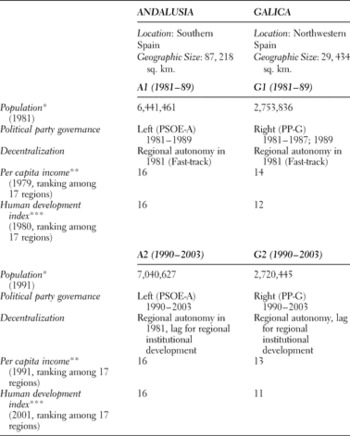
The case analysis is based on a variety of data. Documents from regional women's policy agencies and newspaper archives determine policy outputs. Movement–state relationships are gauged by original questionnaire data, personal interviews with feminist organizations, newspaper archives, and feminist movement and women's policy agency publications.Footnote 6 The development of decentralization, demarcating the longitudinal divisions of the case periods, is determined via the historical timing of regional autonomy and scholarly sources that document the informal passing of equality policy responsibilities to regional administrations.Footnote 7 The political ally variable is based on right and left governance, bolstered by political party platforms and newspaper archives. The independent and control variables are presented in Table 1. Though Andalusia is larger than Galacia geographically and in terms of population, both regions' per capita income and level of development suggest that they are both laggards in the Spanish context.
Case selection

Sources: *INE (Instituto Nacional de Estadística); **Goerlich, Mas, and Pérez Reference Goerlich, Mas and Pérez2002; ***Marchante, Ortega, and Sánchez Reference Marchante, Ortega and Sánchez2006.
REGIONAL CASE RESULTS
Andalusia's Period 1 (1981–89)
The roots of Andalusian equality policies lie in women's centers established by the pre-autonomous Andalusian administration (Junta de Andalucía) in 1978 in the provincial capitals of Seville and Malaga.Footnote 8 The women's centers were probably the first institutions of their kind in transitional Spain and are notable because they precede the granting of regional autonomy in 1981. The centers offered social services to women but were also intended as a source of consciousness raising. In 1982, the Junta developed a special plan of action for women, and a year later the community began addressing women's issues through an interdepartmental commission and the provincial women's centers, then located in Córdoba, Granada, Malaga, and Seville. Upon having health competencies transferred to the region, the Junta created family planning centers.
Because the women's centers provided an institutional structure for equality promotion, the Andalusian Women's Institute (IAM – Instituto Andaluz de la Mujer) was an adaptation of how the administration addressed equality policies, rather than an entirely new endeavor. The direct impetus for the IAM was a questionnaire sent out by the Central Coordinator of Policies for Andalusian Women whose results, presented in October 1988, demonstrated that the condition of Andalusian women was incredibly poor: Many women were illiterate, unemployed, and lacked the free time men had. The Junta subsequently decided to address these disappointing results by establishing a women's policy agency and, in December 1988, the Andalusian parliament approved the IAM. The institution was launched in January 1989 with the stated purpose of overcoming “the inequalities and limits that persist for women” (Instituto Andaluz de la Mujer 1990).Footnote 9 The provincial centers were then subsumed into the structure of the IAM.
Although feminist organizations had been present in the region in Seville, Granada, Cordoba, and Montilla since the democratic transition, policy outputs during the 1980s were not facilitated by cooperative movement–state relationships. Activists in these cities were involved in protests throughout the 1980s and were dedicated, for example, to abortion rights, peace, and fighting gendered aggression. Several Andalusian feminist organizations were interested in equality policies pertaining to health and the establishment of women's centers, and they considered working with the Junta on such matters (“En Sevilla” 1986). Although feminists were open to goals similar to those of the Junta, there is no evidence of a grassroots demand for the IAM or sustained movement–state interactions. In fact, feminists in Granada suspected as early as 1988 that the Women's Institute would eventually come to represent the discourse of feminism in Andalusia, thereby pulling feminism away from feminist movement organizations.
The IAM was the brainchild of female socialist politicians. At this time in Spain, socialist party feminism was evident at the national level and had contributed to the development of the national Women's Institute (Threlfall Reference Threlfall1998). A prominent PSOE-A female politician initiated the region's first women's centers in the late 1970s. Party feminists continued to discuss the possibility of an Andalusian state feminism during the mid-1980s. The creation of the IAM did not generate controversy and, in fact, “the parliamentary debate about the creation of the IAM was practically non-existent” (Granados Vaquero Reference Granados Vaquero, Margarita Ortega and Valiente1999, 396). Statements by parliamentary members at the time were not rejections of regional equality policies; rather, they were suggestions about potential improvements. For example, a PSOE-A representative suggested that the IAM be highly coordinated with all other equality-promoting institutions in Spain. In sum, leftist political allies, including socialist party feminists, hastened institutional developments and policy outputs but did not work hand in hand with feminist organizations.
The Junta's actions included several feminist policy outputs during Period 1. The pre-autonomous regional government took advantage of Spain's incipient decentralization by developing women's centers, and it continued developing policy measures during the course of the 1980s. Therefore, decentralization allowed regional state feminism to be developed at the same time as national state feminism. Although feminists and bureaucrats were open to each other's goals, partnerships between bureaucrats and feminist organizations were not immediately realized and were not necessary to create said outputs; rather, party feminism was the most compelling reason for change in the region.
Andalusia's Period 2 (1990–2003)
Andalusian policy outputs were also numerous during Period 2, with the most notable being the establishment of municipal equality centers, nonsexist education initiatives, job training, and recreational opportunities for women. Each of these has a distinct feminist and regionalized dimension. In its first equality plan, the Andalusian Women's Institute encouraged municipalities to create services for women, and by the completion of the first plan, the region's information centers numbered 139.Footnote 10 Municipal centers have offered information on gender violence, recreation opportunities, small libraries for women's studies, and employment counseling. Moreover, the IAM has coordinated training classes that teach municipal officials how to combat gender violence. The region's provincial centers continue to serve as communication hubs for municipal centers and local women's associations. Andalusia's dense network of municipal centers is notable given that the national Women's Institute began a network in the 1980s that never exceeded more than 11 centers situated in large cities across Spain.Footnote 11 The IAM's education efforts also started immediately after the institute was established. Together with the education ministry, the IAM designed teacher training classes in nonsexist practices and distributed related publications to Andalusian schools, including a set of flashcards about important women in Andalusian history, published for International Women's Day in 2002. Moreover, many other Spanish regions now recognize Andalusian nonsexist education programs as examples of good policy practices. The region's policy outputs in the early 2000s were also in the areas of health and job training. The IAM worked with the health ministry to inform the public about the morning-after pill. To promote the employment of rural Andalusian women, the regional agriculture ministry and the IAM have developed training classes for harvesting peaches, broccoli, and strawberries. Furthermore, the IAM has held training sessions about how to market cosmetic products made from olive oil.
Finally, the region of Andalusia has put great emphasis on women's recreation, because it is understood by socialists as a way to bring women out of the private sphere, raise feminist consciousness, and democratize women's use of free time vis-à-vis men. Recreational activities take place at the region's municipal women's centers and/or through women's associations, the promotion of which has been a major goal of the IAM since its establishment. In 1989 there were only 151 women's associations in the entire region. By 1993, there were nearly six hundred associations, and by 2002 the institute reported more than a thousand. The IAM trains associations in organization and management principles and hosts yearly feminist training meetings at which association members learn about women's rights and feminist theory. In addition to the retreats, the IAM has expressed its feminist identity by using feminist terminology, addressing feminist themes in its magazine publication (Meridiam), and editing books about feminism.Footnote 12
Despite the array of evidence demonstrating the ability of the IAM and regional ministries to engage feminism, Andalusian feminist organizations have not been closely tied to regional policymakers and hold neutral views of them. In the early 1990s, IAM officials met with Granada feminists to discuss how the institute could assist them; shortly thereafter, however, the feminists criticized the IAM in their journal (Menos Lobos) for not inviting them to feminist training meetings. Moreover, although the IAM invited the input of women's organizations through a council meeting (consejo) related to the region's second plan of equality (1995–97), long-standing feminists were not among the women's organizations elected to the regional council.Footnote 13 While bureaucrats and feminists share goals, such as establishing nonsexist education and fighting gender violence, partnerships have not emerged. Nonetheless, the feminist critique of the IAM is not one of total dismay, for many feminists are willing to receive subsidies from the institute and agree that the IAM has accomplished crucial tasks for women. They can, however, imagine more preferable outputs. With respect to gender violence, for example, Cordoba feminists emphasize prevention of violence, and in their opinion, Spanish state feminism focuses too much on services to victims of gender violence. The Cordoba feminists are not opposed to cooperating with bureaucrats, for they worked with municipal officials in the 1990s and received assistance from the IAM to organize the 2000 national meeting of Spanish feminists. Yet they note that the IAM's support was mainly financial and not related to the organization of the conference. Other feminists believe that the IAM is too moderate and overly bureaucratic. As in Period 1, though movement–state relationships are minimal but open, strong coalitions did not prove essential to outputs.
Since the 1980s, the face of Andalusia feminism has become less associated with feminist organizations and more associated with the IAM and new women's associations. One should note that Andalusian feminists have questioned whether new associations have the potential to raise consciousness and challenge patriarchy for, though they advocate equality between men and women, many of their activities are recreational in nature.Footnote 14 With an understanding that Andalusian women's civil society is now broad, we should not be surprised that the 2002 questionnaire data from a variety of women's organizations suggest satisfactory relationships between organizations and bureaucrats. Of 30 respondents, 27 either “agreed” (24) or “agreed very strongly” (3) that the IAM helps women in the Andalusian community. In only one instance did an organizational representative claim that no members of the organization had participated in the activities (conferences, job training, etc.) of the IAM.
Statements by IAM officials and PSOE-A leaders defining the region as feminist point to the most important variable influencing policymaking during the 1990s, namely, political allies. Socialists claimed that Andalusia was the region with the most resources dedicated to equality policymaking, that it had the most extensive network of local services, and that it was a “vanguard in equality policies” (“PSOE: Andalucía” 1992, 4). PSOE ministers working outside the IAM also made feminist statements about policies. The Andalusian education minister in 1994 touted the region's nonsexist initiatives and claimed that they could help Andalusia “achieve a more just, equal, and integral society” (Pascual Acosta Reference Pascual-Acosta1994, 19). The PSOE-A's electoral programs also demonstrate the party's promotion of feminist ideals. That said, the socialist administration did not encourage strong partnerships between feminist organizations and officials; thus, outputs are more of a direct result of the influence of leftist allies than the intervening variable of movement-state relationship.Footnote 15
As expected, Period 2 produced greater outputs than Period 1, demonstrating that decentralization proved more beneficial as it unfolded: Feminist policies increased after the region charged the IAM with policy responsibilities, the IAM became a permanent institutional fixture, and other parts of the regional administration responded in kind. Decentralization did not serve as an opportunity for feminist organizations to influence all policy matters, but rather for growth in new groups spawned by the IAM's extensive network of centers and for the development of a strong equality discourse within the region.
Galicia's Period 1 (1981–89)
Galicia during the 1980s is distinct from Andalusia because the Galician administration (Xunta de Galicia) did virtually nothing to promote feminist policy outputs. In the early 1980s, the national Women's Institute opened a women's center in La Coruña, but otherwise, as of 1986, “no other official support for Galician women exist[ed]: not [even] a battered women's shelter” (“Centros de información” 1986, 19). In the late 1980s, the Galician parliament confirmed the Xunta's lax attitude toward equality policies when socialist PSG-EG women supported a resolution for the establishment of a Galician Women's Institute (Instituto Galego de la Mujer – IGM), a policy agency that would have paralleled the IAM.Footnote 16 The institute's proponents argued that other regions were beginning to develop equality policies; however, the proposal was introduced, and rejected, three times.
After the first failed institute proposal in 1988, the Galician Socialist Party – Spanish Socialist Worker's Party (Partido Socialista Galego-Partido Socialista Obrero Español – PSdeG-PSOE) then governing the Xunta established an Interdepartmental Commission on Women through the regional Ministry of Employment and Social Welfare. The commission had the capacity to coordinate policies through regional ministries, but was not a legally permanent “institute.” During the commission's first year of work, it issued the region's first equality plan, to be enacted between 1988 and 1991, and researched the status of Galician women in politics, employment, and society. Female politicians proposed the institute again in 1989, but it failed because parliamentarians believed that the Interdepartmental Commission was adequate for the region.
Without action from the administration, the region's attention to feminist goals must be wholly attributed to the regional feminist movement. The Galician feminist movement, with its roots in the transition to democracy (Blanco Reference Blanco1997; Mulheres Nacionalistas Galegas Reference Galegas2002), split into several groups throughout the late 1970s and 1980s, yet all groups defined themselves as Galician feminists and prioritized Galician language, history, and culture. Moreover, they held the common goals of gaining full abortion rights and fighting against capitalism. Feminists also pursued nonsexist education and as early as the 1980s produced educational materials to be distributed to Galician schools. In the late 1980s, feminists coordinated with municipal officials to establish a women's help center in one of Galicia's major cities (Vigo). Finally, they participated in annual protests on International Women's Day.
Although feminists cooperated with officials from the Vigo municipal administration, movement–state relationships at the regional level were not open and friendly. The administration did not engage feminists, and the feminists themselves expressed hesitation about the proposed Galician Women's Institute. During the first parliamentary vote for the institute, the feminists hosted a mock tribunal at which they indicted the socialist administrations of Spain and Galicia for overlooking violence against women, and they argued that the Galician Women's Institute would temper the feminist movement and its fight against capitalism and patriarchy. Feminists also maintained that “powerful actors and systems” have “assimilated” societal competition throughout time and that the Xunta, by way of the institute, would dampen the movement (Mulheres Nacionalistas Galegas 1989). In short, feminists were not positioned to impact policymaking, for the regional administration was an incredibly closed structure.
Galicia's lack of policy outputs is tied to conservative governance as well as complacency by socialists. The socialists, through the Interdepartmental Commission, accomplished more during its brief governance than conservatives had throughout the rest of the decade, for the PP-G's only 1989 electoral goal relating to women pertained to maternal health. However, the first institute proposal in 1988 was the initiative of female PSG-EG members because the PSdeG-PSOE socialists would not sponsor the bill. Moreover, the PSdeG-PSOE originally voted against the institute, claiming that developing a women's institute without any past experience with equality programs amounted to “putting the cart before the horse” (“Sobre la propuesta” 1988). In sum, Galician socialists passed up a small window of opportunity to introduce an institutionally strong, legally permanent women's agency. Actions by political parties contributed to the feminists' hesitation toward regional officials and policies.
With the exception of the Interdepartmental Commission, Period 1 demonstrates that decentralization in Galicia did not provide an opportunity for feminist policy outputs. No evidence supports the claim that regional officials, upon gaining autonomy, will engage the feminist movement or pursue feminist policymaking.
Galicia's Period 2 (1990–2003)
Female political party proponents fought for the Galician Women's Institute a third time in 1991, but the People's Party of Galicia already had regained control of the Xunta. The PP-G, which had voted against the proposal in 1988 but for the proposal in 1989, rejected the institute this third time and passed its own proposal for the Galician Equality Service (Servicio Galego de Iguladade—SGI). The SGI was situated in a newly created Ministry of Family, Women, and Youth and was charged with adopting equality measures and “encouraging participation in the social, cultural, economic, and political lives” of women (Servicio Galego de Promoción da Igualdade do Home e da Muller 1994, 11). The Galician Equality Service rendered the Interdepartmental Commission unnecessary.
Unlike the IAM, the SGI did not immediately work hand in hand with various regional ministries to develop policies, and few outputs were apparent in the early 1990s. The first equality plan of the SGI contained less ambitious goals than the equality plan of the previous Interdepartmental Commission. Whereas the commission, for example, set nonsexist education goals and sought to make administrative language gender neutral, the SGI-proposed policy goals were primarily general statements about women achieving equality and increasing their participation in society. According to SGI reports, between 1991 and 1993, the agency studied the situation of women, held conferences, offered training to rural women, and helped women in situations of need. The SGI also pursued safe-housing programs for prostitutes.
The SGI, along with its parent Ministry of Family, Women, and Youth, must be credited with pursuing a more active policy agenda in the latter half of the 1990s. The SGI's second equality plan proposed measures to eliminate sexism from education, improve the health of Galician women, and train women in entrepreneurship, whereas the third equality plan emphasized women in the labor market. More recent innovations of the SGI pertain to gender-related education policy, job training, and local services.Footnote 17 The SGI has published education materials through its Permanent Seminar of Education for Equality (Seminario Permanente de Educación para a Igualdade), created in 1998. In cooperation with the University of Santiago de Compostela, the Permanent Seminar has founded a master's degree program for “agents of equality.” The administration also has published books for children about gender equality in the Galician language. The SGI job-training project Gamela trained women in the fishing industry and, notably, the European Union has called it a “success story” (European Commission 2000). Finally, the SGI created the RIAM network (Rede de Información e Asesoramento á Muller—The Network of Information and Advice for Women) in order to link existing women's centers with newly established ones in each Galician district.
Several more policies are tied to the region's discourse about families. During the 1990s, the regional Ministry of Family, Women, and Youth was concerned about the region's declining demographic growth and proposed measures to assist families with many children, such as government subsidies for large families, thus potentially encouraging women to have more children.Footnote 18 The Xunta also emphasized child-care policies during Period 2. Moreover, the SGI combined its family perspective with nonsexist education, claiming that the family, during the early formation of a child, must help end sexism in society. Despite the Family Minister's attempts to clarify that family policies help women consolidate their family lives and careers, feminists, among others, recall family policies, particularly assistance for large families, as being part of the conservatism of the Franco regime. These sorts of policies had largely been ignored at the national level after the transition to democracy (see Valiente Reference Valiente1996), yet the Galician administration reopened the controversy. Although the aforementioned policies of nonsexist education initiatives and women's centers have feminist potential, they have been undermined by the Xunta's family-policy framework that arguably promotes women's traditional, private roles.
To say the least, synergistic relationships between feminists and the administration did not exist throughout the 1990s, and feminist organizations did not contribute to policy outputs. Feminists in organizations invited SGI bureaucrats to participate in their 1992 International Women's Day protest, but the SGI did not participate (“Catrocentas mulleres” 1992) and, later that year, feminists criticized the Xunta for denying them funds in favor of women's organizations affiliated with the PP-G. In 1994, feminists protested the Xunta's family initiatives, calling them “pronatalist” and claiming that they promoted women's traditional maternal identities, thus denying women other identities (“Colectivos feministas” 1994). For these reasons, Galician feminists describe the 1990s as the “years of patriarchal offensive” when the authorities attempted to “usurp our language and our [feminist] claims [and tried] to make us believe that they cared for us” (Ocampo Reference Ocampo2002). Protests of the Galician feminists in the early 2000s, pertaining to the 2002 Prestige oil spill and the U.S.-led war in Iraq, also placed them diametrically opposed to Spanish conservatives and the regional administration. Finally, feminists have accused the SGI's nonsexist education conferences as being “propaganda” (Mulheres Nacionalistas Galegas Reference Galegas2001).
As in Andalusia, women's civil society has broadened to include many kinds of women's organizations. The most remarkable growth in civil society in Galicia comes from rural women's organizations, which offer the strongest support for the SGI. These organizations have demanded better social services for women isolated in the countryside. They utilize a mild discourse of equality, but do not participate in protests and/or feminist activities. It is important to note that although the magazine publication of the Ministry of Family, Women, and Youth (FM.X— Familia, Muller, e Xuventude) highlighted the activities of rural women's and housewives organizations from the mid-1990s on, it did not mention feminists or feminism. Because of this newfound diversity in women's civil society, questionnaire responses from Galician women's organizations in 2002 yield mixed conclusions. Of seventeen organizations, 12 responded that they either “agreed” (10) or “agreed very strongly” (2) that the SGI helps women in Galicia. Moreover, 14 groups cited “frequent” (13) or “very frequent” (1) communication with the SGI. Only two organizations reported that its members had not participated in SGI-hosted activities. One feminist organization, however, reported that it totally disagrees that the SGI helps women in Galicia and that the SGI negatively affects their goals. Moreover, feminists do not recognize rural women as an essential part of the region's feminist history.
Conservative party governance, specifically the very conservative nature of the PP-G, largely explains the antagonistic relationships between feminist and regional officials and unsatisfactory regional outputs. Whereas the national PP often annoys feminists, the PP-G is arguably hostile toward feminism given the positions of its leaders and policies regarding the family. The Family Minister during the 1990s was a close associate of the Xunta president, Manuel Fraga, a former minister in the Franco regime who has championed family policies and is known in Spain for making sexist comments. The SGI, its parent ministry, and its equality policies were therefore not credible with leftists and feminists, thus prompting the PSdeG-PSOE to insist in its party platforms throughout the 1990s on a more powerful and better-funded institute.
Period 2 demonstrates that locally salient policy outputs may eventually transpire in conservative regions. Therefore, in one sense, time and regional institutional development prove essential in jump-starting Galician policy outputs. Nonetheless, the patriarchal discourse of family policymaking obfuscates the feminist potential of adopted policies. Partnerships between feminist organizations and state institutions were not needed for the minimal outputs present, for bureaucrats did not welcome feminists into the policy process and feminists disapproved of the regional policies adopted.
ANALYSIS OF DATA
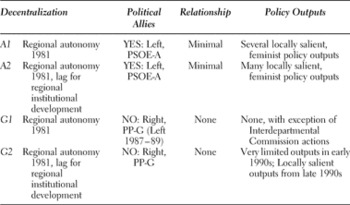
Differences between Andalusian and Galician policy outcomes are striking during both periods, as can be seen in Table 2. Andalusia pursued feminist policies during the 1980s, whereas Galicia largely did not. The policies adopted in each region during Period 2 squarely fit women's local identities, such as job training tailored to the local agriculture products of both regions. Nevertheless, the adoption of feminist policy differed between the regions. In Period 2, Andalusian officials stressed the region's vanguard and feminist actions, whereas Galician policies, though more numerous during the late 1990s, cannot be considered feminist because the region's family policies rejected feminist discourse and exuded a conservative stance of women as mothers.
Case summaries

Sorting out which variables in the two cases led to differences in feminist policy outcomes is therefore important. The most obvious variable at work is that of political allies. Socialist governance explains Andalusian policy outputs in Periods 1 and 2. During the early 1980s, Andalusia benefited from being governed by a regional party whose national counterpart was also pursuing state feminism. More specifically, innovative socialist leaders in the region (i.e., PSOE party feminists) took advantage of upcoming regional autonomy by establishing women's centers in the provinces, and then transferred these efforts to the Andalusian Women's Institute. In Period 2, the PSOE-A maintained its interest in equality policies and coupled it with a strong feminist discourse. In Galicia, conservative leadership did not yield feminist policy outputs during the 1980s, and socialists were modest in their pursuit of outputs. During Period 2, the Galician conservative leadership appeared especially old-fashioned, and although leftists desired stronger policy outcomes, they were not in a position of power to garner them.
One important similarity between Andalusia and Galicia is that each region shows more policy activity during Period 2 than Period 1. For this reason, the decentralization variable, though challenging expectations, confirms the importance of institutional development. Decentralization was viewed here as a formal institutional change and an informal passing of equality policies to regions. The Andalusian administration exceeded expectations in Period 1, and the establishment of the IAM served as a second institutional opening, after which policies greatly increased. Even in Galicia, time and institutional development are crucial for explaining outputs. The Xunta proffered virtually no policies in the 1980s, yet by the end of the 1990s issued equality plans similar to those of other regions. However, because Galician policies cannot be considered wholly feminist, one may oppositely conclude that decentralization—even after many years—does not ensure subnational feminist outputs.
The intervening variable of movement–state relationships, though not functioning according to the theoretical model, provides some explanatory power. On the one hand, the Andalusian region demonstrates that close partnerships between feminists and bureaucrats are not a necessary condition for feminist policy outputs, for bureaucrats there did not require the expertise of feminist organizations even in the case period with the greatest feminist outputs (Andalusia Period 2). Moreover, decentralization's “small-scale nature,” neither at its commencement nor after regional institutional development, inspired coalitions between feminists and bureaucrats; and leftist allies in both cases did not prioritize feminist voices in the policymaking process. That said, the contrast between Andalusia and Galicia demonstrates the negative consequences of antagonistic relations. Conservative governance helps explain poor relationships between the Galician administration and regional feminists, and leftist governance explains minimal, but open, relationships in Andalusia. Although feminists and bureaucrats in Andalusia did not consistently meet and discuss policy goals, together they produced a robust feminist discourse and, hence, a context in which feminist outputs were welcomed and almost expected. Conversely, interactions between Galician feminists and officials were counterproductive. Feminists expended energy protesting the SGI, and the SGI, by ignoring feminist voices, avoided accountability for its lack of actions over many years.
CONCLUSIONS
This study has shown that decentralization is not a guarantor of success for feminist movements and female citizens. The finding of greatest concern is that the transfer of policymaking powers to subnational institutions allows for such institutions to be active or passive about feminist policymaking. If the findings in the Spanish cases were extrapolated worldwide, one might expect to find gaps in equality policies in many subnational venues and, hence, a large number of women would not benefit from progressive advances found in other national and subnational contexts. These cases demonstrate not only that decentralization sometimes fails to offer an immediate opportunity for feminist policymaking but also that even after regional institutional development, and specifically the establishment of a subnational women's policy agency, policy outputs may be less than desirable.
Because decentralization is not consistently advantageous, one must ask under what circumstances satisfactory subnational outcomes are more likely. As mentioned, the leftist region of Andalusia was more feminist in its approach than the right-wing region of Galicia. If this finding can be generalized to other cases, one would expect to find great differences in policy outputs between conservative and leftist regions, that is, uneven policymaking across countries. The timing of decentralization and its development will also be important to analyze in other countries, for Andalusian regional outputs increased over time and Galicia eventually produced locally salient (though not overtly feminist) outputs. Future research may find that other conservative regions slowly develop equality policies, which, though they may be superficially similar to those of their leftist neighbors, continue to promote women's traditional identities.
On the basis of my findings, I would suggest that several avenues of future research be pursued to understand fully when and how decentralization is advantageous. First, future research must grapple with the questions of who the local women involved in subnational politics are and why they interact with subnational administrations. Although it was theoretically expected that feminist organizations from the democratic transition era would take advantage of decentralization, the case analysis confirms Mazur's findings that feminist outputs can emerge without consistent input from feminist organizations (2002). The real winners of the state's close proximity are, instead, new women's associations, which can trace their origins to socialist discourse about recreation and their ongoing support from regional women's policy agencies. Critically speaking, this means that as the Spanish state has interacted with society, it has crowded out feminist voices and instead established new associations with practical gender concerns (Molyneux Reference Molyneux1985) as the more “acceptable” form of women's rights activism (Banaszak, Beckwith, and Rucht Reference Banaszak, Beckwith and Rucht2003, 23). In this way, decentralization has led to bureaucratic control over women's issues and discourses. If viewed in a more positive light, new voices are evidence that Spanish women, who traditionally hold strong private identities, are entering the public sphere. For these new women in civil society, democracy has arguably deepened. Civil society growth has occurred in both Andalusia and Galicia, and thus does not depend on political party governance, for women's policy agencies in both regions have encouraged the mobilization of women in associations. I therefore concur with Valiente that the nonfeminist sector of the Spanish women's movement cannot be left out of future studies (Valiente Reference Valiente2006). I also suggest that researchers examining subnational politics in other countries address the puzzle of movement–state relationships. While it is tempting to judge decentralization positively for its proliferation of equality discourses, women's associations, and policy outputs, such an assessment overlooks the empirical complexity and the theoretical significance of “multiple centers of power” (Banaszak, Beckwith, and Rucht Reference Banaszak, Beckwith and Rucht2003, 25) for multiple women's identities (i.e., feminists and other women in civil society).
Second, because of special features in the Spanish case, I also suggest future cross-national, regional-level studies, that is, research that provides variations in both national and regional contexts. Spanish decentralization approximates federalism and is often referred to as quasi-federalism. On the one hand, this explains why Andalusia and Galicia had the opportunity to tailor locally salient policies, but it also explains why Galicia had the ability to resist progressive changes for so long. Future researchers, therefore, must determine what kinds of decentralization (and federalism) provide the greatest avenues for feminist policymaking and feminist movement activism. Furthermore, although Galicia's outputs are not feminist, they exceed those of conservative subnational governments elsewhere that have shut down women's policy agencies and/or curtailed equality policymaking altogether. The fact that Galicia promoted any kind of policy is due to Spain's stable equality policymaking environment, stemming from the “longevity” of a national political ally—specifically, national socialist governance from 1982 to 1996, which provided “an unprecedented opportunity for the development of equality policies” (Threlfall Reference Threlfall and Threlfall1996, 124). Equality policies have become so accepted in Spain that even conservative administrations do not consider abolishing them. Scholars would do well, in future research, to question how national political contexts affect the outputs of their substate units.
Extending this study to countries across Western Europe, East Central Europe, and Latin America is timely, considering that the European Union encourages multiple layers of governance and newly democratized and consolidated democracies in Latin America and East-Central Europe have reconfigured regional and municipal institutions. I have shown here that these changes have the potential to provide new avenues for feminist policymaking and activism in select cases, yet have suggested that the full impact of subnational politics will not be understood until outputs and movement—state relationships are examined on a cross-national, region-by-region basis. With such analyses, the field of gender and politics may truly capture the complex intersection of local feminisms, subnational institutions, and national politics.