When Harrison Birtwistle's opera Punch and Judy premièred at the Aldeburgh Festival in 1968, it introduced something of the anarchic, revolutionary energy so strongly associated with that summer. In the same month, Pierre Boulez's famous diatribe ‘Opera Houses? – Blow Them Up!’ was published for the first time in English translation in Opera magazine.Footnote 1 (The composer himself was scheduled to appear soon afterwards at Covent Garden, conducting Pelléas et Mélisande.) Thanks in part to its incendiary headline, Boulez's interview has often been seen as emblematic of the avant-garde's opposition to opera and the opera house as irredeemable expressions of bourgeois complacency, to be resisted or destroyed. Even at the time, the interview was seen as a ‘passing of the death sentence’ on opera.Footnote 2 A more specific target emerges in Boulez's interview, though: a kind of middlebrow modern opera, exemplified by a string of commissions by the Hamburg Staatsoper; for Boulez, these operas epitomized ‘bourgeois average taste’ in modern music.Footnote 3
Boulez's comments found some resonance in Britain, where new operas proliferated and composers were experimenting with other forms of music theatre. Harold Rosenthal's introduction to the interview suggested that however outrageous Boulez's remarks may be, they deserved ‘wider discussion, especially in this country’, and obliquely posed the question of where new British opera might fit into Boulez's scheme.Footnote 4 What of Benjamin Britten and Michael Tippett, or Richard Rodney Bennett, who happened to be Boulez's former student? After all, the operatic situation in Britain seemed closely related to that at the Hamburg Staatsoper. Indeed, the two opera scenes overlapped more than the magazine acknowledged: Alexander Goehr's Arden Must Die had premièred at the Staatsoper a few months before Boulez's interview was originally published; Humphrey Searle's Hamlet premièred there in 1968; and when Punch and Judy went on to the Edinburgh Festival after Aldeburgh, the Hamburg Staatsoper presented three operas there as well.Footnote 5 In this context of cross-Channel exchange, Punch and Judy seemed to answer Boulez's call for a more avant-garde, less middlebrow opera. Certainly it was a long way from Hamburg's other new opera in 1968, Gian-Carlo Menotti's Hilfe, hilfe, die Globolinks!, which featured music-hating aliens (represented by electronic music) defeated by a school orchestra in a thinly veiled attack on the avant-garde. Punch and Judy, by contrast, followed many of Boulez's prescriptions: it rejected the trend for opera based on literary texts, and its libretto, by the pianist Stephen Pruslin, was inseparable from music (being full of nonsense sounds and musical images), just as Boulez suggested.Footnote 6
In this sense, Punch and Judy might be said to embody the same sense of revolt against ‘bourgeois’ modern opera that Boulez expressed in a more violent way. What is more, this idea of revolt is explored in the opera itself: the violent Punch attacks everyone he encounters, beginning by throwing his baby onto a fire and stabbing his wife. Roughly following the plot set out by John Payne Collier in 1828,Footnote 7 the opera continues with the murders of the Doctor and the Lawyer, and then of the narrator Choregos, the one major addition to the traditional plot. It ends with the final trick on the hangman and devil, combined here into one figure, as Punch evades punishment for his actions and finally overturns death itself.Footnote 8 In short, Punch revolts against all the social constraints around him in a series of ritualized attacks, destroying them in a quest for his ideal, Pretty Polly. If Punch assaults all constraints, the opera also seems an assault on music itself, with a marked emphasis on noise: in the unpitched, fortississimo scream that opens the opera; in the high nasal laugh that marks Punch's entry; and in the heavy use of percussion and the section for toy instruments, with its grotesque parody of conventional orchestral sounds.
This Punch is a traditional figure of anarchic revolt, drawn from a world of disruptive urban entertainment, but he also doubles as a figure of the avant-garde artist in clownish guise, assaulting audiences, traditions and institutions (‘Bomb the opera houses!’).Footnote 9 This resonance is drawn out at several points, for the opera's Punch is an artist more than a simple brute: an inveterate riddle-maker, a singer of serenades and of prayers, a man on a quest for the ideal. In this sense, he merges with the more traditional figure of the artist, Pierrot – hence Pruslin's observation that the distinctive feature of the opera's Punch was the addition of ‘an idealistic and vulnerable side […] diametrically opposed to his originally uniform aggressiveness’.Footnote 10 Pierrot was arguably a site of ambivalence for modernists, suggesting anxiety about art's display of interiority and its relationship with commercial entertainment: in short, about the artist as entertainer. The idea of combining him with the brutal, crafty Pulcinella – the origins of Punch – seems a telling commentary on how these anxieties had shifted by 1968, when John Cage and Charlotte Moorman could appear on television game shows and Stockhausen could be found on the cover of a Beatles album: the artist was a vehicle of assault, but also a clownish figure of fun.Footnote 11
Critics have tended subtly to distance Birtwistle and the rest of the ‘Manchester Group’ from opera, or at least to emphasize their ambivalence towards it; this works to align them with an avant-garde seen as hostile to the genre, and to foreground the ways in which their music challenged tradition and authority.Footnote 12 I want instead to focus squarely on Birtwistle's engagement with opera through a kind of microhistory of Punch and Judy, looking at the English Opera Group's efforts to stage and promote the work (as recorded in the archives held at the Britten–Pears Library); the large body of notes, reviews and reactions that sought to position it; the spectrum of largely forgotten operatic activity in which it was understood; and the opera's own reflections on the problems of tradition and authority. This material suggests, first, that the 1960s avant-garde was less hostile to opera than has seemed to be the case.Footnote 13 Boulez himself was more engaged with operatic institutions than his statements suggest, even helping the Paris Opera with an ambitious programme of reform in 1968.Footnote 14 Like Boulez, Birtwistle and his champions were invested in opera in the 1960s, and specifically in reclaiming it from the middlebrow. Secondly, this attempt to restake opera's claims was part of a larger process of defining areas within the spectrum of new musical production in 1960s London, with its fluid divisions between the more traditional, the avant-garde and the experimental. Finally, what is at issue in Punch and Judy – in both the opera and the process of its production and reception – is not so much revolt itself as the tension between individual acts of freedom and the authority of tradition and institutions.Footnote 15 In other words, Punch and Judy allows us to examine – with specificity and at the ground level of artistic practice – some of the tensions Pierre Bourdieu outlined theoretically at around the same time: between the ‘personal authority called for by the creator and the institutional authority favoured by the teacher’ and the ‘curators of culture’.Footnote 16 But if for Bourdieu these confrontations played out in a struggle for cultural legitimacy, I aim to go beyond the task of tracing ‘mechanisms of legitimation’, networks or ‘ecologies’ of operatic activity.Footnote 17 For Punch and Judy demands attention to its own reflexivity about these contradictions of the avant-garde, and their fundamental irresolvability. Indeed, opera became a way of reflecting on the contingency and possible futility of artists’ declarations of freedom and revolt in 1968. In other words, this study traces the melancholy experience of an impasse.
Mapping new music in 1960s Britain
This sense of modernism as fundamentally compromised might seem especially acute in the British context. The late 1950s and the 1960s have long been seen as a high point in public support for new music in Britain: a moment when audiences and composers were newly exposed to the music of both pre-war European modernism and the postwar avant-garde, thanks in part to the efforts of William Glock at the BBC.Footnote 18 As a result, 1960s British modernism can appear somewhat blunted by official approval, as well as its ties to an already established modernist tradition.Footnote 19 Oppositional stances tend to be reserved for an ‘underground’ experimentalism, or even more prominently for popular music, while the British composers most closely aligned with the Continental avant-garde were described as ‘dull young things’ in the 1950s, or more recently as ambitious ‘grammar schoolboys’, writing ‘radical but reactionary’ music.Footnote 20 To some extent this suspicion is part of a larger set of doubts about the radicalism of the postwar avant-garde in general.Footnote 21 After all, British music (as well as visual arts and theatre) was not alone in being closely tied to the ‘bourgeois’ or Establishment institutions that modernists often claimed to attack, although it was, perhaps, unusually open – and openly anxious – about these ties, especially in the 1960s.Footnote 22 For instance, when in 1968 the Institute of Contemporary Arts (ICA) moved to Nash House, on the ceremonial Mall near Buckingham Palace, it displayed some discomfort with its distinctly elite location, launching a defence of experimentalism coming out of what it called ‘mainstream’ institutions such as the Royal Shakespeare Company, and positioning itself as a ‘centre of questioning and confrontation, placed at the geographical focus of our inherited system of government’.Footnote 23
The most obvious effect of public support, especially in opera, was to encourage a middle road. Andrew Porter wrote in 1965: ‘The interaction of public welcome and private vision has produced, from a new generation of British composers, an extraordinarily healthy and vital corpus of “central” music, neither reactionary nor avant-garde.’Footnote 24 As Porter noted, young composers were especially active in the production of opera, ‘the form that most openly bids for public acceptance’.Footnote 25 Bennett, whose opera The Mines of Sulphur had just premièred, wrote in 1965 about this sense of ‘public welcome’ in London. In Paris, he said:
Whether you get played depends on who your friends are and if you go to bed with the right people. New York's frightful, too. You're played there if you're wildly avant-garde or if you're an institution with 10 symphonies behind you. There's no hope in between, which is where I am, along with most other English composers.Footnote 26
But this dominance of the ‘central’ and the ‘in-between’ can also be overstated. By the later 1960s, even the most experimental composers drew on public support and used established classical music venues, and the line between an ‘underground’ and mainstream institutions could be hard to draw: this is a moment when Michael Nyman could hear Cornelius Cardew's The Great Learning at Wigmore Hall (‘of all places’, he adds), and then review it positively in The Spectator.Footnote 27 As Benjamin Piekut observes, an ‘experimental music’ venture like Victor Schonfield's Music Now organized events in an ‘anarchic’ range of venues, from the Purcell Room to the ICA and the Roundhouse; such a range was representative of the new music scene in London more broadly, I would add, and involved significant tensions between official institutions and the social and aesthetic goals of the individuals they supported. And if, as he also points out, Nyman's 1974 book Experimental Music created boundaries between improvised and indeterminate experimental music that were much fuzzier in practice, it more fundamentally created barriers between experimentalism in general and other areas of new music activity, barriers which have increasingly hardened in recent historiography.Footnote 28 It was a moment when such categories were under debate – when venue and institution signalled little about content – and opera was being actively repositioned.
Birtwistle himself clearly aimed to avoid the ‘in-between’ status Bennett described. His defenders tended to associate him with the Continental avant-garde, in opposition to the older generation of British composers, still seen as a dominant force. And Birtwistle distanced himself somewhat from the British scene by spending 1966–7 in the United States, exploring integral serialism and Schenkerian analysis.Footnote 29 In 1968, Nyman (who wrote the libretto for Birtwistle's next theatre piece, Down by the Greenwood Side) referred to Birtwistle as a representative of ‘“progressive” English music’, as opposed to William Walton and Britten.Footnote 30 And in Experimental Music, he listed Birtwistle alongside Boulez, Iannis Xenakis, Mauricio Kagel, Karlheinz Stockhausen, Luciano Berio and Sylvano Bussotti as representative ‘avant-garde’ composers (as opposed to the ‘experimental’ ones on which the book focuses).Footnote 31 As Philip Rupprecht has recently argued, such attempts to align postwar British modernism with an international avant-garde have tended to elide some of its central concerns, including its significant engagement with national traditions, an engagement that seems especially strong in the case of Birtwistle.Footnote 32 They also elide its engagement with opera. By restoring that sense of engagement, I do not want simply to realign Birtwistle with a more ‘central’ tradition of British music, but rather to complicate the avant-garde's relationship with opera and indeed with the ‘bourgeois’ audiences, institutions and traditions with which it was associated.
‘Music theatre’ and opera in the 1960s
The story of Punch and Judy's scandalous première at Aldeburgh has done much to associate it with a provocative avant-garde, while distancing it from both opera and a British ‘centrism’:
The premiere of Harrison Birtwistle's first opera, Punch and Judy, at Aldeburgh in 1968 has become part of festival legend. The story is hard to substantiate, but it seems Benjamin Britten was so unimpressed by the score's raucousness that he left at the interval.Footnote 33
The fact that there was no interval at that performance is perhaps just the first clue that this story is precisely myth, significant in its own way but obscuring a more complicated reality. Nonetheless, this account has made its way into the opera's Wikipedia entry, less carefully hedged; and we also find the story recounted with more sceptical distance in recent scholarship on Birtwistle's operas.Footnote 34 Britten also appears publicly antagonistic in the 2003 edition of his collected writings. Here we find Britten in an interview dating from 1969 criticizing a ‘young composer’ for failing to use Mozart as a ‘road-map’ for his new opera; in the editorial footnotes, this composer is identified as Birtwistle, making the target opera Punch and Judy.Footnote 35 This rather inapt criticism suggests an insurmountable distance between Birtwistle's and Britten's operatic ideals, which would appear to be hopelessly out of touch. In the earliest publication of this interview, however, the young composer is unidentified; even if Britten was talking about Birtwistle – and one can imagine other more suitable objects of his reproach – he did not make that public.Footnote 36 Similarly, one searches in vain for printed references to Britten's ostentatious exit in early criticism of Birtwistle's opera, and Birtwistle himself claims it never happened.Footnote 37
If Punch and Judy has been seen to confront Britten, it has also been seen to challenge opera in some ways. There are good reasons for this, with Birtwistle himself claiming recently that it ‘was more Music Theatre than opera’.Footnote 38 The work features an onstage wind band (in addition to a pit orchestra), as well as elements of mime and dance (there are five silent roles for dancers) and highly ritualized action, detailed in extensive production notes that emphasize the work's departures from ‘realistic theatre’ and ‘naturalistic movement’.Footnote 39 Its use of popular theatrical traditions has also been connected with Peter Brook's idea of ‘rough theatre’, which Brook himself described in 1968 as a theatre of revolt: ‘Lightheartedness and gaiety feeds it, but so does the same energy that produces rebellion and opposition. This is a militant energy: it is the energy of anger, sometimes the energy of hate.’Footnote 40
Birtwistle, Peter Maxwell Davies and Goehr are all strongly associated with a move towards experimental music theatre in the late 1960s. In different ways, they produced works that were ritualistic or stylized and removed from the opera house, relying instead on new groups: the Pierrot Players, which Birtwistle founded with his Punch and Judy librettist Pruslin and the clarinettist Alan Hacker in 1967; Goehr's Music Theatre Ensemble, from the same year; and the London Sinfonietta, from 1968. New works for these groups included Davies's Revelation and Fall (1968) and Eight Songs for a Mad King (1969), Goehr's Naboth's Vineyard (1968), John Tavener's ‘dramatic cantata’ The Whale (1968) and Birtwistle's ‘dramatic pastoral’ Down by the Greenwood Side (1969) for the Music Theatre Ensemble, as well as the withdrawn Monodrama (1967) and Cantata (1968) for the Pierrot Players.Footnote 41 The search for alternative types of music theatre extended well beyond these composers. Even Britten largely abandoned mainstream opera in the 1960s, producing only A Midsummer Night's Dream (1960) – a smaller-scale opera that premièred in Aldeburgh's Jubilee Hall rather than an opera house – and the three church parables (highly ritualized and stylized works for the English Opera Group).
Despite this turn to music theatre, though, Birtwistle, Davies and Goehr were also closely engaged with opera and operatic institutions in the 1960s, especially in the middle years of the decade. As David Beard and Michael Hall have shown, opera was a central theme in 1964 at the first Wardour Castle Summer School, an event Birtwistle organized at the girls’ school, Cranborne Chase, where he taught at the time.Footnote 42 In a session called ‘Opera Today’, Birtwistle, Goehr, Davies and Tippett all discussed their operas in progress, as well as the first of Britten's church parables, the recent Curlew River (1964).Footnote 43 According to Hall, the idea of ‘music theatre’ came up already in this discussion, as the composer Anthony Gilbert ‘attacked the whole concept of traditional opera’, suggesting that composers should focus on more politically and social engaged types of ‘Music Theatre’.Footnote 44 The composers on the panel, though, were writing operas in every sense – works that were engaged with the operatic tradition and produced by established companies. At the time, Tippett was working on The Knot Garden (1970), commissioned by the Royal Opera. Davies was at work on Taverner, which would première at the Royal Opera House in 1972, and Goehr was writing Arden Must Die, commissioned by the Hamburg Staatsoper and performed there in 1967. As for Birtwistle, he may have already started planning Punch and Judy. It was commissioned by the English Opera Group (then under the auspices of the Royal Opera) in 1965, in response to a synopsis submitted by Birtwistle and Pruslin, and the libretto was completed by the end of that year.Footnote 45 Hall has recently suggested that the project probably derived from a mime play, The Green Man, set in a Punch and Judy booth, which Birtwistle had prepared for the girls of Cranborne Chase in 1961.Footnote 46 Perhaps we could see these opera projects, all with long gestations, as essentially predating the turn to music theatre in the last years of the 1960s, and to some extent displaced by it.Footnote 47 This is what Hall seems to suggest when he writes that, despite his work with the English Opera Group, Birtwistle ‘felt that the established companies were too cumbersome for experimental activity in music theatre’.Footnote 48 But Birtwistle, for one, did not abandon the genre after Punch and Judy: he had been planning an opera about a pair of Elizabethan alchemists as early as 1965, and in 1969 he accepted a commission from the Royal Opera for the long-delayed Mask of Orpheus.Footnote 49 These projects, then, speak to a closer relationship with the operatic establishment than we might expect, and conversely suggest a British operatic scene in search of experimentation.
At the very least, British companies and festivals were actively in search of new operas, building on the success of Britten and Tippett and responding to a perceived growing international appreciation of contemporary British opera, thanks in part to touring by Sadler's Wells and the English Opera Group.Footnote 50 The 1960s and early 1970s produced a huge number of commissions (see Table 1). Sadler's Wells premièred operas by Malcolm Williamson, Bennett and Gordon Crosse (The Story of Vasco, 1974). Some of these were supported by a new grant from the Gulbenkian Foundation, introduced in 1965 (quoting the official wording) to ‘help encourage young composers and librettists to devote their talents to the composition of operas, which, it is hoped, will eventually be heard at Sadler's Wells’.Footnote 51 The English Opera Group also premièred a series of one-act operas in the 1960s. Between the opera companies and various festivals, the prolific Williamson managed to première ten operas (including children's operas and a ‘choral operetta’ not listed in Table 1) between 1963 and 1972. One of Nicholas Maw's two operas, The Rising of the Moon, had a successful première at Glyndebourne in 1970. Bennett produced four operas (plus two theatre works for children) between 1961 and 1970, including the well-received Mines of Sulphur, commissioned for Sadler's Wells. At the other end of the spectrum, Focus Opera, a small company that had been presenting chamber operas since 1963, decided to shift to more experimental works in 1968, commissioning an ‘opera’ from Cardew (Schooltime Compositions) and performing it alongside Kagel's Sur scène and Ligeti's Aventures and Nouvelles aventures in a programme advertised as ‘three avant-garde operas’.Footnote 52 Most of these 1960s commissions were more conservative – musically and theatrically – than Punch and Judy. But the case of Birtwistle's work reveals institutions willing to take some risks, committed to supporting new opera and surprisingly flexible.
| Composer | Title | Première |
|---|---|---|
| Searle | The Diary of a Madman | UK première: New Opera Company at Sadler's Wells, 1960; premièred Berlin Festival 1958 |
| Britten | A Midsummer Night's Dream | AF 1960 |
| Bennett | The Ledge | SW 1961 |
| Tippett | King Priam | ROH/Coventry Festival, 1962 |
| Williamson | Our Man in Havana | SW 1963 |
| Maw | One Man Show | London Philomusica, 1964 |
| Britten | Curlew River | AF 1964 |
| Williamson | English Eccentrics | AF 1964 |
| Bennett | The Mines of Sulphur | SW 1965 |
| Britten | Burning Fiery Furnace | AF 1966 |
| Williamson | The Violins of St Jacques | SW 1966 |
| Grace Williams | The Parlour | Welsh National Opera, 1966 |
| Crosse | Purgatory | Cheltenham Festival, 1966 |
| Bennett | A Penny for a Song | SW 1967 |
| Walton | The Bear | AF 1967 |
| Lennox Berkeley | Castaway | AF 1967 |
| Thea Musgrave | The Decision | New Opera Group at Sadler's Wells, 1967 |
| Cardew | Schooltime Compositions | Focus Opera Group, International Students House, 1967 |
| Birtwistle | Punch and Judy | AF 1968 |
| Britten | The Prodigal Son | AF 1968 |
| Williamson | The Growing Castle | Dynevor Centre, 1968 |
| Crosse | The Grace of Todd | AF 1969, with Purgatory (1966) |
| Williamson | Lucky Peter's Journey | SW 1969 |
| Searle | Hamlet | ROH 1969, premièred Hamburg 1968 |
| Bennett | Victory | ROH 1970 |
| Tippett | The Knot Garden | ROH 1970 |
| Maw | The Rising of the Moon | Glyndebourne, 1970 |
Note: An essential source of information on these operas is Margaret Ross Griffel, Operas in English: A Dictionary, rev. edn (Plymouth, 2013).
AF Aldeburgh Festival
ROH Royal Opera House, Covent Garden
SW Sadler's Wells Opera Company
Creating space for Punch and Judy
Both this flexibility and the institutional challenges Punch and Judy presented can be seen in the work's complicated genesis. What the English Opera Group had commissioned in 1965 was a short one-act chamber opera. It was first scheduled (rather optimistically) for 1966, and then in 1967 as part of a double bill with Walton's The Bear, commissioned by the Koussevitsky Foundation.Footnote 53 When the opera was finally performed in 1968, it had grown into a stand-alone event on a much larger scale. The English Opera Group adapted to the substantial changes from the original commission and the delays to completion, which involved securing and then dismissing singers at various stages.Footnote 54 When the opera was finally ready, the company put considerable resources into its production and performance. Complicated two-level sets, suggesting a puppet theatre with others nested inside, were created by Peter Rice, and were widely praised by critics (see Figure 1). Anthony Besch, an established director who specialized in new opera, was put in charge. Punch and Judy was featured on the first night of the festival, and from Aldeburgh it went on to the Edinburgh Festival and then to the English Opera Group's Sadler's Wells season in 1969. While the Aldeburgh performance was not immediately broadcast by the BBC, to some critics’ displeasure, it was eventually heard on the Third Programme the following October.Footnote 55
Punch and Judy, Aldeburgh Festival 1968, design by Peter Rice, dir. Anthony Besch © Zoe Dominic, 1968. Image provided by the Britten–Pears Foundation.

Despite Punch and Judy's critical success, it suffered significant financial losses at Edinburgh, and there was much debate about whether to present it again at Sadler's Wells in 1969, particularly after a planned performance in Milan fell through.Footnote 56 But the English Opera Group continued to support the opera, however reluctantly. The decision to go ahead was due in part to Britten. He was no fan of Punch and Judy, to be sure, and his future relations with Birtwistle were cold. (When Birtwistle wrote to Britten in 1970 asking him to sign a letter expressing the need for more English investment in electronic music, for instance, Britten refused, addressing the younger composer formally as ‘Mr Birtwistle’.Footnote 57) Nonetheless, he never made that distaste public – even in private he was far more critical of Bennett's The Mines of Sulphur – and he advocated for the opera's performance in 1969, partly in the hope that it would then quietly disappear, and partly as a public gesture of support for new music.Footnote 58 He wrote to the chairman of the English Opera Group's board of directors, Anthony Gishford:
There has been a bit of delay in talking to all the powers about the Birtwistle. But that is done now, & I do think we have […] reached a composite opinion about it, which I like to think isn't far from your own. Money and stage requirements being ‘equal’, we feel that it would be depressing for younger composers if we don't take a commissioned work to the next convenient London season. We feel your suggested delay of 2 years would be difficult to explain, difficult to get the performers together again, & also (perhaps) commit us to yet further embarrassing performances. Let us get it over & done with, & (pianissimo) perhaps bury it!Footnote 59
Meanwhile, Besch, the director, continued to advocate strongly for the opera. Ideas of pairing it with another work (Walton's Façade) were aired and then dismissed. Besch secured extra rehearsals and wrote a new programme note, recognizing the barrier presented by Pruslin's original and working to make the opera more comprehensible to audiences.Footnote 60 And despite the difficulties posed by the opera, Punch and Judy was followed quickly by the much larger commission of The Mask of Orpheus from the Royal Opera, then the English Opera Group's umbrella organization, suggesting its continuing support.
Mainstream experimentalism
When Punch and Judy finally did make it to Aldeburgh, the première certainly had all the makings of an avant-garde scandal. It took place on the first night of the festival, and audiences, having perhaps heard Britten conduct Haydn's The Seasons already that afternoon, would have been ill-prepared for its violence and noisy aggression.Footnote 61 Indeed, the enigmatic programme note by the librettist, Pruslin, seemed designed to confound listeners rather than to help them. If the action was shocking and the musical language difficult, any sense of discomfort was exacerbated by the performance circumstances. The première began quite late, at 9 p.m., and the one-act opera was staged without an interval, despite being nearly two hours long.Footnote 62 Its venue was the tiny Jubilee Hall, rendering the opera especially noisy. Even the most positive reviews complained of an exhausting combination of uncomfortable seats and harsh acoustics, exaggerating the violence and aggression of the opera, as well as its difficulty. Indeed, the première exhibited a typically avant-garde lack of concern about audience and performance circumstances, palpably flouting the values Britten had articulated not so long before, in the Aspen Award speech of 1962.Footnote 63
Nonetheless, the opera was for the most part well received. A few audience members did leave conspicuously, it seems, but critics sometimes blamed this on sound quality and physical discomfort. ‘Some people could not bear to stay until the end,’ William Mann wrote in The Times, ‘but clumped out noisily. I suppose that the sheer noise of the music drove them away.’Footnote 64 Other critics seemed more impressed by the audience's tolerance: ‘How the traditional Aldeburgh audience survived this I do not know. Only a very few stumbled out.’Footnote 65 And another similarly unconvinced reviewer noted little in the way of response: ‘Towards the end of the opera there come the words: “The tale is told, the damage done.” They provoked a slight titter, the only sign of audience reaction I had noticed throughout the evening.’Footnote 66
Overall, reviews were remarkably generous, and seem striking in their sheer quantity and range. The première was reviewed by a variety of newspapers including the Daily Express, the Daily Mirror, the Financial Times, The Observer, the Glasgow Herald and the International Herald Tribune. The wide coverage was perhaps due in part to the première of Britten's Prodigal Son at the same festival, but Birtwistle was also quickly establishing a presence on the British music scene in the summer of 1968. His Tragoedia (1965) had garnered critical attention a few years earlier, and it was recorded in 1967; some Punch and Judy critics mention having listened to this recording in preparation.Footnote 67 He also had another big première coming up in the summer of 1968, Nomos at the Proms. Perhaps in part because of these other signs of success, most critics were willing to give Punch and Judy the benefit of the doubt: much of the criticism was reserved for the libretto and the inscrutable programme note, while the sets and performance were widely praised. Still, a few critics were frankly baffled, and some quite negative. For Desmond Shawe-Taylor, ‘the point of it all escaped me’, although he appreciated the design and some musical moments.Footnote 68 The Birmingham Post was largely critical, casting Birtwistle as ‘the enfant-terrible of Aldeburgh this year’.Footnote 69 The Scotsman denounced the self-indulgence of the ‘young Yorkshire [sic] composer’ while admitting that the opera was ‘generally well put-over’.Footnote 70 But even negative reviews were at least grudgingly mixed, and the Daily Express was fairly representative in calling the opera ‘both fascinating and pretentious in about equal measure’, locating much of the fascination in the music and staging, and the pretention in the libretto.Footnote 71
This was a moment, though, when London music criticism was dominated by some vocal defenders of new music – including Mann at The Times, but also Porter at the Financial Times, Peter Heyworth at The Observer and Nyman at The Spectator – who threw their support behind the opera.Footnote 72 Porter declared that the English Opera Group had ‘gained for themselves the first modern English opera’, calling the première an ‘important event both for the Group and for the Festival’.Footnote 73 Heyworth wrote that ‘with all its faults and failings it seems to me the most vigorous shoot of new life that native opera has put out since Britten and Tippett first came on the scene’.Footnote 74 Perhaps the most negative major review was by an American critic, Henry Pleasants (best known for his 1955 book The Agony of Modern Music), who observed with disapproval that ‘most of the London critics have chosen to take it seriously, and Mr. Birtwistle is doubtless well on the way to becoming fashionable’.Footnote 75
If Punch and Judy brought something new and welcome into the opera house, what it broke away from, according to these elite critics, was not the operatic tradition writ large, but rather recent trends in British opera. Nyman saw it as challenging the ‘aesthetic backwardness of most new serious operas which present B-feature plots and attempt psychological and physical naturalism in a losing battle with an artificial convention’.Footnote 76 Porter similarly highlighted the problem of realist opera, describing Punch and Judy as ‘breaking with veristic opera tradition’ even while upholding ‘the older traditions of a ritual theatre’.Footnote 77 Another critic called it ‘a breakaway from literary opera into a form of musical theatre as yet only hinted at’.Footnote 78 And Heyworth figured it as a critique of ‘conventional opera’, adding that ‘Punch and Judy has an impact that reveals most of the neo-romantic plush that generally passes for modern opera for the tired stuff it is’.Footnote 79 The target that emerges in this criticism, then, is a particular style of realist or ‘literary’ opera – precisely the mode that Boulez, associating it with the Hamburg Staatsoper, criticized so harshly.Footnote 80
The British trend for ‘literary’ opera owed much to the precedent set by Britten's Peter Grimes, Billy Budd and The Turn of the Screw. If Britten himself turned away from literary realism between The Turn of the Screw (1954) and Owen Wingrave (1971), many new British operas were still very much invested in realism, particularly in a comic mode, from Maw's art-world farce One Man Show (1964) to Bennett's A Penny for a Song (1967) and almost any of Williamson's operas from the 1960s.
Britten himself seemed to be revisiting his older realist mode in the late 1960s. The major Britten work at the 1968 Aldeburgh Festival was a revival of his neglected coronation opera, Gloriana. This restaging of his grandest opera, along with new television productions of Billy Budd (in 1966) and Peter Grimes (in 1969), portended the turn to the explicitly ‘literary’ operas that would dominate his later years, Owen Wingrave and Death in Venice. Meanwhile, Britten's current engagement with a more ritualistic, artificial type of opera was very much on display at the 1968 festival, in his Prodigal Son, the last and perhaps the most critically successful of his church parables. But this, too, provided a useful foil for Punch and Judy, demonstrating a bad sort of operatic artificiality. Heyworth, covering it in the same review as Birtwistle's opera, felt it was too hermetic, evoking ‘less a confrontation with the world than a germ-free refuge from it’.Footnote 81 Punch and Judy, the comparison implies, represented a theatricality that was both relevant and challenging rather than escapist.
Critics distanced Birtwistle's opera from a more conservative new music on the one hand, then. Experimental music hovered on the other, as another thing that Punch and Judy was not – at least not quite. Certainly, it seemed to exhibit some contact with or awareness of London's burgeoning experimental scene, both in its details and in its overall conception. In the central section, where Choregos is bowed to death, for instance, Nyman found ‘Shades of Charlotte Moorman and Nam June Paik’, whom he had just seen at the ICA.Footnote 82 But the opera was praised for bringing a kind of modified, mainstream experimentalism into the opera house, in ways that stand out from the critical denunciation heaped on Focus Opera's ‘three avant-garde operas’ a few months earlier. Porter praised it as an ‘opera created by kinds of thinking more familiar (in this country) in the small concert-hall, the contemporary theatre and dance movements, than in our tradition-bound opera-houses’.Footnote 83 Critics identified pop-art touches in Rice's staging.Footnote 84 And they regularly compared the opera to Artaud's Theatre of Cruelty, prompted in part, it seems, by the director, Besch.Footnote 85 But this was Artaud by way of Brook and the Royal Shakespeare Company, whose ‘Theatre of Cruelty’ season in 1964 and production of Marat/Sade, adapted as a film in 1967, brought Artaud to broad audiences.Footnote 86 For Nyman, the opera represented ‘fresh thinking, new solutions’, yet it was ‘not revolutionary or experimental’.Footnote 87
Tradition
If Punch and Judy established a certain distance from the experimental scene, it also proclaimed some significant engagement with operatic tradition. These operatic links were made explicit in Pruslin's programme note:
Punch and Judy is an opera in quotation marks. We wanted the quintessence of all the components and conventions of opera. The characters are not real people; they are archetypes, or stock characters raised to a principle. The set-pieces […] are likewise formulas that recur with different meanings in many operas. Our aim was the collective generalisation of known operas into a ‘source-opera’ which, though written after them, would give the illusion of having been written before them.Footnote 88
Pruslin goes on to suggest some more specific references to central composers in the operatic canon – Mozart, Beethoven and Monteverdi – in similarly convoluted terms. With reference to the love duet at the end of the opera, for instance, he writes: ‘The triumph of Punch and Pretty Polly is a photographic double-image which could then lead to Tamino–Pamina or Florestan–Fidelio as the “positive” and to Nero–Poppea as the negative.’Footnote 89
Pruslin's obfuscatory note has bothered critics since the première, but its contortions are perhaps best understood as symptoms of an increasing discomfort with Punch and Judy's engagement with the operatic canon. The idea of a source-opera, for instance, seems an attempt to mystify a much simpler point, which Pruslin makes in an earlier draft of the note from March 1968. He makes no mention of a ‘source-opera’ here, writing instead: ‘We wanted to achieve the quintessence of all of the conventional apparatus of opera.’Footnote 90
In these earlier drafts, the opera's particular investment in Mozart also emerges more clearly. Hall mentions that Birtwistle asked Pruslin to write the libretto for Punch and Judy shortly after – and perhaps in response to – a talk Pruslin gave on Mozart's operas at the first Wardour Castle Summer School in 1964. Hall proposes that the idea of a number opera must have formed the basis of Mozart's appeal,Footnote 91 but other evidence suggests that the engagement with Mozart was more multifaceted. Pruslin's early drafts of the programme note provide an expanded sense of Mozart's centrality to the project:
Punch and Judy stems from our mutual obsession with Mozart. Die Zauberflöte, particularly Act II, was our ideal of form and continuity, and Così fan Tutte provided a basic sensibility in which the parodistic and the seriously meant are always simultaneous and never mutually exclusive.Footnote 92
Early in the opera's genesis, Pruslin also wrote about its individual vocal parts similarly in terms of Mozart and Beethoven. In a letter dated December 1965 giving directions for auditions, he wrote: ‘Dorabella's aria from Act I of Così fan Tutte or Leonore's [… arias] from Fidelio would reveal much of what we imagine for the voice of Judy.’Footnote 93 In the same set of directions, Pruslin suggested auditioning two baritones for the roles of Punch and Choregos with Don Giovanni and Leporello's graveyard duet. The effacement of this Mozart ‘obsession’ can be seen in later drafts of the programme note: the statement above is cut, and while Pruslin refers to the ending moral as ‘Mozartian’, this reference is then crossed out in red ink.Footnote 94
It is unclear how much authority should be given to Pruslin's accounts of the opera's musical goals, and it is possible that these changes were made precisely because those notes seemed misleading, or because the creators began to imagine the opera in a slightly different way. Nonetheless, references to operatic tradition are quite evident in Punch and Judy: in Choregos's comic epilogue; in Punch's night-time punishment by his victims, dramatically if not musically reminiscent of the punishment of another paunchy anti-hero, Verdi's Falstaff; and in the riddle game with the executioner Jack Ketch (a devilish figure of death), which recalls not only Don Giovanni's graveyard scene, but also a related one, the card game between Tom and the devilish Nick in Stravinsky's The Rake's Progress (1951). The mix of the parodic and the serious that Pruslin mentions is clearly central to Punch and Judy, as indicated in its very subtitle, A Tragical Comedy or a Comical Tragedy; and its precedent in Mozart makes sense, as does Pruslin's recourse to the set of trials that structures Act 2 of The Magic Flute, a canonical model for the ritualistic play of Punch and Judy. It seems important that Pruslin roots these elements of parody and ritual firmly in the operatic tradition, rather than imagining them as a confrontation with it.
Critics have long noted the opera's engagement with historical styles, genres and forms. The score is littered with terms that call on the musical past: Lullaby, Toccata, Passion Chorale, Passion Aria, Recitative, Couplets, Serenade, Sinfonia, Canonic Prelude, Melodrama, Lament, Love-Duet. These historical debts are perhaps most audible and sustained in the part for Judy, particularly her Recitative and Passion Aria II, a lament in the form of a da capo aria. Hall also hears references to the St Matthew Passion (in Choregos's repeated Moral, ‘Weep, my Punch’), which is also identified by Pruslin as a structural model.Footnote 95 The music occasionally suggests Baroque dance forms through its rhythmic gestures (as Beard notes, Birtwistle cited Bach's orchestral suites as another model), while there are nods to more contemporary composers throughout the score, especially Stravinsky (in the mechanical Toccatas, for instance).Footnote 96 For Adlington, the ‘parodying’ of styles and forms – from plainsong and Baroque dance forms to the sound of Webern and Stravinsky – produces something like ‘a succession of comedy turns’.Footnote 97 Beard, similarly, hears these references as parodic, and modelled in particular on Pierrot lunaire's ironic and grotesque references to the musical past; they add up to a ‘subversive relationship to opera’.Footnote 98 Beard goes on to complicate this idea, reminding us that parody (in the words of Linda Hutcheon) is ‘fundamentally double and divided; its ambivalence stems from the dual drives of conservative and revolutionary forces that are inherent in its nature as authorized transgression’.Footnote 99 Punch and Judy's relationship to the traditions it references and specifically to opera, he concludes, is multisided and ambivalent, rather than straightforwardly subversive.Footnote 100
If Beard tends to focus on the more ironic, ‘transgressive’ side of this tension, reading the work through the lens of Pierrot lunaire, earlier criticism on Birtwistle tended to cast Punch and Judy as more indebted to tradition than in conflict with it. In his 1984 study, Hall suggests that Birtwistle ‘selects contexts which have the weight of tradition behind them’ (although here he may be thinking more of the Punch and Judy show than the art-music tradition).Footnote 101 He observes that ‘the various categories of opera’ at work in Punch and Judy ‘are palpably obvious’, and talks about its references to the Baroque and to the St Matthew Passion in terms of modelling and shared expressive aims.Footnote 102 Birtwistle spoke of the piece in similar terms, recalling in the 1980s how Punch and Judy ‘relied on tradition’, particularly in its use of instrumental forms, and adding that in his later work he ‘didn't want to hark back any more’.Footnote 103 As Birtwistle's comment suggests, the authority of the musical tradition itself was partly at issue. Indeed, Punch and Judy explored the problem of authority – and the possibility for individual action within and against it – perhaps primarily as a musical one, as a problem of artistic production.
Punch and Judy: urban entertainment and popular culture
Punch and Judy introduced the idea of revolt and tradition simultaneously, through its recourse to the puppet tradition itself as a relic of English popular culture. For Birtwistle, as for Davies and Goehr, English traditions offered another point of both confrontation and continuity with the previous generation of composers. We can see the centrality of such traditions in Birtwistle's next theatrical project, Down by the Greenwood Side, which references mummers’ plays and folk ballads.Footnote 104 Meanwhile, Goehr's opera was an adaptation of the Elizabethan play Arden of Faversham, and Davies's major project of the period was an opera about John Taverner, looking to more canonical Elizabethan culture. Even at the time, critics did not generally discuss Punch and Judy as an intervention into operatic uses of English traditions. Still, this aspect of the opera seems foregrounded in the context of the Aldeburgh Festival, where it departed significantly from the other versions of both tradition generally and Punch specifically that were on offer.
The festival presented its own narrative of the Punch and Judy shows in its 1968 programme book, which featured a long essay excerpted from George Speaight's book The History of the English Puppet Theatre.Footnote 105 Rooting Punch in the tradition of commedia dell'arte and linking the puppet show to medieval mystery plays, Speaight's history neutralized Punch's violence – figuring it as a fundamentally formal device – and elided any class associations. Elsewhere in the programme book, we see Punch as harmlessly nostalgic seaside entertainment, as the festival also featured open-air performances by Codman's Punch and Judy Theatre. (These even ended up taking place in the same space as Birtwistle's opera, Jubilee Hall, owing to inclement weather.Footnote 106)
Birtwistle's opera, however, emphasized the violent and disruptive elements of the Punch and Judy tradition. Pruslin's original programme note associated these elements not so much with popular culture as with childhood itself:
Punch and Judy the original is a puppet-play for children in which the audience's glee increases in direct proportion to the overt violence of the events on the stage. At our distance from childhood we repress this identification by convincing ourselves that the characters are ‘only puppets’. Punch and Judy the opera is a puppet-play for adults written in the hope of allowing the audience to re-experience the vividness of its childhood reaction.Footnote 107
The opera, then, drew on the remembered directness of childhood perceptions. In this regard, at least in the context of the Aldeburgh Festival, it might have recalled Britten's children's opera Noye's Fludde of ten years earlier – and since then a staple of the festival – while turning its idealized vision of childhood upside down. Just as Pruslin's note called on the viscerality and directness of childhood memory, it perhaps aimed at a parallel stripping back of cultural memory, seeking to restore an anarchic energy dulled by years of familiarization and co-optation. Punch had been appropriated for middle-class children's entertainment since the early nineteenth century, even appearing within didactic children's literature, or as a harmless, domesticated paper doll.Footnote 108
The opera's visual elements called on this Victorian tradition and its associations with children's entertainment. Birtwistle and Pruslin's published ‘Notes for Production’ suggested that the colours used should recall ‘the illustrations in Victorian children's books such as Struwelpeter’, with their ‘strong pastels’, while the costumes should ‘recreate the aura of George Cruikshank's woodcuts in Victorian editions of Punch and Judy’.Footnote 109 The onstage wind band was to be ‘costumed in typical Victorian military bandsmen's uniforms’.Footnote 110 Meanwhile, another late nineteenth-century reference added a nightmarish twist: the paintings of James Ensor, with their brightly coloured carnival scenes and grotesque masks, would ‘prove suggestive for the visual aspect of the opera as a whole’.Footnote 111 While the production seems to have been largely consistent with the authors’ notes, for the most part reviewers overlooked these more disturbing aspects of the mise-en-scène, as well as its specifically Victorian references. For at least one reviewer, the production directly invoked the seaside tradition still familiar in the 1960s, its red-and-white colour scheme reminiscent of the red-and-white stripes that decorated the puppet theatre from the early nineteenth century to the present. The sets were ‘straight out of a seaside funfair’, and included ‘a fortuneteller's booth, a carnival bandstand (five musicians play on stage), an onion dome reminiscent of Brighton Pavilion, and traditional drawings of Mr. Punch’.Footnote 112 Oliver Knussen recalls simply that the singers ‘really looked like huge Punch and Judy puppets’.Footnote 113 Another reviewer added that the onstage wind band were dressed in ‘old military uniforms’ (perhaps also recalling Birtwistle's own early musical experience as a clarinettist in the North East Lancashire Military Band, as well as his two years of national service in a military band).Footnote 114
At the same time, the Punch tradition is significantly transformed in the opera, in ways that counteract its disruptive energy. Some critics have seen it as a vehicle for exploring Greek tragedy, especially with the addition of the narrator figure, Choregos.Footnote 115 More fundamentally, the opera turns the entertainment into a ritual, slow-moving and deliberate where the puppet show is relentlessly fast, while musically its noisy disruptions are balanced by meditative and lyrical passages, as well as brokenly mechanical ones. The puppet show is inflected by a new quest narrative – much as in Birtwistle's later opera Gawain and the Green Knight – as Punch searches for his ideal, embodied in Pretty Polly. Birtwistle and Pruslin also add images of renewal at the end of the opera, including traditionally comic images of spring and marriage, and ones drawn from English folklore, as the murdered characters return and the miming chorus dances around the maypole, ‘in maying guise’ (see again Figure 1).Footnote 116 One of these guises is the traditional ‘green man’.Footnote 117 The effect of these folklore elements is to highlight Punch and Judy as an engagement with English traditions and also to absorb the urban entertainment into a larger body of more rural, ‘authentic’ folklore. In this sense, it was perhaps a bid for inclusion – much like Birtwistle's own – as much as an act of provocation.
Nonetheless, Birtwistle's Punch and Judy could be seen to restore some of the show's association with a ‘festive, working-class inversion of authority’ (to use one literary critic's words) in the midst of operatic culture at Aldeburgh.Footnote 118 It seems doubtful that the opera or its audience took on Punch and Judy's complicated history of negotiating elite and popular culture and class politics, but it would seem difficult for audiences completely to ignore the tradition's class associations, as displayed, for instance, in the 1963 film The Punch and Judy Man. Here, Tony Hancock plays the titular puppeteer. The world of seaside entertainment he inhabits – a world of fortune tellers and sand sculptors – is clearly on the brink of collapse, his own traditional puppet show largely displaced, he points out ironically, by television. (Hancock himself was famous as a television comedian.) The puppeteer is heavily marked as working class, clinging to an identity that also seems to be under erasure, the social space it occupies quickly shrinking. He is treated as a pariah by the local dignitaries, and as an obstacle to the modern fashionable town they want to create. In one scene he persistently taunts them in the local pub; the wall he attempts to breach so annoyingly here – separating the more exclusive saloon bar from the public bar where he meets his friends – is just one of many such barriers in the film, innocuous but apparently uncrossable. The film reaches its climax when the Punch and Judy man is forced – thanks to his naively social-climbing wife – to perform at a party for the town's elites which degenerates into drunken, bun-throwing chaos, and from there into naked class hostility. This is Punch and Judy as carnivalesque disruption, but also as working-class culture for bourgeois consumption, and as a relic of a world quickly fading away. Punch performs some similar functions in Birtwistle's opera, and we might be tempted to see something of the film's climactic performance in the legendary scandal of Punch and Judy at Aldeburgh, casting a narrative of avant-garde provocation as also one of class hostilities. But the more sedate reality suggests that elite culture tended to absorb any kind of assault: another kind of melancholy truth.
Punch's revolt
The action of Punch and Judy offers further commentary on the larger tensions it navigates: between avant-garde revolt and operatic tradition, and between individual artists and institutions. Indeed, in this sense it has much in common with Goehr's and Davies's operas of the same period. All three works deal with how individuals – especially artists – respond to social and political pressures. In Arden Must Die, a witness to a murderous conspiracy fails to speak out under the weight of social pressure, in what was widely taken as a commentary on the recent German past.Footnote 119 Davies described Taverner as offering parallels with the situation of the artist, as ‘somebody breaking down under social or even purely commercial pressures’.Footnote 120 Punch and Judy explores this theme in slightly different terms that are less overtly political, and perhaps more ambivalent. More than Arden Must Die or Taverner, it figures the problem of authority in musical terms, with music itself as an object of revolt.
The opera is structured by a series of murders, as Punch attacks the constraints around him – from familial duty to societal forces of law and medicine, to death itself – in an individualistic quest for the ideal. However, these attacks are far from celebrated. Punch's final victory over Jack Ketch, the figure of death, is the only straightforwardly triumphant one, inaugurating a celebration of spring and rebirth, followed by a love duet between Punch and Pretty Polly. The other murders, in their ritualistic guise, are presented more as necessary sacrifices than as gleeful acts of violence, despite the triumphant ‘War Cry’ that follows each one. Before each of these sacrificial acts, the victim calmly offers themselves up. ‘To die for Punch’, Judy says, ‘is unending bliss.’Footnote 121 Meanwhile, Punch, Pierrot-like, is often an object of sympathy, even pity, if of a slightly sardonic sort. ‘Weep, my Punch […]. Weep, poor, pathetic Punch’, Choregos sings in the sombre, lyrical ‘Moral’ after Punch's rejections by Pretty Polly (the passage that Hall compared to the Evangelist in the St Matthew Passion addressing Peter after his betrayal).Footnote 122
Punch's melancholy violence was often framed in quite negative terms in earlier criticism, as something like an unfortunate necessity, or even a critique of such acts of revolt. For many, it spoke to the necessity of constraints and the impossibility of breaking free. In an early review, Crosse saw Punch's violence as the unformed part of any individual – ‘destructive, regressive, hurtful; the baby's tantrum beneath our civilized sociability’.Footnote 123 The opera was thus ‘about the positive business of growing up’. Nyman saw Punch even more negatively, as the ‘archetypal anti-hero, who without conscience destroys social institutions in his search for personal liberty; he is also the arrogant dictator who silences reason and opposition to achieve evil ends’.Footnote 124 Hall cast Punch in Jungian terms, as staging a confrontation between the individual and the collective, emphasizing their interdependence: ‘If Mr Punch's ego becomes too assertive it will overwhelm Choregos, the chorus, the collective. To restore the balance Punch must recognize the situation and make amends.’Footnote 125 Elsewhere, he wrote more broadly of this idea of interdependence and symbiosis:
Birtwistle insists, in this period, that the individual cannot survive without the collective, without ‘the other’. The outrageously assertive Punch needs to be tempered by Choregos, his social and psychological complement, and by Pretty Poll [sic], his ideal woman and spiritual complement.Footnote 126
This sense of symbiosis can indeed most clearly be seen in Punch's relationship with Choregos.Footnote 127
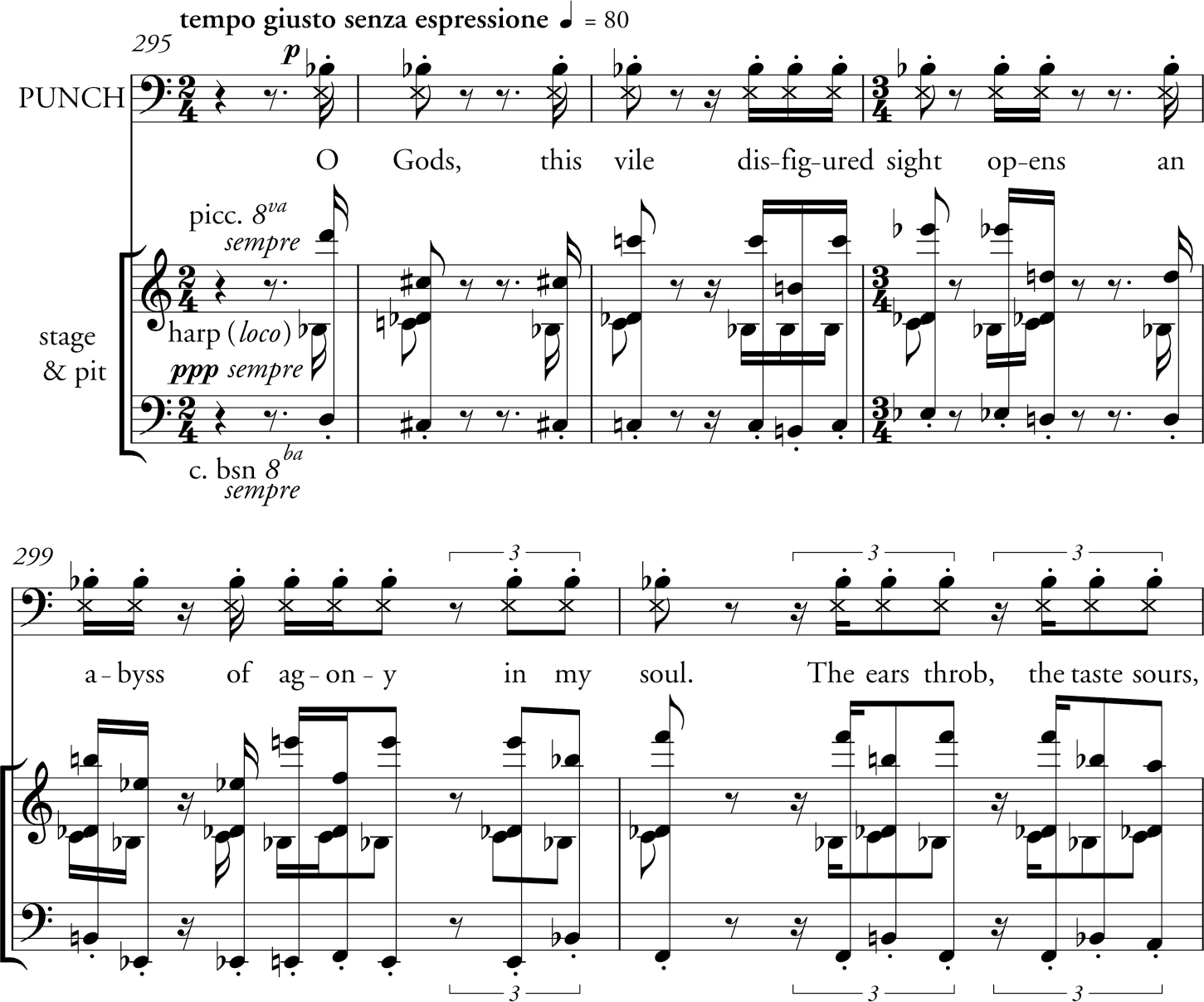
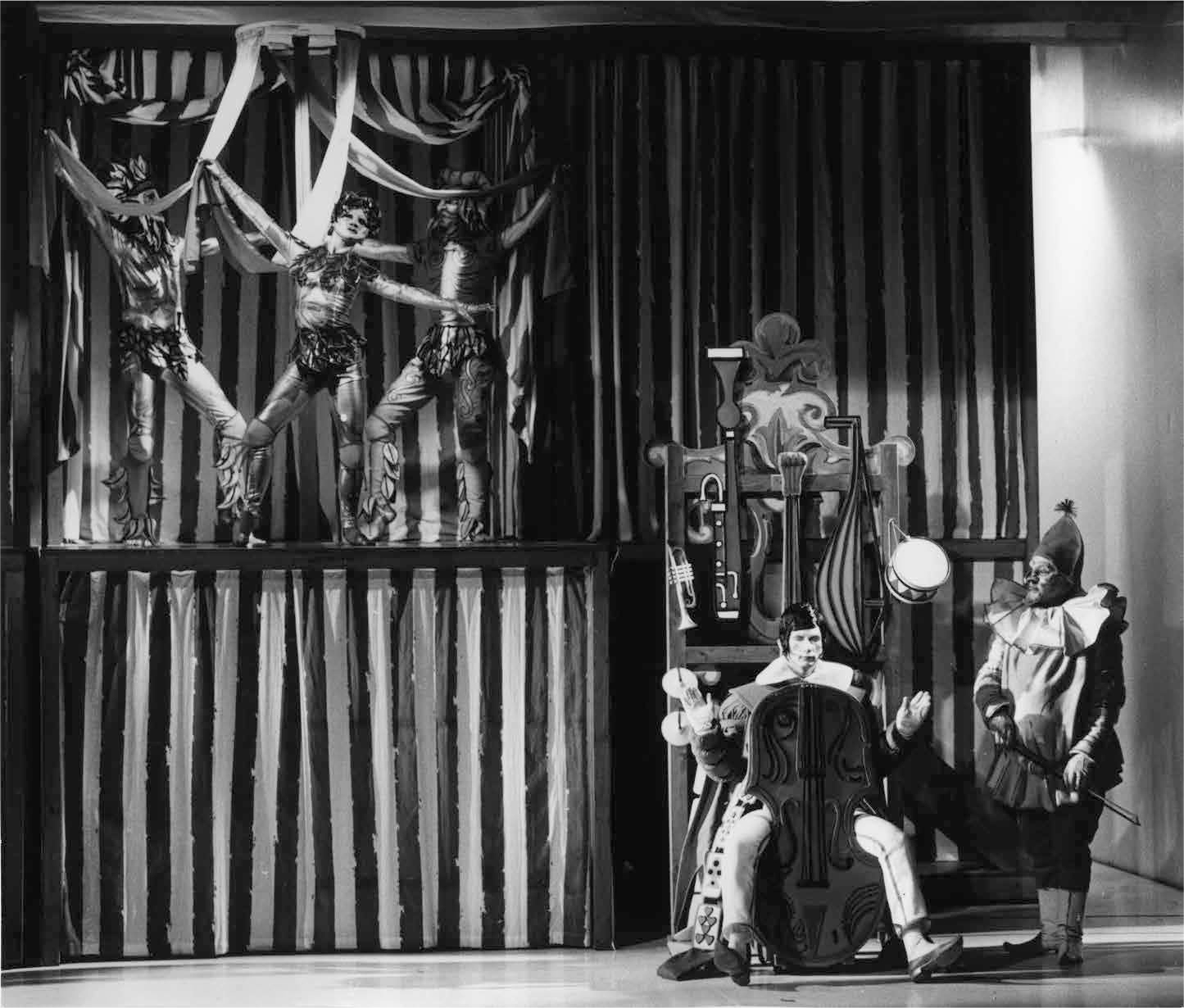
The climax of Punch's series of murders is his attack on Choregos, whom he inserts into a kind of throne in the stylized shape of a bass viol and proceeds to bow to death (see Figure 2).Footnote 128 After he kills Choregos, Punch makes his most regretful statement, labelled ‘Lament’: ‘O Gods, this vile disfigured sight opens an abyss of agony in my soul […]. The lights of the world go out, and I am alone with the beating of wings’ (see Example 1). Detached, half-spoken and expressionless, it highlights Punch's state of abjection, and his alienation from music at this moment of crisis.Footnote 129 This is a turning point in the opera, as Punch goes on to be punished by his victims in the ‘Nightmare’ section, before encountering the devil/executioner and finally triumphing over death.Footnote 130
Punch and Judy, Aldeburgh Festival 1968 © Zoe Dominic, 1968. Image provided by the Britten–Pears Foundation.

‘Melodrama III: Murder Ensemble III’, bars 295–300, Harrison Birtwistle and Stephen Pruslin, Punch and Judy: A Tragical Comedy or a Comical Tragedy: Opera in One Act (London, 2008), 126, reproduced by permission of Universal Edition (London) Ltd.

Choregos emerges as Punch's central antagonist, and the most agonized object of revolt. But what precisely does he represent? For Hall, as we have seen, he is the collective, Punch's ‘social and psychological complement’.Footnote 131 For Besch, in his Sadler's Wells programme note, Choregos is Punch's ‘alter ego’, his ‘better nature’.Footnote 132 But he is also the narrator, and he begins and ends the opera, literally providing its frame. He is the only character who is not a puppet, as Hall observes, and seems in charge, despite becoming a victim himself. Historically, the Greek chorēgos is not precisely a chorus or narrator, but rather a patron of the theatre, the one who pays for the chorus.Footnote 133 He might even be said to embody the institutional authority of the teacher and curator that Bourdieu, writing in 1966, saw competing with the personal authority of the creator – here Punch – for cultural legitimacy, in a relationship of both opposition and complementarity.Footnote 134
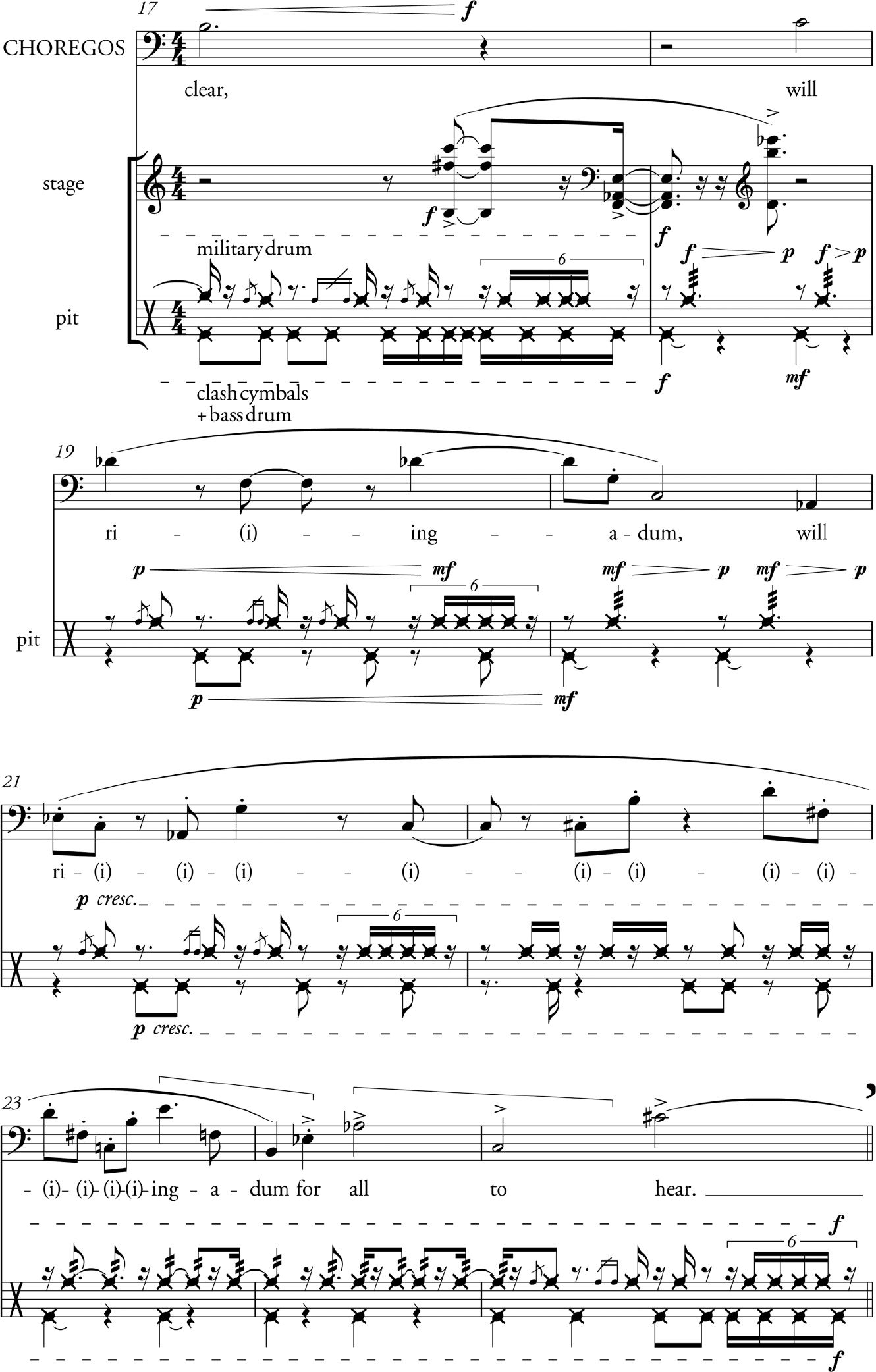
Most fundamentally, Choregos is a figure of music, as suggested visually by his instrument-covered throne (see Figure 3).Footnote 135 ‘Let music begin,’ he sings in the ‘fanfare’ shortly before his death, ‘let trumpets sound, let sounds of Pretty Polly here abound. Sing-song of Polly, shining and clear, will ringadum for all to hear.’Footnote 136 His singing here, while at first recalling the last trumpet of Stravinsky's ‘Tuba mirum’ in the Requiem Canticles, also includes melismas of almost Handelian proportions, serving to depict the pervasive power of sound (see Example 2). Indeed, throughout the large section culminating in his sacrifice, ‘Melodrama III’, the text is almost entirely concerned with sound, and with its real-world efficacy. In the opening duet, for example, Punch ‘turns suddenly to Choregos’ and sings ‘a sound that sings and sounds a thousand wounds’, words introduced by Choregos himself much earlier, in the ‘Word game’.Footnote 137 Sound's efficacy is also at issue in the labelling of some sections of ‘Melodrama III’ as ‘Gebrauch[s]musik’ (utility music), a term meant very literally here, perhaps. The power of music is both thematized and parodied in the repeated injunction to ‘crown him [Choregos] with trumpet and cymbal’ in the ‘Preyer and Coronation Scene’, echoed by the raucous sound of toy trumpets, cymbals and drums in the ‘Dithyrambs’. Sonically, too, this section is perhaps the most vivid; it includes the noise of the toy instruments and the sonic enactment of Chorego's murder, as well as Judy's virtuosic ‘Recitative and Passion Aria II’, one of the central numbers of the opera, with its injunction to ‘be silent, strings of my heart’. Clearly, music itself is centrally at issue in Melodrama III. Choregos's murder, too, is extensively described in terms of sound, as Punch ‘bows a serenade on the bass-viol’, apparently as a form of torture: ‘With downbows of destruction and ponticelli of pain, he turns tones of terror into a song of suffering.’Footnote 138
Punch and Judy, Aldeburgh Festival 1968 © Zoe Dominic, 1968. Image provided by the Britten–Pears Foundation.

‘Melodrama III: Gebrauchsmusik 1’, bars 17–25, Harrison Birtwistle and Stephen Pruslin, Punch and Judy: A Tragical Comedy or a Comical Tragedy: Opera in One Act (London, 2008), 96–7, reproduced by permission of Universal Edition (London) Ltd.

Punch kills Choregos with his own tools, just as he kills the Doctor with a hypodermic syringe and the Lawyer with a quill pen.Footnote 139 And yet his appropriation of Choregos's tools is much more extended: in addition to the act of bowing, we also see Punch bang a cymbal, a trumpet and a drum over Choregos's head,Footnote 140 in an aggressive act of ‘crowning’, while the murder itself is more extensively represented in sound. In other ways, too, Punch seems associated with music alongside Choregos, rendering them doubles. Punch appropriates some of Choregos's music-obsessed language, and they are bound together in their joint attempt to serenade Polly. Punch's assault is an assault by music on itself, in other words.
Despite Punch's despair, though, Choregos is not entirely vanquished. He lives on through the opera, and even has the last word. Moreover, the idea of music for which he stands is transformed, apotheosized, in the shape of Punch's attained ideal, Pretty Polly. As Punch triumphs, she takes up where Choregos left off, elaborating on his melismatic ‘ringadum’ in a song of spring (see Example 3).Footnote 141 We might read the trajectory of Punch's quest in quite simple terms, as suggesting that music as authority (embodied in Choregos) has to be conquered for music as ideal to thrive. Yet Choregos's centrality and durability belie this reading. What we end up with is something quite resigned, in which revolt is a personal necessity for the artist, but is inseparable from art as both ideal and authority.
‘Punch Triumphans: Apotheosis’, bars 130–6, Harrison Birtwistle and Stephen Pruslin, Punch and Judy: A Tragical Comedy or a Comical Tragedy: Opera in One Act (London, 2008), 227, reproduced by permission of Universal Edition (London) Ltd.

It is this sense of resignation – this recognition of an impasse – that finally prevents the opera from simply replaying what Georgina Born, drawing on Bourdieu and Raymond Williams, calls the ‘necessary relation between the accumulation of cultural authority and a show of containing minority elements of dissent and opposition’.Footnote 142 The opera might seem to court this description, introducing the disruptive energy of the Punch and Judy show only to undermine it at every turn. But what emerges is less a gesture of discipline and control than one of melancholy, as the opera acknowledges the impossible contradictions of avant-garde activity in the late 1960s. Punch and Judy offers a self-conscious reflection on the interdependence of authority and dissent, using the traditional and institutional apparatus of opera as a way of making this relationship explicit rather than masking it. The story of its première, moreover, makes that interdependence manifest, revealing an avant-garde less interested in rejecting opera than in rescuing it, and a set of critics and institutions eager to embrace this effort.