Feedback on competences can be an important lever for professional development and successful enactment of a work role. This feedback can come from different sources and/or assessments, including a competencies assessment performed off-the-job by a work psychologist (Boudrias et al., Reference Boudrias, Bernaud and Plunier2014). The relationship between the feedback provided and the adoption of more effective work behaviors is not straightforward, as many intermediate variables are likely to be involved (Fedor, Reference Fedor1991; Kinicki et al., Reference Kinicki, Prussia, Wu and McKee-Ryan2004; London, Reference London2003). Social support to encourage developmental efforts are thought to be a key factor for behavior change and professional development (Blume et al., Reference Blume, Ford, Baldwin and Huang2010; Dimotakis et al., Reference Dimotakis, Mitchell and Maurer2017, Haemer et al., Reference Haemer, Borges-Andrade and Cassiano2017; Maurer et al., Reference Maurer, Mitchell and Barbeite2002). However, the role of social support has rarely been studied in the context of feedback following competencies assessment and the positioning of this variable remains to be clarified in the feedback integration process in this context. Moreover, only a limited number of studies have investigated how an external assessor, operating on very a punctual basis with a participant, could intervene to instill a motivation powerful enough to generate developmental actions aligned with the feedback received (Boudrias et al., Reference Boudrias, Bernaud and Plunier2014; Lessard, Reference Lessard2019). It is therefore required to better understand the behavioral integration of feedback in the context of competency assessment.
Ilgen et al. (Reference Ilgen, Fisher and Taylor1979) developed a model to describe the basic components of feedback and anticipate where the assessor’s interventions and participant’s social support could influence the feedback integration process. This model lays out the influence of the source, the recipient, the environment, and the feedback itself on the psychological steps undertaken by the recipient to integrate feedback into new work behaviors. These steps are, in sequence, the perception of the feedback, its acceptance, the desire to respond, and the intended response. In this model, the source’s characteristics and the nature of the feedback (e.g., assessor’s interventions) influence the perception of the feedback, while the recipient’s characteristics can affect each of the psychological steps of the feedback integration process. As for the facilitators or constraints of the environment (e.g., presence or absence of social support), they are considered as moderators of the relationship between the desire to respond and the adoption of new behaviors. Ilgen et al’s model (Reference Ilgen, Fisher and Taylor1979) was adapted and confirmed in many contexts including performance feedback (Kluger & DeNisi, Reference Kluger and DeNisi1996), but its application in the context of individual psychological assessment (IPA) feedback is recent (Boudrias et al., Reference Boudrias, Bernaud and Plunier2014). However, performance feedback and IPA feedback present many differences.
IPA refers to a process where an expert (assessor) makes inferences regarding an individual’s attitudes, behaviors, competencies, and developmental needs at work. Organizations use IPAs for personnel selection, succession planning or employees’ professional development, especially for executive positions (Thornton et al., Reference Thornton, Hollenbeck, Johnson, Farr and Tippins2010). An IPA is a unique feedback context because the assessor (feedback source) integrates information gathered through psychometric instruments, interviews, or simulation exercises to provide feedback, instead of through past behavior as it is the case in performance feedback (Silzer & Jeanneret, Reference Silzer and Jeanneret2011). Consequently, the IPA participants (feedback recipients) are evaluated on competencies they may have never demonstrated and that may not be solicited in their current position. Moreover, the assessor shares the conclusions of the assessment with the participant to identify areas for development. However, the assessor is typically external to the client organization and is not hierarchically related to the participant as they usually are in performance feedback (Silzer & Jeanneret, Reference Silzer and Jeanneret2011). Therefore, the assessor does not necessarily know what development opportunities and activities are available in the participant’s current organization (and future organization if the IPA is done for selection purposes). Furthermore, the participant’s supervisor and colleagues may not be aware that the participant is engaged in this process, and the participant may subsequently obtain social support for development from other sources than the ones usually providing support for on-the-job training (Blume et al., Reference Blume, Ford, Baldwin and Huang2010). In practice, IPA is an important issue given its intensive use, the money invested by organizations (Hazucha et al., Reference Hazucha, Ramesh, Goff, Crandell, Gerstnen, Sloan, Bank and van Katwyk2011; Moses, Reference Moses2011) and the promise that IPAs can be a useful devices to instill new behaviors and to accelerate the development of competences (Silzer & Jeanneret, Reference Silzer and Jeanneret2011).
Considering the differences between performance feedback and IPA feedback, some modifications were required to adapt Ilgen et al’s (Reference Ilgen, Fisher and Taylor1979) model to the IPA context. As such, Boudrias et al. (Reference Boudrias, Bernaud and Plunier2014) developed a model which specifies that the process of cognitive integration of feedback may be the result of both the acceptance of feedback and the awareness gained from feedback, the latter not previously identified in Ilgen et al’s (Reference Ilgen, Fisher and Taylor1979) model. Boudrias et al’s (Reference Boudrias, Bernaud and Plunier2014) model also proposes that the desire and intent to respond to feedback is a distinct experience (motivational intention) when measured at the end of an IPA feedback session. Further, no “external constraints” (e.g. social support, as seen by Ilgen et al., Reference Ilgen, Fisher and Taylor1979) were incorporated in the model based on the rationale that the feedback provider in an IPA has little control over them. However, Boudrias et al’s (Reference Boudrias, Bernaud and Plunier2014) model does share the same assumptions as Ilgen et al’s (Reference Ilgen, Fisher and Taylor1979) that cognitive integration of feedback is an antecedent of the behavioral integration of feedback.
The adaptation of Ilgen et al’s (Reference Ilgen, Fisher and Taylor1979) model to IPA has led to some interesting findings. In their study, Boudrias et al. (Reference Boudrias, Bernaud and Plunier2014) found that the desire to respond to feedback (motivational intention) about their competences at the end of the feedback session explained a great amount of variance in the behaviors of participants three months later (e.g. 26% of behavioral changes and 11% of involvement in developmental activities). In Boudrias et al’s (Reference Boudrias, Bernaud and Plunier2014) adaptation, predictors of motivational intention (e.g., source credibility, perceived validity/legitimacy of the IPA, awareness gained from feedback) were mostly in line with Ilgen et al’s (Reference Ilgen, Fisher and Taylor1979) model, although they did not affect motivational intention through feedback acceptance. Rather, they were direct predictors of motivational intention, suggesting that motivational intention at the end of the feedback session is an important psychological step to focus on in an IPA if one wants to bring changes in participants’ subsequent behaviors. Further, the study considered a type of intervention from the feedback provider, namely challenging interventions (e.g., bringing to light gaps and inconsistencies in participant’s results). Although the benefit of challenging interventions to increase awareness was previously established, this study was unable to demonstrate the indirect effect of this type of intervention on motivational intention nor on behaviors three months later. Therefore, other types of source interventions should be considered in future study.
The current research builds on the efforts undertaken by Boudrias et al. (Reference Boudrias, Bernaud and Plunier2014) to investigate factors specifically leading to feedback integration by the participant in an IPA context. Two additions are considered to Boudrias et al’s adaptation (Reference Boudrias, Bernaud and Plunier2014) of Ilgen et al’s work (Reference Ilgen, Fisher and Taylor1979). First, a new type of source intervention, namely the assessor’s development-focused feedback techniques, are tested to verify their role as a predictor of motivational intention and subsequent development behaviors (Lessard, Reference Lessard2019). In doing so, this research aims to identify a lever that can be used by the feedback provider to have an impact on participants’ professional development, beyond the typical initial psychological reactions to feedback (e.g., feedback acceptance and motivational intention).
Second, this research takes a closer look at the participant’s perceived social support in order to determine its specific role (moderator or mediator) in the process of behavioral integration of an IPA feedback, as no empirical research has been done on this question. Both possibilities co-exist on a theoretical level, but are based on different assumptions. Generally, the literature on feedback (Dimotakis et al., Reference Dimotakis, Mitchell and Maurer2017; Ilgen et al., Reference Ilgen, Fisher and Taylor1979) and transfer of off-the-job learnings (Blume et al., Reference Blume, Ford, Baldwin and Huang2010) presents social support as a moderator of the relationship between psychological reactions and behavioral integration. This rests on the assumption that external support for development is a characteristic of the environment on which the worker has limited or no influence. In contrast, recent papers defined social support as a result of the worker’s own learning strategy (Haemer et al., Reference Haemer, Borges-Andrade and Cassiano2017), suggesting that the worker has control over their social environment and support (Bandura, Reference Bandura1997). Consequently, perceiving social support could also be a mediator of the relationship between motivational intention to change and behavioral integration of feedback. Research is therefore needed to provide empirical evidence on the role of social support in the process of IPA feedback and to test these alternative hypotheses. In practice, investigating the possible mediating role of social support in the behavioral integration of feedback is important because it may represent a complementary facilitator of development that feedback recipients could actively leverage themselves. Depending on whether social support acts as a mediator or a moderator, feedback providers could adjust their intervention strategy to optimally boost the behavioral integration of their IPA feedback.
Assessor’s Development-Focused Feedback Techniques
Lessard (Reference Lessard2019) investigated feedback techniques used by assessors in an IPA context. Development-focused feedback techniques represent the assessor’s interventions which explore with the participant the possibilities for skill development and their resources to achieve this (Lessard, Reference Lessard2019). An IPA generally does not include the elaboration of a detailed development plan and a follow-up (Moses, Reference Moses2011). However, the assessor can query the participant on what they have already tried to grow professionally and help them set development goals. These techniques are used by the assessor to raise the salience of specific gaps between the participant’s efforts and professional goals, and to highlight the benefits associated with achieving these goals (Lessard, Reference Lessard2019). These techniques are different from challenge interventions that were previously studied in an IPA context (Boudrias, Reference Boudrias, Bernaud and Plunier2014), as the feedback provider not only identifies “gaps” but also shows personal support and provides initial guidelines to the recipient during the feedback session in order to facilitate the adoption of new behaviors. These intervention techniques resemble the motivational techniques that have been incorporated in some practical contexts (Rollnick et al., Reference Rollnick, Miller and Butler2008), but these have yet to be included in feedback integration models (Boudrias et al., Reference Boudrias, Bernaud and Plunier2014; Ilgen et al., Reference Ilgen, Fisher and Taylor1979). Indeed, these models have tended to put more importance on the operationalization of the source characteristics (e.g., credibility, valence) than on an interpersonal behavioral approach that can be used by the source during feedback to instill a desire to try new behaviors. In sum, the development-focused feedback techniques represent the behaviors purposely performed during the feedback session, as reported by the source, to prompt, discuss and encourage development efforts of the recipient in relation to the content of feedback provided.
Effect of Development-Focused Techniques on Motivational Intention to Act on Feedback
In the context of IPA feedback, “motivational intention” is used to emphasize the determination to act upon feedback that the participant experiences at the end of their feedback session (Trudeau et al., Reference Trudeau, Suissa and Boudrias2019). This experience implies that the participant wishes to implement the feedback they have received to grow professionally. This experience has been identified as an important precursor of behavioral response toward feedback about one’s performance (Ilgen et al., Reference Ilgen, Fisher and Taylor1979) and this was confirmed in the context of IPA feedback (Boudrias et al., Reference Boudrias, Bernaud and Plunier2014).
Compared to challenge intervention that appeared useful in raising awareness of feedback recipients (Boudrias et al., Reference Boudrias, Bernaud and Plunier2014), the development-focused feedback techniques could have a more powerful and a more direct effect on the motivational intention to act upon feedback. Indeed, these interventions more specifically tap on principles of performance improvement motivation. In a meta-analysis on motivation, Locke and Latham (Reference Locke and Latham1990) concluded that clear and attainable objectives predict the motivation to act. Moreover, a feedback provider being supportive of development helps persuade a person that they are capable of development (Bandura, Reference Bandura1997; Maurer et al., Reference Maurer, Mitchell and Barbeite2002). Hence, the assessor being involved in one’s development and discussing clear and realistic development goals in the IPA feedback could lead the participant to have a motivational intention and to react to feedback. Empirical support for this hypothesis is available in non-IPA contexts. For instance, it has been shown in motivational interviewing studies (Miller & Rollnick, Reference Miller and Rollnick2013) that showing care and support for the needs of the feedback receiver is an effective strategy to change habits. In learning and education, the systematic review of Winstone et al. (Reference Winstone, Nash, Parker and Rowntree2017) concluded that discussing an action plan with a recipient after feedback can generate in-depth thinking and promote autonomous goal setting in the recipient. To our knowledge, only one study investigated the relationship between developmental techniques and recipient reactions in an IPA context (Lessard, Reference Lessard2019). Though this study did not examine the possible effects of these techniques on behavioral integration, it provided preliminary evidence that developmental techniques are positively related to motivational intention.
H1: Development focused feedback techniques will be positively related to motivational intention to act on feedback.
Behavioral Integration of Feedback
Behavioral integration of feedback can be observed when feedback reaches its goal: Behavior change. This corresponds to the recipient’s response to feedback in Ilgen et al’s model (Reference Ilgen, Fisher and Taylor1979). In an IPA context, this occurs when participants follow the recommendations included in the feedback session (Plunier et al., Reference Plunier, Boudrias and Savoie2013). Behavioral change includes modifications of ineffective behaviors, increased reliance on personal strengths identified through feedback, and discussing ways to develop the skills identified in feedback with one’s social circle (Plunier et al., Reference Plunier, Boudrias and Savoie2013).
Integrating research from Woo et al. (Reference Woo, Sims, Rupp and Gibbons2008), a second dimension of behavioral integration of feedback was identified by Boudrias et al. (Reference Boudrias, Bernaud and Plunier2014). They proposed that engaging in formal developmental activities following IPA feedback represents a way through which feedback leads to new behaviors at work. Engagement in such developmental activities can occur through the elaboration of a development plan with one’s supervisor, by gathering information about developmental activities (training, coaching, discussion group, reading) related to the skills discussed during feedback, and by participating in these developmental activities.
Boudrias et al. (Reference Boudrias, Bernaud and Plunier2014) demonstrated that motivational intention predicts participants’ behavioral change and engagement in developmental activities following the IPA feedback. Forsythe & Johnson (Reference Forsythe and Johnson2017) as well as Forsythe & Jellicoe (Reference Forsythe and Jellicoe2018) replicated these results with university students in a learning context. This also coincide with a meta-analysis by Webb & Sheeran (Reference Webb and Sheeran2006) which shows across different study contexts that a medium-size change in intention, d = .66, leads to a behavioral change of small-to-medium size, d = .36.
H2: The motivational intention to act on feedback will be (H 2a) positively related to change in behaviors identified during feedback and (H 2b) positively related to engagement in developmental activities, three months later.
Effects of Social Support for Development on Behavioral Integration
Social support is the availability and quality of helping relationships for an individual (Leavy, Reference Leavy1983). In an IPA context, especially if the assessment is performed for selection purposes, the individuals can come from different organizations and contexts, thus having different potential sources of support available (within or outside the actual work context). Indeed, social contacts in the work environment may not be aware of the feedback and the developmental objectives. In these situations, individuals can obtain social support from person they trust, whether inside or outside the current work context or organization (e.g., significant others, coach, peers, supervisor). Social support from a supervisor includes, for example, continuous feedback availability, resources and time off for off-the-job training. Support from peers or significant individuals in one’s personal life can take the form of continuous feedback and encouragement of development efforts (Maurer et al., Reference Maurer, Mitchell and Barbeite2002). A meta-analysis by Blume et al. (Reference Blume, Ford, Baldwin and Huang2010) concludes that the perception of social support is critical to the implementation of behaviors learned through training. London and Smither (Reference London and Smither2002) argue that social support after feedback helps individuals to avoid focusing only on the negative aspects of feedback and gives them resources to change their behavior. Thus, previous research in various developmental contexts suggests that the perception of social support following IPA feedback will promote behavioral change and engagement in developmental activities through the gain of time, encouragement and resources.
H3: Perceived social support for development in the direction of feedback will be (H 3a) positively related to change in behaviors identified through feedback, three months later, and (H 3b) positively related to engagement in developmental activities, three months later.
Social support can be viewed as a contextually stable or as a malleable characteristic, which can generate alternate hypotheses on its role (e.g., moderator or mediator) with regard to the motivational intention-behavioral integration relationship.
Social Support for Development as a Characteristic of the Participant’s Environment
According to Dimotakis et al. (Reference Dimotakis, Mitchell and Maurer2017) and Maurer et al. (Reference Maurer, Mitchell and Barbeite2002), in the context of IPA, social support is a contextual variable. Beyond its direct linear relationship with behavioral change and developmental activities, the perception of social support may also play a moderating role in the relationship between motivational intention to change in the direction of feedback and the dimensions of behavioral integration. This addition to Boudrias et al’s (Reference Boudrias, Bernaud and Plunier2014) model is consistent with Ilgen et al’s (Reference Ilgen, Fisher and Taylor1979) theoretical framework, which stipulates that behavior can be moderated by environment factors, no matter how motivated the recipient is.
Social support could be particularly important in an IPA context, compared to training or performance feedback contexts. As opposed to organizational training and performance feedback where a single entity sets the goals, determines the development needs and support employees in improving skills in order to attain organizational objectives, the IPA feedback context is not so well aligned. Indeed, in the context of IPA, there is typically no connection between the competency assessment and organizational mechanisms for skill development and performance management, leaving the participant to their own device following the feedback session. Moreover, the feedback offered following an IPA is usually broader than the direction offered in training or in performance feedback. IPA feedback can even target skills that have never been demonstrated in the participant’s current role (e.g., management skills in an employee that does not have this responsibility). In this context, having a superior, a colleague or a close other who offers development support would compensate by allowing the participant to reflect with someone and jointly develop an action plan. Conversely, an employee with a strong motivational intention, but with poor social support, could be held back in their development.
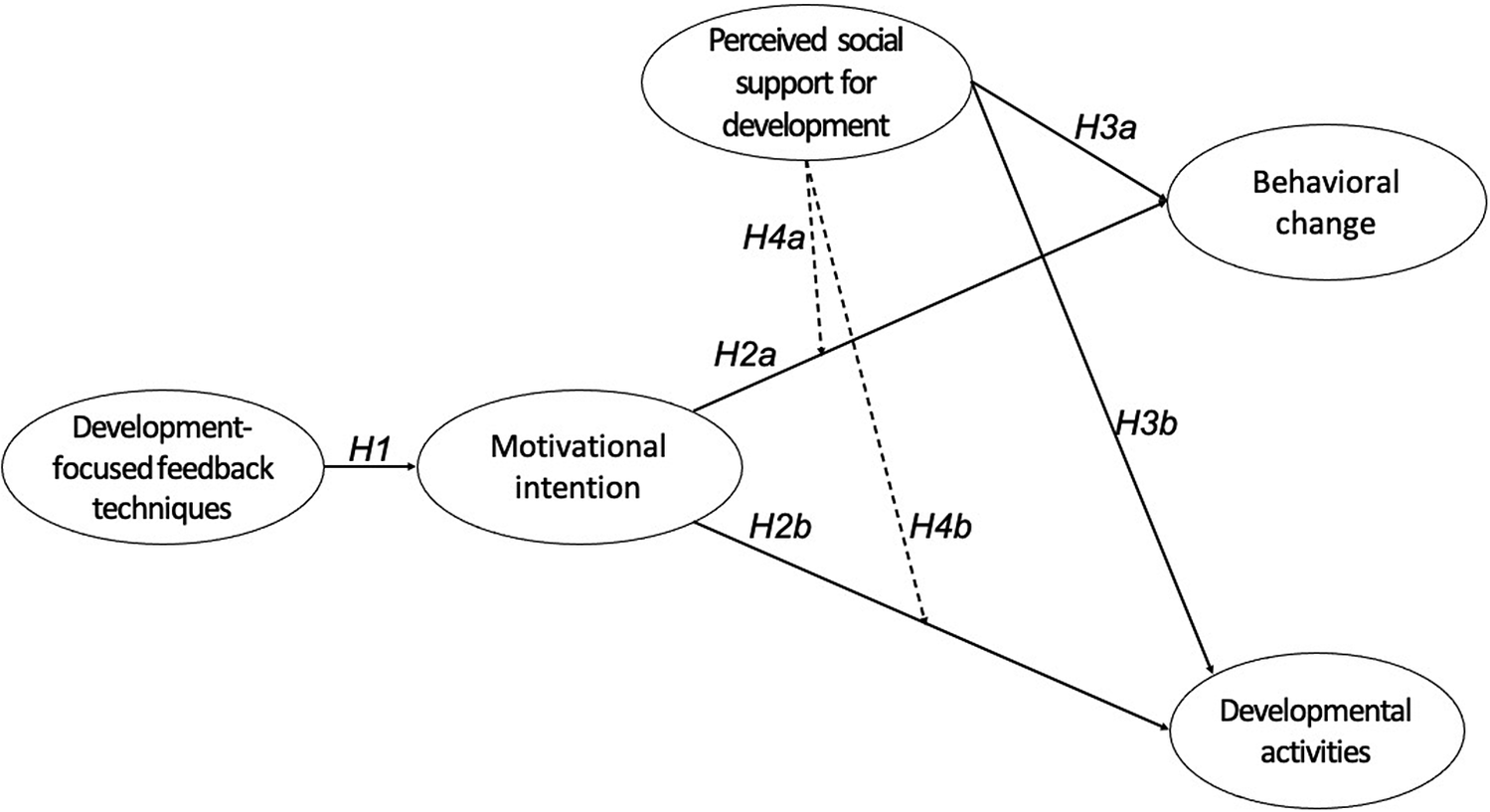
Empirical evidence supports this idea. Dimotakis et al. (Reference Dimotakis, Mitchell and Maurer2017) studied the impact of IPA feedback in employees of a telecommunication company and found that social support lessens the adverse effects of negative feedback on self-efficacy. Similarly, Lauzier and Mercier (Reference Lauzier and Mercier2018) found that social support accentuates the relation between the participant’s motivation to learn and their planning to transfer training. Consistent with these results and Ilgen et al’s (Reference Ilgen, Fisher and Taylor1979) model, it is expected in the first model (M1), represented in Figure 1, social support will increase the relationship between the IPA feedback recipient’s motivational intention and behavioral integration of feedback.
Theorical Moderation Model M1
Note. M1a: without interaction, M1b: with interactions in dotted lines.

H4: Perceived social support is hypothesized to moderate (H 4a) the relationship between motivational intention to act on feedback and behavioral change and (H 4b) the relationship between motivational intention to act on feedback and engagement in developmental activities. It is expected that these relationships be will be higher when the perception of social support is high.
Social Support for Development as a Participant’s Learning Strategy
According to Haemer et al. (Reference Haemer, Borges-Andrade and Cassiano2017), obtaining social support is an effective learning strategy to facilitate a worker’s professional development. Indeed, these authors showed that soliciting interpersonal support increases the level of preparedness and competency in workers who completed undergraduate studies. Their results shed some doubt on the usual understanding of the perception of social support, where it is interpreted as the perception of an environment characteristic over which the workers have no or little control, and where the participants would passively benefit from social support or not (Dimotakis et al., Reference Dimotakis, Mitchell and Maurer2017; Maurer et al., Reference Maurer, Mitchell and Barbeite2002). In Haemer et al’s (Reference Haemer, Borges-Andrade and Cassiano2017) perspective, when a worker identifies a skill that they wish to develop, as in the case of a participant following an IPA feedback with a motivational intention to develop their professional skills, they are likely to seek interpersonal support by themselves. In this scenario, the perception of social support, measured some months after the feedback, would be the result of the recipient’s own actions. To our knowledge, no study has placed social support as a mediator in the motivational intention-development behavior, but researchers in professional contexts have observed that obtaining social support is a preferred way to acquire new competencies at work, such as in hospital workers (Isidro-Filho et al., Reference Isidro-Filho, Guimarães, Perin and Leung2013), call center technicians (Downing, Reference Downing2004), and employees who need to improve their information and communication technology competencies (Korpelainen & Kira, Reference Korpelainen and Kira2010).
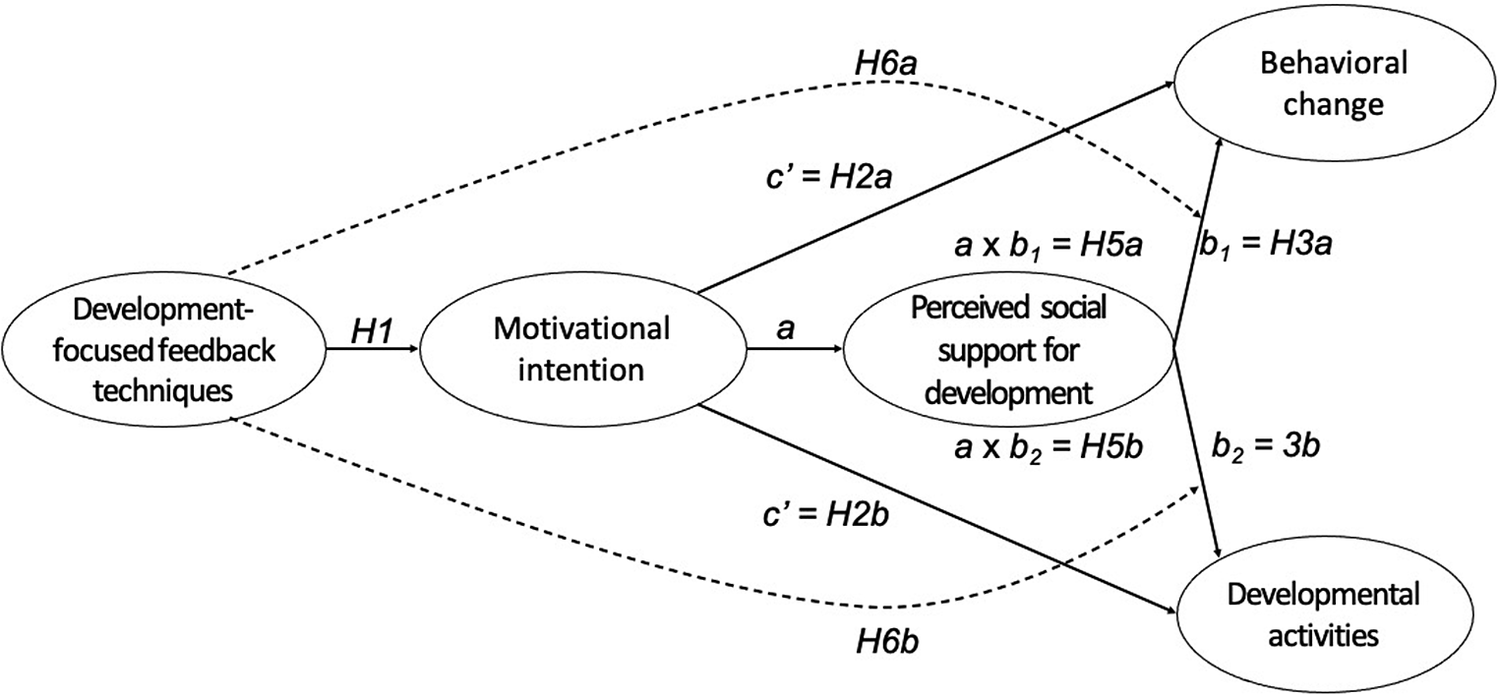
Conceiving social support as a malleable characteristic and as the result of one’s action fits with the general reciprocal causation principle substantiated by Social Cognitive Theory (Bandura, Reference Bandura1997). This principle suggests that personal factors, environmental factors and behavior determine and respond to each other. In an IPA context, the participant who is motivated to change at the end of a feedback session would seek support from others in their social environment who, in turn, would respond with providing support. This environmental reaction would favor the participant’s behavioral integration of feedback. Thus, the alternative model (M2), represented in Figure 2, challenges the well-established position that perceived social support acts as a moderator in training (Blume et al., Reference Blume, Ford, Baldwin and Huang2010) and IPA feedback (Dimotakis et al., Reference Dimotakis, Mitchell and Maurer2017; Maurer et al., Reference Maurer, Mitchell and Barbeite2002) and positions social support as a mediator.
H5: Perceived social support is hypothesized to be a mediator of (H 5a) the relationship between motivational intention to act on feedback and behavioral change, three months later, and (H 5b) the relationship between motivational intention to act on feedback and engagement in developmental activities, three months later.
Theorical Moderate Mediation Model (M2)
Note. M2a: without interaction, M2b: with interaction in dotted lines.

In this alternative model, there would be a synergetic benefit of having two types of support: One that comes from the IPA device (e.g., developmental approach to feedback) and the other one resulting from one’s individual actions with the environment (e.g., social support). The impact of the former would be increased when the latter is higher, based on the job crafting theory (Berg et al., Reference Berg, Wrzesniewski and Dutton2010; Wrzesniewski & Dutton, Reference Wrzesniewski and Dutton2001). Indeed, this theory suggests that interacting with others can enhance or change the meaning of a situation or information on selves. In this case, information coming from IPA can become more meaningful when it is recognized as valid by significant others and caring people that have access to another perspective on that individual. This would then produce a higher impact on the recipient’s subsequent effort to act on feedback received. M2b (see Figure 2) designates the alternative model that includes the following interaction hypotheses:
H6: The assessor’s development-focused feedback techniques will interact with perceived social support for development in order to predict (H 6a) behavior change and (H 6b) engagement in developmental activities. It is expected that development-focused feedback techniques and perceived social support will increase the effect of each other in predicting behavioral integration of feedback.
Method
Procedure
Study procedures were approved by the Arts and Sciences Research Ethics Committee of the University of Montreal (CERAS–2014–15–106–D). Participants who took part in an IPA delivered by a well-established organizational firm between January 2015 and October 2018 were solicited. An administrative agent recruited the participants during their assessment day lunch break, explaining that they would be asked to answer questionnaires once they come back to the office for the feedback session and three months after that. No compensation was offered. This firm conducts approximately 1,500 IPAs each year with clients mainly from financial and government sectors. During the IPA, participants completed several psychometric tests and took part in a one-hour interview. At the end of the IPA, the assessor integrated the information collected into a written report in which they rated several skills, provided a narrative description of their findings, and identified areas for development.
The data was collected through questionnaires at two time points (Time 1 and Time 2) and each questionnaire was administered at only one of them. Time 1 occurred immediately after the one-hour feedback session between the assessor and the participant, where the assessor gives the report to the participant and discusses the results. The feedback session occurred on average 7 weeks (SD = 7) after the IPA. In fact, 90% of participants received their feedback within 90 days of their IPA. Immediately after the feedback session, the participant completed a paper-pencil questionnaire measuring the motivational intention to change in the direction of feedback. The assessor completed the questionnaire measuring the feedback techniques they had used. To evaluate 240 participants, 19 assessors took part in our study, each evaluating from 1 to 37 participants. The assessors were either organizational psychologists or guidance counsellors.
Time 2 occurred three months later. Taris and Kompier (Reference Taris and Kompier2014) suggest that the interval between time-points should correspond well with the underlying causal lag. A three-month interval was determined because it provides enough time for participants to observe the social support for their development, adopt new behaviors and undertake developmental activities. In addition, for those who have obtained a new position, this period allows time for participants’ integration into their new environment or their new team. Moreover, evidence from studies in an IPA context suggest a one-year interval could be too long to adequately capture the behavioral outcomes of the feedback. Indeed, results show that the relationship between motivational intention and developmental activities is better observed with an interval of one to six months (r = .26 – .30, p < .05; Woo et al., Reference Woo, Sims, Rupp and Gibbons2008) than with an interval of 12 months (r = .08, ns; Byham, Reference Byham2005). The participants were contacted by email to answer a questionnaire, through SurveyMonkey, measuring their perception of social support for development and behavioral integration of feedback. Time 2 occurred, on average, 16 weeks (SD = 5) after feedback, resulting in 95% of participants answering the questionnaires between 3 to 6 months after receiving feedback. It is unlikely that the time gaps could affect the results because no relationship was found between the delay between Time 1 and Time 2 and the variables included in the study. Up to three reminder emails were sent to participants who had not yet completed Time 2.
Sample
A sample of 240 French-speaking participants who had received feedback in the context of an IPA took part in the study’s first time-point, and a total of 138 participants also participated at Time 2. No statistically significant difference was found between the participants of only Time 1 and the ones who took part to both times on demographic characteristics and studied variables. Participants’ mean age was 41 years old (SD = 7.9), 58% of participants were men, and 88% had a university degree. Moreover, 73% held a managerial position, with an average of 6.6 years (SD = 7.2) of management experience. The other participants were professionals (20%), technicians (5%) and sales representatives (2%). The IPA was conducted for selection purposes for 83% of participants and development purposes for others. The targeted job (or current job in a development context) was a management position in all cases. Among the participants who participated in the IPA in a selection context, 60% obtained the targeted job.
Measures
The questionnaires measuring behavioral integration of feedback, motivational intention to change in the direction of feedback, and perceived social support all have a response scale ranging from 1 (strongly disagree) to 6 (strongly agree). The questionnaire measuring the assessor’s development-focused feedback techniques has a response scale ranging from 1 (I did not do it) to 5 (I did it, and we talked about it extensively).
The assessor’s development-focused feedback techniques (Time 1) were measured through a questionnaire containing six items (α = .84; see items in Appendix A) elaborated and validated by Lessard (Reference Lessard2019). A confirmatory factor analysis (CFA) indicated that the one-dimensional structure fits well with the data, χ2 = 22.81, p = .01, CFI = .96, TLI = .93, SRMR = .04, RMSEA = .08. The factor loadings of the standardized solution were .51 and up. Concerning its criterion validity, Lessard (Reference Lessard2019) showed that the assessors’ self-reported techniques significantly predict the participants’ self-reported feedback acceptance, awareness gained from the feedback and motivational intention to act on feedback.
The questionnaire used to measure motivational intention to change in the direction of feedback (Time 1) contains three items (e. g., “I am motivated to grow in the direction of feedback”; Plunier et al., Reference Plunier, Boudrias and Savoie2013). A CFA on a three-item unidimensional structure does not yield model fit indices because there are no degrees of freedom. However, the good internal consistency, α = .83, corroborates the one-dimension structure.
Maurer et al’s (Reference Maurer, Mitchell and Barbeite2002) scale was adapted to measure the perception of social support from a significant person related to the main developmental objective identified in feedback (Time 2). As previously mentioned, in the IPA context, the sources of social support available to feedback recipients are more diversified than the two sources of support (supervisor and colleagues) included in the Maurer et al’s scale. Therefore, modifications were made to Maurer et al’s (Reference Maurer, Mitchell and Barbeite2002) questionnaire to prompt participants on a variety of social support sources relevant to their professional development, and we retained the items that could be answered no matter the source of support. This version contains six items (α = .96, see items in Appendix B). The instruction given to the participant at the beginning of the questionnaire indicated that a significant person could be, for example, a supervisor, a mentor, a colleague, or a family member. A CFA indicated that the one-dimensional structure fits very well with the data, χ2 = 13.82, p = .13, CFI = .99, TLI = .98, SRMR = .02, RMSEA = .07. The factor loadings of the standardized solution were .84 and up.
Finally, behavioral integration of feedback (Time 2) was measured with a questionnaire of six items from Boudrias et al. (Reference Boudrias, Bernaud and Plunier2014). Each dimension is measured through three items: behavioral change (α = .88; e.g. “I modified my ineffective behaviors discussed during feedback”) and engagement in developmental activities (α = .79; e.g. “Since the feedback session, I have voluntarily participated in developmental activities [training, development groups, reading, etc.] in line with the feedback I received.”). A CFA indicated that the two-dimensional structure fits very well with the data, χ2 = 8.63, p = .37, CFI = 1.00, TLI = 1.00, SRMR = .03, RMSEA = .02.
Statistical Analyses
A latent moderated structural equations (LMS) approach was chosen to test the hypotheses in a single model, using Full Information Maximum Likelihood estimation in Mplus 7.4. This procedure differs from traditional approaches in that it allows parameters to be estimated with the available data from the sample (N =240), rather than imputing replacement data before estimating the model (Wang & Wang, Reference Wang and Wang2012). This approach reduces estimation bias (Enders & Bandalos, Reference Enders and Bandalos2001) and frequently produces results equivalent to multiple imputation (Savalei & Rhemtulla, Reference Savalei and Rhemtulla2012). However, this approach does not yield the usual fit indices for moderation effects, and there is no standardized solution presented. Therefore, the first interpretation criterion was the comparison of Akaike’s information criterion (AIC). If adding the interaction term lowers the value of the AIC, the model yields less information loss, and it should be retained as the model with the best fit. The second criterion is the statistical significance of the interaction term, determined by the estimation’s p-value and the 95% bootstrapping confidence interval (CI) with 5000 iterations.
Results
Measurement Model
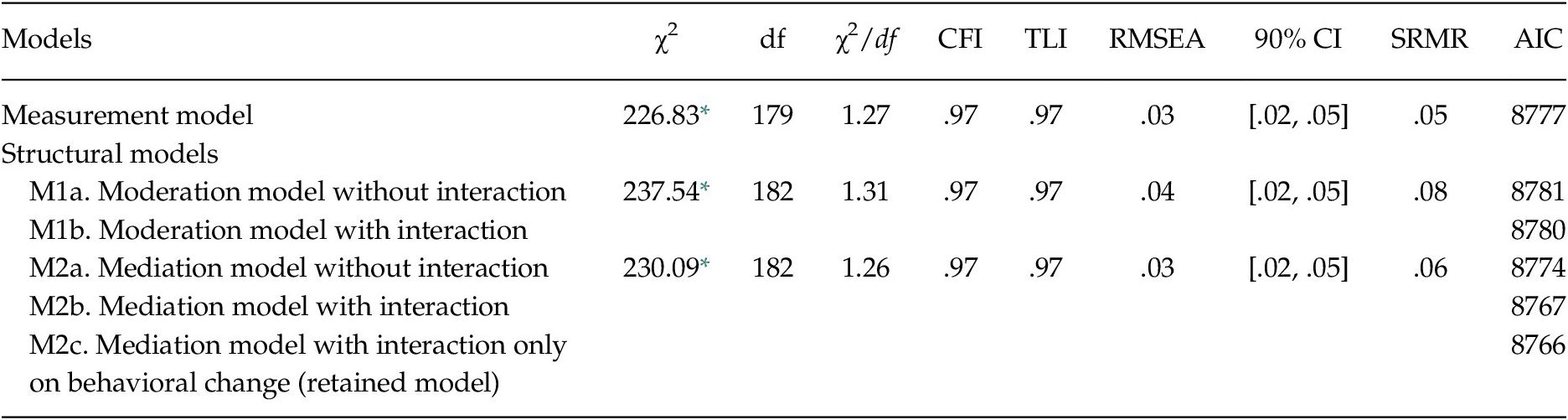
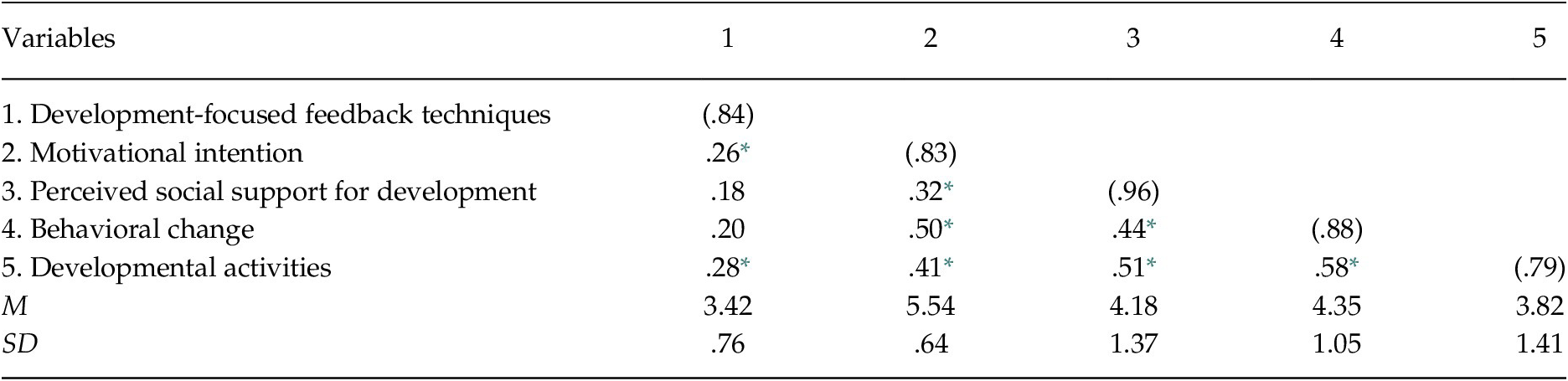
At Time 1 and Time 2, missing data for each item ranged from 0 to 18.8%. The measurement model was tested with a CFA on all questionnaires, presented in Table 1, showing that the expected five-factor model fits well with the data: χ2/df ≤ 3.00; CFI and TLI ≥ .95; RMSEA ≤ .05 (Schumacker & Lomax, Reference Schumacker and Lomax2010). Most factor loadings are above .70. Only five loading values are between .60 and .69 inclusively, and none of them are below .60. Table 2 presents the descriptive statistics and standardized intercorrelations of all factors. Correlations between development-focused feedback techniques, perceived social support for development and behavioral integration dimensions are all in the expected direction, confirming H 1, H 2 and H 3.
Fit Indices for All Questionnaires and Structural Models

Note. N = 240.
* p < .01.
Factor Correlations, Means and Standard Deviations

Note. N = 240. Cronbach’s alphas appear in parenthesis.
* p < .01.
Structural Model
Because the purpose of IPA (selection or development) could have influenced the variables in this study, we verified its associations with all variables included in the measurement model. No association between the purpose of IPA and the variables was found. This is consistent with Plunier et al’s (Reference Plunier, Boudrias and Savoie2013) observation that IPA feedback in a selection context and IPA feedback in a development context are the same because they both aim at behavioral change and because the recipient does not report to the source. Therefore, the purpose of IPA was not included as a control variable in subsequent analysis. Age and gender were not included as control variables for three reasons: (a) They were not related to the variables of interest in previous studies led in an IPA context (Boudrias et al., Reference Boudrias, Bernaud and Plunier2014; Dimotakis et al., Reference Dimotakis, Mitchell and Maurer2017), (b) they would have added a substantial number of unnecessary parameters in the model, and (c) their presence would not have been the result of a conceptually meaningful selection of control variables, as suggested by Becker et al’s (Reference Becker, Atinc, Breaugh, Carlson, Edwards and Spector2016) recommendations regarding the treatment of control variables in organizational research.
First, the moderation model (M1) was tested. To do so, the model without interaction (M1a) was tested to obtain the fit indices. The results, presented in Table 1, indicate that this model fits very well with the data, with the relationships hypothesized in H 1, H 2 and H 3 still in the expected directions. Then, the interaction terms (M1b) were added, and its significance and AIC were observed. The slight decreased of the AIC leads to a preference for M1b. However, the interaction between social support and motivational intention is not significant, neither for behavioral change, b = –.18, p = .19, 95% CI [–.44, .09], nor for engagement in developmental activities, b = –.05, p = .57, 95% CI [–.24, .13]. Consequently, the data does not confirm H 4a and H 4b, and rejects the model that places social support as an environment characteristic that moderates the motivational intention-behavioral integration relationship (M1b).
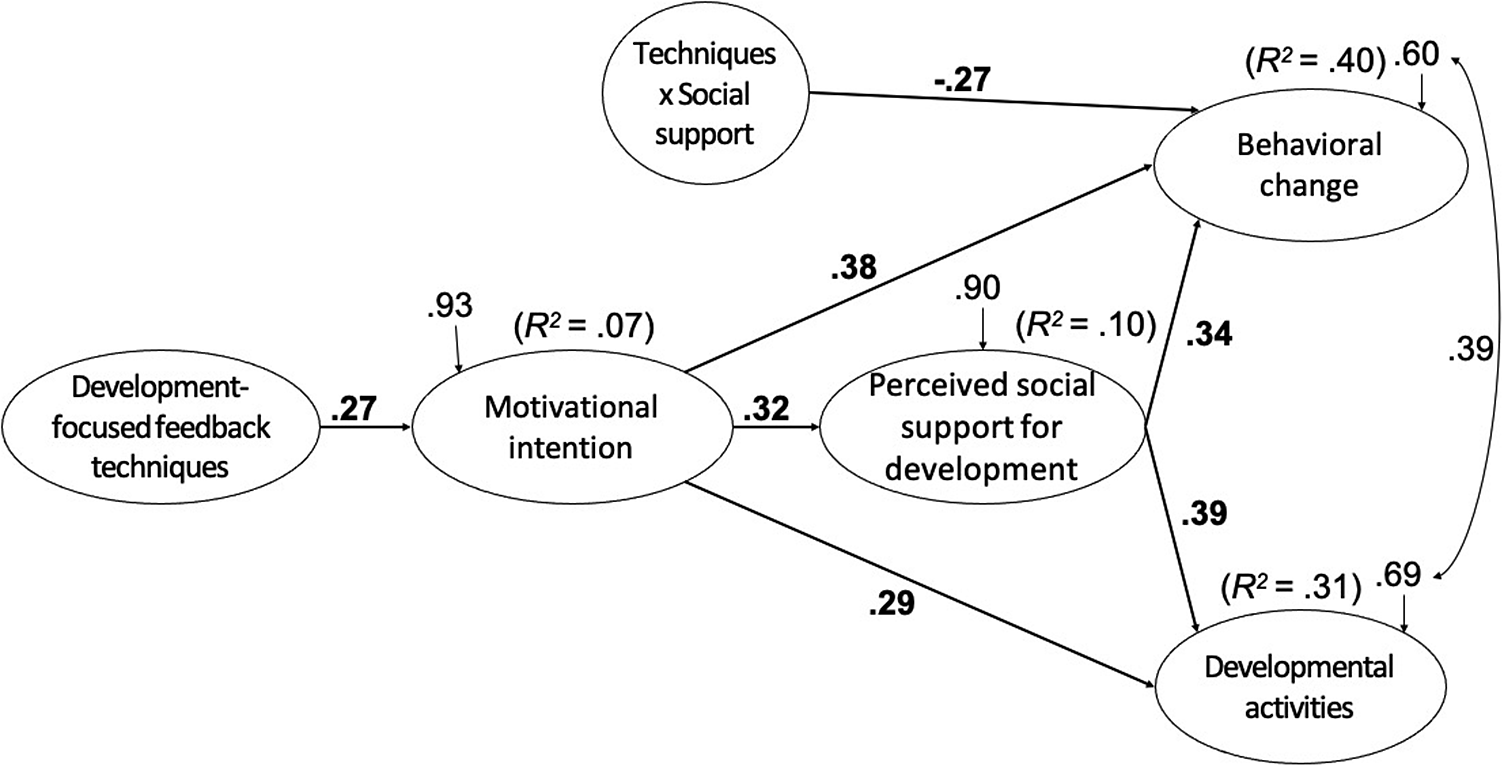
Second, M1 was compared to the alternative model (M2a, without interactions), which yielded similar fit indices while decreasing slightly the AIC. Model 2a explains 34% of the variance for behavioral change and 33% of the variance for engagement in developmental activities, again confirming H 1, H 2 and H 3. Results show that M2b (with interactions) is superior to M2a and both M1s, according to the AIC. The interaction term between development-focused feedback techniques and social support is significant in predicting behavioral change, therefore confirming H 6a, b = –.47, p < .01, 95% CI [–.85, –.08]. However, it is not significant in predicting developmental activities, b = –.13, p = .41, 95% CI [–.54, .28], so H 6b could not be confirmed. Another model (M2c) without the non-significant interaction (excluding H 6b) was tested and yielded a better AIC than previous models. The interaction term between feedback techniques and social support remains significant in predicting behavioral change, b = –.42, p < .001, 95% CI [–.69, –.15]. However, H 6a could not be confirmed because the interaction is not consistent with what was hypothesized. Indeed, the relationship between social support and behavioral change is higher when the assessor uses few development-focused techniques, at –1 SD, b = .32, p < .001, 95% CI [.27, .36], than when they use a lot of them, at +1 SD, b = .15, p < .001, 95% CI [.10, .19], suggesting a compensatory effect instead of the synergic one that was hypothesized. Since the main effects are not provided in the latent variable interaction analyses, the reported effects were derived from an analysis on observed variables as an estimate. All direct effects are statistically significant in M2c, except for the direct effect of the assessor’s feedback techniques on behavioral change, b = –.13, p = .40. In sum, the retained model (M2c), presented in Figure 3, explains 40% of the variance for behavioral change and 31% of the variance for engagement in developmental activities.
Results for the Retained Model (M2c)
Note. All presented coefficients are standardized and significant. The direct link between the assessor’s development-focused feedback techniques and behavioral change in non-significant and not presented in this figure.

Indirect Effects
Finally, the indirect relationships in the retained model were evaluated using the INDIRECT command in Mplus with a bootstrapping analysis (5000 iterations) with a 95% CI. All indirect relationships were in the expected direction, but only one of the two hypotheses was statistically significant, as its CI did not include zero: Motivational intention → social support → engagement in developmental activities, b = .15, [.01 – .30]. Consequently, H 5b is confirmed, but H 5a could not be confirmed.
Discussion
Theoretical Implications
This research built on previous studies to adapt Ilgen et al’s model (Reference Ilgen, Fisher and Taylor1979) to other contexts than performance feedback, namely an IPA context. Two additions have been made to Boudrias et al’s adaptation (Reference Boudrias, Bernaud and Plunier2014) of Ilgen et al’s work (Reference Ilgen, Fisher and Taylor1979) to better explain how feedback can impact behavior. First, the assessor’s development-focused feedback techniques (Time 1 – feedback) were found to be an effective characteristic of the source of the feedback to directly predict the recipient’s motivational intention to change, as Lessard (Reference Lessard2019) suggested, and indirectly predict their perception of social support. Following the elaboration of a development plan with their assessor and the exploration of the means at their disposal to develop their professional skills, the participant may be motivated to act. It is likely that the motivational intention takes root in the active involvement and support coming from the feedback provider (Maurer et al., Reference Maurer, Mitchell and Barbeite2002) and the setting of goals and ways to achieve them (Locke & Latham, Reference Locke and Latham1990). The participants would be inclined to implement the development plan by obtaining social support.
Second, this study extends existing research on IPA feedback in bringing a new perspective on the perception of social support. Based on the reciprocal causation hypothesis (Bandura, Reference Bandura1997), obtaining social support as a learning strategy (Haemer et al., Reference Haemer, Borges-Andrade and Cassiano2017) could be a fruitful way to integrate social support in the process of feedback integration in the IPA context. The well-endorsed view on social support as a constraint of the environment (Dimotakis et al., Reference Dimotakis, Mitchell and Maurer2017; Maurer et al., Reference Maurer, Mitchell and Barbeite2002) is now put into doubt and this calls for further research. As the results suggested, the perception of social support for development, three months later, could be a consequence of the participant being involved in their own development during this time.
Moreover, an interaction was found between development-focused feedback techniques and social support when predicting behavioral change, but not engaging in developmental activities. Indeed, the interaction favors behavior changes that depend mostly on the recipient. The interaction is not significant on developmental activities likely because these activities, that come by definition from some resource (e.g., training, book, mentor), depend on social support. Indeed, a motivated participant engages in developmental activities through the presence of social support (H 5b confirmed), because one has to solicit people in their organizational system in order to know what developmental activities are available for them. On the other hand, a motivated participant can directly change their behaviors in the direction of feedback (H 2a confirmed), without necessarily needing help from supporting people in their social entourage (H 5a not confirmed). By definition, behavior change in an IPA context involves following the recommendations included in the feedback session (e.g., relying more on personal strengths; Plunier et al., Reference Plunier, Boudrias and Savoie2013). Social support is not essential for generating behavior change, but it will be useful when the feedback provider did not use development-focused techniques during the feedback session. In other words, the effect of social support and development-focused feedback techniques on behavior change are compensatory. Based on the principles of job crafting (Berg et al., Reference Berg, Wrzesniewski and Dutton2010), interacting with others can change the interpretation of a situation or information on oneself. The results suggest having one of two types of support is sufficient: One that comes from the IPA process (e.g., developmental approach to feedback) or one resulting from one’s individual actions with the environment (e.g., social support).
This interpretation also helps to explain why social support mediates the relationship between motivational intention and engagement in developmental activities. The effect of motivational intention on engagement in developmental activities would occur through the use of a skill development strategy, obtaining interpersonal help, particularly in a context where developmental activities depend in part on the environment. This extends both Boudrias et al’s (Reference Boudrias, Bernaud and Plunier2014) and Ilgen et al’s (Reference Ilgen, Fisher and Taylor1979) models in identifying a black box between the intended response and desired response that was not previously taken into account. An intention of developing a competency is not one that can be simply translated into action. It needs a proper development plan (Lessard, Reference Lessard2019) and learning strategy (Haemer et al., Reference Haemer, Borges-Andrade and Cassiano2017), especially in this context, as the IPA and the participant’s organization’s development resources are often not coordinated (Plunier et al., Reference Plunier, Boudrias and Savoie2013).
In sum, the model explains a great proportion of the variance of the dependent variables. Indeed, the proposed model explains 40% of the variance for behavioral change and 31% for engagement in developmental activities. This confirms that the assessor’s feedback focused on development, social support, and their interaction, are significant additions to the usual models of feedback integration. In comparison, Boudrias et al’s model (Reference Boudrias, Bernaud and Plunier2014) predicted 26% of the variance for behavioral change and 11% for developmental activities.
Practical Implications
The results of this study suggest that participants tend to change their behaviors more when they have at least one significant individual supporting their efforts to change, particularly if they did not have an assessor focused on their development. Consequently, to make the most of social support, participants involved in an IPA could benefit from sharing this information with significant individuals in their personal and professional lives and make sure that they will be able to support them during the weeks and months following feedback.
Results also suggest that assessors should use development-focused feedback techniques to foster participants’ professional development, whether the IPA occurs in a selection or in a development context. Plunier et al’s (Reference Plunier, Boudrias and Savoie2013) findings, as well as the present results, suggest that feedback in these two contexts is similar because it is provided by an assessor who has no hierarchical influence on the participant and who wants to convey a message and generate professional development. Even if the IPA fulfills staffing purposes, the following feedback with the candidate is focused on development (Plunier et al., Reference Plunier, Boudrias and Savoie2013). Thus, assessors would benefit from learning more about principles associated with training and coaching to elaborate a brief but relevant development plan. They could also benefit from knowing which development tools to suggest and encouraging their participants to seek for interpersonal help.
Although the study relies on questionnaires completed by two different sources (assessors and participants), only self-reported questionnaires were administered. Self-reported data might not reliably represent what someone could objectively observe. A potential solution is to use objective measures of behavioral change. For example, improvement in skills assessed between two multi-source evaluations could be used as an indicator of professional development following feedback. In addition, though the measure of development-focused feedback techniques was normally distributed, concerns might be raised about the symmetry between its scale extreme points (see questionnaire in Appendix A). Moreover, data was collected through a single IPA firm in this study. The assessors’ feedback techniques and the participants’ reactions may be more homogenous than what might have been observed if data had been collected through various firms. Additionally, because of the correlational design used, it is not possible to infer causal links.
In the current study design, perceived social support was measured at only one time point. Social support was assessed months after the feedback, which allowed measuring a sum of social support available that has been perceived by the participant, including both the one present at the baseline and the one they may have obtained after the feedback. In contrast, if social support had been measured on the day of the feedback, it would have represented the participant’s general estimation of the support available after the feedback. It remains an open question if such an operationalization would have led to different results in the debate about the moderator-mediator role of social support. In order to gain confidence in the mediation mechanism of social support, future research should investigate the evolution of social support after receiving a feedback. For example, researchers could assess social support before and after feedback, measure the evolution of support-seeking behavior through logbooks, or design intervention studies where the experimental group is encouraged to seek social support and the control group is not. Future research could also investigate the role of various recipient characteristics (e.g. improvement self-efficacy, Dimotakis et al., Reference Dimotakis, Mitchell and Maurer2017) in the mediation mechanism of social support.
In addition, the role of other influences on behavioral integration of feedback could be investigated in future studies. For instance, the degree of coordination between the elements targeted in the IPA feedback and the development opportunities offered by the participants’ organization is an environmental constraint that could moderate the motivational intention-behavioral integration relationship and should be considered. Further, the role of feedback content could be investigated. The participants who took part in this study fixed their own development objectives. While this is typical in an IPA context, it implies that it was not possible to consider and control the breadth of feedback nor the difficulty and specificity of the participants’ goals (Trudeau & Boudrias, Reference Trudeau and Boudrias2019), as well as their concrete, realistic, and desirable dimensions (Locke & Latham, Reference Locke and Latham1990). These variables could influence the behavioral integration of feedback and the recipient’s efforts to obtain further support to translate their intentions into successful professional development.
Appendices
Appendix A: Free Translation of Lessard’s ( Reference Lessard2019) Questionnaire on Assessors Development-focused Feedback Techniques
On a scale from 1 (I did not do it) to 5 (I did it, and we talked about it extensively), during the feedback session …
1. I asked the participant what they had already tried and/or done to develop, as well as the lessons learned.
2. I helped the participant set specific and realistic professional development goals.
3. I explored with the participant the benefits they see in adopting new behaviors at work.
4. I explored with the participant situations where they could implement new professional behaviors (development opportunity, special mandates, etc.).
5. I explored with the participant the means at their disposal to develop in their current position (readings, coaching, mentoring, etc.).
6. I highlighted the consistency between the participant’s objectives and their professional actions. (reversed item)
Appendix B: Free Translation of Maurer et al’s ( Reference Maurer, Mitchell and Barbeite2002) Adapted Questionnaire on Perceived Social Support toward Achieving the Developmental Objective
A significant person can be, for example, a supervisor, a coach, a mentor, a colleague, a family member, or a friend.
On a scale from 1 (strongly disagree) to 6 (strongly agree), thinking of my main developmental objective identified thanks to feedback, a significant person …
1. Cares about my achievement of this goal.
2. Provides me with resources and concrete support to help me achieve my goal.
3. Rates my progress against this goal.
4. Supports my development efforts towards this goal.
5. Gives me feedback on my progress in relation to my goal.
6. Offers me support when I encounter difficulties related to my developmental objective.