Introduction
This article demonstrates how changing family dynamics and a shift in policy focus towards a ‘work-first’ approach countered the original values of family income supplement (FIS), Ireland’s In-Work Benefit (IWB), creating challenges for policymakers seeking to provide a child income support (CIS), while also promoting full-time paid employment. Since the introduction of FIS, Ireland’s policy regime has moved away from supporting breadwinner families to promoting an ‘adult-worker’ model. However, experiences of implementing FIS reveal the contradictions associated with this change in the absence of attention to implications for the division of unpaid family labour, including caring responsibilities (Daly, Reference Daly2011).
In a recent analysis, McCashin (Reference McCashin2019: 193) described developments in Irish CIS policy as ‘a stable set of provisions in a changing context, such that the changed context undermines the capacity of the provisions to meet their underlying goals.’ He argued that policy makers were constrained over time in their efforts to adapt the male breadwinner model, both by their own views and by a distinctive legal and constitutional legacy (McCashin, Reference McCashin2019: 168). This article adds to McCashin’s analysis by offering a first-hand description of how one of Ireland’s CIS payments – FIS – has altered over time in the context of changing family dynamics and policy priorities. Based on qualitative, semi-structured interviews with key informants, we show that policymakers now see FIS primarily as an incentive for parents to transition into full-time employment. However, their reflections reveal the extent to which this creates new difficulties for meeting FIS’s dual role as a child income support.
The article begins with an overview of international research on IWBs, placing them in the context of the transition towards a social investment state. This is followed by a detailed analytical discussion of FIS, showing how it has altered alongside changing family dynamics and social policy imperatives in Ireland. We then present our analysis of interviews with key informants, carried out as part of a larger study on participant experiences of FIS (Gray and Rooney, Reference Gray and Rooney2018). We conclude with a discussion of our findings and suggest some implications.
Overview of in-work benefits
IWBs are policy measures, introduced in many countries that seek to reduce poverty alongside incentivising employment (Immervoll and Pearson, Reference Immervoll and Pearson2009). Many IWBs and tax credit systems subsidise the wages of low-income workers and particularly target mothers (Blundell et al., Reference Blundell, Costa Dias, Meghir and Shaw2016). Research explores the responsiveness of women to employment incentives and the importance of family situation (Chzhen and Middleton, Reference Chzhen and Middleton2007; Adam and Browne, Reference Adam and Browne2010; Akgündüz and Plantenga, Reference Akgündüz and Plantenga2011). Blundell et al. (Reference Blundell, Costa Dias, Meghir and Shaw2016) find that tax credits increase labour supply of mothers but decrease that of married mothers. Reforms to UK IWBs strengthen the incentive for couples with children to have one earner, and weaken incentives for dual-earner households (Adam and Browne, Reference Adam and Browne2010). Moreover, Chzhen and Middleton (Reference Chzhen and Middleton2007) affirm that working tax credits act as incentives for working partnered mothers to reduce hours.
Social investment emerged from challenges to neo-liberalism and a desire to ensure that populations can deal with post Fordist issues such as employment insecurity and precarious employment (Jenson and Saint-Martin, Reference Jenson and Saint-Martin2003; Jenson, Reference Jenson2009; Morel et al., Reference Morel, Palier and Palme2012). The European Commission (EC) describes social investment as investing in people and maintains that it involves policies designed to strengthen peoples’ skills, as well as to support them to participate fully in employment (EC, nd). This includes key policy areas such as education, quality child care, healthcare, training and job searching. The EC social investment package aims to encourage countries to implement social policies that contribute to economic growth, protect people from poverty and stabilise economies (Bouget et al., Reference Bouget, Frazer, Marlier, Sabato and Vanhercke2015). It states that women benefit through equal and better labour market opportunities. Recently Ireland has adopted elements of social investment, but Irish policies are primarily focused on activation of unemployed people, with small moves in early childhood education (Daly, Reference Daly2015). Transitioning to a social investment state means that there is an emphasis on inclusion, plus labour market participation favouring the formation of two earner households (Ferrera, Reference Ferrera2009).
A work-first policy approach considers caring as a barrier to employment in many countries (Ingold and Etherington, Reference Ingold and Etherington2013). Parents are expected to work but policy often does not consider their preferred care choice and childcare prices also affect mothers’ involvement in employment (Akgündüz and Plantenga, Reference Akgündüz and Plantenga2011; Ingold and Etherington, Reference Ingold and Etherington2013). Therefore, caring restricts opportunities for paid work (Shildrick et al., Reference Shildrick, MacDonald, Webster and Garthwaite2012). Under social investment perspectives, family policies are framed as employment policies and lead to a focus on reducing family constraints towards labour force participation (Saraceno, Reference Saraceno2015). Despite Irish policy moves towards social investment, early childcare education remains expensive and has not embraced a work-life balance approach (Daly, Reference Daly2015). Focusing on paid work devalues other elements of our lives including leisure or social participation (Saraceno, Reference Saraceno2015). Thus it appears that social investment approaches prioritise the right to work over any right to care.
Overview of FIS and changes to FIS
Changes to FIS and family life
FIS is an Irish income tested IWB and CIS introduced in 1984, originally intended as a temporary measure to provide relief to low-income families after food subsidies ceased (DSP, 2010: 40). Over time, FIS has been modified alongside changes in family dynamics. FIS defines ‘family’ as any household with at least one parent or guardian and a child (Citizens Information, 2017a). However, since its introduction, there have been substantial changes in household composition and work-family arrangements. These have been accompanied by legislative changes relating to the status of women and children, marriage, civil partnership and child welfare.
Many European Union (EU) states, including Ireland, have developed policies promoting female labour force participation (Daly, Reference Daly2011) which can lead to de-familisation of care (Lewis, Reference Lewis2001; Coakley, Reference Coakley2005). Although there was a shift towards an adult-worker model, Irish policies relating to caring have not fully adapted to family changes, despite some moves in this direction, including Early Childhood Care and Education (ECCE) schemes. ECCE offers free childcare for fixed hours over a set period of weeks for children aged over three and less than five and a half (Citizens Information, 2017b). However, access to childcare outside of ECCE hours and before or after free pre-school years depends on parents’ income (Byrne and O’Toole, Reference Byrne and O’Toole2012). Failure to fully address caring by Irish policy has implications for FIS. In 2018, FIS was renamed the Working Family Payment (WFP), which aims to make employment monetarily worthwhile and reduce child poverty (Doherty, Reference Doherty2017).Footnote 1 However, critics maintain that it is merely a name change without addressing issues that prevent worthwhile employment, such as precarious working, poverty traps, unaffordable childcare, and low pay (Brady, Reference Brady2017; O’Dea, Reference O’Dea2017). Sections below highlight how FIS was introduced during periods of change to Irish family dynamics and provide an overview of subsequent trends in family life including separation, divorce, cohabitation, lone-parenthood, increasing female employment and immigration (Daly, Reference Daly2004; Gray et al., Reference Gray, Geraghty and Ralph2016).
Early stages 1984–1989
Irish social welfare policy traditionally favoured a full-time homemaker role for mothers and provider duty for fathers (Daly and Clavero, Reference Daly and Clavero2002). It sought to support traditional family structures founded on marriage consisting of male-female partnerships with children. From the 1970s, there was a change in emphasis towards promoting the rights and welfare of individuals within families, rather than on supporting the family as a hierarchical, corporate unit (Fahey, Reference Fahey1998; Fahey and Nixon, Reference Fahey, Nixon and Mihaela2012). For example, an ‘unmarried mother’s allowance’ was introduced in 1973, and payment of children’s allowances directly to mothers was introduced in 1974. Yet aspects of a ‘male breadwinner’ model remained in Irish family policy.
By 1984, Ireland experienced pressure from EU social security equality directives and feminist groups to transition from patriarchal values that had dominated social welfare policy development (O’Connor and Murphy, Reference O’Connor, Murphy and Barry2008). Irish unemployment was high in the 1980s and spending on social welfare increased dramatically as a proportion of GDP (Peillon, Reference Peillon2001). FIS was first introduced to help alleviate child poverty, and support low-income families and because wages of low-income workers converged with those of social welfare recipients (Commission on Social Welfare, 1986: 300). However, its original structure tended to reinforce the breadwinner family because it was offered to one adult per-household, working a minimum of thirty hours per-week. This favoured two-parent families with a division of labour between work and caring, in contrast to lone-parents with limited part-time work availability due to caring requirements. As we will see, FIS increasingly became an important source of support for growing numbers of one-parent families as Irish family patterns changed.
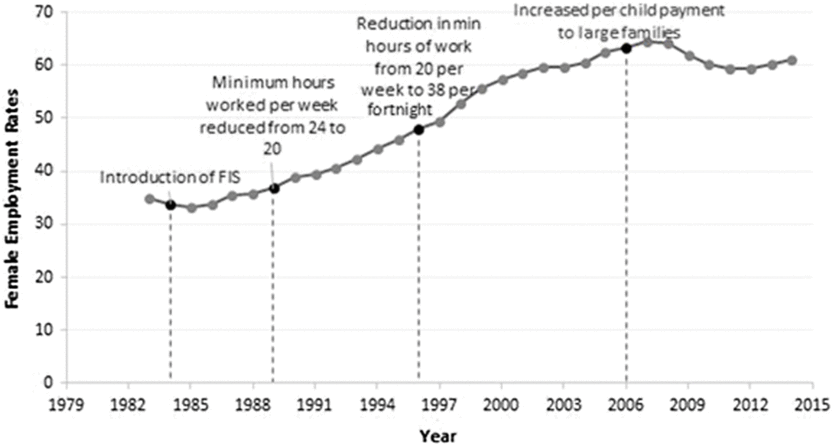
The 1980s witnessed a rapid decline in birth and fertility rates (Punch, Reference Punch2007; Canavan, Reference Canavan2012), accompanied by a steep increase in the proportion of births outside marriage (Fahey, Reference Fahey and Connolly2015: 60). Female employment grew by 54.6 per cent compared to 10.2 per cent for men from 1971–91 (Walsh, Reference Walsh1993: 369), which was mostly attributable to married women entering the workforce (Fahey et al., Reference Fahey, Russell, Smyth, Nolan, O’Connell and Whelan2000: 255). FIS policy responded to these changes in 1989, by enabling a spouse’s income to contribute towards eligibility, rendering it possible to combine couples’ hours to meet FIS criteria. The minimum hours for eligibility were reduced from thirty to twenty-four in 1987 and again in 1989 to twenty hours per-week. Figure 1 demonstrates how the reduction in minimum hours for FIS coincided with increasing female employment. (The increased per-child payment to large families in 2006 is discussed in the section titled 2015-present, below.)
Irish female employment rates.

1990–2005
In the 1990s, European policy discourse shifted in favour of an ‘adult-worker model’ in the context of continuing individualisation and a focus on the employment of mothers (Coakley, Reference Coakley2005). The EU and Organisation for Economic Corporation and Development (OECD) encouraged their members to move from passive to active labour strategies to encourage employment amongst social welfare recipients (Whitworth and Griggs, Reference Whitworth and Griggs2013; Bengtsson, Reference Bengtsson2014). Ireland was slow to move in this direction and we argue that attempts to adapt FIS at this juncture exposed paradoxes of individualisation within the adult-worker model, in the absence of any plans to address caring.
The literature contends that a reluctance to adopt active strategies was partly due to economic conditions and later documents a movement towards a ‘mother worker regime’ where part-time work is facilitated alongside domestic caring duties (Murphy, Reference Murphy2010, Reference Murphy2014). When people make decisions regarding work, economic costs are secondary concerns to moral criteria about what is socially right (Duncan and Edwards, Reference Duncan and Edwards1997). Mothers’ decisions are often based upon childcare obligations and secondly on employment opportunities (Coakley, Reference Coakley2005). Policy has also shifted to promote one parent workforce engagement. In 1996, 0.35 per cent of adults over fifteen were divorced and this increased to 2.77 per cent in 2016. In 1996, 2.82 per cent of adults aged over fifteen were separated whereas 3.15 per cent were separated in 2016 (CSO, 2018). Fewer than 10 per cent of births were outside marriage when FIS was introduced; however, in 1997, approximately 41 per cent of non-marital births were to lone-parents (Fahey and Russell, Reference Fahey and Russell2001: 35) and 12 per cent of children aged less than fifteen lived with a lone-parent (Fahey and Russell, Reference Fahey and Russell2001: 29). Exercising policy elements of both individualisation and familisation through the adult-worker model is not unique to Ireland. Daly (Reference Daly2011) demonstrates the coexistence of both policy types across Western Europe, with individualisation policies that include minimised supports to lone mothers that target activation strategies alongside financial payments to families. She suggests that countries engage in a dual-earner gender specialised family model of policy reform rather than an adult-worker model.
Irish employment rose considerably in the late 1990s and there was a growth in divisions between work-poor and work-rich households due to domestic structural changes in education, economy and employment (Singley and Callister, Reference Singley and Callister2003; Logue and Callan, Reference Logue and Callan2016). Dual-income and work-rich households increased, with all working age family members in paid employment, and such households were likely to have high education levels (Gregg and Wadsworth, Reference Gregg and Wadsworth1994; Russell et al., Reference Russell, Layte, Maître, O’Connell and Whelan2004; OECD, 2011). This contrasted with lone parents who tended to have lower levels of education plus a higher risk of unemployment (Watson et al., Reference Watson, Lunn, Quinn and Russell2011). Furthermore, Irish childcare was not adequately state-subsided, encouraging lone parents to remain at home to raise children, and many low income households engaged in family leave or exit employment (Coakley, Reference Coakley2005; CPA, 2005; Canavan, Reference Canavan2012).
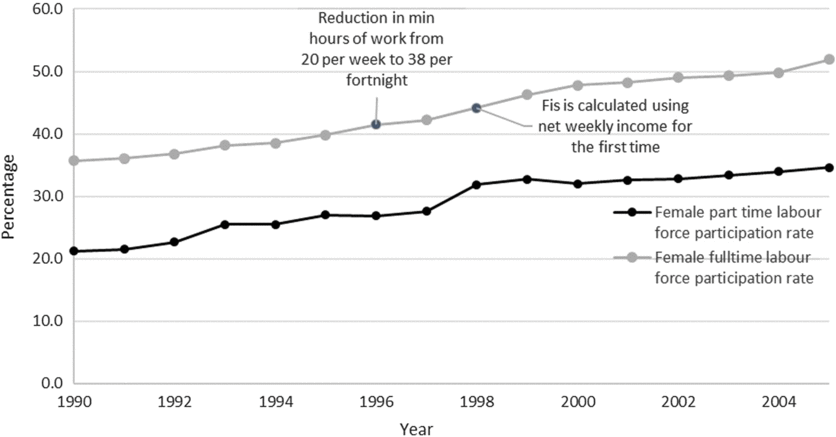
Female labour force participation grew from 37.7 per cent in 1990 to 54.3 per cent in 2005 and many engaged in part-time employment (OECD, 2015). In 1990, 21.2 per cent of employees were part-time female workers, growing to 34.6 per cent in 2005 (OECD, 2014c). A majority of educated women and those without pre-school children changed from full-time domiciliary roles to employment, yet state supports to encourage both parents into employment were lower than other EU countries (McGinnity and Russell, Reference McGinnity and Russell2008). FIS responded to dual-earner household increases and challenges associated with caring roles by reducing minimum eligibility work hours from twenty hours per week to thirty-eight per fortnight (Figure 2). These changes responded to both the movement towards a dual-earner regime and increases in lone-parents working part-time. However, this was not an incentive for mothers to work longer hours, nor did it address the cost of childcare. This policy change is complex and contradictory in nature as FIS attempted to address both the needs of low-income, and lower educated families while also trying to address requirements of lone-parents.
Percentage full-time and part-time Irish female labour-force participation 1990–2005.

Changes to FIS minimum work hours thus represented a response by policymakers to growing female employment participation and women’s tendency to work part-time in the 1990s. They appeared to support an adaptive breadwinner model by promoting part-time employment.
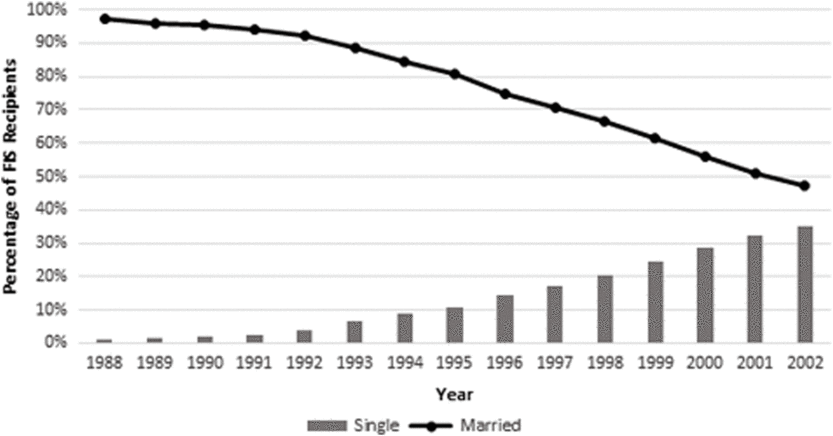
Terminology used to describe social policy gradually changed. The 1970s means tested allowance for unmarried mothers became the 1990s Lone-Parent Allowance and then the One-Parent Family Payment (OFP) in 1997. However, in 2005 the employment rate for lone-parents in Ireland was just 44.9 per cent compared to the OECD average of 70.6 per cent (Hannan et al., Reference Hannan, Halpin and Coleman2013: 5). The Irish rate of cohabitation tripled from 1994–2002 and was often a temporary state more common amongst urban younger childless couples (Halpin and O’ Donoghue, Reference Halpin and O’ Donoghue2005; Canavan, Reference Canavan2012; CSO, 2012; Hannan and Halpin, Reference Hannan and Halpin2014). In a movement away from the original tendency to favour traditional family types, cohabitating couples were made eligible to receive FIS in 1991. There were also decreases in percentages of married FIS recipients and increases in single parent beneficiaries (DSP, 2017; Figure 3). In 1990, 95.4 per cent of recipients were married and 1.9 per cent were single whereas, in 2002, 47.4 per cent of recipients were married and 34.8 per cent were single (Figure 3).
Percentage of single and married FIS recipients (DSP, 2017).

2005-present
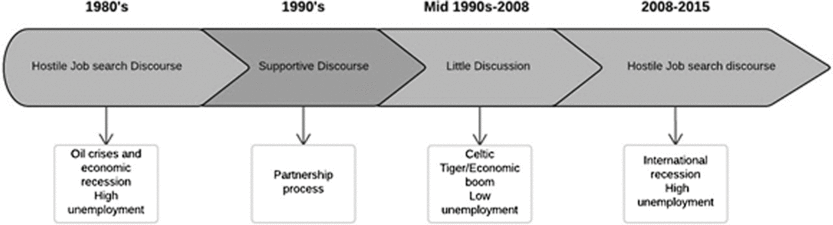
Ireland witnessed substantial spending on active labour market strategies during the Celtic Tiger era. However, critics did not consider them well implemented or monitored and concurrent Social Partnership negotiations led to increases in welfare payments (Martin, Reference Martin2015). Thus, when the Irish economy crashed after 2008, the government was required to implement strictly monitored labour-market activation strategies by The Troika (Murphy, Reference Murphy2016). Although there was discourse regarding job searching support in the 1980s and a job search programme was introduced comparable to activation strategies after 2008, it contained supportive conditionality with poor implementation (Bond, Reference Bond1988; Murphy, Reference Murphy2010). Murphy (Reference Murphy2010) charts how employment policy discourse in Ireland moved from labour market activation in 1980s to more passive strategies alongside strong economic growth during the 1990s and mid-2000s, to vigorous activation strategies post 2008 (Figure 4).
Timeline of labour market discourse in Ireland adapted from Murphy (Reference Murphy2010).

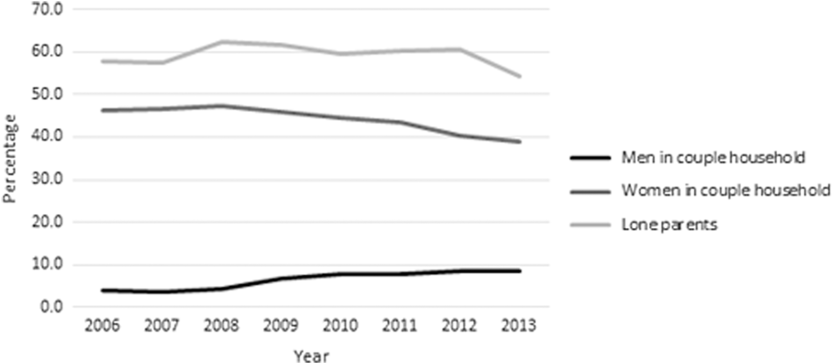
Although FIS is not a labour activation policy, a growing emphasis on ‘work-first’ placed a spotlight on its role in supporting labour-market participation and assisting in work activation of lone-parents. Because of increased awareness of FIS, changes to OFP and an economic recession, the number of recipients increased from 11898 in 1996, to 50306 in 2014 (DSP, 2014). Male dominated occupations experienced dramatic job losses compared to traditionally female sectors such as health and education in the recession (McGinnity et al., Reference McGinnity, Russell, Watson, Kingston and Kelly2014). Although numbers of partnered female employees working fewer than thirty hours per week dipped from 46.2 per cent to 38.8 per cent in 2013, the percentages of partnered men working fewer than thirty hours per week increased from 3.9 per cent in 2006 to 8.6 per cent in 2013 (OECD, 2014c).
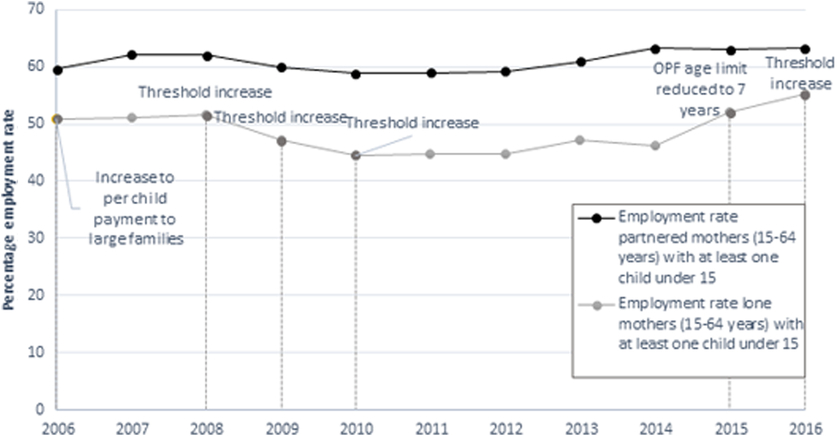
Adjustments to FIS income thresholds coincided with changes in the employment rates of lone and partnered mothers, and reflected the shift in emphasis towards activation (Figure 5). By 2011, 24.5 per cent of Irish births were to lone-parents (Hannan et al., Reference Hannan, Halpin and Coleman2013). In 2012, employment rates were lowest for lone-parents, cohabiting families and formally married single adults (McGinnity et al., Reference McGinnity, Russell, Watson, Kingston and Kelly2014: 27: Figure 6). In 2014 the employment rate for lone mothers was 46.2 per cent compared to 63.3 per cent for partnered mothers (Regan et al., Reference Regan, Keane and Walsh2018).
Percentage of couples and lone-parents working 1 to 29 hours per week (OECD, 2014b).


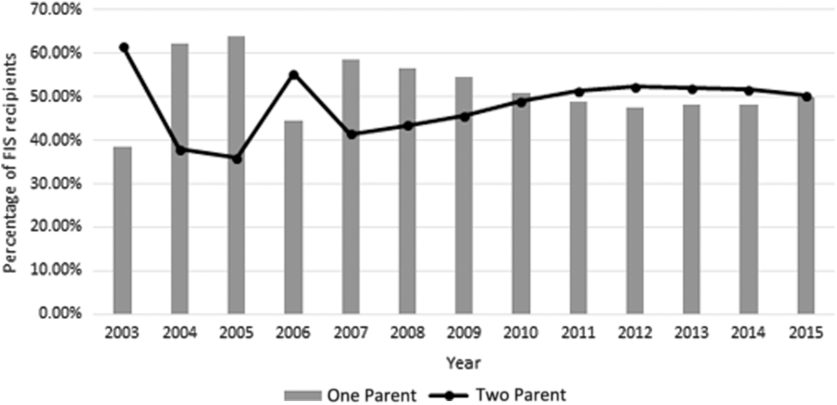
The Survey on Income and Living Conditions shows that, in 2013, lone-parents (c.60 per cent) had the highest basic deprivation levelsFootnote 2 (Watson et al., Reference Watson, Maître, Whelan and Russell2016: 40). The cut-off point to receive OFP was reduced to seven years for one’s youngest child in 2015. Recipients who no longer qualified for OFP transitioned into other programmes. Thus, in 2013, 1,500 people moved from OFP to FIS and another 1,100 moved in 2014 (Millar and Crosse, Reference Millar and Crosse2016). In 2003, 38.37 per cent of FIS recipients were one parent families, which increased to 49.79 per cent in 2015 (DSP, 2014; Department of Employment Affairs and Social Protection, 2016; Figure 7).
Number of one parent and two parent FIS recipients (DSP, 2017).

Throughout the 1980s, large families had been considered most at risk of poverty, before the focus of concern shifted to lone parents (Fahey and Nixon, Reference Fahey, Nixon and Mihaela2012: 131). Although fertility declined rapidly in the 1980s (as discussed previously, above), there are still a substantial number of moderately large families. For instance, in 2006, 21 per cent of mothers had four or more children and 7.5 per cent had more than five (Fahey et al., Reference Fahey, Keilthy and Polek2012: 12). Per-child FIS payments to large families were increased in 2006, considering that larger families continued to be at greater risk of poverty.
This section discussed the evolution of FIS in the context of changing family dynamics and the transformation of Irish social policy. It identified how FIS responded to these changes, sometimes in contradictory ways. In the next section, following a brief discussion of our methodology, we present results from expert interviews that were carried out as part of a broader study on FIS. Our analysis shows how its evolution alongside changing Irish family dynamics created paradoxical goals that continue to inform how experts think about the aims of FIS within the current socio-economic and policy context.
Methodology
Data collection
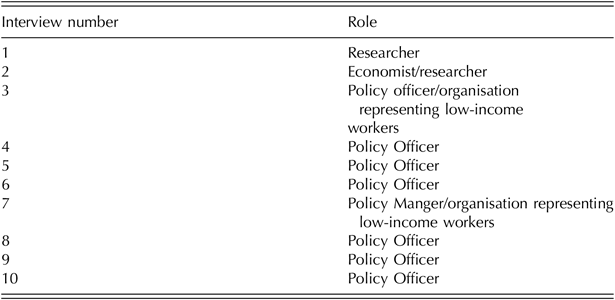
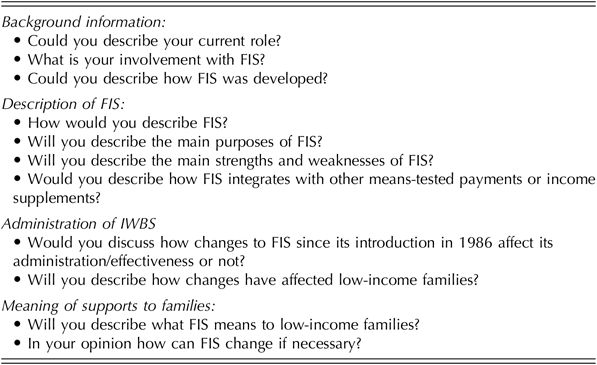
The findings in this section are based on a larger study on participant experiences of FIS, funded by the Irish Research Council (IRC) in collaboration with the Department of Social Protection.Footnote 3, Footnote 4 As part of that study, we conducted interviews with key informants in order to uncover underlying drivers of policy change in an Irish context. The main objective was to understand the motivations behind policy decisions relating to FIS. Ten semi-structured interviews were carried out with informants who had knowledge of IWBs, policy development and research (Table 1). Interviews with experts are valuable data collection tools in the study of public policy-making (Beyers et al., Reference Beyers, Braun, Marshall and De Bruyckera2014). The primary advantage is that interviews provide more detailed information than documentary collection methods alone as they have the potential to uncover ‘the contradictions, uncertainties and politics inherent in policy-making’ (Duke, Reference Duke2002: 55). By engaging with experienced informants working with FIS beneficiaries, the research is grounded in tangible evidence from those with knowledge and expertise to consider the evolution of FIS. Informants were involved in designing, delivering or implementing FIS and consisted of policy actors, representatives of low-income workers and academics. Participants were recruited through snowball sampling. Ethical approval was obtained from Maynooth University Social Sciences Research Ethics Committee prior to commencing fieldwork. Information sheets and consent forms were provided to interviewees with an interview topic guide that focused on participant’s background, administration of IWBs, description of FIS, integration with other supports, and the meaning of supports to families (Table 2). This helped to compare resultant transcripts and ensured consistency of questions, while allowing flexibility to follow emerging leads during interviews (Stevenson et al., Reference Stevenson, Doherty, Barnett, Muldoon and Trew2007).
Participant descriptions

Examples of interview questions

Analysis of interview transcripts
Data were generated using audio-recorded interviews and transcribed verbatim. Interviews were analysed inductively using thematic framework analysis (Ritchie and Spencer, Reference Ritchie, Spencer, Bryman and Burgess1994, Reference Ritchie, Spencer, Huberman and Miles2002). Within this approach, analysis takes place across five stages, namely: identify a thematic analysis framework, index, chart and synthesise the data (Furber, Reference Furber2010). We constructed a thematic framework by coding key themes embedded in the transcripts (Iliffe et al., Reference Iliffe, Wilcock, Drennan, Goodman, Griffin, Knapp, Lowery, Manthorpe, Rait and Warner2013). Transcripts were then further read and annotated according to the thematic framework. Links between categories were identified and grouped to form a hierarchy of themes, and data in previously indexed transcript segments were arranged into charts of themes displaying their key characteristics and relationships (Ritchie and Lewis, Reference Ritchie and Lewis2008). Results were synthesised and described in a report format (Gray and Rooney, Reference Gray and Rooney2018).
Findings
Findings are discussed in the sections below, where three overarching themes emerged from analysis: (1) ‘work-first’ approach, (2) child poverty and (3) encouraging care. Informants reported that FIS responded to economic and demographic changes by moving away from some of its original goals. They noted that the scheme is now accessible to part-time workers in response to increasing numbers of female employees and lone-parents. In terms of expenditure FIS was viewed as a small payment in comparison to other social welfare schemes and originally many eligible families did not take-up the scheme (Callan et al., Reference Callan, O’Neill and O’Donoghue1995). In addition, informants felt that take-up of this scheme was initially low: ‘I think that the participation rate for FIS recipients relative to where it should have been was low’ (Informant 2). They surmised that potential claimants were seemingly unaware of its existence. Overall, however, informants felt that FIS is developing without a clear focus and determined that the purpose of FIS has become unclear after years of change: ‘But there have been quite a lot of changes. You know… lowering… changing the hours threshold… I mean as I have said it’s grown in terms of expenditure and in terms of numbers but still nobody knows what it is actually doing’ (Informant 1). Moreover, Informant 8 cautioned that changes to policy often have unintended consequences that may affect other social welfare schemes, therefore changes to FIS should be given careful consideration:
I think what happens is when the scheme changes, where the eligibility conditions change, often what happens is not what people expected to happen… there can… be unintended consequences and then another change has to be made.
Work-first approach
Informants reported that language used by FIS policy assumed that it supported male breadwinner households:
The original legislation of 1984… said man and wife, or husband and wife… But certainly, over the years the definition of a couple or family was also included. It probably said man and woman cohabiting until the new legislation last year, which allows for same sex couples (Informant 5).
The report for the Commission on Social Welfare (1986: 300)Footnote 5 similarly stated that FIS supplements ‘families where the household head is employed full-time’. However, Informant 1 contended that the overarching intention of FIS was as an employment incentive. Many informant felt that ‘FIS is seen as being a way of addressing the issue of incentives’ and many informants focused upon the continuing role of FIS in increasing overall employment participation: ‘It’s an in-work benefit for low income families to try and keep them connected to the labour market… it’s a bit like making work pay for low paid workers… families with children’ (Informant 2). Although other informants saw an additional role for FIS in incentivising working parents to transition into full-time employment: ‘the more fundamental question is should we actually support people who are working part-time but should there be conditionality that they have to start to look for more work?’ (Informant 10). Informant 9 suggested that, rather than reducing the ‘hours threshold’, employers should be required to improve working hours and conditions to encourage full-time employment: ‘there is an onus on employers I think to give people decent hours and provide decent wages. I think to be reduced any further it (hours threshold) kind of leads to creating unsustainable employment’.
Many policymakers subscribed to a ‘work-first’ approach: ‘At the end of the day we want everyone to be in full employment’ (Informant 5). Informant 4 described a work-first approach as important socially thus encouraging positive mental health:
It has a huge social aspect to it as well and that encourages people to do better for themselves. I think that is really positive. It is always good to see somebody getting into work and doing what they need to do instead of sitting at home.
Furthermore, Informant 8 believed that FIS should encourage in-work approaches through positive conditionality measures for up skilling:
There should be… I think in tandem with employers particularly employers who use FIS quite a lot, I think I’d like to see some sort of training or educational element offered to FIS recipients, not as a stick – as a carrot.
Child poverty
From its inception FIS had a dual role as an income and child support that sought to reduce child poverty. Informant 2 described it as a way of connecting families to the labour force and believed that it retained its purpose as payment to reduce child poverty: ‘the benefits are predominantly intended for the child rather than for the parents’ while Informant 6 believed that FIS can assist parents to meet the final costs of child rearing: ‘It helps to pay for the additional costs of working, child care and travel’. They noted that child rearing costs change according to children’s life stages and suggested some scope to carry out research into FIS effectiveness at different time points:
Because then you have to throw in childcare costs which surely… would wipe out the gains in working. So there is kind of an interesting balance there as to when FIS does and doesn’t work for families…. It would be interesting to see when (FIS recipients) started… and to align that up then to the ages of children.
Informant 3 also found that low-income workers faced challenges throughout a child’s lifespan that may necessitate that parents spend more time at home: ‘They might have a teenager now… They… don’t need childcare but they might be going through difficulties in school, they might have mental health difficulties and parents were saying I actually can’t leave them alone now’. Others asserted that when it was introduced FIS helped workers’ overall recovery from a persistent 1980s recession as it was not previously possible to receive multiple social welfare payments:
The big thing at the time it was introduced was it wasn’t possible to actually be in receipt of FIS and another welfare payment because if you were working thirty-eight hours a week even in relatively low-income employment you actually couldn’t qualify for another means tested payment… even for… one parent family payment (Informant 10).
However, other comments suggest that informants experienced a contradiction between FIS’s impact in reducing child poverty and its work-first approach. Informant 2 suggested the benefit of making FIS available to all low income workers to separate its role as a work benefit and its function as a CIS: ‘Bring in an in work benefit which would then target low income workers irrespective of whether they had children’. In this model, child benefit is means-tested and a universal credit system exists for all low-income workers. However, he felt this system would perhaps dis-incentivise lone-parents and large families.
Reflecting on potential policy changes, informants discussed unintended consequences when changes interact with other schemes. In this context, Informant 7 noted how changes to OFP had knock-on effects on FIS stating that OFP recipients were shocked at weekly payment reductions when their youngest child reached seven years: ‘I don’t think that is particularly incentivising people to stay in work. And anecdotally… we have heard of a number of parents who have said they had to leave work as a result of the reforms.’ Whereas, informant 3 was against removing the objective of supporting children: ‘The combination of FIS being an in-work income support and a CIS at the same time… we think it is important that it does both… if you separate the two out, we’d be concerned that the payment wouldn’t be as generous’.
Encouraging care
Policymakers thus suggest contradictions between the FIS scheme’s original intention as a work incentive and its evolved role in enabling parents to care for children or other family members. Informants maintained that there is a focus on financial models in existing research indicating a need for qualitative research regarding linkages between FIS as a work incentive and how it responds to caring responsibilities:
None of these (existing research reports) are based on people or asked them… are you invested in your job… you know is it an issue of travel?… childcare? Or the money you get? Um… whatever you know… nobody has actually gone out and talked to people (Informant 1).
Many Informants queried whether making FIS available to part-time workers was a disincentive to seeking fulltime work hours given requirements of caring. They felt that there was a conflict between FIS as a work-first policy and the cost of childcare: ‘It would have to be very financially beneficial for a person to increase their hours because otherwise they could spend more time with their children at home’ (Informant 4). Moreover, Informant 10 felt the purpose of FIS was now unclear and was concerned that entry of part-time workers goes against the ethos of work-first strategies:
A reasonably large proportion of the people on FIS have care responsibilities, which are effectively going to prevent them working full-time. Then what is FIS then?…. I’m not sure what it is…. Has FIS become for those people actually a kind of a proxy carer’s payment?
However, others deemed the work-first approach as unfair to lone-parents and suggested that the ability to work part-time and care for family members is particularly important to this group: ‘for a lone-parent the main barriers are their parenting responsibilities, balancing parenting and work, access to affordable child care that is a huge issue’ (Informant 7). They maintained that the ‘hours threshold’ was too high for lone-parents struggling to balance work and caring responsibilities: ‘they might find it hard to meet the thirty-eight hours a fortnight condition, but also if their hours drop at certain times in the year then they lose entitlement to FIS’ (Informant 7). In addition, Informant 3 considered that it was vital to support lone parents: ‘your wages don’t take into account whether you are a single person or a single person with children. So if the social welfare system doesn’t take that into account, people aren’t going to be able to make ends meet in a job’. She believed that many employed lone-parents experienced income cuts due to changes to OFP and FIS in contrast to their stated aim of incentivising work:
And how was that experience for them? To suddenly realise you were €80 a week down as a result of reforms even though you are doing everything the government say they want to you to do which is to go out and to work and to bring in an income.
However, in terms of dual income families, others maintained that current ‘hours thresholds’ enabled these households to split their hours to meet FIS requirements and address caring responsibilities more easily:
Couples have the same childcare responsibilities that a lone-parent has but the hours ‘work threshold’ is the same. So that two people only have to work nineteen hours between them. Whereas the lone-parent only has to work nineteen on their own. So it’s slightly unfair if you’ve small children (Informant 8).
He considered that FIS was a favourable payment for dual-income households with a large number of children: ‘I think perhaps it does favour people with larger numbers of children and it was designed that way in the beginning’. Informant 8 noted that policy discourse is often critical of high income thresholds in large families and that it advocates an option to increase thresholds for one or two children families only. In addition, others emphasised FIS favouring of parents of large families and proposed an income limit reintroduction as many of these have large salaries: ‘(FIS) is based on the number of children that you have… if you have six or seven children the limit is about €1,000s… maybe a limit could be brought in so you could get up to as much as your earnings’ (Informant 6). This strategy originated in a NESC (1979) report which observed that many large families were financially disadvantaged in comparison to childless households.
Informant 2 noted increases in the number of men experiencing reduced incomes in the recent recession and questioned whether FIS creates a disincentive for men to return to work or increase their hours in dual-income settings. He suspected that childcare might prevent partnered workers from increasing their hours regardless of gender:
Female employment has been slow… at recovering… but the recovery it has been a lot slower in the construction sector and they are predominantly males…. that draws up an interesting policy question… of whether there may be a benefit trap for those males to go back to work… because of the fact that it is their income rise that would trigger the reduction of payment. That’s an interesting policy question for future… the provision of childcare is also an element of the impediments that might be there for some males to go back to work.
Discussion
International literature shows that IWBs focus on encouraging low-income mothers to enter employment and increase their working hours (Blundell et al., Reference Blundell, Costa Dias, Meghir and Shaw2016). It appears that IWBs also dis-incentivise second earners to increase employment (Chzhen and Middleton, Reference Chzhen and Middleton2007; Adam and Browne, Reference Adam and Browne2010; Blundell et al., Reference Blundell, Costa Dias, Meghir and Shaw2016), but work-first approaches prioritise the right to work over the right to care (Akgündüz and Plantenga, Reference Akgündüz and Plantenga2011; Ingold and Etherington, Reference Ingold and Etherington2013). This article sheds light on how IWBs tend to create this pattern in an Irish context and shows how changing family dynamics with a shift in policy focus towards a ‘work-first’ approach challenge the original values underlying FIS. This was originally a work incentive to ensure financial gain in low paid employment rather than relying on social welfare payments and was also used as an instrument to fight child poverty (Commission for Social Welfare, 1986; DSP, 2010). Evidence from interviews in this current study, consistent with documentary evidence provided elsewhere (Gray and Rooney, Reference Gray and Rooney2018; McCashin, Reference McCashin2019) show that policymakers believe the initial aim of FIS was to encourage employment based on a ‘male breadwinner’ model. However, policymakers are under pressure to make changes, due both to changing family structures and shifts in policy priorities. Our study shows that even as policymakers try to adapt to changes and shift towards supporting children rather than family types, adjustments to FIS continue to have the unintended consequence of favouring a single income household earning strategy, given families’ responsibilities for caring. This article documents how policymakers reflected on these challenges.
Ireland has been moving away from a breadwinner model of labour market participant to a dual-earner model. This study’s findings concur with previous research that shows that Ireland has adopted elements of a social investment approach by focusing on the labour activation of parents (Daly, Reference Daly2015; EU Commission, nd). Interviews with policy makers and advocacy groups in this study demonstrate that there is a strong emphasis now on work-first strategies and FIS is viewed primarily as an incentive to assist parents in transitioning into full-time employment. Policymakers argued that FIS should encourage both parents to work full-time in dual income households. However, experts also maintain that employers should be obliged to improve working conditions and wages for employees.
This article has outlined changes in family dynamics relating to the recent ‘great’ recession, notably job loss in traditionally male dominated sectors that led to an increase in part-time working for men (McGinnity et al., Reference McGinnity, Russell, Watson, Kingston and Kelly2014) and an increase in the number of lone parents with high levels of deprivation (Watson et al., Reference Watson, Maître, Whelan and Russell2016). Our expert informants believed that FIS helped people to recover from recession, in line with its second primary aim of fighting child poverty. Participants argued that it helped pay for additional costs of working, such as childcare or travel. However, other research shows that, when making decisions regarding work, economic concerns are often secondary to parents versus issues of child care or spending time with their children (Duncan and Edwards, Reference Duncan and Edwards1997; Coakley, Reference Coakley2005). Interviews with FIS recipients carried out as part of the wider study confirm this for the Irish case (Gray and Rooney, Reference Gray and Rooney2018). Although our expert informants believe that FIS helps with the financial cost of child caring, they also noted that lone-parents face particular challenges balancing the requirement to meet the working hours threshold against the need to spend time with their families. Future research could examine how FIS contributes financially to families when their children are at different life stages.
Despite maintaining its role as a work incentive, FIS has changed paradoxically in the context of policy failure to take account of households with different work-life strategies and family formations. Part-time worker eligibility is contrary to its original aims and the views of many policymakers who argue that full-time employment should be promoted under the FIS scheme. Policymakers commented that this aspect of FIS goes against its ‘work first’ ethos in failing to encourage parents to increase their hours. Research suggests that childcare and early childhood education in Ireland is not adequately subsidised by the state (Canavan, Reference Canavan2012; Daly, Reference Daly2015). Contrasting opinions are evident in this present study, where many informants feel that it is important for parents to balance care and work. A lack of affordable childcare adds to the complexity of encouraging parents to increase work hours.
Conclusion
This article helps to offer an important background for understanding why IWBs tend to favour breadwinner or part-time household employment patterns’. It has provided an analytical context for understanding how this tendency persists even in the setting of a policy shift towards adult-worker model policies. Our study demonstrates that even as policymakers try to adapt to changes and shift towards supporting children rather than family types, the scheme paradoxically continues to support this household earning strategy in the absence of wider supports for family caring responsibilities.
FIS was introduced to support working families at a time when family and household dynamics were beginning to change in Ireland. This article highlighted how changes to family formation and a movement in policy focus towards a work-first approach challenged the original values underlying FIS. It has been adapted to some extent to these changes, but has morphed in paradoxical ways in the context of policy failures to take account of divergent family household work strategies. One of the original aims of FIS policy was to encourage full-time working. However, the eligibility of part-time workers goes against this ethos. This policy may unintentionally favour the ‘adaptive’ form of dual-income households in which one parent works part-time to facilitate care for family members. It may also disadvantage lone-parents who wish to work fewer than nineteen hours per-week to care for family. Nonetheless, it continues to be a vital support for many working families. This is in ways that appear contrary to contemporary policy emphasis on activation towards full-time employment and that disadvantage some family-work strategies.
The evolution of changes to Ireland’s IWB opens a critical window on the contradictions inherent in the recent move towards a social investment model with a ‘work first’ agenda, in the context of the ‘innate conservatism’ of the Irish social security system (Murphy, Reference Murphy2012). Irish policy makers face considerable challenges in attempting to reform supports to working families that meet requirements for caring across the family life course. For instance, there is a need to provide high quality early childhood education while acknowledging parents’ preferences to prioritise family based care, without disadvantaging lone-parents. In tandem with policy change it is necessary to recognise the responsibility of employers to provide adequate working conditions that help to encourage parents to remain in full-time employment. Finally, there is a need for policymakers to agree on the modern day purpose of FIS in order to reach its full potential as a family support.
Acknowledgements
The research team would like to thank the individuals and organisations who generously shared their time, experience, and materials for the purposes of this research.