I. INTRODUCTION
Over the past few decades, silkworm silk has attracted considerable interests for its outstanding mechanical properties, comparable to high performance synthetic materials and natural fibers like cellulose fibers.Reference Gosline, Demont and Denny1–Reference Li, Huang and Hua5 As a natural protein fiber, silk is safe, nontoxic, and reliable because most of its amino acids are essential and harmless for human body. Therefore, regenerated silk fibroin (RSF) fibers have potential applications in biotechnological and biomedical materials.Reference Vollrath and Knight6, Reference Jin and Kaplan7 Moreover, RSF fibers hold a high research value of being a spinning model for other protein-based materials such as spider silkReference Viney8–Reference Metwalli, Slotta, Darko, Roth, Scheibel and Papadakis11 and genetically engineered polypeptides.Reference Anderson12, Reference Heslot13 Several different methods have been tried to spin RSF fibers artificially. For example, Ishizaka et al.Reference Ishizaka, Watanabe, Ishida and Fukumoto14 dissolved fibroin in orthophosphoric acid (H3PO4) and used ammonium sulfate [(NH4)2SO4] and sodium sulfate (Na2SO4) mixture as a coagulant. The fibers obtained finally had a breaking strength of 250 MPa and a strain of 10.1%. YaoReference Yao, Masuda, Zhao and Asakura15 prepared RSF fiber from its hexafluoroacetone solution by using dry-jet wet spinning process, in which a dope is extruded from orifices as filaments, which are then coagulated in a methanol aqueous solution. HaReference Ha, Park and Hudson16 reported a study of using the calcium nitrate [Ca(NO3)2]–methanol system as solvent and pure methanol as coagulant bath. Afterwards, HaReference Ha, Tonelli and Hudson17 dissolved silk fibroin in a solvent mixture of formic acid and trifluoroacetic acid, but the obtained RSF fibers still showed poor mechanical properties. UmReference Um, Ki, Lee, Baek, Hattori, Ihm and Park18 used phosphoric acid/formic acid mixture as solvent and spun RSF fibers in methanol coagulation bath. The resultant fibers had a breaking strength of 180 MPa and a breaking elongation of 16%. RSF fibers were also obtained by spinning a concentrated RSF aqueous solution into a hot coagulation bath of ammonium sulfate [(NH4)2SO4] solution.Reference Zhou, Shao, Knight, Yan and Chen19 Taken together, these observations suggest that most artificial fabrications of RSF belong to wet spinning process, which is much different from the natural dry spinning process of silkworm extruding aqueous solution at ambient temperature and low hydrostatic pressure in air.
In our previous work, RSF fibers were dry-spun from its aqueous solutions by mimicking the dry spinning process of silkworm.Reference Wei, Zhang, Zhao, Shao and Hu20 However, the obtained fiber showed a low breaking strength of only 45.5 MPa, which is much lower than that of natural silk. To improve the mechanical properties of the dry-spun fiber, we then tried different agents and methods to preliminarily posttreat the as-spun fiber.Reference Wei, Zhang, Zhao, Shao and Hu21
This study extends our earlier work on dry spinning of silk solution. We emphasized on 80 vol.% ethanol aqueous solution and a method to posttreat the as-spun fiber. The effects of draw ratio, immersion time in ethanol aqueous solution on the conformation, and the mechanical properties of the fibers were studied. The fibers spun from the dopes with different pHs were also posttreated, characterized, and compared. The aim of this work is to further improve the mechanical properties of our dry-spun fibers and to discuss the possibility of establishing an environmentally friendly process for preparing high-performance silk fiber.
II. EXPERIMENTAL
A. Preparation of RSF aqueous solution and fiber spinning
Bombyx mori cocoons from Zhejiang province, China, were degummed twice with 0.5 wt.% Na2CO3 solutions at 100 °C for 30 min each and washed with distilled water to remove sericin, respectively. After drying at room temperature, the degummed silks were dissolved in 9.0 M LiBr aqueous solution at 40 °C for 2 h and then stored at 10 °C for 12 h, yielding a 10% (w/v) solution. This solution was then dialyzed in distilled water for 72 h with a cellulose semipermeable membrane (molecular weight cut-off, 14,000 ± 2000). The water in the solution was slowly removed by forced airflow at 10 °C to prepare a 20 wt.% condensed RSF aqueous solution. 0.1 M 2-(N-morpholino)ethanesulfonic acid (MES)–trishydroxymethylaminomethane (Tris) buffer reagent was mixed with 20 wt.% concentrated RSF aqueous solution in a volume ratio of 1:2 to prepare RSF dopes with pH of 4.8, 5.2, 5.6, and 6.0, respectively. CaCl2 aqueous solution of 3 M was then added into the mixture to adjust the calcium ion concentration to 0.3 M. Since the dope with pH 4.8 gels and solidifies easily, the dope was placed in air for natural vaporization. However, the dopes with other pHs were condensed afterwards by forced airflow at an airflow rate of 5 ± 1 m/s to certain concentrations at 10 °C and 50 ± 5% relative humidity.
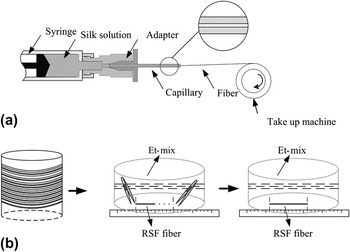
The homogeneous feed solutions without precipitates and air bubbles were dry-spun by using custom-built equipment for dry spinning [Fig. 1(a)]. During spinning, the as-spun fiber solidified as most water in the fiber evaporated in air. After being reeled, the fiber was stored in a sealed dryer containing silica gel for at least 24 h to remove the remaining water for stabilization. The capillary length, the capillary diameter, and the take-up speed in the following experiments were 20 mm, 250 μm, and 30 mm/s, respectively.
(a) Custom-built capillary spinning equipment for dry spinning and (b) posttreatment process for regenerated silk fibroin (RSF) fibers.

B. Posttreatment process
In comparison with alcohol aqueous solutions, such as methanol, isopropanol, and saturated inorganic salt aqueous solutions, for instance, Na2CO3, NaCl, NaHCO3, Na2SO4, NH4CL, NH4HCO3, and (NH4)2SO4, 80 vol.% ethanol aqueous solution (Et-mix) was chosen as the posttreatment agent of the as-spun fibers. As shown in Fig. 1(b), the fibers were first manually drawn with 1.0×–3.0× draw ratio in Et-mix and further immersed in Et-mix for certain time ranging from 1 to 120 min.
C. Measurements
1. Scanning electron microscopy
The morphology of the RSF fibers was observed with a Hitachi S-3000N (Hitachi Co., Tokyo, Japan) scanning electron microscope (SEM) at 15 kV.
2. Raman spectroscopy
Raman spectra were obtained using a Dilor LabRam-1B microscopy Raman spectrometer (HORIBA Jobin Yvon Ltd., Villeneuve d'Ascq, France). A He–Ne laser at 632.8 nm with about 6 mW power was focused on the individual fiber. Spectral data were recorded from 900 to 1800 cm−1.
3. Birefringence measurements
The birefringence and diameter (D) of the fibers were determined using an Olympus BX-51 polarizing microscope (Olympus Co., Tokyo, Japan) equipped with a Model CTB Berek compensator. Optical retardation (R) was obtained from angle retardation table at 546 nm wave length. Birefringence ∆n was determined as R/D.
4. Mechanical analysis
An Instron 5565 mechanical testing instrument (Instron Ltd., High Wycombe, United Kingdom) was used to evaluate the mechanical properties (25 ± 0.5 °C; relative humidity, 60 ± 5%; gauge length, 15 mm; cross-head velocity, 2 mm min−1). The density of silkworm silk, 1.35 g cm−3, taken from the Polymer Data Handbook,Reference Fossey and Kaplan22 was used as the density of the RSF fibers to convert the textile units to SI units. At least 10 individual filaments for each fiber sample were used in the mechanical property test. Before the test, the average diameter of each filament was obtained from more than five places distributed along the fiber axis in optical microphotograph. Then the cross-sectional area of each sample was obtained from the average diameter of the 10 individual filaments to calculate the average breaking stress. Standard deviation was used to present the statistical significance of the resulting data.
5. Fourier transform infrared spectroscopy
Fourier transform infrared spectroscopy (FTIR) spectra of the dry-spinning fibers were obtained with Nicolet NEXUS-670 FTIR spectrometer (Nicolet Instrument Co., Madison, WI) in the spectral region of 500–4000 cm−1 at 25 °C. Absorbance spectra were generated by converting to absorbance using OMNIC 6.0 (Nicolet Instrument Co.). Peak separation of amide II was carried out using Peakfit 4.12 (SeaSolve Software Inc., San Jose, CA). A Gaussian model was selected for the band shape at 1515 and 1545 cm−1, which represented β-sheet and α-helix conformation,Reference Shao, Zheng, Liu and Carr23–Reference Mathur, Tonelli, Rathke and Hudson25 respectively. To quantitatively analyze the conformation transition, conformation ratio of β-sheet to α-helix is calculated as the peak area ratio of I 1515/I 1545. The relationship between the conformation ratio and immersion time was studied by fitting curves using origin 8.0 (OriginLab Co., Northampton, MA).
III. RESULTS AND DISCUSSION
A. The effects of draw ratio on the mechanical properties and the orientation of RSF fibers
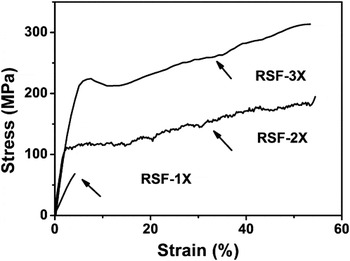
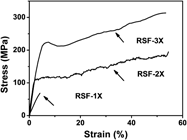
Drawing process significantly improves the mechanical properties of natural silk from silkwormReference Li, Huang and Hua5, Reference Khan, Morikawa, Gotoh, Miura, Ming, Sato and Iwasa26 and RSF fibers.Reference Zhou, Shao, Knight, Yan and Chen19, Reference Um, Ki, Kweon, Lee, Ihm and Park27 In this work, the effects of draw ratio on the mechanical properties and the orientation of posttreated RSF fibers obtained from the dope with pH 4.8 are also investigated. Figure 2 shows the stress–strain curves of the as-spun fiber and the posttreated fibers with draw ratios from 1 to 3. After being drawn in Et-mix, the RSF fibers were immersed in the mixture for 90 min. Table I lists the mechanical properties of the fibers and their birefringence in detail. With the increase of draw ratio, the breaking strength of the posttreated fibers improves drastically from 63.9 to 301.5 MPa, whereas the diameter decreases from 20.1 to 5.7 μm. The very brittle RSF-1× (fibers immersed in Et-mix without stretch) shows an initial modulus and a breaking elongation of 1659 MPa and 7.5%, respectively, although the breaking stress is doubled after treatment. Apparently, the initial moduli of RSF-2× (fibers stretched two times their length in Et-mix) and RSF-3× (fibers stretched three times their length in Et-mix) are much higher than that of the as-spun fiber. Both RSF-2× and RSF-3× exhibit the characteristic stress–strain curves of partially crystalline material with yield points and high elongations. However, the breaking elongation of natural silkworm fiber (see Table III) is much lower than those of RSF-2× and RSF-3×. One of the possible explanations is that the RSF filaments have less-developed crystalline structures and lower crystallinity than natural silk fiber. Consequently, the RSF molecules in the less-developed crystalline regions and amorphous regions could be stretched extensively. This results in the high elongation of the posttreated RSF fibers.
The stress–strain curves of posttreated RSF fibers with draw ratios from 1× to 3×.

Mechanical properties and birefringence of regenerated silk fibroin (RSF) fibers.Footnote a

a The as-spun fiber was obtained from the dope with a pH of 4.8. After being drawn in 80 vol.% ethanol aqueous solution, the RSF fibers were immersed in the mixture for 90 min.
Birefringence reflects the molecular orientations of both the crystalline and amorphous regions at the same time.Reference Um, Ki, Kweon, Lee, Ihm and Park27 As shown in Table I, both the birefringence and the breaking stress increase gradually when the draw ratio increases from 1 to 3. This suggests that the improvement of the breaking stress results from the improved molecular alignment. Moreover, the birefringence–draw ratio relationship first shows a sharp increase, followed by a slow increase, when the draw ratio ranges from 1 to 2 and from 2 to 3. The nonlinear increase indicates that the degree of orientation grows dominantly in the case of the draw ratio ranging from 1 to 2. Despite these, post-drawing is a key poststep to improve the structure and performance of the RSF fibers.
B. The effect of immersion time on the conformation of RSF fibers
Fibroin conformation transform is a process of reorganization of hydrogen bonds. The α-helix/random coil conformation with intramolecular hydrogen bonds is unstable and easily transforms to β-sheet conformation with intermolecular hydrogen bonds.
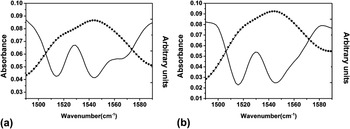
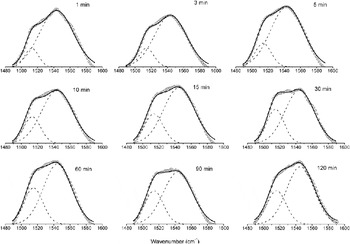
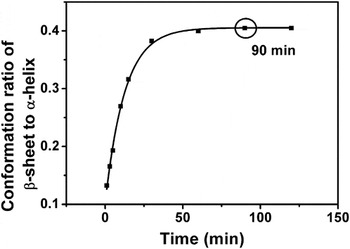
FTIR spectroscopy is a powerful technique to study structure at the molecular level and reveals typical absorption bands sensitive to molecular conformation of silk protein. Figure 3 shows the FTIR spectra of the RSF fibers obtained from dope with pH 4.8, which are post-drawn three times in Et-mix and then immersed in the mixture for 1 and 120 min, respectively. To characterize the structure of the polypeptide, we examined the FTIR spectra in amide II region. It can be seen from Fig. 3(a) that the amide II band of the posttreated fiber with an immersion time of 1 min shows a high, clear band at 1545 ± 5 cm−1, attributed to the random coil or α-helix, and a shoulder band at 1515 ± 5 cm−1, assigned to the β-sheet structure.Reference Shao, Zheng, Liu and Carr23–Reference Mathur, Tonelli, Rathke and Hudson25 The second derivative techniques are very widely used to examine the multiple components in the FTIR.Reference Chen, Shao, Marinkovic, Miller, Zhou and Chance28, Reference Chen, Knight, Shao and Vollrath29 In Fig. 3(a), the second derivative analysis clearly reveals the components at around 1545 and 1515 cm−1, which is in good agreement with the normal FTIR curve. Similar shape of amide II and characteristic bands are also found in the normal FTIR and the second derivative spectra of the fibers with the immersion time of 120 min in Fig. 3(b). It indicates that, in the posttreatment process, an obvious conformation transition from the random coil or α-helix to the β-sheet occurs when the immersion time is in the range of 1 to 120 min. In other words, all the posttreated fibers have the conformations of random coil, (alpha)-helix, and (beta)-sheet. To quantitatively analyze the conformation transition, the conformation ratio of β-sheet to α-helix is calculated as the peak area ratio of I 1515/I 1545. The detailed quantitative analysis of amide II for the posttreated RSF fibers with immersion times ranging from 1 to 120 min is presented in Fig. 4. It can be seen that all the spectra fitted well. The separated curves reveal that the random coil conformation or α-helix conformation is still the most distinctive feature for all the samples. The relationship of the conformation ratio of β-sheet to α-helix and immersion time is presented in Fig. 5. The curve shows an initial sharp increase indicating very rapid formation of the β-sheet and a broad plateau afterwards, which is similar with Chen’s work.Reference Chen, Knight, Shao and Vollrath29, Reference Chen, Shao, Knight and Vollrath30 The conformation ratio is almost constant after a 90-min immersion. This demonstrates that the conformation transforms slightly in a longer time scope, as shown in Fig. 5. According to the above results, we chose the following optimized conditions for posttreatment: draw ratio, 3 and immersion time after postdrawing, 90 min. The fiber posttreated at these conditions is named DT90.
Fourier transform infrared spectroscopy (FTIR) spectra in amide II band of posttreated RSF fibers immersed in 80 vol.% aqueous ethanol solution for (a) 1 min and (b) 120 min (-•-, original FTIR spectra; –––, second derivative of original FTIR spectra).

Deconvolution of FTIR spectra in amide II band of posttreated RSF fibers with different immersion times: original spectra (•), simulated spectra (——), and deconvoluted traces (······).

The relationship of the conformation ratio of β-sheet to α-helix of RSF fibers and immersion time.

C. The effect of posttreatment on the morphology of RSF fiber
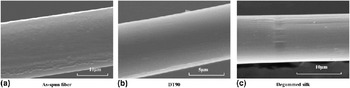
Surface morphologies of the as-spun fiber, DT90, and degummed silk are examined using SEM (Fig. 6). The as-spun fiber and DT90 exhibit a uniform and smooth surface, which is quite similar to that of degummed silk. It suggests that the posttreatment process is moderate and appropriate. It is found that the degummed silk has a smaller diameter (about 10 μm) than the as-spun fibers (about 15 μm). However, after three times postdrawing, the diameter of RSF-3× can reach as small as 6 μm.
Scanning electron microscope images of (a) as-spun fiber, (b) posttreated fiber (DT90), and (c) degummed silk.

D. The effects of the pH of spinning dope on the structure and performance of posttreated RSF fibers
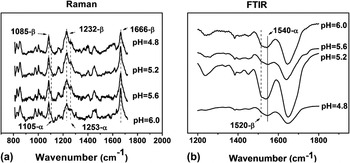
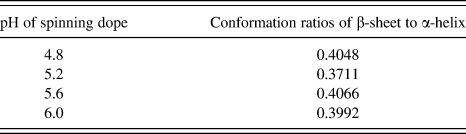
In spite of the dope with a pH of 4.8, the RSF dopes with pH 5.2, 5.6, and 6.0 were also used to dry-spin fibers. In our previous study, we found that these dopes have apparent diversity in spinnability. However, the obtained fibers show similar conformation, orientation, surface morphology and mechanical properties. To investigate the effects of pH of the spinning dope on the posttreatment, the as-spun fibers from the above different dopes were posttreated and further characterized. Figure 7(a) presents the Raman spectra of the posttreated fibers. In general, absorption bands associated with α-helix occur at 1105 cm−1, while random coil conformations results in bands at 950 and 1253 cm−1, and the β-sheet conformation results in bands at 1666, 1232, and 1085 cm−1.Reference Hu, Kaplan and Cebe31, Reference Drummy, Phillips, Stone, Farmer and Naik32 All the posttreated fibers exhibit strong absorption bands at 1085, 1232, and 1666 cm−1, which are attributed to β-sheet conformation. This demonstrates that all the treated fibers suffer an obvious conformation transition from the α-helix/random coil to the β-sheet. This conformation transformation phenomenon was often reported in previous literatures.Reference Ha, Park and Hudson16, Reference Ha, Tonelli and Hudson17, Reference Chen, Shao, Knight and Vollrath30 The peaks at 1105 and 1253 cm−1, assigned to the α-helix/random coil conformation, suggest the fibers are still partially crystalline materials as we mentioned earlier. Figure 7(b) shows the FTIR spectra of the posttreated fibers. Quantitative analysis results of the FTIR spectra in amide II are listed in Table II. There are no big differences among the conformation ratios of β-sheet to α-helix, which are all around 0.4 basically.
(a) Raman and (b) FTIR spectra of posttreated RSF fibers obtained from the spinning dopes with different pHs.

Conformation ratios of β-sheet to α-helix of the posttreated RSF fibers obtained from the dopes with different pHs.Footnote a

a The as-spun fibers were postdrawn 3.0 times in 80 vol% ethanol aqueous solution and further immersed in the same solution for 90 min.
Table III lists the mechanical properties of degummed silk and the posttreated RSF fibers obtained from the dopes with different pHs. All posttreated fibers show close values of diameter and breaking stress, comparable initial modulus, breaking energy, and wide ranges of breaking strain. Considering that the crystalline structures of the fibers are almost same, it is reasonable to exhibit stable mechanical properties even if the pH of the spinning dopes varies. Compared to the properties of degummed natural silk, the tensile strength of the posttreated fibers approaches that of the degummed silk. However, the initial modulus, especially the breaking energy, greatly exceeds that of the degummed silk. This suggests that the posttreated fibers are much tougher than the degummed silk.
Mechanical properties of degummed silk and posttreated RSF fibers obtained from the dopes with different pHs.Footnote a

a The as-spun fibers were postdrawn 3.0 times in 80 vol% ethanol aqueous solution and further immersed in the same solution for 90 min.
IV. CONCLUSION
RSF fibers were directly spun from highly concentrated RSF aqueous solutions by means of a dry spinning method. Moreover, by using 80 vol% ethanol aqueous solution (Et-mix) as posttreatment agent, a posttreatment process was explored to improve the mechanical properties of the as-spun fibers. The optimal processes for the posttreatment are as follows: postdrawing the as-spun fibers 3.0 times in Et-mix and further immersing them in Et-mix for 90 min. The obtained fibers have uniform diameters, smooth surfaces, and greater toughness than degummed silk. The breaking stress of the posttreated fiber is improved to 301 MPa, which is about 10-fold that of the as-spun fiber and approaches that of degummed silk. The breaking energy of the posttreated fibers is 2.4 to 3.8 times that of degummed silk, although the molecular weight of RSF is much lower than that of natural silk fibroin. In addition, the pH of spinning dope has limited effects on the structure and mechanical properties of the posttreated fibers. As a result, the optimal posttreatment process is suitable for the RSF fibers spun from the dopes with different pHs. The posttreatment agent, ethanol aqueous system, is nontoxic and environmental friendly and hence has promising applications.
ACKNOWLEDGMENTS
This work is supported by the National Nature Science Foundation of China (50803011), Specialized Research Fund for the Doctoral Program of Higher Education (200802550001), Shanghai Leading Academic Discipline Project (B603), the Fundamental Research Funds for the Central Universities, and Shanghai Pujiang Program (09PJ1400700).