Gaslight developed fairly rapidly into a new industry in the first two decades of the nineteenth century in Britain, but not in France and Germany where the invention had also existed in some form in the period between 1790 and 1805. Like so many other technologies of the Industrial Revolution, Britain took the lead in creating a new industry.Footnote 1 Although the technological tradition which started on the Continent did not disappear completely, gaslight was almost exclusively a British industry to 1820, and from that point it was largely British engineers and equipment that drove its growth on the Continent.Footnote 2 Even in Britain there were many people and groups who tried to create a commercial form of gas lighting from the 1790s onwards, but among these only one group succeeded in doing so: the manufacturing firm of Boulton & Watt in Birmingham. It managed to develop and consolidate gas lighting as a viable commercial technology between 1801 and 1810, and its work provided an important foundation for the subsequent expansion of the gas industry. Boulton & Watt's efforts in establishing the gas industry included specifically technical work in experimenting with and developing, from the smaller versions they had originally built, large-scale industrial machinery usable for lighting industrial mills – a transition that no other group was able to make. In addition to this technical work, they also marketed and publicized their work to potential customers as well as to the public at large, ensuring that the technology had acquired sufficient momentum that by the time Boulton & Watt lost interest in gas lighting around 1810 it flourished in the hands of others.
In this paper, I examine how Boulton & Watt consolidated gas lighting as a new commercial technology in the early years of the nineteenth century, and examine why they were able to do so, when so many others in Britain and elsewhere failed. I argue that they were capable of achieving this for two key reasons: the first was that they could draw upon a wealth of technical skills and experience, both in-house and with suppliers, derived from their manufacturing background. The second reason was that they had access to an extensive pool of resources which allowed them to do many experiments, to promote the technology through an existing network of large industrial customers, and to publicize its utility. It was this combination of technical innovativeness and the careful management of publicity that also marked their work with steam engines, and indeed there are many parallels between the firm's work with gas and with steam engines.
With regard to manufacturing skills and experience, Joel Mokyr, John Harris and many others have argued that British mechanical and artisanal skills in the eighteenth century were an important source of British invention and innovation, particularly in creating usable versions of technologies that may also have been invented or emulated in other countries.Footnote 3 Larry Stewart, Margaret Jacob and others have further argued that there was greater proximity between Britain's skilled mechanics and contemporary science, which aided them in their development work.Footnote 4 These links persisted to the end of the century, when they reached a state of mutually reinforcing technological and industrial development,Footnote 5 or, in other words, a point of sustained technological momentum. These mechanical skills had various sources, including the iron-founding industry and the scientific-instrument trade.Footnote 6 Both of these branches were present at Boulton & Watt,Footnote 7 and they used their expertise in both areas as they worked on gaslight. In terms of expertise with scientific instruments, they had been manufacturing a pneumatic apparatus derived from contemporary scientific instruments for Thomas Beddoes's pneumatic medicine.Footnote 8 It was this pneumatic apparatus which provided the basic model of the gas plant,Footnote 9 and, by using their experience with building large iron machinery, Boulton & Watt transformed the pneumatic apparatus into a gas plant usable in industrial mills. In addition, their history with building steam engines meant that they and their suppliers knew how to build industrial-scale machines made from iron designed to handle gases. While many of the parts of large gas plants were different from those found in a steam engine, others were not: Boulton & Watt and their suppliers were already manufacturing airtight pipes, joints and containers.
The second reason why Boulton & Watt were able to consolidate gas lighting as an industrial technology was that they were able to draw on their extensive resources as a company of some standing. Some historians, such as Svante Lindqvist and Donald Cardwell, have identified the period from 1790 to 1825 as a time when technological innovations were increasingly made within institutions, such as companies or military units. Whereas earlier in the eighteenth century individual inventors or engineers, perhaps fostered by Enlightenment institutions with industrial interests such as scientific societies, were predominant in innovation, around the turn of the nineteenth century companies and other institutions began to play a more important role, a trend that became more established as the nineteenth century wore on.Footnote 10 Lindqvist suggested that institutions took on a more important role because, in contrast to individuals, companies and other institutions were able to marshal the greater resources needed to develop and commercialize more complex technologies. It became increasingly beyond the resources of individuals to do what was needed to deploy new technologies. This pattern is apparent with gas lighting. As this paper shows, the consolidation of gas lighting as an industrial technology by Boulton & Watt depended to an important degree on the substantial resources dedicated to the project, both by Boulton & Watt and then by some of their steam engine customers, particularly Philips & Lee of Salford. Philips & Lee, led by George Augustus Lee, became development partners and took an active part in many design decisions, but, most importantly, Lee was willing to spend enormous sums on a gas plant for his mills, providing Boulton & Watt with their first full-scale gas installation.Footnote 11
The resources Boulton & Watt used in developing and commercializing gaslight were not only financial and material. They also relied on their large network of connections, both among industrial customers and in political and scientific circles.Footnote 12 This included how they advertised their work. As historians such as Iwan Rhys Morus have shown, display and demonstration were important for inventors and engineers in negotiating the place and acceptance of technical work in this period.Footnote 13 In the case of gas lighting, Boulton & Watt used opportunities for the public display of gaslight to promote their work among potential customers. Later on, when competitive concerns were becoming pressing, they made use of their connections with the Royal Society to gain prestige and bring their work to the public through the Royal Society. As David Miller and Christine MacLeod have discussed, Boulton & Watt were careful in cultivating the image of James Watt as a natural philosopher, and later as a heroic inventor, because it was very important for them commercially that James Watt's reputation be established in this way due to the prestige derived from it.Footnote 14 In a similar vein, their Royal Society connections served as an important means of establishing William Murdoch's status as the ‘true’ inventor of gaslight in the context of a commercial dispute, as well as the economic viability of the new invention.
Historians of gas lighting have debated Boulton & Watt's place in the industry's early years. While most histories celebrated their work,Footnote 15 Malcom Falkus in one of the few critical papers on the early history of gaslight argued that the role of Boulton & Watt had been exaggerated because the dominant form of gaslight in the nineteenth century was as an urban network, not as stand-alone units.Footnote 16 Falkus argued that Frederick Winsor and the London-based Gas Light and Coke Company (GLCC) were the true originators of this model, not Boulton & Watt, and that they developed their version of gaslight independently of Boulton & Watt. While agreeing with Falkus that the GLCC's creation of the network model was significant and difficult,Footnote 17 I argue that despite their relatively short-lived interest in gaslight, Boulton & Watt made three crucial contributions to this new industry. First, through extensive experimental work, they identified many and solved some of the problems associated with building industrial-scale gas plants, including how best to charge the retorts, extending the lifespan of apparatus and improving its robustness, dealing with gas purification and supply, flame efficiency, assessment of economics, and so on. Their second achievement was that they demonstrated the viability of the invention in the eyes of the public; the third that they trained and gave experience to many craftsmen and engineers in the area of gaslight technology. In this way, Boulton & Watt gave a decisive impetus to gaslight.
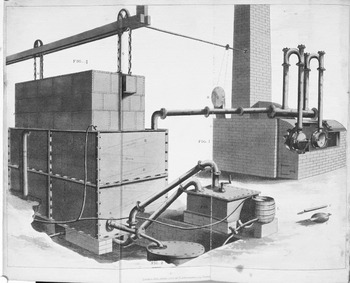
An early nineteenth-century gas plant. Coal was heated and gasified in the retorts on the right. The gases were then washed in water in the hydraulic main and bubbled through lime water to remove hydrogen sulphide (purifier on the left). The gas was stored in gasholders (also called gasometers) before being let into the pipe network. Source: Frederick Accum, A Practical Treatise on Gas-Light, London, 1815.

Early work to 1805
By 1801, when Boulton & Watt seriously started to work on gas lighting, the firm had evolved significantly since it was first constituted as a partnership between Matthew Boulton and James Watt in 1775. The two founding partners were becoming less active in the management of the firm, and by 1800 Watt had effectively withdrawn from day-to-day affairs.Footnote 18 Their sons James Watt junior and Matthew Robinson Boulton, who had been carefully prepared by their fathers to take over the firm, were now in charge.Footnote 19 The nature and activities of the firm had also changed over the preceding decade. Originally, Boulton & Watt did not manufacture many components for steam engines, relying instead on suppliers for most parts, and producing in-house only some precision parts, such as valves. They focused on providing the engineering work in erecting the engines. During the 1790s, the partnership began manufacturing more steam engine parts at the Soho Manufactory, and by 1793 it was making 50 per cent of engine components in-house. Almost all manufacturing was done internally from 1796, when a new partnership called Boulton, Watt & Co. was formed to run the recently completed Soho Foundry.Footnote 20 The partners in the new firm were James Watt junior, Matthew Robinson Boulton, the elder Boulton, and Watt junior's half-brother, Gregory Watt. The elder Watt was not a partner, but did supply capital to the firm. Although Boulton, Watt and Co. manufactured most components of the gas plants Boulton & Watt sold, it was still the original partnership of Boulton & Watt which sold gas plants to customers. It sent orders to manufacture most parts on to the Soho Foundry.Footnote 21 ‘Boulton & Watt’ is used throughout this paper to refer to these companies as in practice they were closely related, and the distinction between them in the gas-lightning context is evident only in accounting matters. In terms of the partners, the senior Boulton died in 1809 and had taken no part in the gas business. Gregory Watt died in 1804, and had no role in running the firm before that, and so the management of Boulton & Watt in the context of gas lighting lay entirely with Watt junior and Robinson Boulton.Footnote 22
Gas lighting at the firm began with William Murdoch's original invention of a form of gas lighting in the mid-1790s when he was erecting steam engines for the firm in Cornwall. He was not, however, the first to come up with the idea. There were a number of forms of lighting that relied on flammable gases from around 1777. Many of these were derived from a flammable air lighter or lamp which Alessandro Volta invented in that year.Footnote 23 His instrument soon spread throughout Europe, including to Britain, and many instrument-makers made their own versions of it.Footnote 24 This lighter was never really more than a curiosity, and was only used in chemical and apothecary laboratories whose occupants were willing to generate hydrogen by dissolving metals in acid and to refill the lighter with a pneumatic trough, a device used to isolate gases in inverted containers sitting over water or mercury.Footnote 25 In addition to these small devices, there were commercial attempts at gas lighting beginning in 1780, including by Philippe Lebon, the French civil engineer who patented his ‘thermolamp’ in 1799.Footnote 26 Even in Britain there were many people trying to light with flammable gases up to around 1805.Footnote 27 In Glasgow and Edinburgh some shopkeepers tried using gaslight, but had given up by 1807 because of the heat, the smell and the constant maintenance, demonstrating that the problems associated with scale and practicability were not easily solved.Footnote 28
It was, in fact, the possibility of losing out to competitors that prompted Boulton & Watt to spring into action over gaslight. Gregory Watt visited Paris in 1801 just when Lebon was publicly promoting his new thermolamp. When Gregory Watt recognized the similarity of Lebon's work to Murdoch's in Cornwall from 1794, he wrote to his brother James Watt junior, who then set in motion development work on gaslight.Footnote 29 A small gas apparatus was soon ready and put on public display during a celebration of the peace treaty of Amiens in March of 1802. The retort used at the celebration could keep a single lamp burning for four hours or so with a single load of coal.Footnote 30
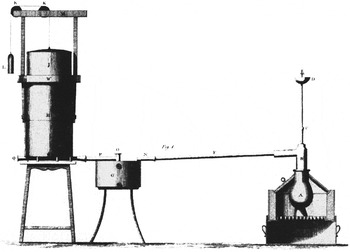
With this first small demonstration behind them, the firm started to tackle the problem of building larger apparatus, a fitful process of design and experimentation lasting several years. Indeed, this work of design and experimentation with gaslight apparatus was actually a continuation of experimental work going on at Boulton & Watt for some time in the context of the chemistry of gases and the design of pneumatic apparatus. The work had been begun by James Watt going back at least to his study of the nature of water. More directly, however, he had become very interested in the medicinal possibilities of gases after the untimely death of his daughter Jessie in 1794 from pulmonary tuberculosis. Watt was in contact with Thomas Beddoes, a medical doctor who had been thinking about the medicinal uses of gases when, in collaboration with Watt, he began to practise pneumatic medicine in earnest. Watt designed and built a pneumatic apparatus whose purpose was to produce and deliver doses of gas to patients suffering various ailments. The apparatus consisted of an alembic or distilling apparatus where the gas, typically hydrocarbonate (a mixture of carbon monoxide and hydrogen), was produced.Footnote 31 In the case of hydrocarbonate, this was done by dropping water onto heated charcoal. The gas was then washed and cooled with water in a refrigeratory and stored in a gasholder or gasometer until the patient was ready to inhale a dose of the air.Footnote 32 Most of this apparatus was originally derived from scientific instruments and laboratory apparatus, such as Antoine Lavoisier's gasometer, and was now repurposed as the basis for gas plants.Footnote 33 The subsequent transformation of the plant on an industrial scale was then the continuation of a tradition of experimentation in chemistry.Footnote 34 In commenting on Watt's experimentation, Larry Stewart has argued that it was representative of the continuities in experimentation ranging in purpose from natural philosophy to industrial application that were often present in the late eighteenth century in the same physical location. For Stewart, Watt's experiments ‘were thus partly exploratory, partly an attempt to assess theoretical explanations for the hotly-contested phlogiston, and sometimes an effort to determine whether any practical benefits might be achieved, as in the assessment of the quality of airs for human life’.Footnote 35 To this sequence, I now add that these experiments culminated in the creation of a new gaslight industry, although the experimental work was taken up by Watt's heirs.
Stewart's claims about the wide range of experimental work done in specific sites are part of a broader argument about the ‘spread of experimental enthusiasm’ in this period that ultimately contributed to the technological innovativeness of the Industrial Revolution. Many historians have argued that the experimental techniques learned from natural and experimental philosophy proved important for technological innovation in the late eighteenth century as a culture of experimentation became entrenched.Footnote 36 Indeed, Watt himself acknowledged that he learned from Joseph Black: ‘correct modes of reasoning and of making experiments, of which he set me the example, certainly conduced very much to facilitate the progress of my inventions’.Footnote 37 The style of experimentation Watt brought to his business enterprises persisted after he gave up an active role, at least to the extent that there was continuity in the context of pneumatic chemistry. Watt designed the original pneumatic apparatus, and others stepped in after 1801 to create industrially useful versions of the gas plant. Watt's experimental heirs in this matter were the Boulton & Watt engineers Henry Creighton, John Southern and William Murdoch, as well as James Watt junior, together with some of their customers, and especially George Augustus Lee.
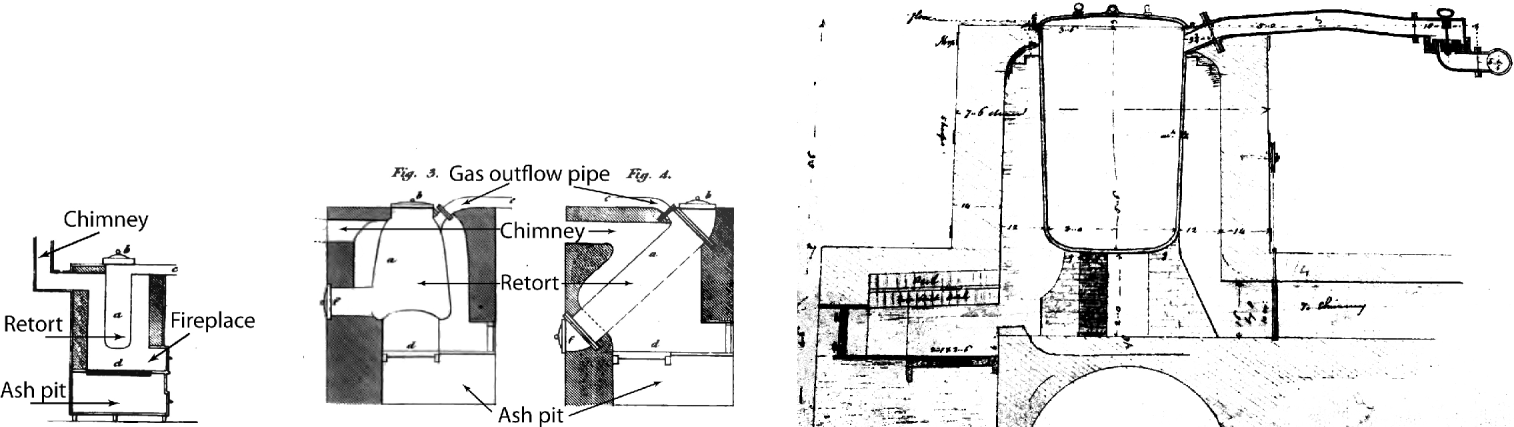
Left: the Amiens retort of 1802. Middle: two models tried until 1805. Right: the model installed at Philips & Lee in 1805. Source: Henry Creighton, ‘Gas-Lights’, in Encyclopaedia Britannica, Supplement, 1824, pp. 448–462.
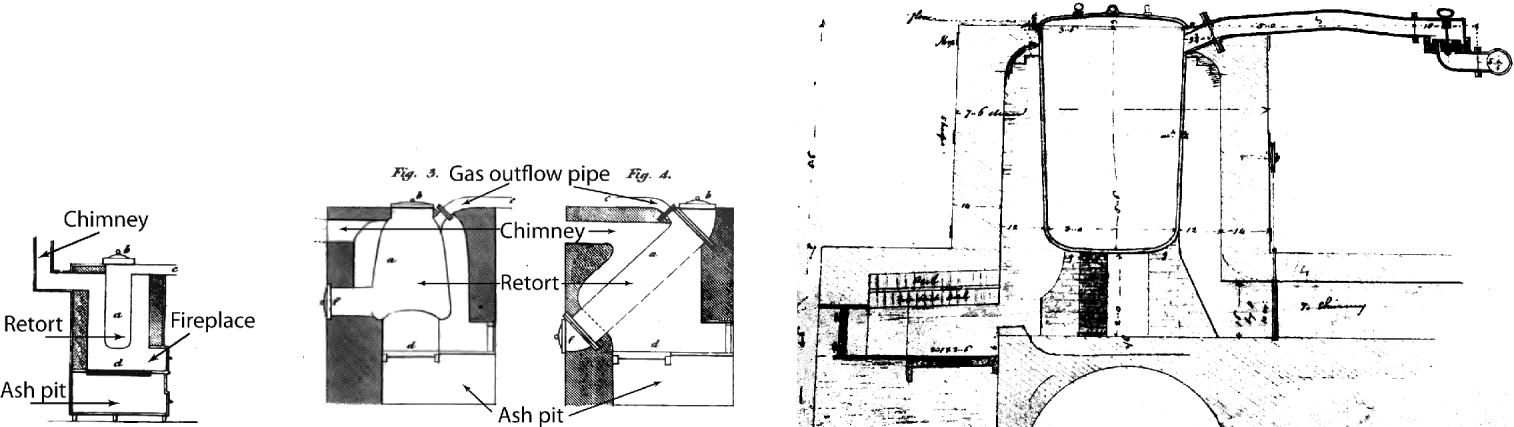
The firm faced a number of engineering challenges as they worked on gaslight. One key problem in scaling up the retorts was their relatively short service life as they burned out fairly quickly with constant heating cycles, either by cracking or by oxidizing. Expensive and complicated retort designs were not possible as they would make the cost of renewing the apparatus prohibitive, both because of manufacturing costs and because of the difficulty and delays caused by replacing a burnt-out retort. A number of complicated retorts designed to simplify the loading and discharging of coal were tried, but the experience Boulton & Watt gained between 1802 and 1805 meant that by the time the first plant was installed at Philips & Lee, the retort design had reverted to a vertical pot much like the 1802 Amiens retort, although on a much larger scale.
Another important problem in creating a form of the apparatus for more general use was ensuring the availability of a smooth flow of gas. In gas plants, the gas was generated in a batch process, meaning that it was produced unevenly over the course of a few hours as the coal was heated, and then ceased entirely once the coal had been exhausted. The workers then had to empty the retorts and reload them with fresh coal. The gas, however, was consumed evenly from early evening onwards, and there was then a mismatch between supply and demand schedules. Boulton & Watt's stationary steam engines used in factories faced a similar problem in that power was originally generated by the piston in only one direction, while textile machines needed a constant supply. The solution in that case was the use of double-acting pistons supplied with steam on both sides.Footnote 38 In the case of gas, Boulton & Watt used the gasometer as a buffer to store production to achieve the shift from the unevenness of gas generation to the smooth continuous flow required for lighting. As indicated earlier, the gasometer was very familiar to the firm as they had been manufacturing pneumatic apparatus for many years, and they simply adopted this device as the basis for the design of the gaslight apparatus.
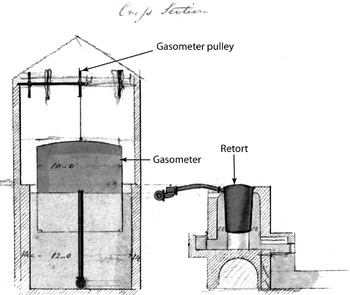
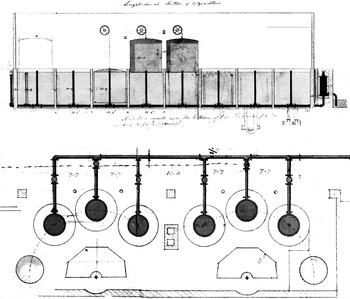
A large gasometer, eight feet deep, with a diameter of six feet and a capacity of three hundred cubic feet, was built and in use by March of 1803.Footnote 39 No sketch or design drawing of this gasometer survives, but it was likely similar to the gasometers installed at Philips & Lee. These had a design almost identical to the one used in Watt's pneumatic apparatus: the single counterweight was attached to the centre of the moveable section, with the chain passing over two wheels to the attached weights. The feed pipes entered from the bottom. With the exception of the feed pipes, which proved to be problematic, this design was the prototype for virtually all of the gasometers Boulton & Watt manufactured from 1806 to 1815, and for many early gasometer designs outside Boulton & Watt.
The pneumatic apparatus. Source: Thomas Beddoes and James Watt, Considerations on the Medicinal Use, and on the Production of Factitious Airs, Bristol: Printed by Bulgin and Rosser for J. Johnson, London, 1795, Plate 1.

Sketches of gasometers for Philips & Lee prepared in 1805 or 1806. Source: BWA MS 3147/5/804/5–7.

Soon after Boulton & Watt started work on gaslight, George Augustus Lee became involved in the project, and his collaboration would be vital because he provided extensive financing for the first large gas plant, installed at his mill in Salford, together with opportunities to gain experience and to display the invention. Lee was attracted to gaslight in part because had an affinity for improvements. He was an early adopter of steam heating and fire-resistant cast-iron construction at his mills, and worked on applying steam power to cotton spinning.Footnote 40 In 1803, just a year after the first demonstrations at Soho, Lee was already considering installing a gas plant, and he even sent a letter to Boulton & Watt urging action.Footnote 41 While his enthusiasm could not be accommodated that year, a small experimental apparatus was built at his house in 1804.Footnote 42 In early 1805 he became convinced of the technology's potential after a visit to Manchester by William Murdoch, as he wrote to Watt junior: ‘I am convinced it [will] be as generally introduced as your Engines here & that you will have the same pre-eminence & preference. In case you think it eligible … please … prepare the requisite apparatus for our Mills as early as possible’.Footnote 43
This letter set in motion a new series of experiments and design work, and Boulton & Watt started actively soliciting orders from other mills.Footnote 44 The manufacturing of Lee's apparatus began in late 1805. One retort and gasometer were ready in early December 1805, and Murdoch went to Salford to oversee assembly of the apparatus personally. By New Year's Day 1806 they were in operation.Footnote 45
A second retort was soon added, and, with the plant finally operating, Boulton & Watt could determine its final size and the number of the retorts and gasholders. They started more experiments in February 1806 to this effect. Watt junior wrote a long letter to Southern back at Soho on 1 March 1806, summarizing all their work, and giving his opinion as to what they meant for the design and sizing of the retorts and gasometers. He acknowledged that the experiments were limited in scope to the extent that the gasometers were of insufficient capacity to hold the entire daily production of the two retorts, and hence complete production figures could not be obtained directly. He thought, however, that although no general rules for gasometer and retort size would be adopted, it was likely that gasometers would be designed to hold three hours of gas production from the retorts. He then observed that ‘it is a combined question of first cost; conveniency of room & comparative wear & tear. I shall thank you for any remarks that occur upon it’.Footnote 46
Southern responded to Watt junior in two letters, one of which is lost.Footnote 47 In the second letter, written on 9 March 1806, Southern identified what was to become the determining issue for the relative size of the retorts and gasometers: the added cost of every heating and cooling cycle. Southern argued that it was best to have the retorts always hot so as to avoid wasting coal in having to reheat the ovens.Footnote 48 His argument was based on the economy of coal alone but, as it turned out over the long run, there was even more cost associated with each heating and cooling cycle than anyone had yet realized. A retort would last longer if it were kept under constant heat and not allowed to cool. The more frequently a retort went through a heating and cooling cycle, the more quickly it burned out, and the more liable it was to cracking. As the gaslight industry matured, retorts which in the early years had been replaced on average every nine months had an extended lifespan of twelve or fifteen months by mid-century. It was soon standard practice to keep them under constant heat. If a retort had to be taken out of operation, it was allowed to cool slowly, over the course of a week.Footnote 49 Boulton & Watt had not yet come to this understanding in 1806, but by the end of 1807 the retorts were always under heat, except on Sundays when the mills shut down.Footnote 50 Gasometers, on the other hand, were not subject to any such operational strains, and therefore they would be less liable to future replacement costs. In general, the larger the gasometer was, the smaller the retorts could be, with the limit determined by the condition of retorts producing gas twenty-four hours a day.
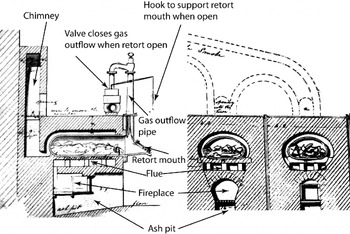
By late 1806, the firm had already reached a fair level of maturity in terms of the design of its gas plants. Those manufactured after 1806 differed from the final Philips & Lee plant in only a couple of major points, which was the orientation and shape of the retorts, and the configuration of the gasometer piping. The change in retort design was the result of a suggestion from Lee based on his experience in running the plant. All the retorts at Philips & Lee were vertical, but in late 1807, when Henry Creighton was at Salford with Lee assessing the plant's performance, Lee noted that they were getting less gas from the coal than had been the case with similar experiments done at the Soho Foundry earlier that same year. He surmised that this could be because their experiments had been done with a vertical retort at his mill, rather than the horizontal retort at the Soho Foundry.Footnote 51 There were other problems with the vertical retorts besides. The heat was affecting the grapnels used to raise and lower the coal, as they continued to bend or break frequently. The cranes were likewise showing signs of heat strain.Footnote 52 These problems prompted Lee to recommend that Boulton & Watt redesign the retort.Footnote 53 In short order the vertical retorts would be abandoned in favour of horizontal ones,Footnote 54 the form that was to dominate in the gas industry for most of the nineteenth century. The retort cross sections were also made into a D-form that became quite common in the later history of the gaslight industry.
Above: side view of the gasometers at Philips & Lee. Below: top view of the retorts with crane bases and swing arm radius. Source: BWA MS 3147/5/804/5–7.

Finding new customers
The transformation of the pneumatic apparatus into the industrial gas plant did not only involve experimental work associated with a different scale and a new purpose. It also included changing the audience for the technology. The pneumatic apparatus was marketed primarily by means of its association with Thomas Beddoes's pneumatic medical apparatus and later his Pneumatic Institution in Bristol, becoming entangled with Beddoes's radical politics, to its commercial disadvantage.Footnote 55 In its new form, the technology was being offered to a completely different group: the industrial mill owners who were Boulton & Watt's customers for their rotative steam engines. Boulton & Watt's activities of marketing and publicity were not new and had been an important part of the firm's work for many years. Even before he had teamed up with Watt, Boulton had established himself as a consummate businessman with a keen sense of finding buyers for his wares.Footnote 56 He famously saw a world market for Watt's steam engines and drove the business end of the partnership. When the time came to publicize Watt's newly developed rotative steam engines, the firm in 1784 built a showpiece factory, the Albion Flour Mill in London, to put the new engines on display.Footnote 57 Likewise, they had settled on the unit of horsepower to create a quantitative standard for the measurement of power. This helped them to convince potential steam engine customers of the value of their products through comparison with other sources.Footnote 58 Their introduction of pressure gauges and later the indicator diagram for steam engines provided a means of measuring the pressure and the power developed by the engine as it cycled. This allowed them to ensure that the engine was closely matched to its load, and thence to give assurances to their customers that they were neither paying for an over-capacity engine, nor at risk of needing to add more power capacity soon. In addition, it showed that the engine represented an important saving over other sources of power, such as horses.Footnote 59 A similar pattern of reaching potential customers and of quantitatively demonstrating the advantages of gaslight over other forms of lighting was evident in this new case as well.
The process of marketing had started in 1806 as they were installing the plant at Philips & Lee. Lee's personal enthusiasm for gaslight was also domestic, and his house was as much part of the gaslight trial as his factory. He had installed some of the first lamps in his own house, and, in the tradition of public display of science and the arts, organized a series of displays for the elite of Manchester and his industrialist friends.Footnote 60 Boulton, who had just arrived in Manchester, described the event to Watt junior: ‘Lee & Co are entertaining all the cognoscenti of Manchester with the wonders of the new lights which is displayed in the mansion as well as the factory.’Footnote 61 The display of the new lights in Lee's home in addition to the mill offered Boulton & Watt the prospect of introducing gaslights to new spaces and markets.Footnote 62
Work continued after this to bring the installation up to the planned three thousand or so candle equivalents.Footnote 63 The lights were being installed in two rooms in the Old Mill (probably the first two floors) and were almost complete when, in early February 1806, Murdoch thought that Lee's effusive talk and demonstrations were creating a real opportunity, and that one of the partners was needed on site to capitalize on it and close the sales: ‘It appears a great deal may be done in the lighting way here which will require the assistance of one of you’.Footnote 64 Watt junior, who was more the promoter of the gaslight project than Robinson Boulton, was soon on his way to Manchester to take advantage of this opportunity.Footnote 65 At this point they lacked any sense of whether the new form of lighting would in fact save the mill owners any money at all, and the aesthetics of these public displays formed the basis of their early marketing for gaslight.Footnote 66
Once on site, Lee and Watt junior arranged for a grand meeting of potential customers to take place on the night of Tuesday, 18 February 1806. Watt junior described the preparations to Boulton:
There is to be a grand meeting of the Illuminandi at Lee's tonight, to see the wonders in his house and to have this general distribution of the apparatus explained to them, but whether the whole, or any of them are to be admitted into the mill, seems not yet determined. I had a glimpse of it last night; one room with the cock[spur] burners all lighted was nearly free from smell; the other room, in which part of the people had left works and perhaps had not turned their cocks very accurately was somewhat unsavoury. The parties have however seem to make nothing of it and I suppose there will be several orders.Footnote 67
The big night proved to be a success, with two major orders placed on the spot.Footnote 68 Many of the rest made expressions of interest which quickly became confirmed orders, with Watt junior reporting to Boulton five more firm orders.Footnote 69 With this volume of orders coming at a single stroke, Watt junior surmised that the works at Soho would have to be rethought to handle the expansion: ‘As soon as I can get a little leisure I shall write what occurs respecting the arrangements which it may be necessary to adopt at the foundry & Soho for meeting these orders’.Footnote 70 Murdoch was sent back to Soho to begin making preparations to manufacture this flood of orders, but Watt junior wanted him back with him as soon as possible to consolidate further possible orders in Leeds and Derby. The hectic pace and sustained salesmanship was not to Watt junior's liking, but he thought he had to do it to seize the opportunity before it slipped from their grasp: ‘It is very evident that whatever is to be done, must be done now, as the whole tribe of Engineers, founders, braziers &c will become our competitors as soon as they know how’.Footnote 71
In the first two weeks of March 1806 Watt junior continued his sales tour, and confirmed more orders as he travelled at a frenetic pace around the mills in the vicinity of Manchester.Footnote 72 Watt junior was enthusiastic, but Robinson Boulton, emotionally and physically more distant from Watt's marketing campaign, wrote back to him a letter with a more sober assessment of their prospects: ‘My expectations of profits from the photogenous orders are very moderate compared with your prospective statement; so much so that if the results should not fall short of one half of the anticipated profits they will not be disappointed.’Footnote 73 He also feared what effect the large volume of orders would have on their business. The steam engine line was their profit-maker of long standing, and he did not want to divert many resources away from it as this new business was threatening to do, and indeed had done so in the last few weeks. Watt junior and Robinson Boulton had discussed how to handle the manufacturing of all the parts, agreeing that they should be farmed out to other manufacturing firms to the extent possible. In this letter, Boulton recognized that they would effectively transfer knowledge and skills to these other firms who would be their competitors after two years or so, but he thought this price was worth paying to protect their existing steam engine business and would not hurt them in the short term. His prediction did come true, as at least one of these subcontractors, Josiah Pemberton, turned out to be among the early manufacturers of gaslight apparatus.Footnote 74 Many of the workers the Gas Light and Coke Company hired came from Manchester and the surrounding area, and it also purchased parts from companies in Birmingham and Manchester.Footnote 75 Boulton & Watt's prior experience with steam engines was important in this regard because they had seen that passing on manufacturing work to outside suppliers had led in time to some of these suppliers becoming competitors. John Wilkinson, who was responsible for boring pistons for Boulton & Watt for many years, was eventually discovered to be producing pirate versions of their engines. Boulton & Watt held many steam engine patents, but none at all for gas, making the likelihood of copying much greater.Footnote 76
On 14 March 1806, Watt junior set out with Lee and Murdoch, who had come up from Soho five days before,Footnote 77 to visit Leeds and Preston and collect what orders they could among mill owners there, including Benjamin Gott. They returned to Manchester four days later, and Watt junior was finally satisfied. He had secured three more orders, meaning he had commitments from almost all the large mills worth having as customers.Footnote 78 He wrote to his father the day after his return satisfied with the fruits of his efforts of the last three weeks:
This concludes my labours in this vocation for the present, as the orders for all the large mills, which are thought tolerably safe, are now secured. Many of the smaller ones will necessarily drop in in the course of another year & the remainder will fall to the lot of our competitors, unregretted by us.Footnote 79
Watt junior now turned his attention to other matters, leaving Manchester the next dayFootnote 80 and the work of gaslight to Murdoch, Southern, Henry Creighton and Eidingtoun Hutton. He did not mention the business much in any surviving letters from this point until 1807, when Winsor and the National Light and Heat Company (the first name used for what later became the GLCC) burst on the scene and threatened to upset the status quo, and forced Watt junior to pay a great deal of attention to gaslight once again.
This batch of orders represents the densest cluster taken by Boulton & Watt in their entire history as a gaslight apparatus manufacturer. At no other time were preparations made for such a number of installations, and, even despite this, letters from Creighton and Hutton from May and June of 1806 indicate that they were more taken up with steam engine work than with gaslight. Robinson Boulton's desire to maintain the firm's emphasis on steam engines was effective even in this period. At the beginning of July 1806, Watt junior instructed Creighton and Hutton to send no more drawings for gaslight apparatus,Footnote 81 although a few more trickled in. At that point, Creighton reported to his brother that Manchester and Leeds mill owners who had placed their orders in March had grown frustrated by Boulton & Watt's delays:
They long to be enlightened and from what I can learn (which is not much) they may remain in the dark for another twelve months. What in the name of wonder hath prevented drawings from being sent of Various gaz pits etc – I believe there are some who wish they never had troubled themselves abt the said light and others are eternally bothering for drawings etc & what can be said to them but repeat the ‘promises’ recd from Soho – ‘drawings will be here in a few days’ ‘be sent without delay’ etc etc … one mill was to have been ready to light the first of this month! But possibly it was the year 1807 or 8 that was meant?Footnote 82
A long pause in collecting new orders now set in, and no drawing was made until May of 1807, and even that was a small one.Footnote 83 Creighton's sarcastic joke to his brother proved to be correct, and Boulton & Watt would not begin manufacturing any sizeable order other than Lee's until May of 1808 when they started work for James Kennedy, another Manchester textile mill.Footnote 84
The Royal Society paper
After James Watt junior became distracted by other matters in late 1806, gaslight faded in importance for the whole firm. Philips & Lee's apparatus was functioning and was even being expanded during 1806–1807, but no effort was put into developing the technology or even into filling the many orders Boulton & Watt had collected in 1806. All this changed in 1807 when Frederick Winsor's campaign to found the National Heat and Light Company reached a fever pitch in London. Although Boulton & Watt had been aware of Winsor as early as 1804,Footnote 85 they took little note of him then and likely forgot about him. Once Winsor intensified his marketing campaign late in 1806 with almost daily advertising in papers in London and elsewhere, it was only a question of time before his ambitions came to Boulton & Watt's notice.Footnote 86 Watt junior did not give it his immediate attention, but when he heard reports from London at the end of February 1807 that Winsor was about to apply for a charter from Parliament he hurried there to investigate the situation.Footnote 87 It was a false report, as it turned out, but Watt junior had now learned at first hand of Winsor's grandiose publicity and ambitions. Winsor hoped to incorporate a company with £1 million in capital to sell apparatus and gas all over the country.Footnote 88 Watt junior decided to monitor the ‘quacks’ in London, asking his London lawyer, Ambrose Weston, to keep him informed should there be any activity requiring his attention.Footnote 89 He then returned to Birmingham reassured,Footnote 90 but returned to the subject again in June of 1807, when he concocted a plan to crush Winsor's pretensions of being the inventor of gaslight: the Royal Society could award the Rumford Medal to Murdoch, based on a paper he would write describing his work on gaslight. The medal had been endowed by Count Rumford in 1796 to be given by the Royal Society to the European natural philosopher who had made significant contributions in research into heat and light in the preceding years. Rumford, who was strongly utilitarian, had been instrumental in founding the Royal Institution, with its programme of spreading scientific knowledge, making it useful and applying it for improvement. Rumford was particularly interested in heating and cooking, and had hoped the Royal Institution would promote research particularly in this area. The medal he had endowed for the Royal Society reflected his earlier interest in the matter, as it was to be granted ‘as a premium to the author of the most important discovery, or useful improvement’ on ‘the theories of fire, of heat, of light and of colour’, including ‘chemical discoveries’.Footnote 91
Watt junior thought that this medal would demonstrate with all the authority of the Royal Society that Winsor was an impostor and mountebank who was trying to swindle Murdoch out of his just claims to gaslight. Parliament would then not dare grant a charter to a project based on a fraud's wild claims and Boulton & Watt's business would be secure. Watt junior must have reasoned that the plan had a fair chance of succeeding because of both Matthew Boulton's and James Watt's friendship with the president of the Royal Society, Sir Joseph Banks. The use of their connections to Banks and the Royal Society to gain an edge over their gaslight rivals was part of pattern they followed in their work on steam engines. As David Miller has shown, it was of considerable importance for Boulton & Watt that James Watt be known as a ‘philosopher’ as they battled over steam engine patents in the late eighteenth century.Footnote 92 Presenting Watt in this way had significant commercial importance for the firm because of the prestige and the perceived superiority it accorded him and his work in the context of commercial competition.Footnote 93 For example, as witnesses in their lawsuits in the 1790s, Boulton & Watt partly relied on fellows of the Royal Society they knew, while their opponents used people in business with practical experience in steam engines. The court rulings were in favour of Boulton & Watt.Footnote 94 In a similar vein, the Lunar Society of Birmingham, of which both Matthew Boulton and James Watt were members, cultivated their relationship with the Royal Society because they thought that the scientific credibility such a relationship could provide might prove helpful in patent disputes.Footnote 95 In this case, it would be Murdoch who would be the target of philosophical polishing. In order to do this the work of all the others involved with gaslight was minimized, and Murdoch became the inventor of gaslight. The paper presented to the Royal Society, with Murdoch as the author, effectively made this claim. In its opening paragraph, Murdoch stated that ‘the apparatus for [coal-gas] production and application [have] been prepared by me at the works of Messrs. Boulton, Watt, and Co at Soho’.Footnote 96 Indeed, this effacing of the group effort extended even to the writing of the paper. Murdoch was to be its sole named author, but, as shown below, the paper was written by James Watt junior, supported mostly by the experiments of Henry Creighton and George Augustus Lee. Murdoch only read it over after the work was done.
This emphasizing of Murdoch to the detriment of others working on gaslight at the firm reflected the growing public prestige accorded inventors. As Christine MacLeod has shown, the seventeenth- and early eighteenth-century figure of a ‘projector’ or ‘patentee’ had been held in very little regard, akin to that of a fraudster or thief. By the mid-eighteenth century, however, inventors had been gaining in regard, a process in which Matthew Boulton and Watt had been important as they promoted their work by emphasizing Watt. By the beginning of the nineteenth century, while inventors had not yet achieved the status they had enjoyed in France for many decades, they were willing to identify themselves as ‘inventors’, and the term ‘patentee’ was no longer one of opprobrium. While the final transformation of Watt into a national hero of invention would come only after his death in 1819, the term ‘inventor’ had sufficient prestige attached to it that Boulton & Watt clearly thought it was worthwhile to have Murdoch depicted as one. Watt junior's creation of Murdoch as the inventor of gaslight was, then, similar to what he did with his father a few years later.Footnote 97
Watt junior led the Royal Society paper project. To begin his calculations, he estimated the total cost of Lee's apparatus at £5,000, including all pipes and burners, excavation work and new buildings. Assuming depreciation cost at 12.5 per cent on the apparatus, the yearly expense for gaslight apparatus at Philips & Lee came to £625. He estimated that Philips & Lee were burning about £104 worth of coal a year, meaning a net yearly expense of £729. The cost of labour was not included in the calculation because it was ‘certain that the cost of attendance upon the Candles would be more than upon the apps’. Watt junior reckoned that Lee would have had to spend £2,600 to light his mills with tallow, an enormous expense. This meant that Philips & Lee were saving £1,871 per year with gaslight. In fact, these calculations proved to be optimistic, not least because the retorts were assumed to last for several years, instead of the lifespan of a few months they in fact had.Footnote 98 With these figures in hand, Watt junior wrote to his father who was in London at the time, asking him to broach the question of Murdoch's paper with Sir Joseph Banks.Footnote 99 James Watt briefly replied five days later that it was too late this year and that they would have to try for next.Footnote 100 Watt junior then dropped the subject again for a few months.
Watt junior was jolted out of his complacency once again at the end of 1807 when the Winsorite threat seemed to be gaining momentum, and he restarted the Royal Society paper with a new set of experiments coupled with design work, as well as the first real efforts on the part of Boulton & Watt to deliver apparatus to customers other than Philips & Lee. Most of the experimentation was done, as usual, at Philips & Lee, but some was done at Soho as well. Creighton was at Manchester, where he worked with Lee at his mills, while Watt junior and Murdoch remained at Soho, and a series of letters, some quite lengthy, were exchanged during December 1807 and January 1808. Creighton's experiments formed the basis of the results eventually reported in Murdoch's paper. The new results, based in part on actual figures from Lee's production apparatus, led to Watt's economic calculations being revisited. Lee provided a more negative assessment than had hitherto been the case, and Watt junior struggled to reconcile himself to the new reality. In the end, the discussion revealed that many results and conclusions made with small apparatus from 1805 did not hold for larger ones.
The experiments at Philips & Lee started on 5 December 1807.Footnote 101 Creighton sent a preliminary report to Boulton & Watt on 28 December, running to three pages.Footnote 102 The experiments consisted of gasifying a certain quantity of various types of coal in Lee's main apparatus, and measuring how much was produced and was needed to feed burners of various luminosities. They showed that the candle-power equivalent of Cannel coal-gas was 0.5–1 ft3/candle, depending on the burner used. The range barely overlapped with the 0.36–0.5 ft3/candle from the recently completed Soho experiments and those of 1805 and 1806.Footnote 103 Lee commented that Creighton's experiments ‘afford no flattering Prospect of extending the oeconomical Principle beyond our former Practice & Expectations’.Footnote 104
In response, Murdoch and Watt junior asked Creighton and Lee a series of questions in a letter of 19 January 1808.Footnote 105 Watt junior was concerned primarily with the economics validating his calculation of £1,871 saved per year with gaslight.Footnote 106 Creighton's preliminary results had put this into doubt, and now Creighton did a thorough economic analysis which formed the basis of Murdoch's 1808 paper. Creighton reported that at this point there were 633 cockspur and 271 Argand burners in the Old and New Mill, counting houses, and Lee's home. This was equivalent to a total of 2,500 candles.Footnote 107 These consumed 2,500 ft3 of gas per day, requiring seven hundredweight of Cannel coal. The yearly cost of distillation coal was £125, plus £20 more for fuel, less £93 for coke sold for a net coal expense of £52. The depreciation on £5,000 for the apparatus at 12.5 per cent was £625 (the same figures as Watt junior's in 1807), for a total yearly cost for gaslight of £677. This replaced the equivalent of £2000 of tallow per year, for net savings of £1,323, or 30 per cent less than Watt junior had reckoned.
Watt junior received Creighton's and Lee's letters and wrote back on 23 January 1808, saying, ‘I confess myself somewhat disappointed by the oeconomical statement for although I did conceive we had rather overdone it before, I did not expect so great a difference as appears, and I think the causes are not yet fully explained’.Footnote 108 Although a few more letters were exchanged on the subject,Footnote 109 Lee and Creighton stood by their original results: ‘Our Photogenous Apparatus produces nearly uniform results & confirms most completely our statement’.Footnote 110 This missive put an end to the discussion and Watt junior went with Creighton's figures in the Royal Society paper, but they lowered the depreciation expense from £625 to £550 because, they claimed, Lee's apparatus was oversized.Footnote 111 Considering that the original £625 depreciation figure was already too low because it did not properly account for retort replacement frequency, the new lower figure had even less validity. Nor was there any allowance for the cost of capital. The revision brought the net advantage of gaslight back to £1,800.Footnote 112 In making this change, however, Watt junior had some justification in contemporary accounting practice. Boulton & Watt, like some other large firms, depreciated their steam engines at 8 per cent and their buildings at 5 per cent per year, while after 1800 textile mills often used 5 per cent.Footnote 113 And so while the reduced depreciation expense did not reflect the reality of retort replacement frequency, it was not out of line in comparison with what the firm used in other contexts.
With the experimental results and economic calculation in hand, Watt junior proceeded to draft a paper based on these results, working with Ambrose Weston. Watt junior wrote to Thomas Wilson, an employee based in Cornwall, asking him to gather what historical evidence he could by interviewing people who might have known Murdoch when he was there in 1792–1798, the period in which he first developed gaslight, and added some of these details to the paper.Footnote 114 The task of portraying him as the inventor of gaslight in the paper was not simple since by this point it was well known that others before him had tried something like it. To get around this, they stated that Murdoch knew nothing of these other versions of gaslight, as well as bolstering his claim to originality by stating that he was the first to apply it in an industrial context.
Once Watt junior had written the paper, Murdoch looked it over and corrected it in a few places.Footnote 115 It was then sent off to Banks, who read it before the Royal Society on 25 February 1808. The following day, Watt junior from London wrote to his father a remarkable letter that demonstrates that the intention behind the paper was to claim priority for Murdoch over Winsor, and that Watt junior had worked with Banks to come up with a paper best suited to secure the Rumford Medal for Murdoch, which he would indeed win in a few months' time:
My time has been a good deal occupied in ascertaining what sort of paper would be most likely to answer Sir Joseph Banks's wishes, and secure Mr Murdock the Rumford Medal. And I have, with some assistance from Mr A. Weston, drawn up one which fully met Sir Joseph's approbation and by his interest, was last night read at the Royal Society, and I suppose will be published in the next volume of the Transactions, it being the desire of Sir Joseph, that it should appear before the public, as early as possible.
I think, however, that although it will undoubtedly affect [sic] its intended purpose of securing to Mr Murdock the claim to the original idea, and first practical application of the Gas from coal to economical purposes it may be wrested to serve the views of the National Heat & Light Company, by the proof it affords of the Gas Light being already successfully introduced upon so considerable a scale, and consequently shewing that their pretensions, as far as utility is concerned, are not altogether nugatory.
But this is a danger, which there was no means of avoiding, consistently with Mr Murdock's wishes & Sir Joseph's intentions and it will not be a very easy matter for the Gas Committee to reduce their statements to correspond with our matters of fact.Footnote 116
The effect of the paper's publication was deep and pervasive. With the full weight of the Royal Society's prestige behind it, whose effect was multiplied when the Rumford Medal was finally granted on 21 November 1808,Footnote 117 the Murdoch paper became an object of great interest. The furore conjured up by Winsor had created an intense curiosity about gaslight among the general public, and now the Royal Society had waded in, giving its approbation to the technology, and favouring Boulton & Watt in the commercial rivalry. The extent of the interest in Murdoch's paper and in gaslight more generally is reflected by the number of publications that picked up and reprinted the paper in whole or in part after it was printed in the Philosophical Transactions in July 1808. It appeared in at least sixteen serial publications over the next year, and more instances could likely be found.Footnote 118
As Watt junior had planned, the Royal Society, by printing the paper, had also acknowledged Murdoch as the true inventor of gas. The publicizing of Murdoch as ‘inventor’ had effectively rejected the validity of Winsor's assertions to any patent rights and thrown into question the value of the National Heat and Light Company which was based on the premise of working with Winsor and his patents. Winsor had been painted as a projector.Footnote 119 As The Athenaeum commented, ‘this paper of Murdoch proves incontistably [sic] … his being the original inventor of the method of using coal-gas to produce light, and of the consequent insufficiency of any patents for the invention to others’.Footnote 120 From Watt junior's point of view, the paper and the medal closed the affair and he dropped the subject again.
The end of gaslight
Boulton & Watt's hesitations and delays regarding new orders stopped in 1808. When Creighton was at work at Philips & Lee in early 1808, he met with McConnel & Kennedy and James Kennedy, two textile firms in the Manchester area, both of whom had begun making preparations for their installations. He wrote that
M[cConnel] K[ennedy] is resolved to proceed with immediately … I will endeavour to get the whole finally settled as well these as at Mr Jas Kennedys who is now digging the pits for his gasom. as he means to have part of the apparatus ready for next winter.Footnote 121
His plant was running by 1809.Footnote 122 A few other textile mills also made orders and had their plants running in 1809, such as Birley & Co. of Manchester, Gillespie & Co. in Glasgow, and Wormald, Gott & Wormald of Leeds.Footnote 123
Retorts at James Kennedy, side view and front view. Note the use of firebrick to protect the retorts. Gasometer side and top view. All from 1808. Source: BWA MS 3147/5/817/8.

Boulton & Watt picked up a number of other customers in 1809–1811, but the business peaked very quickly. In 1809 they signed up four new customers, in 1810 another four, and only two in 1811. Their income peak lagged their customers by a year as the equipment took time to manufacture and deliver, reaching £3,513 in 1809, £4,808 in 1810, and £3,126 in 1811. In 1812, they had no new customers, and total sales of £250, a pittance in comparison to the six previous years. Boulton & Watt had clearly lost interest in the manufactured-gas business, although sales are recorded to 1815.Footnote 124 The drawings and plans in the 1810–1812 period also show that development work on gaslight at Boulton & Watt had effectively ground to a halt. The retorts did not change in design, and drawings prepared in 1812 are almost identical to those of 1808. The gasometers from the later period were somewhat larger than the earlier one, reaching five thousand cubic feet, but this was not a giant step.Footnote 125 In 1815, Henry Creighton wrote a letter to his brother that was likely reflective of the firm's attitude to gas by that point: ‘Verily I wish it [gas] had been found out elsewhere long since – or that this gas had been one of the things to be discovered abt the year 1900 or 2000’.Footnote 126
The lack of development was not because the technology was not mature enough. Boulton & Watt were simply not developing this line of their business. Watt junior had even written in April 1809 that he felt unacquainted with it.Footnote 127 This was despite the urging of Lee, who was of the opinion that the gaslight business was ready to expand rapidly in 1809: ‘Depen'd the Demand for the apparatus will one day be as great as sudden, & you have now an oppt[unity] of more leisure to determine all difficult or dubious points’,Footnote 128 of which the most pressing was purification of gas to remove the foul smells stemming from its sulphur content. Lee had described it as the last remaining desideratum.Footnote 129 This was not a problem that Boulton & Watt ever solved, but Samuel Clegg (among othersFootnote 130) had implemented a solution during work done between 1805 and 1808 when he used cream of lime to remove the hydrogen sulphide. Lime was, however, never used successfully by Boulton & Watt.Footnote 131 Perhaps they were unaware of this process in 1808, but they could not have remained ignorant over the next seven years. They were not interested enough in the technology after 1810 to put much effort into it.
As for the Winsor group, Boulton & Watt re-engaged battle with them once again in 1809 when they tried again to incorporate a joint-stock company through an Act of Parliament. The bill was defeated with the vigorous opposition of Boulton & Watt. The following year, however, saw Winsor's group and Boulton & Watt reach an agreement whereby the soon-to-be-incorporated Gas Light and Coke Company renounced the power to sell apparatus and concentrated on selling gas for light, thereby preserving Boulton & Watt's business. Ironically, Boulton & Watt were by then no longer interested. The newly formed Gas Light and Coke Company expanded rapidly, providing lights to the street, shops and homes of a large part of London by 1820.Footnote 132
George Augustus Lee had always been a major driving force behind Boulton & Watt's development of gaslight. He was certainly not the only one: both Murdoch and Watt junior had been very much taken with the project for some time, but both lost interest. Robinson Boulton had never been enthused with the technology, and his coolness affected how many resources the firm was willing to dedicate to gaslight. It might even have rubbed off on Watt junior over time. Watt junior certainly developed a case of ‘gaslight fatigue’ after the battles of 1807–1809 with the Winsorites, and even if he never consciously gave up the business he conceded that he could not keep out serious competitors. His interest was also turning in other directions. The firm was starting to manufacture marine steam engines, and he grew increasingly keen on this new line of products.Footnote 133 It is also possible that the entire battle with the Winsorites, and their use of the Royal Society, had always been primarily a reputation-building exercise, with the protection of their gas business being a secondary goal. Certainly the result of it was that one of their engineering employees had acquired a national reputation as an inventor, courtesy of the Royal Society. Even if the gas business was no longer of interest, such a reputation was undoubtedly important for the firm's commercial interests.
Lee, however, remained as enthused as at the outset. In 1813, after the Gas Light and Coke Company had been established and was operating, Lee received a visitor from London. He was the architect for the General Post Office, and was investigating using gaslight for their buildings. Having heard of the famous gaslights at Philips & Lee, he made a trip to Manchester with the purpose of dropping by the mill to see the lights in action. After the visit, Lee wrote to Watt junior,
It appears to me that with a little exertion there is a very extensive field opening for the Extension of the Gas Lights and that after expending so much money & brains you will let the Quacks in & out of the Metropolis derive all the Advantage of the Dyscovery and our Experience.
Being satisfied that Coal gas can be effectually purified by agitation in the Cream of Lime, the time is near at Hand for its more general Introduction. A Gentleman from the General Post office in London who is their Architect came expressly for the Purpose & by their Directions to inquire about it and I am since informed means actually to introduce it there. He says the present Expense of Oil & Candles is no less than £3000 pannum. I have endeavoured to guard him against the quacks in London. This & more general but important Considerations induce me to press the Subject upon your early Attention, & if you can give it the due Exertions I shall either hear or see you about it.Footnote 134
But Watt junior did let the ‘quacks’ derive all the advantage of their discovery.
Conclusion
Between 1801 and 1810, Boulton & Watt consolidated an invention that had been around in various forms from the late 1770s. Although many people and groups had tried to develop a commercial implementation of gaslight, none had succeeded. Of the many groups scattered throughout the Continent and in Britain, only Boulton & Watt built a version of gaslight usable on industrial scales. By the time they lost interest in the technology around 1810, it was sufficiently mature that others picked up where they had left off and went on to create an entirely new industry. During this period, Boulton & Watt efforts in establishing the new industry included specifically technical work related to scaling up the apparatus of gaslight from the small models used originally by Boulton & Watt and others to a size appropriate for industrial mills. In addition, they also built up a possible client base by marketing and advertising the invention to the industrial mills of northern England, as well as to the public at large.
This story has a number of implications for the historiography of the Industrial Revolution relative to why Britain created industries where other regions failed to do so, even if the basic technology was present everywhere. Although I argue elsewhere that it is a distortion to claim that gaslight simply failed on the Continent,Footnote 135 Boulton & Watt were nevertheless the only ones to build functional industrial-scale gas plants. They were able to do this in large part because of their and their suppliers' skills in ironworking. Specifically, they had experience in building large airtight machines in the form of steam engines. Furthermore, they had a background in making scientific instruments, and particularly Beddoes's pneumatic apparatus. This experience with ironworking and pneumatic chemistry meant that when Murdoch thought of lighting with gases in the 1790s, he was located in a firm that had many resources at its disposal to transform it into a viable industrial technology.
The continuities between the pneumatic apparatus and the gas plant at Boulton & Watt, and the engineering experimentation done by the firm to create an industrial form of gaslight, are both representative of a culture of experimentation within the firm. This culture had at least some roots in James Watt's own work on the steam engine. It has been suggested that the experimental culture of the late eighteenth century helped bring about the technical innovativeness of the Industrial Revolution, and that this culture was learned in part from natural and experimental philosophy. In the case of gaslight at least, the culture of experimentation can be traced partly to James Watt's work in pneumatic chemistry and his design of the pneumatic apparatus, together with the methods and attitudes he had infused in the firm more generally.
The scaling up of apparatus to industrial sizes was a procedure that came to be repeated more frequently as the nineteenth century progressed, whether with chemical processes or with physical models for experimentation. The rise of chemical-engineering education in the late nineteenth century represented a formalization and a systematization of the process of scaling up chemical reactions produced in the laboratory for industrial applications.Footnote 136 Likewise, the widespread acceptance of scale models in engineering experimentation later in the nineteenth century required the use of engineering theory, called scale modelling, as opposed to the rules of thumb that pre-dated it.Footnote 137 In both these cases, the use of theory was important for the scaling process. Boulton & Watt's own work with scaling a chemical technology did not, however, rely on any theory of similitude. For them, scaling was an empirical process.
Establishing gaslight also meant finding a new base of customers, and this involved marketing. As with the steam engine, Boulton & Watt engaged in a number of publicity-seeking activities to create a place for gaslight. These included public display at Soho in 1802 and at Philips & Lee in 1806. Later on, with Joseph Banks's full complicity, they used the Royal Society, through the paper in the Philosophical Transactions and the resulting medal, to attempt to crush their competitors in the Winsor camp. By 1809, gaslight, William Murdoch and Boulton & Watt had become a well-known grouping through the many publications that reprinted Murdoch's paper. In a further parallel with steam engines, and indicative of their proclivity for privileging quantification, Boulton & Watt attached great importance to demonstrating that gaslight was an economically attractive form of lighting. James Watt junior made this a central point of Murdoch's paper, against the analysis of his own engineer Henry Creighton and his first customer George Augustus Lee.
In addition to associating Murdoch and gaslight with natural philosophy, the Royal Society episode represented an elevation of William Murdoch to the status of heroic inventor, a status he has maintained in the historiography of gas lighting. The archives clearly show that many people at Boulton & Watt, in addition to Lee himself, were involved in the extensive work of designing and building industrial gas plants. Certainly Murdoch was the first to think of it at the firm, and was important in subsequent work. But just as the Royal Society paper itself was the product of people besides Murdoch, so too it was the firm as a whole, relying on its suppliers and its customers, that was responsible for establishing gaslight. Watt junior's creation of Murdoch as a heroic inventor would be soon repeated with his own father.