Severity of Menopausal Symptoms and Nicotine Dependence in Postmenopausal Women Smokers
Cigarette smoking has serious health consequences for individuals, including cardiovascular disease (CVD), stroke, respiratory illness, and cancer of the lungs, stomach, bladder, and kidneys. Women are at greater risk than men for experiencing certain smoking-related illnesses, such as lung cancer (Ben-Zaken Cohen, Pare, Man, & Sin, Reference Ben-Zaken, Paré, Man and Sin2007; Zang & Wynder, Reference Zang and Wynder1996). Women smokers who have reached menopause (defined as occurring a year after a woman's final menses) are even more vulnerable than other women smokers to adverse health effects. This is largely because cigarette smoking has antiestrogenic properties and has been associated with altered estrogen metabolism and serum estrogen levels (Michnovicz, Hershcopf, Naganuma, Bradlow, & Fishman, Reference Michnovicz, Hershcopf, Naganuma, Bradlow and Fishman1986; Tanko & Christiansen, Reference Tanko and Christiansen2004).
The antiestrogenic effects of smoking may worsen the symptoms and health risks associated with menopause, which is characterised by a gradual loss of ovarian function and a decrease in circulating estrogen (Hardy & Kuh, Reference Hardy and Kuh2002). The physiological changes that occur during menopause result in an increased risk of CVD, osteoporosis, and other illnesses in postmenopausal women, and these health risks appear to be augmented by smoking (Tanko & Christiansen, Reference Tanko and Christiansen2004). Women who smoke enter menopause an average of two years earlier than non-smokers (Cramer, Harlow, Xu, Fraer, & Barbieri, Reference Cramer, Harlow, Xu, Fraer and Barbieri1995; Kalogeraki et al., Reference Kalogeraki, Tamiolakis, Relakis, Karvelas, Froudarakis and Hassan1996), are more likely to experience menopausal hot flashes (Staropoli, Flaws, Bush, & Moulton, Reference Staropoli, Flaws, Bush and Moulton1998; Whiteman et al., Reference Whiteman, Staropoli, Langenberg, McCarter, Kjerulff and Flaws2003), and experience greater levels of vaginal atrophy (Kalogeraki et al., Reference Kalogeraki, Tamiolakis, Relakis, Karvelas, Froudarakis and Hassan1996). Despite these adverse effects, 18.1% of women 45–64 years of age report that they currently smoke cigarettes (CDC, 2014) and are thereby at risk for experiencing these complications.
It is certainly advisable that postmenopausal women smokers quit smoking to avoid serious health consequences resulting from the combined effects of smoking and menopause. However, successful smoking cessation interventions with this population would likely need to address the symptom course of nicotine withdrawal alone and in combination with the vasomotor and psychological symptoms commonly experienced during menopause. These interventions need to be informed by studies in which menopausal symptoms and nicotine withdrawal symptoms are assessed simultaneously. There are existing studies that have addressed the effects of nicotine replacement therapy (NRT) on the cessation-related symptom course in postmenopausal smokers. These studies may indirectly indicate how menopausal and nicotine withdrawal symptoms interact to influence the cessation process. Allen, Hatsukami, Brittnell, and Bade (Reference Allen, Hatsukami, Brittnell and Bade2005) found that NRT use predicted less weight gain than placebo in postmenopausal women, during two weeks of acute smoking cessation. Oncken, Cooney, Feinn, Lando, and Kranzler (Reference Oncken, Cooney, Feinn, Lando and Kranzler2007) found only short-term smoking cessation benefits with the use of NRT patches in postmenopausal women smokers. The short-lived benefit of NRT in these studies may indicate that NRT is less effective in treating nicotine withdrawal symptoms in postmenopausal women. However, evidence that NRT is less effective for women than men smokers in general (Cepeda-Benito, Reynoso, & Erath, Reference Cepeda-Benito, Reynoso and Erath2004), makes it unclear if these effects have anything to do with menopausal status of women smokers (Oncken et al., Reference Oncken, Cooney, Feinn, Lando and Kranzler2007).
In the present study, we prospectively assessed severity of menopausal symptoms throughout the nicotine withdrawal and cessation process. The present study is a secondary analysis of data collected from a clinical trial for smoking cessation amongst postmenopausal smokers for which the primary outcomes are reported elsewhere (Copeland, McVay, Martin, Baillie, Spears, Rash, Kendzor, & Geiselman, Reference Copeland, McVay, Martin, Baillie, Spears and Rash2015). Women smokers were assessed with the Kupperman Index (KI) of menopausal symptoms (Kupperman, Blatt, Wiesbader, & Filler, Reference Kupperman, Blatt, Wiesbader and Filler1953) and smoking-related indices of nicotine dependence, cotinine level, daily smoking rate, and number of years smoking. We hypothesized that: (1) menopausal symptoms would improve with smoking abstinence; and (2) smoking-related variables, such as nicotine dependence would account for less variance in menopause symptom severity, as length of smoking abstinence increased.
Methods
Participants
Participants were postmenopausal women smokers, who smoked at least 10 cigarettes per day for at least 1 year, had a body mass index (BMI) > 18, a carbon monoxide (CO) level of > 10 ppm, and expressed concern regarding postcessation weight gain. Postmenopausal status was determined by a follicle stimulating hormone (FSH) level above 30 mlU/ml and self-reported cessation of menses for at least 12 months. Exclusion criteria included: pharmacological or behavioural weight loss regimens, weight fluctuation > 20 pounds within the previous 6 months, active substance use disorders, major affective disorders, eating disorders, psychosis, and history or presence of severe physical illness (e.g., renal failure, hepatic failure, cancer, immunological disease). Participants were not excluded if they were taking any schedule of hormone therapy (HT). Participants were included in the present study if they had completed the 8-week follow-up from the larger clinical trial for smoking cessation in weight-concerned postmenopausal women (see Copeland et al., Reference Copeland, McVay, Martin, Baillie, Spears and Rash2015). This study was approved by the Institutional Review Board of Louisiana State University and Pennington Biomedical Research Center. All persons gave their informed consent prior to their inclusion in the study.
Procedure
Participants were recruited from the community by way of newspaper and billboard advertisements. Those who met the initial inclusion criteria (smoked > 10 cigarettes per day for > 1 year; endorsed fear of postcessation weight gain) were scheduled for a screening interview and two assessment meetings before entering a 2-week cessation group. Assessments included CO breath analysis to verify self-reported smoking status, cotinine, FSH, KI, SCID, anthropometric assessment for BMI, and the questionnaires listed above. Smoking cessation treatment groups (5–15 participants) were led by therapist pairs of clinical psychologists and doctoral students. Groups met for six sessions over 2 weeks for a structured cognitive-behavioural protocol of nicotine and smoking psychoeducation, stimulus control, relapse prevention, and cognitive restructuring. Eight weeks of the nicotine transdermal patch was distributed in 2-week supplies. Participants attended an orientation meeting 1 week prior to the first treatment session during which they were informed of their quit date and provided their first patches. Patch dose was determined following the Nicoderm CQ instructions in which individuals currently smoking 11+ cigarettes per day started on the 21-mg patch for 4 weeks, then stepped down to the 14-mg patch for 2 weeks, then stepped down to the 7-mg patch for two final weeks. Alternatively, individuals smoking 10 cigarettes per day started on the 14-mg patch for 6 weeks and stepped down to the 7-mg patch for two final weeks. CO level and nicotine patch use were monitored throughout the cessation programme. Participants attended follow-up assessment sessions in which post-treatment measures were obtained. Participants received brief, cognitive-behavioural counselling information for smoking cessation at each follow-up meeting. Reporting of the cessation outcomes for the clinical trial are reported elsewhere (Copeland, Martin, Geiselman, Rash, & Kendzor, Reference Copeland, Martin, Geiselman, Rash and Kendzor2006; Copeland et al., Reference Copeland, McVay, Martin, Baillie, Spears and Rash2015).
Measures
Carbon monoxide (CO) measurement
BreathCo monitors were used (Vitalograph Inc.) to determine expired CO level (ppm). A cut-off of <10 ppm was used to confirm self-reported non-smoking status (Underner & Peiffer, Reference Underner and Peiffer2010).
Serum cotinine
Cotinine, an active metabolite of nicotine, was assessed via blood serum levels. Serum cotinine levels of < 10 ng/ml were used to confirm self-reported non-smoking status (Bramer & Kallungal, Reference Bramer and Kallungal2003) at baseline and at the 8-week follow-up assessment. In the present study, we used only continuous abstinence rates to measure non-smoking status due to the relatively short follow-up time period assessed and because the effects of nicotine withdrawal were of interest. There were no cases in which self-report contradicted biochemical verification. Any participant data that was missing at the follow-up time points were conservatively counted as smoking in the statistical analyses.
Follicle stimulating hormone (FSH)
FSH levels were assessed via blood serum levels. Normal FSH levels are <10–15 mlU/ml. Postmenopausal status was determined by FSH levels of >30 mlU/ml (Kuller, Gutai, Meilahn, Matthews, & Plantinga, Reference Kuller, Gutai, Meilahn, Matthews and Plantinga1990; Matthews et al., Reference Matthews, Meilahn, Kuller, Kelsey, Caggiula and Wing1989).
Phone screen
Gender, age, ethnicity, and three additional questions using a dichotomous (yes/no) response format: Do you smoke more than 10 cigarettes per day? Do you use smoking as a way to control your weight? Are you afraid of gaining weight if you quit smoking?
Anthropometric data
Baseline body weight and height were converted into BMI (in kg/m2). Participants were also weighed at each of the six follow-up sessions.
Fagerström test for nicotine dependence
(FTND; Heatherton, Kozlowski, Frecker, & Fagerström, Reference Heatherton, Kozlowski, Frecker and Fagerström1991). The FTND assessed nicotine dependence through current smoking patterns.
Kupperman index of menopausal symptoms
KI; Kupperman et al. (Reference Kupperman, Blatt, Wiesbader and Filler1953). The KI was used to assess menopausal symptoms in participants. It yields separate scale scores for symptoms of insomnia, hot flashes, tingling/prickly sensations in extremities, irritability, depression, dizziness, muscle aches, headaches, night sweats, fatigue, vaginal dryness, skin dryness, hair loss, heart palpitations, and nervousness, in addition to yielding a total score for all symptoms combined. Separate symptom scale scores and total KI scores were used in the present study. KI scores and corresponding severity of menopausal symptoms are as follows: 15–20 mild, 20–35 moderate, and >35 severe.
Weight concern
Participants rated how concerned they were about postcessation weight gain using a 9-point scale.
Statistical Methods
Statistical analyses were conducted using SPSS version 22. Alpha was set at 0.05. Participant characteristics were assessed using descriptive statistics. Severity of menopause symptoms were then compared in successful abstainers versus smokers (i.e., women who relapsed to smoking) by conducting a multivariate analysis of variance (MANOVA) at 2-weeks postcessation with smoking status (abstinent vs. smoking) as the factor and KI scale scores as the dependent variables. The 2- and 8-week time periods coincided with follow-up sessions for the cessation study and were planned with the intent of gradually increasing the latency between sessions in which assessments were administered as participants progressed through acute nicotine withdrawal. We repeated this analysis with KI scale scores and smoking status assessed at 8-weeks postcessation. Next, we analysed predictors of menopause symptom severity at baseline, 2-weeks postcessation, and 8-weeks postcessation using a separate hierarchical linear regression analysis at each time point. For each analysis, participant age, race, BMI, FSH, and HT use (yes/no) were entered as predictor variables on the first step, cigarettes smoked per day (CPD), number of years smoking, FTND, and cotinine were entered as predictor variables on the second step, and KI total score was the dependent variable. These predictor variables (demographics, HT use, and smoking-related variables) were selected to include in the regression analyses because they share theoretical or previous empirical associations with the dependent variable of menopausal symptoms. These predictors were included to make for a rigorous test of smoking-related variables explaining variance in menopausal symptoms.
Results
Participant Characteristics
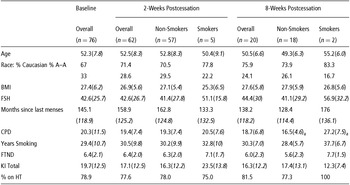
Participants (n = 76) were 67% Caucasian and 33% African–American. Mean age was 52.3(SD = 7.8) years, mean FSH level was 42.6(SD = 25.7), mean number of months since last menses was 145.1(SD = 118.9), mean BMI was 27.4(SD = 6.2), mean daily smoking rate was 20.3(SD = 11.5), for a mean of 29.4(SD = 10.7) years, mean Fagerström Test for Nicotine Dependence (FTND) was 6.4(SD = 2.1), and mean carbon monoxide was 23.8(SD = 13.0) ppm. Mean KI total score at baseline was 19.7(SD = 12.5), and mean KI subscale values were as follows: hot flashes 1.0(SD = 1.0), insomnia 1.2(SD = 1.1), tingling or prickling sensations in extremities 0.7(SD = 0.9), dizziness 0.4(SD = 0.6), depression 0.7(SD = 0.9), fatigue 1.2(SD = 1.0), muscle aches 0.9(SD = 0.9), headaches 0.7(SD = 0.8), heart palpitations 0.4(SD = 0.6), nervousness 0.6(SD = 0.8), night sweats 1.0(SD = 1.1), irritability 0.8(SD = 0.8), vaginal dryness 0.7(SD = 1.0), skin dryness or changes 1.0(SD = 1.0), and hair loss 0.5(SD = 0.8). Eleven percent of women reporting severe symptoms of menopause, 27.9% moderate, and 19.2% mild. The majority of participants (78.9%) were on HT. Participants on HT and those not currently on HT did not differ significantly in their KI total score, F(1, 75) = 0.631, ns, nor did they differ in their specific symptoms reported on the KI subscales, Wilk's Lambda F(15, 50) = 0.793, ns. Amongst these specific symptoms, those reported to be most severe were hot flashes [m = 1.2(SD = 1.0) in HT non-users and m = 0.9(SD = 1.0) in HT users], insomnia [m = 1.5(SD = 1.0) in HT non-users and m = 1.1(SD = 1.1) in HT users], fatigue [m = 1.0(SD = 0.8) in HT non-users and m = 1.2(SD = 1.0) in HT users], and night sweats [m = 1.2(SD = 1.1) in HT non-users and m = 0.9(SD = 1.1) in HT users. See Table 1 for baseline participant characteristics in all participants and divided into smokers versus non-smokers at 2-weeks and 8-weeks postcessation.
Participant characteristics at baseline and by follow-up smoking status

Note: A–A = African–American; BMI = body mass index; FSH = follicle stimulating hormone; CPD = cigarettes per day; FTND = Fagerström Test for Nicotine Dependence; KI = Kupperman Inventory; HT = hormone therapy.
Severity of Menopause Symptoms in Abstainers versus Smokers
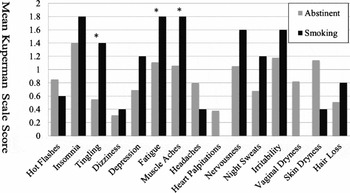
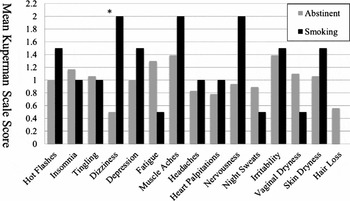
The model was significant, Wilk's λ (15, 54) = 0.659, p = 0.04, partial ω 2 = 0.34, whereby smokers reported significantly greater experience of tingling (0.1.40 vs. 0.55), F(1, 70) = 4.09, p = 0.023; fatigue (1.80 vs. 1.11), F(1, 70) = 2.75, p = 0.05; and muscle aches (1.80 vs. 1.06), F(1, 70) = 2.75, p = 0.05, as compared to abstainers. See Figure 1 for illustration of KI scale scores by smoking status at 2-weeks. At 8-weeks postcessation, the model approached significance, Wilk's λ (15, 4) = 0.057, p = 0.08, partial ω 2 = 0.94, whereby smokers reported significantly greater experience of dizziness than abstainers (2.0 vs. 0.50), F(1, 19) = 5.83, p = 0.014, and the difference between smokers and abstainers on experience of nervousness approached significance (2.0 vs. 0.94), F(1, 19) = 2.79, p = 0.06. See Figure 2 for illustration of KI scale scores by smoking status at 8-weeks postcessation.
Menopausal symptoms in smoking versus abstinent women at 2-weeks postcessation abstinent: n = 57; smoking: n = 5;*groups differ significantly at p < 0.05.

Menopausal symptoms in smoking versus abstinent women at 8-weeks postcessation abstinent: n = 18; smoking: n = 2;*groups differ significantly at p < 0.05.

Predictors of Menopause Symptom Severity
Baseline
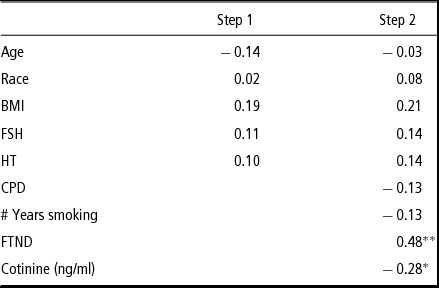
A hierarchical linear regression analysis was conducted with participants who had completed the KI at baseline (n = 76). Step 1 was not significant [F(5,70) = 1.06, ns. Step 2 was significant [F(9,66) = 2.62, p = 0.012], with FTND (β = 0.48, p = 0.001) and cotinine level (β = −0.27, p = 0.02) as significant predictors of KI total scores. See Table 2 for individual variable beta coefficients, R-square, Adjusted R-square, and R-square change at each step of the regression analysis.
Predictors of menopause symptom severity in participants (n = 76) at baseline

Note: BMI = body mass index; FSH = follicle stimulating hormone; HT = hormone therapy; FTND = Fagerström Test for Nicotine Dependence.
Step 1, R-square = 0.07, Adjusted R-square = 0.004, R-square change = 0.07, ns; Step 2, R-square = 0.263, Adjusted R-square = 0.162, R-square change = 0.192, p=0.004.
***p < 0.001; **p < 0.01; *p < 0.05.
Two weeks postcessation
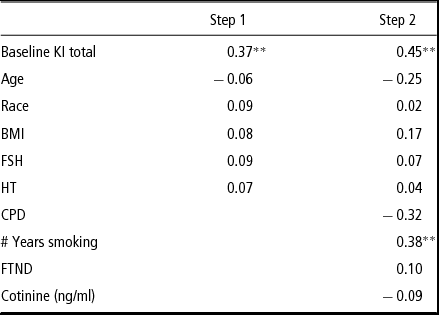
Amongst participants who achieved abstinence for 2-weeks postcessation and had completed the KI at the coinciding follow-up time point (n = 62), the mean KI total score at this time point was 19.4(SD = 10.6). Step 1 approached significance [F(6, 55) = 2.05, p = 0.08, with baseline KI as a significant predictor (β = 0.37). Step 2 was significant [F(10, 51) = 2.69, p = 0.01], with baseline KI (β = 0.45, p = 0.005), and number of years smoking (β = 0.38, p = 0.01) as significant predictors of KI total scores. See Table 3 for individual variable standardised beta coefficients, R-square, Adjusted R-square, and R-square change at each step of the regression analysis.
Predictors of menopause symptom severity in abstainers (n = 65) at 2-weeks postcessation

Note: KI = Kupperman Inventory; BMI = body mass index; FSH = follicle stimulating hormone; HT = hormone therapy; CPD = cigarettes per day; FTND = Fagerström Test for Nicotine Dependence. Step 1, R-square = 0.219, Adjusted R-square = 0.252, R-square change = 0.219, p =0.08; Step 2, R-square = 0.402, Adjusted R-square = 0.104, R-square change = 0.183, p =0.03.
***p < 0.001; **p < 0.01; *p < 0.05.
8-weeks postcessation
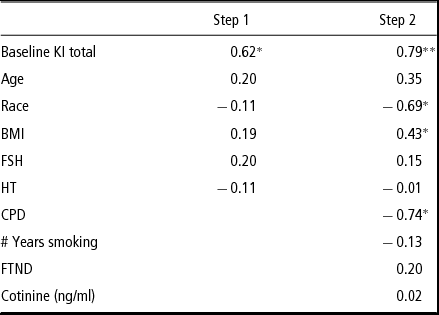
Amongst participants who achieved abstinence for 8-weeks postcessation and had completed the KI at the coinciding follow-up time point (n = 20), the mean KI total score at this time point was 21.9(SD = 10.6). Step 1 was significant [F(6, 19) = 5.22, p = 0.01, with no predictor variables significant. Step 2 was also significant [F(10, 19) = 10.08, p = 0.005, with baseline KI (β = 0.79, p = 0.009), race (β = −0.69, p = 0.05), and CPD (β = −0.74, p = 0.02) as significant predictors. BMI approached significance as a predictor (β = 0.43, p = 0.08). See Table 4 for individual variable standardised beta coefficients, R-square, Adjusted R-square, and R-square change at each step of the regression analysis. In order to determine whether those participants with higher BMIs would yield different findings, we conducted a quartile analysis on the variable of BMI and re-analysed the data using only those in particular quartile BMI categories. The results for each of the regression analyses were similar to the findings with all participants included.
Predictors of menopause symptom severity in abstainers (n = 20) at 8-weeks postcessation

Note: KI = Kupperman Inventory; BMI = body mass index; FSH = follicle stimulating hormone; HT = hormone therapy; CPD = cigarettes per day; FTND = Fagerström Test for Nicotine Dependence. Step 1, R-square = 0.758, Adjusted R-square = 0.613, R-square change = 0.758, p = 0.01; Step 2, R-square = 0.944, Adjusted R-square = 0.850, R-square change = 0.186, p = 0.04.
***p < 0.001; **p < 0.01; *p < 0.05.
Discussion
Postmenopausal smokers were assessed for severity of menopausal symptoms throughout the nicotine withdrawal and cessation process in order to determine how menopause symptoms would be influenced by the change in smoking status. We hypothesised that menopausal symptoms would improve with smoking abstinence, and that smoking-related variables, such as nicotine dependence would account for less variance in menopause symptom severity, as length of smoking abstinence increased. These hypotheses were based on literature regarding nicotine's antiestrogenic effects, which may exacerbate the aversive vasomotor and psychological symptoms associated with menopause in women who smoke (Cramer et al., Reference Cramer, Harlow, Xu, Fraer and Barbieri1995; Kalogeraki et al., Reference Kalogeraki, Tamiolakis, Relakis, Karvelas, Froudarakis and Hassan1996; Staropoli et al., Reference Staropoli, Flaws, Bush and Moulton1998; Whiteman et al., Reference Whiteman, Staropoli, Langenberg, McCarter, Kjerulff and Flaws2003).
As predicted, women who achieved just 2-weeks’ abstinence from smoking showed significantly lower menopausal symptom severity than those who were smoking. Specifically, women who continued to smoke reported higher levels of tingling, fatigue, and muscle aches than abstainers. A similar pattern was observed at 8-weeks posttreatment; women who had resumed smoking reported significantly higher levels of dizziness than abstainers. These findings support previous research that postmenopausal smokers are more likely to experience more severe menopausal symptoms than non-smoking counterparts (Collins & Landgren, Reference Collins and Landgren1995; Dennerstein et al., Reference Dennerstein, Brown, Gotts, Morse, Farley and Pinol1993). In fact, one study found that risk for aversive vasomotor symptoms (i.e., hot flashes) increased with a greater number of cigarettes smoked, with female heavy smokers reporting more severe and daily hot flashes (Whiteman et al., Reference Whiteman, Staropoli, Langenberg, McCarter, Kjerulff and Flaws2003). The present study provides evidence that quitting smoking may ameliorate or lessen many of the aversive symptoms associated with both menopause and smoking cessation.
To the authors’ knowledge, this is the first study to date which has sought to identify predictors of postcessation menopausal symptom severity (see McVay & Copeland, Reference McVay and Copeland2011 for review). Regression analyses showed that precessation, FTND and cotinine levels were associated with greater menopausal symptom severity. This is similar to past research finding more aversive vasomotor symptoms amongst women who smoked a greater number of cigarettes per day (Whiteman et al., Reference Whiteman, Staropoli, Langenberg, McCarter, Kjerulff and Flaws2003). With 2-weeks abstinence, the predictor remained smoking-related in that number of years smoking was significant, such that the longer participants had been smoking, the more severe symptoms were reported. By 8 weeks without smoking, baseline daily smoking rate was the only significant predictor of menopause symptom severity, such that those with lower daily smoking rates experienced greater menopause symptom severity. This finding was contrary to prediction and indicates that smoking-related variables continue to influence menopause symptom severity throughout an extended period of abstinence from nicotine.
The current study has several notable limitations, for example, participants were part of a larger clinical trial for smoking cessation in weight-concerned postmenopausal women, limiting its generalisability. As with many secondary analyses using studies that were designed for other purposes, there may be problems with the interpretation of circumstantial data. Because women in the current study were not randomly assigned to either quit or not quit, it is possible that whatever characteristics led them to succeed or not in the quit attempt also influenced their postmenopausal symptoms. It is possible that women with more symptoms have greater difficulty quitting, or that some unknown variable that influences quit success also influences the reporting of symptoms. Therefore, the study design presents a significant limitation, and these analyses may be considered exploratory. A second limitation is that, although the differences in postcessation menopausal symptoms reached statistical significance, there may be a limitation in their clinical significance as experienced by participants in the study. Future studies will need to address this issue. Finally, mean FSH levels were only taken during participants’ baseline study visit. Previous research has suggested that FSH measurements may fluctuate during the menopausal transition, implying that a single measurement may not be the most accurate predictor of menopausal status (Burger, Reference Burger1994). Also, the participants were followed through 8 weeks of cessation. It remains unclear how the effects of precessation menopausal symptoms affect long-term cessation attempts. Thus, additional research is needed to clarify the extended effects of nicotine abstinence on the decrease in menopausal symptoms.
These results further support previous research suggesting that the antiestrogenic effects of nicotine worsen menopausal symptoms and further complicate cessation attempts amongst postmenopausal women. Previous literature has implied that there is significant symptom overlap (e.g., negative affect, poor concentration, memory deficits) between hormonal changes during the menopausal transition and nicotine withdrawal (Allen, Hatsukami, & Christianson, Reference Allen, Hatsukami and Christianson2003; Allen, Hatsukami, Bade, & Center, 2004). These findings are important, as successful cessation interventions need to account for the combined effects of symptoms of smoking and menopause. Research has begun to simultaneously treat these similar symptoms. Allen, Hatsukami, and colleagues (Reference Allen, Brintnell, Hatsukami and Reich2004) used both placebo and active transdermal NRT amongst female smokers, some of whom were receiving HT. Despite no interaction between NRT and HT amongst those females receiving NRT at week-one postcessation, less severe withdrawal symptoms were reported, including reduced cravings. At week-two postcessation, participants receiving HT demonstrated an improved mood on depression ratings (Allen, Hatsukami et al., Reference Allen, Hatsukami, Bade and Center2004). These preliminary findings suggest that upon abstinence, acute symptomatology may be best treated with NRT. It should be noted that we did not directly assess nicotine withdrawal symptoms in the present study. Future research is needed to clarify the effects and interactions between NRT and HT, as well as to describe the effects of these treatments on vasomotor and psychological symptoms experienced by postmenopausal women. This study begins to address the effect of concurrently treating menopausal and smoking cessation symptoms in women receiving HT, NRT and cognitive behavioural treatment. However, further research will need to isolate or discern the benefits of undergoing these interventions during these two concurrent life changes.
Acknowledgements
This study was funded by National Institutes of Health (NIH) grant AG18239. The authors have no circumstances that represent a potential conflict of interest. Human subjects were treated according to ethical principles, as this study was reviewed and approved of by the institutional review board. This study was funded by National Institutes of Health (NIH) grant AG18239.
Conflict of Interest
The authors have no circumstances that represent a potential conflict of interest.