In 1929, the leading body of Protestant churches in the United States, the Federal Council of Churches in Christ (FCC), released a report from the Committee on Marriage and Home titled “Ideals of Love and Marriage.” Coming at the end of a decade in which a consumer culture increasingly glamorizing sex gained national prominence, it should come as no surprise that Protestant leaders made sure to declare that “the sex instinct is not to be set free but to be held under control.”Footnote 1 What might be more surprising is that they uncovered a traitor from within, a group of purportedly religious figures who were circumventing the authority of parents, church, and community by performing on-demand marriages. “In numerous communities there is a ‘marrying parson’ who commercializes his sacred office,” the committee wrote. “The ‘marrying parson’ is the man who intrigues for weddings, who is manifestly commercial, who treats as lightly as he may the safeguards with which the church and society have surrounded marriage. The committee appeals to such ministers to discontinue their traffic.”Footnote 2
The “marrying parson”—a minister who would marry any couple who came to his door and who actively promoted this fact—was a prominent figure in both popular discourse and in debates about marriage in the early twentieth century. His presence elicited responses that ranged from amusement to anxiety to anger. A Virginia newspaper editor in 1911, for example, blamed marrying parsons for causing “endless miseries, mortifications, sorrows, disappointments, wrecked families, ruined lives, and moral and social disasters.”Footnote 3 Yet, even though scholars have recently furthered our understanding of the contested notions of marriage and sexuality in the early twentieth century—including the increasing emphasis among reformers and radicals on sex education, companionate marriage, non-reproductive sexuality, and no-fault divorce—the role of the Protestant ministers who became known as marrying parsons has not yet been explored.Footnote 4
That marrying parsons are now mostly forgotten would be welcome news to most early twentieth-century white Protestant leaders. For them, marrying parsons were an embarrassment to true Christianity; marrying parsons' penchant for novelty, their blatant commercialization of the wedding ceremony, and their apparent connection to social ills made them something other than “religious.” But even if Protestant leaders wanted to distance themselves from marrying parsons, they nevertheless took them seriously as a threat, as evidenced by the FCC's denunciation.
By reconstructing how the marrying parson rose to prominence and why so many reacted so strongly against them, we can get a better sense of the way that the American legal and cultural landscape privileged Protestant religion, and also the challenges faced by white Protestant authorities as they attempted to police and control that privilege.Footnote 5 At the turn of the twentieth century, Protestants made up about 60 percent of the American population. Beyond their numerical strength, Protestants perceived and projected themselves as the nation's moral guardians and exerted outsized influence over major cultural institutions. In a country where Protestant assumptions had long determined the boundaries of what counted as “religion,” marrying parsons posed a unique problem. They were clearly marked by ordination as Protestant leaders and they had direct access to the benefits that the legal category of religion provided. Yet their actions appeared to undermine white Protestant moral and social proscriptions.
Of course, Protestants were not the only religious figures allowed to solemnize marriages. But ministers from other religious groups did not usually receive widespread attention for their marrying activity. While American Jewish communities experienced internal controversy over mercenary marriage officiants in the nineteenth century, their minority status in the United States meant that such controversies rarely received outside attention from the daily newspapers.Footnote 6 As for Roman Catholics, another American “outsider” group, their church had a clearly defined and centralized structure of control that discouraged clergy from becoming matrimonial entrepreneurs. Thus, in the early twentieth century, the marrying parson was primarily a white Protestant problem. He represented at once the privileged place that Protestant religion occupied in American society, and also white Protestants' fear that their privilege was eroding. For white Protestant leaders to maintain their supposed mandate to speak for the nation, they first needed to get their house in order—no small task for a decentralized, informal network of religious communities and denominations.
MARRYING PARSONS AND MARRIAGE LAW IN THE NINETEENTH CENTURY
The “modern marrying parson” who rose to prominence in the Progressive Era could not have existed outside of the American legal and cultural landscape forged in the nineteenth century. Even so, he was in some ways a supercharged version of an old character. In eighteenth-century England, the term “marrying parson” was used to describe ministers—some fraudulent, some licensed —who plied their trade in the Fleet Prison area. A loophole in English law exempted Fleet Prison from regulations that required a license or banns before clergy could marry a couple. Clergy who were sent to Fleet Prison—usually as punishment for debt—quickly discovered an opportunity to make money while they served time: they could perform official weddings on a moment's notice with no questions asked. Business boomed until an l753 act effectively shut down the clandestine marriages. Because the Marriage Act did not extend to Scotland, English runaway couples responded to the new law by crossing into border villages, the most notorious of these being Gretna Green. There, runaway couples continued to secure quick marriages, legally sanctioned by the laws of Scotland.Footnote 7
The marrying parsons of Fleet Prison were viewed as unscrupulous and greedy characters. But the term “marrying parson” did not always carry a negative connotation. Many communities in the nineteenth-century United States had popular local pastors who performed many weddings. These preachers were occasionally called marrying parsons. For example, an 1864 newspaper report declared that an Indiana minister was “fast earning the reputation of the marrying parson” due to “his genial and lively disposition.”Footnote 8 When marrying parsons became newly prominent figures in the Progressive Era, commenters drew on both the negative and positive connotations from the past. Some marrying parsons could be depicted as greedy, opportunistic, and irreverent, while others—particularly those in rural areas or those who made their marriage work secondary to other pastoral duties—could be described as charming sources of local pride.Footnote 9
Of course, no amount of greed or charm could create a legally binding system that allowed clergymen to be the figures through whom men and women entered into the marriage relationship. For that, the blending and privileging of English common law and Christianity in the American legal system was essential.Footnote 10 Throughout the eighteenth and nineteenth centuries, states passed various ordinances regulating marriage, infusing their laws with Anglo-Christian assumptions. They prescribed proper forms of solemnization; decreed that marriages must be monogamous; and, most important for the rise of the marrying parson, assigned the power to perform marriage ceremonies to clergymen. In colonial America, the right of ministers to perform marriages was often confined to the town in which they lived and worked. But over the span of the nineteenth century, states expanded ministers' legal right to perform marriages, eliminating residency requirements.Footnote 11 In 1906 every state and territory in the United States gave the power to solemnize marriages to licensed ministers or other religious leaders.Footnote 12 While all but two states also allowed certain secular officials the same power, the Christian proclivities of U.S. culture made clergy the preferred means of solemnizing a marriage.Footnote 13
Along with the legal privileges of being a licensed religious leader, marrying parsons also benefited from the federalist system of government. Each state had the autonomy to forge its own marriage rules and to enforce those rules as it saw fit. Hendrik Hartog describes these state-based differences as “marital regimes.” From the age of consent to the ease in obtaining a divorce, marriage law differed widely by state, and states used their marital regimes to compete for residents and resources.Footnote 14 If a couple in one state with strict marriage licensing requirements wanted to get married, they merely needed to cross over to a state with less stringent requirements. The practice of the courts further limited government control of marriage. As historian Michael Grossberg has shown, judges in antebellum America led the way in formulating a distinctive American approach to marriage built upon a republican ethos that prized individual freedom and cast a suspicious eye on state intervention. Common law marriage—living as husband and wife without a formal ceremony or documentation—flourished in this environment. Once two individuals lived as if they were united in marriage, judges generally did not try to separate the couple even if their marriage did not have proper documentation or if it violated a state's marriage laws (such as marrying under the age of consent).Footnote 15
Not all Americans supported the decentralized, laissez-faire approach to marriage in nineteenth-century America. These critics increasingly gained momentum after the Civil War. Seeking to combat discrepancies in state law, improve government recordkeeping, and promote proper morality, reformers in search of order—especially the New England Divorce Reform League (later renamed the National League for the Protection of the Family)—successfully pushed states in the late nineteenth century to assert more control over nuptial rights. A major area of emphasis was the promotion of marriage licensing laws.Footnote 16 By 1887 all but eleven states required a marriage license; by 1923 all states had a license requirement.Footnote 17 Couples united through common law marriage were still usually regarded as legally married, but the encouragement of the legal system and church leaders led more and more people to seek a licensed marriage.Footnote 18 The turn away from common law marriages to formal, licensed ceremonies had unintended consequences. First, states that delayed implementing marriage license requirements could attract couples from nearby states who sought a marriage ceremony without the cost of a license. Second, even as license requirements became standard practice across all states, quick and easy marriages did not disappear. Since license requirements included an obligation that marriages be solemnized by a minister or justice of the peace, ministers willing to perform on-demand weddings had a burgeoning state-created market to exploit if they so desired.
MARRYING PARSONS AND CONTROVERSIES OVER SEXUALITY
The legal structure of American society provided the environment in which marrying parsons could exist and a product they could sell. But marrying parsons did not become figures of national controversy until late nineteenth-century newspapers began to document their actions, drawing the suspicious eye of moral and social reformers who were combating what they perceived to be a crisis in sexual behavior and family life. In 1886 New York's famed minister T. DeWitt Talmage provided an early example of this. Expressing alarm at the rising divorce rate, Talmage blamed elopements, citing newspaper reports as evidence that couples were “all hours of the night, climbing down ladders or crossing over from State to State, that they may reach laws of greater laxity.” Elopements, according to Talmage, occurred due to modern dime novels that encouraged sinful desires, men who were “first-class scoundrels,” and Satan himself, who “presides over the escapade. He introduces the two parties to each other … He shows them where they can find officiating minister … He points out to them the ticket office for the rail train.”Footnote 19
Although Talmage did not use the term “marrying parson,” his sermon expressed themes later used by opponents of marrying parsons. Like those later critics, Talmage linked modern transportation, out-of-state weddings, unscrupulous men, and youthful autonomy to “hasty” elopements, which he blamed for the divorce evil. Another critic of elopements, National Divorce Reform League secretary Samuel Dike, made similar arguments in 1886, noting an “almost incredible” report that “some clergymen have converted their privilege of solemnizing marriage into a trade.”Footnote 20 In the 1880s, when Talmage and Dike wrote, the newspaper-created caricature of the marrying parson had not yet claimed a place in the national imagination. By the end of the 1890s, however, the officiating ministers who Talmage suggested were Satan's tools and who Dike suggested were commercializing their privilege had begun to receive a more prominent place in diatribes against elopements, divorce, and youth sexuality. They also received a more formal name for public use: “marrying parsons.”Footnote 21
Wesley A. Hunsberger, a Methodist minister in Milwaukee, was perhaps the first individual to earn national attention as a modern marrying parson. Hunsberger's rise to fame came thanks to a Chicago Tribune investigation in 1895: “Ten Chicago couples were ‘Hunsbergered’ within an hour at the home of the marrying parson yesterday afternoon,” the newspaper reported on August 26.Footnote 22 The following week, two Tribune journalists continued to investigate. Donning bloomers and riding bicycles, they claimed to be witnesses for two friends who were getting married. When they arrived in Milwaukee they encountered five hundred people standing outside Hunsberger's home, with “couples turned out at the rate of about one every twelve minutes.” The journalists' report of Hunsberger's operation went viral as newspaper across the country picked up the story. For his part, Hunsberger appeared to be “horrified at the sensation that had been created.”Footnote 23 What had once been a secretive (and lucrative) side business was now exposed for the world to see. Even the New York Times took note of Hunsberger's notoriety.Footnote 24 In 1897 when the minister declared an end to his foray into the marriage business, the newspaper noted on the front page that he was “known all over the West as the marrying parson” and that his retirement might be “a death blow to Milwaukee as the Gretna Green of Chicago.”Footnote 25
The New York Times made an astute comparison between Milwaukee and Scotland's Gretna Green. Milwaukee, operating under the laws of Wisconsin, did not require a license for a legal marriage in the 1890s. People from Illinois, which did require a license, often took advantage of the lax marriage regulations across the state line. This was especially true in the summer months, when steamboats, an increasingly popular form of commercial entertainment in the 1890s, made regular excursions between Chicago and Milwaukee. An 1898 newspaper exposé titled “Marriage Made Easy: An Alleged American Industry in Western Water,” took aim at the marriage trade in Wisconsin. The article mentioned Hunsberger, noting that “One minister in Milwaukee alone, the Rev. W.A. Hunsberger, has earned for himself the title of the ‘marrying parson.’”Footnote 26 The article's author highlighted the blatant commercialization of marriage, noting with disgust a steamboat company's offer to pay a couple's marriage fee and provide an annual pass on the steamboat if they agreed to get married on the vessel.
The newspaper coverage of Hunsberger's activities and subsequent accounts of similar ministerial entrepreneurs helped to infuse the cultural figure of the “marrying parson” with a new, modern meaning. As one newspaper explained in 1905, marrying parsons provided evidence that the “business of marrying is now taking place with the other specialized activities of this strenuous age.”Footnote 27 Along with commercializing marriage, marrying parsons seemed to encourage the sexual desire associated with modern consumer culture. In the eyes of critics, they enabled the forces that threatened to upend the sexual standards of the nineteenth-century white Protestant order.
Of course, numerous “vernacular” sexual standards had long operated alongside and in spite of the white Protestant standards of personal self-control, female virtue, and lifelong monogamous heterosexual marriage as the only acceptable forum for sexual relations.Footnote 28 Yet, in the late nineteenth and early twentieth centuries, middle-class ministers and reformers believed that a new crisis was at hand. Thanks to improvements in technology and transportation, travel to and from urban commercial attractions became much easier. Advertising flourished, bolstered by the growing reach of newspapers: per capita circulation of daily newspapers tripled between 1880 and 1900, reaching a total of 15,102,156 homes.Footnote 29 More Americans were made aware of, and had access to, the social changes wrought by a budding mass consumer culture. According to Sharon Ullman, these developments helped to modernize sexuality. Desire and sexual fulfillment became more important; sexual discourse entered the public realm more fully; and, as Ullman puts it, the “framework for sexual understanding came loose from religious and proscriptive moorings” that had emphasized self-control.Footnote 30
The clash between an emerging modern sexuality and a nineteenth-century white Protestant sexual order was especially evident in three interrelated controversies: divorce, the sexual exploitation of young women, and youthful sexual autonomy. The divorce rate more than doubled in America between 1870 and 1900, going from 28 divorces per 100,000 people in 1870 to 73 divorces per 100,000 people in 1900.Footnote 31 Although relatively low by today's standards (in 2010, there were 680 divorces per 100,000 people) the increase alarmed Protestants concerned with the moral destiny of the American nation, and moral reformers connected the newly prominent marrying parsons with divorce.Footnote 32 In 1904, for example, when reports circulated about a marrying parson performing his 1500th marriage, a newspaper caustically responded: “Doubtless many of these 1500 couples have separated and secured divorces.”Footnote 33
Social reformers, many of them white Protestant women, were also concerned with the sexual exploitation of young girls. Believing that men often coerced and manipulated young girls into sexual activity that led to prostitution, in the late nineteenth and early twentieth centuries, they succeeded in getting laws passed across the United States that raised the minimum age at which a girl could consent to sexual activity and banned the “white slave trade.”Footnote 34 The movement to protect the sexual innocence of young girls extended into attempts to assert greater public control over marriage. If girls (or at least middle-class white girls) were especially innocent, the theory went, predatory men could easily deceive them. In such circumstances, marriage itself was no protection against sexual degradation. One critic of Wesley Hunsberger in Milwaukee, for example, declared that his marrying parson work was a “hideous form of legalized prostitution.”Footnote 35 Similarly, a report in 1909 warned:
Whenever crowds of young people mingle in the pursuit of pleasure there are hatched the romances which spell heartbreak and unhappiness. The darker side of this summer silliness is that the runaway marriage is a favorite trick of the white slaver. He [woos] the girl whose head is turned with silly notions about romantic courtships and marriages; he takes her to a marrying parson or justice of the peace of the excursion resort type and a ceremony is performed. Then comes the return to the big city and the sale of the girl into a slavery worse than death.Footnote 36
Meanwhile, an urban middle-class youth culture had begun to emerge by the turn of the twentieth century, fostered by a redefinition of youth as a life stage in need of special protections. This redefinition served to extend childhood into what we now call the teenage years. But along with protecting the young, it gave them greater freedom. New avenues for premarital sexual activity emerged for adolescents thanks to commercial amusements, improved forms of transportation, and the growing presence of “respectable” women in public spaces.Footnote 37 Worries over adolescent sexual autonomy, like those over female sexual innocence, could apply to marriage as well as to premarital relationships. Moral and social reformers feared that young couples caught up in romantic passion would make impulsive decisions to marry. As one critic of marrying parsons complained, “any couple may, in a capricious moment, fall in love at first sight, get the license, and be married all within an hour.”Footnote 38 Even though this decision technically aligned with the belief that sex was to be reserved for a monogamous heterosexual marriage, it was no less a troublesome prospect—particularly when hasty matches were linked to divorce. In such an environment, many Americans become increasingly suspicious of ministers who seemed willing to marry all comers.
The Progressive Era marrying parsons, then—exemplified by Hunsberger, and propagated in newspapers—were viewed as a modern phenomenon primarily because of their association with commercialization and with what appeared to be an increasingly sexualized consumer culture. Marrying parsons became symbols of a world gone awry, a world in which impulsive children rebelled against parents and religious authorities sanctioned their rebellion, a world in which those same religious authorities gave their blessing to mismatched couples who would inevitably divorce or (to the horror of eugenics supporters later in the twentieth century) mate and further weaken the American nation. “The marrying parson is one of the most dangerous characters to society of the present generation,” a journalist for the Richmond Times declared in 1898. “It too often happens that a preacher will join together any couple presenting themselves without taking the trouble to inquire whether or not such persons are fit candidates for matrimony, or whether or not the marriage is agreeable to the parents of the candidates.” The journalist concluded that “There is a growing sentiment against the marrying parson. . . . The marrying parson must go.”Footnote 39
These denunciations of marrying parsons, first appearing en masse in the 1890s, occurred only after newspapers began to publish sensational stories about their exploits.Footnote 40 The publicity that made the marrying parson a prominent cultural figure also fueled a reaction. Yet, the negative reaction seemed to propel more business. After all, the states had given marrying parsons a legal product they could use for their economic benefit. Marrying parsons offered a legal marriage done on a moment's notice at the whim of the couple, cloaked in a spirit of religious authority. As marrying parson Charles Savidge put it, “Those marriages performed by a minister hold tighter and last longer than do those performed by a civil officer … perhaps it is because of the very fact that a religious atmosphere is thrown around a ceremony performed by a minister.”Footnote 41 The veneer of religiosity that made marrying parsons attractive to potential couples also made them a target for Americans concerned with the nation's slide into immorality. While justices of the peace also received criticism for their willingness to marry all comers, marrying parsons were different. Their actions undercut the good name of (Protestant) religion.Footnote 42
CELEBRITY MARRYING PARSONS
In the first two decades of the 1900s, new ministers picked up where Hunsberger had left off. Realizing the power of advertising, they utilized creative marketing techniques to attract business. One minister in New Jersey offered trading stamps with every knot tied; another in Indiana offered a free wedding supper with each ceremony.Footnote 43 Marrying parsons became so ubiquitous that they served as reference points to jokes. “Doctors announce that moonlight bathing is a bad thing. Meanwhile the moonlight picnic retains the high esteem of marrying parsons,” the editor of the Omaha Bee wrote in 1901.Footnote 44 The Washington Evening Star’s “pithy saying” section included this one-liner: “No marrying parson has yet been brave enough to advertise, ‘Money back if not satisfied.’”Footnote 45
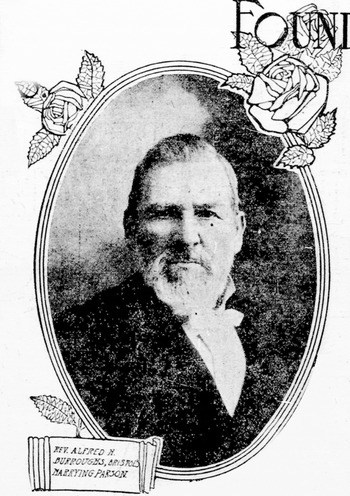
Although every region seemed to have at least one or two well-known marrying parsons, two individuals who captured widespread attention from newspapers in the Progressive Era were Alfred H. Burroughs of Bristol, Tennessee; and Charles W. Savidge of Omaha, Nebraska. Along with Hunsberger, they represented the three main types of marrying parsons. Hunsberger, the first type, was an active minister in charge of an established Protestant congregation. Burroughs represented a second type: the retired minister. No longer active in the pastoral field, he nevertheless retained his ministerial credentials and thus the legal right to perform weddings. Savidge, meanwhile, formed his own holiness movement congregation in Omaha, making him a representative of the third type: independent Christian ministers. With no denominational oversight, independent and retired preachers generally had more freedom to operate in the marrying trade than active ministers from established denominations.
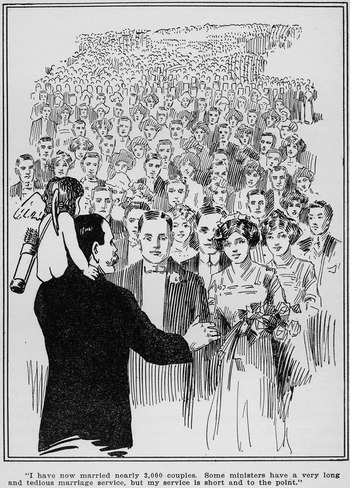
Burroughs began his work in the early 1890s and received intense scrutiny after the turn of the century. The New York Tribune declared in 1905 that Burroughs “has perhaps officiated in more marriage ceremonies than any other man in America.”Footnote 46 In 1910, the Chicago Tribune printed a full-page spread on Burroughs, complete with pictures and maps, describing him as the “world's champion marrying parson.”Footnote 47 A retired Baptist pastor, he owned a hotel in Bristol (population 5,271) that served as his wedding chapel.Footnote 48 The marriage laws in Tennessee, with a minimum age requirement of only sixteen, were lax compared to neighboring states, and Bristol, straddling the Tennessee/Virginia border, was a short train ride away for Virginia residents.Footnote 49 Burroughs would wait by the train depot with his eye out for young couples.Footnote 50 One newspaper reporter wrote that “His presence at the depot… has put it into the heads of many couples to … be wedded at once out of an impulse to be romantic, who before had not given serious thought to marriage.”Footnote 51
This 1901 article was one of the earliest newspaper features on Alfred Burroughs's marrying work. Virginia-based newspapers like the Richmond Times were especially concerned with Burroughs because he provided an easily accessible way for Virginians to subvert their state's more rigid marriage regulations.

By 1910 discontent among Bristol's leading citizens led them to petition the Norfolk and Western Railway to “do something to check the disgraceful trade.” Over the next year, the movement to put an end to Burroughs's practice gained traction. The Bristol Ministerial Association called on Tennessee to pass laws raising the minimum age of marriage and prohibiting out-of-state eloping couples from marrying in Tennessee.Footnote 52 Newspapers in Virginia supported the proposed law, hoping it would put an end to ministers “lurking about a railway station with a lantern looking for jobs to marry runaway boys and girls, many barely of age and who have defied the authority of their natural protectors and advisers.”Footnote 53 Despite these efforts, the campaign against Burroughs in 1911 failed.Footnote 54 Burroughs continued his controversial work until his death in 1916—and after death, in the words of folk musicians from the region who memorialized Burroughs in song.Footnote 55
As Burroughs emerged as the marrying parson of the South, in the Midwest Charles Savidge gained fame. A unique and well-known character in Omaha, Savidge left the Methodists in 1891 to start an independent congregation in the slums of the city. As a proponent of George Müller's faith principle—the idea that one should rely entirely on God's supernatural provision to meet one's financial needs and not on routinized, man-made means—Savidge did not receive a salary from his new church.Footnote 56 To compensate, Savidge turned to the marriage trade as God's means of supernatural provision, relying on freewill donations rather than a standard fee. By the early 1900s he had developed a local reputation as a marrying parson, and he continued to expand his business through modern marketing techniques. Branding himself as the man who “had tied more nuptial knots than any minister west of the Missouri River,” Savidge placed advertisements for his services in newspapers across the country and hired “matrimonial drummers” to search out potential customers at the Omaha courthouse and train depots.Footnote 57 When letters from lonely singles started pouring in from across the country, Savidge also decided to launch a matchmaking service, opening up an office in downtown Omaha for that purpose in 1913.Footnote 58 In 1921 numerous newspapers recognized Savidge's work, printing a picture of the minister with a caption noting that with 5,000 weddings performed he could claim “the world championship as a ‘marryin’ parson.’”Footnote 59
Perhaps the easy read on marrying parsons like Savidge and Burroughs is to see them as flippant and opportunistic at best, and at worst conniving and greedy. Indeed, to their critics, desire for money was the only possible explanation. “The famous marrying parson … that the newspapers tell us about,” one critic complained, viewed marriage as “simply a matter of commerce. … They are conscienceless and wink at the pranks Cupid plays with the very crude marriage laws in all of the states.”Footnote 60 By imputing financial motivations to marrying parsons, reformers and religious leaders sought to sever marrying parsons from the very category of “religion.” Marrying parsons were depicted as sideshows, or, as a Lutheran pastor in Omaha put it, “novelty wizards” who “join in marriage the dissolute social lions” and “bring reproach on the whole church.”Footnote 61
Yet Savidge and Burroughs, while undoubtedly influenced in part by self-interest, defended themselves by claiming altruistic reasons for their actions. “I have been criticized for marrying so many young people. I feel sure that the criticism is undeserved,” Burroughs told an English reporter in 1911. “When young people run away and marry in defiance of the wishes of their parents they are prompted in this course by a mutual love. … It is my experience that those who marry of mutual affection are the ones most likely to be happy in wedded life.”Footnote 62 Burroughs pressed his claim even further in another interview. “If parents would be more considerate of the desires of the hearts of their children in so important a matter,” he said, “we would have less of the now growing evil of divorce.”Footnote 63
Savidge took a slightly different tack, focusing not just on divorce but on premarital sex and on working-class living conditions. “It is the greatest tragedy of this age—the single life men and women are leading,” he said in 1913.Footnote 64 The proper cure for social ills was simple. “We can never beat the evils of the present day except the people enter the marriage relation and establish their own homes,” he wrote in his autobiography.Footnote 65 A marrying parson from Rockville, Maryland, put it more succinctly: better to “just make them man and wife, and thwart certain evil which would ensue otherwise.”Footnote 66 Operating under the belief that marriage was God-ordained and always a positive good, marrying parsons like Burroughs and Savidge claimed that their actions were far from self-interested and detrimental to society: they actually provided a useful service and a positive moral influence.
Burroughs and Savidge, then, shared with the bulk of their Protestant critics the same rhetoric of decreasing divorce and strengthening the nineteenth-century Protestant concepts of marriage and family that seemed to be under attack. For Burroughs, nineteenth-century romantic notions of true love were the key ingredient of successful marriages. Savidge, on the other hand, emphasized middle-class Victorian gender norms. His work in the slums of Omaha brought him into contact with working-class women toiling in factories, a tragedy that he believed could only be corrected if women found husbands and occupied their proper place in the home.Footnote 67
Thus, the conflict between parsons such as Savidge and Burroughs and their critics was not so much about theological differences or how they viewed marriage. Rather, the conflict occurred because both sides offered competing innovations in their quest to maintain—or create—an idealized version of an old order. Burroughs and Savidge used new tactics like mass marketing, while holding to the notion formulated in the early nineteenth century that marriage should be easy and free from state interference. Let people get married and they will figure it out, the theory went. The vast majority of white Protestant establishment leaders, whether conservative or liberal theologically, disagreed. They believed that the old laissez-faire approach to marriage did not work: the rising divorce rate and shifts in sexual norms were proof enough of that. If the Anglo-Saxon Protestant character of the nation was to be preserved, new laws and regulations and more efficient forms of recordkeeping were needed. And if the Protestant churches were to maintain their position as the nations' moral and cultural arbiters in the face of increased competition for those roles, they needed to protect the sanctity and respectability of the ministerial office. The apparent novelty of marrying parson methods did not help in either regard.Footnote 68
CAMPAIGNS AGAINST THE MARRYING PARSON
Journalists, social scientists, clergymen, and Christian civic organizations worked together in states and cities across the country in the 1910s to stop the scandal of the marrying parson. When a law passed in New Jersey in 1912 prohibiting justices of the peace from performing marriage ceremonies, the New-York Tribune argued that the law did not go far enough. “There are various more or less notorious marrying parsons who are authorized to perform marriages by virtue of their status as ministers of some church denomination … who are fully as careless … as any of the discredited justices,” the newspaper declared.Footnote 69 Meanwhile, ministerial associations from Washington, DC, to Seattle campaigned against marrying parsons in the press and in city ordinances, and marrying parsons under denominational oversight increasingly found themselves under investigation if they engaged in “the promiscuous marriage of couples.”Footnote 70
Advance notice laws provided one of the most effective ways to combat marrying parsons. These laws instituted a longer waiting time in between the application for a marriage license and the disbursement of the license. They supposedly limited midnight escapades, in which couples, swept away in late-night romantic passion, impulsively decided to get married. By 1923 twelve states had such laws, and eleven of them had implemented the laws after 1897. Wisconsin, the state in which the commercialized marrying parson first rose to national prominence, implemented its advance notice law in 1899, effectively and deliberately ending the work of marrying parsons in the state.Footnote 71
Despite heavy criticism, Charles Savidge took pride in his role as a marrying parson, prominently featuring his marriage work in his autobiography.

On occasion local remedies could be applied on an ad hoc basis. In one such case in Seattle in 1909, race played a factor. Galen Wood, a retired minister, worked as a county clerk in the city. Couples who stopped by the courthouse for a marriage license often asked him to solemnize their marriage on the spot. Wood generally obliged such couples. Although he received some ribbing from his coworkers, his supervisor let him continue his side job up until the point that he married a Japanese man and a white woman. That proved to be too much, and the supervisor put an end to Wood's matrimonial business.Footnote 72 While interracial marriages could inspire enough local resolve to stop a marrying parson, in general the best efforts of reformers merely shifted the marriage action elsewhere. Numerous attempts to nationalize divorce and marriage laws throughout the early twentieth century failed.Footnote 73 With no uniform federal law in place, the decentralized, state-based legal attacks on the quick-marriage industry mirrored the results of state-based prohibition laws in the Progressive Era: when one state or city passed harsh laws, a nearby location inevitably picked up the slack—and all the financial benefits therein.
Undergirding the financial benefits, of course, were the consumers, the “bashful lad and blissful lass, the runaways, the elopers, the widowers who are ashamed of their age, and the old maids who haven't any age” who chose the marrying parson to solemnize their nuptials.Footnote 74 To meet consumer demand, towns like Bristol and Omaha with well-known marrying parsons invariably had an infrastructure in place to support the marriage work and reap a financial windfall. The local government (through marriage license fees), newspapers (through advertising revenue), train companies, taxi cab drivers, jewelers, hotel owners, and even professional witnesses benefited when a town or minister earned a reputation as a provider of easy marriage. The clear demand for marrying parsons' service and their shared economic interests with the community—along with their charismatic personalities and long-time relationships with local residents—helps to explain the support that marrying parsons could receive even as journalists, pastors, and reformers denounced them.
The competing forces of support for and resistance to marrying parsons is illustrated by events in Wilmington, Delaware, in 1913. That year Rev. William Hantzmon, a Methodist Protestant minister, took charge of a pulpit previously occupied by a well-known marrying parson named George L. Wolfe. In his first sermon Hantzmon denounced Wolfe, claiming that the city was “looking for a Moses to lead it out of the bondage of the legalized marriage traffic which has made this city a Gretna Green.” Hantzmon's criticism, and his suggestion that Wolfe should return his ministerial credentials, led to a backlash. His congregation refused to pay his salary, forcing him to leave town. Hantzmon, however, had the last laugh: the state of Delaware passed an advance notice law in 1913, ending the quick-marriage industry in Wilmington.Footnote 75
Delaware's passage of an advance notice law highlights another structural component to marrying parsons' cultural resilience: immediately, a town in a nearby state picked up the slack. “The harvest of new marriages that Delaware is unwilling to reap is being garnered in the antique Maryland county seat,” the Wilmington Morning News announced in 1913. “Elkton, Md. is the Gretna Green that threatens to become the only Gretna Green.”Footnote 76 The newspaper was not far off. Perfectly positioned to be a hub of marrying parson activity, Elkton, Maryland, was a county seat (and thus a place where marriage licenses could be procured) located in one of two states that required a religious ceremony for all legal marriages. This requirement stayed in force until the end of the 1920s, giving ordained ministers a monopoly on the marriage solemnization market.Footnote 77 Elkton also stood in the northeast corner of the state, near Pennsylvania, New Jersey, and Delaware. After 1913, those three states had more restrictive marriage regulations than Maryland. Eloping couples turned toward Elkton in droves; by the 1920s, Elkton had become perhaps the most well-known American Gretna Green.Footnote 78
THE MARRYING PARSON IN THE 1920S
The distinctive cultural caricature of the commercialized marrying parson was formed, and the battle against him launched, in the years between 1895 and World War I. Despite the attacks, marrying parsons proved resilient, continuing to perform marriages at a moment's notice and attracting newspaper attention into the 1930s. There was continuity in the depictions of marrying parsons before and after World War I, but there were also subtle shifts in emphasis. Before 1920, critics usually depicted marrying parsons as greedy enablers of manipulative men and impulsive boys. But in the 1920s reformers increasingly spoke not just of girls as innocent victims or flighty lovebirds, but also of a “girl problem”—too many young women, it seemed, were choosing to reject traditional behavioral and moral expectations in favor of “conspicuous heterosexuality.”Footnote 79 As a result, marrying parsons began to receive criticism not just because innocent girls were seduced into marriage (although that criticism continued), but also because young women could use marrying parsons to assert their independence.
One example of this shift came from newspaper reports of late-night marriages done on a dare.Footnote 80 The stories usually involved alcohol and midnight carousing between young men and women, culminating in the couple deciding to board a train or hop in an automobile, find a marrying parson, and immediately tie the knot. According to newspapers, these marriages—sometimes called “gin marriages”—often led to an annulment. One marrying parson apparently could not handle this change. Renouncing his previous occupation in 1920, he declared that “Women are the worst offenders against the marriage vows. They get married on a dare in the morning and are separated in the afternoon.” The former marrying parson continued his screed, claiming that women “spend their nights on the dance floor to jazz tunes and meet some young fellow and decide at once they're in love. … Give me the days when the baby carriage and the cook book held places of honor in the home and a homespun sock was not a luxury.”Footnote 81
Numerous other newspaper stories throughout the decade emphasized women's assertiveness in choosing their partners and securing a marriage from a marrying parson—or not securing. In an interview with one marrying parson, the minister recalled a woman who arrived at his door with her would-be husband, only to decide “forever is too long a time” and back out.Footnote 82 Similarly, in 1921 a satirical report of a new “Jazz wedding ceremony, all revised to fit the conditions of the Twentieth Century modernity” made the rounds in numerous newspapers. The report claimed that the vows had been devised by a marrying parson, thus linking marrying parsons with the improvisational nature and subversiveness of jazz music and egalitarian gender roles. The vows read, in part:
[to the groom] Wilt though take her for thy pard, for better or for worse; to have, to hold, to fondly guard, till hauled off in the hearse? Wilt thou let her have her way, consult her many wishes, make the fire every day and help her with the dishes? [to the bride] Wilt thou take him for thy pard, for better or for worse; to have, to hold, to fondly guard his person and his purse? Wilt thou make him eat the scraps that belong to days of yore, so you'll get your midday naps and over novels pore? Wilt thou be quick to take control of all that's on the place and say to him in language bold, You're not my boss in any case?Footnote 83
This association with more egalitarian notions of marriage was somewhat similar to the controversy over companionate marriage that erupted in the second half of the 1920s. Identified with Judge Ben Lindsey, companionate marriage was an attempt to modernize marriage by basing it on “mutual sexual desire, contraceptive use, and companionship.”Footnote 84 As with the marrying parson controversy, both conservative and liberal Protestants denounced companionate marriage, believing that it undermined traditional notions of marriage and promoted sexual promiscuity. While marrying parsons and companionate marriage were not directly related—the latter, for example, promised to limit the number of children born, while the former received criticism in part because marrying parsons encouraged “unfit matings”—both seemed to provide moral and legal cover for marital decisions driven by sexual desire.Footnote 85 Thus, in the eyes of critics, both made a mockery of marriage by using marriage itself to undermine the sexual standards that the institution was supposed to uphold and protect.
In the 1920s, then, marrying parsons became associated with flappers and frivolity as well as with the lost innocence of young girls. But if the perception of marrying parsons evolved slightly in the ferment of 1920s popular culture, the critics' reason for concern did not. Whether the marriages performed by marrying parsons were frivolous, fraudulent, or foolhardy, the disreputable match still threatened the nation's social and moral order, and it was still sanctioned by a religious leader. “Is this spiritual business or commercial business?,” sociologist and eugenics supporter Frederick Lumley asked in a 1924 article criticizing marrying parsons. “Does this sort of thing dignify the preacher's calling and add to the sum total of human happiness or is it a gross abuse of privilege?”Footnote 86 Justices of the peace received criticism as well, but in an era in which white Protestant authority appeared to be in decline, marrying parsons seemed to exacerbate the crisis from within.
For their part, in the 1920s Protestant leaders became increasingly active in disassociating themselves from and censuring marrying parsons. The marrying hub of Elkton, Maryland, once again serves as a useful example. In 1921, the General Assembly of the Presbyterian Church in the United States of America concluded a three-year ecclesiastical dispute over the activities of Elkton Presbyterian minister John McElmoyle. Charged with “commercializing the sacred ceremony of marriage, thereby degrading the moral tone of the community [and] bringing ridicule and reproach upon the church,” McElmoyle had been ordered to step down from his pastoral duties in 1919. He appealed the decision. After hearing his case, in 1921 the General Assembly upheld McElmoyle's removal, finding that his marrying activities did indeed bring “reproach on the good name of the Church and community.”Footnote 87
McElmoyle's removal garnered widespread attention from the press. Protestant leaders concerned with the reputation of their churches and the influence of American Protestantism within the broader culture supported the decision. Moreover, the Presbyterian action inspired Methodists in Elkton to remove one of their pastors who had engaged too enthusiastically in the marriage trade.Footnote 88 But McElmoyle also had his defenders. Importantly, they took issue with the fact that newspapers described McElmoyle as a “marrying parson.” Such a “devastating” term, they claimed, was undeserved and “bestowed by his enemies.”Footnote 89 That McElmoyle's camp recognized so clearly the disreputable connotations of the term is telling: reformers may not have ended ministerial involvement in the quick-marriage trade, but they had at least made the label anathema for most respectable white Protestants. Liberal Protestant theologian Edward Scribner Ames made this point clear in a 1922 article for the Christian Century. Taking on the character of Satan writing to a junior devil, he wrote:
my interest and work with the clergy consists also in making many of them appear ridiculous. Wherever I can do so, I succeed in cheapening the gospel of Jesus Christ which of course is always my advantage to do. … Recently I …converted a minister of the gospel into a “marrying parson” and you know this became the basis of an ecclesiastical trial.Footnote 90
THE DECLINE OF THE MARRYING PARSON IN POPULAR DISCOURSE
Marrying parsons remained a perceived threat throughout the 1920s, as the 1929 report from the FCC's Committee on Marriage and Home quoted at the beginning of this article demonstrates. But despite these fears, by the 1930s marrying parsons were beginning to lose their place in national discourse. A New York Times story that year on America's “Gretna Greens” seems unlikely evidence. The story revealed that the Progressive Era pattern persisted, and that the American quick-marriage industry was alive and well: every time one state or locality shut down easy marriages, a new place suddenly became an attractive site for easy marriages.Footnote 91 But even if quick-and-easy marriage would not go away, marrying parsons—at least in newspaper coverage—seemed to be on the decline. The New York Times story above, for example, did not mention the presence of marrying parsons in the various Gretna Greens, even though most stories in previous decades often linked the two together.
A range of factors contributed to this decline. One factor was the realization that all publicity, even negative, increased the allure of marrying parsons. Mary Richmond and Fred Hall, two social reformers, noted in a 1928 study on marriage that marrying parsons relied heavily on free publicity and that the marriage industry in one town declined when “gradually other matter crowded out these marriage stories” in newspaper coverage.Footnote 92 So, too, as John C. Spurlock has noted, by the 1930s youth dating culture had taken to “going steady.” This provided a way for adolescents to “play” marriage (including sexual experimentation) without entering into a formal, legal marriage.Footnote 93 The youth who may have sought out a marrying parson in a fit of romance in previous decades now had less need for the marrying parson's services. Meanwhile, as the wedding industry boomed and as new consumer rites became entwined with the event, young people—especially those whose families could afford more expensive celebrations—likely desired more elaborate weddings than the quick ceremonies provided by marrying parsons. And, for those who did elope, some evidence suggests that civil officiants were increasingly preferred over ministers.Footnote 94 For these and other reasons, by 1940 marrying parsons were far less prominent in popular discourse. As a clear symbol of the marrying parson's decline, even Elkton's marrying parsons lost their market in 1938 after Maryland passed an advance notice law.
That the figure of the marrying parson became less prominent and less feared by 1940 is evidence of his transitory symbolic nature during a time of perceived dramatic changes to family structures and sexual standards.Footnote 95 Seeing sensational stories printed in Progressive Era newspapers of hasty marriages alongside statistics detailing the rising divorce rate, Protestant leaders and reformers put two and two together. To save traditional conceptions of marriage and family, protect the public authority of Protestantism, and maintain the nation's moral strength, marrying parsons had to be stopped. But they could not be eliminated entirely. In a nation that privileged Protestant religion but prided itself on separating church and state, government regulation of a minister's right to perform weddings went a step too far. The dilemma that Progressive Era opponents of the marrying parson faced—how and to what extent to limit or police the religious privilege associated with state-sanctioned marriages—could not be solved at a national level.
Unable and unwilling to sacrifice the ministerial right to solemnize marriages on behalf of the state, leaders of the Protestant establishment instead settled for a two-pronged strategy: they quarantined the marrying parsons, casting them out of the realm of respectable religion, and they offered support at the state and local level for regulatory devices like the advance notice laws in place in more than half of the states by 1940.Footnote 96 Never fully eradicated but no longer a scandalous cultural figure, modern-day marrying parsons continue to ply their trade, using religious ordination as a way to make a living in the quick-marriage industry, most prominently in Las Vegas.Footnote 97